2004: Yang Xinhai, Monster Killer

When I killed people I had a desire. This inspired me to kill more. I don’t care whether they deserve to live or not. It is none of my concern…I have no desire to be part of society. Society is not my concern.

-Yang Xinhai

On this date in 2004, China executed one of its most prolific serial killers ever.

Yang Xinhai was an impoverished migrant worker with previous theft and rape convictions already to his name when he commenced his infamous spree in 1999.

Over the ensuing four years the so-called “Monster Killer” amassed 67 murders and 23 rapes via terrifyingly bold home invasions: he would break into rural occupied rural dwellings under cover of darkness wielding a heavy iron hammer or similar slasher-villain melee weapon, and then just go to town.

“He didn’t leave survivors, and more than a few families were exterminated by his hand,” one newspaper report described. (In fact, about five people are known to have survived Yang’s various attacks.)

The last of his slayings — eight people in two different attacks in Hebei Province villages — occurred a bare six months before Yang himself caught a bullet to the back of his end. A routine police stop in November 2003 made him a little too shifty and prompted beat cops to detain him. Almost immediately the diabolical character of their new capture spilled out.

Yang himself didn’t see the point in resisting the inevitable. He provided a full confession, didn’t bother to defend himself in an hour-long trial on February 1, 2004, and declined to mount any sort of appeal to prevent his swift execution 13 days after that.

On this day..

2013: Zhang Yongming, cannibal corpse

(Thanks to Meaghan Good of the Charley Project for the guest post. -ed.)

One year ago today, 57-year-old Zhang Yongming was executed in China, just six months after a court in the province of Yunnan convicted him of murder. Zhang, a farmer, was modern China’s answer to Fritz Haarmann: authorities believe he killed young men and boys, cannibalized parts of their bodies and sold the leftover flesh at the village market.

Convicted of eleven murders, he’s suspected of six more.

When young people started disappearing in the neighborhood, the police initially assumed they’d been kidnapped and sold for slave labor, a sad situation that’s all too common in present-day China.

From TruTV:

Witnesses reported that Yongming began selling meat at the local market, which he had never done before, after 1997. The meat, which he sold as ostrich meat, was cured and dried.

When police finally searched Yongming’s house, they found strips of human flesh that were hung up to dry around his house. He kept dozens of human eyeballs preserved in alcohol in bottles, which police said looked like “snake wine.” Investigators said Yongming likely fed human remains to his dogs. In a nearby vegetable garden, police found bones believed to be human.

This wasn’t the first time Zhang had faced the death penalty, either: in 1979, he was convicted of murder and sentenced to death, but the sentence was reduced and he was released from prison in 1997. The government even helped him get back on his feet by giving him a bit of land and a monthly allowance.

But Zhang simply couldn’t stay on the straight and narrow: by the spring of 2008, he’d started killing again, and the murders didn’t stop until his arrest four years later.

Following his conviction in July 2012, he confessed to his crimes and didn’t bother to file any appeals. He reportedly showed no remorse and didn’t offer any apologies for his victims’ families or any explanation for his conduct.


Zhang’s victims.

On this day..

1938: Martha Marek, Zeliopaster

On this date in 1938, Austrian Martha Marek was guillotined in Vienna for several murders by poison.

She first came to the attention of the discerning interwar crime audience in 1925 when she and her husband Emil were convicted of insurance fraud: Emil claimed to have “lost his leg while chopping wood” just after having taken out a policy, but examination showed that the lost leg had actually been chopped off methodically — and clumsily. They both served a short stint in prison but at least Martha still had four good limbs to go with her wits.

Martha before her marriage had been the lover of a department store magnate five decades her senior who lavished money on her and left her a tidy inheritance to the chagrin of his family. She made her way in the world hitting mother lodes and living comfortably on them, and the time would come that poison would suit her ends better than seduction.

In July 1932, Emil died of apparent tuberculosis. The next month, the couple’s infant daughter Ingeborg died too. Martha, who had lately been reduced to peddling vegetables in the street, pocketed insurance payments on both.

Shortly after, she moved in with an elderly aunt, and the aunt soon died too — leaving her home and assets to her “caregiver”.

As this nest egg dwindled, Martha opened the place to boarders, and one of these poor souls also died — not before mentioning to some people that he always seemed to get sick when he ate Martha’s food. Turned out, Martha had insured his life too.

Martha actually got away with all of this at first, despite the agitation of the dead boarder’s relative. But she pushed her luck a little bit too far when she tried to fraudulently report some insured paintings as stolen in 1937. Persnickety insurance adjusters investigated, and the whole murder spree came out in the process. She was convicted for killing husband, daughter, aunt, and lodger with the rat poison Zeliopaste (thallium).

Austria’s traditional execution method had been hanging, and its traditional executive behavior had been to commute women’s death sentences.

However, the March 1938 Anschluss annexing Austria to Hitler’s Germany brought an update to Germany’s capital punishment policies. Hitler rejected the mercy application (it didn’t help that Martha was half-Jewish) … and prolific Third Reich executioner Johann Reichhart overpowered a violently struggling Martha Marek to behead her on the fallbeil.

On this day..

2000: Kiyotaka Katsuta, Japan’s “most evil” killer

On this date in 2000, Japan hanged three fifty-something murderers.

While Takashi Miyawaki and Kunikatsu Oishi were rather garden-variety criminals who killed family members over private vendettas, Kiyotaka Katsuta had been impressively dignified by one of his judges as the “most maliciously evil criminal in Japanese history.”

The former firefighter was convicted of eight murders but twice or even thrice that number might lie upon his soul.

He got started in 1972, strangling and robbing a Kyoto bar hostess.

Having found a workable m.o., Katsuta murdered and stole from (police suspected rapes, too, but couldn’t prove it) another four women over the 1970s. Then he moved on to armed robbery of men, stealing a gun from a policeman and killing at least three (with others wounded) in his various stickups — deeply shocking in Japan where guns are hard to own and firearm crime vanishingly rare.

Katsuta was so notorious after his 1983 arrest that a movie came out based on his crime spree.

In the will scribbled out during the few minutes he had left after being informed of his imminent execution, Katsuta professed that he had “managed to lead myself to a spiritual state of resignation.”

One of his victims’ family expressed a different form of closure — that Katsuta’s hanging “has made us feel we at long last have become able to close a chapter in our anguish, although we still feel never able to forgive the perpetrator.”

On this day..

2010: Farid Baghlani, womanslayer

On this date in 2010, Farid Baghlani was hanged in Ahvaz for a 2004-2008 serial murder spree that claimed the lives of six women.

At trial, Baghlani openly attributed his crimes to his hatred for women, probably not a defense calculated to maximize his prospects of acquittal. Those who lost loved ones to Baghlani returned the sentiment, and celebrated his execution by handing out sweets.

On this day..

1942: Eddie Leonski, the Brownout Strangler

(Thanks to Meaghan Good of the Charley Project for the guest post. -ed.)

On this date in 1942, a boyishly handsome G.I. named Edward Joseph “Eddie” Leonski was hanged at Pentridge Prison in Melbourne, Australia.

Although his crimes were committed in Australia and were not war-related, he was court-martialed and sentenced to die under American military law.

This was the first and last time a foreign national who committed crimes in Australia was tried and sentenced under the laws of their own country. Eddie was only the second U.S. serviceman to be executed in World War II. (The first, James Rowe, had been convicted of murdering another soldier and was hanged in Arizona just three weeks earlier.)

Known as the “Brownout Strangler” due to his penchant for attacking women at night on Melbourne’s dimly lit streets, Leonski killed three people and assaulted several others of the course of just over two weeks, from May 3 to May 18, 1942. He said he was fascinated by women’s singing and killed his victims to “get at their voices.”

Leonski was born in New Jersey in 1917, the sixth child of Polish/Russian immigrant parents, and grew up in New York City. Crime historian Harold Schechter notes he had the kind of unstable childhood, dysfunctional family background and mommy issues typical of serial killers:

Both [parents were] confirmed alcoholics. He was seven when his father abandoned the family. Not long afterward, his mother, Amelia, took up with another drunkard. She herself suffered at least two mental breakdowns, severe enough to land her in Bellevue, where she was diagnosed with both manic-depression and incipient schizophrenia. From an early age, three of his brothers were chronic troublemakers, eventually racking up lengthy rap sheets. One of them ended up in a state institution, where he lived out his life.

According to all accounts, Eddie was the apple of his unstable mother’s eye. He, in turn, had the kind of deeply disturbing attachment to her found in other homicidal mama’s boys.

On the surface Eddie seemed to have risen above his origins. He began weight-lifting in adolescence and eventually developed an impressive physique. Following high school he took a three-year stenography course and graduated in the top ten percent of his class. He was a promising employee at a Manhattan supermarket chain before he was drafted into the Army in 1941.

Leonski didn’t do nearly so well in the military: although he was reliable and charming when sober, he drank heavily and was unstable and aggressive when under the influence. As a result, he was always in some minor trouble or another.

But there was a war on and the United States was not in a position to be picky about who would serve. Eddie was sent to Australia in early 1942.

Only weeks after his arrival, he began attacking women and trying to choke them. The first few times, he was interrupted and had to flee before he could accomplish his purpose. Then his crime spree was interrupted in the last week of March after he went AWOL on a six-day bender and was thrown into the brig for a month. As soon as he got out he began stalking women again.

At 2:00 a.m. on May 3, an extremely intoxicated Leonski encountered 40-year-old Ivy Violet McLeod waiting for a streetcar near a dry cleaner’s. He strangled her to death and ripped off her clothing, but was scared away when he heard footsteps.

McLeod’s body was found several hours later: “legs wide apart and feet tucked under her thighs, with genitals exposed.” Her killer had not had time to rape her.

A week later, Eddie was in a restaurant when he struck up a conversation with 31-year-old Pauline Buchan Thompson, a policeman’s wife and mother of two. They went to a bar after dinner and spent several hours talking and drinking.

Close to midnight, Eddie offered to escort her home. On the way, Mrs. Thompson started drunkenly singing.

“She had a nice voice,” he said in his confession. He got angry when she stopped: “I got mad and then tore at her, I tore her apart.”

A few hours later a night watchman found her body on the very steps of her boardinghouse. Like Mrs. McLeod, she was nearly nude with her legs splayed, but had not been raped.

Hours later, a hung-over Eddie Leonski was nursing the hair of the dog that bit him when he told a fellow soldier what he’d done. He made more statements about the two murders over the next few days, but his friend didn’t believe him and told no one what Leonski was saying — time during which Leonski made three more unsuccessful assaults on women.

Eddie’s friend finally took him seriously on the morning of May 19, after the body of 41-year-old Gladys Lillian Hosking was found sprawled in a patch of yellow mud outside Camp Pell, where the American soldiers were stationed.

The previous night, Eddie had come in after midnight, slathered head to toe in the same yellow mud. Too drunk to clean himself up (he’d consumed an incredible thirty beers and seven whiskeys that day), he just shed his soiled clothes and collapsed into bed.

Leonski’s friend finally went to the cops.

When he was arrested, Eddie made no pretense of innocence: he quickly confessed, and various witnesses to his aborted attacks identified him. (That said, Ivan Chapman’s out-of-print book on Leonski makes the point that the evidence against him might not really have held up without those confessions: 1940s forensics techniques would not have yielded a positive match to a victim from his bloodstained trousers, and the yellow mud could easily have been picked up innocently by any drunken G.I. who stumbled traversing the trench.)

Fredric Wertham, a noted forensic psychiatrist who never met Leonski, believed he was insane and the murders were prompted by his twisted relationship with his mother:

That his three victims were all women considerably older than he was is psychiatrically most significant. He unconsciously linked their voices with his mother. The whole psychological explosion occurred in a period of deprivation when he was away from home and separated from his mother — but not from her dominating image. The deeds constituted symbolic matricide.

Very Norman Batesian.

Army psychiatrists, however, believed that while Eddie Leonski was certainly a psychopath, he was not psychotic and was fully aware of the wrongfulness of his acts. Douglas MacArthur personally signed the death warrant.

Eddie maintained a positive, chipper attitude awaiting execution. He spent his time memorizing Oscar Wilde’s Ballad of Reading Gaol, and converted to Catholicism, and went to the gallows singing a popular song that was called, ironically, “It’s a Lovely Day Tomorrow.”

His remains were moved several times before finally finding a permanent grave in a military cemetery in Hawaii. The Australian modernist artist Albert Tucker made a painting titled “Memory of Leonski.” The film Death of a Soldier is based on his crimes.

On this day..

1964: Eric Edgar Cooke, the Night Caller

On this date in 1964, Western Australia conducted its last hanging — that of Eric Edgar Cooke.

Cooke was one of Australia’s worst serial killers, and also one of its strangest: the eight homicides were almost unpatterned save for their rage.

A harelipped, bullied youth turned delinquent turned small-time criminal — he had numerous arrests to his name for theft, for vandalism, for torching a church that rejected his choir audition, for auto theft and for being a peeping tom — Cooke busted out of obscurity and into nightmares on the night of Australia Day 1963 when he gunned down five random people in Perth‘s comfortable suburbs. But even by then he had already been stabbing and shooting at people, and menacing them with cars.

Cooke’s Australia Day spree comprised four distinct incidents united to one another and to Cooke’s previous patterns by little but a lust for the hunt: his sole methodology was opportunism. Cooke shot a couple parked in a car (they survived), then an accountant through his apartment window (not so lucky); then, Cooke murdered a young man asleep on an open veranda, and rang the doorbell of another house to lure a fifth victim (both of these men also died).

As he’d been previously arrested on the strength of his fingerprints, Cooke had taken the precaution to wear gloves, leaving police a very cold trail indeed. The shock of the one night’s carnage multiplied as weeks, and then months, elapsed with no arrest. Thirty thousand men were fingerprinted in a futile fishing expedition.

An isolated western city in the midst of a transformative population boom, Perth learned mistrust from Eric Edgar Cooke. Of course that can’t literally be true; Perth was half a million people strong by this time. But in the civic memory Cooke’s Australia Day signposts an innocence lost. Estelle Blackburn in her Broken Lives depicts Cooke as the baleful spirit come to scourge Perth’s newly, complacently prosperous. (See this pdf.) It was

[t]he small city … [that] had ways of a friendly, easy going big country town where people left their doors unlocked and their car keys in the ignition of open cars. They trusted each other. He turned it into a city of suspicion and terror. For the first time people started locking the doors of their homes and cars, stopped going out at night and slept with guns or any weapons they could find under their pillows.

There’s a kernel of truth in this cliche, for Cooke liberally exploited Perthians’ inattention to security. When finally arrested in August of 1963 after he shot an 18-year-old babysitter, his confession explained that thanks to car owners’ habit of just leaving the keys in the ignition, he had frequently stolen vehicles parked for the night, used them in hit-and-runs or other crimes, and returned them before morning … the owners very often none the wiser.

Cooke had, meanwhile, also strangled a social worker in the Perth suburbs in February 1963, and stabbed to death a South Perth beautician during a home invasion robbery back in 1959. He proved to have a photographic memory of his misdeeds, and could detail exactly the objects he had stolen in hundreds of long-past burglaries. He copped in all to eight murders and 14 attempted murders.

With such evidence from Cooke’s own mouth his barristers had little choice but to pursue an insanity defense. This didn’t fly with the courts, but neither too did Cooke’s more embarrassing admissions to two murders for which two other men were already imprisoned. (Officially, the crown only credited him with six of his eight kills.) A “villainous unscrupulous liar” he was called for those claims; Darryl Beamish and John Button each served many more years in prison for these two disputed murders; with Blackburn’s help, they were both formally vindicated in the 2000s.

On this day..

1926: Sataro Fukiage, serial killer

On this date in 1926, serial killer Sataro Fukiage (English Wikipedia entry | Japanese) was hanged at Ichigaya prison for rape-murder.

Most of what’s out there about Sataro Fukiage is in Japanese (like this book). Born in 1889, his hardscrabble upbringing saw him enter the workforce at age nine. He was not a model apprentice, alternating escape attempts with evictions for bad conduct; stealing from his master to procure a prostitute landed him in Kyoto prison at the tender age of 12, and it was in his periodic incarcerations that, Oliver Twist-like, he learned the finer points of pickpocketing from yakuza. He would need those finer points to do the breadwinning for his penniless mother in between his stints behind bars.

His somewhat sympathetic childhood also included a voracious and deviant sexual appetite which was to blossom in time into a carnivorous pattern of abuse.

Fukiage committed his first murder in 1906, when he took an 11-year-old acquaintance to a remote location, then raped and strangled her, only avoiding the death sentence because he himself was still underage at that time.

Released in 1922, he immediately brought himself to widespread public notoriety for a 1922-23 rape spree with at least 27 victims — most of them, again, underage girls. He mixed at least six murders into the one-man crime wave.

He completed an autobiography in prison, but it was banned shortly after its publication.

On this day..

1876: Jesse Pomeroy’s sentence commuted

(Thanks to Meaghan Good of the Charley Project for the guest post. -ed.)

On this date in 1876, serial killer Jesse Pomeroy was reprieved by a 5-3 vote of the Governor’s Council of Massachusetts. Rather than hanging him, they elected to bury him alive instead.

With a “mere” two deaths to his name, at first glance Jesse Pomeroy may not seem like much of a serial killer. In fact, according to some definitions that require a higher body count, he wasn’t a serial killer at all. But give the kid some credit: he was only fourteen years old when he was caught. What’s more, his two murders were committed in a most brutal, sadistic manner.

Jesse was born in Massachusetts in 1860, the son of a violent and abusive father and a doting mother. He’d always been considered a “difficult” child and had tortured the family pets, but his known criminal career didn’t begin until he was twelve years old.

Over the course of nine months, he lured eight young boys between five and eight years old to remote areas and attacked them, beating them badly with a stick, a belt or his hands. In his later attacks he took to biting, and started using a knife as well. He tried to stick a needle into one child’s eyes, another boy, age six, was stabbed between the shoulders and had his penis nearly half cut off. Eventually Jesse would let his victims go, leaving them physically and mentally scarred for life.

Each attack was worse than the last, and each time the intervals between them got shorter. There were three months between the first assault and the second, and only five days between the seventh incident and the eighth (which was the last).

In his biography of Pomeroy, Fiend: The Shocking True Story of America’s Youngest Serial Killer, Harold Schechter described the assaults vividly:

The seventh attack occurred … on Wednesday, September 11. This time the “boy torturer” lured a seven-year-old named Joseph Kennedy to a vacant boathouse near the salt marshes of South Boston bay. Once inside the building, he slammed his victim’s head against the wall, stripped him naked, and administered a ferocious beating, breaking the little boy’s nose and knocking out several of his teeth. Then, pulling out his pocketknife, he forced the seven-year-old to kneel and ordered him to recite a profane travesty of the Lord’s Prayer, in which obscenities were substituted for Scripture.

When young Joseph refused to commit this blasphemy, his tormentor slashed him on his face, his back, his thighs. Then he dragged the bleeding child down to the marsh and — laughing delightedly at the little boy’s suffering — doused his wounds with salt water.

Most serial killers have a basically normal appearance, and some are downright handsome.

Jesse, however, actually did look pretty creepy. His head was too large for his body, he was blind in his right eye and the eyeball was covered by a whitish film that was deeply unsettling to look at. One of the boys he attacked said the eye looked like a “milkie,” a white marble. After that, the press often referred to the unknown assailant as “The Boy with the Marble Eye.”

On the day of his arrest on September 20, 1872, the police brought Joseph Kennedy, one of Pomeroy’s victims, around to various local schools to see if the child could find his attacker in the classrooms.

When little Joseph entered Jesse’s classroom, Jesse lifted his head when the teacher told him to but kept his gaze directed down at his desk. Joseph couldn’t see his deformed eye and didn’t recognize him. That afternoon, however, for some reason Jesse decided to pop in to the local police station on the way home from school. The boy was there and this time he recognized him.

Arrested and subjected to several hours of grilling, Jesse quickly confessed to his crimes, saying he “could not help himself” and wasn’t sure why he’d done such terrible things.

His victims identified him as the boy who had hurt them, and five of them testified against him in juvenile court. Jesse was sent off to the Lyman School for Boys, a juvenile reformatory.

The authorities were supposed to keep him locked up until he turned 18, but Pomeroy, who was no fool, read the fine print in his sentencing and discovered that if he “reformed,” he would be released early.

He immediately set about becoming an absolutely angelic inmate. He obeyed all the rules, did all the work assigned to him and didn’t talk back to the staff. When the other boys tried to bully him, he ignored them.

Before long, he was awarded the coveted position of dormitory monitor, with some responsibility over the other boys. On the outside, his devoted mom, who never believed in his guilt, kept up a letter-writing campaign, asking anyone with influence to help get her son released.

Jesse’s good behavior was rewarded and he was paroled to his mother’s custody in February 1874. He had been in custody for less than a year and a half. By then, his mother had left his father and was running a small store in South Boston.

On March 18 that year, six weeks after Jesse was released from the reformatory, ten-year-old Katie Curran disappeared. She was last seen when she went into the Pomeroy family’s store to buy a notebook for school. A neighbor boy saw her go into the store, where Jesse was manning the counter, but no one ever saw her come out.

Shockingly, in spite of his antecedents, the police at the time didn’t consider him a suspect in Katie’s disappearance, didn’t thoroughly search the store, and accepted his story that he hadn’t seen Katie at all that day.

This may have been because Jesse had never been known to attack little girls. In any case, over the ensuing six weeks the search instead concentrated on the Boston Wharf, on the theory that she’d accidentally fallen off a dock and drowned. Another theory was that she had been kidnapped.

The investigation went nowhere.

On April 22, Jesse accosted four-year-old Horace Millen while the child was on the way to the bakery with a few pennies to buy a sweet. Numerous witnesses saw them together, hand in hand, walking to the harbor; most of them assumed they were brothers out for an adventure.

What happened next is unprintable.

Suffice it to say that at 4:00 p.m., Horace’s body was found beyond a hill in a remote area near the shore. He’d been stabbed eighteen times in the chest, his throat was cut, and his face and genitals were mutilated. His fists were still clenched, the nails biting into his palms, indicating he’d been conscious during the attack and died in considerable pain.

As the police began their murder investigation, someone remarked that Horace’s injuries were remarkably similar to the attacks Jesse Pomeroy had committed before he was locked up two years ago.

As soon as the cops discovered Jesse was in fact on parole, they rushed to his house and took him into custody. His boots were caked with mud and grass was stuck to the soles, his face was scratched and his pocketknife was bloodstained.

At first, Jesse denied having done anything wrong. But when he was confronted with Horace Millen’s corpse, he cracked and started sobbing. “Please don’t tell my mother,” he pleaded. “Put me somewhere, so I can’t do such things.”

Unaccountably, more than a month passed from the time Jesse was arrested until Katie Curran’s body was found, and it was located by accident. Jesse’s mother and brother had to move out of their store in the wake of the murders. A new tenant moved in to the building and decided to refurbish the basement. Workers found Katie’s body. Her throat had been cut and her genitals mutilated.

When confronted with the news about Katie, Jesse denied any knowledge of her death and seemed indignant. “After all,” Harold Schechter noted, “aside from the fact that he was already in custody for child-murder and the little girl’s decomposed corpse had been found in the cellar of his family’s store, there was no reason in the world suspect him.”

Jesse ultimately confessed to killing the girl as well. He said he’d lured Katie down into the basement by saying there were some notebooks down there for her to look at. As soon as they reached the bottom of the steps, he took hold of her and cut her throat. He hadn’t even concealed her body very well, just tossing it in the ash heap.

The police search of the Pomeroys’ store must have been perfunctory indeed to have missed it.

(Jesse would later retract both confessions and claimed, to the end of his days, that he had never harmed a child in his life and was the victim of circumstances, coercive tactics by the police and a deliberate frame up.)

At his trial, his defense was one of insanity.

Three psychiatrists, or “alienists” as they were known in those days, examined him, one for the defense and two for the prosecution. Jesse told them he would get “a sudden feeling” that prompted his violence to small children and “I could not help doing it.”
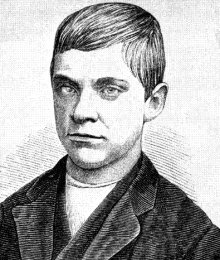

Jesse Pomeroy, young and old.

The doctors noted his lack of remorse or any sympathy for his victims. They believed Jesse would always be dangerous to society. His attorney argued that he should be found not guilty by reason of insanity and then locked away in a mental institution for good.

In the end, the jury convicted him of first-degree murder, for which the mandatory penalty was hanging. However, they issued a recommendation of mercy on account of his youth.

Although juveniles had been executed in the United States before and would be again, the state of Massachusetts had never hanged a boy of fourteen. On the other hand, Jesse had committed no ordinary crimes. By any standard he was a monster. His case was extremely controversial and the governor, William Gaston, was besieged with petitions both for and against clemency.

Gaston didn’t want to hang Jesse Pomeroy and stalled on the issue for as long as he could. It may well have cost him re-election. But his successor, Alexander Rice, didn’t want to hang Jesse either, campaign promises to the contrary.

So in August 1876, two years after Jesse’s murder conviction, by which time the furor in the press had died down, Rice commuted the now-sixteen-year-old’s sentence to life in prison. But there was a catch: the sentence had to be served in solitary confinement.

He would spend 41 years in a tiny cell, isolated from the world. His mother visited him once a month until her death. The only other people he saw were the guards. He was allowed to exercise alone in the prison yard and was allowed to read books. He wrote some bad poetry. Most of his efforts, however, were concentrated on escape. Schechter records:

Nothing — no amount of time locked in a dungeon, no beatings administered with a brass-tipped cane, no efforts at reinforcing his cell — discouraged Jesse for long. When plates of boiler-iron were bolted to his walls to keep him from digging at the stones, he set to work prying loose the bolts. When the walls were painted with a white preparation that would make even a pin-scratch conspicuous, he turned his attention to the floor, cutting loose one of the heavy boards, then digging at the ground underneath … Over the course of fifty years, virtually everything that fell into his hands became a potential implement of escape … He managed, over the decades, to fashion an amazing assortment of tools: awls, chisels, saws, drills, files, pry bars.

He never even came close to breaching the prison walls and his escape attempts mainly just made him a pain in the prison’s collective ass. Then again, a man needs a hobby.

In 1887, his ninth year in the solitary cell, he caused an explosion that blasted a hole in the ceiling and temporarily blinded him but didn’t get him anywhere. Only in 1912 was he ever able to actually make it out of the cell, something that took three years of work to accomplish — and he was caught within minutes. By then he was fifty-two.

His sentence was relaxed in 1917 and he was allowed into the general population. By then, Jesse’s health was failing, and his crimes were passing out of local memory. New inmates to the prison no longer recognized his name, something that deeply upset him. In 1929, he was transferred to the prison farm at Bridgewater. He took a car to get there, his very first automobile ride, but didn’t he didn’t seem interested in his surroundings. One reporter described him as “a deadened creature gazing with lusterless eyes upon a world that means nothing to him.”

He died at the Bridgewater Prison Farm on September 29, 1932, having spent sixty of his seventy-two years behind bars.

On this day..

1949: John George Haigh, the Acid Bath Murderer

On this date in 1949, Britain’s “Acid Bath Murderer”* was hanged by Albert Pierrepoint at Wandsworth Prison.

The name really tells you all you need to know about this enduringly infamous serial killer.

John George Haigh drained puddles of deathly sludge into the pipes at 79 Gloucester Road in London and 2 Leopold Road, Crawley, West Sussex.

He wasn’t a criminal mastermind, but he had that one good idea, and the doggedness to keep going with what worked through the latter half of the 1940s. Serving a previous sentence for fraud, Haigh impressed himself with a jailhouse experiment revealing the efficacy of sulfuric acid for completely dissolving the body of an unfortunate mouse. Perhaps he had been motivated to the test by the memory of a notorious trial in France featuring the same disposal-of-remains expedient. Perhaps he thought it up all by himself.

Shortly after obtaining his parole, Haigh put the insight to foul use by whacking his wealthy former employer over the head and stuffing him into a 40-gallon drum in his Gloucester Road basement. William McSwan’s body dissolved over two days in a sulfuric acid bath. Haigh poured the remnant ooze down a manhole and moved into McSwan’s house, telling the victim’s parents that their son had ducked out to avoid World War II conscription. Once the war ended and the questions came, Haigh made slurry of mom and dad, too.

Undoubtedly a sociopath, Haigh didn’t murder out of compulsive love of taking life. He had a cold, pecuniary motive. “I discovered there were easier ways of making a living than to work long hours in an office,” he wrote of the earlier, non-homicidal frauds and thefts that had started his criminal career. “I did not ask myself whether I was doing right or wrong. That seemed to me to be irrelevant. I merely said, ‘That is what I wish to do.’ And as the means lay within my power, that was what I decided.”

Now the means lay within his power to appropriate a fellow’s pension and estate by disappearing him into a vat of chemicals. Why should he ask himself whether that was right or wrong?

Haigh had blown through the McSwan’s fortune by 1948, and started dissolving hand to mouth. In February of that year, the killer lured a doctor and his wife to his new acid bath station in Crawley. These he shot dead, and rendered as per usual into vitriol compote. But he got sloppy the following year by targeting a wealthy widow who actually shared his same apartment block; when she was reported missing, the neighbor with the criminal record went right into the suspect filter. A search of Haigh’s workshops turned up papers tying him to all three sets of murders … as well as a nearby dump whose “yellowish white greyish matter” yielded “28 lb. of melted body fat, part of the left foot eroded by acid, three gallstones, and 18 fragments of human bone eroded by acid.” (London Times, April 2, 1949) Preserved dentures proved a match for the late Olive Durand-Deacon.

Haigh was a pragmatist, as always.

“Tell me, frankly, what are the chances of anybody being released from Broadmoor?” he chattily asked one guard, referring to the high-security psychiatric facility he intended to inhabit. But his problem would be getting into it. Haigh’s jury needed only minutes to dismiss his longshot insanity defense, and condemn the Acid Bath murderer to die.**

Haigh hanged a mere three weeks after sentence, not even six full months from his last murder.

* Not to be confused with the “Brides in the Bath” murderer. Best just to stick to showers.

** Legal oddity: the Daily Mirror described Haigh as a “murderer” during his trial — that is, before his lawful conviction. Haigh was able to land the editor of this paper in the clink himself for this accurate, prejudicial epithet.

On this day..