2011: Reginald Brooks, flipping the bird

(Thanks to Meaghan Good of the Charley Project for the guest post. -ed.)

On this day in 2011, multi-filicide Reginald Brooks was executed in the Southern Ohio Correctional Facility in Lucasville, Ohio.* He was the fifth man executed that year and, at 66, the oldest since 1999.


Brooks (top) and the children he murdered.

Although his guilt was never in question, he had spent close to thirty years on death row while his appeals wound their way through the system.

On March 6, 1982, just days after his wife filed for divorce, Brooks shot their three sleeping sons: Reginald Jr., 17, Vaughn, 15, and Niarchos, 11. He then bought a bus ticket to Las Vegas, taking the gun with him in his suitcase, as well as his birth certificate and high school diploma. The police caught up with him in Utah.

Brooks had some history of domestic violence, but his only prior arrest had been for grand theft. His aunt, when asking the appeals board for clemency, said he had a normal, loving relationship with his children. Before shooting them all in their sleep, that is.

His attorneys argued that his crimes were motivated by mental illness, namely paranoid schizophrenia. Brooks had a normal childhood and young adulthood, but started to fall apart in the years prior to the murders. He quit his job in the 1970s because he thought his coworkers were trying to poison him. (He never worked again and his wife had to support their family.)

Beginning around 1980, he began isolating himself from friends and family, and accused his wife of committing incest with Reginald Jr. The family tried to get psychiatric help for him, to no avail.

In spite of overwhelming evidence, Brooks never admitted to his crime and suggested various bizarre theories as to what had really happened. A psychiatrist who evaluated him in 2010 and 2011 believed Brooks genuinely could not remember shooting his sons.

There was, however, clear evidence of premeditation: Brooks had purchased the murder weapon nine days before the murders, lying on his application form where it asked if he’d ever been convicted of a felony. He also turned on the stereo in his apartment and left the music blaring loudly, presumably to drown out the sound of the gunshots. Then, after the murders, Brooks immediately left town, taking documents he would need to start a new life — clearly suggesting cognizance of guilt.

The prosecution conceded Brooks did have schizophrenia, but argued that his illness was not so severe as to make him incompetent or legally insane, and that he was lying when he said he couldn’t remember committing the murders. Attorneys for the state suggested he murdered his children to spite his wife, “through a twisted sense of jealousy, hatred, or despair.”

Brooks’s ex-wife, Beverly, witnessed his execution. He had no last words, but he did give a message: glaring at the glass behind which the witnesses were standing, he stuck out the middle fingers of both hands. And as he slowly lost consciousness and breathed his last, his middle fingers still stood erect.

* The Texas of the North when it comes to capital punishment.

On this day..

2005: Hastings Arthur Wise, workplace shooter

On this date in 2005, Hastings Arthur Wise was executed in South Carolina for a shooting rampage at his workplace.

Or rather — and this was the problem — his former workplace.

Canned from his machine-operator job of four years at the Aiken County R.E. Phelon engine manufacturing plant that July, Wise warned that he’d be back.

On September 15, 1997, he turned up packing a 9 mm pistol and exacted his revenge — just another of America’s endless cavalcade of mass shootings.

He shot a guard to get into the plant. The guard survived, but four others were not so fortunate as Wise stalked through his former employer’s halls screaming and firing. Police later recovered four empty eight-round magazines.

The human resources director who had fired him was the first Wise killed.

Two men in the tool and die area who had jobs that Wise had once sought unsuccessfully were the next.

A young woman in a job Wise had sought promotion to was wounded with shots to the back and leg, then finished off execution-style.

Wise took to firing almost indiscriminately and wounded a few others, but the body count still might have been higher. Some others Wise saw and could have murdered, but did not — some possibly saved by happenstance, others whom Wise said in court that he declined to shoot because he used to get along with them as coworkers. The whole rampage was calculated to such an extent that Wise took a 9,000-mile road trip to California and Texas to tick a few items off his bucket list first.

Wise always intended to check out at the end of his spree; the SWAT team found him on the floor suffering from a swallow of insecticide that turned out to be non-fatal. The judicial process was the slow train, but the destination remained the same.

“I don’t have much to say except that I did not wish to take advantage of the court as far as asking mercy,” Wise said to the court at his sentencing. “It’s a fair trial. I committed the crimes.”

As good as his word, Wise voluntarily dropped his appeals and went quickly from his 2001 conviction to execution, declining to make any final statement.

On this day..

1875: Henry Brown, Skinker assassin

Cincinnati Daily Gazette, May 27, 1875.

ST. LOUIS, May 26. — Philip Pfarr, a German, living on what is known as the Skinker road, several miles from this city, was murdered about half-past 9 o’clock last night, by a negro, name unknown, and his wife, who was about to become a mother, ravished. It appears that a negro man, about twenty-five years old, called at Pfarr’s house, about 5 o’clock last evening, and asked for work.

Mrs. Pfarr told him they wanted no help.

He called again about 7 o’clock, after Mr. Pfarr had returned from his labor in the field, and was again told no help was wanted.

About half-past 9 at night Pfarr and his family were aroused by a noise in the yard, and by the barking of their dog.

Pfarr went out to see what was the matter, and was met by the negro who visited the house in the evening, and struck a violent blow on the head, apparently with some blunt instrument, and his skull fractured.

Mrs. Pfarr, who followed her husband to the door, was then savagely seized by the negro, forced to give up what money was in the house, and afterward brutally ravished.

After the negro had fled, Mrs. Pfarr dragged her insensible husband to the house and aroused her neighbors, and everything possible was done for him, but he remained unconscious until noon to-day, when he died.

Intense excitement prevails in the neighborhood, and twenty mounted policemen have been scouring the woods and fields all day, but at last accounts had found no trace of the fiendish murderer.


Cincinnati Daily Gazette, May 29, 1875.

ST. LOUIS, May 28. — Mrs. Pfarr, whose husband was murdered last Tuesday night at her home, a few miles from this city, was brought to town, to-day, by the police authorities, and promptly and fully identified the negro, Henry Brown, who was arrested last evening, as the man who killed her husband and violated her own person.

Aside from this identification, Capt. Fox, of the mounted police force, has worked the case up to such a point that there is no doubt whatever but that the man under arrest is the one who committed the atrocious deed.


Cincinnati Enquirer, Oct. 23, 1875.

ST. LOUIS, MO., October 22. — About 2,500 specators were present at the execution of Henry Brown, who was hanged to-day in the jail-yard of this country, for the murder of Philip Pfarr, and the rape and robbery of Mrs. Pfarr.

All the forenoon the doomed man was melancholy and uncommunicative. At 11 a.m. his two sisters called on him and bade him farewell.

At 1 p.m. he was led to the scaffold, which he mounted with a ready, fearless step, It was evident that he had been liberally plied with whisky.

He made a rambling speech, twenty minutes long, and was so tedious in its delivery that he had to be reminded that his time was up. His harangue was incoherent and disconnected, such as any drunken man would make. He persistently denied the rape of Mrs. Pfarr, and asserted that he only struck Pfarr in self-defense.

His death was almost instantaneous, the neck having been broken. Eight minutes after the drop fell he was pronounced dead. His body was lowered into a rude coffin and carted off to the bone-yard.

BROWN’S CRIME

Was of a peculiarly atrocious character, involving, as it did, murder, rape and robbery. The scene of this triple deed was a small farm in this county, three miles from the city limits, on which lived a well-known German farmer named Philip Pfarr and his wife. The place is somewhat secluded, no one living nearer than one-quarter of a mile.

According to Mrs. Pfarr’s statement, a negro man, who was subsequently identified as Henry Brown, came to the house on the afternoon of May 26th and asked for work. Mr. Pfarr informed him that he had no work to give him.

The negro continued to loiter around the gate, and Mrs. Pfarr was so suspicious of danger that she would not permit her husband to return to the field to work that afternoon.

About nine o’clock that night Mr. and Mrs. Pfarr were awakened by the loud barking of their dogs. Pfarr went outside to ascertain the cause, and Mrs. Pfarr got up and stood in the doorway.

She heard her husband ask, “What do you want?” and immediately thereafter she heard a heavy blow struck, and saw her husband stagger and fall.

Before she had time to get out of the doorway the assassin, who was none other than Brown, rushed upon her, and throwing her violently upon the floor ravished her before she recovered from the stunning shock of the fall.

To complete his brutality, he struck her a severe blow on the head and demanded what money she had in the house. She delivered her purse, which contained only seventy-fie cents. Taking this he disappeared in the darkness.

The unfortunate woman was at that time in the last stages of pregnancy, and her injuries were so serious that she could scarcely walk. But she managed to go to her husband, whom she found lying at the gate breathing heavily. He was still able to move, and with her assistance reached the door.

She laid him down upon the floor, placing a pillow under his head and covering him with a quilt.

He immediately became insensible, and did not speak again. His skull had been crushed in with a heavy piece of wagon timber, which was found at the gate.

After thus caring for her husband Mrs. Pfarr alarmed the neighbors, who gathered in crowds. When she told her pitiful story the excitement became intense.

Old man Pfarr died at midnight.

By daylight next morning numerous parties had been organized, and the country for miles around was scoured.

More than twenty negroes were arrested and carried into the presence of Mrs. Pfarr, but she failed to identify any of them as the criminal who assaulted her. The excited populace came near lynching two or three suspected individuals, in spite of the declaration of the outraged woman that the right man had not yet been caught.

THE FATAL BELT.

The detection of Brown was brought about by one little circumstance.

In retreating from the room, the ravisher dropped a leather belt from his waist. A police officer took this belt and showed it to a number of people, among whom was a colored woman living near by, who instantly recognized it as the property of her son, Henry Brown.

The entire police and detective force were put on the watch for Brown, who had suddenly and mysteriously disappeared.

The next day his arrest was effected and Mrs. Pfarr was brought to the jail for the purpose of

IDENTIFYING THE ACCUSED.

She had previously failed to identify at least twenty-five colored men, promptly exculpating each as they were produced, but as soon as Brown was brought into her presence she exclaimed, in broken English, that he was the man who had killed her husband, and ravished and robbed her.

In reply to her reproaches, the prisoner hung his head and confusedly said that he did not know what the woman was talking about.

Brown at first bitterly denied all connection with the crime, and alleged that he was not in the neighborhood on the fatal night. The next day, however,

HE CONFESSED

That he was walking past Pfarr’s place on the night in question when Praff came out and set his dog on him, at the same time throwing a heavy stick at him.

He caught the stick in his hands and threw it back, striking Pfarr and knocking him down. He persistently denied the assault upon Mrs. Pfarr.

He was tried September 15th, the jury, on the testimony of Mrs. Pfarr, promptly finding him guilty of murder in the first degree.

His attorneys were untiring in their efforts to save his neck. The Supreme Court refused a writ of supersedeas and the Governor declined to interfere. There was nothing left for the doomed African but the halter and the cap.

AN INTERVIEW WITH BROWN.

Your correspondent called upon the doomed man Wednesday afternoon.

At first he refused to talk, answering questions in profane and vituperative monosyllables.

After a brief time, however, he became more communicative. He bitterly denied the assault on Mrs. Pfarr and alleged that the blow he struck Pfarr was in self-defense.

He made a special request that his body should not be given to the dissectors, and asked his attorney to make a speech for him on the scaffold. His attorney promised him that both requests should be complied with.

Brown’s personal appearance was extremely brutal.

His forehead was low and narrow, his nose flat and his lips thick and projecting. His color was of that black and shiny hue so peculiar to the pale African. His look was diabolic. Nature seems to have stamped him as an assassin and cut-throat. His muscular development was something wonderful, and his strength must have been prodigious. Despite his protestations of justification and innocence, the community feels that his fate was just and well deserved.

(Line breaks have been added to all the above stories for readability relative to their solid-wall-of-text 19th century originals.)

On this day..

1571: Hans Haslibacher, Bern Anabaptist

On this date in 1571, Anabaptist Hans Haslibacher was martyred in Bern, Switzerland.

Haslibacher (German link) joined the oft-suppressed movement in 1532 and quickly established himself as one of the most energetic proselytizers in the Emmental in Bern canton.

Condemned at last in 1571 after a lifetime of arrests, he was honored in a 32-stanza anonymous poem “Das Haslibacherlied” (German) alleging that Haslibacher prophesied that his death would be marked with three signs:

  1. His head when struck off would spring into a hat and laugh aloud;
  2. The sun would turn blood-red;
  3. The town fountain would spew blood.

According to the poem, all three prophesies came to pass … and “the hangman too was heard to say: / ‘Tis guiltless blood I’ve shed today.”

The Swiss Anabaptists are noteworthy as the confessional ancestors of the present-day Amish: the latter sect is named for 17th century Bern canton Anabaptist Jakob Ammann, who was the leader of one faction in a 1693 schism within the Swiss Anabaptist community.

Fortunately (though not for this here site) that schism emerged too late in the day for a classic religious martyrdom. Hans Haslibacher, in fact, was the last Anabaptist put to death for his faith in Bern.

On this day..

1940: Lluis Companys, Catalan president

“Above all, there was a belief in the revolution and the future, a feeling of having suddenly emerged into an era of equality and freedom. Human beings were trying to behave as human beings and not as cogs in the capitalist machine.

-George Orwell, Homage to Catalonia

On this date in 1940, Catalan president Lluis Companys was shot by the Spanish fascists.

Companys had held that notional office for mere hours six years before — but he’s still the last to hold it in any form at all.

Political exile was no unfamiliar terrain for Companys. As a young lawyer, his activism in the first two decades of the century had seen him incarcerated over a dozen times; in fact, his path to political respectability had entailed getting out of a Menorca prison in 1920 courtesy of the parliamentary immunity conferred by winning an election.

And he’d drawn a long sentence for an attempted 1934 rising against a center-right government — the occasion when he had become the President of the Catalan Republic on October 6, and been dispossessed of both office and state by the very next day.

That prison sentence’s reversal by the new republican government in 1936 was a bit of Pyrrhic victory for Companys’s left-wing politics — inasmuch as said republicans’ ascent was also the trigger for the nationalist revolt that resulted in the Spanish Civil War and a military dictatorship lasting until the 1970s.

As the virtual personification of Catalan national aspirations, Companys remained head of the Generalitat de Catalunya from 1933 until his death — in prison, in exile, wherever Companys went he bore along the Catalan cause.

As such, he was in the thick of the civil war’s scrap for control of Barcelona: not only against the fascists but among the left parties whose fractious alliance tore apart in 1937.

It was truly a case of riding the tiger. Companys struggled to maintain the cooperation of his alliance even while the republicans’ Soviet sponsors excommunicated anarchist and anti-Stalinist elements internally. The dreadful spectacle of internecine street fighting among the anti-fascists in May 1937 fills the final tragic pages of Orwell’s Homage, decided by the inescapable materialist circumstances: “the Government could not afford to offend the Communist Party while the Russians were supplying arms.”

Few sources direct much personal blame at Companys for what followed. Under Soviet pressure, he accepted the Communist police raids that had set off the street fighting, accepted the purges and the press censorsip, sacked anti-Stalinist minister Andres Nin from the government. (Nin was later “disappeared” and murdered.)

Who knows but that even these evil days were not still the best that could be made of a bad circumstance: whatever they were, they were not enough for republican Spain or for Catalonia.

When those dreams fell under the fascist advance little more than a year later, Companys couldn’t flee Franco far enough for safety. Soon after his 1939 escape to France, that country was overrun by militaristic rightists from the other direction — and the German occupiers happily handed Companys back to Spain as soon as they got their hands on him.

Condemned after the formality of a perfunctory trial for “military rebellion” conducted on October 14, 1940, Companys was shot the very next morning Montjuic Castle. (See Franco: A Biography)

Spain, where questions of Catalan sovereignty and the Franco years are both sensitive subjects, has never reversed the judgment (Spanish link) against Companys. However, a Barcelona promenade is named in Companys’s honor, as is a major stadium — actually the arena where the anti-fascist 1936 People’s Olympiad in opposition to the notorious master race spectacle of Berlin was to have taken place, before that whole Civil War unpleasantness.

On this day..

1943: Yitskhok Rudahevski and family

(Thanks to Meaghan Good of the Charley Project for the guest post. -ed.)

Sometime in early October 1943, fifteen-year-old Yitskhok Rudashevski and his entire family were rousted out of their hiding place in the Vilna Ghetto, taken to nearby Ponary, shot to death and buried in a mass grave.

The Rudashevski family were among the last remnants of a once-vibrant Jewish community in the city once known as “the Jerusalem of the north” for its culture and scholarship. People came there from as far away as the United States to study in its highly regarded yeshivas.
After the start of World War II, Vilna was annexed by the Soviet Union. It became a sanctuary to Jews fleeing from the Nazis, who occupied western Poland.

All of that changed on June 22, 1941, when Operation Barbarossa began. On the day Germany invaded the USSR, there were approximately 80,000 Jews living in Vilna, many of them refugees from the Nazi terror. By the time the Red Army arrived and kicked the Nazis out three years later, Vilna’s Jewish population had been reduced –through starvation, disease, deportation and executions — to zero.

Yitskhok (also spelled Yitzhak, Yitzak, etc., or anglicized to Isaac), was thirteen years old at the time his city was occupied by the Germans.

An only child, he was the son of a typesetter and a seamstress. Talented in writing, history and languages, he was also a faithful Communist and a member of the Pioneers, the Communist youth organization.

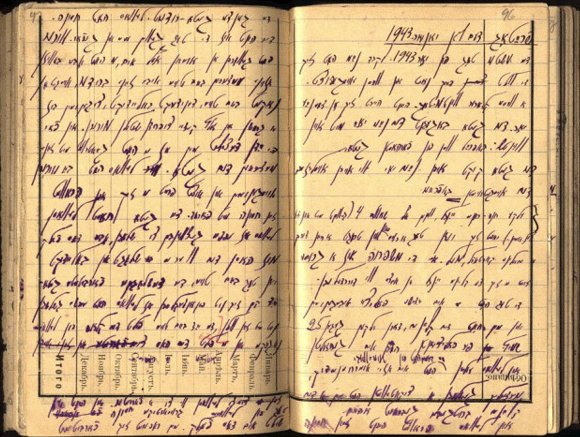
From June 1941 to April 1943 he kept a diary in Yiddish. Yitskhok had a sense of the significance of his account; at one point he wrote, “I consider that everything must be recorded and noted down, even the most gory, because everything will be taken into account.”

He not only wrote about his own life and his family and friends, but about the wider community events and the devastation the Germans wrought on his people. The historian Allan Gerald Levine called him “an astute and passionate observer of the times,” and compared him to Anne Frank.

Nor was the diary Yitskhok’s only writing project.

When one of his teachers, a beloved figure in the ghetto, died, he wrote a eulogy for the man and read it out before a large audience. He was a member of a literary group and was also attached to the ghetto’s history project, for which he interviewed ghetto residents about their lives:

I got a taste of the historian’s task. I sit at the table and ask questions and record the greatest sufferings with cold objectivity. I write, I probe into details, and I do not realize at all that I am probing into wounds … And this horror, this tragedy is formulated by me … coldly and dryly. I become absorbed in thought, and the words stare out of the paper crimson with blood.

The Vilna Ghetto, whose population initially numbered 40,000, had a rich cultural life, just like prewar Jewish Vilna had. There were theaters, cabarets, the symphony, art exhibits, a library, public lectures, and underground schools for both children and adults.

Vilna Jews saw art, music, literature and the pursuit of knowledge as a form of resistance. As Jacob Gens, head of the “ghetto’s Judenrat, put it, cultural activity gave a person “the opportunity to free himself from the ghetto for a few hours … We are passing through dark and difficult days. Our bodies are in the ghetto, but our spirit has not been enslaved.”

Reality intruded, however, and in the final analysis the Vilna Jews were doomed to extinction.

Yitskhok’s final diary entry was dated April 7, 1943, two days after five thousand Vilna Jews had been rounded up and shot at Ponary. He was understandably in a very grim mood. His prophetic last line was, “We may be fated for the worst.”

On September 23, 1943, the Nazis began the final liquidation of the Vilna Ghetto, which had by then been reduced to about 10,000 people. After a selection, those who could work were sent off to labor camps in Estonia and Latvia, where almost all of them died due to the brutal conditions there.

Children, the elderly, and the sick were shot at Ponary or sent to the extermination camp Sobibor and gassed.

Yitskhok, his parents and his uncle’s family chose to go into hiding rather than take their chances at the selection. In hiding he sank into apathy and said very little. After about two weeks in the hideout, they were discovered and taken to their deaths.

The only surviving member of Yitskhok’s family was his teenage cousin, Sarah “Sore” Voloshin. Somewhere on the route to Ponary she was able to escape. She joined a partisan group in the forest and survived until the Red Army liberated the area in the summer of 1944. After the war was over, she returned to the family’s hiding place and found Yitskhok’s diary. As of 2010, Sore Voloshin was still alive in Israel.

And the diary she retrieved had become one of the major sources on day-to-day life in the Vilna Ghetto.

Yitskhok Rudashevski suffered and died in just the same way as hundreds of thousands of others, but unlike them he did not remain anonymous: he is one of the ghetto’s most famous inhabitants. His writings have been published in their original Yiddish and in Hebrew, German and English translations. Extracts of his diary can be found in several anthologies, and it’s available in its entirety under the title The Diary of the Vilna Ghetto.

On this day..

1943: 1,196 Jewish children from Bialystok

(Thanks to Meaghan Good of the Charley Project for the guest post. -ed.)

On this date in 1943, a special transport of 1,196 children and 53 adults arrived at Auschwitz and were gassed shortly thereafter. Thus ended one of the lesser-known tragedies of the Holocaust.

The children were very nearly the last survivors of the Bialystok Ghetto, which had been liquidated in August 1943. Almost all of the inhabitants of the ghetto wound up being sent to the Treblinka Extermination Camp and killed, but over a thousand children were mysteriously separated from their parents and taken away for some as-yet-unknown purpose. (The transport list can be found here.)

At the time, there were tentative negotiations between the Red Cross and the Nazis to trade Jewish children for either German prisoners of war or cold, hard cash. The exact details are unclear, and there’s a great deal of contradictory information about the entire event.

In any case, the Germans selected children from Bialystok, one of the few places in Nazi Europe where there were any Jewish children left alive.

The children, all of them under 16, spoke only Yiddish and Polish. They were in terrible shape, both mentally and physically. One witness later described them:

Suddenly, a column of bedraggled children appeared, hundreds of them … holding each other’s hands. The older ones helped the small ones, their little bodies moving along in the pouring rain. A column of marching ghosts, with wet rags clinging to their emaciated bodies, accompanied by a large number of SS men …

The children, looking like scarecrows, refused to undress. They held on to their dirty clothing, the older stepping in front of the young ones, protecting them with their bodies, clutching their hands and comforting those that were crying. Their clothing permeated with lice, their bodies full of sores, these children refused to wash.

Their first stop was Theresienstadt in Czechoslovakia, the so-called “model ghetto” which was used by the Nazis as a propaganda tool to show that they weren’t mistreating their Jews.

Theresienstadt was in fact a horribly overcrowded, disease-ridden city and its inhabitants were all dying of starvation, but it was the best there was available. There were no gas chambers there, and the Theresienstadters knew nothing about the kinds of horrors the Bialystok children had been through.

To keep knowledge of said horrors from leaking out, once in Theresienstadt the children were placed in isolation and weren’t allowed to leave their barracks. 53 doctors and nurses were recruited from the local population to take care of them, and they were locked up with the children.

In spite of these security measures, some of the adults were able to make contact with people from the outside. Theresienstadt youth leader Fredy Hirsch got caught making an unauthorized visit to the children’s barracks, for example, and as punishment he was sent to Auschwitz on the next train.

A child thought to be Deborah Klementynowska, possibly the only surviving photo of one of these lost Bialystok children.

The adults — one of whom was Franz Kafka‘s sister, Ottilie — didn’t know what to make of the children’s behavior at first.

For instance, why, when they were invited to take a shower, did they start crying and screaming about gas? The children started to talk about their experiences, and their caregivers were horrified by their stories.

The Nazis intended to quite literally fatten up the children before they were sent off into the world, so the group was treated very well. Everyone got enough to eat, and they were given baths, clean clothes, medical treatment and even toys. Anyone who got seriously ill was taken away “to the hospital” and, ahem, never returned.

Slowly, assisted by their kind caregivers, the children got their equilibrium and began to act like normal kids again.

Meanwhile, negotiations continued …

The Allies wanted to send the children to British Mandate Palestine. The Germans, however, were against this plan because they didn’t want the children growing up there, strengthening the Palestinian Jewish community and possibly establishing a Jewish state someday. (The Mufti of Jerusalem, whom the Nazis were quite friendly with, didn’t like the idea either.)

The Germans wanted the children sent to Great Britain instead.

The UK, however, had already accepted many Jewish refugees, including 10,000 German, Austrian and Czech children with the Kindertransport, and were unwilling to take in any more.

And there was another problem, relating to the prospect of exchanging the children for money.

This money would have to be provided by the American Joint Distribution Committee and other Jewish welfare agencies, and they flat-out refused to give anything to the people who had promised to wipe them off the face of the earth.

In the end, the negotiations collapsed, through what one witness later called “an ill-applied sense of ‘correctness'” on the part of the Allies. Of course, given the Nazis’ track record, one wonders if they ever seriously intended to release the children no matter what they were given in return.

The plan was discarded and the Germans were left with 1,196 useless Jewish children on their hands. They dealt with them in the usual manner.

None of the Bialystok group or their caregivers had any idea what was coming up for them when they were sent away from Theresienstadt. They’d been told the negotiations had been successful and they were on their way to Switzerland, and thence to Palestine. They were told to take off their yellow stars and the adults had to sign a statement promising not to say anything bad about the Germans.

The transport set off in high spirits, rejoicing at their upcoming freedom.

But their train went not to Switzerland but to Poland, marked for “special treatment” on arrival at its destination. Apart from a few of the adults who were selected to work, there were no survivors.

On this day..

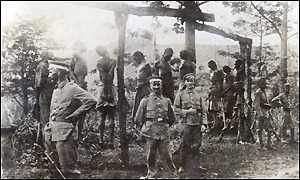
1904: Herero prisoners, at the command of Lothar von Trotha

My initial plan for the operation, which I always adhered to, was to encircle the masses of Hereros at Waterberg, and to annihilate these masses with a simultaneous blow, then to establish various stations to hunt down and disarm the splinter groups who escaped, later to lay hands on the captains by putting prize money on their heads and finally to sentence them to death.

-German General Lothar von Trotha (pdf source)

On this date in 1904, von Trotha did a little of that executing bit, further to doing a whole lot of genocide. It was the very day after von Trotha’s Vernichtungsbefehl, or extermination order, against the Herero people.

We give the narrative here to Jan-Bart Gewald’s “Colonization, Genocide and Resurgence: The Herero of Namibia 1890-1933”, from a collection of papers at a German symposium. Gewald’s complete text is available in scanned pdf form here.

Gewald:


Pocketed by the desert and the German patrols the Herero chiefs and their followers congregated along the Eiseb river. Around the first of October 1904, General Lothar von Trotha, who was actively taking part in the pursuit, and his retinue had reached the waterhole Osombo-Windimbe. During the afternoon of the following day, Sunday 2 October 1904, after the holding of a field service, General von Trotha, addressed his officers. In his address Trotha declared that the war against the Herero would be continued in all earnestness, and read out the following proclamation:

I the great General of the German troops send this letter to the Herero people.

The Herero are no longer German subjects. They have murdered and stolen, they have cut off the ears, noses and other bodyparts of wounded soldiers, now out of cowardice they no longer wish to fight. I say to the people anyone who delivers a captain will receive 1000 Mark, whoever delivers Samuel will receive 5000 Mark. The Herero people must however leave the land. If the populace does not do this I will force them with the Groot Rohr [cannon]. Within the German borders everyHerero, with or without a gun, with or without cattle, will be shot. I will no longer accept women and children, I will drive them back to their people or I will let them be shot at.* These are my words to the Herero people.

The great General of the mighty German Kaiser.

At dawn the following morning, Herero prisoners, who had been sentenced to death by a field court-martial, were hung in the presence of about 30 Herero prisoners, women and children amongst them. After the hanging, Trotha’s proclamation was read out to the prisoners in Otjiherero. Printed copies of the text in Otjiherero were distributed amongst the Herero prisoners. The prisoners were then turned loose and driven out into the Omaheke. [i.e., the western Kalahari desert -ed.]


In a letter the next day, Oct. 4, to the general staff, von Trotha reported on his order the day’s executions, in the context of a detailed tactical and philosophical justification of destroying the entire Herero nation. It’s quoted at length in Absolute Destruction: Military Culture and the Practices of War in Imperial Germany:

For me, it is merely a question of how to end the war with the Herero. My opinion is completely opposite to that of the governor and some “old Africans.” They have wanted to negotiate for a long time and describe the Herero nation as a necessary labor force for the future use of the colony. I am of an entirely different opinion. I believe that the nation mustbe destroyed as such, or since this was not possible using tactical blows, it must be expelled from the land operatively …

Because I neither can treat with these people, nor do I want to, without the express direction of His Majesty, a certain rigorous treatment of all parts of the nation is absolutely necessary, a treatment that I have for the present taken and executed on my own responsibility, and from which, as long as I have command, I shall not detour without a direct order. My detailed knowledge of many Central African tribes, Bantu and others, has taught me the convincing certainty that Negroes never submit to a contract but only to raw force. Yesterday before my departure, I had the warriors who were captured in the last several days [and who were] condemned by court-martial, hanged, and I have chased all the women and children who had gathered here back into the desert, taking with them the proclamation to the Herero people. This proclamation (enclosed), which will unavoidably bcome known, will be attacked … accepting women and children, who are mostly ill, is an eminent danger to the troops, and taking care of them is impossible. Therefore, I think it better that the nation perish rather than infect our troops and affect our water and food. In addition, the Herero would interpret any kindness on my side as weakness.They must now die in the desert or try to cross the Bechuanaland border. This uprising is and remains he beginning of a race war, which I already predicted in 1897 in my reports to the chancellor on East Africa … Whether this uprising was caused by poor treatment [of the Africans] remains irrelevant to its suppression.


It should be added that this explicitly genocidal policy was neither unique to German colonies, nor, as von Trotha himself notes, uncontested within Germany itself.

German Christian missionaries logged a piteous catalog of horrors, “skeletons with hollow eyes, powerless and hopeless,” and their reports of same to their home offices led to church pressure to brake the atrocities.

Gewald also quotes one of von Trotha’s subalterns, undisguisedly revolted at what he was involved in.

Cattle which had died of thirst lay scattered around the wells. These cattle had reached the wells but there had not been enough time to water them. The Herero led ahead of us into the Sandveld. Again and again this terrible scene kept repeating itself … the water became ever sparser, and wells evermore rare. They fled from one well to the next and lost virtually all their cattle and a large number of their people. The people shrunk into small remnants who continually fell into our hands, sections of the people escaped now and later throug the Sandveld into English territory. It was a policy which was equally gruesome as senseless, to hammer the people so much, we could have still saved many of them and their rich herds, if we had pardoned and taken them up again, they had been punished enough. I suggested this to General von Trotha but he wanted their total extermination.

Technically, complete destruction of the Herero was reversed as German policy a few months after von Trotha began implementing it, and the general himself recalled from South West Africa before the end of 1905 — leaving only a “softer” genocide of disease-ridden concentration camps through 1908. Although firm numbers are hard to come by, it’s thought that well over half the Herero population died during this period.

Yet neither was von Trotha a lone butcher. Diary entries of settlers and regular soldiers well before the extermination order record many instances (pdf) of the most cavalier slaying of Herero prisoners and noncombatants, abuses which continued long after von Trotha’s departure.

It’s difficult not to see in the racial ideology and the eliminationist military doctrine prefiguring (pdf) later and better-publicized brutalities. Indeed, even some of the personnel are the same:

  • Hermann Goering‘s father Heinrich was Germany’s first Reichskommissar in South West Africa, plopping his home down right on a Herero burial site.
  • Eugen Fischer, a eugenicist who availed the Namibian concentration camps’ ready supply of subjects to produce career-making research that would influence German race law and make Fischer a big brain in Nazi intellectual circles
  • Franz Ritter von Epp, one of von Trotha’s officers, formed in the aftermath of World War I one of the far-right Freikorps paramilitaries, with many subsequently-influential Nazis among its membership, including Ernst Roehm (who may have cribbed the SA “brown shirt” look from colonial Schutztruppe khakis) and Adolf Hitler himself

* He meant, shooting over their heads to run them off. “I assume absolutely that this proclamation will result in taking no more male prisoners, but will not degenerate into atrocities against women and children,” Lothar explained. “The latter will run away if one shoots at them a couple of times. The troops will remain conscious of the good reputation of the German soldier.”

On this day..

1893: Scuffletonians in Mt. Vernon, Georgia

From the Crittenden Press, Marion, Ky., Oct. 5, 1893, page 1 (pdf).

ON ONE SCAFFOLD.

Five Murderers Executed In Public at Mt. Vernon, Georgia

Three Killed a Merchant, the Fourth a Child and the Fifth a Companion.

Mt. Vernon, Ga., Sept. 29. — Five murderers were executed upon one scaffold at this place at 2:05 p.m. today. They were Hiram Jacobs, Hiram Brewington, Lucien Manuel, Purse Strickland and Weldon Gordon. All were commonly called negroes, but the first four named were descendants of the Crowatan Indians of North Carolina, and locally were known as “Scuffletonians,” from the name of the community from which they came. Three of them murdered Alexander Peterson, a rich merchant, last July, the fourth killed a five-year-old child and the fifth murdered a negro companion.

Over ten thousand people, white and black, witnessed the executions. Every incoming train deposited its load of human freight and steamboats on the Oconce and Attamba rivers ran a daily schedule. Thousands of women viewed the spectacle without a shudder.

The condemned men spent their last night on earth without any perceptible dread. This morning in the jail several colored ministers offered prayer for their spiritual salvation, exhorting them to be firm and courageous. At 1:30 p.m. the march to the scaffold was begun. The sheriff and prisoners were seated in a hack surrounded by a score of armed guards. They stood side by side on the scaffold. They were requested to make a statement if they desired.

Manuel said: “I have every reason to believe that I am going to meet the angels above. I fear nothing, my sins are forgiven and I shall go to heaven. I tell you my friends, to put your trust in God — good-bye.”

The others followed in the same strain. Strickland shed tears, while the vast throng sang, “A Charge to Keep I Have.” The Rev. Mr. Ross, a colored minister, prayed fervently. Then Sheriff Dunham adjusted the black caps and a photographer took their pictures.


Image from here, which appears to misdate the execution.

At this moment Sheriff Dunham bid them farewell, shaking each other by the hand, saying: “May God have mercy on your souls.”

At 2:05 p.m. the trap was sprung. There were no signs of a struggle, and the bodies hung straight and motionless. Half an hour later the bodies were cut down and deposited in pine coffins.

Update: Here’s a lovely wrap-up of the whole sordid affair.

On this day..

1803: Joseph Samuel survives three hangings

On this date in 1803, Joseph Samuel just wouldn’t hang.

Transported to Australia in 1801 for theft, Joseph Samuel was part of a cohort of Sydney Cove convicts who, on the night of August 25-26, burgled a house.

The band was surprised by constable Joseph Luker, himself a former convict. One or more of the thieves battered him to death on the spot with whatever was at hand: recovered with Luker’s broken body at morning’s light were a bloodied wheelbarrow wheel, and the hilt of Luker’s own cutlass, buried in his brains. Luker was the first policeman killed on duty in Australia, and his name can be found on the country’s National Police Memorial.

But the order of the day in 1803 was a different sort of memorial. “Avenging Heaven directs the Hand of Justice, and the Manes of the Deceased inspires us with Indignation and Resentment,” the Sydney Gazette fulminated. The need to cut a deal for crown’s evidence with one of Samuel’s compatriots eventually meant that Samuel was the only one to bear the vengeance of Luker’s Manes. (A third man, Isaac Simmonds, was acquitted at trial, but he was so heavily suspected that he was made to attend the execution.)

We’ll pick up the narration of the Sydney Gazette (Oct. 2, 1803):

James Hardwicke were brought, in pursuance of the sentence passed upon them on the preceding Friday.

Both prisoners conducted themselves with becoming decency; and when the Reverend Mr. MARSDEN had performed the duties of his function, and quitted Hardwicke, he turned to Samuels (who being a Jew, was prepared by a person of his own profession) and questioning him on the subject of the murder of Luker, he solemnly declared, that during the interval of his confinement in the cell with Isacc [sic] Simmonds, nicknamed Hikey Bull, they in the Hebrew tongue exchanged an oath, by which they bound themselves to secrecy and silence in whatever they might then disclose.

Conjured by that GOD before whom he was shortly to appear, not to advance any thing in his latter moments that would endanger his salvation, he now repeated with an air of firmness what he had before declared ; and appearing deeply imprest with a becoming sense of his approaching end, appealed to Heaven to bear him testimony that Simmonds had, under the influence of the oath by which they were reciprocally bound, acknowledged to him that Luker had accidentally surprised him … and that he, in consequence thereof, had “knocked him down, and given him a topper for luck!” … [and] that he would hang 500 Christians to save himself.

Simmonds, as we’ve noted, was right there in forced attendance at the public hanging, and as Samuel’s accusations started the audience murmuring, Simmonds tried to interject his denials. The very fact that the words were spoken by a man on the brink of death and presumably in fear for his soul made Samuel a credible accuser in the eyes of the populace, “in whose breasts a sentiment of abhorrence was universally awakened … and the feelings of the multitude burst forth into invective.” Yikes.

While the gendarmes moved to protect Simmonds from the possible wrath of his neighbors, and Hardwicke received a last-minute pardon,* Samuel commenced the inadvertently superlative finishing act of his persuasive performance.

at length the signal was given, and the cart drove from under him; but by the concussion the suspending cord was separated about the centre, and the culprit fell to the ground, on which he remained motionless with his face downwards. The cart returned, and the criminal was supported on each side until another rope was applied in lieu of the former: he was again launched off, but the line unrove, and, continued to flip until the legs of the sufferer trailed along the ground, the body being only half suspended.

All that beheld were also moved at his protracted sufferings; nor did some hesitate to declare that the invisible hand of Providence was at work in the behalf of him who had revealed the circumstances above related. To every appearance lifeless, the body was now raised, and supported on men’s shoulders, while the executioner prepared anew the work of death. The body was gently lowered, but when left alone, again fell prostrate to the earth, this rope having also snapped short, close to the neck.

Compassion could no longer bear restraint; winged with humanity, the Provost Marshal sped to His EXCELLENCY‘S presence, in which the success of his mission overcame him; A Reprieve was announced — and if Mercy be a fault, it is the dearest attribute of GOD, and surely in Heaven it may find extenuation!

Samuells when the Provost Marshal arrived with the tidings which diffused gladness throughout every heart, was incapable of participating in the general satisfaction. By what he had endured his reasonable faculties were totally impaired; and when his nerves recovered somewhat from their feebleness, he uttered many incoherences, and was alone ignorant of what had past. Surgical assistance has since restored him; And MAY THE GRATEFUL REMEMBRANCE OF THESE EVENTS DIRECT HIS FUTURE COURSES!

It didn’t.

In 1806, Samuel made an escape attempt with some other convicts by boat. It was swept away in a tempest, with all presumed lost at sea.

* A number of sources claim that Hardwicke did hang successfully while Samuel’s rope repeatedly broke. We think the eyewitness newspaper report days after the execution to the effect that Hardwicke was reprieved is by far the more credible report.

On this day..