1944: Max Sievers, freethinker

On this date in 1944, German freethinker Max Sievers was beheaded at Brandenburg Prison for “conspiracy to commit high treason along with favouring the enemy.”

A working-class Berliner, Sievers (English Wikipedia entry | German) became a prominent communist and atheist writer in the interwar years. He directed the Association of Freethinkers for Cremation from the early 1920s, and in 1927 became the chair of the German Freethinkers League.

This was not a demographic Adolph Hitler was courting. In the wake of the 1933 Reichstag Fire, the Nazis stamped out atheistic movements, even converting the Freethinkers’ building into a Protestant recruitment venue.

Briefly imprisoned, Sievers fled Germany upon his release later in 1933 and from exile in Belgium — and then, after Belgium was conquered, in hiding in France — he kept up a drumbeat of antifascist propaganda, notably the 1939 book Unser Kampf gegen das Dritte Reich: von der nazistischen Diktatur zur sozialistischen Demokratie.

He was finally arrested by the Gestapo on June 3, 1943, and condemned to death by Roland Freisler.

Sievers was posthumously exonerated in 1996, and is today — and on January 17th in particular — an honored martyr for German humanist, atheist, and freethinker groups.

On this day..

2013: Rizana Nafeek, Sri Lankan maid

A year ago today, a blindfolded, white-clad Rizana Nafeek had her head chopped off in public in Dawadmy, near the Saudi capital of Riyadh.

Rizana Nafeek, a Sri Lankan, was among the numerous foreign laborers routinely imported to Saudi Arabia for domestic work. There are an estimated 1.5 million migrant domestic workers in Saudi Arabia from South Asia (especially Sri Lanka), Nepal, Indonesia, East Africa, and the Philippines. Most are employed via the kafala (“sponsorship”) system that places their host in an almost lord-like position of authority.

Such workers are excluded from Saudi Arabia’s labor protections, and as a result stand vulnerable to horrifying abuse.* Household heads often confiscate these workers’ passports, and in some cases have subjected their domestic employees to rape, beatings, wage confiscation, and work weeks of 100-plus hours. One Sri Lankan woman had nails driven into her hands when she complained about overwork.

Rizana Nafeek hardly had time to find out whether any of these perquisites were in store for her. Not long after she arrived in Saudi Arabia in 2005 hoping to make enough money as a domestic drudge to move her impoverished family into a house, she had bottle-feeding duties for her host family’s infant foisted upon her. Nafeek had no training in caring for infants.

In May 2005, that child began choking while in Rizana’s care, and her panicked shouts summoned the mother. By the time the mother arrived, the infant had fallen unconscious, and the upset family immediately handed over their maid to the police, accusing her of strangling the baby.

This was the victim for whom Nafeek was decapitated, and also perhaps an illustration of tunnel vision in law enforcement. It’s quite doubtful whether there was ever any objective basis for supposing a homicide, but the fact that this was the color the family gave to events in the horror of the moment set in motion all the ensuing events.

During the investigation leading up to her 2007 trial and condemnation, Nafeek confessed to smothering the child — but she would later claim this confession was tortured out of her, and that the baby simply started choking on its bottle. (There was never a post-mortem on the dead baby.)

Opaque as the Saudi Arabian criminal justice system is, it’s got ample reputation for obtaining confessions by violence, and for mistreating migrant workers. And the accused had scant legal representation and no translator when she was tried for her life in a Saudi court.

After her conviction, it would also emerge that, order to land her the gig, Nafeek’s Sri Lankan recruiting agency falsified her papers to bump her age up past the legal minimum of 21. Rizana Nafeek arrived in Saudi Arabia carrying a passport that said she was born in 1982, making her 23 years old when she committed the supposed murder … but her birth certificate said that she was born in 1988, and was still a minor when the “murder” took place.

As an international clemency push developed for the potentially-innocent underaged migrant worker, the Saudi government strongly rejected its critics’ charges.

Noting that the dead infant’s family refused repeated blandishments of “blood money” to exercise its right to grant clemency, Riyadh officially “deplore[d] the statements made” by Rizana’s supporters “over the execution of a Sri Lankan maid who had plotted and killed an infant by suffocating him to death, one week after she arrived in the kingdom.”

More sympathetic Saudis, undoubtedly meaning well, offered Rizana Nafeek’s family cash compensation after the young woman was beheaded. That money, too, was angrily refused.

“I will not accept any gifts from the Saudis or the Saudi government which murdered my daughter,” mother Saiyadu Farina told a Sri Lankan newspaper. That anger was widely shared in Sri Lanka; Colombo even recalled its Saudi ambassador in protest.

That’s as may be, but money is sure to carry the argument at the end of the day. Wage remittances by overseas laborers are a massive boon to the island nation, amounting to $6.3 billion in 2012 — 8.8% of the Sri Lankan economy. And Saudi Arabia remains the single largest employer (pdf) of Sri Lankans abroad.

As of the time of Rizana Nafeek’s execution, at least 45 other foreign domestics, most of them Indonesians, were also awaiting execution on Saudi Arabia’s death row.

* Ill treatment of migrant domestic workers is a phenomenon elsewhere in the Middle East, and elsewhere around the world.

On this day..

1554: Guillaume Dalencon, defrocked priest

Felix Platter is our narrator for Guillaume Dalencon’s death at the stake on this date in 1554.

This book portrays the 16th century through the remarkable Platter family.

Platter (English Wikipedia entry | German) was a 16-year-old Swiss student, and we find him on the midpoint of his family’s upward arc in the world. His father, Thomas, had as a child been put out of the house by his impoverished mother and made his way for a time as a beggar; by dint of lifelong struggle and application, he had gained a precarious foothold among the bourgeoisie of Basel. Thomas Platter nurtured still greater ambitions for his son.

Accordingly, the very genial Felix, who had never before traveled, set out in 1552 on the 400-mile journey to the city of Montpellier in southern France. Young Platter was an energetic diarist, and his impressions of the journey and of Montpellier were published in English as Beloved Son Felix. (That’s how Felix’s father addressed him in letters.) Though the book is out of print, it’s available online at archive.org.

One of its immediately striking features is the omnipresence of danger and death. Platter luckily left Basel just ahead of a plague outbreak, but he nearly lost his life in the frightening Jurthen forest. Taking shelter from the rain there in “a wretched inn” at a squalid hamlet called Mezieres, Platter and his companion found the place full of aggressive Savoyard peasants, and having no choice but to stay overnight they blockaded their door with a bed and kept a waking vigil all night with weapons at the ready. Three hours before dawn, they crept through the snoring mass of drunken thugs and slipped away, and a good thing it was too: the boys’ French guide told them as they set out that he had overheard the brutes plotting to murder the hapless travelers that morning.

The bandit “Long Peter”, who was then active in this forest, was eventually caught and executed on the breaking-wheel in Berne. Only in his old age did Platter learn that the brigand’s confession included a declaration that he had planned, but failed, to kill some students in Mezieres.

They had escaped by the skin of the teeth, but seemingly every page of the journal finds others who succumbed to the many paths to abrupt death the 16th century had to offer. (Not a few of them are corpses that Platter stole from their graves with fellow-students in order to anatomize.) This was, too, the age of spectacular public execution: the travelers’ road on October 18th, 1552, passed numerous “bodies of men hanging from the trees” and as darkness fell Platter gave himself a fright when he nearly rode into one. By the 20th they approached Lyons, where they beheld “several men hanging from gibbets and others exposed on wheels.” As they entered that city, they passed a Protestant “being led out to be burnt outside the gate; he was in his shirt with a truss of straw fastened on his back.”

Platter makes no further comment on this sight, but it must have touched him with pity — if not fear. Platter had been born in Basel about the same time that John Calvin, fleeing French persecution, arrived there; it was in Basel that Calvin first published his seminal theology Institutio Christianae religionis. To this faith, predominant in Swiss cities but illicit in France, Platter too subscribed. The French Wars of Religion loomed around the corner in the next decade, and Montpellier would become a Huguenot stronghold during that conflict. While Platter was there, an uneasy peace prevailed between growing ranks of Protestants and the official religion. The University of Montpellier attracted numerous Protestant students (the city lay in the heart of the Languedoc, a center of resistance to the papacy from long before the Reformation), and Platter’s own mentor, the brilliant doctor Guillaume Rondelet, had ambiguous religious affiliations.

Day to day, these students kept their heads down in matters religious and went about mostly unmolested. Taking a vocal stand on theological controversies here would be to embark upon a different path than Thomas Platter had in mind for his son, for heretics were among the many executions Platter recounts in his journal.

Guillaume Dalencon, the boy learned, was a former priest of Mountauban, “unfrocked on the 16th of October” when it was discovered that he had gone Protestant and brought back heretical books from Geneva. “Dressed in his priestly robes, he was brought on to a platform before the bishop” for his defrocking. “After protracted ceremonies in Latin he was divested of his chasuble and the rest, and given secular clothing. Hishead was then shaved, and two fingers were cut off his hand. After this he was delivered to the civil justice and once more thrown into prison.” The secular power took it from there.

On the 6th of January Guillaume Dalencon, unfrocked eleven weeks before, and since then held in prison, was condemned to death. In the afternoon a man carried him on his shoulders out of the town towards the monastery, to the place of execution. A pyre had already been built there. Beind the condemned man two other prisoners walked, one a cloth shearer, in his shirt, with a bale of straw fastened to his back; the other of good appearance, and well dressed. Both of them had recanted and denied the true faith. [i.e., both had recanted Protestantism under the threat of execution. -ed.] Dalencon, however, sang psalms all the way. At he pyre, he sat down on a log and himself took off his clothes as far as his shirt, and arranged them beside him tidily, as though he would be putting them on again. He exhorted the other two, who were about to apostasize, so touchingly that the sweat stood out in great drops, as big as peas, on the forehead of the man in the shirt. When the monks, formed in a curve around him, and mounted on horseback, told him that it was time to make an end, he leapt joyously on to the pyre and sat down at the foot of the stake that rose in the center of it. This stake was pierced by a hole, through which ran a cord with a running noose. The executioner put the cord round Dalencon’s neck, tied his hands across his breast, and placed near him the religious books he had brought from Geneva. Then he set fire to the pyre. The martyr remained seated, calm and resigned, with his eyes raised towards heaven. When the fire reached the books the executioner pulled on the cord and strangled him; his head dropped to his breast and he made no further movement. Little by little the body was reduced to cinders. His two companions stood at the foot of the fire, where they were made to watch his sufferings, and could feel the heat of the flame.

After the execution they were both taken to the Hotel de Ville. Near there, in front of the church of Notre-Dame, a platform had been set up, with a statue of the Virgin on it, before which they would have to recant. The crowd had to wait for them for a long time. At last only one of the two men was brought out. The cloth shearer had refused to abjure and demanded that he should be executed without mercy for having failed his beliefs. He was therefore taken back to prison. The other man, who seemed to be a man of substance, was placed on his knees before the statue of the Virgin, with a lighted candle in his hand. A clerk read out various charges, to which he had to reply. In this way he saved his life, but he was sent to the galleys and there put in chains.

On the following Tuesday, the 9th of January, it was the turn of the cloth shearer again. He was strangled and burnt as the priest had been. He showed great courage, and no less repentance for having come so near to denying his faith. It had rained on that day, and the fire would not burn. The victim, who was not completely strangled, endured great suffering. At last the monks of the neighbouring monastery brought some straw, and the executioner took it and sent for oil of terebinth from my master’s pharmacy to ignite the fire. Afterwards I reproached the assistants who had given it to him, but they advised me to hold my tongue, for the same fate could befall me also, as a heretic.

During these affairs an extraordinary phenomenon occurred. On the 6th of January, immediately after the execution of the first man, it began to thunder violently. I heard it plainly and so did many others with me; but the priests deried us and said that it was the smoke from the burning of heretics that produced that effect.

On this day..

1854: Uhazy, amid Minnesotan depravity

On this date in 1854, a Dakota Indian named Uhazy was publicly hanged in a scene of “Total Depravity” at St. Paul, Minnesota — the first execution in the Minnesota Territory.

Uhazy (many other transliterations are possible) was convicted of the 1852 murder of a German woman near Shakopee. He then enjoyed the hospitality of St. Paul’s jail for two solid years while his appeals played out.

Even when juridical remedies proved unavailing, there was at least some public sentiment for his reprieve.

A large number of ladies (including the wife of the previous governor) applied to territorial Gov. William Gorman for clemency. Gorman refused it.

Besides, if he granted such a petition, Gorman replied, “others of his savage tribe might be tempted to hope for a like release, and commit a like offence; and the danger of such results would be far greater from Indians than from civilized man.”

“Civilized man’s” tense relationship with the “savage tribe” would in a few years spark a brief war and (in Mankato, Minn.) the largest mass execution in U.S. history.

Civilization had a different challenge on this occasion: the ribald street scenes that often accompanied public hangings.

St. Paul’s own Daily Minnesota Pioneer (Dec. 30, 1854) were far too genteel to report from the scene, a fact which of itself suggests the intelligentsia’s growing moral disgust for witnessing people witnessing executions.

As we had no inclination to witness the tragedy, we are unable to give the lovers of the dreadful a detail of the poor fellow’s suffering; but understand he met his fate with all that stoicism for which his race is noted.

Others were not so retiring. The scene they reported does not flatter; the mob was so large and unruly that when the sheriff set about erecting a scaffold that morning in a downtown square, he was obliged by Gov. Gorman to relocate it to St. Anthony Hill for public safety. (See this book.) Uhazy didn’t hang until 3 o’clock in the afternoon.

“Liquor was openly passed through the crowd, and the last moments of the poor Indian were disturbed by bacchanalian yells and cries,” one paper editorialized. “Remarks too heartless and depraved, in regard to the deceased, to come from men, were freely bandied. A half-drunken father could be seen holding in his arms a child eager to see well; giddy and senseless girls chatted with their attendants, and old women were seen vying with drunken ruffians for a place near the gallows.”

Capital punishment in general and the public spectacle of execution specifically long troubled the Minnesotan conscience. The Espy file credits Minnesota with just 28 executions in addition to that aforementioned Mankato mass-hanging; in 1889, the state moved all its exections behind prison walls and away from drunken ruffians. It hasn’t executed anybody at any venue since 1906.

On this day..

1806: Hepburn Graham, HMS St. George rapist

Hepburn Graham, masters’ mate aboard the HMS St. George, was tried by Admiralty court-martial in early December on a charge of sodomy forwarded by the ship’s captain, Thomas Bertie.

We excerpt from the trial record via Gay Warriors: A Documentary History from the Ancient World to the Present:

George Parr, a boy of fourteen years of age belonging to His Majesty’s ship, St. George, called in and sworn:

Capain Bertie asked:

Q. Do you know the prisoner?

A. Yes

Q. Relate to the court what the prisoner was guilty of with you on the twenty-first of November last, the day after the St. George arrived in Torbay, and also n the twenty-seventh of November last.

A. On the twenty-first of November last, Mr. Graham took me into his hammock. He got me on a stool and got hold of me, telling me I must be a good boy. He got hold of my hair, and pulled me into his hammock in his berth on the starboard side, forward on the lower gun deck. It was between eight and nine o’clock in the evening of the first watch. He told me to put down my trousers, and he put them down himself. He pulled his yard out, and put it into my backside. He kept doing backwards and forwards, and made my arse wet. I was laying on my side in his hammock when he committed the act, and immediately afterwards he said you may go to your hammock now, and told me I must not tell any one, and if I did he would get me flogged …

On the twenty-seventh of November at night, between eight and nine o’clock in the [illegible] watch, I was in his berth attending him as his servant. He told me I must be a good boy. He would make me a good boy. He got hold of me and pulled me into his hammock. I did not want to get into it and he kept hitting me on the head while I was in the hammock. I wanted to get out, and he kept hitting me and asked me to stay in and said if I did not, he would get me flogged, he would get me three dozen [lashes]. He had made me unbutton the buttons before, and he them pulled down my trousers and pulled out his yard and put it into my backside. It went into my backside. He kept moving backwards and forwards, and made my backside wet. He then told me to go to my hammock and get up in good time in the morning and I went away. On the following morning early, I was again in his berth. It was before breakfast, before the hammocks were up. He pulled a hole in my trousers behind with his fingers and told me he would get them mended. He then pulled his yard out, and put it through the hole of my trousers to my backside, but did not enter it, but kept moving backwards and forwards and made my arse wet.

Q. Did he ever make any more attempts than what you have related?

A. Yes, he has attempted it five times in all, but only entered me twice.

A second boy on the same ship gave similar testimony.

John Sky, a boy about fifteen years of age, belonging to the St. George, called in and sworn.

Captain Bertie asked:

Q. Relate to the court what the prisoner was guilty of with you on the twenty-ninth of November, last.

A. On the twenty-ninth of November last I was down between decks talking to one of the boys whose name is Taylor. Mr. Graham, the prisoner came to me and [illegible] me he wanted me in his berth. I went in and he told me he would give me a bed. He then took me round the deck and set me down on a stool [illegible] of him. He began kissing me and told me he must feel my cock. I told him to leave it alone. If he did not, I would sing out. He was at this time going to unbutton the flap of my trousers. Mr. Miller, a midshipman, came in and he asked Mr. Miller to take down a great coat that [illegible] on the gun to give him more light. He said it gave him light. Whilst Mr. Miller was taking down the coat, he took me by the arm and hoved me out of the berth. I told the boy, George Parr, if he did not complain, I would. He then said that he would complain, and I told him to mention my name. He did complain to the first lieutenant, and mentioned my name. I told Mr. Graham that I could not stand it, and would complain. About a fortnight before, Mr. Graham [illegible] me in his berth and had my trousers down and pulled out his private parts. He tried to get these into my backside, but could [illegible], but got them between my thighs. Before he had had his turn, someone came in and disturbed him. I told him I would go out of the berth, and he put me out of the berth. He never succeeded with me in what he wanted to do.

George Parr’s rape claim was vouched by the ship’s surgeon.

Mr. Hugh Hughes, surgeon of the St. George, called in and sworn:

Captain Bertie asked:

Q. On the twenty-ninth of November was the boy, George Parr, sent to you to undergo a certain examination?

A. Yes.

Request: Relate to the court the result of your examination.

A. About seven o’clock in the evening of the twenty-ninth of November I was sent for by Lieutenant Caulfield on the quarter deck, and when I appeared, he said that Captain Bertie desired that I should examine the two boys, Parr and Sky. I immediately took them down to the sick bay accompanied by my two assistants, and there examined them immediately and found the anus of George Parr inflamed and not excoriated at all. I also examined Sky, and found no appearance of inflamation in the anus, as in the former boy. In order to corroborate what I have now stated I requested both my assistants to examine them also and begged that they would give me their opinion, and it corresponded with my own.

The court asked:

Q. Did you ask the boy, Parr, what had occasioned this appearance in his anus?

A. I did. He answered that two nights before, the twenty-seventh, that Mr. Graham had connection with him and gave him an infinite deal of pain. I asked him whether the anus was very painful at the time he was examining. He said, no, not very painful just then.

Q. Was it your opinion that the apperance was occasioned by the insertion of an instrument similar to a man’s yard?

A. I could not ascertain that.

Q. Would such an insertion cause a similar appearance in your opinion?

A. I think it would.

Q. As a professional man, do you think that the crime of which the prisoner stands charged could be committed upon a boy so young as George Parr.

A. Yes, I do.

Q From your knowledge of instruments could you imagine that the crime could be committed with a passive obedience on the part of that boy?

A. I do think he must have been placed in a particular position and he must have been a passive instrument.

One of the surgeon’s assistants testified to like effect. At this point, the Graham gave a scanty defense, merely describing his service since 1793 without addressing the charges against him.

The court was cleared and agreed that the charge had been proved against the said Hepburn Graham, and did adjudge him to suffer death by being hanged by the neck onboard such ship of His Majesty and at such time as the commissioners for executing the Office of Lord High Admiral of the United Kingdom of Great Britain and Ireland, etc. or any three of them for the time being should direct.

The court was again opened, the prisoner brought, [illegible] audience admitted, and sentence passed accordingly.

Greentham
Deputy Judge Advocate of the Fleet

Just a few weeks before he’d been wetting the arse of boys on the St. George. Now, only King George III stood between Graham and the noose.

Admiralty, 16 Dec 1806.

Mr. Grenville has the honour to lay before your Majesty the minutes and sentence of a court martial held on Mr Hepburn Graham, master’s mate on board the St George for an unnatural crime.

Mr. Grenville humbly submits to your Majesty that the sentence of the court martial may be put into immediate execution.

This petition was transmitted simultaneously with a like appeal from a seaman condemned for a Caribbean mutiny. Mr. Grenville recommended a pardon for the mutineer, and recommended denying pardon for the sodomite; King George endorsed both recommendations.

The King’s reply, Windsor Castle, 17 Dec.

The King upon consideration of what is stated in Mr Grenville’s letter in regard to the case of Naiad Sware, consents to remit the sentence of death pronounced by the court martial. Under the circumstances which attend the crime of which Mr Hepburn Graham has been found guilty, his Majesty is under the painful necessity of directing that the sentence of death may be carried into immediate execution.

Accordingly, that same day the Admiralty issued a warrant to hang Hepburn Graham on the upcoming Saturday, December 20.

On this day..

1941: The massacre at Skede in Liepaja

The World War II occupation of the Latvian town of Liepaja (Libau, to the Germans) produced mass executions throughout 1941.

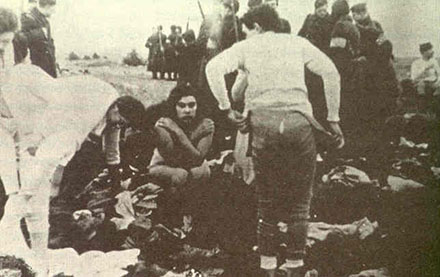
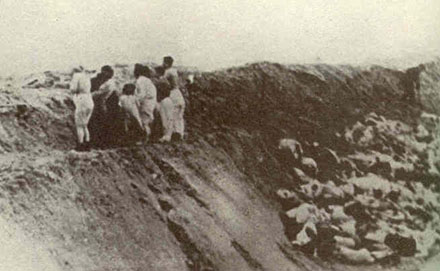
This date in 1941 commenced one of the largest such actions: over 2,700 Jews as well as 23 Communists forced over the course of two-plus days to strip on the freezing Skede dunes overlooking the Baltic and there shot by German and Latvian teams into a vast pit. It’s one of the most recognizable Holocaust atrocities because it was extensively photographed.*

As one can see from the pictures, the victims here were mostly women.


Some of the women in this photographs can be identified by name (pdf). Left to right: (1) Sorella Epstein; (2) presumably Rosa Epstein, her mother; (3) unknown; (4) Mia Epstein; (5) unknown. Alternate identification makes Mia Epstein (5) instead of (4), and (2) Pauline Goldman.

Almost all of Liepaja’s Jews perished during the war.

* Germany’s Bundesarchiv (search on Libau 1941) confirms the precise December 15 dating for these images; it also has some other photographs of atrocities in Liepaja/Libau on other occasions.

On this day..

1957: Jorge Villanueva Torres, Monstruo de Armendáriz

On this date in 1957, Jorge Villanueva Torres was shot in Lima, Peru as the notorious “Monstruo de Armendáriz”.

Except Jorge Villanueva Torres wasn’t actually the monster. His case is well-known in Peru but less so beyond, and all links in this post are to Spanish pages.

Villanueva’s hasty transmogrification began on the ninth of September 1954, when headlines announcing the discovery of a dead three-year-old child near Lima commenced a national crime hysteria. Authorities surmised that the little boy had been raped, too.

Vague eyewitness fixing on the suspect’s height and dark skin* brought many arrests of people fitting these loose criteria. Villanueva, a career petty criminal, fit that bill; when police announced him as the suspect, he became the object of his countrymen’s hatred.

Convicted in an atmosphere of prejudicial hysteria on the strength of eyewitness testimony loosely matching him to someone who might have given the victim a sweet to lure him off, Villanueva exploded with rage, even attempting to attack the judge. Naturally this only served to further implicate him as an uncontrollable beast — not as a falsely accused man pitiably near the breaking-point after two years as a nation’s scapegoat.

Villanueva asserted his innocence all the way to the fatal stake.

Those futile protestations are today widely accepted as true. There was little firm evidence against him and even the contemporary autopsy ruled against the incendiary child-rape allegation. Later forensic investigations have suggested that the poor child might simply have been the victim of a hit-and-run car accident. The mingled torments of guilt and relief in such a motorist as the matter played out must have been profound.

This case remains in present-day Peru a standing warning against occasional attempts to reintroduce the death penalty in response to the outrageous crime du jour. (Peru abolished the death penalty for all peacetime offenses in 1979.)

The Peruvian band Nosequien and Nosecuantos muses on the injustice in a single that shares its title with Villanueva — “Monstruo de Armendáriz”.

Whomever was the true “monster” — and whatever that person’s true measure of monstrosity — has never been known.

* Racism in Peru against black skin was then and remains today endemic.

On this day..

1881: Four Black Friday hangings

November 25, 1881, was the day after Thanksgiving. And that date was a true “Black Friday” on the American gallows: four distinct murderers, all African-American men, were hanged in four different cities on this date in 1881.

We’re cadging entirely from the New York Herald of Nov. 26, and all quotes (as well as the pictured headline) source to that journal.

Richard James (South Carolina)

Richard James hanged in Marion, South Carolina for the previous year’s murder of a local shopkeep, David M. Harrell.

James insisted on his innocence, and even “turned upon the preacher with indignation” at in his cell on his last day when importuned to unburden himself of his sin. He “swore by all that was holy that he knew nothing of the crime, and was ready to face his Maker with this oath on his lips.”

James, “a light colored negro about thirty two years old” who “looked capable of committing any crime” and had a bad reputation in town, had been tried with his two brothers, Benjamin and Lewis for having waylaid the Harrell on his way home from closing the store.

A mixed-race jury (nine whites, three blacks) convicted the first two but acquitted Lewis. Benjamin had already been executed some weeks previously.

Henry Johnson (South Carolina)

Shortly afternoon that same day, Henry Johnson hanged in the jail in Sumter while “the housetops and fences near the jailyard were crowded with negroes, who heightened the scene by melancholy exclamations.”

Johnson, who converted to Catholicism the week before his death, occupied his last morning writing to a sweetheart in Port Royal, S.C. (He sent her some wooden buttons to remember him by, and demanded that she never marry.)

While he went mildly, his crime was “one of the most cold-blooded and unparalleled murders ever known in South Carolina.” (Of course, newspapers say this about every crime.)

John Davis, a good and hard working colored man was going through Hope Swamp on his way to the forest, where he was employed to cut cross ties for the railroad [but] he was followed by one Henry Johnson, also colored, who shrouded himself from view by the thick undergrowth. Thus, Indian like, he thirsted for his victim’s blood, and followed David step for step with the greed of a hungry panther until they arrived at a point where the depth and loneliness of the swamp was best suited for the tragedy that was enacted. The desired spot having been reached, Johnson, without uttering a word, raised his gun and fired, shooting John Davis in the middle of the back. Davis dropped dead in his tracks instantly. Johnson then caught him by his heels and dragged him to a hollow log, in which he placed Davis and then covered the log all over with … straw and leaves.

And then Johnson went to Davis’s house, where he knew he would get a good reception since Davis’s wife fancied him.

Explaining that Davis had had to go into town on business and would not be back for a day or three, Johnson made himself “not only lord of Davis’ house, but his much beloved wife.” He tried to lay the blame on a local fellow named Orange Isaacs whom Johnson by all appearances sincerely believed to be a sorcerer.

Joseph Harris (Tennesee)

In Rogersville, Tenn., Joseph Harris hanged for slaying two men in November 1880 in a crime that aroused so much local hatred that he was stashed away in Nashville until two days prior to the execution to prevent the appearance of lynch law.

Unlike the South Carolina condemned, Harris’s hanging was fully public, and a fair concourse of onlookers braved freezing temperatures to satisfy themselves with the course of justice.

Harris had targeted the outgoing proprietor of a country farm called Marble Hall. John Brown, having sold the estate, had sent his family on to their next lodgings in Bristol while he remained at Marble Hall with a 17-year-old stable hand named Heck to sell off the remaining livestock and close up affairs.

Those affairs were closed for good on November 23, when the room that Brown and Heck occupied was discovered on fire, its inhabitants having had their brains bashed in. $500 Brown had recently pocketed from the sale of his hogs was missing.

Sang Armor (Georgia)

Sang Armor not only had the most unusual name of November 25’s grim harvest, but was distinguished as the first-ever public execution (or execution of any kind) in Taliaferro county, Georgia. Taliaferro is currently (circa 2010 census) the least populous county east of the Mississippi with a population of just 1,717.

Armor was egged on by the crowd at his gallows to give up the names of accomplices whom he had previously implied had aided him in the murder of an elderly white man, but he remained “sullenly silent on the subject and talked only on religious matters.” The scaffold was erected in Ellington meadow, on the land of his victim, Amos Ellington.

“The feeling against Armor was very strong,” concludes the report, “especially among the colored men, several of whom he tried to implicate in the crime.”

Not Squire Clark (South Carolina)

It wasn’t all doom and gloom. Squire Clark, who was supposed to hang in Lexington, S.C., was respited until December 23.

Clark, sentenced to be die in a strange case where a body was found on a railroad tracks, mutilated by passing trains, had been convicted circumstantially for having killed the fellow before dumping his remains on the tracks. Convicted, overturned on appeal, convicted again, and ultimately commuted to a penal sentence, Clark never made it into the executioners annals.

The estate of his victim later sued the railroad for negligence in having run over the remains of W.S. Hook no fewer than three times.

On this day..

1797: Figaro the Elder and Jean Louis, Charleston slaves of Dominguan exiles

On this date in 1797, two French slaves were hanged in Charleston for plotting rebellion.

This plot was the product of the liberation-minded aftermath of the Haitian Revolution … although whether the product was in the minds of the slaves, or those of the paranoid slaveowners, is still up for debate.

As the great slave revolution unfolded, many of Saint Domingue’s white planters had fled abroad. Charleston, South Carolina was a major destination, one of several Atlantic cities in the U.S. that received these refugees in quantity* — lugging along as many slaves as they could. “My Fellow-Citizens know your goodness,” said one of their number in an address to the South Carolina legislature, “and anticipate the Share you are about to take in their Calamities.” The state government accordingly granted relief money to these put-upon immigrants; the British themselves are thought to have been kicking into the relief kitties in Charleston as part of 18th century covert ops to check the spread of Jacobinism.

With the Haitian Revolution and its beneficiaries aligned (for the moment) with the French Revolution,** these French exiles fit right in with pro-British federalists to a continental reactionary backlash.

Revolutionary France’s consul in Charleston (he was U.S. ambassador by the time of the events in this post) maneuvered against that city’s planter exiles (“colonial aristocrats,” as he called them†) and eyed hemispheric emancipation, according to this book.

Yet the very flight of Saint Domingue planters also brought like a contagion the idea and experience of successful revolt in the breast of those refugees’ own chattel slaves … and in the midnight terrors of those slaves’ owners. As early as August 1793, rumor gripped Charleston that a slave revolt was in the offing. Jittery Southern states began passing laws to restrict slave imports from the West Indies who might be carriers of the virulent dream of liberty.

It was in this context that Charleston authorities discovered in 1797 “a conspiracy of several French Negroes to fire the City and to act here as they formerly done at St. Domingo.”

These several Negroes denied the plot, for a while.

Eventually, and surely encouraged by what me might today dignify “enhanced” interrogation, one of them turned state’s evidence. This “Figaro the Younger” — there were two named Figaro arrested for this same plot‡ — was the property of one Jacques Delaire, one of the Dominguan community’s more belligerent aristocratic grandees. Figaro the Younger’s evidence, though only a “partial confession” was enough to doom two of his fellows.

After the condemnation of Jean Louis, he turned to the two Figaros and said, “I do not blame the whites, though I suffer, they have done right, but it is you who have brought me to this trouble.”

(A French freedman named Mercredi hanged for the same affair a week later.)

For testifying against his mates, Figaro the Younger saved his own life and was sentenced to be transported to Suriname. En route, the pressure of his leg irons caused “a swelling about the ankles which turn’d into a sore & … a mortification of the flesh ensuing his toes rotted & one of his feet drop’d of[f] entirely.”

The southern anti-slavery cause was soon crippled, too.

Especially after the 1800 Gabriel Prosser revolt, any dalliance with emancipation, republicanism, revolution, became practically unutterable, as if to speak the words would conjure up the flames of Cap-Francais. “Beyond a reasoned fear of domestic insurrection seems to have lain a desire to banish the reality of St. Domingo,” as Winthrop Jordan put it.

But the threat and the example of Haiti long stalked the imagination of those caught in the toils of the South’s peculiar institution. And more literally than that, as Robert J. Alderson notes,

Captain Joseph Vesey … was [one] of the dispensers of [refugee relief] aid, [and] many Domingan refugees made calls on him. When the Domingan planters visited, their slaves had a chance to speak with one of Captain Vesey’s slaves, Denmark Vesey.

* For example, see Gary Nash, “Reverberations of Haiti in the American North: Black Saint Dominguans in Philadelphia” in Pennsylvania History, Vol. 65 (1998). Philadelphia was at the time still the U.S. capital.

** Said alignment between revolutionary Haiti and the mother country was, of course, tenuous and not permanent.

There’s a report in the Paris archives from this period of the French consulate’s low opinion of Charleston’s Dominguans: “tricky people, at the end of their resources that vengeance towards their country and despair may lead to anything. Among the French whom we have here, there are some very good patriots who know what the hospitality of the country demands of their gratitude, but the number is small.”

‡ The Figaro plays and some of their operatic adaptations were culturally current in the 1780s and 1790s. That includes Mozart’s Marriage of Figaro but not yet Rossini’s Barber of Seville with its definitive Figaro aria … although such would be very poor excuse not to post the latter.

On this day..

1688: Goodwife Ann Glover, Salem trial run

On this date in 1688, colonial Boston hanged its last witch … or, its first Catholic martyr.

Goodwife Ann Glover was an Irishwoman who had been among some 50,000 Catholics deported to Barbados* by Oliver Cromwell during the 1650s.

1688 finds her with a daughter, desperately poor, as housekeepers in Boston to one John Goodwin and his family.

After one of Goodwin’s daughters accused the Glovers of stealing some linen, the daughter got cussed out and — per Cotton Mather’s credulous account of the washerwoman’s devilry — “visited with strange Fits, beyond those that attend an Epilepsy or a Catalepsy, or those that they call The Diseases of Astonishment.” In fact, four Goodwin children began suffering these symptoms, and would do so for weeks on end, only abating enough for meals and a good night’s sleep. (They would finally be cured, weeks after their supernatural tormenter’s hanging, by having to fast for a couple of days.)

The family doctor diagnosed “an hellish Witchcraft.” Mather has an extensive description of their thrashings, but his contemporary, Boston merchant Robert Calef, charged in his anti-Mather tract More Wonders of the Invisible World that Mather himself did not shy from “taking home one of the children, and managing such intrigues with that child, and printing such an account of the whole … as conduced much to the kindling of those flames, that in sir William‘s time threatened the destruction of this country.”

This Glover case is Cotton Mather’s underreported debut on the witchcraft scene. With the moderating hand of his father away, the ambitious 25-year-old divine took on a starring role in the drama. He would boast of it in published material in the years following, and as Thomas Hutchinson later observed,

The printed account was published with a preface by Mr. Baxter, who says, ‘the evidence is so convincing, that he must be a very obdurate Sadducee who will not believe.’ It obtained credit sufficient, together with other preparatives, to dispose the whole country to be easily imposed upon by the more extensive and more tragical scene, which was presently after acted at Salem … these books were in New-England, and the conformity between the behavior of Goodwin’s children and most of the supposed bewitched at Salem, and the behavior of those in England, is so exact, as to leave no room to doubt the stories had been read by the New England persons themselves, or had been told to them by others who had read them. Indeed, this conformity, instead of giving suspicion, was urged in confirmation of the truth of both.

Years later, when the public turned against Mather’s appalling leading role in the Salem Witch Trials, one of the Goodwin children was among the parishioners whom Mather detailed to come to his defense. “[Mather] never gave me the least advice, neither face to face nor by way of epistles, neither directly nor indirectly,” insisted Nathaniel Goodwin, later to become the executor of his estate. “[H]e never advised me to anything concerning the law, or trial of the accused person.”**

Eventually persuaded by the children’s mysterious or staged illnesses, the town magistrates hauled Goody Glover in for questioning and set upon her poor command of the King’s English. Glover was a native speaker of Gaelic; she had lived in Boston for only a few years, and it’s likely that whatever degree of English she picked up in her indenture in Barbados was heavily creolized by that island’s enormous mid-17th century influx of African slaves for the sugar plantations.

Whatever she said sounded like it came straight from perdition to the ears of Cotton Mather.

she being sent for by the Justices, gave such a wretched Account of her self, that they saw cause to commit her unto the Gaolers Custody. Goodwin had no proof that could have done her any Hurt; but the Hag had not power to deny her interest in the Enchantment of the Children; and I when she was asked, Whether she believed there was a God? her Answer was too blasphemous and horrible for any Pen of mine to mention. An Experiment was made, Whether she could recite the Lords Prayer; and it was found, that tho clause after clause was most carefully repeated unto her, yet when she said it after them that prompted her, she could not Possibly avoid making Nonsense of it, with some ridiculous Depravations. …

It was not long before the Witch thus in the Trap, was brought upon her Tryal; at which, thro’ the Efficacy of a Charm, I suppose, used upon her, by one or some of her Cruel the Court could receive Answers from her in one but the Irish, which was her Native Language; altho she under-stood the English very well, and had accustomed her whole Family to none but that Language in her former Conversation; and therefore the Communication between the Bench and the Bar,’ was now cheefly convey’d by two honest and faithful men that were interpreters.

Just imagine how apoplectic this guy would be if he ever heard “para Espanol o prima dos.”

One can readily picture confusion and malice multiplying one upon the other as it passes not only between two different tongues but also between two different cosmologies. We don’t know very much about Ann Glover; even her name is a slave name. But she was Catholic, and so had a religious world of saints and symbols that her persecutors could readily equate with demons. (Querying her in the condemned cell at one point, Mather is told that “saints” forbid her cooperating with his Protestant exhortations, but he understands it as “spirits” — apparently the Gaelic word is one and the same — and he presses her for the identities of these infernal agents.) She probably did not remotely share her prim persecutors’ regard for temperance and submission. She was of course poor and uneducated, ready prey for the entrapment of a well-schooled prig who could scarcely conceive the lives she had already led in Ireland and Barbados. If one likes, one might take her as the luckless victim of a conservative clergy’s backlash against the slow fade of its authority.

Glover’s broken speech and wrong religion surely made it easy to “other” her. Even so, at least in Mather’s construction, Goodwife Glover’s condemnation reads as if it proceeded with at least the partial participation of the accused.

Several rag dolls were recovered from Glover’s home, and Mather says that Glover agreed that these were “her way to torment the Objects of her malice … by wetting of her Finger with her Spittle, and streaking of those little Images.” Even if this matter is just as her foe depicts it, Glover wouldn’t exactly by the only person in history to be irritated by her employer, nor to satisfy her vengeance on some fetish of an untouchable enemy.

Glover might herself have believed in the folk magic whose practice was only slowly ebbing away at this time; Mather even says that Glover obligingly healed a boy whom she had bewitched when his mother testified at her trial.

Or she might have defiantly embraced the sorcery accusations against her as a last rebuke to the Puritans who had torn her from hearth and home all those years before and now despised her as an idolatrous papist. Her contemporary defender Robert Calef just thought she was a bit out of her gourd; “the generality of her answers were nonsense, and her behaviour like that of one distracted,” giving “crazy answers to some ensaring questions.” The court actually explored this possibility as well by empaneling a group of medical men to explore Glover’s competency. They found her compos mentis.

It’s too bad that we don’t have Goodwife Glover’s own account of herself. Instead we read her through axe-grinding interlocutors.

Mather wearied his victim with demands to convert, along with an interpreter since “she entertained me [in her cell] with nothing but Irish.” (He didn’t mean whiskey.) It was only “against her will” that Mather prayed with her — or maybe more like “at her” — although he also claimed to have extracted an admission that other witches were operating who would continue to afflict the Goodwin children.

She was drawn on this date to the gallows at Boston Neck — coincidentally almost the very spot where Boston’s Catholic Cathedral of the Holy Cross stands today.

There’s a precious alleged† first-person account of her execution:

There was a great concourse of people to see if the Papist would relent … Her one cat was there, fearsome to see. They would to destroy the cat, but Mr. Calef would not [permit the cat to be killed]. Before her execution she was bold and impudent, making to forgive her accusers and those who put her off … She predicted that her death would not relieve the children, saying it was not she afflicted them.

November 16 is now, by a 1988 tricentennial resolution of Boston’s considerably more Catholic-friendly city council, Goody Glover Day in that city. What better spot to celebrate than at Goody Glover’s Irish pub?

* Such deportees were said to be “Barbadosed”.

** This is not the only link between those Massachusetts witch-hunts; Rebecca Nurse, one of the women hanged at Salem, might have visited Ann Glover in jail.

† So far as I have been able to determine this widely-reproduced quote sources entirely to a 1905 Journal of the American Irish Historical Society piece. This was itself reproduced from a strongly partisan article titled “A Forgotten Heroine” and published in a devotional Catholic magazine, The Ave Maria. It was written by Harold Dijon, an instructor at a Baltimore Catholic school, without primary footnotes — only a general citation that it has “been gleaned from Cotton Mather, Upham, Drake, Moore, Owens, Calef, Cartrie, and papers of the Massachusetts Historical Society.” I have not been able to locate the document Dijon quotes here.

On this day..