1951: King Abdullah’s assassins

AMMAN, Jordan, Sept. 4 — Four men sentenced to death here last week for complicity in the assassination of King Abdullah in July were hanged today in Amman prison. Regent Emire Naif had confirmed the sentences of the special tribunal.

Those put to death were Musa Abdulla el-Husseini, Abed Okkeh, Abdulkadir Farhat and Zakariya Okkeh.

Col. Abdulla el-Tell, former governor of Jerusalem, and Musa Ayyubi who were sentenced to death in absentia are reported to be living in Egypt.

New York Times, September 5, 1951*

The men hanged this day were among the authors of “the most dastardly crime Jordan ever witnessed”: the July 20, 1951 assassination of independent Jordan’s first king.

The cagey Hashemite monarch Abdullah I had been emir of Transjordan, an artificial British mandate jigsaw-piece that Abdullah got by virtue of cutting a deal with Winston Churchill.

This sinecure came with the significant drawback of dependency on London’s reach and interests, and Abdullah’s great achievement was to set Transjordan-cum-Jordan** on firm enough footing to survive the postwar sunset of the British Empire.

Abdullah faced an early test of Jordan’s chops shortly after his country’s 1946 independence when the Arab-Israeli War erupted. For Abdullah, this was a state-building opportunity; indeed, his government had for years backed Palestinian-partition plans that other Arab states had opposed — with the expectation that Jordan could help itself to the eastern part of that partition.

Abdullah did just that in 1948, invading and annexing the Jordan River’s West Bank all the way to East Jerusalem … while willingly acceding to (some have said actively colluding in) the creation of a partitioned Jewish state that was theoretically anathema to Jordan’s allies.

Jordanian territorial aggrandizement, however, brought with it the West Bank’s Palestinian population, severely aggrieved at having seen their aspirations to statehood cynically sacrificed by Abdullah. They got, into the bargain, Jordanian citizenship and a severe suppression of independence agitation.

So when Abdullah came to visit Jerusalem’s Al-Aqsa Mosque, a Palestinian gunman murdered him.

While the assassin himself was immediately shot dead by the king’s bodyguards, ten allegedly in on the plot were very hastily tried in mid-August … eight in the Amman courtroom, and two overseas in Egypt tried in absentia. Dr. Musa Abdullah el Husseini, Abdel Kadir Farahat, and the brothers Abed and Zakariya Okka were condemned to die, along with the absconded Abdulla el Tel and Musa Ahmed el Ayoubi. (The latter two would never be executed.)

According to the London Times‘ Aug. 29, 1951 wrap of the legal proceedings,

The events leading up to the murder, as they were described during the hearing, began with two meetings in Egypt, in September and October [1950], between el Tel and el Ayoubi, who decided then that the king should die. El Tel then met el Husseini i Cairo, and henceforth directed and financed the plot with el Ayoubi as his chief lieutenant. Abed Okka acted as an intermediary, and Zachariya Okka and Farahat were later drawn into the plot, the latter ultimately providing the murderer with a revolver.

The remaining four men who faced trial — Dr. Daud el Husseini, Franciscan Father Ibrahim Ayyad, Tawfik el Husseini, and Kamil Kaluti — were acquitted.

This event, which might have been feared to prefigure a more terrible disruption within Jordan, within Palestine, even in the entire Middle East, did nothing of the sort. Power transitioned to the long reign of Abdullah’s grandson King Hussein, who was actually present at his grandfather’s assassination. (And might have shared his fate, save for a medal the teenaged Hussein had pinned to his breast that deflected a bullet.)

As Mary Cristina Wilson writes,

There was an element of cover-up in the conduct of the trial. The grievances and frustrations of the accused were not broached … The idea of an independent Palestine was, for the moment, dead. Abdullah’s assassination was a terrible revenge wreaked for the death of that idea, but it signified retribution for events that were already history, not the beginning of the new order … Though not without parallels in the future, it was without echoes.

Jordan would govern the West Bank, albeit absent virtually any internationally-recognized legitimacy there, until Israel attacked and occupied the territory in the Six-Day War in 1967. The legacy of this event will be familiar to the reader.

In 1988, Jordan officially resigned its own claims on the West Bank to the Palestine Liberation Organization, “the sole legitimate representative of the Palestinian people.”

* Any number of online sites say this hanging occurred on September 6. Given the existence of September 5 papers reporting the execution, I think it’s safe to rule those erroneous. Wikipedia sources this version to James Lunt’s Hussein of Jordan.

** “Transjordan” officially became simply “Jordan” in 1949. Events in this post span either side of that re-branding, so for the sake of clarity, we’re just going to use “Jordan” throughout.

On this day..

1942: Henryk Landsberg, Lvov Judenrat

[Adolf Eichmann] did not expect the Jews to share the general enthusiasm over their destruction, but he did expect more than compliance, he expected — and received, to a truly extraordinary degree — their cooperation. This was “of course the very cornerstone” of everything he did … Without Jewish help in administrative and police work — the final rounding up of Jews in Berlin was, as I have mentioned, done entirely by Jewish police — there would have been either complete chaos or an impossibly severe drain on German manpower …

To a Jew this role of the Jewish leaders in the destruction of their own people is undoubtedly the darkest chapter of the whole dark story.

-Hannah Arendt in Eichmann in Jerusalem

Among the many horrors of the Holocaust were the Judenräte, Jewish administrative councils set up under the aegis of Nazi Germany’s occupation of Eastern Europe.

Typically recruited from local elites and granted special privileges by the Germans, these collaborators managed the day-to-day operations of the ghettos, up to and including the horrible sharp end of Final Solution: confiscating Jewish property for the Germans, registering and organizing Jews destined for slave labor or extermination, and even managing deportations with the desperate hope that willingly engaging a sacrifice they could never prevent might enable them to save some others. Once all the deportations were done, the Judenrat itself would be executed or deported: Faust had nothing on this bargain.

Chaim Rumkowski, perhaps the most (in)famous Judenrat administrator, issued posterity the definitive howl of a collaborator’s agony when he was forced by the imminent Lodz Ghetto children’s action to implore Lodz’s families to peaceably surrender their young people to certain death: “I never imagined I would be forced to deliver this sacrifice to the altar with my own hands. In my old age, I must stretch out my hands and beg. Brothers and sisters: Hand them over to me! Fathers and mothers: Give me your children!”

Rumkowski, a deeply checkered figure who fended off liquidation of his ghetto until the very late date of 1944, well knew that Judenrat personnel were entirely disposable. After all, he delivered this plaintive speech on September 4, 1942 — just three days after his counterpart in the Lvov Ghetto had been publicly strung up on a balcony.


Six Jews (including Henryk Landsberg) hanged in the Lvov Ghetto, September 1, 1942 (via). The US Holocaust Memorial Museum also identifies this clearly distinct execution as a picture of Lvov Jewish Council members being hanged in September 1942.

The city of Lwow/Lvov (or to use its present-day Ukrainian spelling, Lviv) had had a centuries-old Jewish population when the Soviet Union seized it from Poland in consequence of the Molotov-Ribbentrop pact. That population almost immediately doubled as Jewish refugees fleeing the half of Poland that Germany got in the deal poured into the city.

Practically on the frontier of the German/Soviet border, Lvov was captured in the opening days of Germany’s June 1941 surprise invasion of the USSR. In November-December 1941, the 100,000-plus Jews* still surviving in Lvov (after several post-conquest massacres) were crammed cheek to jowl into the new Lvov Ghetto. There they endured the usual litany of privations for World War II ghettos: starvation rations, routine humiliation, periodic murders. forced labor at the nearby Janowska concentration camp.

The ghetto’s first chairman, Dr. Josef Parnas, didn’t live to see 1942 before he was killed in prison for non-cooperation. Dr. Adolf Rotfeld followed him, and died of “natural” causes in office a few months later.

Dr. Henryk Landsberg, a lawyer, succeeded Rotfeld. He had been a respected community figure before the war, but was disposable to the Nazis as his predecessors; during a large-scale Aktion to cull the camp and further reduce its boundaries, a Jewish butcher resisting the SS killed one of his persecutors. Landsberg and a number of the Jewish policemen employed by the Judenrat were summarily put to death.

“I have gladly accepted the nomination,” Landsberg’s successor remarked. “Maybe they will shoot me soon.” He was indeed shot (or perhaps committed suicide to avoid that fate) in the first week of January 1943. (All this from Judenrat: The Jewish Councils in Eastern Europe Under Nazi Occupation)

The Lvov Ghetto was liquidated June 1, 1943; a bare handful of its former inmates escaped into the sewers or managed to avoid death in the camps before the war ended. After the Red Army took back the city, a 1945 survey of the Jewish Provisional Committee in Lvov tallied just 823 Jews. Today, there are all of 5,000.

* Among the Lvov Ghetto residents was Simon Wiesenthal.

On this day..

1535: Guillaume Husson, colporteur

On this date in 1535, the Protestant Guillaume Husson was burned for heresy.

The year before, Protestants had outraged the capital with a placarding campaign; maybe inspired by or in league with them, Husson turned up in early 1535 in Rouen and proceeded to flood the place with heretical tracts. Husson was identified by his hotelier and turned over to authorities before he could proceed to wreak his freaky doctrines on the next city.

The spectacle of public execution at this time followed a ceremonial script, although it was one that Protestants like Husson were going to rewrite with their behavior.

In an hours-long process, the condemned was first forced to perform amende honorable before a church, begging pardon of God with a rope about his neck and a heavy candle in his hands. For some offenses, this ritual penance could comprise the entirety of the punishment; for an execution, it was just the first act.

Its effect depended, of course, on the compliance of offenders who could usually be counted on to play the only part that held out hope of social redemption and everlasting salvation.

But as a Protestant, Husson wasn’t in a very compliant mood: he owed no plea to God for distributing correct religion, and he certainly rejected the Pope’s right to demand it of him. So Husson refused to perform the amende honorable, and even refused to hold the candle.

Catholic authorities would face in the years ahead the novel challenge of stage-managing many executions of reformers, ready to welcome execution, unreconciled with the Church, as their holy martyrdom. They would need strategies to deal with these obstinates. On Aug. 30, 1535, that strategy was “more violence”: for besmirching the ceremony, Husson had his tongue punitively torn from his mouth.* (Mutilation at this point could also sometimes be a formal part of the sentence.)

Following a long procession through the city to the place of execution, Husson was said (by his fellow Protestant propagandist Jean Crespin) to have died with such great firmness — thrusting his own head into the leaping flames to dramatize his embrace of the stake, and inspiring many onlookers (per Crespin) “to want to know more closely the true God of Israel.”

* David Nicholls, “The Theatre of Martyrdom in the French Reformation,” Past & Present, no. 121 (Nov. 1988)

On this day..

2007: John Joe “Ash” Amador

On this date in 2007, John Joe “Ash” Amador died of lethal injection in Texas.

Amador, age 18, and a 16-year-old cousin, hailed a taxi in San Antonio in the dark predawn hours of January 4, 1994, directed it on a long drive to a dark street in Poteet, Texas, and abruptly shot the cabbie in the head with a .25 caliber handgun. Amador’s cousin shot the cab driver’s ride-along companion.

It’s possible to get unusually up close and personal with Amador — both the man himself, and the gears of the death penalty process at the anticlimax of 13 long years.

To begin with, journalist Dave Maass interviewed Ash Amador a month before the latter’s execution, and posted 52 minutes of audio on Archive.org.

And in a more outre vein, a team of British filmmakers crafted a surreal and digressive but frequently touching documentary of Amador’s end, most especially through the eyes of the condemned man’s wife and family. As Maass put it, they’ve “given the man one wicked afterlife.”

If that teaser intrigues, the entire documentary is freely available online here — complete with an amazing scene of a death mask being cast from the freshly-executed, just-body-bagged Ash.

On this day..

1765: Three Burglarious Johns

(Thanks to Meaghan Good of the Charley Project for the guest post. -ed.)

On this date in 1765, John Fagan, John Grimes and John Johnson alias Cochran were hanged in Burlington County, New Jersey in a rare triple execution.

The three Johns were convicted of home invasion robbery.


Wrong Three Johns.

On July 18 in Northampton Township, the three men, with their faces painted, burst into the house of Joseph Burr. By “threats of violence” they convinced Burr’s wife to give up her keys to the locked cabinets and made off with the following:

  • 1 silver sauceboat
  • 8 silver tablespoons
  • 9 silver teaspoons
  • A sum of money
  • A considerable quantity of shirts, aprons, caps and handkerchiefs
  • A great parcel of “wearing apparel made in the manner of people called Quakers”

They also took three valuable horses from Burr’s stable and rode off on them.

Burr and his wife told the authorities they knew the robbers were Irish because “they all had the brogue upon their tongues,” and it turned out three Irish laborers had gone missing from a farm near Mount Holly.

The thieves’ trail was discovered and a posse caught them red-handed, as it were, riding the stolen horses and carrying the stolen goods.

Justice acted quickly and Fagan, Grimes and Johnson were executed a mere six weeks after their crime. The Burlington County Treasury compensated the jailer his expenses in feeding the three men for 39 days.

According to Burlington County this Gallows Hill “stood not far from the Burlington-Mt. Holly Road (Rte. 541)” — perhaps the present-day Laurel Hill Cemetery.

On this day..

1897: Harvey DeBerry, raving like a madman

(Thanks to Meaghan Good of the Charley Project for the guest post. -ed.)

On this date in 1897, a 23-year-old black man named Harvey DeBerry was hanged for sexually assaulting his employer’s daughter.

His offense, this sexual assault, was a new one under the Tennessee statutes, different from the crimes of rape and attempted rape, and DeBerry was the first person in Shelby County to be convicted of it.

DeBerry was a live-in laborer on the Eigiman farm in Frayser Station, Tennessee, and his wife was the farm’s cook. Mr. and Mrs. Eigiman had three children aged seven, five and two. It was the oldest child, Elenora, that DeBerry assaulted on October 8, 1896.

At the time of the crime, Mr. Eigiman was in the hospital in Memphis recuperating from a fractured skull and a broken leg. Mrs. Eigiman went to see him that day, leaving her children in the care of the DeBerrys. She left Elenora in bed in her nightgown, because the little girl said she wasn’t feeling well.

When Mrs. Eigiman returned at the end of the day, Elenora was still in bed, crying and acting as if she was in pain. She refused to tell her mother what was wrong, and cried and moaned all night.

The next morning, her mother stripped the bed and found blood on the sheets. Mrs. Eigiman confronted her daughter, and Elenora said Harvey DeBerry had come into her room, lain on top of her and hurt her. That same day, a doctor was called to examine the victim. His findings, according to court documents, were as follows:

He found the child highly excited, nervous, and trembling; that the person of the child was swollen, and very tender to the touch; that the parts showed acute inflammation and swelling; that he found a purulent discharge, and a slight rupture of the hymen; that penetration had been partial, but not complete; that the acute inflammation, purulent discharge, and swelling indicated that the injury was recent. During the course of the examination the physician asked the child who hurt her, and she replied that ‘Harvey hurt her.’ The mother was not present when the child made this statement.

Harvey DeBerry fled when Mrs. Eigiman and Elenora confronted him with their accusations.

He turned up soon enough, though, living in Arkansas under the alias Frank Berry, and was extradited to Tennessee for trial. He was represented by a father-and-son team of black lawyers and offered two witnesses in his defense: a washerwoman who said there was no blood on Elenora’s clothing, and someone who said he and DeBerry were harvesting corn together at the time of the crime.

However, the prosecution was able to prove that DeBerry’s alibi witness was mistaken about the date, and the washerwoman had laundered Elenora’ clothing a full month before she was attacked.

Elenora testified about her experience at the trial, saying the reason she hadn’t immediately told her mother about the attack was that Harvey had threatened to kill her if she breathed a word about what he had done. The defense tried to convince the court that another man had abused the little girl, but Elenora denied this on the stand.

A jury acquitted DeBerry of two counts of rape, but convicted him of “assault and battery upon a female under ten years of age, with intent to unlawfully and carnally know her.” What exactly constituted “rape” when there was scant to no penetration was a grey area in Anglo jurisprudence, but with the sexual assault law it was six of one and a half-dozen of the other: both rape and sexual assault were capital offenses.

On the scaffold DeBerry was sobbing and appeared terrified.

A newspaper said later that his last words were “the ravings of a madman. There was no connection of coherency in what he said.”

When he stood on the trap and the sheriff pulled the lever, nothing happened. After an agonizing moment, a deputy stepped forward and pulled it a second time. This time the trap worked and DeBerry fell, cleanly breaking his neck. He was pronounced dead within twelve minutes.

As to whether he confessed before he died, the sheriff and the minister refused to say.


For a bit of period context, the same date that DeBerry hung lawfully saw the summary lynching of an unknown tramp in Manheim, Illinois, outside Chicago. That man attempted to outrage a farmer’s wife but was fought off by the “muscular German woman,” then led a desperate chase through woods and cornfields for half an hour until one of the pursuing posse finally plunked him with a gunshot.

The wounded assailant was searched for identity papers (none turned up), then instantly strung up on the nearest sturdy tree. (Source: The News and Observer (Raleigh, NC), Aug. 20, 1897)

On this day..

1941: 534 Lithuanian Jewish intellectuals

(Thanks to Meaghan Good of the Charley Project for the guest post. -ed.)

On this date in 1941, 534 Jewish intellectuals were lured out of the Nazi ghetto in the city of Kovno, Lithuania (also known as Kaunas), taken to Ninth Fort, and shot to death.

Over 5,000 Jews would die there during the Nazi occupation.

The Nazis had captured these people using a very clever ruse: on August 14, they had advertised for 500 Jews to help sort out the archives at City Hall, which were in disarray due to the chaos that followed the Germans’ conquering the city in June.

The workers had to be intelligent, educated types and fluent in German and Russian. They would be treated well and given three solid meals a day, in order that they could do the work properly and make no mistakes.

Most of the other jobs available for Jews at that moment involved manual labor under brutal conditions, on starvation-level rations.

More than the requested 500 showed up. The Nazis happily took them all.

Vilius “Vulik” Mishelski (later anglicized to William Mishell), who was 22 and had studied engineering in Vytautas Magnus University [Lithuanian link], was nearly victim no. 535. His mother told him about the job offer, because it upset her when he home from working at the airfield, “my clothes torn, my face covered with dust and sweat, my fingers bleeding, and I myself so exhausted I could hardly speak.” The archives job seemed like a gift from heaven to her.

Vulik wasn’t so sure.

Why, he asked, had the archives not been sorted out sooner? After all, the Germans had conquered Kovno a full two months earlier.

And why not get Lithuanians to do the job? It certainly wasn’t necessary to employ Jews.

He debated with himself for the next four days, then finally decided to go. Many of his friends were going, he wrote later on, and “this put me at ease. All of them could not be crazy.”

When he actually arrived at the gate, however, what he saw made him profoundly uneasy. The size of the guard was unusually large, and he witnessed Jewish police and Lithuanian partisans mistreating and beating people. Because it was taking long for the quota of 500 people to arrive, the Lithuanians started dragging people from their homes by force.

This struck me as odd. This was supposed to be a job where we were to be treated in a civilized manner; was this the treatment awaiting us? Oh, no, I would not be caught in this mess! Without hesitation, I turned around and rushed back home.

My mother was astounded. “What happened, why are you back?” she asked.

“Don’t ask questions,” I said, “move the cabinet, I’m going into hiding.”

Vulik was right not to trust the Nazis’ promises. He stayed in his hideout, a little cubbyhole behind the kitchen cabinet, all day.

The chosen 534 didn’t return that night, or the next night either, and no one believed the assurances that the work was taking longer than they thought, and they had spent the night at City Hall. Before long, the truth leaked out.

That same day, the men had been lead away in several smaller groups to an area containing deeply excavated holes in the ground. Then the Lithuanian guard, known as the Third Operational Group, had shot them all. Several men who tried to escape were killed on the run. Almost the entire intelligentsia of Jewish Kovno had thus been liquidated in one mass execution.

Mishelski stayed in the Kovno Ghetto until 1944, when he was sent to Dachau. He survived the war: 95% of the Lithuanian Jews, including most of his family, did not.

Mishelski moved to America, changed his name to William Mishell, got a master’s degree in engineering from New York University, and settled in Chicago. Following his retirement in the 1980s, he wrote a memoir titled Kaddish for Kovno: Life and Death in a Lithuanian Ghetto, 1941 – 1945. Mishelski died in 1994, aged 75.

On this day..

1786: Tom, “faithful, industrious, healthy slave”

(Thanks to Meaghan Good of the Charley Project for the guest post. -ed.)

On August 9, 1786, in the state of Franklin (in what is now eastern Tennessee), a black slave named Tom was hanged for murder.

Tom had poisoned John Fuller Lain, a white man. The circumstances of the murder and Tom’s motive for it have been lost to history; all we know is that Lain was not his owner. Tom’s owner, William Evans, actually hired counsel to defend him, but the court refused to hear it.

Tom was imprisoned in July of that year, tried and convicted on August 8 and put to death the next day.

Aptly for a man of Franklin, Evans was concerned about the Benjamins. He filed a lawsuit against the sheriff for wrongful destruction of his personal property, but this was dismissed. Doggedly, on May 2, 1799 — nearly thirteen years after Tom’s death — Evans petitioned the General Assembly asking to be reimbursed for the value of the dead man, whom he described as “faithful, industrious, healthy slave … in the prime of life.”

Edwards reckoned Tom was worth £100. A hundred people signed the petition, but the General Assembly — by now the Tennessee General Assembly, since “Franklin” had failed as an independent entity — refused to cough up the funds.

On this day..

1899: Three in the Klondike Gold Rush

On this date in 1899, the gallows of gold rush boom down Dawson City, Yukon strained for three murderers.

The 1896 gold strike in the Klondike triggered a huge rush of prospectors warming sub-Arctic climes with visions of sudden wealth. “When the world rang with the tale of Arctic gold, and the lure of the North gripped the heartstrings of men,” as put by that lure’s great muse Jack London, who himself had already come and gone from the Dawson City by this time, and struck his own variety of fortune in the process.

Miners pouring into the Yukon did not, of course, enter virgin territory. Native peoples had occupied it for thousands of years.

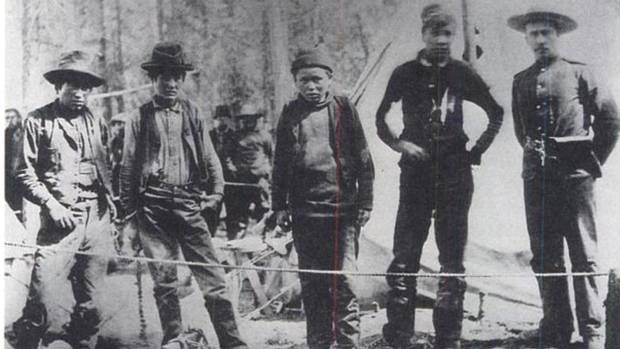
In May 1898, two prospectors, Christian Fox and William Meehan, camped near the mouth of McClintock Creek were only mildly uneasy about the arrival of the Nantucks, Tagish brothers who set up an adjacent camp. Relations were amicable for a while, but when returning one afternoon from the day’s work the prospectors were suddenly fired upon from ambush by their neighbors.

Meehan was slain in the fusillade. The injured Christian Fox managed to float away, get to land, and reach a miners’ settlement. He described the attack thus:

I was lying on the sacks against the side of the boat … and I saw Joe standing with his gun like this … and all the boys went into the brush, and I says to myself “Now they have shot us for our outfit, and are hurrying down to the next bend in the river to catch the boat … My only show is to get to the opposite side of the river and try to make for a white habitation” … I took the paddle in my hand and tried to paddle the boat but I was too weak, so I … used it as a pry … The boat ran up to a nice little level place where it was grassy and as I stepped out I stepped over the leg of my partner as he was stretched out over the boat with his head back and his mouth open and I saw that he was dead, and I said “Good by Billy old boy, I can do nothing for you here.”

By Fox’s report, the four Nantucks were soon taken into custody.


The four Nantuck brothers, shackled after arrest.

The trial unfolded in a court at the territorial capital of Dawson City. A compelling chapter in Strange Things Done: Murder in Yukon History does wonderful work with the cultural disconnections, including a two-page exchange between judge and interpreter (and, off-camera, Frank Nantuck) in which the court struggles to get the accused sworn “so help me God” since Frank’s cosmology has no idea of an afterlife. “He says, when he is dead he is dead — that is all I can get out of him,” the helpless middleman reports.

Q Has he any knowledge of God at all or any idea about a future state of rewards and punishments?

A No sir.

Q Or any clear belief in religion of any kind?

A No sir.

Q Will you say to him that we want him to tell us the truth and not to tell us anything that is not the truth; that he may be punished if he tells us anything that is not the truth; that we are going to ask him some questions and that he must tell us just the truth; ask him if he will agree to do that.

The outcome of the trial will not surprise and there was no question but that the Nantucks had done the shooting. What the Dawson court only barely noted was that brothers had been detailed to avenge two Tagish deaths. An old woman had previously been given or found some “baking powder” and proceeded to make bread with it: in fact, it was arsenic, which was used in mining. Here again is the cultural dislocation; the Nantucks living next to Fox and Meehan were trying to feel out whether those two prospectors were of the tribe that had provided this poison, and of equivalent social rank to the two men who died eating the arsenic-bread. Basically, neither side in this subarctic tragedy had any concept of what the other was on about.

There’s a play about this case, Justice. Peruse the play’s pdf companion study guide on the real historical case here.

In the end, all four Nantucks were condemned to die; Frank was probably still a minor, and he had cooperated with the investigation, so his sentence was commuted to life imprisonment … which did not turn out to be very long at all, since Frank and his condemned brother Joe both died in jail of tuberculosis during the 1898-99 winter.

Dawson Nantuck and Jim Nantuck remained to hang.

Momentarily sensational, the case was long forgotten among whites; it has, however, remained in the oral tradition of Yukon First Peoples. Both communities, however, saw the case brought to the fore when excavations accidentally turned up their remains — along with those of two other hanged men.

One of the other two was the third man to hang this date, a fellow by the name of Ed Henderson. Henderson was an American prospector whose fate might be a bit less instructive for posterity. He suffered from a horrible bladder infection that caused him to pass bloody water every 15 or 20 minutes. “The tortures of the damned,” he described it to court. Wincing yet?

The fact that Henderson suffered from it meant his two prospector-mates suffered from it as well — call it purgatory-level suffering; a member of their party had to relieve himself constantly and thrashed about in his sleeping bag all night for the agony it caused him.

Their empathy for his situation was overturned along with Ed Henderson’s inside-the-tent piss-bowl one night. The drenched and vengeful Tomberg Peterson started an immediate brawl, but Henderson’s leaky plumbing didn’t impair his ability to shoot Peterson dead. Henderson himself reported the incident when the prospectors reached their destination, possibly thinking that no jury would convict him.

The trio comprises the first men hanged by the Yukon Territory, which was only separated from the Northwest Territory in 1898. In fact, there was a bizarre procedural deficiency for the Nantucks (but not for Henderson): they were condemned by the court of the wrong, former territory since word of the territories’ separation had not reached Dawson City at the time of the trial. Nobody saw fit to remedy this blunder, however.

On this day..

1949: Jacob Bokai, the first Israeli spy executed

On this day in 1949, Jordan hanged Jacob Bokai. The Syrian Jew was the first Israeli intelligence agent put to death in service of the infant state. (At least, the first that’s been publicly acknowledged.)

The flight of Palestinians displaced by the Arab-Israeli War gave Israel a convenient means to insert its agents into its neighboring countries: just disguise them as refugees.

Posing as a Palestinian named Najib Ibrahim Hamuda, Bokai’s mission to infiltrate Jordan started at a Palestinian refugee camp in Jaffa, where he was abused by the guards to establish his credentials. Those beatings went for naught, however, as Bokai never made it past the checkpoint: he was arrested immediately upon passing the Mandelbaum Gate into Jordan on 4 May 1949. Since he refused to cop to his mission or his Jewish identity, he was given a Muslim burial after hanging for espionage.

That charge was indeed well-founded: Bokai is now openly honored at a memorial to Israeli agents opened in 1985.

According to the story related by a former Mossad chief who gave a tour of this place to Tom Friedman back when the latter was the Times‘ Middle East scribe and not its leading nutter columnist — just mind the source is what I’m saying here — the doomed “Mr. Hamuda” still managed to get a message back to his Israeli handlers reassuring them that the enhanced interrogation he enjoyed in Jordan prior to execution had not compromised whatever operations he was privy to: “I did not commit treason.”

On this day..