1578: Thee Bruges Minnenbroder

During the Dutch Revolt — a proto-nationalist conflict pitting the Low Countries against the Habsburg Empire, overlaid with a religious conflict pitting Calvinist against Catholic — the Low Countries principals came to an expedient arrangement to lay off fighting with one another in order to concentrate on controlling their respective internal revolts.

As we’ve previously discussed, this truce helped set up now-unmolested local religious majorities to do some internal purging.

Whereas Calvinist Ghent went after some Catholic monks on accusations of homosexuality, Catholic Bruges (today in Belgium) … went after some not-Catholic-enough monks on accusations of homosexuality.

The results, as described in Same-Sex Desire in the English Renaissance: A Sourcebook of Texts, 1470-1650, were depressingly similar.

In [illustrator Franz] Hogenberg‘s Scenes an engraving dated May 18, 1578, shows a lengthy procession of monks being marched out of a monastery in Bruges under armed guard. The title and verses explain that two Franciscans of Calvinist leanings were whipped and then interrogated (probably on account of their Protestantism). But they revealed that many in their order were tained by sodomy (Sodomi). The other monks admitted this (under torture?), and “they were all taken prisoners and led away to the gate for their godlessness.” Presumably depicting a result of this … [is] Execution for Sodomitical Godlessness in the City of Bruges … Three monks are about to be burned in a public square while two are being beaten. Underneath, the verses state, “in well-known Bruges in Flanders three Franciscans (Minnenbroder) have been burned. Also two others were well beaten with switches and two had to be banished. For they were young and inexperienced and had been seduced by the old ones, so that they unjustly practiced sodomy (unzuchtt) upon their bodies.” Though the circumstances of the monks’ trial are as yet unclear, such sentences were carried out by secular authorities. Minnenbroder (Franciscans) may be a satiric pun on the word minne (which had come to mean debauchery), suggesting “brothers in lust” as opposed to brotherly love. Hogenberg connects sodomy with “godlessness,” as was common.

… The investigations, convictions, and punitive displays in these monastic cases [in Bruges and in Ghent] had special topicality for inclusion because they not only afforded titillations of sexual scandal, censure, and public punishment, but also added alleged religious transgression and appealed to Protestant-Catholic rivalries of the time. Although Hogenberg’s sodomites are ecclesiastics, his engravings indicate how these public spectacles were managed, while also providing us one contemporary view of the attitudes attendant crowds displayed.

Detail view (click for the full images) of Hogenberg prints from this British Museum collection. Also see this slightly different version of the arrest print.

On this day..

Feast Day of St. James the Greater

It’s a big day today in the Galician city of Santiago de Compostela, because the twenty-fifth of July is the feast of its patron and namesake* St. James the Great.

One of the original Apostles (literally, he and his brother John are the first two whom Jesus calls in the Gospels), James also had the distinction of apparently being the first Apostle to die for Christ.** His execution at the hands of Herod Agrippa† is reported in Acts 12:2;‡ it’s the only apostolic execution in the New Testament.

This, of course, occurred on the southeastern fringe of the Mediterranean, so it’s a wonder that James’s bones came to repose at a Spanish city literally situated on Finisterre, the far western edge of the world as far as Europeans saw it. The Lord works in mysterious ways.

It’s certainly plausible — though impossible to substantiate — that James evangelized in Spain prior to his execution. The whole Mediterranean was a Roman lake. More towards the outlandish is the patriotic story (pdf) that James’s relics were miraculously discovered there in 813 at the moment when Muslim expansion into Iberia gave the hard-pressed Christian kingdoms the greatest possible need for a morale boost.§

James became for those souls Saint James Matamoros, Moor-slayer, and started turning the tide of fictional battles and blessing his own very real chivalric order.


Saint James gets his Moor-slaying on.

“A knight of Christ’s squadrons,” Cervantes wrote. “St. James the moorslayer, one of the most valiant saints and knights the world ever had, and that now the heavens have … this great knight with the vermilion cross has been given by God to Spain for its patron and protection.”

James’s martial prowess is entirely posthumous: when the Son of God recruits him, he’s a humble piscator at labor mending his nets (there are some less-bellicose present-day churches going under the name “Saint James the Fisherman”). Gibbon could not but marvel at the “stupendous metamorphosis [that] was performed in the ninth century, when from a peaceful fisherman of the Lake of Gennesareth, the apostle James was transformed into a valorous knight, who charged at the head of Spanish chivalry in battles against the Moors. The gravest historians have celebrated his exploits; the miraculous shrine of Compostella displayed his power; and the sword of a military order, assisted by the terrors of the inquisition, was sufficient to remove every objection of profane criticism.”

But mythmaking exercises a historicity all its own, and the James legends offered a rallying-point for Spain’s Christians. He stands to this day the patron of Spain as well as a number of places colonized by Spain.

Pilgrims have ever since that stupendous metamorphosis of the 9th century made the journey to the apostle’s purported resting-place; this Way of St. James, actually comprising several different possible routes covering hundreds of kilometers on foot, has in recent years emerged as a major tourist draw. The Way terminates, of course, at Santiago de Compostela and the enormous cathedral there where repose James’s relics.

Saint James’s Day, 25 July, is its celebratory culmination.

James so overawes July 25 on the liturgical calendar that it’s a mere footnote to add that this same day also pays homage to Saint Christopher, a historically dubious Christian martyr from the third or early fourth century Roman Empire.

Christopher is rather nifty, because he’s sometimes depicted in iconography as cynocephalic — that is, having the head of a dog. At least the rest of him is human, unlike Saint Guinefort the Greyhound. (No lie. It’s a doggie saint, albeit of the distinctly unofficial variety. To stamp out folk veneration, an incensed preacherhad the dead dog disinterred, and the sacred wood [where it received offerings] cut down and burnt, along with the remains of the dog.”)

* The name “Santiago” derives from our saint’s name in Latin, Sanctu Iacobu. This is also the source, and James the intended honorary, for other places on the map named Santiago, such as Santiago, Chile.

** Assuming you don’t count Judas Iscariot, of course.

† Herod Agrippa is not to be confused with his grandfather Herod the Great — the Biblical Massacre of the Innocents guy — nor with his uncle Herod Antipas — the guy who punted Jesus’s prosecution back to Pontius Pilate. Three different Herods; three different New Testament heavies.

‡ James’s death in Acts 12 is followed immediately by Saint Peter staging a supernatural jailbreak out of the same prison. The latter goes on to evangelize for another 20-odd years.

§ The holy remains reached that resting point, goes the legend, only by perilously navigating a path of dragons, pagans, and wagons.

On this day..

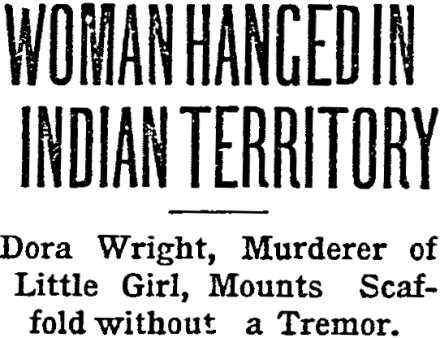
1903: Dora Wright, in Indian Territory

On this date in 1903, Dora Wright was hanged at McAlester in Indian Territory — the present-day U.S. state of Oklahoma.

Wright beat and tortured to death a 7-year-old orphan in her charge named Annie Williams. Wright tormented the little girl over several months until she finally succumbed to a thrashing in February 1903. It was, the local paper said, “the most horrible and outrageous” crime in memory in the area; Wright’s jury only needed 20 minutes’ deliberation to condemn her.

As Oklahoma was yet four years shy of statehood, “Indian Territory” jurisdiction — and with it any decision on executive clemency — fell to U.S. President Theodore Roosevelt. The inclination of the Rough Rider is aptly conveyed by the words of Attorney General Philander Knox‘s brief on the case to the President, which were released for press consumption:

The real facts in this case are that this woman tortured to death a little child seven years old, her niece, whom she was pretending to care for and support. She whipped the child most unmercifully with large switches, struck it about the hand and face so as to cause wounds sufficient to produce death, burned holes in its legs and thighs with a heated poker, and committed other nameless atrocities upon the person of the child. The testimony shows that the woman pursued a course of cruelty which was fiendish and barbarous … The only ground upon which her pardon is sought is that she is a woman, and that the infliction of the death penalty upon a woman would be a shock to the moral sense of the people in the community.

T.R. was incredulous at the feminine special pleading.

“If that woman was mean enough to do a thing like that,” Roosevelt said, “she ought to have the nerve to meet her punishment.”

Wright did have that nerve in the end, and was noted for the calm with which she comported herself on the scaffold. (She was hanged alongside another fellow, Charles Barrett, who shot a man dead in a robbery.)


From the Duluth (Minn.) News-Tribune, July 18, 1903.

On this day..

1644: Joost Schouten, LGBT VOC VIP

On this date in 1644, Joost Schouten, the able merchant and diplomat of the Dutch East India Company, “was strangled and burned to ashes in my presence in Batavia [Jakarta] because of his gruesome sodomy.”

That’s the report of Gijsbert Heeck who, like Scouten, left a noteworthy memoir. Heeck allowed that Schouten “was a man of unusual knowledge and extraordinary intellect,” but despite his gifts remained “in his heart … a hypocritical villain and seducer of many, secretly using his prominence and great authority to force them away from the path of decency into the way of his shameful foulness, seeking thereby to satisfy his devilish lechery.”

Before all that devilish lechery stuff came to light, Joost Schouten (English Wikipedia link | Dutch) had enjoyed a brilliant two-decade career in the Far East, most notably in Siam. There, Schouten ingratiated himself with the Siamese king Prasat Thong,* winning lucrative trade concessions, personal honors, and a seat for himself on the East India Company’s executive organ, the Council of the Indies.

A report that Schouten initially wrote for that company surveying Siam’s geography, people, and politics was published in 1638 and translated into many tongues: he was the first general account of Siam for Europeans. While several others would follow (pdf) in the 17th century, Schouten’s Description remains an essential source for the period.

Schouten himself was no mere observer in the ferocious scramble for colonial position and trade leverage in East Asia. It’s for this august person that the explorer Abel Tasman (as in Tasmania) named Schouten Island (off the coast of Tasmania). That was on the voyage that Tasman undertook to circumnavigate Australia, and discover (for Europeans) New Zealand — a voyage outfitted by Joost Schouten. Given another decade, with Dutch commerce on the come, who knows what heights he might have attained.

But the envoy’s scintillating service record did him little good when a handsome French halberdier repulsed by Schouten’s advances entrapped him in June 1644. This was an offense the Company took incredibly seriously.

Schouten confessed the crime voluntarily, and the only consideration the judges showed him was a pre-burning mercy strangulation. Their verdict, according to Peter Boomgaard, evinced “fear for the punishing hand of God if those who ruled did not take drastic measures.” Schouten was an educated man; indeed, he himself had been a judge. All the worse that, where he had wrought his best service for the Dutch Republic, he had also consciously invited its undoing in a hail of fire and brimstone.

One could, on the other hand, say that it was the Company itself that tempted divine wrath. After all, those in its service routinely spent months in overwhelmingly male environments: ships at sea, and trading outposts that were by now barred to European women. (Local women were a different story, of course.) Nor was Schouten’s particular stomping-grounds of Siam near as virulent in its attitude towards homoeroticism as the Calvinists back home; Schouten’s own travelogue noted that “their Priests, as well as many of the Gentry, are much given to Sodomy, that unnatural passion, being esteemed no sin, nor shameful thing amongst them.” Abroad on the blooming East, coinpurse bursting with the commerce of nations: it must have been a heady experience.

Whether coming around to the Siamese “esteem” or having nurtured it from the start, Schouten had, he said, indulged same-sex encounters** with some 19 different men since putting to sea from a return visit to the mother country in 1637. At least three of those partners — a boatswain’s mate, a soldier, and a burgher — were to their sorrow alive and conveniently identifiable in the Indies.

“Those who were known [to have taken part in his deeds] were, either with him, or later … smothered under water since they were unworthy to continue living among humans,” concluded our eyewitness Gijsbert Heeck. “Which is a fitting recompense and retribution for their gruesome life on earth. In the hereafter, however, the worst is still to come. But it is not for us to judge.”

* Prasat Thong, a law-and-order type, is alleged by the account of another 17th century Dutchman to have personally conducted some executions.

** Schouten, 40ish at his death, said that he was always the “passive” (penetrated) partner in these affairs with much younger men. (This, and all the text that follows it in the post, is also as per Boomgaard.)

On this day..

1917: “John Nelson”, mystery man


(Salt Lake (Utah) Telegram, Dec. 31, 1916)

On this date in 1917, someone was electrocuted in Rockview, Pennsylvania.

“John Nelson”, the cipher alias by which authorities were eventually content to call him, was 5′ 8″ tall and 165 pounds, and looked like an African-American. (“Nelson” himself said that neither white men nor black were of his race.) Papers put this about quizzically because he was also utterly steadfast in refusing to identify himself or his background.

He eventually allowed that he came from Canton, Ohio (but who knows if that’s true). “He reads Shakespeare and seeks high grade newspapers and magazines,” ran news-of-the-weird wire copy all around the country. He boasts “long hair which bears the appearance of having been done up in kids to give a ‘Sis Hopkins’* effect” as well as “long gray whiskers, sideburns and a heavy mustache.” He looked maybe 60 years old.

Anyone?

Aw, heck.


The Scranton Times sent 5,000 of these postcards around the country hoping to scare up information about their mysterious murderer.

Tips poured in from all over — but nothing definitive. An upstate New York sheriff reported discharging a guy named John Nelson from jail a couple of years before. A woman in Butte, Montana recognized the picture and thought it might be her vanished father. The prisoner also resembled a missionary from Ohio and a bank president from Richmond, Va., also both missing; a Scranton woman thought he maybe used to be her gardener. (All but the last of these indefinite tips via Cheryl Kashuba’s two-part series on this case in the March 17 and March 24, 2013, issues of the Scranton Times-Tribune.)

Although nobody could figure out who he was, everyone was pretty sure what he’d done.

On the evening of Oct. 30, 1915, he’d trudged into Mill City, a Wyoming County township outside of Scranton, and made an unexplained sudden attack on three men lolling about a barbershop porch.

According to those three men’s story — and they’re all we have to work with since Nelson kept mum on this, too — a little white boy running down the darkened street bumped into the mystery pedestrian. At that, “Nelson” suddenly produced a knife and charged at the trio of nearby men, bellowing “White people in a tank town like this can’t run over me!”

J.M. Sickler, a prosperous local farmer, bravely intercepted the attacker before he reached Judge Robert Westlake, and suffered mortal stab wounds for his trouble. The attacker fled, but other locals roused by the commotion overpowered him as he escaped; Sickler lived long enough to give a deathbed positive identification.

Of course, it wasn’t really “positive” — that’s the whole point. And “John Nelson”, whoever he might have been, kept his nose in his Shakespeare and his lips enigmatically sealed on the crime and its causes; on his background and biography; on everything whatsoever. “I just wouldn’t care to talk about that,” he would reply when questioned, or similar versions of that polite deflection.

He kept his queer peace all the way to the electric chair.

* Maybe Mr. “Nelson” was just taking Sis Hopkins’ good advice: “There ain’t no sense in doin’ nothin’ for nobody what won’t do nothin’ for you.” As Nelson blithely put it (and who could contradict him?) any name at all would do for his circumstances.

On this day..

1631: Giles Broadway and Lawrence Fitzpatrick, for consistency

On this date in 1631, Giles Broadway and Lawrence Fitzpatrick hanged at Tyburn.

Although the evidence against them was extremely questionable, their trial just nine days prior could hardly have turned out otherwise, for these men were the servants implicated in conniving with the Earl of Castlehaven in the scandalous debauch of his household.

This notorious case had that May resulted in Castlehaven’s execution (wonderfully guest-blogged in these pages by Courtney Thomas). The Earl appears to have run his household as a veritable den of sexual iniquity, but the actual facts upon which a capital conviction had been secured were sketchy and subject to no little public controversy. Castlehaven himself declared on the scaffold that he was a victim of a conspiracy by other members of his family to lay hands on his inheritance.

Manservants

Crucial to the Earl’s condemnation was the testimony of the servants Giles Broadway and Lawrence Fitzpatrick. Broadway owned, under pressure, that he had raped Castlehaven’s wife at the Earl’s direction. Fitzpatrick copped to having sexual relations with the Earl — but crucially claimed that those acts had not entailed actual penetration.

The whole scandal inspired no end of bodice-ripping broadsides and warring doggerel arguing the Earl’s perspective or his wife’s. Crude as this one is, it gets at the key legal issues at stake in the trial — to wit, whether the actual acts that took place in Castlehaven’s Sodom met the legal definition of buggery or of rape:

The prisoner nowe
had leave to shewe
concerninge the rape of his wife

How that hee did it not
but conceived it a plott
to take away him and his Life

But alas twas in vayne
himselfe for to straine
since the Judges delivered it Plano

that to knowe by the tuch
was eaven just as much
as if it had beene in Ano

Its thought their trunke hose
did alsoe suppose
that in concubilu cum faeminis

ther might bee a rape
if lust made an escape
per ejectionem seminis

Book CoverGiven that the court had found the ejectionem seminis here sufficient to lop off the head of a peer of the realm, the man’s low-born servants could hardly be acquitted in the same matter without undermining the verdict’s already tenuous public confidence. As the judges in the servants’ case put it, “We for our parts thought it to stand with the honor of common justice, that seeing their testimony had been taken to bring a peer of the realm to his death, for an offense as much theirs as his, that they should as well suffer for it as he did, lest any jealousy should arise about the truth of the fact, and the justness of the proceedings.” (Quoted in A House in Gross Disorder: Sex, Law, and the 2nd Earl of Castlehaven, a recent book on the scandal.)

Law Orifices

Broadway was the easier condemnation.

Desperately, he tried insisting that his “rape” of the Countess had not achieved actual penetration: the scare quotes here because the boundaries of a body constituted the bright line establishing whether the capital crime of rape had been committed. (Compare for instance this close call from the 18th century.) As the poem implies, Broadway suggested that he suffered premature ejaculation before he crossed the coital, and legal, threshold.

This circumstance required the victim to testify against him. Anne Stanley, fruit of an ancient and powerful family — she had once upon a time had a case as the heir to the throne of England — therefore had to present herself to attest that this mean person “had known her carnally, and that he did enter her body” while her late beheaded husband sadistically held her down. In court she could not bear to look at Broadway, she said, “but with a kind of indignation, and with shame, in regard of that which had been offered unto her, and she suffered by him.”

Fitzpatrick was a tougher trick.

Castlehaven himself had only been convicted by a bare majority on the sodomy charges, and that only by the dubious expedient of expanding the reading of the sodomy statute to compass all same-sex contact: previously, as with rape, penetration had been understood to constitute the crime.

When it came to Fitzpatrick’s trial, he argued vehemently that he could not be made his own accuser. Moreover, as he said in his dying address at the scaffold, “my lord Dorset had entrapped and ensnared him to his destruction; for saying upon his honour, and speaking it in the plural number (as the mouth of the whole [Privy Council]) that whatsoever he delivered should no ways prejudice himself, he thereby got him to declare the earl guilty of the sin of Buggery; wherein himself being a party, was the only cause he came now to suffer death.” That’s a right dirty trick, just another one of many compelling reasons never to talk to cops.

Broadway, for his part, charged under the gallows that his victim Anne Stanley — who remained in the twisted marriage for five-plus years despite having the means to escape it — was herself a principal despoiler of the household’s virtue, “the wickedest woman in the world.” Two other servants, he said, “lay with her commonly,” and one of them had “gotten a child upon her, which she, like a wicked woman, had made away,” leading that vengeful servant to rape at the Earl’s instigation Anne’s 12-year-old daughter by her previous marriage — for which purpose the Earl himself had to apply “oil to open her body.” Home sweet home.

(Young Elizabeth Barnham was dynastically married to her stepbrother James, who himself initiated the complaint against his father. Castlehaven appears to have hated his own son, and the son feared that the Earl’s largesse with his favorites and his apparent attempt to have his servant father on Elizabeth an heir that was not of the family’s own blood would destroy the Touchets. Castlehaven was not indicted on this specifically and the other charges against him were sufficient to the purpose. But it was surely a sensitive offense for his fellow-bluebloods. In his exhortation to the condemned Castlehaven, the Lord Steward scarcely mentioned the rape and sodomy stuff. “Although you die not for that,” he intoned, “you have abused your own daughter! And having both honour and fortune to leave behind you, you would have had the impious and spurious offspring of a harlot to inherit!” This quote, like all the quotes from the trials and scaffold, can be found here; this volume, however, proposes not “harlot” but the seemingly more suitable word varlet.)

On this day..

1945: Louis Till, father of Emmett

The Aug. 28, 1955 lynching of Emmett Till and the subsequent acquittal of his murderers by an all-white Mississippi jury were among the American civil rights movement’s pivotal events.

For a certain indecent number of people, however, the passion of the 14-year-old youth — alleged to have flirted with a white woman — was to be mourned only insofar as it confirmed the menace that insatiable Negro libidos posed to southern way of life.

Further to that end, the months following Emmett Till’s death brought to the headlines the formerly obscure* July 2, 1945 hanging of an American G.I. in Italy: Emmett’s father, Louis Till.

The violent Louis Till ruined his marriage to Emmett’s mother Mamie shortly after his son’s birth. Repeatedly violating her restraining order eventually landed Till pere before a judge, who gave him a choice between hard time and enlistment. Till joined the U.S. Army.

In 1945, he was court-martialed for murdering an Italian woman and raping two others. His execution near Pisa — he’s buried in Europe in the Oise-Aisne American Cemetery, the same final resting place as Eddie Slovik — was the no-account end of a no-account man for many years thereafter. Mamie Till said that she wasn’t even told what happened to her ex-husband, and was stonewalled when she sought information.

By the end of 1955, everyone knew.

In Jim Crow’s backlash against nationwide condemnation of the Till lynching, Louis Till came back to life in newsprint all that autumn to visit the sins of the father upon his late son: here was the mirror of the young predator all grown up, violating Italian women. Mississippi’s white supremacist senators used their rank to obtain his army file, and leaked it to reporters.

According to Davis Houck and Matthew Grindy’s study of the Mississippi media’s conflicting reactions to the events of 1955, “Louis Till became a most important rhetorical pawn in the high-stakes game of north versus south, black versus white, NAACP versus White Citizens’ Councils.”

The pawn’s sacrifice did not figure in the endgame.

Crude attempts to impose blood guilt for Louis Till’s crimes aside, Clenora Hudson-Weems argues in her Emmett Till: The Sacrificial Lamb of the Civil Rights Movement that it was Emmett Till’s shocking death that catalyzed the civil rights movement — that the horrifyingly mutilated face at his open-casket funeral and the insouciant confession of his killers once they had been acquitted shook southern blacks and northern whites alike so profoundly as to dispel any confidence that legal briefs or political incrementalism could grapple with America’s race problem. Civil rights lion Joyce Ladner was an 11-year-old Mississippi girl when Emmett Till was lynched; she would tell Hudson-Weems of the shock it delivered in her world coming on the heels of the Brown v. Board of Education ruling desegregating schools.

A very important thing is that it followed the Supreme Court decision in 1954. It’s like the Whites said that they don’t care what rights we were given … So when the spark came in Mississippi to sit in the public library, for example, people who participated had been incensed by the Till incident and were just waiting for the spark to come. The Till incident was the catalyst.

On December 1, 1955, Rosa Parks refused to give up her seat to a white man on a Montgomery, Alabama bus, launching the famous bus boycott. “I thought of Emmett Till and I just couldn’t go back,” Parks said later.

Emmett Till’s body was exhumed for autopsy and DNA testing in 2005, in part to dispel the old story first promulgated by the attorneys who defended Till’s murderers — that the body wasn’t Emmett Till’s at all. On the corpse’s finger was a ring inscribed with the initials of his father: L.T.

* Louis Till did have one small claim to fame prior to his son’s murder: the fascist poet Ezra Pound chanced to be imprisoned with Till; he mentions the later-famous execution in his Pisan Cantos:

Till was hung yesterday
for murder and rape with trimmings

On this day..

1943: Willem Arondeus, gay resistance fighter

(Thanks to Meaghan Good of the Charley Project for the guest post. -ed.)

On this day in 1943, Willem Arondeus and eleven other Dutch resistance members were executed for sabotage and treason in connection with their anti-Nazi activities in the Dutch Underground.

Arondeus, an artist, novelist and biographer, was rather old for a resistance fighter; he was 48 at the time of his death.

He was the son of theater costume designers and one of six children, but became estranged from his family after he came out as gay at the age of seventeen. At a time when homosexuality was still illegal and deeply taboo, Arondeus spoke openly about it.

For seven years in the 1930s he lived with his lover and struggled to make a living. In 1940, after the Nazis invaded the Netherlands, he joined the resistance.

Arondeus utilized his artistic skills by forging identity papers for Dutch Jews. (Being himself part of a persecuted minority, perhaps he felt a special kinship with them.) He urged other artists to stand up against the Nazi invaders.

On March 17, 1943, he and other members of his resistance unit set the Amsterdam General Registry Office on fire, trying to destroy all the original records so the false identity papers couldn’t be checked. They successfully destroyed about ten thousand records, but five days later the entire unit was arrested. Their conviction was a foregone conclusion.

Arondeus said he hoped that by his life and death, he could prove that “homosexuals are not cowards.” Yad Vashem has honored him as Righteous Among the Nations. (pdf)

On this day..

1944: A day in mass executions in Axis Europe

June 29, 1944, saw several noteworthy mass executions around Axis western Europe.

France: Seven Jewish hostages for the assassination of Philippe Henriot

Poet and journalist Philippe Henriot (English Wikipedia entry | French), the “French Goebbels”, was the Vichy government’s able chief propagandist.

On June 28, 1944, Henriot was assassinated by Maquis operatives disguised as milice paramlitaries.

Incensed, the real milice this morning gathered seven Jews already held in prison as hostages at Rillieux, drove them to the cemetery, and shot them one by one.

(Paul Touvier, who orchestrated this retaliatory execution, managed to stay underground until 1989. At his 1994 war crimes trial, he claimed that the Germans wanted 30 hostages killed, and therefore what he actually did was “save 23 human lives.” Touvier was convicted on the charge of crimes against humanity.)


Italy: Massacres in San Pancrazio, Cornia, and Civitella

As dawn broke this date, German soldiers retreating from liberated Rome fell upon several Tuscan villages.

German columns had been beset by partisans on the way, and standard operating procedure was to retaliate against partisans indirectly, by killing civilians — as in the notorious massacre in the Ardeatine caves. This vengeance was visited on the three towns: over 200 civilians were summarily executed on June 29, 1944.

“My mother later said she went to speak to my father,” remembered one San Pancrazio man. “A soldier turned her back and told her they were taking him to be tortured. She and my father both cried.” The father and those taken with him were shot in the basement of a farmhouse.

Caution: Graphic video.

The towns themselves have kept this date in remembrance, but the massacres were swept under the rug in the postwar settlement as Italy, Germany, and their former western enemies realigned for the Cold War. Only in the 21st century have they come to wider attention, when the discovery of secret archives documenting the atrocities enabled an Italian court to convict an aged German soldier in absentia.

There’s a CNN documentary on these events focusing particularly on San Pancrazio. Called “Terror in Tuscany”, it may be viewable here or here, depending on your location.


Denmark: The Hvidsten Group

The Danish resistance group named for a Jutland tavern was betrayed by a captured Brit under torture.

S. P. KRISTENSEN * 20. 8. 1887
ALBERT IVERSEN * 28. 9. 1896
NIELS N. KJÆR * 2. 4. 1903
JOH KJÆR HANSEN * 2. 4. 1907
HENNING ANDERSEN * 16. 7. 1917
MARIUS FIIL * 21. 6. 1893
PETER SØRENSEN * 8. 6. 1919
NIELS FIIL * 12. 6. 1920

1944 on the 29 June
They fell before German bullets
Precious is their memory to Denmark

Hvidsten Group stone photo is a (cc) image from Hansjorn.

On this day..

1890: A quadruple hanging in Jim Crow America

(Thanks to Meaghan Good of the Charley Project for the guest post. -ed.)

Close to midnight on this date in 1890, four convicted murderers — three of them black and one white — were hanged on the gallows inside the Shelby County Jail in Tennessee. They were Edward Carr, 28, Parker Harris, 30, Hardy Ballard, 45, and Frank Brenish, 36.

Carr, who was half-black, had murdered his estranged wife Sallie in broad daylight on the street in Memphis on November 9, 1889. Edward Carr wanted to move to Mississippi and Sallie did not, and she had left him and moved in with a woman friend. When Edward saw his wife and her friend walking down the street, he said, “Sallie, I am going to kill you,” and then shot her.

She ran away, but he chased after her and shot her three more times. Sallie Carr died in her friend’s arms.

Edward surrendered to the police three days later, and his lawyer had to persuade him not to plead guilty to murder.

At his trial he said, “I do not know why I killed her. It was not because she offended me. We had lived happily together … I loved her so well, and she would not go with me.” Offering no defense, he was accordingly convicted on December 17, six weeks after his crime.

Harris had also killed his wife, Letha “Lettie” Harris, on the street in front of witnesses. Lettie was an “octoroon”, a now-outdated term for someone who is of mixed race and one-eighth black, seven-eighths white.

Like the Carrs, the Harrises were estranged and Lettie was living apart from her husband. On August 18, 1889, said husband encountered her riding in a buggy with several women and asked her to come home; Lettie replied that she never wanted to speak to him again.

In response, Parker Harris slashed her throat, then his own. He was able to run from the scene but collapsed several blocks away, weak from blood loss. He recovered sufficiently from his wounds to face trial; he too was easily convicted.

Hardy Ballard had killed a streetcar driver, G. Emmett Pinkston, on Christmas Day 1889 after an argument over the nickel fare. Ballard insisted he had paid; Pinkston said he hadn’t, and kicked him off the car. Both parties were armed in the ensuing fight, Ballard with a knife and Pinkston with an iron hook, and Ballard got the better of the streetcar driver and stabbed him to death.

His plea of self-defense at trial was not believed by the jury.

The sole white man, Frank Brenish, was a wife killer just like two of his co-condemned. Mary, his wife of two years, had left him because of his drinking and his failure to support her and his two stepchildren. Frank threatened to kill his wife if she didn’t come back to him, and Mary took these threats seriously enough to report them to the police. The cops had a talk with Frank and he promised to leave his wife alone.

Mary remained fearful, however, and when she went out she took her fourteen-year-old daughter, her sister and another man to protect her in case she encountered her husband. They were with her the night the murder was committed: they saw the whole thing.

Frank Brenish’s crime was so similar to Parker Harris’s that there was some speculation the two might have a joint trial: on July 5, 1889 he jumped out of a dark alley and slashed Mary’s throat, nearly decapitating her. Then he cut his own throat. Against the odds, a doctor was able to save Frank’s life, but Mary was beyond help: she had died almost instantly.

All four of the condemned were given copious amounts of alcohol while awaiting their execution, and Brenish got morphine as well. The wound on his throat hadn’t healed and it leaked from time to time. The night before his executed, he made a halfhearted attempt at suicide by slashing his wrist with a makeshift knife.

This was the era of racial apartheid in America, however, and even when men died together, they perhaps might not die together.

The gallows in this instance was built for two, so the natural idea was to hang the four men as two pairs.

Brenish, however, refused to suffer the indignity of being hanged alongside a Negro.

His jailers — and one hardly needs to mention their racial identity — honored his request for a segregated execution and modified the gallows so three people could be hanged at once.

The three black prisoners went first. Brenish died alone, fifteen minutes later. Harris, Ballard and Carr had “clean” hangings and died quickly, after making the usual final statements about their sins and their hope for redemption in Heaven.

When the time came for his racially unsullied death, Brenish was either so drunk or so scared he could barely stand, and he took several more swallows of whiskey while standing on the scaffold. He had severed his trachea when he slashed his throat and could only barely speak above a whisper. When he was asked for a final statement, the best he could come up with was, “They oughtn’t to hang a man when he ain’t in his right mind.”

It often happens that, when a person’s throat was previously cut, the wound will re-open during hanging. This didn’t happen to Harris, but it sure did during Brenish’s execution. Lewis Laska in Legal Executions in Tennessee: A Comprehensive Registry, 1782-2009 has a graphic description of what happened:

The officers had difficulty in placing the handcuffs because of his bandaged wrist. Blood trickled down his white gloves. With the noose and cap placed, he swayed to and fro and had to be held. When the lever was pulled and he dropped there was a pop (his neck was broken) and a hissing sound. The drop had opened the hole in his throat from the attempted suicide on the night of the killing. The hole was large enough to hold a cigar. As he hung, his wrist wound bled profusely.

Gruesome as his death may have appeared, though, Brenish didn’t suffer long. His heart stopped in less than a minute.

On this day..