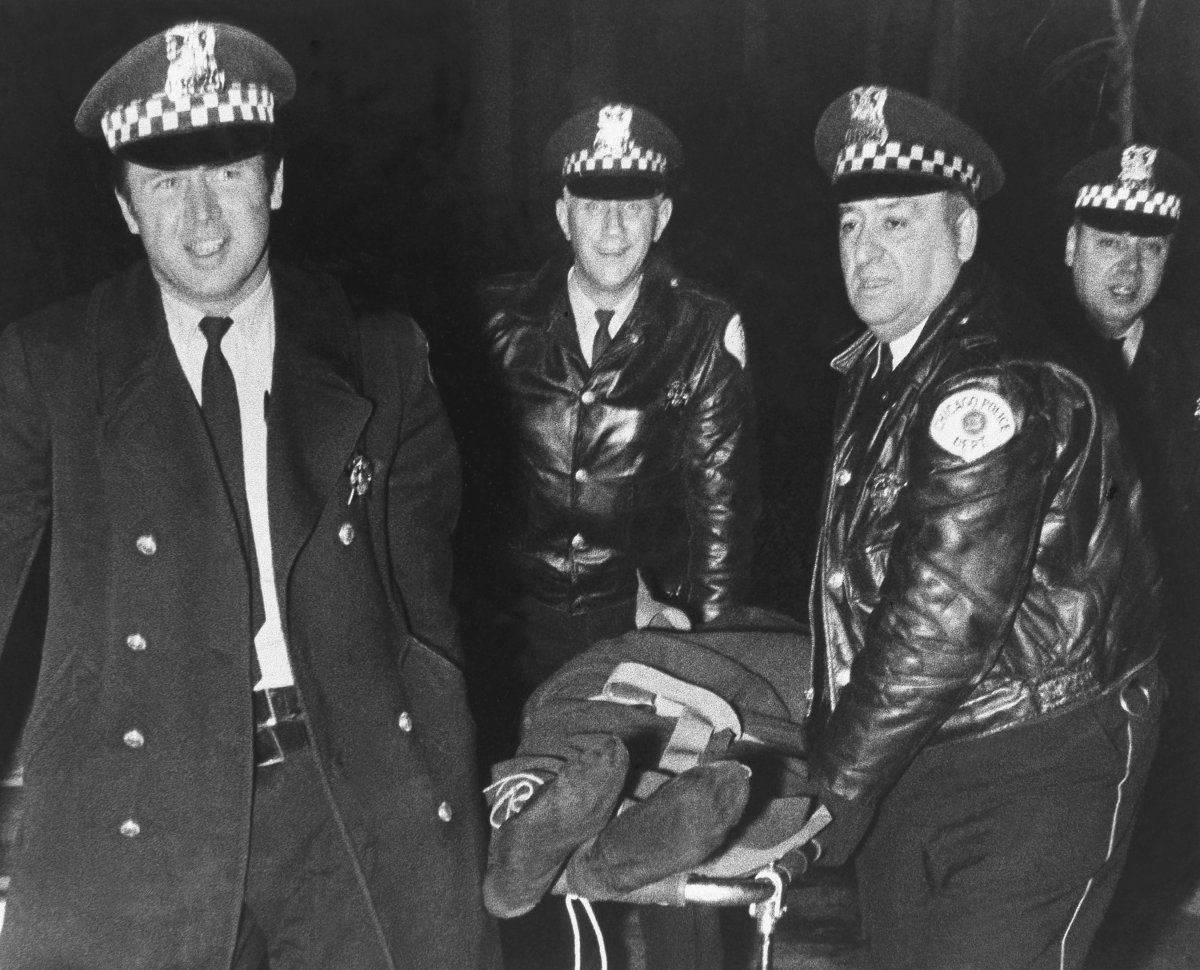
Associated Press story from the Gastonia (North Carolina) Gazette, Dec. 30, 1949:
RALEIGH, Dec. 30 (AP) — Two Indian farm workers died today in the gas chamber after a futile effort by one to save the life of his companion in crime.
Leander Jacobs, 28, and Hector Chavis, 29, were executed for the robbery-murder of Martin L. Blackwell, 79-year-old Lumberton storekeeper.
Jacobs yesterday told Prison Warden Joe Crawford and Paroles Commissioner T.C. Johnson that although Chavis participated in the robbery, he took no actual part in the killing.
For this reason Chavis did not learn until about 3:30 a.m. today that he was going to die at 10 a.m.
Crawford told him that Governor Scott had decided not to intervene.
“All he said was, ‘Thank you’.” Crawford said.
Chavis entered the chamber calm. Jacobs walked briskly. They both were pronounced dead in less than 12 minutes.
The governor’s decision followed conferences at the mansion last night and this morning with Paroles Commissioner T.C. Johnson to whom Jacobs made his statement.
Jacobs made his confession to Johnson and Central Prison Warden Joe Crawford. Johnson said Jacobs’ story was a “full confession” and was the first detailed account obtained from either of the men.
The two Indian farmers were convicted last April in Robeson superior court of the robbery-murder of Martin L. Blackwell, 79-year-old Lumberton storekeeper.
Jacobs’ statement came yesterday shortly after he heard that governor [sic] would not intervene. The condemned man said he only wanted to clear his conscience before he died.
Johnson said “He told us that he didn’t want to take another man with him.[“]
However, the paroles commissioner pointed out that despite Jacobs’ attempt to take the full blame the fact remained that both men were present at the murder scene and both shared in the ensuing robbery.
On this date in 1661, the French customs officer and writer Jacques Chausson (English Wikipedia entry | French) was burned at Paris’s Place de Greve for sodomy.
Chausson with another man, Jacques Paulmier, forced themselves upon a handsome 17-year-old aristocratic youth, “and [Chausson] while embracing him [the victim] undid the button of his pants at the same time, and then Paulmier began knowing him carnally, and committing with him the crime of sodomy. Having felt this, he began to shout and struggle, and then an old woman, working that day at the home of Mr. Petit, merchant and head of the house, came running.”
As we’ve noted before in these pages, Chausson entered French letters as the subject of verse by Claude le Petit, himself later executed, disdaining the hypocrisy of executing for a diversion widely practiced among the elites.
If we burned all those
Who do like them
In a very short time alas
Several lords of France
Great prelates of importance
Would suffer death.
Do you know the storm that rises
Against all good people?
If Chausson loses his case,
The arse (“le cu“) will not serve any more.
If Chausson loses his case,
The cunt (“le con”) will prevail.
I am this poor boy
Named Chausson
If I was roasted
At the flower of my age
It’s for the sake of a page
Of the Prince of Conde. [a bisexual lord -ed.]
If the bastard D’Assouci. [a raunchy poet who was possibly the lover of Cyrano de Bergerac -ed.]
Had been taken
He would have been roasted
In the flames
Like these infamous two
Chausson and Fabri.
That was written in the weeks between Chausson’s condemnation and his execution. Le Petit returned to the subject in evident disgust once the deed was done.
Friends, we burned the unfortunate Chausson,
That rascal so famous, with a curly head;
His death immortalized his virtue:
Never will we expire in a more noble way.
He sang cheerfully the lugubrious song
And bore without blanching the starched shirt,
And the hot fagots at the fiery stake,
He looked at death without fear or shudder.
In vain his confessor exhorted him in the flame,
The crucifix in hand, to think of his soul;
Then lying under the stake, when the fire had conquered him,
The infamous one towards the sky turned his foul rump,
And, to die finally as he had lived,
He showed his naughty ass to everyone.
Nor was this the only poet incensed by events. Taking note that yet another sexually flexible nobleman Guillaume de Guitaut was to be elevated on the subsequent New Year’s Day to the Order of the Holy Spirit, the poet Charles de Saint-Gilles Lenfant mused,
Grands Dieux! Quelle est vôtre justice?
Chausson va périr par le feu;
Et Guitaut par le même vice
A mérité le Cordon bleu.
Meaning …
Great Gods! Where is your justice?
Chausson is about to die in the fire;
And Guitaut for the same vice
Has deserved the Cordon bleu.
This quatrain can be heard in vocal recital in a brief Soundcloud clip here.
Dutch Jewish aid worker (A)Lex Aronson was hanged on this date in 1975 in Iraq.
Aronson (English Wikipedia entry | Dutch) had survived Bergen-Belsen as a child* — his grandfather was not so fortunate — and gone on to a peripatetic career in global relief work that took him to Israel, Syria, Gabon, Nigeria, India, Bangladesh, and points beyond.
By the accounts of his friends, Aronson was a free spirit, a man of idealism and wanderlust. By the account of the Iraqi government that arrested him, Aronson was an Israeli spy.
There’s a published collection of his correspondence; in a letter to his mother dated March 13, 1975 — the last he would post before his arrest 11 days on — achingly shows him eschewing a judicious evacuation in order to press onward into the teeth of a devastating offensive Iraq had launched on March 7.
the political bosses here have decided that all foreigners should be evacuated. By foreigners, they are referring to a few press photographers, the team of five English from “Save the Children,” and yours truly. The hospitality is so extensive here that at the first sign of a threat, they are stepping out of their way to secure the safety of their guests. The local bosses mean well. However, what daddy has in his head, he doesn’t have in his arse… by which I mean that whatever I have set my mind to, I don’t give up easily.
I was determined to go to Badinan. I went from one political office to another, pestering all the leaders save for Barzani himself. Finally, I was rewarded with a letter of introduction to all the Kurdish military commanders requesting that they give me the help necessary for me to reach my goal.
A subsequent letter by a Save Our Children doctor to Aronson’s father in early 1976 explained something of the circumstances in the following days that led to his capture,
I saw your son on 20 March 1975. He was breakfasting with me at the home of the leader of the Barzan community, Sheikh Abdullah, in preparation for a journey to Badinan. He was taking medicine and other equipment with him so that he could set up a surgery to treat the inhabitants of a single community somewhere in that area. He had bought a donkey to convey these items, but unfortunately this had got lost between Senidan and Sideka, over the pass to the east of Hassanbeg Mountain with the snow so deep that no donkey could traverse it.
The donkey was under the control of two Pesh Merga (Kurdish Freedom Fighters). Apparently they became separated from your son and he had no idea of the [whereabouts of?] this medicine or his passport and money. He was travelling against the advice of the Kurds in the border area who were keen (at that time) that all foreigners should get out as quickly as possible. For this reason, he retraced his steps to try to find the donkey, yet wanted to press on towards Amadiyah. He had spent a day or so looking. He asked me to look for the animal. I made inquiries in both Sideka and Semilan, but I could not find it. However, as at that stage there was total chaos in these villages, it was not at all surprising that I was so unsuccessful. I must explain that he was in danger, as he had no identification papers with him when I saw him.
A confusing and, for his loved ones, anguishing period ensued his arrest. The Iraqi News Agency announced his execution on November 3, only to retract that announcement shortly afterward and clarify that he remained alive, still facing execution. His parents for months thereafter received notes scribbled on cigarette packages which meandered through smuggling channels at indifferent speeds, but with the irresistible implication that their son yet drew breath — and so they kept up their struggle to save him via appeals and publicity well into 1976, when the Iraqi embassy in March 1976 finally notified them that he was long since hanged.
“Nobody can imagine how we feel now,” his father told the press. “All hopes smashed at once. There is nothing left to fight for. Now we can only try not to get too depressed.”
* He was a passenger on the “Lost Transport”, a train of inmates evacuated from Bergen-Belsen that ended up with no destination as the Reich collapsed, and were eventually liberated by the Red Army.
This charismatic — nearly every bio uses this word — 21-year-old star of the Illinois Black Panther Party had in his brief life shown himself a visionary exponent of radicalism; he would end as one of the signal martyrs to his movement’s violent suppression.
Well did he know it.
“If you’re asked to make a commitment at the age of 20 and you say, I don’t want to make a commitment only because of the simple reason that I’m too young to die, I want to live a little bit longer. What you did is, you’re dead already,” Hampton once mused. “You have to understand that people have to pay the price for peace. If you dare to struggle, you dare to win. If you dare not struggle then damnit, you don’t deserve to win … And I think that struggle’s going to come. Why don’t you live for the people? Why don’t you struggle for the people? Why don’t you die for the people?”
Emerging late in 1966 out of Oakland, Calif., the Black Panthers were a revolutionary and pointedly armed movement that fused black power demands with critique of the entire edifice — war, imperialism, capitalism and the rest of it. Although the organization was dissolved in 1982, the Panthers’ actions and legacy are still quite controversial and their mere specter remains a potent bogeyman for much of contemporary white America.
One thing is for sure: in their moment, they scared the shit out of the powers that be. Within months of its founding, the Federal Bureau of Investigation turned upon the Panthers its COINTELPRO program of domestic surveillance, suppression, and assassination. One particularly notorious FBI memo drew a bead on “Black Nationalist-Hate Groups” with an avowed intention to “prevent the rise of a ‘messiah’ who could unify, and electrify, the militant black nationalist movement” — and to “pinpoint potential troublemakers and neutralize them”.
Fred Hampton isn’t mentioned by name in this chilling missive from early 1968; he was just then beginning to emerge onto the FBI’s index of rabble-rousers. (Literally, the feds had a list called the “Rabble Rouser Index”.) He was fresh out of high school in 1966, and subsequently a wildly successful NAACP chapter leader, but gravitated to the new Illinois Panthers organ by 1968 where he quickly became its most outstanding organizer and spokesman, the prospective future face of a stirring cross-racial, class-conscious justice movement that Hampton perceived with a wisdom well beyond his years. Under his leadership the BPP spun out health care programs, legal aid programs, and free breakfast programs; he forged the original Rainbow Coalition* that brought rival street gangs and activist groups from different racial communities into a shared political ambition.
“We’re going to fight racism not with racism, but we’re going to fight with solidarity,” Hampton said. “We’re not going to fight capitalism with black capitalism, but we’re going to fight it with socialism.”
Just as energetically did the FBI work — and succeed, in the end — to break up such alliances, using informers and agents provocateur and false flags to encourage schisms and discredit leaders. Chicago’s police department was a ready collaborator in these operations; its relationship was the Panthers was hostile and often violent. Just three weeks before Hampton’s murder, two Chicago cops and a 19-year-old Black Panther were killed in a shootout. (Hampton was in California at the time.)
We don’t have the full documentary paper trail with deliberations and countersigned orders, but the known facts (and the smug grins of the cops) admit no reasonable dispute this side of performative naivete that Hampton was assassinated by a state death squad — “executed”, if you like, to fit an admittedly expansive read of this here site‘s mandate.
A compromised Hampton bodyguard named William O’Neal gave his FBI handler — who also happened to be running the Chicago COINTELPRO operation targeting the Panthers — a detailed floor plan of Hampton’s apartment, which the FBI shared with the Chicago police for a raid putatively hunting illegal weaponry. On the night of December 3, O’Neal slipped Hampton a barbituate to dull his reactions for what was to come; surviving comrades would describe Hampton being roused amid the early-morning fusillade only with difficulty, responding barely and in “slow motion” even as Chicago police stormed front and rear entrances and poured nearly 100 rounds into the place. Another Hampton aide named Mark Clark, sitting watch, was blasted dead in the initial barrage, convulsively discharging his shotgun once into the ceiling as he fell. It was the only shot fired that night by any of the Black Panthers.
By the account of Hampton’s eight-months pregnant partner Deborah Johnson, corroborated by other Panthers in the apartment, Fred Hampton was injured by the volley, but alive — and cold-bloodedly finished off with a coup de grace.
First thing that I remember after Fred and I had went to sleep was being awakened by somebody shaking Fred while we were laying in the bed. Saying, “Chairman, Chairman, wake up, the pigs are vamping, the pigs are vamping!” And, um, this person who was in the room with me, kept shouting out “we have a pregnant sister in here, stop shooting”. Eventually the shooting stopped and they said we could come out. I remember crossing over Fred, and telling myself over and over, “be real careful, don’t stumble, they’ll try to shoot you, just be real calm, watch how you walk, keep your hands up, don’t reach for anything, don’t even try to close your robe”. I’m walking out of the bedroom, there are two lines of policemen that I have to walk through on my right and my left. I remember focusing on their badge numbers and their faces. Saying them over and over on my head, so I wouldn’t forget. Um, as I walked through these two lines of policemen, one of them grabbed my robe and opened it and said, “Well, what do you know, we have a broad here.” Another policeman grabbed me by the hair and pretty much just shoved me — I had more hair then — pretty much just shoved me into the kitchen area. It was very cold that night. I guess that it snowed. And, ah, the back door was open. Some people were on the floor in the kitchen area. I think it was Harold Bell was standing next to me in the kitchen area. They, ah, it was a police, ah, plainclothes policeman there, and I asked him for a pin, so I could pin my robe, because it was just open. And he said, “Ask the other guy.” And, ah, then somebody came back and handcuffed me, and Harold Bell behind the back. I heard a voice come from the area, I guess from the dining room area, which was, the kitchen was off from that area. And someone said, “He’s barely alive, he’ll barely make it.” The shooting, I heard some shooting start again. Not much. Just a little shooting, and, um, and someone said, “He’s good and dead now.” I’m standing at the, um, kitchen wall, and I’m trying to remember details of these policemen’s face, say it over and over in my head, and, and badge numbers, so, you gotta remember, gotta remember. And then when I felt like I was just going to really just pass out, I started saying the ten-point program over and over in my head. Um, at one point I turned around, the shooting had continued again, and I saw the police drag Verlina Brewer and throw her into the refrigerator. And it looked like blood was all over her. And she fell to the floor and they picked her up and threw her again. I saw Ronald Satchel bleeding. I kept trying to focus on the ten-point program platform, because I, again, I wanted to take myself out of that place. And I knew I just couldn’t break down there. Because I didn’t know if I would be killed, or what would happen.
Incidentally, Hampton’s killing was also a key catalyst for the terroristic turn of the Weather Underground — whose decisive “war council” meeting occurred later that same month of December 1969, with Hampton’s blood heavy in the air (and his picture prominently displayed on the wall) as an emblem of the futility of pacific resistance within the belly of the beast. “It was the murder of Fred Hampton more than any other factor that compelled us to feel we had to take up armed sturggle,” said David Gilbert, who’s now serving a prison sentence for a deadly bank robbery. “We wanted to create some pressure, to overextend the police so they couldn’t concentrate all their forces on the Panthers. We wanted to create a political cost for what they were doing. And we also felt that to build a movement among whites that was a revolutionary movement, a radical movement … it had to respond when our government in our name was destroying the most promising, exciting, and charismatic leadership to come out of the Black movement in a long time.” (Source) It was a paradoxical inspiration, since Hampton himself had criticized the emerging Weathermen after their “Days of Rage” riot in Chicago as “anarchistic, opportunistic, individualistic,” and even “Custeristic” — as in Indian Wars cavalryman George Armstrong Custer, famous for his defeat — “in that its leaders take the people into situations where they can be massacred. And they call that revolution.”
* The name and concept of the Rainbow Coalition were later revived by Jesse Jackson in his left-wing presidential challenges in 1984 and 1988, but there is not a continuous institutional thread from Hampton’s coalition to Jackson’s. Jackson did, however, deliver a eulogy at Hampton’s funeral on December 6, 1969.
Ethnic Hungarians Sass Kálmán and Istvan Hollos were shot in Romania on this date in 1958. Links in this post are in Hungarian.
Both were condemned — along with a third man, Vilmos Balasko, his sentence subsequently commuted — as the result of a mass trial earlier that year of alleged traitors and saboteurs.
The trial targeted the large ethnic Hungarian population in Transylvania, bordering Hungary, in the aftermath of the 1956 Hungarian Revolution. There the feared Romanian secret police rolled up culprits for offenses ranging from subversive leaflets in simpatico with failed revolution, to a general penumbra of perceived unreliable loyalty.
Istvan Hollos, a lawyer and teacher, had fought in the German-allied Hungarian army during World War II and unsuccessfully attempted to flee to Switzerland afterwards. Sass Kálmán was a Calvinist pastor once close to anticommunist peasant party leader Ferenc Nagy; a previous brush with political scrutiny had been shielded by towering general Pal Maleter, but Maleter’s participation in (and execution for) the 1956 revolution played against Kálmán too. (A third man, pastor Vilmos Balasko, was condemned to death in the same mass trial but he received clemency and was released a few years later in a general amnesty. He lived until 2004 and published a memoir after the fall of the Iron Curtain.)
Kálmán’s Reformed Church, whose adherents are predominantly ethnic Hungarians in Transylvania, treat Kálmán as a martyr and have pressed hard for his official rehabilitation — thus far, to no avail.
Calvinist nobleman Michal Piekarski was spectacularly executed in Warsaw on this date in 1620 for attempting the life of the Polish-Lithuanian king.
The lengthy reign of Sigismund III Vasa marks Poland’s downward slide out of her golden age, although how much of this trendline is personally attributable to Sigismund embarks scholarly debates well beyond this writer’s ken.
Sigismund III Vasa held both the Polish-Lithuanian and the Swedish thrones in a personal union but he lost the latter realm to rebellion; he meddled unsuccessfully in Russia’s Time of Troubles interregnum; and he faced a rebellion of nobility in 1606-1608 that, although it failed to overthrow him, permanently curtailed the power Polish monarchy.
That conflict with the aristocracy overlapped with a sectarian schism common throughout Europe in the train of the Protestant Reformation — for Sigismund was very Catholic and his nobility divided.
It’s the latter fissure that’s thought to have supplied the proximate motivation for our date’s principal. Piekarski (English Wikipedia entry | Polish), a petty noble, had long been noted as a moody, melancholic man too unstable even to be entrusted with the management of his own estates — the consequence of a childhood head injury.
He was also a staunch Calvinist, but broad-minded enough to find virtue in his opponents’ tactics. In 1610, Catholic ultra Francois Ravaillac had assassinated France’s Henri IV, and it’s thought that Ravaillac’s boldness put the bee into Piekarski’s bonnet.
A decade later, the Pole stung with cinematic flair: he jumped Sigismund in a narrow corridor while the latter was en route to Mass and dealt 1d8 bludgeoning damage by thumping the king in the back with a warhammer; after a second attempted blow only grazed the sovereign’s cheek, the royal entourage subdued Piekarski and started looking up chiropractors.
It’s only a model: replica of the would-be assassin’s instrument on display in Warsaw.
Torture failed to elucidate a coherent motivation from a muddled mind. Reports had him only babbling nonsense, so attribution of the attack to religious grievance remains no more than partially satisfying; there were rumors of other more determined instigators to steer Piekarski’s mind towards regicide for their own ends. (Although he didn’t get the king, he did confer upon the Polish tongue the idiom “plesc jak Piekarski na mekach” — “to mumble like Piekarski under torture”.)
In the end, for Ravaillac’s crime, he took Ravaillac’s suffering: the Sejm condemned him to an elaborate public execution which comprised having his flesh torn by red-hot pincers as he was carted around Warsaw, until reaching a place called Piekielko (“Devil’s Den”) where the hand he had dared to raise against the king was struck off, and then what was left of his ruined flesh was torn into quarters with the aid of four straining horses.
Spanish seaman Joseph Garcia was hanged at Usk Prison on this date in 1872, for the Llangibby Massacre.
It occurred in the Welsh village of that name, inland from the mouth of the Severn where Garcia had alit as a mariner at Newport nearly a year before.
He’d committed a burglary there, and been committed to jail for his pains. His sentence was nine months … followed by release to a foreign land whose language he barely spoke, his ship long gone and no friend or occupation to direct him.
A “short, thin man, just five feet five inches tall, with a swarthy complexion, coarse black hair and beard,” Garcia trudged the road in to the farming town. Several times he was observed loitering there but his presence was really announced by the billows of smoke pouring from the home of William Watkins, a farmworker — and neighbors who rushed to the scene beheld the horror of its owner dead from a stab wound through his throat, his wife similarly dealt with, and all three of their small children also put to the blade — their wee corpses already partly charred from the fire.
The stranger’s foreignness invited attention, of course, and when he was arrested back at Newport circumstantial evidence appeared to confirm the connection: he had some injuries and bloodstains that suggested a scrap, a pair of boots that might have been stolen from Watkins, and some stolen household articles that a surviving daughter of Watkins fortunate enough to be away from the house at the fatal hour recognized as the family’s own. He also possessed a knife that he hadn’t been discharged with.
Then as now the fury for a swarthy outlander come uninvited to go a-viking among law-abiding Britons was potent; while legal proceedings were entirely regular, “the noise outside the court was powerful enough at times to prevent the witness from being heard, and from the character of the exclamations which permeated to the interior of the court the crowd appeared ready to lynch Garcia.” (Period press quoted here.) Indeed, such a sentiment was openly published in at least one broadsheet murder ballad:
May the murderers to justice quickly be brought,
And suffer the penalty they surely have sought,
Lynch law in some countries they would very soon find,
And their bodies be swinging on the trees to the wind.
(Thanks to Elizabethan Catholic martyr Edward Osbaldeston for the guest post on the 16 November, 1594 York execution of Elizabethan Catholic martyr Edward Osbaldeston. We offer here the letter from his own hand recounting the circumstances of his capture, as published subsequently by Richard Challoner. -ed.)
I was apprehended at Towlerton by Mr. Thomas Clark, the apostate priest, upon St. Hierome’s day [September 30], at night; a thing much more to my comfort, than at any other time; for that I had such a special patron to commend myself to, and such a stout champion under Christ; and, besides, it pleased God, much to my comfort, to let this sign of his love fall unto me that day above all others; for that it was God’s great goodness to call me to the honour of priesthood; and that, upon St. Hierome’s day, I said my first mass, and consecrated the blessed body and blood of my Saviour Jesus Christ, and received him with great reverence and devotion, and ever since have honoured St. Hierome [Jerome]. And the morning before I came forth, I made my prayer to blessed St. Hierome; and, in his merits, I offered myself a sacrifice to God, and recommended myself to him, to direct me to his will and pleasure, and that I might walk aright in my vocation, and follow St. Hierome, as long as God should see it expedient for his church, and most for his honour and glory: and if it pleased him still to preserve me, as he had done before, I never would refuse to labour, or murmur at any pain or travail; and if it should please his majesty to suffer me to fall into the prosecutors’ hands, that then it would please his infinite goodness to protect me to the end; which I have no doubt but he will, after so many and so great goodnesses and gifts, as he hath bestowed on me over all my life, which are without number and inexplicable: wherefore my hope and trust is much helped, that now be will be most sure unto me, since this is the weightiest matter that I ever was about in my life: and so considering this, and infinite others, such like, I find great comfort, and fully trust in God’s goodness, and distrust only in myself; but in him that comforteth me, I can do all things. And this actual oblation of myself that morning, and this that ensueth, maketh me very comfortable, and bringeth me into many good and heavenly cogitations, feeling his strength so much as I have done in lesser matters, and further off from him than this is: therefore I nothing doubt, by his grace, but he will grant me to finish that which was for him, and by him, begun; which I pray God I may worthily do when his good will and pleasure is, and not before: and that I may not wish or desire any thing in this life but what may best please him and honour him, and our blessed lady his mother, and all the court of heaven, the most, and edify the people, and strengthen them in the way to Jesus, the king of bliss.
The manner [of my apprehension] was thus: Abraham Sayre and I came to the Inn a little before Mr. Clark, and we all came before night. I knew him not fully; for I thought he had been in the south; but at supper I looked earnestly at him, and I thought it was he, and yet I still persuaded myself that he knew me not, and if he should know me, he would do me no harm: which fell out otherwise; God forgive him for it. For when we were going to bed, he went and called the curate and constable, and apprehended us, and watched us that night, and came with us to York, and stood by when I was examined before the council, but said nothing then, that I feared; and he was present afterwards when I was called again; and since I have been nothing said unto; what will follow, God knoweth: but I will not be partial to myself, but prepare me for death, and what else may befal unto me. Now I pray you, for God’s sake, what you hear or learn let me know; and what is the best course for me to take in all points; and how mybrethren have behaved themselves in this case, that have gone before me; and, for myself, I yield me wholly to obedience to you in that blessed society and number in the castle: and desire, in all points, to live in discipline and order, and as the common live; and what I have, or shall have, it shall be in common. — And therefore I pray you direct me in all things, both for my apparel and diet, and every thing; and as my brethren have gone before me, so would I follow in the humblest sort.


 Aronson (


_-_Ant%C3%B3nio_de_Oliveira_(%3F),_Museu_de_Arte_Sacra_da_S%C3%A9_de_%C3%89vora.png)