1306: Nigel de Brus, brother of the King

On an uncertain date in September of 1306 — sometime after the mid-September English capture of Kildrummy CastleNigel de Brus was drawn and quartered at the border town of Berwick.


The present-day ruins of Kildrummy Castle. (cc) image from Stu Smith.

As his name indicates, Nigel, Niall, or Neil — as your taste may run — was kin to Robert the Bruce, his brother in fact, and a key supporter of Robert in the latter’s fight for the Scottish crown.

Someone must have put the Bruces under that old Chinese curse about living in interesting times. Though the extremely interesting First War of Scottish Independence would indeed put Robert the Bruce on the Scottish throne, it was achieved in a period of devastation. Not only Nigel, but every single one of Robert’s brothers, died violently: three in all were executed, and a fourth slain in battle.

None of the five had reached his teens when times started getting really interesting with the shock 1286 death of Scotland’s King Alexander III, who got lost in the dark riding to Fife in bad weather and had a fatal fall down an embankment.

All three of Alexander’s children had predeceased him, so the hope of succession settled on a three-year-old* granddaughter, the Norwegian princess remembered as Margaret, Maid of Norway. Margaret now became for several years a chesspiece of diplomacy between the Scottish, Norwegian, and English courts, and was slated for marriage to the crown prince, the future King Edward II.** But we can slide right past the delicacies in all that because Margaret, too, dropped dead — in her case, at sea while en route to Scotland in 1290.† Little Margaret had never once set foot in the country she putatively ruled.

With no clear successor to Margaret, a free-for-all scramble for power ensued with no fewer than 14 noblemen claiming the throne for themselves. This “Great Cause” soon coalesced into John of Balliol (the claimant by primogeniture) vs. Robert the Bruce (the claimant by proximity of blood) — and the Guardians solicited the arbitration of the English King Edward I.

Having been balked of his goal of bringing Scotland into his dynastic thrall by means of the marital arrangements, Edward did not mean to miss the diplomatic opportunity and twisted the candidates’ arms to accept the suzerainty that Edward claimed over them. The disunited Scots had little choice but to do so.

(The Great Cause is covered in this episode of the History of England podcast.)

Edward ruled for Balliol, but his impositions and concomitant Scottish resistance soon brought the situation to open warfare. Incensed at a Scots-French alliance to oppose them, the English invaded in 1296‡ — forcing Balliol’s deposition (he’s known as “Toom Tabard”, or “empty coat”, for the regal insignia torn from his raiments) and provoking the celebrated resistance of William Wallace.

We know what happened to that guy, but Edward’s bloody pacification of the north came undone in 1306.

In February of that year, Robert the Bruce summoned the successor Balliol claimant, his rival John Comyn, to Greyfriars Church in Dumfries and sacrilegiously stuck a knife in him.


19th century illustration of John Comyn’s murder. Since we’re citing the handy History of England podcast, here’s the relevant episode.

In this affray the relative measures of perfidy by Bruce and by Comyn, both of whom were scheming nobles angling for the throne, are down to your choice of parties and sources. The consequences, however, can hardly be mistaken.

Bruce had himself defiantly crowned King of Scotland just weeks after imbruing his hands with Comyn’s blood, but a furious Edward I was smashing up the outclassed Scottish by springtime. The Bruce himself had to flee to hiding, and eventually to Ireland, while many of his supporters wound up hemmed in in Kildrummy Castle, commanded by our man Nigel. The English soon overwhelmed it (legend has it, as legend usually does, that the fortress was treacherously betrayed). Nigel was hauled off to Berwick for more or less immediate punishment; his fellow-commander at Kildrummy, the Earl of Athol, suffered the same in London on November 7.

One could forgive Nigel if, in the midst of having his entrails ripped out of his trunk by the executioner of Berwick, he indulged a moment’s despair for the family’s Great Cause. Robert himself was reduced to feeling out whether any English terms could be had.

But from this nadir of his fortunes, Robert the Bruce gloriously (nigh miraculously) returned to lead a successful guerrilla campaign against the English beginning in 1307, crucially aided by the death that same year of Edward I. He would sting the English repeatedly over the ensuing years before his gathering strength finally forced the English to recognize Scottish sovereignty in 1328.

* Margaret was actually just two years old at the time Alexander died. Alexander’s second wife was thought to be pregnant at the time — that turned out to be a nonstarter — so official succession didn’t settle on Margaret until she was three.

** Though this proposed union, never realized, raised the prospect of uniting English and Scottish realms, the Guardians of Scotland who called the shots while waiting for their sovereign to grow up insisted that the relevant document’s language assure that even if ruled by the same monarch Scotland would “remain separate, apart and free in itself without subjection to the English Kingdom.”

† A “False Margaret” posing as the lost Scottish queen would later turn up in Norway, and be executed for her charade.

‡ Among other things, this invasion seized the previously Scottish city of Berwick — Nigel’s eventual execution-place — for the English. Berwick changed hands repeatedly between the Scottish and the English for several hundred years before settling permanently into English possession in 1482.

On this day..

1846: Andrew Kim Taegon, the first Korean priest

The first native Korean Catholic priest, Andrew Kim Taegon, was martyred for his faith on this date in 1846.

Catholicism had begun making inroads in Korea from the late 18th century, a development most unwelcome for the Confucian Joseon dynasty. Catholic adherents graduated over the decades of the 19th century to heavier and heavier degrees of persecution. By 1866, the peak of anti-Catholic sentiment, it’s thought that Korea’s Catholic community numbered about 20,000 living souls — and had lost about 10,000 others to martyrdom.

Andrew’s father was one of these 10,000.

The son, and the principal figure of this post, was baptized in his childhood. He trained for Holy Orders at overseas seminaries, in China and the Philippines (according to Wikipedia, he has a statue in the Philippines village where he once hung his hat), finally stealing illicitly into Korea to evangelize underground. Such missions were of ancient vintage for the Church; they have also proven a font of martyrs.

Kim managed about 13 months before he was captured and put to death in the 1846 “Pyong-o persecution”, one of several distinct crackdowns on the alien faith whose episodes punctuated the overall fearful climate for Korea’s Catholics.

Beheaded at the age of 25 among a group of 20 Catholic martyrs, the young man was eventually canonized as St. Andrew Kim Taegon by Pope John Paul II. He shares a common September 20 feast date with other Korean martyrs, including Paul Chong Hasang.

St. Andrew is the patron of the Korean clergy, and of the Pontifical Korean College in Rome. When in Seoul, stop at the Jeoldu-san museum and shrine to remember him.

On this day..

1782: Bartolina Sisa, indigenous rebel

September 5 is International Indigenous Women’s Day, in honor of the torturous execution in Bolivia on this date in 1782 of the Aymara peasant rebel Bartolina Sisa.

Sisa (English Wikipedia entry | Spanish) shared with her husband Tupac Katari leadership of a huge indigenous uprising against the Spanish.

Eighteen months before Bartolina’s execution, she and Tupac Katari — Julian Apasa, to use his given name before he staked out a nom de guerre claiming the inheritance of Tupac Amaru and Tomas Katari — laid La Paz* under siege with an army 40,000 strong. Over the course of that spring summer, the Bolivian capital lost 10,000 souls and teetered on the brink of collapse — actually in two separate three-month sieges with a brief interim between.

Bartolina Sisa was recognized by the rebels as the coequal of her husband; the two took command decisions together in consultation.

As such, when the siege was finally relieved and the natives defeated that October, Sisa was in line to share her husband’s fate. This was easy to effect because she had been betrayed into Spanish hands between the first and second sieges. Her enemies refused Tupac Katari’s every blandishment to exchange her, and in time had the cruel pleasure of forcing her to watch her defeated husband’s butchery. Nearly a year later Sisa tasted a like fate, and her body was thereafter chopped up to display as a warning in various towns to cow potential future native insurgents.

A present-day peasant women’s union bears Sisa’s name, the Bartolina Sisa Confederation; the president of Brazil’s 2006 Constituent Assembly that drafted the country’s current constitution was an indigenous Quechua woman named Silvia Lazarte, who was the Bartolina Sisa Confederation’s former executive secretary.

* The city‘s full original name was Nuestra Señora de La Paz, “Our Lady of Peace”. It was founded in 1548 at the site of a former indigenous village and the “peace” referred to is the restoration of calm after Gonzalo Pizarro‘s rising.

On this day..

1865: Gerardo Barrios, Salvadoran statesman

August 29 is a National Day of Commemoration in El Salvador, honoring the execution on this date in 1865 of the country’s beloved ex-president Gerardo Barrios.

Today, you’ll find Barrios (English Wikipedia entry | Spanish) entombed adjacent Francisco Morazan, an apt deposition for both those great statesmen of Central American union. Barrios was just old enough — he enlisted at age 14 — to have served in Morazan’s army of the United Provinces of Central America, the abbreviated political expression of a wonderful vision for Spain’s former possessions. “This magnificent location between the two great oceans,” Bolivar once enthused of Central America,

could in time become the emporium of the world. Its canals will shorten the distances throughout the world, strengthen commercial ties with Europe, America, and Asia, and bring that happy region tribute from the four quarters of the globe. Perhaps some day the capital of the world may be located there, just as Constantine claimed Byzantium was the capital of the ancient world.

El Salvador was the capital of this prospective emporium, and not only in the sense that its government met at San Salvador.* As the “provinces” of Guatemala, Honduras, Nicaragua and Costa Rica pursued more autonomy and, eventually, outright independence, El Salvador was also the bastion of support for the failing union. It’s where Morazan fell back to as the United Provinces fractured, and it’s where he landed to mount a doomed reunification campaign.

Gerardo Barrios, come to political maturity as well as to manhood in Morazan’s service, was a Senator by the time the union ended. He followed Morazan into exile, and he raised a battalion for the abortive restoration attempt that cost Morazan his life.

After Morazan’s execution, Barrios increasingly became the key leader of remaining unionist aspirations, which also meant leadership of El Salvador’s liberal faction. This was the country — independent at last because all her sister provinces had declared independence from her — that Gerardo Barrios assumed leadership of in 1859,** a generation on from Morazan’s execution. Actual political reunification of the former provinces was by then as distant and gauzy a dream as Bolivar’s Byzantium; perhaps their most noteworthy common-purpose act in the meantime had been the coordinated defeat of American filibuster William Walker, an operation for which Barrios provided essential behind-the-scenes diplomacy.

So Barrios’s executive tenure would be a crucial period of state-building for Nicaragua: building up roads, schools, and other pillars of civil infrastructure; professionalizing the army; promulgating a comprehensive legal code; and economic development.†

It is from this farsighted era that Barrios won lasting fame as his country’s great statesman. And crowning the period with martyrs’ laurels has surely not done his reputation a bit of harm. His regional rivalry with the Guatemalan caudillo Rafael Carrera broke out into war in 1863, which quickly pulled in Honduras (on the side of El Salvador) and Nicaragua and Costa Rica (on the side of Guatemala). The populist Carrera, Guatemala’s “supreme and perpetual leader for life,” had been the central anti-unionist and anti-liberal figure dating back to the Morazan era, and besides his international alliances he gained the support in 1863 of Salvadoran Catholic clergy opposed to the secularization part of Barrios’s modernizing project. Finally encircled by his enemies in a besieged San Salvador in October of that year, Barrios was once again forced into exile.

Carrera died on April 14, 1865‡ and with the passing of the local hegemon Barrios — by now cooling his heels in Panama — saw an opportunity to regain leadership of his country. But the attempted rising that was to augur his re-entry into El Salvador came to nothing, and Barrios realizing the failure turned around to return to Panama almost as soon as he had arrived. Alas for him, a storm grounded his schooner in Nicaraguan waters.

Nicaragua extradited Carrera back to his native soil, albeit with an arrangement that the prisoner — who had been declared a traitor in absentia during his exile — would not face the death penalty. Once the man was in hand, El Salvador reneged on that part of the agreement and subjected Barrios to a military trial. “Today Duenas pronounces my sentence,” Barrios observed of his successor and enemy late the night of August 28, when the tribunal condemned him to be shot just hours thereafter. “But tomorrow I receive the verdict of history.”

The latter judgment has been an unmitigated victory for our man. His life is taught to schoolchildren and his image has graced the Salvadoran currency repeatedly. Two Salvadoran towns (Gerardo, and Barrios) are named in his honor, and many others have streets or plazas that bear his name, including a huge one in the center of San Salvador, ornamented with a monumental equestrian statue of its namesake.


(cc) image from Bradier044 of the Barrios statue in San Salvador’s Plaza Gerardo Barrios, also known as Plaza Civica.

* San Salvador, which is the present-day capital of El Salvador, was the capital of the United Provinces from 1834. Prior to that time, the capital was Guatemala City.

** Barrios had also been president on a brief interim basis for a few months in 1858.

† If you enjoy brewing a morning pot of El Salvador’s top agricultural export, coffee beans, tip your mug to Barrios: he’s credited with introducing coffee cultivation in the country.

‡ The same date John Wilkes Booth shot Abraham Lincoln.

On this day..

1610: Roger Cadwallador, English priest

On this date in 1610, the priest Roger Cadwallador was hanged, drawn, and quartered in Herefordshire, where he had maintained an illicit Catholic ministry for 16 years.

Having spent most of the morning in spiritual preparation (for his end) about ten o’clock he took some corporal food, viz. a little comfortable broth; and calling for a pint of claret wine and sugar, on occasion of a friend that was come to visit him, he made use of the words of bishop Fisher in the like case, as he said, when he was taking a cordial, before the like combat of death; fortitudinem meam ad te domine custodian, Saying in English, he took it to make himself strong to suffer for God. Then as if he had been to go to a feast, he put on his wedding-garment (viz. a new suit of cloaths) which a friend had provided for him, from top to toe, whom he requited with a good and godly exhortation, counselling him to persevere till death in the catholic faith; and giving him directions to bestow twelve pence of his money on the porter; for he kept two shillings in his own pocket to bestow on him that was to lead and drive the horse, when he went to execution.

His jailer pressed him repeatedly, as was usual, to apostasize and save his flesh. The terrors of the gallows being quite real even to martyrs, this menace surely worked for some … but never, it seems for those who reach these grim annals.

Being taken off the hurdle, and brought within sight of the gallows, and the block whereon he was to be quartered, they shewed him these and other instruments of death, leading him between two great fires, the one prepared to burn his heart and bowels, the other to boil his head and quarters: and thinking the sight of these did somewhat terrify him, they promised him once more that none of them should touch him, if he would take the oath; but his christian courage made him persist in his resolution of dying in that quarrel.

Cadwallador would need every drop of that resolution when an artlessly executed hanging unintentionally left him quite sensible to experience the horrors of having his trunk ripped open to tear out organs that would feed those great fires. When “the unskilful executioner”

came to turn the ladder … [Cadwallador] said aloud five or six times, In manus tuas Domine commendo spiritum meum. Into thy hands, O Lord, I commend my spirit. And lastly, Domine accipe spiritum meum. Lord receive my spirit. He hunt very long, and in extraordinary pain, by reason that the knot, through the unskilfulness of the hangman, came to be directly under his chin, serving only to pain, and not to dispatch him.

Insomuch that when the people were persuaded that he was thoroughly dead, he put up his hand to the halter, as if he had either meant to shew how his case stood, or else to ease himself: but bethinking himself better, and perhaps a scruple coming into his head to concur to hasten his own death; he had scarce touched the halter, but that he presently pulled away his hand. And within the space of a Pater-noster after, he lifted up his hand again to make the sign of the cross; which made all the standers by much amazed; and some of the vulgar desirous to rid him of his pain, lifted him upwards by the legs twice or thrice, letting him fall again with a swag.

Then after a little rest, when they thought him quite dead, he was cut down: but when he was brought to the block to be quartered, before the bloody butcher could pull off his doublet, he revived and began to breathe; which the multitude perceiving began to murmur; which made the under-sheriff cry out to the executioner to hasten: but before they had stripped him naked he was come to a very perfect breathing.

It was long after they had opened him before they could find his heart, which, notwithstanding, panted in their hands when it was pulled out.

As soon as the head was cut off, one of the sheriff’s men lifted it up on the point of a halbert, expecting the applause of the people, who made no sign that the fact was pleasing to them. Nay, they that were present were struck at the sight, and said, this priest’s behaviour and death would give great confirmation to all the papists of Herefordshire: which saying fell out to be true; for it ministered to them great courage and comfort.

Cadwallador was beatified in 1987.

On this day..

1806: Johann Philipp Palm, press martyr

Gentlemen, you must not mistake me. I admit that the French Emperor is a tyrant. I admit that he is a monster. I admit that he is the sworn foe of our nation, and, if you will, of the whole human race. But, gentlemen, we must be just to our great enemy. We must not forget that he once shot a bookseller.

Thomas Campbell

Nuremberg bookseller Johann Philipp Palm was shot on this date in 1806 for publishing a manifesto against the French occupation.

For centuries a proud Free Imperial City, Nuremberg had over the few months preceding Palm’s martyrdom been smushed up by the conquering Grande Armee into an amalgamated French client, the Confederation of the Rhine.

This was a huge political shakeup. Even the Empire of which Nuremberg had been a Free Imperial City was no more: the 854-year-old Holy Roman Empire was dissolved in 1806, a casualty of the Battle of Austerlitz. At just 25,000 residents and far removed from its mercantile preeminence of yesteryear,* Nuremberg wasn’t even one of the Confederation of the Rhine’s 16 constituent polities: it had been rolled up into Bavaria, in a partial cleanup of the tiny Kleinstaaten pocking the old German map.

Nuremberg’s prostration in this arrangement mirrored Germany’s as a whole vis-a-vis the Corsican. Napoleon was the official “protector” of the Confederation of the Rhine, and its end of the protection racket entailed shipping conscripts to the French army.

The Confederation of the Rhine ultimately included four kingdoms, five grand duchies, 13 duchies, 17 principalities, and the Free Hansa towns of Hamburg, Lübeck, and Bremen, and covered much of the territory of present-day Germany (sans Prussia). For some odd reason, Germans whose dreams of national unification were beginning to stir weren’t too enthusiastic about having it marshaled by France.

In July of 1806, Palm gave voice to the sentiment by publishing a 144-page treatise, Germany in its Deep Humiliation. (It’s available online in an 1877 printing at archive.org.) The identity of the seditious author(s) he resolutely kept secret, but it’s commonly attributed now to Count Friedrich Julius Heinrich von Soden.

Palm had the fortune or sense to be safely away in Prussia by the time irate Frenchmen raided his shop, but was caught after he boldly slipped back into the city against all sensible advice. He was transferred to a fortress at Braunau am Inn, and shot there.

His death made him an early national martyr (“involuntary hero”, in the words of a 2006 Braunau bicentennial remembrance), and his name is still preserved on a variety of streets in German cities. In Palm’s native Schorndorf, the Palm Pharmacy building sports plaques honoring the martyr. And a Palm Foundation awards, every two years, a Johann Philipp Palm Prize journalism prize. It’s announced on this date, each even-numbered year. (Update: Salijon Abdurakhmanov of Uzbekistan and Nazikha Saeed of Bahrain received the 2014 Palm awards.)

A publishing house, Palm und Enke, actually founded post-Napoleon by the uncle under whom our Johann Palm completed his apprenticeship, still exists today. (It is no longer in the control of any Palm relative, however.)

Braunau am Inn, now a charming little burg of 16,000 just over the border into Austria, is probably best recognized in the wider world these days as the birthplace of Adolf Hitler … and it turns out the little future Nazi was deeply stirred by Palm’s model of patriotic sacrifice, albeit less so his model of an independent press. We find out all about Hitler’s admiration of Palm in the very first stanzas of Mein Kampf.

Volume 1: A Reckoning

CHAPTER 1
IN THE HOUSE OF MY PARENTS

Today it seems to me providential that Fate should have chosen Braunau on the Inn as my birthplace. For this little town lies on the boundary between two German states which we of the younger generation at least have made it our life work to reunite by every means at our disposal.

German-Austria must return to the great German mother country, and not because of any economic considerations. No, and again no: even if such a union were unimportant from an economic point of view; yes, even if it were harmful, it must nevertheless take place. One blood demands one Reich. Never will the German nation possess the moral right to engage in colonial politics until, at least, it embraces its own sons within a single state. Only when the Reich borders include the very last German, but can no longer guarantee his daily bread, will the moral right to acquire foreign soil arise from the distress of our own people. Their sword will become our plow, and from the tears of war the daily bread of future generations will grow. And so this little city on the border seems to me the symbol of a great mission. And in another respect as well, it looms as an admonition to the present day. More than a hundred years ago, this insignificant place had the distinction of being immortalized in the annals at least of German history, for it was the scene of a tragic catastrophe which gripped the entire German nation. At the time of our fatherland’s deepest humiliation, Johannes Palm of Nuremberg, burgher, bookseller, uncompromising nationalist and French hater, died there for the Germany which he loved so passionately even in her misfortune. He had stubbornly refused to denounce his accomplices who were in fact his superiors. In thus he resembled Leo Schlageter. And like him, he was denounced to the French by a representative of his government An Augsburg police chief won this unenviable fame, thus furnishing an example for our modern German officials in Herr Severing‘s Reich.

In this little town on the Inn, gilded by the rays of German martyrdom, Bavarian by blood, technically Austrian, lived my parents in the late eighties of the past century; my father a dutiful civil servants my mother giving all her being to the household, and devoted above all to us children in eternal, loving care Little remains in my memory of this period, for after a few years my father had to leave the little border city he had learned to love, moving down the Inn to take a new position in Passau, that is, in Germany proper.

* Back when being the executioner of Nuremberg was a plum assignment.

On this day..

1944: Durga Malla

Seventy years ago today, the British in Delhi hanged Gurkha soldier Durga Malla for spying against them — and on behalf of the army of the Japanese-backed nationalist provisional government, the Azad Hind.

World War II catalyzed India’s long-running national movement and helped lead directly to postwar independence. But during the war itself, it was a delicate relationship with the British Empire that still ruled the Raj.

Activists at the time took different views of how to proceed in wartime. For Gandhi, and this was also the predominant position of his Congress Party, India’s national rights overrode the mother country’s wartime exigencies: India must be free to choose her own part in the affair, as a coequal nation.

Unsurprisingly, London saw it differently. (The Raj sent over two million soldiers into the British ranks in these years.)

This led in August of 1942 to the Quit India movement, an attempted civil disobedience campaign against continued British rule. It was suppressed with difficulty — and with mass detentions, including of Gandhi himself. But hours before the arrest that would land him in British custody for the balance of the war, he delivered his Quit India speech, which warned in part against

hatred towards the British among the people. The people say they are disgusted with their behaviour. The people make no distinction between British imperialism and the British people. To them, the two are one. This hatred would even make them welcome the Japanese. It is most dangerous. It means that they will exchange one slavery for another.

Which brings us to Durga Malla.

For Gandhi himself, there was no question of going so far as to collaborate with Britain’s wartime enemies to force the issue. But not everyone eschewed the “enemy of my enemy” line, and behavior at once treasonable and intensely patriotic has excited controversy from the moment the guns stilled down to the present day. Azad Hind established itself as a government-in-exile in Japanese-occupied Singapore, making plans to invade British India. The fervidly patriotic Durga Malla joined that exile government’s army, and was eventually caught reconnoitering British deployments, then given a military tribunal and hanged. His last words on the gallows affirmed his purpose, and would be vindicated with the passage of just a few years.

“I am sacrificing my life for the freedom of my motherland … The Sacrifice I am offering shall not go in vain. India shall be free. I am confident, this is only a matter of time.”

There are public monuments in present-day India to Durga Malla.

On this day..

1714: Constantine Brancoveanu and his sons

Three centuries ago today, Wallachian prince Constantine Brancoveanu was beheaded in Istanbul with his four sons.

Brancoveanu (English Wikipedia entry | Romanian) had fallen foul of the Sublime Porte, which dominated Wallachia, by dallying with the Ottomans’ European rivals, the Habsburgs and the Russians.

During the then-current installment the oft-renewed Russo-Turkish War derby, he actually massed armies for a potential swing all the way to the anti-Ottoman team. Breaking those up and returning Peter the Great’s gifts after the Russian clock got cleaned did not a tribute of loyalty make in the eyes of Turkey.

Not only Contantine but his entirely family — wife, four sons, and six daughters — were carried thereafter to Istanbul prisons. On the Feast Day of the Blessed Virgin, in the presence of the Sultan himself and of Christian diplomats who would be sure to put the word out, his four sons Constantine, Stefan, Radu and Matei were beheaded in his presence, as was the Wallachian treasurer Enache Vacarescu. The 60-year-old prince exhorted them as they endured their martyrdoms to remain steadfast, until at last he too lost his head. (Istanbul Christians managed to give the bodies honorable burials after fishing them out of the Bosphorus. The remains were later translated to Bucharest.*)

Most of the web sites about Branacoveanu and family are in Romanian; he was in his quarter-century reign a great cultural patron. The first Romanian Bible was completed in his time, and he undertook a great building program whose distinctive architectural stile still bears his name — Brancovenesc.

The Romanian Orthodox church conferred upon the martyred family the laurels of sainthood in 1992, a fine time to honor Romanian independence from foreign domination although of course by that time the Ottomans were yesteryear’s news and the outside heavy in question was the Russians.


Brancoveanu and his sons, from a mural at a monastery Brancoveanu founded.

Constantine also has a full panoply of secular miscellany in his honor: roads, statues, ballads, a metro station named after him, and so forth.

* At least, the alleged remains; it is well not to turn a forensic lens on saintly relics, and when Brancoveanu’s tomb was opened at the bicentennial of his death the skeleton therein appeared by the state of its teeth to be that of a man half Brancoveanu’s age. (Source)

On this day..

1570: John Felton, papal bull promulgator

On this date in 1570, the English Catholic martyr John Felton suffered hanging, disemboweling, and quartering at St. Paul’s Churchyard in London for the Old Faith.

Not to be confused with the 17th century assassin of the same name, our John Felton was reported by the biography from his daughter’s hand to be a wealthy Southwark gentleman whose wife had gamboled in her own childhood with the future Queen Elizabeth.

John’s crime was to hang up publicly in the dark of night before Corpus Christi the papal bull excommunicating Queen Elizabeth — an act not merely of religious dissidence but of overt political rebellion, inasmuch as the bull released English subjects from their obedience to “the pretended Queen of England” and exhorted them on pain of damnation to ignore her edicts. This directive from Rome was to prove so taxing for Catholics that it was soon modified to permit outward obedience in civil matters, pending the overthrow of the heresiarchess.

Following a decade of uneasy religious tolerance — in which, not coincidentally, Elizabeth entertained the suits of assorted continental royalty, some of them Catholic — Regnans in Excelsis marked the onset of open hostilities. The Catholic “Ridolfi plot” would be hatched this very year, for instance, and lead the Duke of Norfolk to the scaffold by 1572.

And then he said, O Lord, into thy hands I commend my spirit, in English; and as he was saying it in Latin, In munus tuas Domine, he was turned off the ladder; and hanging there six turns, he was cut down, and carried to the block, and there his head was smitten off, and held up, that the people might see it: whereat the people gave a shout, wishing that all Traitors were so served. Then he was quartered, and carried to Newgate to be parboiled, and so set up as the other rebels were. — God save the Queen.

John Felton’s son Thomas Felton was also martyred, in 1588. Both have since been beatified.

On this day..

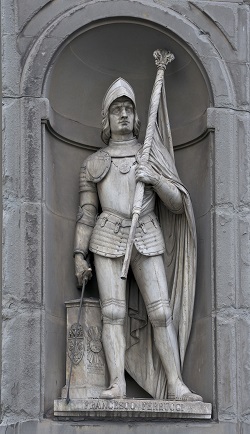
1530: Francesco Ferruccio, victim of Maramaldo

On this date in 1530, Francesco Ferruccio (or just Ferrucci) and his executioner Fabrizio Maramaldo clinched their immortality at the Battle of Gavinana.

The battle was the tragic final scene of the War of the League of Cognac, in which an alliance of Italian city-states tried to expel the Habsburg Holy Roman Emperor Charles V from the peninsula. Charles had already in effect decided matters by forcing the French out of the fight, which also brought about the capitulation of the Vatican.

Left alone in the fray, doughty Florence — ever so briefly at this moment restored as a Republic, having given the Medici the boot — continued to hold out against impossible odds. A vast imperial army swollen by landsknechts whose mercenary arms were now unnecessary elsewhere in Italy besieged Florence on October 24, 1529.


The Siege of Florence, by Tuscan Renaissance Man Giorgio Vasari.

The intrepid Florentine commander Francesco Ferruccio (English Wikipedia entry | Italian) strove to take his hopeless fight to the enemy. After a plan to coerce papal support by striking Rome was vetoed, Ferruccio mounted a march through the Apennines to threaten the Imperials’ rear.

He was intercepted at Gavinana, a battle decided by the arrival of landsknecht reinforcements under the command of the notoriously cruel condottiere Fabrizio Maramaldo.

Maramaldo would elevate himself for posterity out of the ranks of his merely brutal brethren by finding Ferruccio, badly wounded, his prisoner, and putting him to immediate death by his own hand — an execution that resulted in Florentine capitulation one week later, and the installation of Alessandro de’ Medici as Duke of the now ex-Republic.*

While admittedly borderline as an “execution” suitable for this here site, Ferruccio’s defiance in the face of his killer and his last denunciation of Maramaldo — “Coward, you kill a dead man!” — became the stuff of legend in a later Italy. (It also helped Ferruccio’s case for the nationalist pantheon that he died fighting against the Germans, not against the next city-state over.)

The romantic novelist Francesco Domenico Guerrazzi** made Ferruccio the subject of his magnum opus L’Assedio di Firenze, and before you knew it the name was on the lips of every risorgimento Tom, Dick and Francesco. Garibaldi invoked him in speech; Goffredo Mameli wrote him into the national anthem.


Every man has the heart
and hand of Ferruccio …

Under the Italian state those men helped to make, Ferruccio was appropriated as the name of a battleship; fascist Italy especially found Ferruccio congenial to the national-pride project and valorized the martyr relentlessly.


1930 Fascist Italy stamp depicting — for the 400th anniversary of the occasion — Fabrizio Maramaldo murdering his prisoner Francesco Ferruccio. Other Februccio stamps from the same period can be found on the man’s Italian Wikipedia page.

For Maramaldo, a less flattering but possibly more durable legacy: Italian gained the noun maramaldo, the adjective maramaldesco, and the verb maramaldeggiare to signify bullying or cruel domineering.

* Alessandro had a reputation for despotism, and was assassinated a few years later by his cousin Lorenzino de’ Medici in a tyrannicide that was Brutus-like in both its motivation and effect. That later affair is the subject of the 19th century play Lorenzaccio.

** Guerrazzi also did his bit for the legend of Beatrice Cenci.

On this day..