1795: Ignac Martinovics and the Magyar Jacobins

On this date in 1795, Ignac Martinovics was beheaded in Budapest with other leaders of a Hungarian Jacobin conspiracy.

A true Renaissance man, Ignac (Ignatius) Martinovics (English Wikipedia entry | the more detailed Hungarian) earned doctorates from the University of Vienna as both a scientist and a theologian.

He ditched a youthful commitment to the Franciscan order and went on a European tour with a Galician noble named Count Potoczki,* rubbing shoulders with the likes of Lalande and Condorcet.**

This journey stoked Martinovics’s political interests along with his scientific ones.

After spending the 1780s as a university instructor at Lwow, the ambitious scholar became the Austrian emperor’s “court chemist” — a position that got pegged back almost immediately upon Martinovics taking it by the 1792 death of the scientifically inclined Emperor Leopold II.

This at least gave Martinovics ample time to devote to his interest in the political secret societies coalescing in sympathy with the French Revolution. Despite his authorship of tracts such as Catechism of People and Citizens, his overall stance in this movement is debatable; Martinovics was also a secret police informant, and some view him as more adventurer than firebrand.

But the adventures would worry the Hapsburg crown enough for martyrs’ laurels.

Tiring of whatever gambit he was running in the imperial capital, Martinovics returned to Hungary and marshaled a revolutionary conspiracy by fraudulently representing himself as the emissary of the Parisian Jacobins.

About fifty Hungarian conspirators were arrested when this plot was broken up, resulting in seven executions. These “Magyar Jacobins” are still honored at Budapest’s Kerepesi cemetery.


(cc) image from Dr Varga József.

* A much later Count Potoczki was assassinated by a Ukrainian student named Miroslav Sziczynski (Sichinsky) in 1908, who was in turn death-sentenced for the murder. Sziczynski won a commutation, and was eventually released from prison, emigrated to the United States, and became a respectable statesman for the Ukrainian national cause.

** See Zoltan Szokefalvi-Nagy in “Ignatius Martinovics: 18th century chemist and political agitator,” Journal of Chemical Education, 41, no. 8 (1964).

† Martinovics’s chemistry experimentation in this period led him to oppose Lavoisier‘s theories of combustion. The two shared the same fate, whatever their differing hypotheses.

On this day..

1866: Mokomoko and the Maori killers of Carl Volkner

On this date in 1866, five Maori men hanged for the murder of a German proselytizer.

Hesse-born Carl Sylvius Völkner* arrived in New Zealand as a Lutheran missionary in 1849; by 1861, he was directing an Anglican-run mission at Opotiki, the center of Maori Te Whakatohea territory.

Unfortunately for Volkner, his mission to win souls overlapped with the British mission to win land.

This same early 1860s period saw a sharpening of the European-Maori conflict on the North Island where Volkner kept his mission — the bloodshed in turn fostering the militant Pai Marire or Hau Hau faith in place of the settlers’. Though the Te Whakatohea weren’t directly involved in this war, they had felt its effects: refugees, food shortages, disease outbreaks.

Volkner, who was seen by Maori as a pro-government character and a British spy,** was warned that under the fraught circumstances he might be wise to extend his most recent trip to Auckland indefinitely and wait for things to simmer down.

He did not heed that warning.

On March 2, 1865, the day after Volkner’s return to Opotiki, a group of Pai Marire hanged the missionary to a willow tree outside his Church of St. Stephen, then butchered the dead body.

The Pai Marire leader Kereopa Te Rau then preached from the church’s pulpit with Volkner’s severed head at his side, in the course of which he tore the eyeballs from his grisly prop and, calling one “the Queen” and the other “Parliament”, theatrically devoured them. (Kereopa Te Rau is nicknamed “Kai whatu”, “the eyeball eater”.)

Old eyeball eater would eventually hang for this display as well, but he avoided capture until the 1870s — so this narrative takes its leave of him here.

The slaughter of the European evangelist at the very steps of the protomartyr’s church in turn fired the fury of white New Zealand.

The most immediate response was the government’s landing 500 soldiers in Opotiki in September 1865. From there they raided throughout Te Whakatohea territory (confiscating some 240,000 hectares that would feed white settlers’ surging demand for real estate) and put crops to the torch until the tribe surrendered up some 20 chiefs for punishment of the Volkner affair.

Five of those eventually hanged for their participation: Heremita Kahupaea, Hakaraia Te Rahui, Horomona Propiti and Mikaere Kirimangu … and a man named Mokomoko who was then and remains now the most controversial execution of the bunch.

Mokomoko’s guilt was sharply disputed by eyewitnesses who gave conflicting accounts of whether he was even present at the church on March 2. It was Mokomoko’s rope that strangled Carl Volkner, but the man himself insisted that he was not present. (The three witnesses who placed him on the scene said he carried the rope, suggesting participation far exceeding a bystander.)

Maori tradition preserved Mokomoko as an emblem of wrongful persecution, along with his song Tangohia mai te taura i taku kaki kia waiata au i taku waiata (Take the rope from my neck that I may sing my song):

Violent shaking will not rouse me from my sleep
They treat me like a common thief
It is true that I embrace eternal sleep
For that is the lot of a man condemned to die.

Shielded from the harsh light
With narrow eyes I reflect on the retribution taken at Hamukete
Remember how I was taken on board ship (chained)
The memory of it burns me with shame.

Bring me justice from distant lands to break my shackles
Where the sun sets is a government in Europe
It is for them to say that I must hang
Then shut me in my coffin box.

Under pressure from Mokomoko’s descendants, latter-day New Zealand has made a number of gestures of apology for Mokomoko’s hanging over the past 20-odd years, culminating in a posthumous pardon.

* A copse of rocks sprouting out of New Zealand’s Bay of Plenty is named for our man — the Volkner Rocks, also known as Te Paepae o Aotea.

** He sent reports to the government about subversive activity.

On this day..

1559: The remains of David Joris, Anabaptist fugitive

On this date in 1559, the corpse of “Johann van Brugge” — recently exposed as underground Anabaptist leader David Joris, even though Brugge/Joris was three years dead — was burned in Basel.

The flame-bearded Joris (English Wikipedia entry | the more detailed Dutch) was a glass-painter by trade who came to the fore of the Anabaptist movement following its catastrophe at Muenster.

His home city of Delft in 1528 had flogged him and bored his tongue for his religious scruples, but Joris maintained a strong following among the re-baptized in that city. Many of those followers had occasion to try their faith against the torturers’ tongs, and dozens of arrestees impressively concealed their leader’s whereabouts from his enemies. The man’s own mother was executed in 1539.

He could only duck in and out of Delft — once he had to slip out in a basket innocuously loaded onto a boat* — or any other city. From the 1530s, his was a life on the run in Reformation Europe, where Anabaptists were no safer from Protestants than they were from Catholics.

(Sample dangerous heresy: Joris was a very early adopter of the idea that the devil was best understood as an allegorical figure, not an actual entity.)

With a literal price on his head he wandered to Strassburg, to England, back to the continent in Westphalia and Oldenburg, Strassburg again, then Antwerp, and on to Basel, Switzerland in 1544.

In Deventer in 1542 his ecstatic Wonder Boeck was printed. (We recommend the engravings.)

In Basel our hunted man was able to settle in as Brugge and live out the balance of his life, still pouring out voluminous writings in secret — a very impressive retirement considering his notoriety and his distinctive facial hair. Joris was in his fifties when he died: the years of rough living on the run had done him no favors.

Three years after his death, his son-in-law — who disagreed with Joris theologically — exposed his real identity. Basel had nothing left to do about it but to visit on his bones the punishment David Joris’s living flesh escaped to the end of his days.

* From Gary Waite’s “Staying Alive: The Methods of Survival as Practiced by an Anabaptist Fugitive, David Joris” in the January 1987 Mennonite Quarterly Review.

On this day..

1527: Johann Hüglin, Meersburg martyr

On this date in 1527, authorities in the Swabian city of Meersburg gathered in the city marketplace in their most impressive regalia to condemn Johann Hüglin to immediate execution.

Hüglin — this link is in German, like almost everything about him that’s available online — was a priest of peasant stock.

After the 1525 Peasants War, a rebellion against authority both secular and ecclesiastic, everyone got real nervous about stirrings of rebellion. Accordingly, a divine from nearby Überlingen had several priests of suspicious heterodoxy arrested early in 1527, Hüglin among them. The other three of these soon regained their safety with a timely expression of contrite fealty. Hüglin preferred obstinacy to submission.

Charged with heresy, and with dangerously promulgating same to the simple folk in his flock in sympathy with the recent rebellion, Hüglin defended himself in terms that were becoming recognizably out of bounds — defending the primacy of the Biblical text, for instance, to uphold unwelcome doctrines like tax resistance, salvation by faith alone, and priestly marriage.

“If the Holy Scripture says nothing of Purgatory, why should I say it?” he replied when pressed on that doctrine. “Is [the torture] I have suffered not Purgatory enough?”

One hopes so, for he was condemned that same day and immediately degraded out of the clergy and relaxed to the secular authorities for immolation on a ready-built pyre, which consumed him as he sang “Gloria in Excelsis” and “Te Deum Laudamus”.

Today in Meersburg there’s a street, Johannes-Hüglin-Weg, named for this Protestant martyr.

On this day..

1624: Antonio Homem, at the hands of the Portuguese Inquisition

On this date in 1624, Coimbra University theologian Antonio Homem was burned at the stake in a Lisbon auto de fe.

Homem came from a “neo-Christian” family, Jews who had been forced to convert to Christianity. Considering the compulsion, one could fairly question the piety of such “Christians”; in a great moment in damned-if-you-do, damned-if-you-don’t, the Spanish Inquisition fired up to probe the potential un-Christian activity of neo-Christians.

Neighboring Portugal was just a beat behind Spain in all this; Spain expelled its Jews — the ones who weren’t willing to convert — in 1492, and Portugal did so in 1497. The Portuguese Inquisition began in 1536 and, like Spain’s, took conversos as a primary focus.*

Homem’s family’s response was to be more Catholic than the Pope and have Antonio trained for the clergy; he became canon of the Cathedral of Coimbra and a doctor at the University of Coimbra.

Homem was in his fifties when it became known among his colleagues that he was of New Christian stock, and this circumstance soon attracted unwanted attention — and eventually, his denunciation for allegedly leading a secret Judaic cell. Homem, it is said, “often took the part of priest”; The Other Within: The Marranos, Split Identity and Emerging Modernity describes a Kippur ceremony from the Inquisition records.

The public, all fasting and dressed in white, used the Christian Bible (the Vulgate) to recite Latin Psalms that expressed a Jewish-Marrano sentiment (Psalms such as “When Israel came out of Egypt,” “On the rivers of Babylon,” and “From the Abyss I called you, O God”). In those ancient Jewish poems the Marranos expressed their own, specific sense of exile and yearning for redemption. A few “priests of the Law of Moses,” replicating a Catholic ceremony, dressed Homem in a long elegant garment and put “a sort of miter” on his head, decorated with golden plaque. There was an altar there, and incense, and painted images of Moses and of a Marrano martyr or saint “who had been … burned as a Jew.”

The inner life of the converso is a great riddle from our distance of time and context. It is immediately tempting to perceive religious martyrs here, people who were forced underground but still kept what they could of the faith of their fathers at risk of life and limb.

Such a reading paradoxically allies us with their persecutors, for it is by the Inquisition’s hand that we have the evidence — and this is a source whose evidence we greet very skeptically when it, for instance, charges conversos with murdering Christian children. Inquisitors all around Europe were after all involved in these very years in scaring up secret witches’ covens to incinerate, and it was not unknown for the deadly judicial apparatus to be borrowed here and there from restraining the minions of Hell in order to service business opportunities, political aspirations, or private grudges of the personal or professional variety. Try asking a present-day academic how easy they’d sleep knowing their colleagues on the tenure committee also had a few buddies in the Holy Inquisition.

Antonio Jose Saraiva’s The Marrano Factory: The Portuguese Inquisition and Its New Christians 1536-1765** contends that most “Judaizing” Christians were just plain Christians — caught up like accused witches and warlocks could be in some specious neighborhood rumor that became a self-fulfilling accusation. “Inevitably,” says Saraiva, “a family quarrel or a commercial intrigue would lead to several series of denunciations, followed by arrests. Arrests led to trials which spiraled into new rounds of arrests and trials.” Saraiva argues that Homem’s recently-exposed Jewish heritage probably just made him a ready target when a commercial dispute of some sort led the Inquisition’s Coimbra tribunal to seize “scores of merchants engaged in the triangular commerce between Brazil, Oporto and Amsterdam.”

Whether Homem really did head a covert cult with 100-plus adherents reading Old Testament verses from the Latin Bible — or whether this was what an inquisitor goaded by Homem’s enemies supposed a secret Jew might do — he was left to rot in prison several years† after his 1619 condemnation while the Inquisition investigated dozens of his alleged adherents. These included other cathedral canons, professors and students at the university, nuns from four nearby convents, and other persons of some stature. (Homem, to his credit, refused to accuse anyone else.)

Homem was eventually among eight burned (Portuguese link) at an auto this date at the Ribeira de Lisboa, and his house was torn down to be replaced with a pillar inscribed “Praeceptor infelix”. Prior to their destruction they were favored with the preachings of Friar Antonio de Sousa who railed against the insidious Semitic threat to homeland security.

For our sins of the last years people of quality have been cross-breeding with these perverse Jews to whom I am referring. They became corrupted by their contact with them and have become Jews like they are. Just a few years ago only low-class, trashy Jews were paraded at the autos-da-fe. See what now appears for sentencing in the autos-da-fe and in this very one at which I am preaching: ecclesiastical personnel, friars, nuns, holders of master’s degrees, licentiates, doctors and professors with family connections to the nobility, people only half of New Christian origin, or a quarter, or an eighth, all confessing and convicted of Judaism. (Translated excerpt via Saraiva)

Readers with Portuguese proficiency can find more on this case in this 1999 book exploring the Inquisition’s Coimbra archives, or in Antonio Homem e a inquisição.

* For the setting of this post, the 1620s, Spain and Portugal are under the personal union of a common monarch, Philip IV.

** We’ve mentioned it before.

† One of the great (and eventually fatal) inefficiencies of the auto-de-fe system was its tendency to leave its future exhibits to languish for years in prisons before the prescribed spectacle could be properly arranged.

On this day..

1471: Edward of Westminster, Prince of Wales, after the Battle of Tewkesbury

May 4, 1471 was the date of one of England’s most pivotal battles, Tewkesbury.

Tewkesbury was the last great victory in the War of the Roses for the House of York, and it must have seemed to contemporaries like the last victory Yorkists would ever need. The “kingmaker” Warwick was dead from a previous battle that April; the Lancastrian claimant Henry VI was imprisoned by the Yorkists, who would murder him before the month was out; and Henry’s heir apparent, the 17-year-old Prince of Wales, was put to death immediately after Tewkesbury.

Young Edward of Westminster had been stewing these past several years — until the aforementioned Kingmaker swung to his side — in exile in France, trying to finagle a way to rally the Lancastrian cause. Like many a teenager he was prone to nursing bilious fantasies of revenging himself on people, as the Milanese ambassador wrote in 1467.

This boy, though only thirteen years of age, already talks of nothing but of cutting off heads* or making war, as if he had everything in his hands or was the god of battle or the peaceful occupant of that throne.

“Peace” would not be the watchword of the abortive Lancastrian restoration attempt.

Shortly after returning to England, Edward had word of Warwick’s defeat. But having taken the trouble to come all this way from France, he still plowed ahead into the desperate stand at Tewkesbury. Edward had no experience at all in battlefield command.

When the Lancastrian lines broke at Tewkesbury, a disordered rout fled towards nearby Tewkesbury Abbey. The nobles who reached it would hole up there claiming the privilege of sanctuary … for just two days, at which point the victorious Yorkist King Edward IV had them arrested and put to swift execution, sanctuary be damned. (The abbey had to close to re-purify.)

Prince Edward didn’t even make it that long. There are varying accounts of his death at Tewkesbury suggesting a summary execution scenario of some kind.

In one version, the Duke of Clarence overtook him in flight. Clarence having himself briefly supported the rebellion before he returned to the Yorkist side, he’s supposed to have immediately beheaded the youth in a paroxysm of demonstrative loyalty.

Alternatively,

Prince Edward was taken as he fled towards the towne, by Sir Richard Crofts, and kept close … After the field was ended, proclamation was made, that whosoever could bring forth prince Edward alive or dead, should have an annuity of a hundred pounds during his life, and the princes life to be saved, if he were brought forth alive. Sir Richard Crofts, nothing mistrusting the kings promise, brought forth his prisoner prince Edward, being a faire and well proportioned young gentleman; whom when king Edward had well advised, he demanded of him, how he durst so presumptuously enter into his realm with banner displayed.

Whereunto the prince boldly answered, saying; “To recover my fathers kingdom and heritage, from his father and grandfather to him and from him after him to me lineally descended.” At which words king Edward said nothing, but with his hand thrust him from him, or (as some say) stroke him with his gauntlet; whom incontinently, George duke of Clarence, Richard duke of Gloucester, Thomas Grey marquess Dorset,** and William lord Hastings that stood by, suddenly murdered: for the which cruel act, the more part of the doers in their latter days drank of the like cup, by the righteous justice and due punishment of God.

Shakespeare dramatized this (considerably more dramatic — if admittedly less execution-like) version in Henry VI, Part 3.

Lancaster’s very dim (circa 1471) fortunes would ultimately be rescued in the 1480s by the grandson of a beheaded Welsh courtier — who won the throne as Henry VII and founded the Tudor dynasty.

* Edward as a seven-year-old was alleged to have been given the authority by his mother to decide what fate should befall the knights who had not successfully protected Henry VI from capture. Edward decreed their beheading.

** Ancestor of Lady Jane Grey.

On this day..

1813: Albrecht Ludwig von Berger and Christian Daniel von Finckh, Oldenburgers

On this date in 1813, the Napoleonic forces occupying Oldenburg, Germany shot Albrecht Ludwig von Berger and Christian Daniel von Finckh as rebels.

The Duchy of Oldenburg in northwest Germany could date its history back to the 12th century — but the end of its run was Napoleon’s takeover in 1810. This action helped break up France’s tenuous arrangement with Russia and lead to continental war, because the tsar’s sister was married to the Duke of Oldenburg. Russia had gone so far as to write Oldenburg’s sovereignty into its treaty with Napoleon.

The ultimate knock-on effects included France’s disastrous invasion of Russia and the collapse of Napoleon’s army.

As we meet Oldenburg in 1813, the French are headed the other way, harried by a vast European coalition. While the overall arc of this war bends towards French retreat, the situation at any given time and place was unpredictable, and Napoleon often gave better than he got.

Such uncertain circumstances offer martyrdom to the unlikeliest of characters. Berger and Finckh were just bureaucratic types, respectable figures in their own day whose peers’ bones presently molder unattended in the forlorn appendices of especially thorough genealogists.

But at a momentary nadir of French authority in Oldenburg in March 1813, local risings and the threat of Russian cavalry temporarily put the French administration to flight — leaving in its place a temporary administrative commission to which both Berger and Finckh belonged.

Had Oldenburg immediately fallen to the Sixth Coalition, that item would be a footnote to a treatise on governance in the duchy. Instead, the French regained authority and decided that our two principals were a little too subversively enthusiastic about running Oldenburg sans France. The notoriously hard-hearted commander Dominique Vandamme had them condemned at a court-martial on April 9, and the sentence put to execution the very next day. (The other commissioners got off with prison sentences.)

Little more than a year later, the two were posthumously rehabilitated by the restored dynasty of the post-French Grand Duchy of Oldenburg. Though minor figures in the scheme of things, every martyr pays the same coin; accordingly, the patriotic German might wish to spare a moment for the memorial to them in Oldenburg’s historic Gertrudenfriedhof cemetery.


Memorial to Berger and Finckh at Gertrudenfriedhof in Oldenburg, Germany. (cc) image from Corradox.

On this day..

1782: The Gnadenhutten Massacre

You recall the time when the Jesus Indians of the Delawares lived near the Americans, and had confidence in their promises of friendship, and thought they were secure, yet the Americans murdered all the men, women, and children, even as they prayed to Jesus?

Tecumseh, to William Henry Harrison in 1810

This date in 1782 marks one of the more appalling single atrocities in the United States’s long destruction of indigenous Native Americans — the Gnadenhutten Massacre.

This incident during the American Revolution took place in the Ohio River basin, a vast and fertile flashpoint whose part in not only the revolution but the antecedent French and Indian War perhaps entitles it to claim the midwifery of the coming American empire.

After victory in the French and Indian War, the British closed the area west of the Appalachian mountains to European settlement. This proclamation:

  • Made good a wartime pact Britain had made to secure the support of the Iroquois, Lenape (Delaware) and Shawnee tribes; and
  • Trailed facts on the ground the moment it was issued.

European settlements and land claims already existed in the supposed Indian Reserve, and land-hungry settlers did not let the supposed frontier deter them from advancing new ones. Confrontations between these arriving claimants and the native inhabitants not infrequently came to atrocious resolutions.

By 1768, a new treaty pushed the line further west, effectively ceding to the colonists everything south of the Ohio River — present-day Kentucky and West Virginia.*
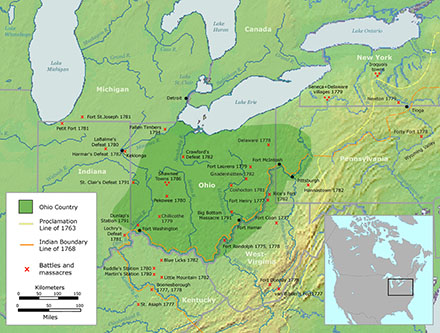

Map of the disputed area: the frontier moved from the yellow line along the Applachians to the orange line along the Ohio.

Ohio Country, the remaining territory in dark green shading north of the Ohio River, lay at the time of the American Revolution between the British garrison at Fort Detroit and colonial outposts along the nascent United States’s western marches, such as Fort Pitt (Pittsburgh).

The Lenape Indians in Ohio Country had a difficult calculation to make as to which side (if any) and how to support during the British-American fighting. The question split the Lenape internally.

In this cauldron, a strange morsel: Lenape who were Moravian** Christian converts had established a little missionary village. “Gnadenhutten” literally means “huts of grace”.

As one might imagine, Gnadenhutten and its sister settlements of pacifistic, Christian Lenape stood in a terribly ambiguous position in the brutal irregular war going on around them. Their fellow Lenape distrusted them because they were Christians; their fellow Christians, because they were Lenape.

Suspected by the British of being friendly enough with the American colonists to pass intelligence to their eventual murderers, these converts were in 1781 forced out of Gnadenhutten by British-allied Lenape to a new settlement aptly named “Captive Town”.

Starving there in the ensuing winter, the Moravians dispatched nearly 100 of their number back to Gnadenhutten to retrieve food abandoned at that settlement.

The Moravians were still at their village when a raiding party of Pennsylvanians descended on the town. Under no authority but the militiamen’s own festering grievances from the ongoing dirty war, the Pennsylvanians rounded up the Delaware and heartlessly declared their deaths.

Here were Indians who would pay for the violence Indians had done. And they were the best kind: the kind who didn’t fight back.

After spending a night praying and preparing for the end, the Moravian Lenape were systematically butchered on the morning of March 8† with mallet blows and scalpings.

Depending on your source, there were either 90 or 96 scalps to take that morning – women, men, and children in nearly equal proportions. At least one young boy survived the death squad and reported the massacre. Nor were all the militia themselves at peace with their deed.

one Nathan Rollins & brother had had a father & uncle killed took the lead in murdering the Indians, & Williamson was opposed to it; & Nathan Rollins had tomahawked nineteen of the poor Moravians, & after it was over he sat down & cried, & said it was no satisfaction for the loss of his father & uncle after all. — So related Holmes Jr. who was there — who was out on both Moravian campaigns, & Crawford’s. (Source)

Ah, Crawford’s campaign.

Later in 1782, another expedition of frontiersmen under Col. William Crawford set out “to destroy with fire and sword” a different Lenape settlement in Ohio. Instead, the Lenape met and routed the expedition, taking Crawford prisoner. He and the other captives from that misadventure would be burned to death, in part to avenge Gnadenhutten.

This, and whatever like tit for tat could be exacted in the field, was all the justice the Lenape could ever hope to have for the hecatomb of Gnadenhutten. American authorities declined to prosecute or sanction any members of the militia.


“Here triumphed in death ninety Christian Indians March 8, 1782”: inscription at the base of a memorial obelisk in Gnadenhutten. (cc) image from Mike Drabik.

* This might have been a nice solution, except that said treaty was made by the Iroquois — and only the Iroquois. For the Shawnee who actually lived and hunted in this cessation, this was two outside powers bartering their land. They didn’t mean to give it up on the say-so of the Iroquois. Another nasty frontier war followed, and even when that was won by Virginian militia, dissatisfied Shawnee continued targeting settlements in Kentucky; it’s partly for this reason that the Declaration of Independence slates King George III with having “endeavoured to bring on the inhabitants of our frontiers, the merciless Indian Savages whose known rule of warfare, is an undistinguished destruction of all ages, sexes and conditions.”

For more on the long and tragic Shawnee struggle in this period, see “‘We Have Always Been the Frontier’: The American Revolution in Shawnee Country” by Colin G. Calloway in American Indian Quarterly, Vol. 16, No. 1 (Winter 1992).

** The Moravian Church‘s name harkens to its Czech origins. It’s a successor to the reform tradition of Jan Hus.

† There are a few cites out there for the day before or the day after March 8.

On this day..

1687: The first of the Martyrs of Eperjes

On this date in 1687, the Austrian empire made the first of its many Protestant martyrs in Eperjes — the Hungarian name for the city now in Slovakia, where it is known as Prešov.

In the wake of the unsuccessful Zrinski-Frankopan Hungarian conspiracy against Hapsburg absolutism, the arch-Catholic Holy Roman Emperor Leopold did some cracking down.

Leopold suspended the Hungarian constitution and rounded up Protestant pastors, who “were not executed, but the choice of those convicted was between recantation and serving as galley slaves.” (Source)

Rough handling pushed the most aggrieved Hungarians into outright revolt in the 1670s, eventually led by the nobleman Imre Thököly.*

Thokoly enjoyed fantastic success, carving by force of arms a Principality of Upper Hungary roughly corresponding to present-day Slovakia. Squeezed as he was between the great powers of the Holy Roman Empire and the Ottoman Turks, Thokoly allied himself with Sultan Mehmed IV and aided the Turks’ 1683 siege of Vienna.

That meant that his followers would share the downfall of that enterprise.

After the siege was thrown off, Thokoly’s rebellion was gradually quashed, culminating in a 1685 battle at Presov — one of Thokoly’s major bastions. (Hungarian link)

Thereafter, Thokoly himself would be a ward of the Ottomans, alternately a prisoner or a vassal captain in the field. (He would briefly establish himself as Prince of Transylvania with Ottoman backing in 1690.)

Pope John Paul II and Evangelical bishop Jan Midriak prayed together at a monument to the Presov martyrs in 1995.(cc) image from Jozef Kotulic.

For Presov and those misfortunate enough to be caught there, matters were worse.

The Hapsburg military governor of the former rebel territory, Antonio Caraffa, set up a star chamber to deliver some harsh justice.

From February 1687, Presov Protestants trying to raise money to re-establish war-damaged schools were accused of conspiring to rise again and subjected to a series of torture-driven show trials.

The first four of these, Sigmund Zimmermann, Caspar Rauscher, Andreas Keczer and Franz Baranyay, were beheaded and quartered on March 5, 1687. All told, some two dozen would die over the course of 1687 in this hunt, most of them on the scaffold — the Martyrs of Eperjes. (German link.)


Statue of Imre Thokoly at Budapest’s Heroes’ Square. (cc) image from Hungarian Snow.

On this day..

1943: France Bloch-Serazin, bombmaker

On this date in 1943, French resistance heroine France Bloch-Serazin was executed by the Germans in Hamburg.

Bloch-Serazin English Wikipedia entry | French) was a Jewish Communist who had supported the Spanish Republican cause, so she was right in line for some official persecution after the Germans blitzed France.

No longer employable as a chemist, she put her training to good use manufacturing explosives in her apartment. (Today, a plaque in the 19th arrondissement marks the building.)

Arrested by French police on May 16, 1942, she was condemned to death by a German military court but deported to Germany to suffer that punishment. Her husband, Fredo Serazin, was subsequently murdered by the Gestapo in prison.

As France Bloch-Serazin was born in 1913, she has recently enjoyed a renewed appreciation around the centennial of her birth, including the homage (French link) of her native city of Poitiers.

On this day..