39: Gnaeus Cornelius Lentulus Gaetulicus, erotic poet

On an uncertain date likely around early October* in 39 A.D., former Roman Consul Gnaeus Cornelius Lentulus Gaetulicus (not to be confused with Publius Cornelius Lentulus) was executed at the order of Caligula for his part in some sort of plot long lost to history.

In his public life, Gaetulicus was a Machiavellian politician connected to the fallen Praetorian Guard captain Sejanus (their kids were at one point engaged to be married). He evidently survived the post-Sejanus purge with an adroit bit of written diplomacy to the Praetorian’s patron-cum-executioner the Emperor Tiberius, tactfully pointing out that the Emperor had made the same errant choice of alliance. Thus did Gaetulicus retain both his head and his career.

After a decade milking his German province, and Tiberius shuffled off the mortal coil and young Caligula now ruling the empire, Gaetulicus seemingly** involved himself in something treasonable with Marcus Aemilius Lepidus, the latter a recent fave of Caligula and briefly his designated heir.

Or, if you credit scandal-mongering Roman historian Cassius Dio‘s description of the Emperor’s deadly northward road trip, he did it out of some whim of rivalry or opportunity for pecuniary advantage.

Gaius had now spent practically all the money in Rome and the rest of Italy, gathered from every source from which he could in any way get it, and as no source of revenue in considerable amount or practicable to collect could be found there, and his expenses were pressing him hard, he set out for Gaul, ostensibly because the hostile Germans were stirring up trouble, but in reality with the purpose of exploiting both Gaul with its abounding wealth and Spain also. However, he did not openly announce his expedition beforehand, but went first to one of the suburbs and then suddenly set out on the journey, taking with him many actors, many gladiators, horses, women, and all the other trappings of luxury. When he reached his destination, he did no harm to any of the enemy — in fact, as soon as he had proceeded a short distance beyond the Rhine, he returned, and then set out as if to conduct a campaign against Britain, but turned back from the ocean’s edge, showing no little vexation at his lieutenants who won some slight success — but upon the subject peoples, the allies, and the citizens he inflicted vast and innumerable ills. In the first place, he despoiled those who possessed anything, on any and every excuse; and secondly, both private citizens and cities brought him large gifts voluntarily, as it was made to appear. He murdered some men on the ground that they were rebelling, and others on the ground that they were conspiring against him; but the real complaint was one and the same for the whole people — the fact that they were rich. By selling their possessions himself, he realized far greater sums than would otherwise have been the case; for everybody was compelled to buy them at any price and for much more than their value, for the reasons I have mentioned. Accordingly, he sent also for the finest and most precious heirlooms of the monarchy and sold them off by auction, selling with them the fame of the persons who had once used them. Thus he would make some comment on each one, such as, “this belonged to my father,” “this to my mother,” “this to my grandfather,”, “this to my great-grandfather,” “this Egyptian piece was Antony’s, the prize of victory for Augustus.” At the same time he also explained the necessity of selling them, so that no one could persist in pretending to be poor; and thus he made them buy the reputation of each article along with the thing itself.

In spite of all this he did not secure any surplus, but kept up his customary expenditures, not only for other objects that interested him — exhibiting, for example, some games at Lugdunum — but especially for the legions. For he had gathered together two hundred thousand troops, or, as some say, two hundred and fifty thousand. He was acclaimed imperator by them seven times, as his whim directed, though he had won no battle and slain no enemy. To be sure, he did once by a ruse seize and bind a few of the foe, whereas he used up a large part of his own force, striking some of them down one at a time and butchering others then masse. Thus, on one occasion, when he saw a crowd of prisoners or some other persons, he gave orders in the famous phrase, that they should all be slain “from baldhead to baldhead.” At another time he was playing at dice, and finding that he had no money, he called for the census lists of the Gauls and ordered the wealthiest of them to be put to death; then, returning to his fellow-gamesters, he said: “Here you are playing for a few denarii, while I have taken in a good one hundred and fifty millions.” So these men perished without any consideration. Indeed, one of them, Julius Sacerdos, who was fairly well off, yet not so extremely wealthy as to become the object of attack on that account, was slain simply because of a similarity of names. This shows how carelessly everything was done. As for the others who perished, there is no need of my naming over most of them, but I will mention those of whom history requires some record. In the first place, then, he put to death Lentulus Gaetulicus, who had an excellent reputation in every way and had been governor of Germany for ten years, for the reason that he was endeared to the soldiers. Another of his victims was Lepidus, that lover and favourite of his, the husband of Drusilla, the man who had together with Gaius maintained improper relations with the emperor’s other sisters, Agrippina and Julia, the man whom he had allowed to stand for office five years earlier than was permitted by law and whom he kept declaring he would leave as his successor to the throne. To celebrate this man’s death he gave the soldiers money, as though he had defeated some enemies, and sent three daggers to Mars Ultor in Rome. He deported his sisters to the Pontian Islands because of their relations with Lepidus, having first accused them in a communication to the senate of many impious and immoral actions. Agrippina was given Lepidus’ bones in an urn and bidden to carry it back to Rome, keeping it in her bosom during the whole journey.

It’s a pity that the details of this affair, whatever they were, have been lost to history. The History of Rome podcast treats this episode among a review of Caligula’s gnarly reign

According to Post-Augustan Poetry, Gaetulicus

was consul in 26 A.D., and for ten years was legatus in Upper Germany, where his combination of firmness and clemency won him great popularity. He conspired against Caligula while holding this command, and was put to death. Pliny the younger speaks of him as the writer of sportive and lascivious erotic verse, and Martial writes of him in very similar terms. His mistress was named Caesennia, and was herself a poetess.

Only a fragment (which I have not been able to locate online) of a Latin verse describing Britain remains affirmatively attributed to this poet, though he is sometimes speculatively identified with the “Gaetulicus” to whom some epigrams in the Greek Anthology (or “Palatine Anthology”) are attributed e.g.

TO APHRODITE EUPLOIA

Guardian of the seabeach, to thee I send these cakes, and the gifts of
a scanty sacrifice; for to-morrow I shall cross the broad wave of the
Ionian sea, hastening to our Eidothea’s arms. But shine thou
favourably on my love as on my mast, O Cyprian, mistress of the bride-
chamber and the beach.

* Date ballparked by public sacrifices offered in Rome on October 27 “to mark the exposure of the evil plots of Gnaeus Lentulus Gaetulicus against Gaius Germanicus.” (Agrippina: Sex, Power, and Politics in the Early Empire, which speculates at some length on what the dimensions of a Gaetulicus plot might have been.)

** Though Lepidus was executed at about the same time, and Cassius Dio suggests a connection, it’s not completely clear that they conspired together. Since Cassius Dio (and Suetonius, who also connects them in Life of Claudius), wrote generations after the events themselves, we want for dependable information.

On this day..

1898: The Six Gentlemen of the Hundred Days’ Reform

This afternoon in 1898, six liberals got the chop for their hopeless attempt to give a tottering empire the reforms it desperately needed.

The Hundred Days’ Reform — actually 103 days, from June 11 to September 21 — marked the attempt by China’s Guangxu Emperor to implement a far-reaching modernization programme backed by forward-thinking officials with a mind to correct China’s supine position vis-a-vis the West, and even vis-a-vis its neighbors.

“Reform has never come about in any country without the flow of blood. No one in China in modern times has sacrificed himself for the cause of reform, and because of this China is still a poor and backward country. Therefore, I request that the sacrifices begin with myself.” –Tan Sitong

The Wuxu Constitutional Reform still stands as the great attempt made by Chinese progressives who tried to follow the example of the modern powers in order to save China from extinction. Represented by Kang Youwei and Liang Qichao, the bourgeois reformists were imbued with the spirit of national salvation; they carefully set about designing a blueprint for a constitutional monarchy based on the example of Western countries. They advocated the establishment of parliament and a national conference, and wanted to see honest and fair-minded people with the courage to criticize authority installed in a position of power. National policies should be discussed by the monarch and the people. They also wanted a constitution to stipulate the rights and obligations of the monarch, officials, and the people. The constitution was to be the highest code for all people in the country. They also wanted to establish a system featuring a tripartite balance of forces: parliament was to legislate, the magistracy to deal with issues of justice, the government with administration. All of these would be under the monarch.

The constitutional reform was to take place with radical intellectuals submitting their memoranda to Emperor Guang Xu, who alone had the power to promulgate them. The feudal diehards being in a position of strength and the national bourgeoisie being weak, however, the new politics survived no more than 100 days or so. When the forces of reaction inevitably clamped down on the movement, the six reformists who had inspired the movement for constitutional reform met their deaths like heroes.

Although sincere in its aspirations, the reform movement was bound to fail, as it depended on a reform “from top to bottom”, which ultimately had to be enacted by the emperor. The Hundred Days’ Constitutional Reform, however, remains a landmark event in the modern history of China, its failure notwithstanding. The Chinese bourgeoisie in fact succeeded in spreading democratic and constitutionalist ideas widely, and this had a significant effect on future generations. The political and legal theory of the Western bourgeoisie could now take root in the soil of China.*

The emperor’s Machiavellian conservative aunt, the Empress Dowager Cixi, who had been the power behind the Chinese throne since 1861, made the sure reform didn’t see two hundred days with a “coup” that didn’t formally overthrow the Emperor — just made him irrelevant.

Troublemakers further down the food chain didn’t get off so easily.

Kang Youwei, the reform movement’s chief exponent, escaped to Japan. Six others suffered the wrath of the Dowager Empress: Kang Guangren (Kang Youwei’s brother), Lin Xu, Yang Shenxiu, Yang Rui and Liu Guangdi … along with the young reformer Tan Sitong, who notably refused imprecations to flee arrest.

The sword’s blade across my neck,
I look toward heaven — laughing.
-Etched on a prison wall, allegedly by Tan Sitong


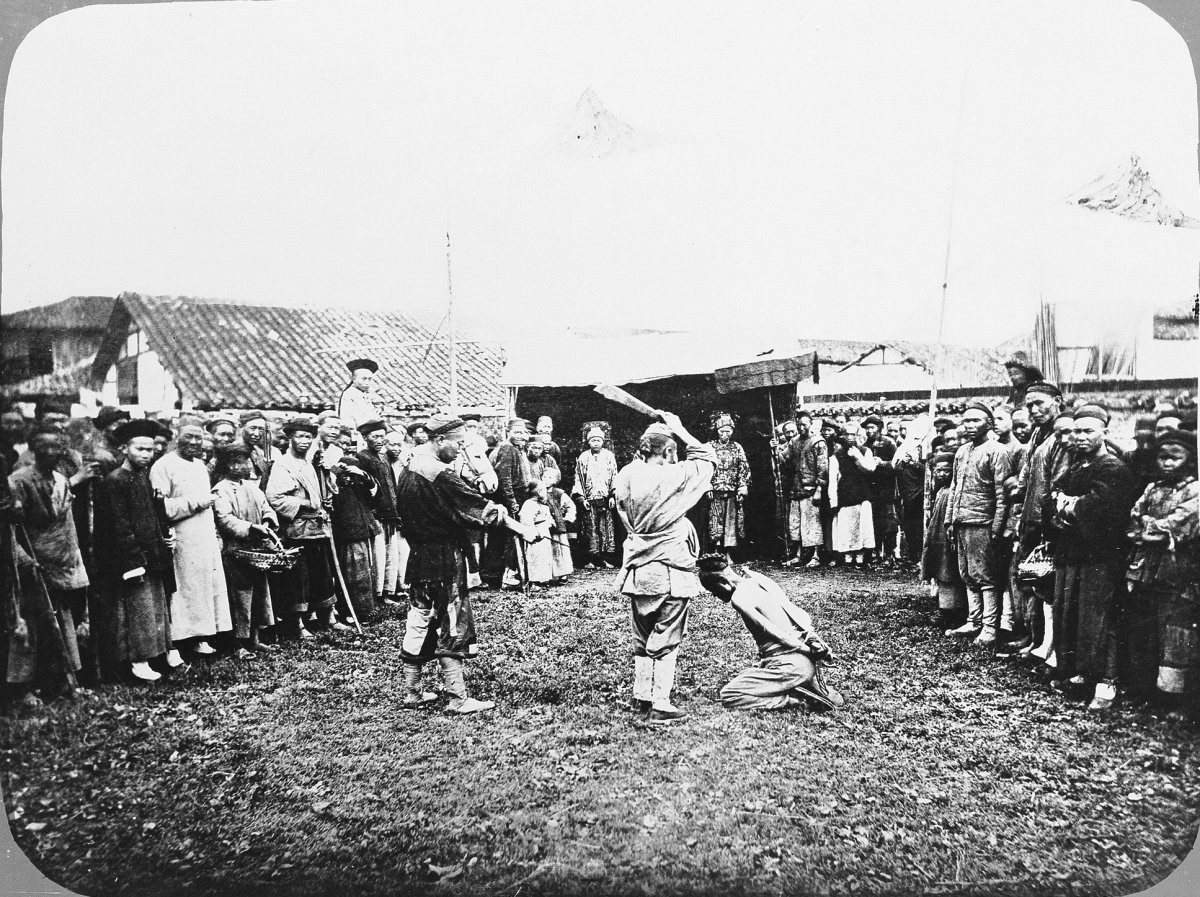
Photo of an unspecified 1867 Qing beheading in Canton.

* “The Chinese Legal Tradition and the European View of the Rule of Law” by Wu Shu-Chen in The Rule of Law History, Theory and Criticism, Part VI.

On this day..

1996: Dr. Mohammad Najibullah

On this date in 1996, the man who once ruled ruled Afghanistan under the aegis of a superpower succumbed to the tender mercies of his country’s fundamentalist insurgency.

Mohammad Najibullah was the last president of the Soviet-backed Democratic Republic of Afghanistan. Unfortunately for Najibullah, he was on the job when Moscow decided to throw in the towel on the Soviet-Afghan War.

After losing the subsequent civil war, the former President was trapped for a nervous few years in Kabul — blocked from joining his family in flight to India by the offices of former Soviet client and present-day American client Abdul Rashid Dostum.

When Kabul finally surrendered to the Taliban in 1996, the hated onetime Communist viceroy — whose stepping-stone to that post was heading the hated Afghan secret police — had a problem.

At the instigation of future Taliban second-in-command Mohammad Rabbani, Najibullah and his brother were hauled out of the U.N. compound where they had taken refuge, publicly beaten, tortured and castrated, and strung up on a traffic barricade.

There was a new sheriff in town.


On this day..

1961: Adnan Menderes

On this date in 1961, the Turkish Prime Minister deposed in the previous year’s military coup was hanged at the island of Imrali.

Condemned at the same trial as his comrades in government,* Adnan Menderes delayed his execution with an unsuccessful suicide bid. Revived from a sleeping pill-induced coma, the gag about Istanbul was that he would soon be fit enough to hang.

Twenty-four hours and one involuntary stomach-pumping later, and he was.

The 62-year-old Smyrna/Izmir native had had a memorable run. He served in Ataturk’s army, then toppled Ataturk’s political party: Menderes won the first three free elections in Turkey in 1950, 1954, and 1957, a feat never since replicated. He was notorious for his temper and sensitivity to criticism, reportedly given to smashing things in his office and demonstrably given to firing ministers and aides for even trifling differences of opinion. Just months before his ouster, he’d survived a plane crash in England — “the former Premier,” observed the New York Times,** “might have gone down in Turkish history as a great patriot and champion of the people” if he had died in it.

His ignominious end didn’t blacken his name to posterity. Years later, he (and the officials who preceded him to the gallows) was posthumously pardoned and reburied in an Istanbul mausoleum. Today, he’s so far from public opprobrium that his name can be found on public accommodations like airports and ferries

There’s more information about Menderes available online in Turkish, including this biography and this film:

* Among the co-defendants also condemned but reprieved was Mahmut Celal Bayar, President of the Republic of Turkey. Bayar died in 1986 at age 103, supposedly the longest-lived head of state or head of government in all of history.

** September 17, 1961.

Part of the Daily Double: Turkey’s “Left-Wing Coup”.

On this day..

1961: Fatin Rustu Zorlu and Hasan Polatkan

On this date in 1961, two former Turkish ministers of state were hanged together on the island of Imrali.*

A ten-month trial on the island of Yassiada had ended just the previous day, condemning 15 to death; 12 sentences were commuted, leaving only the biggest fish to fry.

Zorlu, the former Foreign Minister, and Polatkan, late the Finance Minister, were both implicated in the financial crimes often characteristic of high office. Zorlu was also condemned for helping instigate a notorious 1955 anti-Greek riot. The two were helicoptered to Imrali for a pre-dawn hanging.

Zorlu, at least, was reported to have died game. He helped slip the noose over his own neck, and at his hanging “asked that he be allowed to kick away the chair himself. Permission was granted.” (Los Angeles Times, September 18, 1961)

* Tangentially, the prison on Imrali is the one American drug-smuggler Billy Hayes subsequently escaped from. Hayes went on to write Midnight Express, later adapted for the silver screen by Oliver Stone.

Part of the Daily Double: Turkey’s “Left-Wing Coup”.

On this day..

1842: Francisco Morazan, Central American statesman

On this date in 1842, church bells throughout Central America tolled in celebration of the death by firing squad of the great liberal statesman Francisco Morazan.

Morazan monuments litter Central America. Colombian writer Gabriel Garcia Marquez once claimed (he later backed away from it) that this equestrian job in Tegucigalpa, Honduras was actually a remaindered statue of Napoleonic general Michel Ney.

The self-educated soldier and politician rose to helm the short-lived Federal Republic of Central America after it broke free of Spain (and a brief hitch with Mexico) but before it splintered into Guatemala, Honduras, Nicaragua, El Salvador and Costa Rica.

After beating conservative forces in the field, Morazan forced upon them a slate of liberal reforms that had the knives out for him for a decade-plus: free speech, civil equality, separation of church and state guaranteed by the expulsion of clergy. As this patronizingly favorable biography from the late 19th century wrote,

His ambition was for the advancement and development of Central America; and while the means he used cannot be entirely approved, his purpose should be applauded. His crusade was quite as important in the civilization of this continent as the bloody work England attempted to accomplish in Egypt and the Soudan. He was better than his race, was far in advance of his generation …

Thanks, racist uncle.

Anyway, the Federal Republic fell apart in the late 1830s as its constituent statelets broke apart and the familiar conservatives-landowners-priests coalition started getting the upper hand on Morazan. After an 1842 landing that briefly established him as ruler of Costa Rica (he had also had shifts as the head of state of El Salvador and of Honduras), he overreached with an announcement for universal conscription to form an army that would reunite the Central American state.

“Posterity,” he said before the bullets felled him, “shall do us justice.”

On this day..

1941: Olga Kameneva, Christian Rakovsky, Maria Spiridonova and many others by the NKVD

On this date in 1941, as Nazi armies surged into the USSR, the Soviet NKVD summarily executed a reported 157 prisoners held in the soon-to-be-Nazi-occupied city of Oryol (Orel).


Kameneva (top), Rakovsky (middle) and Spiridonova.

Most prominent among them were:

  • Olga Kameneva, a pol in the 1920’s, she was the sister of recently-murdered Communist heretic/Stalin gadfly Leon Trotsky, and she was the widow of executed Old Bolshevik Lev Kamenev.
  • Christian Rakovsky, internationalist Bulgarian revolutionary turned Soviet diplomat. Rakovsky, Dmitry Pletnyov and Sergei Bessonov had been the only three to avoid execution at the Trial of the 21, one of Stalin’s red-letter purges. But all three were shot together this day.
  • Prominent Left SR Maria Spiridonova, a revolutionary who had taken four decades of beatings from tsarist and Bolshevik alike, and who Emma Goldman saluted as “one of the most sincere, well-poised, and convincing” opponents of the Soviet regime.

Many other political transgressors less memorable than these went along with them, leftover targets of opportunity from a generation’s internecine purges and counterpurges.

Why bother to spend the resources evacuating an enemy of the people? By this time, Operation Barbarossa was nearly three months old, and mass prisoner executions ahead of the advancing Germans were a practiced art. One difference this day: this hecatomb was not in the western Soviet Republics, but in Russia proper.

In the autumn of 1941, the Left SRs Spiridonov, Izmailovich, and Mayorov, the Maximalist Nestroyev, and the SR Timofeyev were among the 157 prisoners shot in the Medvedevsky woods. (A Century of Violence in Soviet Russia

As many of them might have been denounced as “fascist” in their time for not hewing the correct revolutionary line, one doubts they would have enjoyed any more comfortable treatment at the hands of the Wehrmacht, which overran Oryol on Oct. 3.

On this day..

2007: Duan Yihe, mistress-murderer

On this date in 2007, former senior Chinese lawmaker Duan Yihe was executed in Jinan along with the policeman nephew who had helped him spectacularly assassinate Duan’s mistress just two months before.

Taking up with a teenager 30 years his junior must have been an appealing perk of the job when Duan Yihe was a rising official in the early 1990’s.

Fast forward 14 years, and he’s in for several cars, a couple of apartments, and tired of the now 31-year-old Liu Haiping, who’s blackmailing him for more. Much less appealing.

Solution?

Why, detonate a remote-controlled explosive in her car.

“The blast was so powerful that her Honda sedan was ripped apart, her lower body was destroyed and her torso landed 30 metres away,” reported The Times.

The case helped crystallize growing official concern with the corrupting potential of senior officials’ ubiquitous mistresses. The day before the car-bombing, the Chinese Supreme Court issued a ruling extending anti-graft laws to mistresses.

The method of execution (either gunshot or — more likely — lethal injection) was not publicized.

On this day..

1944: Ernst Thälmann, German Communist

On this date in 1944, German Communist Ernst Thälmann was shot at the Buchenwald concentration camp.

A true proletarian turned proletarian leader (and reliable adherent to Moscow’s line), Thalmann stood for election to the German presidency no the Communist Party ticket against Hindenburg and Hitler in 1932 (he’d also run in 1925).

Hitler wasn’t a very good winner.*

The Gestapo nabbed Thalmann in its sweep for leftists following the Reichstag Fire. Eleven years he waited in prison — being tortured, naturally — for his turn on the stage of a show trial. Or any trial at all.

It never took place.

Instead, the Weimar Communist leader languished in detention as the horror of Naziism swallowed Germany, with nothing to give the anti-fascist cause but his name — here adopted by a Spanish Civil War battalion.

We have such cinematic treatment of the man because after the war, the legitimately proletarian, demonstrably antifascist, ideologically unsullied, and conveniently dead Thalmann made ideal material for the Communist East German state’s national pantheon.

The myth employed all of the media available to a modern industrialized state. In addition to the scholarship produced by professional historians, popular works with a similar agenda also appeared. Irma, the slain party leader’s daughter, wrote a biography of her father intended for children. Max Zimmering wrote one of several children’s novels about Thalmann, and East German poets lionized the martyred communist leader. … Thalmann memorials were built, and membership in the SED’s youth organization, the Free German Youth (FDJ), began with the Thalmann Pioneers. Finally, Thalmann’s life was the topic of several films and television movies, the most important being the two features, Ernst Thalmann – Sohn seiner Klasse (Ernst Thalmann – Son of His Class, 1954) and Ernst Thalmann – Fuhrer seiner Klasse (Ernst Thalmann – Leader of His Class, 1955).

And something else, too: a barely-there Caribbean island ceremonially gifted to East Germany by Cuba in 1972. Is it the last outpost of the German Democratic Republic?

* Yes, this is glib; Hindenburg, not Hitler, won the 1932 election. However, the Nazis’ plurality victory in that year’s Reichstag election also gave Hitler the juice to demand the Chancellorship and set himself up to wield total power in Germany. Whatever the ballot boxes on any particular day had to say, Hitler obviously won the early 1930’s.

On this day..

1628: Johannes Junius “will never see you more”

On this date in 1628 was burned in Bamberg (former) Burgomaster Johannes Junius, a civic official caught up in the frenetic witch-hunts of Bavaria in the Thirty Years’ War.

Fellow townspeople under torture accused him; Junius eventually did the same, copping to the stock stuff witch trials knew just how to use:

there had come to him a woman like a grass-maid … And thereafter this wench had changed into the form of a goat, which bleated and said, “Now you see with whom you have had to do. You must be mine or I will forthwith break your neck”. Thereupon he had been frightened, and trembled all over for fear. Than the transformed spirit had seized him by the throat, and demanded that he should renounce God Almighty, whereupon Junius said, “God help me”, and thereupon the spirit vanquished through the power of these words. Yet it came straightway back, brought more people with it, and persistently demanded of him that he renounce God in Heaven and all the heavenly host, by which terrible threatening he was obliged to speak this formula: “I renounce God in Heaven and his host, and will henceforward recognize the Devil as my God”.

After the renunciation he was so far persuaded by those present and by the evil spirit that he suffered himself to be baptized by the devil in the evil spirit’s name. The Morhauptin had given him a ducat as dower-gold, which afterward became only a potsherd.

He was then named Krix. His succubus was called Vixen (Füchsin). Those present had congratulated him in Beelzebub’s name and said that they were now all alike.

Etc.

What survives of him among the thousands of similar unfortunates is the illicit letter in his own hand describing those tortures in detail … a reminder (regrettably current) of the reality of crippled limbs and ripped flesh and the meager limits of human hardiness that surround a word like “torture”.

July 24, 1628

Many hundred thousand good-nights, dearly beloved daughter Veronica. Innocent have I come into prison, innocent have I been tortured, innocent must I die. For whoever comes into the witch prison must become a witch or be tortured until he invents something out of his head and – God pity him – bethinks him of something.

I will tell you how it has gone with me.

When I was the first time put to the torture, my brother-in-law, Dr. Braun, Dr. Kotzendorffer, and two strange doctors were there. Then Dr. Braun asks me; “Kinsman, how come you are here?” I answer, “Through falsehood and through misfortune”. “Hear, you,” he retorts, “you are a witch. Will you confess it voluntarily? If not, we’ll bring in witnesses and the executioner for you”. I said, “I am no witch; I have a pure conscience in the matter. If there are a thousand witnesses, I am not anxious, but I’ll gladly hear them”.

Then the Chancellor’s son was set before me, who said he had seen me. I asked that he be sworn and legally examined, but Dr. Braun refused it. Then the Chancellor, Dr. George Haan, was brought, who said the same as his son. Afterward Höppfen Ellse. She had seen me dance on Hauptsmorwald, but they refused to swear her in. I said: “I have never renounced God, and will never do it – God graciously keep me from it. I’ll rather bear whatever I must”.

And then came also – God in highest Heaven have mercy – the executioner, and put the thumbscrews on me, both hands bound together, so that the blood spurted from the nails and everywhere, so that for four weeks I could not use my hands, as you can see from the writing.

Thereafter they stripped me, bound my hands behind me, and drew me up on the ladder. Then I thought heaven and earth were at an end. Eight times did they draw me up and let me fall again, so that I suffered terrible agony. I said to Dr. Braun, “God forgive you for thus misusing an innocent and honorable man”. He replied, “You are a knave”.

And this happened on Friday, June 30, and with God’s help I had to bear the torture. When at last the executioner led me back into the cell, he said to me, “Sir, I beg you, for God’s sake, confess something, whether it be true or not. Invent something, for you cannot endure the torture which you will be put to; and, even if you bear it all, yet you will not escape, not even if you were an earl, but one torture will follow another until you say you are a witch. Not before that,” he said, “will they let you go, as you may see by all their trials, for one is just like another”.

Then came George Haan, who said the commissioners had said the Prince-Bishop wished to make such an example of me, that everybody would be astonished.

And so I begged, since I was in wretched plight, to be given one day for thought and a priest. The priest was refused me, but the time for thought was given. Now, my dearest child, see in what hazard I stood and still stand. I must say that I am a witch, though I am not – must now renounce God, though I have never done it before. Day and night I was deeply troubled, but at last there came to me a new idea. I would not be anxious, but, since I had been given no priest with whom I could take counsel, I would myself think of something and say it. It were surely better that I just say it with mouth and words, even though I had not really done it; and afterwards I could confess it to the priest, and let those answer for it who compel me to do it . . . And so I made my confession, as follows; but it was all a lie.

Now follows, dear child, what I confessed in order to escape the great anguish and bitter torture, which it was impossible for me longer to bear.

Then I had to tell what people I had seen (at the witch sabbat). I said that I had not recognized them. “You old knave, I must put the torturer at your throat. Say – was not the Chancellor there?” So I said yes. “Who besides?” I had not recognized anybody. So he said: “Take one street after another. Begin at the market, go out on one street and back on the next”. I had to name several persons there. Then came the long street (die lange Gasse). I knew nobody. Had to name eight persons there. Then the Zinkenwert – one person more. Then over the upper bridge to the Georgthor, on both sides. Knew nobody again. Did I know nobody in the castle – whoever it might be, I should speak without fear. And thus continuously they asked me on all the streets, though I could not and would not say more. So they gave me to the torturer, told him to strip me, shave me all over, and put me to the torture. “The rascal knows one on the market-place, is with him daily, and yet won’t name him”. By this they meant Burgomaster Dietmeyer: so I had to name him too.

Then I had to tell what crimes I had committed. I said nothing. . . “Hoist the knave up!” So I said that I was to kill my children, but I had killed a horse instead. It did not help. I had also taken a sacred wafer, and had buried it. When I had said this, they left me in peace.

Now, dearest child, here you have all my acts and confession, for which I must die. And they are sheer lies and inventions, so help me God. For all this I was forced to say through dread of the torture beyond what I had already endured. For they never leave off with the torture till one confesses something; be he ever so pious, he must be a witch. Nobody escapes, though he were an earl. If God send no means of bringing the truth to light, our whole kindred will be burned. God in heaven knows that I know not the slightest thing. I die innocent and as a martyr.

Dear child, keep this letter secret, so that people do not find it, else I shall be tortured most piteously and the jailers will be beheaded. So strictly is it forbidden. . . . Dear child, pay this man a thaler. . . . I have taken several days to write this: my hands are both crippled. I am in a sad plight. . . .

Good night, for your father Johannes Junius will never see you more.

Junius adds, in the margin, a touching gesture towards posthumous healing by asking no bitterness be kept against his false accusers.

Dear child, six have confessed against me at once: the Chancellor, his son, Neudecker, Zaner, Hoffmaisters Ursel, and Hoppfens Elsse–all false, through compulsion, as they have all told me, and begged my forgiveness in God’s name before they were executed. . . . They know nothing but good of me. They were forced to say it, just as I myself was. . . .

Haan, Junius’s accuser, was also burned at the stake.

Their mutual inquisitor, Dr. Braun, was arrested in 1629 — tortured — confessed — and burned as well. (Source)

On this day..