1959: Cho Pong-am, Presidential runner-up

A half-century ago today, South Korean strongman Syngman Rhee, winner of that country’s 1956 presidential election, had the runner-up hanged for treason.

Cho Pong-am (or Cho Bong-am), who cut his teeth as a young Communist in the 1920’s and 30’s but had become an independent socialist since, won over 2.1 million votes as the Progressive Party candidate in 1956, on a platform of peaceful reunification with North Korea — the outstanding political issue in South Korea at the time.

The position had some popularity as against Rhee’s “march North” policy of conquering North Korea by force. Peaceful unification and support for the Progressive Party continued to grow after 1956, to Rhee’s fury.

Probably in fear of the increase in popular sentiment favourable to ‘peaceful unification’, the Rhee regime was determined to destroy the Progressive Party. On 13 January 1958, Cho Pong-am was arrested, together with other party officials, on charges of espionage and violation of the National Security Act … Given the fact that the government had suspected Cho’s ideological orientation, and that Communist infiltration of the South was increasing at that time … the arrest of the progressive leader might have been caused partly by the government’s genuine fear of Communist subversion. Cho’s trial, however, clearly indicated that the main purpose of Rhee’s action was to suppress political opposition, and especially to control the idea of ‘peaceful unification’.

Cho Pong-am was indicted on charges that his advocacy of ‘peaceful unification’ by elections in North and South Korea denied the sovereignty of the ROK and consequently was subversive in nature, and that he had been in secret contact with North Korean agents. … police and prosecution officials admitted that the espionage case against Cho was ‘very weak’, and indicated that they were expending considerable effort on analysing his concept of ‘peaceful unification’ in order to classify it as a crime against the ROK.

… Seoul district court, in July, sentenced him to five years’ imprisonment … [and] found that the Progressive Party’s platform did not violate the National Security Law. Three months later, however, the appellate court, reversing the decision of the district court, sentenced Cho to death … [and] ruled that his unification formula represented a plan to overthrow the ROK government.

Cho was hanged just one day after the Supreme Court rejected his appeal — “sudden and highly questionable,” to the American embassy that hurriedly attempted to impress Rhee’s Foreign Minister with the damage this execution could do to South Korea internationally. Cognizant, perhaps, of such concerns, Seoul imposed press censorship from August 1 on further reporting about the case.

Rhee himself would be forced from office by popular outcry the following year after attempting to steal the 1960 election, but “the tragic end of Cho Pong-am and his Progressive Party made it unequivocally clear that a serious leftist movement could not be openly promoted in South Korea without falling victim to violent suppression by the Government.” (Source)

Update: He was posthumously rehabilitated in 2011.

On this day..

1540: Thomas Cromwell

“Who cannot be sorrowful and amazed that he should be a traitor against your majesty? He that was so advanced by your majesty, he whose surety was only by your majesty, he who loved your majesty, as I ever thought, no less than God; he who studied always to set forward whatsoever was your majesty’s will and pleasure; he that cared for no man’s displeasure to serve your majesty; he that was such a servant, in my judgment, in wisdom, diligence, faithfulness, and experience, as no prince in this realm ever had …

If he be a Traitor, I am sorry that ever I loved him, or trusted him, and I am very glad that his treason is discovered in time; but yet again I am very sorrowful; for who shall your grace trust hereafter, if you might not trust him? Alas!”

Archbishop Thomas Cranmer, writing to King Henry VIII upon news of the arrest of Thomas Cromwell

It was on this date in 1540 that the Machiavellian minister of Henry VIII fell by the instrument he had wielded so ably against so many others.

While Henry strove to get his end away, Thomas Cromwell made the Reformation, setting his energetic hand to the needfully violent reordering of England.

In almost a decade as the king’s chief minister, he had dissolved so many monasteries, annulled so many noble prerogatives, backstabbed so many courtiers, and sent so many of every class to the scaffold that most at court had some reason to hate him. (Cranmer was the only one to (cautiously) object to his old partner’s arrest.)

Every matter of importance in 1530’s England concerned Cromwell. He raised and then destroyed Anne Boleyn; he managed the realm’s religious turmoil so fearsomely that his ouster was one of the demands of the Pilgrimage of Grace; he did what he had to do in the matter of Sir Thomas More.

Hilary Mantel’s acclaimed Man-Booker Prize-winning 2009 novel Wolf Hall humanizes Cromwell’s side of his clash with Thomas More. (Review)

Though it may be, as Edward Hall recorded, that “many lamented but more rejoiced” at Cromwell’s fall from the very height of his power — “and specially such as either had been religious men, or favoured religious persons; for they banqueted and triumphed together that night [of his execution], many wishing that that day had been seven year before” — the reasons for it are murky enough to invite recourse to the royal person’s irrationality.

The bedroom politics get all the press: Cromwell’s bit of marital statecraft arranging Henry’s marriage to Anne of Cleves was a famous dud, but negotiations to end it were well on their way by the time of Cromwell’s arrest.

Why, too, should the minister have been ennobled Duke of Essex in April 1540, months after the disastrous union? That Cromwell, whose own security rested upon the stability of the realm, was a radical Protestant promulgating inflammatory religious ideas — and he was condemned for both treason and heresy, incidentally giving the king wide latitude for just how painfully to kill his former servant — seems to beggar belief.

Once fallen, Cromwell was kept alive long enough to add testimony to the Cleves divorce; that much is clear. But then why keep him alive still three weeks more?

In the end, maybe it was inevitable that one in his position, at his time and place, had to follow to the scaffold the many he had sent thither, just the Tudor version of that familiar “bad advisors” trope: it were not treason to murmur against the aide whose ill counsel did wrong by His Majesty, and so Cromwell stood to accumulate the share of hostility that properly belonged to his sovereign. As an expert practitioner of the game of power politics, Thomas Cromwell could hardly be in a position to complain.

Oh, and by the by: with the German princess on the outs, the king’s wandering eye had fallen upon a niece of Cromwell’s enemy. On the day that Cromwell lost his head, Henry married Catherine Howard. No matter your brilliance, in Henrican England you only had to lose at court politics once, even if the king would be lamenting this injudicious trade within months.

Henry gave his loyal servant the easiest death, beheading on Tower Hill (although it turned out to be a botched job) — alongside a distinctly undercard attraction, Walter Hungerford, the first person executed under the Buggery Act.

Hall records Cromwell playing ball with a fine entry in the scaffold-speech genre that kept his son in the peerage.

I am come hether to dye, and not to purge my self, as maie happen, some thynke that I will, for if I should do so, I wer a very wretche and miser: I am by the Lawe comdempned to die, and thanke my lorde God that hath appoynted me this deathe, for myne offence: For sithence the tyme that I have had yeres of discrecion, I have lived a synner, and offended my Lorde God, for the whiche I aske hym hartely forgevenes. And it is not unknowne to many of you, that I have been a great traveler in this worlde, and beyng but of a base degree, was called to high estate, and sithes the tyme I came thereunto, I have offended my prince, for the whiche I aske hym hartely forgevenes, and beseche you all to praie to God with me, that he will forgeve me. O father forgeve me. O sonne forgeve me, O holy Ghost forgeve me: O thre persons in one God forgeve me. And now I praie you that be here, to beare me record, I die in the Catholicke faithe, not doubtyng in any article of my faith, no nor doubtyng in any Sacrament of the Churche.* Many hath sclaundered me, and reported that I have been a bearer, of suche as hath mainteigned evill opinions, whiche is untrue, but I confesse that like as God by his holy spirite, doth instruct us in the truthe, so the devill is redy to seduce us, and I have been seduced: but beare me witnes that I dye in the Catholicke faithe of the holy Churche. And I hartely desire you to praie for the Kynges grace, that he maie long live with you, maie long reigne over you. And once again I desire you to pray for me, that so long as life remaigneth in this fleshe, I waver nothyng in my faithe.

And then made he his praier, whiche was long, but not so long, as bothe Godly and learned, and after committed his soule, into the handes of God, and so paciently suffered the stroke of the axe, by a ragged and Boocherly miser, whiche very ungoodly perfourmed the Office.

If Cromwell’s dying sentiment concealed any lasting bitterness for the crown, maybe his spirit would take some satisfaction a century later when another of his name and family rose high enough to behead a king.

* Cromwell’s bit about the “Catholic faith” in his dying confession is to be carefully handled; it’s sometimes rendered “the traditional faith,” and occasionally treated by later Protestant polemicists as a phony addition made by Roman apologists. It’s not, appearances aside, walking back the Reformation; according to Charles Carlton’s “Thomas Cromwell: A Study in Interrogation” (Albion: A Quarterly Journal Concerned with British Studies, Vol. 5, No. 2 (Summer, 1973)) our day’s victim “did not see himself as a Catholic separate from the Church, but as a Christian, who, with his King, had escaped the Pope’s usurped authority.” Cromwell is also explicit in this passage about rejecting sacramentarianism, which was part of the heresy accusation against him.

On this day..

1915: 167 Haitian political prisoners

On this date in 1915, Haitian President Jean Vilbrun Guillaume Sam had his predecessor* Oreste Zamor, and 160 or so of his closest proximity, executed in Port-au-Prince.

Within hours, Sam himself was dead at the hands of an outraged mob — and Haiti on its way to 19 years of American military occupation.

Haiti in the 1910s was a dangerous place to aspire to political authority; Sam was the 7th different man to hold the presidency since 1911. Like many others, he gained it by force, and held it tenuously against rivals who planned to do likewise.

The hecatomb that did in Sam, who had been head of state for less than five months, was seemingly intended to shore himself up in the face of an advance upon Port-au-Prince by one Rosalvo Bobo — or else just done for the principle of the thing. Either way, it left a mess.

A few minutes after 4 a.m., Charles Oscar Etienne, the chief military officer of the Haitian government and a close friend of the President, hurried to the national prison, where ensued the bloody massacre of some 167 prisoners who were held only as political suspects without being even charged with any crime. Among the victims were members of the most prominent families of Haiti …

Stephen Alexis, one of the political prisoners who escaped death in the massacre, has testified before the claims commission that on the morning of the twenty-eighth [sic] of July he has awakened by the prisoner who shared his cell and told that there was firing in town. He heard shots being fired with increasing intensity, and at twenty minutes past four the sound of voices in the conciergerie and the order, “To arms, sound the bugle, prepare for action; fifteen men, forward march.” As the firing squad reached the first cell, Alexis heard Chocotte, the adjutant of the prison, say, “Fire close to the ground; a bullet in the head for each man,” and when the second cell was reached a loud voice cried, “Every one of the political prisoners must die. The arrondissement’s orders are that not one be left standing” …

Except for the very few who escaped by a miracle, the political prisoners were all slaughtered like cattle, their bodies slashed and horribly mutilated, limbs hacked off, the skulls of some of the corpses smashed in, and the bodies of others disembowelled …

The report of the claims commission says: “The barbarous act perpetrated in the prison in Port-au-Prince is all the more inexplicable in that it had no act of war for excuse. There had been no revolt in the interior of the prison. The prisoners were locked into their cells. The prison had not been attacked. The bureau of the arrondissement, which adjoined the prison, had not had to repulse any offensive on the part of the revolutionists. It was with appalling cold-bloodedness that Haitian officers, in whom military authority had been vested, to whom the care and security of the prisoners had been entrusted, perpetrated, with the assistance of their subordinates, the wholesale slaughter of July 27.”

An incensed mob invaded the French embassy (where Sam had taken refuge) and literally tore apart the president.

On July 28, marines from the American ship USS Washington landed in Port-au-Prince to do the usual restore-peace-and-freedom thing. (Greeted as liberators? Surprisingly, “Haitians Dislike[d] Landing of Marines”.)

As a happy side effect, the American occupation froze out French and German commercial interests who had made Haitian inroads, secured debt repayment from the bankrupt country, and allowed Washington to reorder its neighbor to its liking.

From 1915 to 1929 U.S. military tribunals made rulings on political cases. A treaty that provided for American control of customs and construction of roads, as well as supervision of schools and the constabulary, was approved by the Haitian legislature under threat that American troops would remain in the country. American officials dissolved the Haitian legislature when it refused to approve a new American-sponsored constitution, which was then ratified by a referendum supervised by the U.S. military.**

* Zamor was not Sam’s immediate predecessor; rather, Sam had deposed the man who had deposed Zamor.

** Filed under “everything old is new again,” here‘s the American chattering class circa 1921 making a familiar-sounding case for giving the occupation a few more Friedman units on behalf of the Haitian

people, all of whom, less the native ruling class, a small group, recognize the benefits of the American occupation and are grateful for the peace and security they now enjoy … The United States, [Admiral Knapp] says, has only made a start for the good of Haiti, and five years of healing occupation would be lost if the Americans withdrew.

On this day..

1942: Joan Peiro i Belis, Catalan anarchist

On this date in 1942, anarchist, trade unionist and anti-fascist Joan Peiro was shot with six others at Paterna, Spain.

Joan (or Juan) Peiro (English Wikipedia page | Spanish) was a Barcelona glassworker of anarcho-syndicalist politics.

As Secretary General of the Confederacion National del Trabajo (CNT) and editor of the anarchist rag Solidaridad Obrera, Peiro mixed it up in the rough-and-tumble interwar political scene, eventually becoming Minister of Industry for Republican Spain — an untoward position to more orthodox anarchists.

When the Spanish Republic lost the Civil War, Peiro fled to France, where he was nabbed and extradited.

The nationalist general Emilio Mola had said before the war’s conclusion,

Whoever is, openly or secretly, a supporter of the Popular Front, must be shot … we must sow terror … eliminating without scruple or hesitation those who do not think as we do. (Source)

In practice, reprisals weren’t that vicious (maybe because Mola himself had died in a plane crash and wasn’t managing them) — but the leadership and intelligentsia who could rally an anti-Franco political bloc were purged ruthlessly.

The imprisoned Peiro was offered — repeatedly — a sellout package to oversee Franco’s house unions, and he repeatedly refused.

He earned martyrdom for his troubles, and after Franco’s death re-entered the public sphere as the sort of bloke to name streets after. (As an anti-Stalinist, Peiro had had all the right enemies.)


Placa Joan Peiro, a major square in Barcelona.

The Spanish judiciary, however, has thus far declined (Spanish link) to overturn his sentence.

Peiro is saluted in Catalan here.

On this day..

1579: Hatano Hideharu, en route to the Tokugawa Shogunate

On this date in 1579, the treacherous execution of a rebellious Japanese lord set events in motion that would shape the nation’s destiny.

For two centuries, Japan had been shaken with civil strife in the Sengoku, or “Warring States”, period.

Hatano Hideharu, chief of the minor Hatano clan, got himself on the outs with powerful daimyo Oda Nobunaga. Nobunaga’s samurai general Akechi Mitsuhide forced Hideharu’s capitulation, convincing him to lay down his arms by offering his own mother as a hostage.*

And here’s where the bodies start piling up.

Nobunaga overruled Mitsuhide’s promise of safe conduct and had Hatano Hideharu put to death.

Outraged, the Hatano clan retaliated by crucifying Akechi Mitsuhide’s mother.

Since Mitsuhide suffered the consequences for the bad behavior of his boss, this tit-for-tat left a bit of tension between the two. (The Hatano were done as a factor in Japanese politics, so having served to poison this relationship, our story takes its leave of them here.)

Perhaps as a result — there’s no single agreed-upon reason, but the personal vendetta has drawn the most commentary — Mitsuhide himself rebelled and forced Oba Nobunaga to commit seppuku.

It probably wasn’t exactly like this fanvid of Samurai Warriors 2 scenes.

Mitsuhide’s betrayal opened the door for another Nobunaga retainer, Toyotomi Hideyoshi, to in turn crush Mitsuhide,** and seize power for himself.

From that station, Hideyoshi completed the national unificiation that Nobunaga had commenced and set the stage for the Edo period under the shogunate founded by his successor, Tokugawa Ieyasu.

And maybe — with a stretch — they owe it all to Hatano Hideharu.

* The online sourcing on the death of Makiko, Akechi Mitsuhide’s mother, is a bit inconsistent; some suggest that the Hatano didn’t have her a hostage, but found a way to kidnap her for revenge.

** Mitsuhide’s daughter Hosokawa Gracia, became a legendary Christian convert after his death.

On this day..

1795: The last Montagnards

On this date in 1795, the Mountain that had so recently dominated revolutionary France was destroyed by the blade.

This largely forgotten date is actually a significant milestone of those years’ imbroglio: the date on which the French bourgeoisie achieved its revolution by slaying the last sans-culottes-affiliated deputies in punishment for the last sans-culottes uprising.

In the year since the fall of Robespierre, a White Terror had purged his former adherents — or in class terms, had put Madame Guillotine to work pushing the Paris working class out of its former political authority.

The latter’s last hurrah of resistance was the Prairal Rebellion of May 20, 1795, when a mob stormed the Convention.

In the florid narration of Thomas Carlyle,

[I]t billows free through all Corridors; within and without, far as the eye reaches, nothing but Bedlam, and the great Deep broken loose! … Insurrection rages; rolls its drums; will read its Paper of Grievances, will have this decreed, will have that.

… National Representation, deluged with black Sansculottism, glides out; for help elsewhere, for safety elsewhere; here is no help.

About four in the afternoon, there remain hardly more than some Sixty Members: mere friends, or even secret leaders; a remnant of the Mountain-crest, held in silence by Thermidorian thraldom. Now is the time for them; now or never let them descend, and speak! They descend, these Sixty, invited by Sansculottism: Romme of the New Calendar, Ruhl of the Sacred Phial, Goujon, Duquesnoy, Soubrany, and the rest. Glad Sansculottism forms a ring for them; Romme takes the President’s chair; they begin resolving and decreeing. Fast enough now comes Decree after Decree, in alternate brief strains, or strophe and antistrophe, — what will cheapen bread, what will awaken the dormant lion. And at every new decree,* Sansculottism shouts “Decreed, decreed!” and rolls its drums.

Fast enough; the work of months in hours, — when see, a Figure enters … And then Gilt Youth, with levelled bayonets, countenances screwed to the sticking-place! Tramp, tramp, with bayonets gleaming in the lamp-light: what can one do, worn down with long riot, grown heartless, dark, hungry, but roll back, but rush back, and escape who can? The very windows need to be thrown up, that Sansculottism may escape fast enough. Money-changer Sections and Gilt Youth sweep them forth, with steel besom, far into the depths of Saint-Antoine. Triumph once more! The Decrees of that Sixty are not so much as rescinded; they are declared null and non-extant. Romme, Ruhl, Goujon and the ringleaders, some thirteen in all, are decreed Accused. Permanent-session ends at three in the morning. Sansculottism, once more flung resupine, lies sprawling; sprawling its last.

The so-called Cretois were hailed before a tribunal; six were condemned to death on this date.**

They dramatically attempted to cheat the headsman by stabbing themselves after the trial, somehow passing down the line without intervention a single knife smuggled by Goujon.

Three of them died of their self-inflicted injuries. The other three went immediately to the guillotine.

“They were,” Carlyle concludes, “the Ultimi Romanorum … Sansculottism sprawls no more. The dormant lion has become a dead one; and now, as we see, any hoof may smite him.”

* According to A Popular History of France from the First Revolution to the Present Time, one of the decrees was abolition of the death penalty “except in the case of emigrants and forgers of assignats.”

** Other less treasonably culpable former Montagnards who had not cast their lot squarely with the Thermidorians were proscribed or otherwise cut off from power in the aftermath of the Prairal rebellion.

On this day..

1405: Richard le Scrope and Thomas de Mowbray, without color of law

On this date in 1405, Henry IV had two rebellious peers beheaded on his authority at York.


The lower panels of this stained glass in St. Andrew’s Church, Bishopthorpe, depict the trial of Archbishop Scrope. Image (c) Roger Walton and used with permission.

Richard le Scrope, Archbishop of York, and Thomas de Mowbray, Earl of Norfolk, had both become estranged from Henry Bolingbroke, the noble who had wrested control of the English crown as Henry IV.

Since Henry’s legitimacy was dubious, he faced even more than a monarch’s usual ration of plots and rebellions — most famously that of young Sir Henry Percy, remembered as “Hotspur” in Shakespeare’s Henry IV part 1.

That particular enemy met his end in 1403, but old man Percy was soon back to fomenting from his expansive holdings in the north.

Mowbray, a disaffected teenager, and Scrope, a seasoned prelate who should have known better, were drawn into the next intrigue — by “the odor of French promises or rewards,” their enemies charged. A noble loyal to Henry intercepted their modest force and (so the story goes*) by representing to accept Scrope’s offer to parley induced the rebels to disband, whereupon the ringleaders were arrested.

Henry demanded their immediate condemnation; Chief Justice William Gascoigne insisted upon their right to be judged by other peers of the realm (and upon the inviolability of the archbishop**). The hot-blooded† Henry was inclined not to bother, and simply had their heads lopped off on his own authority.

Shakespeare treats this episode in Henry IV, part 2:

HASTINGS [another rebellious lord, who shared the same fate]

Our Army is dispers’d:
Like youthfull Steeres, unyoak’d, they tooke their course
East, West, North, South: or like a Schoole, broke up,
Each hurryes towards his home, and sporting place

WESTMORLAND

Good tidings (my Lord Hastings) for the which,
I doe arrest thee (Traytor) of high Treason:
And you Lord Arch-bishop, and you Lord Mowbray,
Of Capitall Treason, I attach you both

MOWBRAY

Is this proceeding just, and honorable?

WESTMORLAND

Is your Assembly so?

BISHOP SCROPE

Will you thus breake your faith?

JOHN

I pawn’d thee none:
I promis’d you redresse of these same Grievances
Whereof you did complaine; which, by mine Honor,
I will performe, with a most Christian care.
But for you (Rebels) looke to taste the due
Meet for Rebellion, and such Acts as yours.
Most shallowly did you these Armes commence,
Fondly brought here, and foolishly sent hence.
Strike up our Drummes, pursue the scatter’d stray,
Heaven, and not wee, have safely fought to day.
Some guard these Traitors to the Block of Death,
Treasons true Bed, and yeelder up of breath.

(See this scene played here.)

Scrope’s execution in particular played very badly as an arrogation of secular power over the ecclesiastical authorities. The pope was persuaded not to excommunicate Henry — that step would be reserved a later King Henry — but many contemporaries viewed the monarch’s subsequent (and ultimately fatal) bouts with disfiguring “leprosy” as a judgment from above St. Peter’s throne.

This Google books freebie has much more on the cast of characters at the center of this day’s action.

* This popular version has its opponents; the rebels may have simply surrendered when they recognized their hopeless military disadvantage.

** Interestingly, the very uncle of the noble who effected the arrest of Scrope and Mowbray had been implicated a traitor a generation before by the Merciless Parliament. Unlike many, Alexander Neville was spared a death sentence for his perceived proximity to Richard II … because he was, as Scrope would become, the Archbishop of York.

† Henry was making noises about destroying York altogether as punishment for its disloyalty as he rode there following the “Battle” of Shipton Moor. Residents of that northern city met him in poses of desperate submission — dressed in sackcloth, ropes about their necks, offering up their weapons.

On this day..

1098: Yaghi-Siyan, commander of Antioch

On this date in 1098, the Turkish commander of Antioch put to flight by the invading Crusader army was seized and beheaded as a trophy of the victory.

Yaghi Siyan, the Seljuk governor known to European chroniclers as Acxianus, Gratianus or Cassianus, found himself in a bad way when Christian forces of the First Crusade laid siege to Antioch late in 1097.

Although the Europeans were famished, they maintained the siege for the best part of a year, finally surging into Antioch on the night of June 2-3, 1098, with the help (as so often the case in siege warfare) of an inside man who agreed to open a gate.

Arab historian Ali ibn al-Athir described the city’s fall.

Yaghi Siyan showed unparalleled courage and wisdom, strength and judgment. If all the Franks who died had survived they would have overrun all the lands of Islam. He protected the families of the Christians in Antioch and would not allow a hair of their head to be touched.

After the siege had been going on for a long time the Franks made a deal with one of the men who were responsible for the towers. He was a cuirass-maker called Ruzbih [or Firuz, or Firouz] whom they bribed with a fortune in money and lands. He worked in the tower that stood over the river-bed, where the river flowed out of the city into the valley. The Franks sealed their pact with the cuirass-maker, God damn him! and made their way to the water-gate. They opened it and entered the city. Another gang of them climbed the tower with ropes. At dawn, when more than 500 of them were in the city and the defenders were worn out after the night watch, they sounded their trumpets … Panic seized Yaghi Siyan and he opened the city gates and fled in terror, with an escort of thirty pages.

Yaghi-Siyan fell from his horse in flight; his

companions tried to lift him back into the saddle, but they could not get him to sit up, and so left him for dead while they escaped. He was at his last gasp when an Armenian* shepherd came past, killed him, cut off his head and took it to the Franks at Antioch.**

A borderline “execution” at best, but close enough for our purposes; the Turkish garrison Yaghi-Siyan left behind to face the music was receiving similar treatment from the Crusaders, as were civilians, Muslim and Christian alike.

The month following Yaghi-Siyan’s death was a strange and pivotal one in the strange and pivotal history of the Crusades.

The city of Antioch was almost immediately invested again — by a relief force of Turks who had arrived too late. Facing seemingly long odds on the other end of the siege, and still near to starvation, the Crusaders discovered the “Holy Lance”† and managed to repel the Turks, enabling the upstart Christian army to march on to Jerusalem.

* Having had their homelands overrun by the Seljuks during the preceding decades, there was no small tension in the Armenian relationship with their Turkish rulers; the man who betrayed the city was himself said to be an Armenian who had been forced to convert to Islam. The account of the city’s capture by Raymond d’Aguiliers reports that our day’s victim “was captured and beheaded by some Armenian peasants, and his head was brought to us. This, I believe, was done by the ineffable disposition of God, that he who had caused many men of this same race to be beheaded should be deprived of his head by them.”

** Different accounts give slightly different versions of how Yaghi-Siyan came to his end — whether thrown from his horse or caught attempting to take refuge — and the station in life of the Armenian (everyone seems to agree on the nationality of the executioner) who decapitated him.

† The spear supposed to have pierced Christ on the cross, whose discovery was directed by Peter the Hermit at the direction, he said, of St. Andrew. Ibn al-Athir had a more skeptical take:

a holy man who had great influence over them, a man of low cunning … proclaimed that the Messiah had a lance buried in the Qusyan, a great building in Antioch … Before saying this he had buried a lance in a certain spot and concealed all trace of it. He exhorted them to fast and repent for three days, and on the fourth day he led them all to the spot with their soldiers and workmen, who dug everywhere and found the lance as he had told them.

On this day..

1453: Çandarli Halil Pasha, after the fall of Constantinople

On this date in 1453, Ottoman Grand Vizier Çandarli Halil Pasha (or Chandarly) was put to death, the first time anyone holding that office had suffered such a fate.

In Istanbul, Halil Pasha tower — part of the siegeworks used to take Constantinople — overlooks Fatih Sultan Mehmet Bridge, named for the man who ordered Halil Pasha’s death.

It was a stunning fall for the man who had presented himself in the sultan’s council just six days before to argue for discontinuing the seven-week-old Ottoman siege of Byzantine Constantinople.

This siege would succeed, on May 29, in conquering the second Rome, and it may have been Halil Pasha‘s longstanding opposition to this project so glorious for the rising Ottomans that cost him his life.

Or, something else; we are obliged to speculate. Other possible factors include:

  • Halil Pasha’s enormous personal wealth, which made his family both a potential rival and a source of confiscated revenues badly needed by the state.
  • Personal rivalry with the sultan now known as Mehmed the Conqueror, whom Halil Pasha had deposed in the former’s childhood in favor of his retired father when exigencies of state required a more experienced hand.
  • A generation gap with the sultan’s younger advisors. Both Ottoman and Christian sources recorded charges that he was in league with Byzantium’s defenders; even if not true in a literally treasonous sense, the veteran statesman had relationships with Christians through Constantinople and (as evidenced by his opposition to the siege) likely had more to lose than to gain from Mehmed’s aggressive foreign policy.

Especially in the last respect, Chandarly Halil Pasha’s death turned over a leaf in Europe’s complex relationship with the rising Turks. And among those inclined to view a clash of civilizations between the Christian and Muslim worlds, the May 29, 1453 Ottoman conquest of Constantinople rates as a day just as weighty for the fate of the world as for that of Halil Pasha himself.

A highly recommended digression: Lars Brownworth’s coverage in the 12 Byzantine Rulers podcast of that empire’s last ruler, Constantine XI — who died with his boots on the day Constantinople fell, “the empire as his winding-cloth.”

[audio:http://download.12byzantinerulers.com/16-Constantine-XI.mp3]

On this day..

1871: The Paris Commune falls

On this date in 1871, the last barricade of the Paris Commune fell to the onslaught of the army — and a legion of Parisians fell to the army’s firing squads.

On the evening of that bright Sunday when the insurrection finally collapsed, a Sunday when the streets of central Paris were crowded with returning bourgeois, all expressing their satisfaction that the struggle was at last over, the city’s walls were placarded with a proclamation emanating from MacMahon. “Inhabitants of Paris,” said he, “the Army of France has come to save you. Paris is delivered. At four o’clock our soldiers carried the last position occupied by the insurgents. Today the struggle is over, order, work and security will now revive.

I read that announcement in the Rue de Rivoli, not far from the Hotel-de-Ville. A moment later, however, I heard a discharge of musketry … Several insurgents who had been taken fighting were being shot. (My Adventures in the Commune, Paris, 1871, an anti-Commune source)

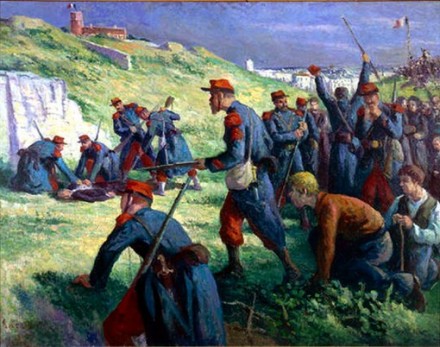
The day was climax and curtains for the first working-class seizure of power in industrial Europe, but in truth indiscriminate reprisal executions had been underway since troops of the conservative Versailles government first breached rebellious Paris on May 21.

What followed was semaine sanglante, the “bloody week” — each barricade’s surviving defenders executed summarily, and anyone in the city liable to a similar fate if the nearest French officer disliked the cut of his or her jib. Rumors swept the city that women of the Commune were torching buildings, for instance, and suddenly any woman in the street could be killed as an arsonist; some firefighters were shot as saboteurs when the “water” they threw on such flames failed to speedily quench them,* and was consequently adjudged to be kerosone.

And heaven help he who should chance to resemble one of the wanted Communard leaders!

Any passer-by calling a man by a revolutionary name caused him to be shot by soldiers eager to get the premium … Members and functionaries of the Commune were thus shot, and often several times over, in the persons of individuals who resembled them more or less.


Un rue de Paris en 1871, by Maximilien Luce.

The total body counts are guesswork: the killing ran far ahead of the record-keeping. Twenty thousand, or thirty, or more are thought to perished by summary execution. Even the press of the bourgeoisie, whose sword arm the Versailles men comprised, was aghast. London’s Times filled its broadsheets with calumnies upon the Commune, but noted on May 29:

“The Revolution is crushed;” but at what a cost, and amid what horrors! … the Communists seem not very much worse than their antagonists. It sounds like trifling for M. Thiers to be denouncing the Insurgents for having shot a captive officer “without respect for the laws of war.” The laws of war! They are mild and Christian compared with the inhuman laws of revenge under which the Versailles troops have been shooting, bayoneting, ripping up prisoners, women and children, during the last six days.

Whatever the true death toll, it massively surpassed that of the much more eagerly commemorated Revolutionary Terror.

Not for Executed Today to number what the butchers themselves could not. In a city turned charnel house in the midst of a Week of Blood, a few scenes of mortality from the day the Commune fell. (Heavily sourced to the very pro-Commune — hence potentially sensational — History of the Commune of 1871)

This people, heroes in the face of the foreigner, must therefore by called assassins, criminals, wretches, because they died for the Universal Republic, because in defense of their beliefs, their conscience, their idea, they preferred, in their fierce enthusiasm, to bury themselves in the ruins of Paris rather than abandon it to the coalition of despots a thousand times more cruel and more lasting than any foreigner.

-Lissagaray

The 147 Fédérés at Communards’ Wall

At a wall still consecrated to leftists in the Pere Lachaise cemetery of Belleville, 147 were summarily shot.

The 147 are acclaimed as the last defenders of the Commune.

the Commune is in its death throes. Like the dragon of fairy lore, it dies, vomiting flames … What must these men feel who are killing and being killed in the cemetery! To die among the dead seems horrible. But they never give it a thought; the bloody thirst for destruction which possesses them allows them only to think of one thing, of killing! Some of them are gay, they are brave, these men. That makes it only the more dreadful; these wretches are heroic! Behind the barricades there have been instances of the most splendid valour. A man at the Porte Saint-Martin, holding a red flag in his hand, was standing, heedless of danger, on a pile of stones. The balls showered around him, while he leant carelessly against an empty barrel which stood behind. — “Lazy fellow,” cried a comrade. ‘”No,” said he, “I am only leaning that I may not fall when I die.”

Paris Under the Commune, an anti-Commune source

Communard Eugene Varlin

Varlin, alas! was not to escape. On Sunday the 28th May he was recognized in the Rue Lafayette, and led, or rather dragged, to the foot of the Buttes Montmartre before the commanding general. The Versaillese sent him to be shot in the Rue des Rosiers. For an hour, a mortal hour, Varlin was dragged through the streets of Montmartre, his hands tied behind his back, under a shower of blows and insults. His young, thoughtful head, that had never harboured other thoughts than of fraternity, slashed open by the sabres, was soon but one mass of blood, of mangled flesh, the eye protruding from the orbit. On reaching the Rue des Rosiers, he no longer walked; he was carried. They set him down to shoot him. The wretches dismembered his corpse with blows of the butt-ends of their muskets.

Varlin was shot along with a nameless batch of others to whom the March 18 execution of Generals Lecomte and Thomas had been hastily imputed (they were held at the generals’ execution site, to contemplate their sin). A pro-government paper allowed that Varlin “died game.”

L’execution de Varlin, another Maximilien Luce scene.

Many at the stock exchange

According to the Paris Francais as quoted by this Marxist review of the events

It is at the Bourse that there was to-day the largest number of executions. The doomed men who attempted to resist were bound to the iron railing.

The stock exchange is “a fit place, to be sure, for this sort of business,” observes our interlocutor.

Eighty-plus defenders of Belleville, at the Arc de Triomphe

The London Times editorialized on May 31 upon this incident when the Marquis de Gallifet plucked from the mass of Belleville’s May 28 captives “eighty prisoners, principally soldiers of every arm, linesmen, artillerymen, and Zouaves, [who] were set apart and afterwards led to the right of the rampart to be shot.”

The French are filling up the darkest page in the book of their own or the world’s history. The charge of ruthless cruelty is no longer limited to one party or to one class of persons. The Versailles troops seem inclined to outdo the Communists in their lavishness of human blood. The Marquis de Gallifet is escorting a column of prisoners to Versailles or Satory. He “picks out eighty-two of them, and shoots them at the Arc de Triomphe.” Next came a lot of 20 firemen, then a dozen women, one aged 70. On another spot our Correspondent came upon “80 corpses, piled upon each other, a mass of arms and legs and distorted faces, while the roads and gutter literally flowed with blood.” About 1,000 are said to have thus suffered. By this wholesale and summary execution of prisoners in batches of 50 and 100, not only must the innocent perish with the guilty, but many must bear the penalty of imaginary guilt.

An utterly disconnected Englishman, according to the paper’s correspondent, was accidentally among the four score at the Arc, and only saved by the fortuitous intervention of a Belgian attache.

an English officer somehow got mixed up in the procession, and was forced to keep in it by the escort, who, out of 5,000 prisoners, could not, of course, be expected to recognize one innocent man … it so happened that some of the prisoners tried to escape, and to make an example the leader of the cavalry escort, the Marquis de Gallifet, a man who is not prone to err on the side of mercy, had then and there 81 shot, and the English officer was all but one of them, his explanations being at first refused the slightest attention. Human life has, in fact, become so cheap that a man is shot more readily than a dog.

Socialist physician Tony Moilin

One single fact was Tony Moilin reproached with: that of having on the 18th March taken possession of the mairie of his arrondissement, and having thus had a share in giving the signal for the insurrection …

The court-martial condescended to tell him that the fact of the mairie, the only one he could be reproached with, had in itself not much importance, and did not merit death, but that he was one of the chiefs of the Socialist party, dangerous through his talents, his character, and his influence over the masses; one of those men, in short, of whom a prudent and wise Government must rid itself when it finds a legitimate occasion to do so

[A] respite of twelve hours was granted him in order that he might make his testament, write a few words of farewell to his father, and finally [marry his pregnant lover] … on the 28th May, in the morning, Tony Moilin was led into the garden a few steps from the palace and shot. His body, which his widow claimed, the surrender of which had been at first promised, was refused her. (History of the Commune of 1871)

The unnumbered dead of Lobau Barracks

Since morning a strong cordon is being formed round the theatre (Châtelet); where a court-martial is permanently established. From time to time one sees a band of fifteen to twenty individuals coming out, composed of National Guards, civilians, women and children fifteen to sixteen years old.

These individuals are condemned to death. They march two by two, escorted by a platoon of chasseurs, who lead and bring up the rear. This cortege goes up the Quai de Gevres and enters the Republican Barracks in the Place Lobau. A minute after one hears from within the fire of platoons and successive musketry discharges; it is the sentence of the court-martial which has just been executed.

The detachment of chasseurs returns to the Chatelet to fetch other prisoners. The crowd seems deeply impressed on hearing the noise of the shootings.

This is another publication’s story cited in the History of the Commune of 1871, which itself also details the court-martial procedures of this drumhead tribunal:

Thousands of prisoners who were led there were first of all penned in upon the stage and in the auditorium, under the guns of the soldiers placed in the boxes; then, little by little, like sheep driven to the door of the slaughter-house, from wing to wing they were pushed to the saloon, where, round a large table, officers of the army and the honest National Guard were seated, their sabres between their legs, cigars in their mouths. The examination lasted a quarter of a minute. ‘Did you take arms? Did you serve the Commune? Show your hands.’ If the resolute attitude of a prisoner betrayed a combatant, if his face was unpleasant, without asking for his name, his profession, without entering any note upon any register, he was classed. ‘You?’ was said to the next one, and so on to the end of the file, without excepting the women, children, and old men. When by a caprice a prisoner was spared, he was said to be ordinary, and reserved for Versailles. No one was liberated.

The classed ones were at once delivered to the executioners, who led them into the nearest garden or court. From the Châtelet, for instance, they were taken to the Lebau Barracks. There the doors were no sooner closed than the gendarmes fired, without even grouping their victims before a platoon. Some, only wounded, ran along by the walls, the gendarmes chasing and shooting at them till they fell dead. … There were so many victims, that the soldiers, tired out, were obliged to rest their guns actually against the sufferers. The wall of the terrace was covered with brains; the executioners waded through pools of blood.


Summary executions — death squads — continued for days or weeks afterwards in Paris; martial law throttled left organizing in the city; and those “fortunate” enough to have been captured alive were processed in a steady stream of judicial executions over the months yet to come.

The Commune, a palpably subversive example even in the present day, was destroyed in every way possible for the Versailles government. But its example could hardly be forgotten.

Marx would write The Civil War in France of the only proletarian revolution he would actually witness in his lifetime.

The next generation’s subversives also took inspiration from the Parisian example … and lessons from its mistakes. Lenin — a fond student of the Commune, who was eventually buried wrapped in a Communard banner — said that

two mistakes destroyed the fruits of the splendid victory. The proletariat stopped half-way: instead of setting about “expropriating the expropriators”, it allowed itself to be led astray by dreams of establishing a higher justice in the country united by a common national task; such institutions as the banks, for example, were not taken over … The second mistake was excessive magnanimity on the part of the proletariat: instead of destroying its enemies it sought to exert moral influence on them; it underestimated the significance of direct military operations in civil war, and instead of launching a resolute offensive against Versailles that would have crowned its victory in Paris, it tarried and gave the Versailles government time to gather the dark forces and prepare for the blood-soaked week of May.

“The lesson learnt by the proletariat will not be forgotten,” Lenin vowed, and his own revolution gained a vital object lesson in the Bloody Week of Paris, and an anthem besides: Communard Eugene Pottier, fleeing the Versailles army’s slaughter, wrote the verses that have been sung ever since by millions dreaming of a better world — the Internationale.

* Water can accelerate a fire, under the right circumstances.

On this day..