1922: Seven Republican guerrillas in the Curragh of Kildare

(Thanks to author and historian James Durney for the guest post, an excerpt from On the One Road: Political Unrest in Kildare 1913-1994. -ed.)

Seven men were executed in the Glasshouse, in the Curragh Camp on December 19 in the biggest official executions of the Civil War. They were Patrick Bagnall and Patrick Mangan, Fairgreen, Kildare; Joseph Johnston, Station Road, Kildare; Bryan Moore and Patrick Nolan, Rathbride, Kildare; Stephen White, Abbey St. Kildare and James O’ Connor, Bansha, Co. Tipperary. These seven men, along with Comdt. Thomas Behan were found in a dug-out at Mooresbridge, on the edge of the Curragh, on the night of December 13. They were under the command of Comdt. Bryan Moore, 38, a veteran IRA officer, and comprised a section of the 6th Battn. Column. They were armed with rifles bought from a soldier stationed in Naas Barracks.

A detachment of troops from the Curragh searching a farmhouse at Mooresbridge, about one-and-a-half miles from the Curragh Camp, “found the proprietress in possession of a fully loaded Webley revolver.” A subsequent search disclosed a dug-out underneath a floor. The dug-out was surrounded by National soldiers who called on the men to come out. Eight men were in the dug-out, which was also found to contain 10 rifles, a quantity of ammunition, one exploder, a roll of cable and food supplies. When they surrendered Tom Behan was struck with a rifle butt and had his arm broken. When the captives were ordered into the back of a truck Tom Behan could not climb aboard because of his broken arm. He was struck again on the head with a rifle butt and died at the scene. Behan was a veteran IRA man and at the time of his death was Intelligence Officer, 1st Eastern Division. The Free State authorities claimed that Behan was shot while trying to escape through a window in the Glasshouse (so called because of its roof), issuing a statement saying: “One of the party of men arrested when trying to make his escape from the hut in which he was detained at the Curragh, ignoring the warning of the sentry to desist, was fired on and fatally wounded.” Mick Sheehan was in the Glasshouse at the time and thought it highly unusual that an experienced volunteer like Tom Behan would try to escape through such a small window. It was only years later that he found out the truth. The Glasshouse was a small stone and brick military prison up the hill where the military usually housed their own prisoners. It consisted of two floors enclosed within a twelve foot high walled enclosure with cells for 64 prisoners. During the Civil War, and after, it was used as a punishment block for Republican prisoners.

The remaining seven men were executed by firing squad on the morning of December 19. The following official report was issued from Army Headquarters, GHQ, on that evening: “Stephen White, Abbey Street, Kildare, labourer; Joseph Johnson, Station Road, Kildare, railway worker; Patrick Mangan, Fair Green, Kildare, railway worker; Patrick Nolan, Rathbride, Kildare, railway worker; Brian Moore, Rathbride, Kildare, labourer; James O’Connor, Bansha, Tipperary, railway worker; Patrick Bagnel, Fair Green, Kildare, labourer who with others, were arrested at Rathbride, Co. Kildare, on the 13th inst., were charged before a Military Committee with being in possession, without proper authority, of – 10 rifles, 200 rounds of ammunition therefor, 4 bomb detonators, 1 exploder.

“They were found guilty and sentenced to death. The sentence was duly executed this morning, 19th inst., at 8.30 a.m.”

This stone at Grey Abbey commemorates the seven IRA men. Image courtesy of Mario Corrigan.

They were all veteran IRA men and belonged to a column of ten which operated against railways, goods trains and some shops in the vicinity of Kildare. Five of them were on the derailment of engines at Cherryville on December 11 when they made a serious attempt to dislocate the whole railway service on the Great Southern and Western Railway Line. Two engines were taken out of a shed at Kildare and sent down the line by Cherryville. One engine ran out of steam and did no harm, while the other overturned and blocked the line for a considerable time. The column was also responsible for an ambush on National troops at the Curragh Siding on November 23 when a large party of troops were returning to Dublin after escorting prisoners to the Curragh Internment Camp. On their return journey the troops were fired on at the Curragh Siding and two were wounded. In the confusion a policeman was accidentally shot by a National soldier. Father Donnelly, chaplain to the troops, administered to the seven volunteers before their executions. They were shot one by one and were buried in the yard adjacent to the Glasshouse.

The last letters from the seven men were printed in the Republican paper Eire. /The Irish/ /Nation/. James O’Connor of Bansha wrote to his mother: “I am going to Eternal Glory tomorrow morning with six other true-hearted Irishmen.” Patrick Mangan wrote to his mother: “I am to be shot in the morning. I fought for Ireland and am sorry I could not do more… I have made my peace with God and was never so happy as tonight.”

On March 31 1923 Eire (The Irish Nation) printed the last poignant letters from Bryan Moore, Patrick Bagnell and Paddy Nolan under the title ‘Last letters of “executed” soldiers of the IRA.’*

Letter of Bryan Moore to his Brother.

Hare Park Prison, 18-12-22.

Dear Pat, – I am about to die for the Cause of Ireland as many did before. Pray for me and get the children to pray for me. I’ve just had the priest and will see him again in the morning at 6.30 and receive Holy Communion. He says we are to be envied the deaths we are about to meet, as we shall go straight to Heaven.

Do all you can for Father and Mother. Tell Mary and Kathleen to say a prayer for me every night,

Bryan.

Letter of Bryan Moore to Mother and Father.

Hare Park Prison, 18-12-22.

Dear Mother and Father, – I am about to be executed in the morning and I wish to bid you good-bye, and to ask you to pray for me and the rest of the boys.

I had the priest this evening and will see him again to night. I am resigned to die. God comfort you both.

Tell Johnny to pray for me. – Your loving Son.

Bryan.

Letter of Bryan Moore.

Hare Park Prison, 18-12-22.

Dear Johnny, – Good-bye, and be good to Father and Mother. Pray for me. – Bryan.

P.S. – You can do a man’s part by looking after Father and Mother. Tell them not to worry for me, as I am better off. God bless you.

Dear Annie, – Good-bye. God bless you. Pray for me.

Bryan.

Letter of Patrick Bagnall to his Uncle.

Hare Park Prison, 18-12-22.

Dear Jimmy, – I hope you and Willie are well. Tell all the boys and girls I was asking for them. I am writing to my sister and father. I am to be shot in the morning, 19th December, at 8.15. Mind Mary and do what you can for her. I know this will nearly kill her. We had a priest who heard our confessions. We are all here, seven of us – Johnston, Mangan, White, Moore, Nolan, Connor, and I. We are all to go “West” together, so don’t forget to pray for us. I know you and Willie will be sorry, but it is all for the best, and I hope it sets old Ireland free. We are not afraid to die.

Tell them all in Kildare I was asking for them. Don’t forget Harry Moore. We are dying happy anyway. So good-bye old Kildare, good-bye Jimmy and God bless you. I will meet you in Heaven. Tell Tom Byrne I was asking for him. – Your loving nephew, Paddy Bagnall.

The priest’s name and address is Father_____, Curragh Camp, a very nice man: you can write him if you want to. He said we will die like men anyway.

Letter of Paddy Nolan to his Father and Mother.

Curragh Camp Prison, 18-12-22.

Dear father and Mother, – I am writing my last few lines to you. I am to be executed to-morrow morning, and I hope you will bear it with the courage of an Irish Father and Mother. I am proud to die for the Cause I loved and honoured, and for which I give up my young life.

Six more of my comrades are to be executed. We have all been to confession and Holy Communion. Father ______ told us we would go straight to Heaven, so do not worry.

Dearest Mother, there are a few pounds in my suitcase, you can have them, or anything else in the house belonging to me.

Loving Father and Mother , good-bye for ever, – Your fond and faithful Son.

Paddy.

Father _____, Curragh Camp, sends his sympathies and prayers.

Letter of Paddy Nolan to his Elder Brothers and Sisters.

Curragh Camp Prison, 18-12-22.

My Dear Brothers and Sisters.

Now that I’m about to part from this world, I ask you for one favour – be kind and good to Father and Mother, and never dishonour the Cause for which I die – a Free and Independent Ireland. I bear no ill will to any person. Fond Sisters and Brothers, pray for me. Good-bye forever.

Paddy.

Letter to his Young Brothers and Sisters.

My Dear little ones, – I, your fond brother about to pass out of this world, ask you loving little ones to offer up your innocent prayers for me and my comrades on Christmas morning. Be good children, and always obey your parents and do everything in your power to make them happy. God bless you little ones. Good-bye for ever. – Paddy.

The executions caused a lot of bitterness locally. Both Mick Sheehan’s uncles, who had taken the pro-Treaty side, left the National Army. One, Capt. Patrick Kelly, who had served in the Republican Police, resigned his commission and went to the Civic Guards.

* The last letter of 18-year-old Stephen White, which seems not to have been printed at the time, can be read on this history of the day’s executions. -ed.

On this day..

1922: Robert Erskine Childers, for carrying the gun of Michael Collins

On this date in 1922, Robert Erskine Childers was shot by the Irish Free State for carrying a gun its founding colossus had gifted him.

Many Irishmen were executed on either side in this terrible time, but Childers cuts a unique figure among them.

To begin with, he wasn’t all that Irish — “that damned Englishman,” fellow Republican turned Civil War enemy Arthur Griffith called him. The London-born son of a British scholar and an Irish mother, Childers was a lifelong Protestant, itself an anomaly since Irish nationalism mapped (and still maps) strongly to Catholicism.

You’d think he’d be a loyal man of the empire. Early on, that’s just what he was.

In his twenties, Childers volunteered for the Boer War, and he would later say the rank savagery and underlying injustice of England’s war “changed the whole current of my life and made me a Liberal and a Nationalist.” (Source.)

Laying down the sword, Childers took up the pen and wrote several books of military history. (Long since into the public domain, at least two can be read free online: War and the Arme Blanche, German Influence on British Cavalry.) He also wrote a novel, The Riddle of the Sands, that has a (debatable) claim as the first spy novel. Riddle has never gone out of print since it was published in 1903, though it is also available free online.

Both in fiction and nonfiction, Childers’ warnings against the German challenge to British hegemony were prophetic, but he was himself becoming a man divided. 1914 saw him running German guns to Irish nationalists aboard his yacht Asgard … and then signing up for the royal navy when World War I erupted.

The British crackdown on the Easter Rising during the war completed his radicalization; he moved to Dublin and turned his eloquence against the British.

Here, Childers was swept into the tragedy of the Irish War of Independence, and the civil war that followed it; though both were in the delegation that produced the contentious Anglo-Irish Treaty, Childers broke with Michael Collins over it and backed the IRA nationalists who fought the Irish Free State.

After Collins’s assassination, emergency laws promulgated the death sentence for anyone caught armed without authorization. Childers was a writer, not a partisan, but he was arrested in early November with a small sidearm — a gift Michael Collins had given him, back when they were on the same side. It was a time of bloody justice, and they threw the book at him.

Childers knew as well as Collins had that the internecine conflict would have to end. He checked out with awe-inspiring forgiveness; summoning his 16-year-old son to prison the night before his execution, Childers extracted a promise that the boy would find everyone who signed his death warrant … and shake their hands. (Young Erskine Hamilton Childers eventually became President of Ireland.)

Childers himself likewise shook the hands of his own firing squad, one by one. His last words (reported in a number of slightly different variations) were lightheartedly addressed to them:

Take a step or two forwards, lads. It will be easier that way.

On this day..

1817: Policarpa Salavarrieta, Colombian independence heroine

This morning in 1817, a Colombian seamstress was shot in Bogota for spying on the Spanish forces fighting to quell South America’s Bolivarian independence movements.

Policarpa Salavarrieta — it was the name her brother used for her; her legal given name and origin are romantically lost — was infiltrated into Bogota during the reconquista, when a Spain recovering from Napoleon’s intrusion deployed in force to quash the separatist aspirations of its New World colonies.

It was the day of Simon Bolivar, but Spain had completed its apparent pacification of New Granada* in 1816, and established a stronghold in Bogota. Subversives had to mind their P’s and Q’s.

Although she was a known agitator in the city of Guadas, “La Pola” could slip into Bogota without drawing attention.

There, she used her skills as a domestic to hang around royalist households, sewing up clothes while snooping around, and helping revolutionaries recruit soldiers.

She was arrested when the Spanish busted the network, (the link is in Spanish) and shot publicly with her lover, Alejo Sabarain, and a number** of others — all men, none of them half so well-remembered or beloved as Salavarrieta. She was supposed to have ignored the priests murmuring te deums in her ear on the scaffold in order to exhort the onlookers to resistance.

Over the years to come, she would become an emblematic martyr of independence; just see how many times her theme is visited in this history of Colombian painting (Spanish again). She’s also the only historical (not mythological/allegorical) woman ever used on Colombian currency.

As will be readily surmised, of course, she merits her tribute because the movement in whose service she died soon rallied and carried the day.

* The Spanish territory of New Granada encompassed most of the ice cream of the South American cone.

** Various numbers are given for the day’s total execution count. This site (Spanish) says a total of nine — Policarpa Salavarrieta and eight men, including Alejo Sabarain — and persuasively names all of them.

On this day..

1841: Hermano Pule and his surviving followers

On this date in 1841, Apolinario de la Cruz was shot at Tayabas for leading a revolt against Spanish occupation of the Philippines.

Known to history as Hermano Pule, the young de la Cruz had dreamt of entering the priesthood — but finding that most barred native Filipinos, he founded the Cofradia de San José (Confraternity of St. Joseph).

Organizing secretly and outside of the approved channels, it gained the enmity of both civilian and religious authorities, though it doesn’t on the surface look like a seditious entity; rather, it attracted Filipinos (and Filipinas) excluded from the official organs. Suddenly, that looked like trouble to Spain.

Condemnation helped the Confradia’s numbers burgeon, and forced its programme towards radicalism: where freedom of religion was forbidden, worship was a revolutionary act.

Matters came to a head when a government raid precipitated armed resistance by Pule and his followers, with the inevitable closing act postponed by an inspiring but short-lived rebel victory at arms. Pule and his followers were overrun on Nov. 1, rounded up as fugitives by the next day, and put to death outside the Tayabas courthouse — with Pule’s head, hands and feet cut off for salutary public display in his adjacent hometown of Lucban (or Lukban).

On this day..

1803: Robert Emmet, “let no man write my epitaph”

On this date in 1803, Irish nationalist Robert Emmet was hanged and posthumously beheaded, a day after his trial for treason against England.

The well-to-do scion of a Protestant family, Robert Emmet followed his older brother into the Republican ferment of the time and led an unavailing uprising in Dublin on July 23, 1803.

Captured a month later when he romantically recklessly moved his hideout closer to his beloved Sarah Curran.*

Emmet won his great laurels in the annals of Irish Republicanism with a stirring “Speech from the Dock” addressed to the courtroom the day before he died. Or better to say that it was addressed in a courtroom, for knowing that his death sentence was a foregone conclusion, the real audience was posterity and a wider world.

Emmet found that audience with one of the great orations of the 19th century.

This clip is a truncated version of a longer speech not set to paper by Emmet, so no single definitive version exists. Versions can be found at this Irish history site, and at SinnFein.ie.

I have but one request to ask at my departure from this world — it is the charity of its silence! Let no man write my epitaph: for as no man who knows my motives dare now vindicate them. let not prejudice or ignorance asperse them. Let them and me repose in obscurity and peace, and my tomb remain uninscribed, until other times, and other men, can do justice to my character; when my country takes her place among the nations of the earth, then, and not till then, let my epitaph be written. I have done.

On the strength of such sentiment — and the public’s learning of his love for Sarah Curran — the 25-year-old became iconic in death. Robert’s own death inspired the mandatory Irish patriotic ditty, “Bold Robert Emmet”:

But that sundered love between Emmet and Sarah Curran — who broken-heartedly accepted another proposal and moved to Sicily — was at least as stirring to the Romantic imagination. Washington Irving dedicated a short story to the lost romance; Emmet’s friend Thomas Moore made Curran the subject of a poem (beware: link opens an auto-playing audio file).


Anti-British terrorist Robert Emmet has a statue on Washington, D.C.’s Massachusetts Ave, and probably an entry on the no-fly list.

* 19th century Irish poet Thomas Moore paid her tribute in “She Is Far From the Land”:

She is far from the land where her young hero sleeps,
And lovers are round her, sighing:
But coldly she turns from their gaze, and weeps,
For her heart in his grave is lying.

She sings the wild song of her dear native plains,
Every note which he lov’d awaking; —
Ah! little they think who delight in her strains,
How the heart of the Minstrel is breaking.

He had liv’d for his love, for his country he died,
They were all that to life had entwin’d him;
Nor soon shall the tears of his country be dried,
Nor long will his love stay behind him.

Oh! make her a grave where the sunbeams rest,
When they promise a glorious morrow;
They’ll shine o’er his sleep, like a smile from the West,
From her ow lov’d island of sorrow.

Part of the Themed Set: Counterrevolution.

On this day..

46 B.C.E.: Vercingetorix the Gaul

On an uncertain date around this time — sort of — in 46 B.C.E., the Gallic chief Vercingetorix was marched as Julius Caesar’s star captive in Rome, then strangled in prison.

A nobleman who in the course of things would have been destined for that class of domestic elites bought off by Rome for orderly management of conquered provinces, Vercingetorix instead mounted a massive and effective semi-guerrilla resistance. A few months after Caesar had declared “Mission Accomplished” and Gaul at peace, it rose in arms … and, as Vercingetorix rolled out a scorched-earth defense, in flames.

Julius Caesar, then serving a long and lucrative career as Governor of Gaul, managed only with difficulty — and staggering bloodshed — to pacify the province at the Battle of Alesia. It was a signal military engagement in the development of the Roman Empire, cementing Roman power in Gaul for centuries to come.

The wily barbarian’s revolt and the very serious danger it posed to Caesar’s ambitions are the subject of a five-part BBC documentary.

Vercingetorix’s allegedly theatrical surrender to Caesar essentially ended the Gauls stubborn, centuries-long resistance to Roman dominion.

Yes, that’s the Highlander, Christopher Lambert, playing the French Braveheart version of barbarian heroism in Druids. HBO’s series Rome went with a less romantic version:

Either way, the once-intractable province became the bastion from which Caesar would overthrow the foundering Roman Republic.

Political rivals in the capital for whom Caesar’s Gallic campaign was nothing to celebrate denied Caesar a ceremonial Triumph and maneuvered to check the ambitious general. When the conflict came to a head in 49 B.C.E., Caesar’s bold move from the provincial borders of Gaul into Italy — crossing the Rubicon — ignited civil war in Rome.

Vercingetorix languished in Roman chains all along, until Caesar finally mopped up his enemies in the field and returned to Rome, where he celebrated an extravagant quadruple Triumph for his various military achievements.

As described by Appian,

when he returned to Rome he had four triumphs together: one for his Gallic wars, in which he had added many great nations to the Roman sway and subdued others that had revolted; one for the Pontic war against Pharnaces;* one for the war in Africa against the African allies of L. Scipio, in which the historian Juba (the son of King Juba), then an infant, was led a captive. Between the Gallic and the Pontic triumphs he introduced a kind of Egyptian triumph, in which he led some captives taken in the naval engagement on the Nile.** Although he took care not to inscribe any Roman names in his triumph (as it would have been unseemly in his eyes and base and inauspicious in those of the Roman people to triumph over fellow-citizens), yet all these misfortunes were represented in the processions and the men also by various images and pictures, all except Pompey, whom alone he did not venture to exhibit, since he was still greatly regretted by all. The people, although restrained by fear, groaned over their domestic ills, especially when they saw the picture of Lucius Scipio, the general-in-chief, wounded in the breast by his own hand, casting himself into the sea, and Petreius committing self-destruction at the banquet, and Cato torn apart by himself like a wild beast. They applauded the death of Achillas and Pothinus, and laughed at the flight of Pharnaces.

It is said that money to the amount of 60,500 silver talents was borne in the procession and 2822 crowns of gold weighing 20,414 pounds, from which wealth Caesar made apportionments immediately after the triumph, paying the army all that he had promised and more. Each soldier received 5000 Attic drachmas, each centurion double, and each tribune of infantry and perfect of cavalry fourfold that sum. To each plebeian citizen also was given an Attic mina. He gave also various spectacles with horses and music, a combat of foot-soldiers, 1000 on each side, and a cavalry fight of 200 on each side. There was also another combat of horse and foot together. There was a combat of elephants, twenty against twenty, and a naval engagement of 4000 oarsmen, where 1000 fighting men contended on each side. He erected the temple to Venus, his ancestress, as he had vowed to do when he was about to begin the Battle of Pharsalus, and he laid out ground around the temple which he intended to be a forum for the Roman people, not for buying and selling, but a meeting-place for the transaction of public business, like the public squares of the Persians, where the people assemble to seek justice or to learn the laws. He placed a beautiful image of Cleopatra by the side of the goddess, which stands there to this day. He caused an enumeration of the people to be made, and it is said that it was found to be only one half of the number existing before this war.

War is hell.

At the Gallic triumph, Vercingetorix — by far the most fearsome enemy Caesar had to display vis-a-vis a five-year-old child and the sister of his lover — was at last the center of attention again for a day. Still defiant, he was marched through the Eternal City, then strangled at the Tullianum, or Mamertine Prison.

But which day? The bare fact is that we just don’t know, but this one has more than the typical imprecision that characterizes dating ancient events. This footnote on a page about Egyptian royalty grapples with the timing.

Suetonius gives us that his Triumphs were celebrated

four times in one month, each Triumph succeeding the former by an interval of a few days.

Since Cassius Dio claims that Caesar dedicated the Temple of Venus (datable to late September of 46) on the last day of the last Triumph, that presumably makes September the “one month” of the various celebrations.

That’s about as close as it gets, but even “September” comes with a caveat. During his few months in Rome between campaigns, Caesar accomplished a frenetic civil agenda (it helps to be dictator). Perhaps none is of such recognizable consequence for posterity as reform of the wacky solar-lunar hybrid Roman calendar — and 46 B.C.E. was the very year he implemented it.

Disdaining incrementalism, Caesar tackled the mess the Roman calendar had become at once, by stuffing the year 46 up to 445 days. As a result, 365 days after the execution of Vercingetorix was not September of 45, but July (or possibly June) — and those months are sometimes given for the dates of Caesar’s Triumphs on this basis. Since Caesar actually won his decisive battle in April of 46 B.C.E. and returned to Rome that July, the potential for confusion multiplies: if you’re not accounting for the exceptional calendar, July Triumphs appear initially plausible.

It is here that one beholds the essential subjectivity behind a putatively mechanistic device like a calendar: if Vercingetorix was executed in spring or summer, was he executed in September?

Whenever it was that he was throttled in the Mamertine, Vercingetorix did not go quietly. If his cause of resistance to Roman authority was doomed for the time being, the eternal allure of rebellion — and, as the Gallic lands later germinated France, the proto-nationalism of his cause — secured him his own symbolic immortality.


Napoleon III, with his complex relationship to the Gallic and Italic dreams of another age, was just the man to put up this statue of Vercingetorix where the barbarian was thought to have made his last stand. Its inscription reads:

La Gaule unie
Formant une seule nation
Animée d’un même esprit,
Peut défier l’Univers.

* The speedily resolved Pontic War gave us Caesar’s “veni, vidi, vici”.

** It was at the Egyptian triumph that Cleopatra’s sister Arsinoe was marched, though she was not executed afterwards.

On this day..

1305: William Wallace, Braveheart

On this date in 1305, Scottish knight Mel Gibson — er, William Wallace — was hanged, drawn and quartered at Smithfield for treason to a British crown he refused to recognize.

Just like so:

Well, close enough. Some wags have alleged one or two historical liberties in Braveheart.

Among the lesser (but more pertinent here): that they weren’t — you knew this already — offering the former Guardian of Scotland the opportunity to reduce his suffering with a public submission, or use the stage for theatrical defiance. Hanging, drawing and quartering was a brand new execution Edward I was experimenting with for emasculating, disemboweling, and (so the idea went) utterly cowing the rebellious hinterlands of the British Isles. Wallace may have been just the second person to suffer it.

But only a pointy-headed blogger could possibly care when the main point is that back before Christendom succumbed to nancy decadences like Vatican II, men wore woad, defenestrated queers, and tapped top-shelf babes.


Among the few things known for certain about William Wallace is that he did not score with Isabella of France. Or with Sophie Marceau.

Facts? This is show business!

Mel’s bloodbath only riffs the already-fantastic 15th century epic of “the Wallace” by Scottish minstrel Blind Harry, which in turn got a lyrical call-out in Robert Burns’ 18th century Scottish patriotic tune Scots Wha Hae.

National martyrs — and, sure, it helps to die at the right time, as Wallace did just before Robert the Bruce secured Scottish independence — feed a train of hungry authors and ready audiences in every time, place and medium.

However genuinely flesh-and-blood the limbs that wrought his feats and were torn apart on this day, Wallace returns to his generations of interlocutors half-shrouded in mythology. Seven centuries on, his contested (and sometimes absurd) use as precedent or metaphor stakes a claim to his Truth at least as compelling as battlefield tactics at Stirling Bridge. What does he “really” have to tell us? No matter how grisly his end, William Wallace doesn’t get to decide: it’s between you, me, Mel, and a few billion other folks.

Only a character really worth remembering is worth that kind of fictionalizing.

On this day..

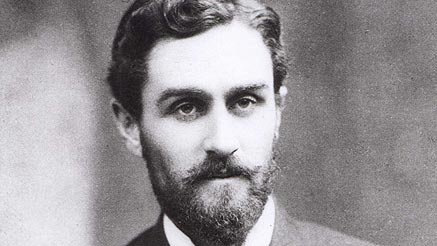
1916: Sir Roger Casement

On this date in 1916, Roger Casement was hanged for treason by the British crown that had knighted him only a few years before.

Casement died for his part in the Easter Rising, but this Irish nationalist hero’s layered story has long made him a very different sort of cultural marker than, say, James Connolly.

Casement came to public prominence for his damning report on Belgium’s atrocious treatment of natives in its Congo colony, e.g.:

[T]he great decrease in population, the dirty and ill-kept towns, and the complete absence of goats, sheep, or fowls — once very plentiful in this country — were to be attributed above all else to the continued effort made during many years to compel the natives to work india-rubber. Large bodies of native troops had formerly been quartered in the district, and the punitive measures undertaken to his end had endured for a considerable period. During the course of these operations there had been much loss of life, accompanied, I fear, by a somewhat general mutilation of the dead, as proof that the soldiers had done their duty.

. . . Two cases (of mutilation) came to my actual notice while I was in the lake district. One, a young man, both of whose hands had been beaten off with the butt ends of rifles against a tree; the other a young lad of 11 or 12 years of age, whose right hand was cut off at the wrist. . . . I both these cases the Government soldiers had been accompanied by white officers whose names were given to me. Of six natives (one a girl, three little boys, one youth, and one old woman) who had been mutilated in this way during the rubber regime, all except one were dead at the date of my visit.

[A sentry in the employ of one of the concessionary private companies] said he had caught and was detaining as prisoners (eleven women) to compel their husbands to bring in the right amount of rubber required of them on the next market day. . . . When I asked what would become of these women if their husbands failed to bring in the right quantity of rubber . . , he said at once that then they would be kept there until their husbands had redeemed them.

Casement’s is an honorable name in the campaign for the Congo, an early human rights and anti-colonial struggle; in this 92-minute BBC documentary on the notorious depredations in the Congo, the Casement report’s creation and impact are treated from about 1:15:15 through the end:

A similar investigation undertaken in Peru — where the lens focused on British employers, rather than strictly the malfeasance of foreign states — earned him knighthood in 1911, but Casement’s personal evolution from loyal Protestant* imperial operative with a sympathy for the Irish cause to revolutionary nationalist was already underway. “This journey into the depths of the Congo has been useful in helping me discover my own country and understand her situation, her destiny, her reality,” he wrote his sister. “I’ve also found my true self: the incorrigible Irishman.”

He resigned from the consular service and began recruiting for the Irish Volunteers.

As World War I opened, Casement identified British aggression as its cause, an extension of the violent imperial hegemony he chronicled in The Crime Against Europe:

The British Empire was not founded in peace; how, then can it be kept by peace, or ensured by peace-treaties? It was born of pillage and blood-shed, and has been maintained by both; and it cannot now be secured by a common language any more than a common Bible. The lands called the British Empire belong to many races, and it is only by the sword and not by the Book of Peace or any pact of peace that those races can be kept from the ownership of their own countries.

While any Irish Republican would have agreed with that sentiment, the resulting moral and tactical calculus for the Irish cause to ally with the German was not universally embraced — and was certainly anathema to the British.

“In the Streets of Catania”
by Roger Casement

All that was beautiful and just,
All that was pure and sad
Went in one little, moving plot of dust
The world called bad.

Came like a highwayman, and went,
One who was bold and gay,
Left when his lightly loving mood was spent
Thy heart to pay.

By-word of little street and men,
Narrower theirs the shame,
Tread thou the lava loving leaves, and then
Turn whence it came.

Ætna, all wonderful, whose heart
Glows as thine throbbing glows,
Almond and citron bloom quivering at start,
Ends in pure snows.

Casement spent the first two years of the Great War in Germany itself, and arranged a shipment of guns that would have supported the Easter Rising, but thought the aid too little and too late. He had a German U-boat drop him at Ireland, trying to get word to the Republican leadership to postpone the revolt.** Instead, he was picked up three days before the doomed rising and hanged after a sensational trial.†

His “treason” — and of course, the very crime of which he was convicted imports a British legitimacy in Ireland that Casement explicitly rejected — shocked many old associates, but he still had friends in high places. To dampen the international clemency campaign, England circulated the notorious “Black Diaries,” photographs of supposed Casement diary pages detailing the author’s homosexuality.

This dirty (and successful) trick brings a personal-is-political quality to Casement’s legacy as well as an enduring debate over the diaries’ authenticity. Since Irish nationalism gained mainstream acceptance well before homosexuality, right-thinking folk long held the Black Diaries a forgery, and time was you solicited a black eye by saying otherwise in the wrong company.

The gay rights movement has seen a posthumous redefinition of Casement; although homosexuality was not on the indictment against him, one could argue that it was the reason he hanged. Given recent handwriting forensics that support the diaries’ authenticity, the general‡ consensus about the Black Diaries has inverted with the effect of only heightening sympathy for their alleged author, albeit at the expense of some tension over how to situate that characteristic within the whole of Casement’s life and thought.

And that is only one aspect of the shifting place of Casement in the firmament of Republican martyrs since his death. His hagiography waxed in the interwar years, with Yeats among those calling for the return of Casement’s remains in The Ghost of Roger Casement”.

But the humanitarian’s German ties were an inconvenience as World War II raged, and not until afterward was that cause renewed. When his body was finally returned in 1965, an Irish state funeral elided the matter of the diaries.

Even Casement himself, who would be the last to die for the Easter Rising, had a hand in the myth-making. His last mission’s purpose to avert the Easter Rising fit neither the government’s interest in maximizing his perfidy nor Casement’s own in identifying with the Irish cause; he himself therefore owned the Rising fully in his defense which made him fine fodder for Republican hymns like “Lonely Banna Strand”:

RTE radio’s What If? series recently explored Casement’s complex legacy:

[audio:http://www.rte.ie/podcasts/2008/pc/pod-v-240208-27m06-whatif.mp3]

As Casement put it in his voluminous personal writing, “It is a cruel thing to die with all men misunderstanding — misapprehending — and to be silent forever.”

* Casement’s father was Protestant and his mother was Catholic; he lived with a somewhat split identity between the two faiths, but formally converted to Catholicism while awaiting execution (which surely did not hurt his memory to the Irish cause) and his last meal was simply the Host.

** The guns themselves were interdicted by the British navy and ended up scuttled to the ocean floor.

† Since Casement’s incitements to rebellion had occurred on foreign soil, there was some fine legal parsing over whether he could be tried for “treason.” The dispute resolved to the placement of a comma in a medieval law — leading to the epigram/-taph that Casement was “hanged by a comma.” In the midst of war and before an English jury, however, punctuation was an even weaker defense than it sounds.

‡ But still not universal.

On this day..

1811: Miguel Hidalgo y Costilla, for Mexican independence

On this date in 1811, Mexican independence icon Miguel Hidalgo was shot for treason at the government palace in Chihuahua.

The subversive priest had set the spark to the Mexican War of Independence in the hours before sunrise of September 16, 1810. There, he rang the parish bell in the small town of Dolores and issued his “Grito de Dolores” — “Cry of Dolores” — summoning native Amerindians and mestizos to throw off the Spanish.

The movement got added juice from the fact that the Spanish jackboot was then being worn by Napoleon, who had installed his brother as king.*

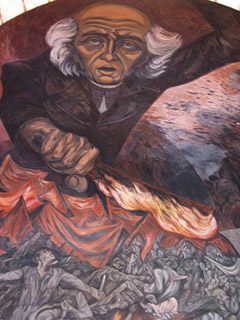
Hidalgo tributes are a mainstay of every Mexican town. This Orozco mural is in a government building in Guadalajara.

Hidalgo’s fired-up downtrodden mob slaughtered the local garrison and gathered numbers on a march towards Mexico City before the professional Spanish soldiery rallied to stop it. But the priest wouldn’t make his father-of-the-country credentials in generalship: he’d been relieved of command after repeated combat debacles by the time the insurrection’s leaders were betrayed in March.**

While his comrades Ignacio Allende, Jose Mariano Jimenez and Juan Aldama were shot on June 26, Hidalgo got an old-school detour through the ecclesiastical arm for defrocking (and a highly suspect alleged retraction).

When he was shot this day, he directed the firing squad to aim for the hand he placed over his heart.

Then, his head was cut off and stuck on a pike as a warning.

The struggle lived on, long past Hidalgo’s execution and Bonaparte’s fall, and finally resulted in Mexican independence in 1820. Today, the padre whose call to action not only started the revolt but made it a mass movement is the face on the 1,000-peso note, and his Grito de Dolores is repeated every Diez y Seis de Septiembre as an independence day tribute by Mexican authorities — as in this from 2006:

* Inspiring this blog’s banner in the process.

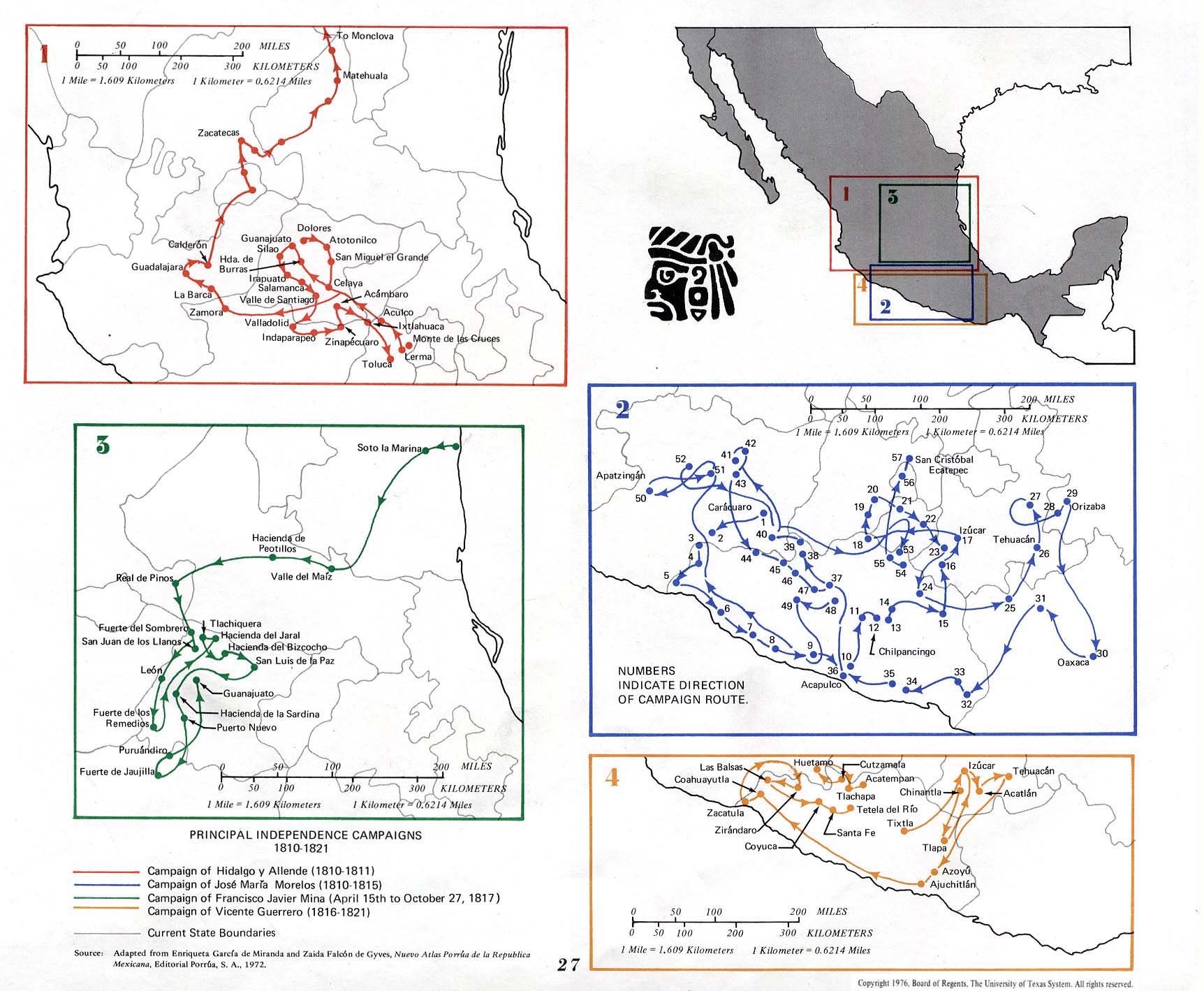
** There’s a map of Hidalgo and Allende’s army’s movements — and subsequent campaigns in the war — here.

On this day..

1573: Wigbolt Ripperda, Haarlem city governor

On this date in 1573, Wigbolt Ripperda was beheaded in Haarlem’s Grote Markt for having led a stubborn seven-month resistance to a Spanish siege.

Ripperda had been a Calvinist with a hand in the iconoclastic spasm against Catholic churches that had led to the beheadings of Counts Egmont and Hoorn a few years prior.

In the intervening years, relations between the Low Countries and the Spanish crown that ruled them had deteriorated into outright revolt — the germ of the decades-long struggle that would result in Dutch independence.

Haarlem had initially tried to keep its head down in the conflict, but had declared against Spain in 1572. That brought it into the sights of a vengeful Spanish army that greatly outnumbered Haarlem’s 4,000 defenders. Spurning any talk of compromise or capitulation, city governor Ripperda rallied his garrison and held out against the Spanish siege throughout the winter and spring.

In the end, starvation did the work that engines of war could not. Haarlem fell on July 12, 1573.*

Ripperda was beheaded with a lieutenant a few days later, but in winning the battle, Spain had suffered a setback in the war: besides the seven-month delay, other Calvinist strongholds took heart from the effective resistance and got a lot less cowed by the royal army.

While this day’s martyrdom made “Ripperda” a fixture in Haarlem place names, and despite a somewhat illustrious family tree that also includes a signatory of the Peace of Munster and a fascinatingly disreputable 18th century politician, actual Ripperdas are apparently hard to find in present-day Holland. According to American Tom Ripperda, who runs the family site ripperda.org, the name lives on only in the U.S. and Germany.

“In the 1830s the last of the Dutch Ripperdas died,” Ripperda told me. “There are no Ripperdas in the Netherlands since they moved to Germany (about 200 or so) and on to America (about 600 or so).”

* As to the vengeful mass executions visited on Haarlem, John Lothrop Motley conveys this anecdote.

Instead of Peter Hasselaer, a young officer who had displayed remarkable bravery throughout the siege, the Spaniards by mistake arrested his cousin Nicholas. The prisoner was suffering himself to be led away to the inevitable scaffold without remonstrance, when Peter Hasselaer pushed his way violently through the ranks of the captors. “If you want Ensign Hasselaer, I am the man. Let this innocent person depart,” he cried. Before the sun set his head had fallen.

On this day..