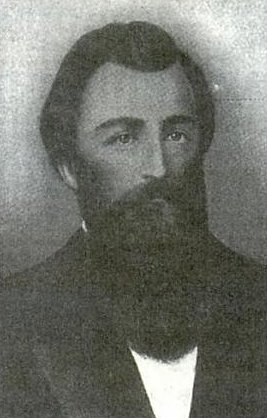
1862: William B. Mumford, flag desecrator

On this date in 1862, a 42-year-old gambler hanged at the New Orleans mint where, six weeks before, he had pulled down the Stars and Stripes of the arriving Union occupiers to the delight of a Confederate mob.

Moving to secure the Mississippi, Northern forces had the Big Easy encircled and about to surrender when, an advance team landed in the undefended city and pulled down the Stars and Bars over the mint on Esplanade Avenue.

William Bruce Mumford was among the Confederate loyalists who took exception to the Yankee flag, so he chopped it down and dragged it through the street (provoking a cannonade from a Union warship). The flag was little but tatters by the time he had through with it.

Although the city was not officially occupied at the time of this incident, the mint was a federal building. Army General Benjamin Butler resolved to make a salutary example out of the incident to quell any possible civil unrest.

I find the city under the dominion of a mob. They have insulted our flag — torn it down with indignity. This outrage will be punished in such a manner as in my judgment will caution both the perpetrators and abettors of the act, so that they will fear the stripes, if they do not reverence the stars of our banner.

Butler, it should be allowed, had some reason for this conclusion. The Picayune exulted the act as, well, a call to resistance.

The names of the party that distinguished themselves by gallantly tearing down the flag that had been surreptitiously hoisted, we learn, are W. B. Mumford, who cut it loose from the flag-staff amid the shower of grape. Lieutenant N. Holmes, Sergeant Burns and James Reed. They deserve great credit for their patriotic act. New Orleans, in this hour of adversity, by the calm dignity she displays in the presence of the enemy, by the proof she gives of her unflinching determination to sustain to the uttermost the righteous cause for which she has done so much and made such great sacrifices, by her serene endurance undismayed of the evil which afllicts her, and her abiding confidence in the not distant coming of better and brighter days — of speedy deliverance from the enemy’s toils — is showing a bright example to her sister cities, and proving herself, in all respects, worthy of the proud position she has achieved. We glory in being a citizen of this great metropolis.

This free book argues that Butler’s clemency a few days before to a group of condemned southern enlisted men made mercy politically impossible in the Mumford case, lest the citizenry interpret executive weakness as an invitation to lawlessness.

If that was Butler’s calculus, Confederate die-hards did not appreciate it.

Accordingly, when Mumford was “hung … from a flag-staff projecting from one of the windows under the front portico” of the mint, he won promotion into the pantheon of southern martyrs.

Confederate President Jefferson Davis issued an order condemning General Butler, and even his officers, to death, along with some outsized bluster about embargoing prisoner exchanges that the Confederacy had not the manpower to seriously intend:

William B. Mumford, a citizen of this Confederacy, was actually and publicly executed in cold blood by hanging alter the occupation of the city of New Orleans by the forces under the command of General Benjamin F. Butler when said Mumford was an unresisting and non-combatant captive, and for no offense even alleged to have been committed by him subsequent to the date of the capture of the said city …

the silence of the Government of the United States and its maintaining of said Butler in high office under its authority for many months after his commission of an act that can be viewed in no other light than as a deliberate murder, as well as of numerous other outrages and atrocities hereafter to be mentioned, afford evidence only too conclusive that the said Government sanctions the conduct of said Butler and is determined that he shall remain unpunished for his crimes:

Now therefore I, Jefferson Davis, President of the Confederate States of America, and in their name do pronounce and declare the said Benjamin F. Butler to be a felon deserving of capital punishment. I do order that he be no longer considered or treated simply as a public enemy of the Confederate States of America but as an outlaw and common enemy of mankind, and that in the event of his capture the officer in command of the capturing force do cause him to be immediately executed by hanging; and I do further order that no commissioned officer of the United States taken captive shall be released on parole before exchange until the said Butler shall have met with due punishment for his crimes.

And whereas the hostilities waged against this Confederacy by the forces of the United States under the command of said Benjamin F. Butler have borne no resemblance to such warfare as is alone permissible by the rules of international law or the usages of civilization but have been characterized by repeated atrocities and outrages

… (examples of atrocities omitted) …

I, Jefferson Davis, President of the Confederate States of America and acting by their authority, appealing to the Divine Judge in attestation that their conduct is not guided by the passion of revenge but that they reluctantly yield to the solemn duty of repressing by necessary severity crimes of which their citizens are the victims, do issue this my proclamation, and by virtue of my authority as Commander-in-Chief of the Armies of the Confederate States do order-

1. That all commissioned officers in the command of said Benjamin F. Butler be declared not entitled to be considered as soldiers engaged in honorable warfare but as robbers and criminals deserving death, and that they and each of them be whenever captured reserved for execution.

2. That the private soldiers and non-commissioned officers in the army of said Butler be considered as only the instruments used for the commission of the crimes perpetrated by his orders and not as free agents; that they therefore be treated when captured as prisoners of war with kindness and humanity and be sent home on the usual parole that they will in no manner aid or serve the United States in any capacity during the continuance of this war unless duly exchanged.

3. That all negro slaves captured in arms be at once delivered over to the executive authorities of the respective States to which they belong to be dealt with according to the laws of said States.

4. That the like orders be executed in all cases with respect to all commissioned officers of the United States when found serving in company with armed slaves in insurrection against the authorities of the different States of this Confederacy.

The Confederates never got a chance to enforce the order; he resumed his colorful political career and died in 1893 hailed as Massachusetts’ greatest citizen-soldier. Complain (pdf) as they might of his iron-heeled rule, the residents of New Orleans had good cause to appreciate the relatively early and orderly occupation of their city, which spared it the flames visited on more recalcitrant rebel strongholds.

For the South, the loss of its largest city and the gateway to the Mississippi was a severe blow. As the rebel position crumbled in the months to come, Jefferson Davis must have had a worry for his own neck.

Somehow, he and every other Southerner escaped execution for their treasonable design, which leaves William Bruce Mumford, the riverboat gambler who tore down Old Glory, as the only American since at least the War of 1812 to be put to death for treason against the United States.*

* Anti-slavery rebel John Brown was hanged for treason in 1859, but it was treason against the state of Virginia — not against the U.S. Julius and Ethel Rosenberg were electrocuted for espionage, not treason.

On this day..

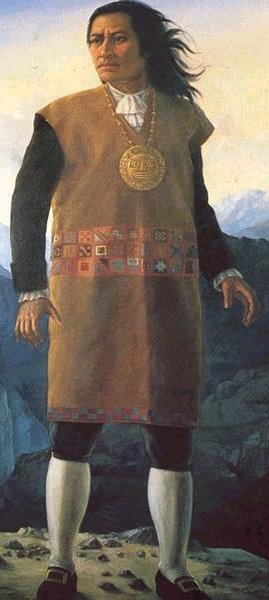
1781: Tupac Amaru II, Incan insurgent

On this date in 1781, the last name in Incan rebellion met a horrible end in the ancient Incan capital of Cusco.

José Gabriel Condorcanqui — rechristened Tupac Amaru II, as he was a distant descendant of the last Incan king — was a member of the privileged indigenous population depended upon by the Spanish to administer the forced and extorted labor that made its New World empire worth having.

Condorcanqui evidently had an epiphany.

In November 1780, he launched a well-planned rebellion by engineering the public execution of a hated corregidor Antonio de Arriaga at the hands of his own servant.

“From this day, no longer shall the Spanish feast on your poverty!”

This attention-grabbing entry onto the political chessboard was followed with an exemplary victory over Spanish forces. His revolt rapidly metastasized into an ethno-religious crusade, with all the accumulated bitterness of the Indians’ two-plus centuries maltreatment ferociously visited upon the Spanish.

It was a heady moment — but only a moment; within a few months, the Spanish had rallied and Tupac Amaru was betrayed into their hands.

The rebel had seized Incan symbology for his own purposes — speaking at ancient shrines, for instance — and the Spanish sentence against him included not only the inevitably horrific execution (of both Tupac Amaru and his wife and family) but a comprehensive and explicit programme of cultural annihilation to consign the Incan identity to the past. This lengthy sentence is well worth the read. (Sourced here, a pdf file; the bolded sections are my highlights.)

I must and do condemn José G. Túpac Amaru to be taken out to the main public square of [Cuzco], dragged out to the place of execution, where he shall witness the execution of the sentences imposed on his wife, Micaela Bastidas [Spanish link]; his two sons, Hipólito and Fernando Túpac Amaru; his uncle, Francisco Túpac Amaru; and his brother-in-law, Antonio Bastidas, as well as some of the principal captains and aides in his iniquitous and perverse intent or project, all of whom must die on the same day.

And once these sentences have been carried out, the executioner will cut out his tongue, and he will then be tied or bound by strong cords on each one of his arms and feet in such a way that each rope can be easily tied or fastened to others hanging from t he saddle straps of four horses, so that, in this position, each one of these horses, facing opposite corners of the square, will pull toward his own direction; and let the horses be urged or jolted into motion at the same time so that his body be divided into as many parts and then, once it is done, the parts should be carried to the hill or high ground known as “Picchu,” which is where he came to intimidate, lay siege to, and demand the surrender of this city; and let there be lit a fire which shall be prepared in advance and then let ashes be thrown into the air and a stone tablet placed there detailing his main crimes and manner of his death as the only record and statement of his loathsome action.

His head will be sent to the town of Tinta where, after being three days on the gallows, it shall be placed on a stake at the most public entrance to the town, one of his arms will go to the town of Tungasuca, where he was chief, where it will be treated in like manner, and the other in the capital of the province of Carabaya; one of the legs shall likewise be sent for the same kind of demonstration to the town of Libitaca in the province of Chumbilcas, while the remaining one shall go to Santa Rosa in the province of Lampa along with the affidavit and order to the respective chief magistrates, or territorial judges that this sentence be proclaimed publicly with the greatest solemnity as soon as it arrives in their hands, and on the same day every year thereafter; and they will give notice in writing of this to their superiors in government who are familiar with the said territories.

Since this traitor managed to arm himself and form an army and forces against the royal arms by making use of or seducing and leading with his falsehood the chiefs who are the second in command in the villages, since these villages, being of Indians, are not governed by such chiefs but rather by mayors who are elected annually by the vote or nomination of the chiefs: let these same electoral communities and the chief magistrates that care to give preference to candidates who know Spanish, and who are of the best behavior, reputation, and customs so that they will treat their subjects well and lovingly, honoring only those who have demonstrated honestly their inclination and faithfulness, eagerness, respect, obedience, submission, and gratitude to the greater glory of our great Monarch through the sacrificed of their lives, properties, or ranches in deference of their country or religion, receiving with brave disdain the threats and offers of the aforesaid reel leader and his military chiefs, yet taking care that these elected leaders are the only ones with the right to the title of chief or governor of their ayllus [communities] or towns, and that they cannot transmit their position to their children or other family members.

To this same end, it is prohibited that the Indians wear heathen clothes, especially those who belong to the nobility, since it only serves to symbolize those worn by their Inca ancestors, reminding them of memories which serve no other end than to increase their hatred toward the dominant nation; not to mention that their appear is ridiculous and very little in accordance with the purity of our relics, since they place in different parts images of the sun, which was their primary deity; and this prohibition is to be extended to all the provinces of this southern America, in order to completely eliminate such clothing, especially those items which represent the bestialities of their heathen kings through emblems such and the unco, which is a kind of vest; yacollas, which are very rich blankets or shawls of black velvet or taffeta; the macapaycha, which is a circle in the shape of a crown from which they hand a certain emblem of ancient nobility signified by a tuft or tassel of red-colored alpaca wool, as well as many other things of this kind and symbolism. All of this shall be proclaimed in writing in each province, that they dispose of or surrender to the magistrates whatever clothing of this kind exists in the province, as well as all the paintings or likenesses of their Incas which are extremely abundant in the houses of the Indians who consider themselves to be nobles and who use them to prove their claim or boast of their lineage.

These latter shall be erased without fail since they do not merit the dignity of being painted in such places, and with the same end in mind there shall also be erased, so that no sign remains, any portraits that might be found on walls or other solid objects; in churches, monasteries, hospitals, holy places or private homes, such duties fall under the jurisdiction of the reverend archbishops or bishops of both viceroyalties in those areas pertaining to the churches; and in their place it would be best to replace such adornments with images of the King and our other Catholic sovereigns should that be necessary. Also, the ministers and chief magistrates should ensure that in no town of their respective provinces be performed plays or other public functions of the kind that the Indians are accustomed to put on to commemorate their former Incas; and having carried out the order, these ministers shall give a certified account to the secretaries of the respective governments. In like manner shall be prohibited and confiscated the trumpets or bugles that the Indians use for their ceremonies and which they call pututos, being seashells with a strange and mournful sound that celebrate the mourning and pitiful memorial they make for their antiquity; and there shall also be prohibited the custom of using or wearing black clothing as a sign of mourning, a custom that drags on in some provinces in memory of their deceased monarchs and also of the day or time of the conquest which they consider disastrous and we consider fortunate since it brought them into the company of the Catholic Church and the very loving and gentle domination of our Kings.

With the same goal it is absolutely forbidden that the Indians sign themselves as “Incas,” since it is a title that anyone can assume but which makes a lasting impression on those of their class; and it is ordered, as is required of all those who have genealogical trees or documents that prove in some way their descent, that they produce them or send them certified and without cost by mail to the respective secretaries of both viceroyalties so that the formalities may be observed by those persons responsible to their excellencies the viceroys, consulting His Majesty where necessary according to each case; and the chief magistrates are charged to oversee the fulfillment of such requirements, to seek out and discover anyone who does not observe them correctly, in order to have it done to collect the documents with the aim of sending them to the proper authorities after giving their owners a receipt.

And so that these Indians renounce the hatred that they have conceived against the Spaniards, and that they adhere to the dress which the laws indicate, adopting our Spanish customs and speaking Castilian [Spanish], we shall introduce more vigorously than we have done up to now the use of schools, imposing the most rigorous and fair penalties on those who do not attend once enough time has passed for them to have learned the language; the duties and responsibilities involved in this plan going to the very reverend ecclesiastical prelates so that, in the opposition between parishes and doctrinas, they take care that those candidates bring affidavits from the provincial judges as to the numbers of people who speak the Said Castilian in those provinces … it being left up to the sovereign discretion of His Majesty to reward and honor those towns whose inhabitants have rendered, under the present circumstances, their due loyalty and faithfulness.

Finally, the manufacture of cannons of all kinds shall be prohibited under the penalty that any noble found manufacturing such items will be sentenced to ten years of prison in one of the presidios in Africa and any commoner will receive two hundred lashes as well as the same penalty for the same time period; reserving for a future time a similar resolution with regards to the manufacture of powder. And since there cannons of almost every caliber in the many ore-crushing mills and timber yards in these provinces, they will be gathered up by the magistrates once of the pacification of this uprising has been completely terminated in order to give account of them to the respective captaincy general so that he may determine whatever use he deems proper for them. Thus have I visualized, ordered, and signed: this is my final judgment.

José Antonio de Areche.

Tupac Lives.

The Spanish campaign to eradicate his name and identity didn’t exactly have legs.

The savagery of the crackdown helped generate Incan support for the rebellions that would shake off Spanish authority in the generations to come. He entered the official iconography of the post-colonial state, and can be found on Peruvian currency.

The very name Tupac Amaru became pregnant with the spirit of resistance — both in Peru, where it was adopted by a 1990’s revolutionary movement, and abroad, where a New York City Black Panther activist (pdf) gave the name to a son: Tupac Amaru Shakur.

On this day..

1859: Tantia Tope, Indian independence hero

This is the sesquecentennial of Tantia Topi’s hanging for what is sometimes called India’s First War of Independence.

Tantia Topi — there are many variations of the name — commanded Indian troops when a mutiny mushroomed into outright revolt.

Putatively in the service of a rebellious lord, Topi immediately established himself as the cause’s most capable commander. His forces bloodily seized Cawnpore (Kanpur) in a heady surprise victory during the conflict’s opening stages.

A British counterattack overturned that promising development. The Indian lord was captured, but “all the capacity for resistance that he ever displayed” had been supplied by Topi. Now, Topi found a more impressive liege in Rani Lakshmibai, and deployed his genius for soldiery in a fast-evolving war — harrying the occupiers in both conventional and (increasingly) guerrilla-style combat.

The rebels were outclassed; the time was not yet ripe — but Topi’s was the model of anticolonial guerrilla insurgency that would figure so prominently in the next century.

Topi’s exploits and elusiveness, maintaining his freedom in the field long after every other pillar of the uprising had collapsed, made him a domestic hero, and formed a continuing theme in the British press in 1858 and 1859. He was genuinely admired by his enemies as a soldier, however much his cause was abhorred. (The stiff-upper-lippers dinged him for inadequate personal courage, however.)

Topi was taken, at last, by betrayal, and dead at the order of a drumhead military court within days.

But the day after the London Times published its report of the popular hero’s hanging (“a great scramble was made by officers and others to get a lock of hair, &c”), it editorially eulogized* Topi with the gusto of victor catching, perhaps, the foreshadow of Indian resistance awaiting in generations still to come.

He raised armies as fast as we could disperse them, took up one position after another to our infinite annoyance, and led us a chace which, despite of unexampled efforts on the part of our soldiers, seemed to be really endless. Our troops pursued him without intermission, contrived more than once to surprise him, repeatedly captured his artillery and scattered his troops, but could never deprive him entirely of followers or guns. He seemed to summon forces from the earth as if by magic. As the pursuit grew hotter and hotter he mounted his men on ponies and camels, and marched, it is said, at the average rate of 60 miles a-day. Wherever we found him he had always cavalry and guns, and these he posted with remarkable skill.

Be it remembered that for half a century we had been training soldiers, and that in Bengal alone there were 150,000 natives under arms when this revolt broke out. Now, in all this enormous host there was not a single man who, when the bonds of allegiance and discipline were abruptly removed, displayed the intuitive capacities of a military commander. … The two years of the revolt, with all their opportunities, never produced one native General. … One man alone reproduced the old Indian character, and that man was TANTIA TOPEE — an obscure civilian, without place or power. He, by the light of nature alone, discerned the strong points of the rebels’ position and our own weak points. By the exercise of that faculty with which heroes are gifted he could always, even in his most desperate straits, draw followers to his standard. …

Nothing could more forcibly illustrate the reputation which this man had acquired than the fact that his fate has been attended with some regret … if he had not met his match in those opposed to him he might have founded a dynasty.

* May 21, 1859. Information moved a little slower.

On this day..

1865: Not George S.E. Vaughn

On this date in 1865, Abraham Lincoln had a date for Ford’s Theater — and with John Wilkes Booth’s single-shot Derringer pistol.

Abraham Lincoln was famous for his clemencies.

But Honest Abe had one last order of business to attend to before his carriage called him away to destiny: the pardon of a convicted Confederate spy due to be shot in St. Louis two days hence. Lincoln’s handwritten clemency for George Vaughn was the last official act of his presidency.

Lincoln in Story (“The Life of the Martyr-President told in Authenticated Anecdotes,” a light 1901 volume for popular consumption) relates:

Before the war Vaughn, with his wife and children, lived in Canton, Mo. He was a friend of Martin E. Green, a brother of United States Senator James S. Green, both strong pro-slavery men. At the opening of the war Martin E. Green recruited a regiment and received a colonel’s commission from the Confederate Government. George Vaughn enlisted under Green’s command and fought through the war.

After a period of fighting, Green and Vaughn crossed into Mississippi from Tennessee, camping at Tupelo, Miss. Not having heard from his family, Green was anxious to hear from his old home, so he delegated Vaughn to go on the mission of delivering letters to his wife.

Vaughn had almost completed his trip, having reached La Grange, six miles south of Canton, when he was captured by a squad of Federal troops.

They searched his person, and, finding letters and papers concealed about him, he was tried as a spy and sentenced to be shot. John B. Henderson, Senator from Missouri, finally succeeded in getting an order from the President for a retrial, but the verdict remained as hitherto. Again Henderson appealed to Lincoln, who granted a third trial, with the same result.

Henderson was not disconcerted, and again went to Lincoln. It was on the afternoon of April 14, 1865 — a melancholy date — that the Senator called at the White House. He called the attention of Lincoln to the fact that the war was practically closed, and said: “Mr. Lincoln, this pardon should be granted in the interest of peace and conciliation.”

This story gravitates naturally to the clemency of “the Great Heart” (as, for instance, D.W. Griffith called Lincoln). Far be it from us to say otherwise, but this is also self-evidently a story of the unusual prerogatives of the well-connected: not just any accused spy could get two trial do-overs and then a pardon free and clear ordered straight from the White House.

Mr. Lincoln replied: “Senator, I agree with you. Go to Stanton and tell him this man must be released.”

Henderson went to the office of the Secretary of War. Stanton* became violently angry, and swore that he would permit no such procedure.

Vaughn had but two days to live, and Henderson hastened to make one more stand. After supper he went to the White House. The President was in his office, dressed to go to Ford’s Theatre, when the Senator entered and told of the meeting he had had with Stanton.

Lincoln turned to his desk and wrote a few lines on an official sheet of paper. As he handed it to Senator Henderson he remarked: “I think that will have precedence over Stanton.”

It was an order for an unconditional release and pardon — the last official paper ever signed by Abraham Lincoln.

Lincoln was dead within hours. Vaughn passed away in 1899 in Maryville, Mo.

* Stanton is supposed to have delivered the remark as Lincoln’s deathbed, “now he belongs to the ages” … an alleged epitaph whose actual content is subject, like all biography, to textual uncertainty and ideological redefinition.


Update: The excellent tale of a different soldier pardoned on this same date has recently been debunked by the National Archives in an academic scandal: in January 2011, researcher Thomas Lowry confessed to altering the pardon order for one Patrick Murphy from the true (and much less dramatic) date of April 14, 1864 to April 14, 1865.

Vaughn was actually pardoned just before Lincoln went to Ford’s Theater; Murphy (totally unconnected to Vaughn) was pardoned 365 days prior.

On this day..

1836: The defenders of the Alamo, much remembered

On this date in 1836, Mexican forces commanded by President Antonio Lopez de Santa Anna overran the Alamo — and executed those few of its defenders who survived the day’s battle.

“Remember the Alamo!”

This most memorable battle of the Texas Revolution has since retained its place in the founding mythology of Texas and its draw as a tourist destination in San Antonio, no matter the complexities on the ground. (You can watch the earliest surviving film treatment, The Martyrs of the Alamo, free online. D.W. Griffith made it the same year he made Birth of a Nation.)

That Alamo of blood and legend, and the countervailing interpretations it eclipses, are much beyond our scope here, but we are attracted to notice the reputed summary execution of five to seven defenders who had surrendered or otherwise been captured during the fight. (A few dozen mostly civilian noncombatants in the former mission also survived, and were not executed.)

According to Robert Scott, Santa Anna was empowered by a Mexican resolution holding (not without cause) that

“foreigners landing on the coast of the Republic or invading its territory by land, armed, and with the intent of attacking our country, will be deemed pirates.”

Who counted, at this moment, as “foreigners” among the Anglo settlers trying to break away from Mexico and their supporters among from the United States to which Texas would eventually attach poses a historiographical riddle. But then, Santa Anna wasn’t there to write a dissertation, but to win a war — and he was said to be sorely annoyed at the defenders having tied him down for a week and a half.

King of the Wild Frontier

Covered by most any definition of “foreigner” would have been the Alamo’s most famous defender, Tennessee frontiersman and former U.S. Congressman Davy Crockett. He had arrived in Texas just a few months before, on a rendezvous with destiny.*

It’s a matter of dispute whether Crockett was among those last few executed; in an event this emotionally remembered, every version of the Crockett death scene — from “found dead of injuries amid a heap of Mexican casualties” to “cravenly bargained for his life” — gores someone’s ox.

Even if the account of Crockett’s presence among the executed derives from a disputed source — well, this blog has not scrupled to highlight the fictional and the mythological, those executions whose resonance transcends factual accuracy.

And even if Davy Crockett was not among those anonymous souls put to death this day, it is by his name that they have their tribute, as in the 2004 film** The Alamo:

* Destiny by way of Walt Disney.

** This Disney film diddles with the Crockett legend that Disney helped to inflate in the 1950’s — to the annoyance, of course, of traditional-minded Alamo partisans.

On this day..

1957: Dedan Kimathi, Mau Mau commander

At a Nairobi prison this morning in 1957, the most famed and feared of the so-called Mau Mau was hanged under emergency measures permitting the death penalty for illegal firearms possession.

The armed Mau Mau uprising against British colonialism was by this time on its last legs militarily, having been ground down by years of murderous anti-insurgent operations and pleasantries like mass internment.

It had been an ugly fight on all sides, with overlapping conflicts — within the Kikuyu tribe, between Kenya’s native populations, and between the British Empire and her faraway subjects — brutally settled.

Certainly the Mau Mau’s depredations had garnered voluptuous press coverage in the mother country; accordingly, the capture of “Field Marshal” Kimathi, the biggest name in the insurgency, was a plume in the British lion’s cap.

(An earlier propaganda piece along the same lines sounded the war tocsin “so that peace may come to this troubled colony.”)

Notwithstanding the (still) official London take on Kimathi and the Mau Mau, their fight for the independence Kenya would soon attain has made Kimathi a hero to many Kenyans.* He was honored on the 50th anniversary of his death with a bronze statue in Nairobi.

And more than that: the Mau Mau would metastasize into a sort of floating signifier for implacable racialized anti-colonialism, a powerful symbol for an age of decolonization. Malcolm X frequently invoked the Mau Mau example. Frantz Fanon saw in the Mau Mau the potency of spontaneous rural resistance in generating white interest in “compromise” with the moderate who

never stop saying to the settlers: ‘we are still capable of stopping the slaughter; the masses still have confidence in us; act quickly if you do not want to put everything in jeopardy.’ … as the settlers cannot discuss terms with these Mau-Mau, he himself will be quite willing to begin negotiations.

* Although many surviving Mau Mau themselves are nonplussed by their post-independence treatment.

On this day..

1915: Veljko Cubrilovic, Danilo Ilic and Misko Jovanovic, Archduke Ferdinand’s assassins


“Executions as a consequence of the Sarajevo assassination”. From the Visual Archive of Southeastern Europe.

On this date in 1915, three of the Black Hand conspirators who had assassinated Archduke Franz Ferdinand in Sarajevo the previous June were hanged for treason and murder as the World War that assassination ignited engulfed Europe.

You could say it was too little, too late.

Ironically, the gunman who actually got the Archduke, Gavrilo Princip, was too young to receive the death penalty under Austro-Hungarian law — barely short of his 20th birthday,* a more liberal standard for capital responsibility than even present-day human rights standards require.

In fact, that was true of five of the eight student nationalists convicted; the Slavs’ barbarous oppressor accordingly punished them for murdering the heir to its throne and involving it in a ruinous war with prison sentences of no more than 20 years. Three of the underaged five (Princip included) contracted fatal tuberculosis cases in custody during World War I; the other two, Cvijetko Popovic and Vaso Cubrilovic, outlived the Habsburg Empire by decades.

Three remained, old enough to swing for turning Europe into a charnel house: Vaso’s older brother Veljko (a schoolteacher), Danilo Ilic (a newspaper editor) and Misko Jovanovic (a businessman).

But if their names aren’t familiar, and their comedy assassination plot succeeded almost in spite of themselves, these forgotten radicals still rank among the midwives of modernity for the global cataclysm unleashed by their deed, for its calamitous aftershocks of nationalism and ideology, and for the second war that succeeded the horrors of the first.

According to John S. Craig’s Peculiar Liaisons, Gavrilo Princip left his poetry scrawled on the wall of his cell.

Our ghosts will walk through Vienna
And roam through the palace
Frightening the lords

All things considered, he sold himself short.

* There seems to be some uncertainty as to Princip’s actual date of birth, so he might in fact have been 20 years old. The court, at any rate, took him for 19.

On this day..

1781: Mutinous ringleaders of the New Jersey line

On this date in 1781, George Washington quelled a dangerous mutiny in his starving Continental Army with a couple of salutary summary executions.

Weeks before, the Pennsylvania Line had mutinied for better pay — successfully. (When approached by British agents offering hard currency should they turn coat, the mutinous troops patriotically arrested the agents.)

General Washington had cause to fear widespread discontent in his chronically undersupplied army, however. He circulated to Congress and to several state governors an urgent appeal (.pdf) for more aid to hold up morale.

The aggravated calamities and distresses that have resulted from the total want of pay for nearly twelve months, the want of clothing at a severe season, and not unfrequently the want of provisions, are beyond description … it is vain to think an army can be kept together much longer under such a variety of sufferings as ours has experienced … unless some immediate and spirited measures are adopted to furnish at least three months’ pay to the troops in money, which will be of some value to them, and at the same time ways and means are devised to clothe and feed them better … the worst that can befall us may be expected.

Washington vowed in the meantime to “continue to exert every means I am possessed of to prevent an extension of the mischief.”

The mischief, however, extended.

The New Jersey line at Pompton imitated — and the imitation was reportedly explicit — the Pennsylvania line. They had legitimate grievances, like nearly everyone in the Continental Army, and that was precisely the problem: if mutiny became the means to resolve grievances, Washington wouldn’t have a Continental Army much longer.

Washington detailed Gen. Robert Howe to make an example.

Sir: You are to take the command of the detachment, which has been ordered to march from this post against the mutineers of the Jersey line. You will rendezvous the whole of your command at Ringwood or Pompton as you find best from circumstances. The object of your detachment is to compel the mutineers to unconditional submission, and I am to desire you will grant no terms while they are with arms in their hands in a state of resistance. The manner of executing this I leave to your discretion according to circumstances. If you succeed in compelling the revolted troops to a surrender you will instantly execute a few of the most active and most incendiary leaders.

And as Washington reported this afternoon to New Jersey Governor William Livingstonsuccess.

Dr. Sir: I have the pleasure to inform your Excellency, that the measures concerted for quelling the mutiny in the Jersey line were this morning carried into full execution. The mutineers were unexpectedly surrounded and awed into an unconditional surrender with little hesitation and no resistance. Two of the principal actors were executed on the spot, the rest pardonned. The spirit of mutiny seems now to have completely subsided and to have given place to a genuine repentance. This was very far from being the case previous to this step, notwithstanding the apparent submission which the assurances of redress had produced; they still continued insolent and refractory and disobedient to the commands of their officers.

A general pardon was promised by Colonel Dayton, on condition of an immediate and full return to duty. This condition was not performed on the part of the mutineers and of course they were not entitled to the benefit of the promise; besides which the existence of the Army called for an example. I have the honor etc.

That second paragraph of the letter hints at a bit of ass-covering from Washington. The officer on the scene, Elias Dayton, had, according to Charles Patrick Neimeyer, already smoothed the disturbance by promising that a state commission would adjudicate discharge claims.

The placated “mutineers” were therefore surprised to be roused from their beds at Ringwood, N.J., by Howe’s forces and forced to form a firing squad to execute their own sergeants. (Neimeyer also claims that the first six-man squad intentionally missed.)

This in-the-field execution to enforce military discipline was a precedent later cited by Alexander Mackenzie to justify hanging Philip Spencer, Samuel Cromwell and Elisha Small at sea for mutiny.

On this day..

1758: Francois Macandal, forgotten black messiah

(Thanks to Mark Davis of macandal.org for the guest post on a remarkable historical parallel to today’s inauguration of Barack Obama. -ed.)

The world was astounded when Barack Obama was elected to the Presidency in 2008 knowing the cultural barriers minorities have faced for hundreds of years. The date of inauguration, January 20, also happens to be the anniversary of the burning at the stake of a virtually unknown man, Francois Macandal,* whose epic war against cultural barriers has been buried for centuries.

Read some of his story and judge if the historic election of Barack Obama could have occurred without the man they called “Macandal.”

The parallels with Barack Obama’s journey are numerous, but the life of Macandal was perhaps even more remarkable, reaching great heights and falling into the darkest chasms of despair, yet succeeding in spite of staggering odds. Macandal’s travails may be about finding one’s purpose and dreaming of victory even when condemned by a majority, as he was relentlessly pursued by soldiers and hounded by countless naysayers.

251 years ago on January 20, 1758, Macandal was chained to a post on a platform before thousands of slaves brought together to witness his brutal torture and execution. Because of his importance, the French gathered slaves from hundreds of plantations throughout the colony of St. Domingue (now Haiti and the Dominican Republic). They believed such a horrific spectacle would quash Macandal’s Revolution, which he began to end French rule and abolish slavery, 12 years before.

Around 1746 Macandal escaped his plantation, united thousands of escaped slaves along with many still enslaved, and proclaimed that he would lead them all to independence and freedom. This declaration, from someone who had only six years before been taken from his home in the Congo, was unprecedented, since no slave colony had ever defeated a European nation. Then Macandal mobilized tens of thousands and may have inspired millions to end slavery and defeat colonial hegemony in the Haitian Revolution consummated decades after his death.

But ironically even the famous, black Marxist writer C.L.R. James, attributed one of the greatest revolutions in history to something akin to ‘spontaneous rioting’ by 500,000 black slaves in 1791. Since 1791 almost every historian has reduced the “Haitian Revolution,” the only successful overthrow of a colonial power by black slaves, to a ‘collective rage,’ inspired by the whites of the “French Revolution.” Yet it may have been Macandal’s Revolution, not the starving peasants of France, that inspired their uprising in 1789.

The true story of Macandal represents obscure but recorded testimonies about his life and explains why the slave revolt of 1791 was in fact, “Macandal’s Revolution,” almost 50 years in the making. Macandal foretold the end of slavery, then planned it, plotted it and began it. His story shatters a myth that has gone unchallenged for over 200 years: that the Haitian Revolution of 1791 was a spontaneous slave uprising inspired by the French peasants who had charged the Bastille Prison in Paris two years earlier.

The Haitian Revolution ultimately ousted the French, defeating Napoleon and numerous French generals. It also succeeded against the vaunted British army and established a new government run by former slaves. It was the first domino in a series of colonial defeats and changes in law that led to the end of institutional slavery; and Macandal started it all.

Correcting the Historical Record

Macandal is rarely the focus of historians and when mentioned only his insignificance is noted. But the popular version of his story was immortalized by the original French writers themselves, in the interest of bolstering a self-image of innate superiority as a nation and a race. To have recognized Macandal’s brilliance would have acknowledged slavery’s illegitimacy, so Macandal’s real story had to be trivialized and buried.

This telling of Macandal’s journey from a free child in Africa to slavery and then revolution, relies less on popular writings and more on a review of all of the records in context. For example French writers claimed Macandal broke free because he was tied with ropes and the post was made of rotted wood that fell apart when he was set ablaze. Historians have repeated this without scrutiny. The French on St. Domingue regularly burned slaves to death at the town square of the capital, “Cap Francais.” At Macandal’s execution they gathered thousands of slaves as witnesses, to insure a humiliating defeat and halt his widely supported rebellion. Yet, despite this grandiose staging, we are supposed to believe Macandal was insignificant. And we must accept that the French military was so inept they forgot how to execute and did not know that ropes burn and untreated, rotted wood is flammable. Many such dubious “facts,” are still repeated blithely about Macandal and few Westerners grant him his bravery, genius or impact.

Interestingly, the U.S. Bill of Rights guaranteeing equality for all was also adopted in 1791, but it would be more than seven decades before slavery was outlawed in the U.S. and almost two centuries before equal opportunity laws were passed and enforced. For one tiny nation, Macandal enabled this to occur over 200 years ago.

Background

I began researching the life of Macandal 20 years ago, startled and inspired by one chapter in Wade Davis’ popular book The Serpent and the Rainbow, which focused on secret societies, Voodoo and Zombification. His version of Macandal’s story was dictated to him by Rachel Bouvoir-Dominique, a Haitian Anthropologist I interviewed in 1997, at her office in Cap Haitien. Working under the tutelage of well-known author and expert on Haitian history Michel Laguerre, a professor at U.C. Berkeley, I received grants for a field study and documentary on the subject of Macandal.

Anthropologists often allocate greater weight to oral history, informal observer accounts, burial remains, maps and gravures, re-evaluating more accepted published works historians rely on, and so this account reflects my perspective and research as an Anthropologist. I examined European gravures (illustrations) and colonial records cited commonly more skeptically, because they were clearly burdened by religious, sexist and racial paradigms of the day. For example illustrations portrayed slaves with happy smiles and sanguine facades, enjoying their lives in idyllic settings on the plantations. Yet slaves faced torture, rape, separation of family and death from over-work, every day. Blacks were often drawn with monkey features (toes, ears etc.) and other demeaning caricatures.

Western writers were fiercely loyal to provincial rhetoric, including the gender and racial bias then considered crucial foundations of Christian theology. Western scholars dehumanized natives and women to rationalize slavery, prejudice and justify the infamous “hierarchy of being,” which granted “white men” a closeness to God that no one else could approach. This endowed them with the right to use others as they saw fit.

There were many reasons colonial authorities destroyed or buried the noteworthy exploits of slaves. Few accounts of courageous acts from among the ranks of millions of Africans during 400 years of slavery were recorded and preserved, primarily to maintain the perception that slavery was justified, necessary and Nubian Africans were not truly human but beasts of burden. There are literally thousands of articles, books and films about individuals among the six million Jews who died during the holocaust but only a scant few from among the 100-200 million indigenous peoples killed during the colonial expansion; all the more reason to re-evaluate slaves like Macandal.

A Brief History of Macandal

During the early 18th century, around the age of 12, Macandal was taken from the west coast of Africa, probably the Loango Kingdom in the Congo. I claim the date of his birth was 1728 primarily because oral historians in Haiti I interviewed believed him to be 30 when he was fastened to a post before thousands and set on fire in 1758.

The French called him Macandal which may derive from a city in the Congo called “Makanda.” The town of Makanda no longer exists due to civil war but could have ancient roots and slaves were often named after the places they came from. His name may have been taken from the term makanda (plural form of “kanda”) referring to African societal groups. Some written accounts report that Macandal claimed to be descended from a ranking societal group and the son of a Chief or King.

Amazingly, Macandal could speak, read and write Arabic fluently. Some believe this is because he was raised Muslim, yet the Congo was Christianized long before Macandal was born. Portuguese mercenaries, missionaries and armies had combed every square inch of the Congo beginning in the late 1400’s, searching for gold, diamonds and slaves, forcing conversion to Christianity. However Macandal’s words and actions reveal a unique knowledge of both Christianity and Islam. His ancestors may have emigrated from the east coast where Muslims and Asians had allied with Swahilis to build beautiful cities and schools before the Portuguese invasion. His family may have then hidden themselves for centuries.

Conversion to Christianity was also a requirement for slaves on colony plantations but Macandal defied the French by learning the underpinnings of Christianity, to understand the roots of slavery and challenge newly acquired doctrines. Despite many influences the adult Macandal claimed no affiliation with Christianity, Islam, Voodoo or Animism.

As a child Macandal was educated and known to be accomplished in both music and art, including painting and sculpture. His dedication to learning was apparent throughout his life. He displayed a vast knowledge of plants, became a doctor on the plantation he was taken to and was sought by even the French themselves for treatment of diseases and ailments. Yet the vegetation on St. Domingue was completely different from that of the Congo; therefore, Macandal had to study his new environment and learn the properties of perhaps hundreds of plants. He secretly taught himself French and became so eloquent that the French aristocrats remarked that he could speak it better than they themselves, though education was strictly forbidden for slaves.

Based on historical records and interviews, it appears that Macandal was first sentenced to death on his plantation, around 1746 at the age of 18, for falling in love with the plantation owner’s favorite lover, a young and beautiful house slave. He underwent a scene of heinous torture intended to culminate in his death in front of many witnesses, but escaped mysteriously and fled into the hills. The French replaced this account with a tale about Macandal becoming handicapped from losing a hand in a sugar mill and then being left unguarded. His escapes were always attributed to poor guard oversight.

Though Macandal probably began his new life of freedom with the intention of bringing vengeance to his former owner Lenormand de Mezy and rescuing his true love, for some reason his objective evolved. Perhaps because of the totality of his traumatic experiences or because of the influence of Maroons (ex-slaves already living in the distant mountains) Macandal met after escaping, he began working for a new goal of freedom for all.

Macandal led a sweeping and unwavering revolution during the 12 years after his escape from the plantation. Unlike other escaped slaves, Macandal actually made the end of slavery his stated mission. He became the first to unite thousands of disparate Maroons who were living free but divided by tribal affiliation and known to be ardently dedicated to the destruction of each other. His uniting of these groups was an extraordinary accomplishment and he is the first known black leader and ex-slave to do so.

He began calling himself the “Black Messiah” and gave rousing speeches in secret locations to recruit slaves. He made dangerous and daring appearances on plantations during the night to urge loyalty and inspire hope. The name “Black Messiah” had great meaning to Macandal as evidenced by one of his famous speeches at a secret recruitment meeting. The words exposed Macandal’s understanding of Islam and Christianity and their link to institutional slavery. The term was a powerful catalyst he used to preempt religious and ethical indoctrination of blacks and free them from the ideological bonds of slavery. He had to usurp the authority of the Church and French government to convince slaves they deserved equality, freedom, family sanctity, education and self-government.

Macandal became a brilliant strategist and had a large, organized camp with lieutenants, captains and other ranks. He led countless attacks and escaped capture mysteriously many times. His tactics were unique and devastating. They were known to be carried on after his disappearance despite the brutal efforts of the French to extinguish illegal grassroots activity. During his reign as a Maroon leader he may have recruited half or more of the 100,000 slaves living on the plantations as secret agents of his revolution.

Maroons and slaves apparently employed his tactics for decades after his disappearance in 1758. During the decade before the final thrust for overthrow in 1791, and despite harsh measures to thwart rebellion, Maroon activity greatly increased. This activity was so secret that virtually nothing is known about this period and is one reason historians assume the war for independence was unplanned, even though the first massive attack was led by Boukman Dutty, formerly a cruel black overseer who was a contemporary of Macandal. His gathering, which launched the war, was convened at a hidden location where Macandal formerly gave his speeches, the symbolism of which cannot be denied.

Generals that followed Boukman used ingenuity and unique strategies to win the 13-year war and Toussaint L’Ouverture is given most of the credit for the victory. But Toussaint refused to support the war until after it had begun; its inevitability certain. He was 13 when Macandal was sentenced to death in 1758. A voracious reader and student of warfare he was well aware of Macandal but content as a slave under a liberal planter.

It is my thesis the “Macandal Revolution” continued through the three decades preceding the Haitian Revolution. No other slave is known to have prophesied and promised the end of slavery yet Macandal predicted that blacks would defeat the French, become free and independent of colonial rule and control the colony of St. Domingue. His rally cry and pronouncement repeatedly rang throughout the colony despite opposition and betrayal from many slaves who greatly feared the French and did not believe victory was possible.

The Haitian Revolution remains the only successful movement by black slaves to defeat a colonial power and achieve complete independence. It stands alone as a towering victory against incalculable odds. Though it is characterized as a ‘riot’ that generated its own momentum, 500,000 slaves and free blacks mysteriously rose up in unison, using sticks and stones, against over 50,000 heavily armed soldiers, landowners and henchmen.

The Fall of Colonialism

As Macandal’s victories mounted I propose that word of his revolution spread to Europe and bolstered many anti-colonial movements. For example one of his closest secret allies was a French Jesuit priest and the Jesuits along with other religious leaders in Europe began fomenting rebellion during this period. Before news of Macandal’s revolt spread, many in Europe believed the slave trade was not only profitable but philanthropic. It had long been heard in the churches that slaves were heathens being brought to Christ and treated well in the process. His uprising no doubt made many Europeans aware that slaves were not being treated well and were desperate. Macandal’s shocking victories may have provoked Europeans to finally condemn colonialism and slavery. His fearless attacks and disregard for colonial might may have also seeded the French Revolution.

What really happened on January 20, 1758? Macandal endured great agony during an intense and excruciating punishment. He did this so that slaves everywhere might become free. The French claim Macandal was burned alive at the town square in Cap Francais.** Admitting he broke free and leaped out of the fire, they wrote that soldiers reclaimed Macandal and threw him back in. However some observers claimed Macandal broke his chains and fled, never to be seen again. How he broke free during any of his escapes despite being surrounded by guards and soldiers, is not known. It is interesting to note that his remains were never found and there is no burial site. Given the French proclivity for making examples of slaves to increase fear and enforce discipline, a successful execution should have been commemorated by another French monument.

For most historians, January 20, 1758, came and went with barely a mention in official memorandums. Yet a detailed search of documents reveals a massive cover-up, confusion and consternation. Macandal’s Revolution was not quashed or even slowed; instead it was impelled and sent wildly rumbling down a path of manifest destiny. Plantation owners later discovered their most trusted slaves were working for the revolution. New restrictions were put on all blacks throughout the colony and 4-5 rebels were burned at the town square every month to strike fear into the rest. Intense interrogation and torture revealed ever more depth to the conspiracy. Macandal’s execution day inflamed slaves and intensified their commitment to him and they became more united and fervently bent on winning freedom. Jesuits were banned from St. Domingue five years later.

As the first U.S. President with African roots is inaugurated on January 20, no one will speak of Macandal or Macandal’s Revolution, which led to equal rights in 1804 for one small nation. January 20, 1758, the day the French sought to secure colonialism and slavery in perpetuity, became a day of victory for Macandal and a watershed event which brought colonialism down. Though Macandal has been denied his place, his actions may have ended slavery and paved the way for people like Barack Obama to make history.

Mark Davis received his Bachelor of Arts degree in Anthropology from U.C. Berkeley and a Master’s in Anthropology from the University of Hawaii. He is the foremost authority on Macandal and his one hour documentary The Black Messiah was broadcast on PBS in 1997. He publishes information through his website at www.macandal.org.

* The man’s true name is lost to us; the one he was given by the French can be alternately spelled “Mackandal” or “Makandal” or “Mackendal”.

** Renamed Cap Haitien after Haiti won its independence.

On this day..

1864: Two Dodds, as two spies, in two states, and twice botched

On January 8, 1864, young David Owen Dodd was hanged in Little Rock for spying on federal troops … and cavalryman Ephraim Dodd (no known relation) suffered the same fate for the same crime in Knoxville.

Just one of those strange coincidences.

Ephraim Dodd

Ephraim Shelby Dodd is the subject of an outstanding HistoryNet profile whose contents this blog can not so much improve upon as summarize.

A member of Terry’s Texas Rangers (“men who ride like Arabs and fight like devils”) Dodd was captured in December 1863 and convicted by his diary — a particularly harsh reading of his diary in which a reference to having passed himself off as a Yankee was interpreted as evidence of espionage. (The diary is available online and as part of a book on Terry’s Rangers.)

Knoxville worthies rallied to save him and Ephraim Dodd insisted upon his innocence, but not so vociferously that he displayed any terror of his fate.

Do not grieve for me, my dear parents, for I am leaving a world full of crime and sin for one of perfect bliss.

The hanging itself wasn’t bliss, exactly, despite a well-planned soundtrack.

From the “Death March” the music gradually slid into “Mary’s Dream,” and then we were carried back by the magic of the plaintive notes to juvenile days; to visions of “Sandy far at Sea,” and to the sad cadence of that fading refrain,

“When, soft and low, a voice she heard
Saying, Mary, weep no more for me.”

The solemn march, the wailing notes of the fife, and perhaps above all the calm, unmoved, manly bearing of the prisoner — so we thought — produced a mournful impression upon the spectators.

Points earned on artistic merit, however, were deducted for technique.

At a signal the bolt was now withdrawn, the culprit fell, but the cotton rope broke by the sudden tension, and the man lay stretched and stunned upon the frozen ground below. A mummer of horror, mingled with expressions of pity, ran through the assembled crowd. Recovering for an instant from the shock — for his neck was not broken — he said — perhaps incoherently: “Release me quick, if you please.” For some ten minutes the unfortunate man lay thus upon his back, without moving a muscle. Meantime the officers and men, whose painful duty it was to see to the execution of the law, adjusted this time two parts of the same rope instead of one, and the half-conscious man was borne up the fatal steps a second time, being partly supported upon the drop until the double noose had been adjusted. Not a word or sign of suffering all this time escaped his lips. In another moment the drop fell, and prisoner’s form now hung by the neck — the knot behind the head. Death finally ensued by strangulation. In ten minutes, Dr. Cogswell, the officiating surgeon, pronounced life extinct, and the body was taken down and buried.

David Owen Dodd

A few hours later and 500 miles down the way, the entirely unrelated hanging of David Owen Dodd proceeded in Little Rock, Ark.

David Dodd’s final resting place at Mount Holly cemetery. Image courtesy of Richard Theilig.

Only 17 at his hanging and not physically robust enough to get his brains blown out at Gettysburg, Dodd was sent by his father on a business trip across Union lines — everything legit, and carrying a pass — but got busted with morse code notations of Union troop strength in the city.

Unlike Ephraim, who was basically a normal soldier thrust into incriminating-looking circumstances by the chance of war, young David Dodd was rightly accused.

He didn’t bother protesting his innocence, but he also kept mum about his contacts. (Suggestively, a teenage girl and her father were whisked out of town and kept under guard in Vermont for the rest of the war.) That proud silence has won him quite a reputation in Arkansas as the Boy Hero of the Confederacy.

But similarities between the condemned men extended beyond their names. David’s parting filial reassurance could pass for a paraphrase of Ephraim’s.

[D]o not weep for me for I will be better off in heaven. I will soon be out of this world of sorrow and trouble.

And the hanging itself, conducted in a tense atmosphere, was likewise a botched job. In this case, the slight young man didn’t fall hard enough to break his neck, but did fall far enough to get his tiptoes on the ground, initiating an agonizingly protracted strangulation which the soldiers on detail expedited by (accounts differ) pulling on David Dodd’s legs and/or pulling up on the rope.

On this day..