1818: Abdullah ibn Saud, last ruler of the first Saudi state

On this date in 1818, the last ruler of the first state established by the Al Saud who rule the modern state of Saudi Arabia lost his head to the Ottoman Sultan.

The Ottoman state and its (largely independent) vassal Egypt begged to dispute the Wahhabi tribe’s authority in the Arabian peninsula (and its proclivity for raiding Ottoman caravans) and made war on the House of Saud throughout the 1810’s.

The Battle of ad-Dir’iyah in 1818 settled the matter, with our day’s principal Abdullah I surrendering to the Egyptian general Ibrahim Pasha.

We pick up the action from the third-hand, well-after-the-fact reports of the London Times. This, printed on Jan. 16 1819 under the “German Papers” heading:

FROM THE TURKISH FRONTIERS, DEC. 16.

The last victory over the Wechabites puts an end to the war at once. Ibrahim Pacha, who commanded the Turkish army, sends the captive Abdallah to Constantinople, but he first had his head shaved, and all his teeth pulled out.

On Feb. 6, the Times channeled the Dutch and Flanders mail:

Intelligence from Constantinople, dated the 24th December, states, that the Chief of the Wechabites, Abdallah, and his Iman, were brought prisoners into that capital on the 16th of the same month. After being led, in chains, through the principal streets, they were taken to prison and put to the torture. On the following morning, they were brought before the Sultan and beheaded. Their naked bodies were exposed during three days, and then delivered to the populace.

In addition to Abdullah himself, this affair finished off the city of Diriyah as a Saudi capital.

But of course, the Saud and their state were just getting started.

On this day..

1520: Hemming Gadh

On this date in 1520, Hemming Gadh was beheaded at Raseborg Castle, Finland for his support of Swedish independence from Denmark.

Gadh (English Wikipedia entry | Swedish | free Swedish biography), around 70 by this time, had had a colorful, opportunistic career in Swedish politics. And religion: he was once temporarily Bishop of Linkoping, but could not win papal approval for the post and got excommunicated a few years later.

A Gadh-fly to the Danish-run Kalmar Union, he was a longtime supporter of Swedish independence agitator Sten Sture the Elder — so much so that when Sten kicked the bucket in 1503, it was Gadh who spiked the story and sent a squire disguised as the late statesman running off to Stockholm to rally his successors before the opposition could capitalize on the situation. (Sweden: The Nation’s History, by Franklin D. Scott)

Gadh was a key figure holding the Swedish party together in a decade-long interregnum until Sten Sture the Younger was up to the task.

And young Sten’s arrival was just in time, because around 1518, Gadh got captured, went over to the Unionist party, and helped it capture Stockholm … precipitating an infamous bloodbath.

Danish King Christian II evidently didn’t trust this turncoat any further than he could throw him, however, which was quite a bit further when he was cut in two. The opportunism that had served Gadh so well for so long this time cost him his head. (Swedish link.)

When in Finland, you can still see the dramatic former island keep where it all went down:


Raseborg Castle (Finnish: Raaseporin linna, Swedish: Raseborgs slott) in Ekenas.

(More information here)

On this day..

1689: Karposh, Macedonian rebel

On an uncertain date in early December (or possibly late November), the Macedonian* rebel Karposh was executed at Skopje.

The Great Turkish War had seen the Ottomans advance to the gates of Vienna, but an alliance of European powers pushed the Mohammedan back.

Their crisscrossing armies roiled the Balkans, creating the opportunity for a bit of ill-fated separatism.

Arambasha [a title, not a name] Karposh raised a native Macedonian rebellion (detailed account of it here) that waxed and waned with the fortunes of the Austrian army. In his brief heyday, he was acclaimed “Prince of Kumanovo“.

But a November 1689 counteroffensive seriously harshed that vibe; the Turks overran his force and drug Karposh back to Skopje where he and a couple hundred fellow Macedonian captives are said to have been put to death by impalement on the lovely Stone Bridge over the Vardar. (Other versions of this story cite, less picturesquely, hanging.)

You can still see this landmark today in Skopje … capital of the now-independent Macedonia.

* Lest I wade carelessly into the Balkan ethnic crossfire, I hasten to declaim that “Macedonian” here refers to the geographic environs roughly coincident with the present-day Republic of Macedonia. No representation as to the man’s ethnicity or his project is intended, or attempted.

On this day..

1885: Louis Riel, Metis leader

On this date in 1885, Louis Riel, “the puzzling Messianic figure of Canadian history,” was hanged in Regina for treason.

We have already met in these pages the magnetic, controversial figure of Louis Riel when his Red River Rebellion caused the 1870 execution of Thomas Scott, one of the soldiers sent to suppress it.

Now, after a decade and a half in the political and sometimes literal wilderness, the champion of the Métis had been recalled from the United States to press the rights of his mixed-race French-indigenous people against the Anglo Canadians’ westward march.

It was North America’s familiar clash of civilizations between expanding industrial economies and the traditional ways of life they displaced. (Here’s a good background documentary video, with a Part 2 that gets into the weeds on battlefield events.) Because the Metis were “half-breeds” whose European stock was French, the story’s familiar cocktail of racism had a twist of Canada’s Anglo-French rivalry, too.

Riel declared an independent Provisional Government of Saskatchewan, and the North-West Rebellion was on.

The rebels had some initial successes. But hampered by an inability to make a firm alliance with the more politically realistic Cree, by the non-support of the Catholic Church in view of Riel’s increasingly out-there millenarianism, and by the extension of technological superiority another 15 years’ railroad-building had given the Ottawa government, Riel’s forces soon gave way.

The lightning-rod leader was arrested and repaired to the provincial capital for trial, where he spurned his lawyers’ desperation attempt to plead insanity and cogently vindicated his position.

“Life, without the dignity of an intelligent being, is not worth having.”
Riel

For a man twice a rebel, the hanging sentence was no surprise. Later, juror Edwin Brooks would tell a newspaper “We [the jury] tried Louis Riel for treason but he was hanged for the murder of Thomas Scott.” (Source, via this pdf handbook all about the Metis.)

His hanging was met with outrage in Francophone Quebec, and Louis Riel remains a polarizing figure down to the present day — an emblem of multiple overlapping cultural conflicts never fully resolved. The upcoming year’s 125th anniversary of events profiled here promise a renewed examination of Louis Riel (or at least of his tourism potential).

Below are a few more-or-less obtainable recent books about Riel and the North-West Rebellion, culled from this pdf reading list. Also note the public-domain volume The history of the North-west rebellion of 1885.

Recent considerations of Louis Riel and the North-West Rebellion

On this day..

1864: Six of Mosby’s Rangers

It was on this date in 1864* that an infamous Union war crime took place in Front Royal, Virginia.

Union forces in the Old Dominion were bedeviled by John Singleton Mosby, whose bold and legendary guerrilla tactics are commemorated in Herman Melville’s “The Scout Toward Aldie”:

All spake of him, but few had seen
Except the maimed ones or the low;
Yet rumor made him every thing–
A farmer–woodman–refugee–
The man who crossed the field but now;
A spell about his life did cling —
Who to the ground shall Mosby bring?

In 1864, the “Gray Ghost” haunted the Shenandoah Valley, and his spooky brand of warfare eventually goaded the Union into crossing the streams.

Allegedly raging from the murder by Mosby’s troops of a surrendering northern cavalryman, the blues rounded up six captured Mosby men — actually only five, plus one 17-year-old civilian who had opportunistically joined the fray — and summarily executed them.

David Jones, Lucien Love and Thomas Anderson were shot. So was the aforementioned civilian, Henry Rhodes, under the eyes of his shrieking mother.

Then, two last unfortunates were hanged. William Thomas Overton spurned an offer of clemency in exchange for information on Mosby’s hideouts with the memorable parting, “Mosby will hang 10 of you for every one of us.”

Not quite so … but not an empty threat, either. Weeks later, Mosby would order the retaliatory executions of a like number** of randomly-selected Union prisoners of war, and communicate this intelligence to his foes along with his (successful) suit to resume more gentlemanly methods of killing one another.

* Some sources (including some cited in this post) claim September 22nd. The consensus of authoritative sources appears to be clearly September 23rd. The Gray Ghost himself may be one source of the confusion; according to Custer and the Front Royal Executions, “In his memoirs, which were published over 50 years after the event, Mosby got the date wrong, apparently based upon one of the newspaper accounts … [which] stated that the Front Royal incident occurred on September 22, not September 23, the date upon which it actually did occur.”

** Seven were condemned in retaliation, for these six plus a separate execution that occurred Oct. 13.

On this day..

1851: Narciso Lopez, filibuster

On this date in 1851, Venezuelan-born adventurer Narciso Lopez was garroted in Havana for his repeated expeditions to overturn Spanish dominion in Cuba.

Narciso Lopez had fought for the Spanish against Simon Bolivar, and migrated to Cuba when Bolivar carried the day.

Initially a loyal government functionary, Lopez gradually became sweet on the anti-Spanish cause, and fled Cuba for the United States (pursued by a death sentence in absentia) when a treasonable conspiracy of his was discovered.

Like MacArthur, he meant to return — and did.

Lopez crisscrossed the United States, drumming up support for filibustering raids on Cuba meant to detach it from Spain and make it an American slave state.

In this proposed enterprise, wedded alike to both national expansionism and southern sectionalism, Lopez rubbed shoulders with the likes of Jefferson Davis and Robert E. Lee, even helping precipitate criminal charges against a former U.S. Senator who backed him.

But the five expeditions went from bad to worse, until Lopez was captured in August 1851.

Tom Chaffin’s Fatal Glory: Narciso Lopez and the First Clandestine U.S. War Against Cuba, describes the scene of his death, just days after capture.

Between the wide Gulf sky and the waters of Havana harbor, the Gothic Morro Castle’s high tabby walls gleamed in the Sunday morning light on September 1, 1851. Though it was barely seven o’clock, a noisy crowd of four thousand already had gathered in a public plaza just across the harbor from the Morro. The plaza spread below the walls of the Punta, a small citadel guarding the western side of Havana’s finger-shaped harbor. At the center of the crowd’s attention on the cloudless dawn was a ten-foot high wooden scaffold that rose from the plaza. At its top was a garrote, an iron chair with a pair of clasps on its back. The mechanics of this grim machine were simple: just below its clasps, designed to grip the condemned man’s head, was a metal collar for his throat. With a turn of the screw on the garrote’s back, the collar tightens, strangling the prisoner.

Lopez was brought out at seven o’clock. At age fifty-four, with his mustache, white hair, and dark piercing eyes, he remained a handsome man. Accompanied by a line of Spanish soldiers, he wore a long white gown and a white cap. His wrists were tied in front. Another rope, binding his elbows, was knotted from behind, its strands held by guards. With two friends who had been allowed to join him, Lopez climbed the steps of the wooden tower. At the top he knelt in prayer for a moment, then rose and faced the crowd. “Countrymen,” he said in a steady voice that observers would recall as one of remarkable composure, “I most solemnly, in this last awful moment of my life, ask your pardon for any injury I have caused you. It was not my wish to injure anyone, my object was your freedom and happiness.” When an officer interrupted, Lopez quickly concluded, “My intention was good, and my hope is in God.”

He bowed, took his seat in the iron chair, and eased his head back. The executioner, a black man, placed the iron clamps around Lopez’s throat. His feet were then tied to bolts on the sides of the chair. He exchanged a few words with his friends and kissed a small cross. Then, with a turn of a screw, Narciso Lopez’s three-year campaign to vanquish Spain’s dominion over Cuba came to an end.

This forbidding example put a real damper on American plans to annex Cuba (for a while), but hardly stanched the North American appetite for filibustering.

Despite the bad end of his own project, Lopez managed to bequeath the eventually independent Cuba the flag (Spanish link) which it still flies today.

On this day..

1915: Eleven Arab nationalists

On August 21, 1915, the Turkish governor of Syria had 11 Arab nationalists publicly hanged in Beirut for seditious contacts with the French.

A larger and more famous batch would follow these the next year, like today’s victims the fruit of the French consul‘s leaving an incriminating list of potential allies in its embassy when it bugged out.

According to Charles Winslow,

[i]n all, fifty-eight individuals were tried and sentenced to death; forty-five of these were either out of the country or avoided arrest; two were given reprieves; and the other eleven, ten Muslims and one Christian, were disgracefully hanged. This public display of terror was only a prelude to additional steps taken as part of the wartime policy of repression…

Lightly defended, Jemal argued that he had no means other than those of terror to hold the area. He claimed that the executions had, in fact, forestalled a rising in Syria. Others, however … see Jemal’s actions in Syria as turning the tide against Istanbul, “causing the Arab Muslims in the area to make up their minds once and for all to break away from the Turkish Empire.” Jemal had perpetrated a “Remember-the-Alamo” for the Lebanese. Throughout the country, the story of his perfidy was passed from person to person and from village to village … One can hardly measure the significance of these hangings in stimulating people to abandon their Ottoman attachment.

By the next year, Arabs had risen in revolt, in alliance — as Pasha had feared — with the Triple Entente.

On this day..

1909: Madanlal Dhingra, Indian revolutionary

A century ago today, the first Indian revolutionary martyr to be hanged in England was put to death at Pentonville Prison.

Madanlal Dhingra (or Madan Lal Dhingra) was a bright young scion of a loyalist Indian family that disowned him when he took to radical politics.

As an engineering student in London, Dhingra quaffed the martyr’s cup by assassinating Sir William Curzon Wyllie, a career imperial official spending his golden years keeping tabs on nationalist types among England’s Indian students. (Evidently, he could have been doing his job better.)

Dhingra rejected the legitimacy of the British court, disdained a defense, and was sentenced to death on the first day of trial. His martyrdom being the shared object of both the prosecutors and the offender, he was not long for the world — supposedly checking out with the well-turned last words,

My only prayer to God is that I may be re-born of the same mother and I may re-die in the same sacred cause till the cause is successful.

Dhingra is a noteworthy martyr to the cause of Indian independence now, but like anything else things weren’t so black and white at the time. Gandhi was not down with Dhingra — Gandhi’s own differences with Hindu extremists would eventually cost him his life — and plenty of Indian liberal types shared his abhorrence.

On the other hand, a subversive Brit like poet Wilfrid Scawen Blunt filled his blog-like diary with admiration for the assassin during the weeks of his celebrity — writing of this date, for instance:

They have done me the honour of choosing [my birthday] for Dingra’s execution, thus making of it an anniversary which will be regarded as one of martyrdom in India for generations.

And reflecting later, after the hanging:

People talk about political assassination as defeating its own end, but that is nonsense; it is just the shock needed to convince selfish rulers that selfishness has its limits of imprudence.

Other subjects of the Empire were inclined to agree.


From the Aug. 19, 1909 London Times.

On this day..

1922: Joseph O’Sullivan and Reginald Dunne, helping spark the Irish Civil War

(Thanks to Rob at Another Nickel In The Machine, a delectable blog about 20th century London, for this post. It originally ran on Another Nickel October 4, 2008.)

“I do not approve, but I must not pretend to misunderstand” – Eamon de Valera

The arrest of Reginald Dunne and “James Connolly” (Joseph O’Sullivan) in 1922

On December 1921 at 22 Hans Place in Knightsbridge, a treaty was signed between a provisional Irish Government and the British to create what was called the Irish Free State. However only six months later, a few hundred yards away in Eaton Place, an assassination occurred, the reverberations of which could be said to have helped start the Irish Civil War in 1922.

Sir Henry Hughes Wilson in 1918

Sir Henry Hughes Wilson in 1921

At around midday of 22 June 1922, Field-Marshall Sir Henry Wilson unveiled a war memorial at Liverpool Street Station. He made a speech, quoted some relevant Kipling poetry and soon after returned by taxi to his home at 15 Eaton Place in Knightsbridge. Two 24 year old men, Reginald Dunne and Joseph O’Sullivan, were surreptitiously waiting for his arrival. They watched while Wilson paid for his taxi before running up to him and killing him in cold blood on the footsteps leading up to his front door. In Dunne’s words:

I fired three shots rapidly, the last one from the hip, as I took a step forward. Wilson was now uttering short cries and in a doubled up position staggered towards the edge of the pavement. At this point Joe fired once again and the last I saw of him he (Wilson) had collapsed.

Joseph O’Sullivan

Reginald Dunne

The Field Marshall had half withdrawn his sword in a futile effort to protect himself but after being shot seven times he fell face first on to the pavement with blood running profusely from his body and mouth. Dunne and O’Sullivan started to run but O’Sullivan had been seriously wounded at Ypres during WW1 (both men had fought for the British) and his wooden leg severely hindered their escape. Dunne and O’Sullivan both attempted to shoot their way out of trouble and shot and injured two policemen and a civilian in the process but were soon surrounded by an angry and hostile crowd and the two men were quickly arrested. They actually had to be protected by the police from a mob who wanted instant revenge for Wilson’s death.

The steps of 36 Eaton Place where the Field Marshall fell fatally wounded.

The killing of Field-Marshall Wilson in Eaton Place turned out to be pivotal in an extraordinarily complex political period of Ireland’s history when a national liberation struggle turned into a civil war. However much of Britain was outraged with the murder and The Times wrote:

Field-Marshall Sir Henry Wilson, the famous and gallant soldier, was murdered yesterday upon the threshold of his London home. The murderers were Irishmen. Their deed must rank among the foulest in the foul category of Irish political crimes.

Six months earlier at 2.20 am 6th December 1921 the Anglo-Irish Treaty was signed between an Irish delegation, led by Michael Collins, and the British Government at 22 Hans Place. Incidentally, there is nothing on the outside of the building commemorating the historical event and today, in what is probably one of the most expensive property areas of London, seems to be unused and empty with security boards up in the windows.

22 Hans Place in Knightsbridge and where the Anglo-Irish Treaty was negotiated

Signing the Anglo-Irish treaty in 1922

Michael Collins in London October 1921

11th October 1921

Collins outside Downing Street 1921

The treaty envisaged an independent Ireland that would be known as the Irish Free State but the agreement was hugely controversial, especially back in Ireland. For a start, de Valera, the President of the Irish Republic and who had a difficult relationship with Collins at the best of times, was angry that the treaty was signed without his authorisation (although it was at his insistence that Collins went, with de Valera considering it wrong to be involved in the negotiations if Britain’s King George V wasn’t either). Also controversial was both the British insistence that they continued to control a number of ports, known as the Treaty Ports, for the Royal Navy and that Northern Ireland (which had been created in the Government of Ireland Act 1920) was able to leave the Irish Free State within one month, which of course it duly did.

In April 1922 a group of 200 anti-treaty IRA men had occupied the Four Courts in Dublin in defiance of their Government. Collins, wanting to avoid Civil War at all costs, decided to leave them alone. However after the Field Marshall’s assassination and the subsequent Fleet Street outrage this all changed. It was assumed by the British that Dunne and O’Sullivan were anti-treaty IRA men and after the shock of the Field Marshall’s murder Winston Churchill wrote to Collins threatening that unless he moved against the Four Courts anti-treaty garrison he (Churchill) would use British troops to do so for him. After a final attempt to persuade the men to leave the Courts, Collins borrowed two 18 pounder Artillery guns from the British and bombarded the Four Courts until it’s garrison surrendered. A surrender which almost immediately led to the Irish Civil War with fighting breaking out over Dublin and subsequently the rest of the country.

The Four Courts siege, Dublin 1922

Sackville Street, Dublin 1922

Meanwhile back in London at the Old Bailey, and before Mr Justice Shearman, Dunne and O’Sullivan were both tried together for the murder of Sir Henry Wilson on 2 July 1922. Dunne stood with his arms folded while the charge was being read while O’Sullivan stood stiffly at attention. When Dunne was asked, “Are you guilty or not guilty?” he replied “I admit shooting Sir Henry Wilson.” “Are you guilty or not guilty of the murder?” the Clerk of Arraigns repeated. “That is the only statement I can make,” was the response. O’Sullivan made a similar reply and after some discussion the plea was treated as one of “Not guilty.”

Towards the end of the trial, which lasted just three hours, the defence Counsel handed the judge a double sheet of blue official paper given to him by Dunne. After perusing the contents Mr Justice Shearman said – “I cannot allow this to be read. It is not a defence to the jury at all. It is a political manifesto…I say clearly, openly, and manifestly it is a justification of the right to kill.”*

Dunne’s hand written statement

Dunne and O’Sullivan were sentenced to death by hanging and sent to Wandsworth gaol where they were both hanged together by the executioner John Ellis on the 10th August 1922.

Less than two weeks later Michael Collins was ambushed and shot dead in his home county of Cork by anti-treaty IRA members.
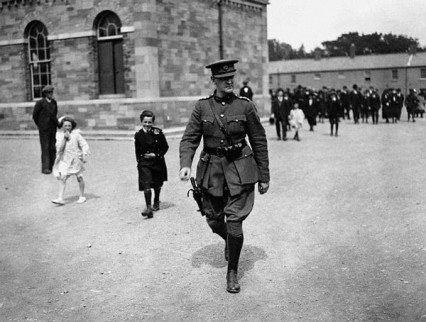
Commander in Chief Michael Collins in July 1922, two or three weeks before he was assassinated in Cork.

Michael Collins' funeral, O'Connell Street August 1922
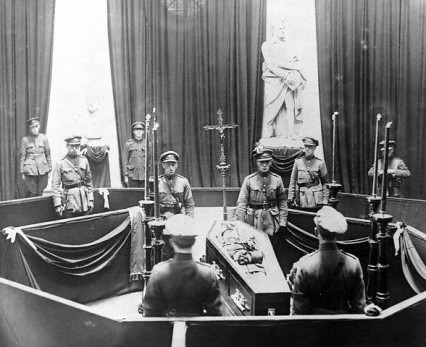
The coffin bearing the body of Michael Collins lying in state in the City Hall, Dublin. September 2, 1922 Dublin, Ireland

Michael’s brother Sean Collins

It was never really established whether Dunne and O’Sullivan acted on their own (the assassination seemed pretty badly organised for an official assassination so this was likely) or with the approval and help of Michael Collins. Collins had been a friend of Dunne’s while Sir Henry Wilson was responsible for establishing the Cairo Gang (a group of experienced British Intelligence agents who met frequently at Dublin’s Cairo Cafe) twelve of whom were murdered by the IRA acting under Collins command in 1920. The Cairo Gang killings provoked the British Auxiliaries in Dublin to shoot trapped innocent civilians at Croke Park in not the bloodiest but perhaps the nastiest of the various historical Bloody Sundays.

The infamous Cairo gang

Perhaps the ironic aspect to the story of the murder of Sir Henry Hughes Wilson was that Reginald Dunne and Joseph O’Sullivan were both born and bred in London, whereas Field-Marshall Wilson was born smack bang in the middle of Ireland at Ballinalee in County Longford.

A letter sent to O'Sullivan while waiting for his execution

Sinéad O’Connor – She Moves Through The Fair

* The text of Dunne’s intended last statement, as transcribed from the images in this post.

Lord and Members of the Jury. My friend and I stand here before you today charged with the offense of murder; and I have no doubt that, from the evidence placed before you by the prosecution, you will find us both guilty. With respect to the charges of attempted murder, we merely tried, as everyone must know, to try and escape arrest.

The offence of murder is a very serious matter; so much so, that any act which results in loss of human life requires very grave and substantial reason. We have never until now been charged with any crime. As you have heard from the Police Officer, who gave evidence as to our character and our previous records, we have both been in the British Army. We both joined voluntarily, for the purpose of [making Europe safe?] in order that the principles for which this country stood, should be upheld and preserved. These principles, we were told, were Self-Determination and Freedom for Small Nations. We both, as I have said, fought for these principles, and were commended for doing so; and I imagine that several of you gentlemen of this jury did likewise. We came back from France to find that Self-Determination had been given to some Nations we had never heard of, but that it had been denied to Ireland, We found, on the contrary that our Country was being divided into two Countries; that a Government had been set up for the Belfast district, and that under that Government outrages were being perpetrated, that are a disgrace to civilization — many of the outrages being committed by men in uniform and in the pay of the Belfast Government. We took our part in supporting the aspiration of our fellow Countrymen, in the same way as we took part in supporting the nations of the world who fought for the right of small nationalities.

Who was Sir Henry Wilson? What was his policy? And what did he stand for? You have all read in the newspapers lately, and been told, that he was a great British Field Marshal; but his activities in other fields are unknown to the men of the British public. The nation to which we have the honour to belong, the Irish nation, knows him, not so much as the British Field Marshal, but as the man behind what is known in Ireland as the Orange Terror. He was at the time of his death the Military Advisor to what is colloquially called the Ulster Government, and as Military Advisor he raised and organized a body of men known as the Ulster Special Constabulary, who are the principle agents in his campaign of terrorism.

My Lord and Members of the Jury, I do not propose to go into details of the horrible outrages committed on men, women and children of my race in Belfast and other places under the jurisdiction of the Ulster Government. Among Irishment it is well known that about 500 men, women and children have been killed within the past few months, nearly two thousand wounded, and not one offender brought to justice. More than 9000 persons have been expelled from their employment; and 23,000 men, women, and children driven from their homes. All the big cities of this country and even those of Northern France are now receiving these refugees. Sir Henry Wilson was the representative figure and the organiser of the system that made these things possible.

At his suggestion and advice the Ulster Parliament passed an Act authorising the [purging?] of political opponents and this power is now exercised and enforced by the Courts in Ulster.

There is and can be no political liberty in a country where one political party outrages, oppresses, and intimidates not only its political opponents, but persons whose religious opinion differ from those of the party in power. The same principle for which we shed our blood on the Battle Field of Europe led us to commit the act we are charged with.

My Lord and Members of the Jury, you can condemn us to death today, but you cannot deprive us of the belief that what we have done was necessary to preserve the lives, the homes, and the happiness of our countrymen in Ireland. You may by your verdict find us guilty, but we will go [to] the scaffold justified by the verdict of our own Conscience.

Dunne truncated his statement to “cut out the patriotic adjectives I feel inclined to use under the present circumstances” (as well as his specific delineation of the atrocities of Henry Wilson and the Ulster government). -ed.

On this day..

1944: Marc Bloch, French historian

On this date in 1944, the Gestapo shot French historian Marc Bloch among a batch of Resistance members.

When war broke out between France and Germany in 1939, the 52-year-old professor spurned advice to get out of the country. Driven by his love of France, he resigned his post at the Sorbonne to join the reserves.

I was born in France, I have drunk the waters of her culture. I have made her past my own. I breathe freely only in her climate, and I have done my best, with others, to defend her interests.

(Bloch had won the Legion of Honor for his brilliance and bravery in World War I, “always ready to March and give example.”)

High-profile intellectuals of Resistance proclivities and Jewish extraction, needless to say, had a problem in those terrible years.

The remarkable Bloch almost made it through the whole of the war in the French Resistance, but was arrested a few weeks before the Allied landing at Normandy, tortured, and shot. Comrades in arms remembered his death as an unusually sobering loss.

We couldn’t, no we couldn’t bear that image: Marc Bloch, our “Narbonne” of clandestine life, turned over to the Nazi beasts; this perfect exemplar of French dignity, of exquisite and profound humanism, this spirit become a prey of flesh in the vilest hands. We were there, a few of us, in Lyons, his friends, his comrades in the clandestine struggle, when we learned of the arrest, when we were immediately told that, “They tortured him.” A detainee had seen him in the offices of the Gestapo, bleeding from the mouth (that bloody trail in the place of the last malicious smile he had left me with on a street corner before being caught up in the horror). I remember: at those words, “He was bleeding,” we broke out in tears of rage. The most hardened lowered their heads despondently, as we do when things are just too unfair.

For months we waited, hoped. Deported? Still in Montluc? Transferred to another city? We didn’t know anything until the recent day when we were told, “There’s no more hope. He was executed at Trévoux on June 16, 1944. His clothes and papers were recognized.” They killed him, alongside a few others who he inspired with his courage.

For we know how he died. A kid of sixteen trembled not far from him. “This is going to hurt.” Marc Bloch affectionately took his hand and simply said, “No, my boy, it doesn’t hurt,” and fell first, crying out: “Vive La France!”

Marc Bloch, commemorated at this French site, bequeathed 20th century scholarship one of its great intellectual legacies. His The Historian’s Craft,* a composition halted short of completion by the Nazi firing squad, was posthumously published and remains one of the classic texts of historiography; the journal he co-founded in 1929 gave its name to a whole school of thought in the field. (Bloch’s own name also adorned a school in a more literal sense, the Marc Bloch University, now subsumed by the University of Strasbourg.)

Works By and About Marc Bloch

* The blog To The Roots is in the midst of a series of posts exploring The Historian’s Craft.

On this day..