On this date in 1716, legendary Sikh warrior Banda Singh Bahadur attained his martyrdom.
Born Lakshman Dev, the man who would become Banda Bahadur went on a spiritual wandering jag as a young man and chanced to be plucked out of hermitage by Sikh guru Gobind Singh.
When this guru’s efforts to make inroads for Sikh interests with the new Mughal Emperor Bahadur Shah foundered, the converted hermit (now returned to the martial exercises of his caste) was tasked with a punitive expedition against one of the more obnoxious governors.
The zealous general did his mentor one better, attracting thousands of sympathetic followers and carving out a Sikh kingdom in Punjab in the early 1710s.
This proto-state (forerunner of an actual state in the next century) was in due time outmuscled by the Mughals, capturing the rebels’ last redoubt by means of a perfidious assurance of leniency that would not be forthcoming. Not at all.
The captured were marched back to Delhi, along with the pike-mounted heads of their fallen comrades, and there subjected to grisly mass executions.
British diplomats making nice with the Mughal court at the time recorded the scene.
The great rebel Guru (Bandu, the Sikh) who has been for these twenty years so troublesome in the province of Lahore, is at length taken with all his family and attendance by the Subahdar, or Viceroy, of that province. Some days ago they entered the city laden with fetters, his whole attendants which were left alive being about 780,* all severally mounted on camels, which were sent out of the city for that purpose, besides about 2,000 heads stuck upon poles, being those who died by the sword inb attle. He was carried into the presence of the King, and from thence to a close prison. He at present has his life prolonged with most of his officers, in hopes to get an account of his treasure in several parts of his kingdom, and of those that assisted him, when afterwards he will be executed for the rest. There are one hundred each day beheaded. It is not a little remarkable with what patience they undergo their fate, and to the last it has not been found that one has apostatised from the new formed religion.
Their captain’s turn finally came this date when — spurning conversion to Islam, as had his fellows — he saw his son slaughtered before his eyes, then was hacked limb from limb.
On this date in 1723, Major Jean Davel was beheaded for an abortive separatist bid in Vaud.
The French-speaking Swiss Canton was at this time under the heavy-handed domination of neighboring Bern(e), part of an oligarchic arrangement of power in Switzerland that would provoke regular unrest.
On March 31, 1723, Davel took advantage of a general absence of bailiffs gone to Berne for government sinecures, and marched 600 men to the Vaud capital of Lausanne to pitch the town on breaking away from its Teutonic overlords.
Instead, the city worthies paid him lip service just long enough to betray him.*
“I see well enough,” Davel observed, “I will be the first victim in this affair.”
Yup.
But he held firm under torture to his insistence that the revolt was his doing alone (well, his and God’s), and perhaps thereby saved others from sharing his fate.
The Execution of Major Davel, by Charles Gleyre. A very in-depth analysis of this work by Michel Thevoz titled “Painting and Ideology: A Commentary on a Painting by Charles Gleyre” is available in pdf form here.
Davel is noted for checking out with a unique scaffold speech, discoursing on a topic rarely explored on that platform: the role of music in worship.**
As concerns the praise of God, in what manner is it sung? Is there any sense of orderliness, any real music, anything whatever calculated to excite and sustain the devotion? Yet this part of divine service is one of the most considerable and the one by which is the most effectively demonstrated the lifting up of our hearts to God … Such being the importance of this part of Christian worship, I cannot too much emphasize my exhortation to you to give it a new and serious attention, in order to correct the faults of which you are at present guilty in connection with it.
In a similar vein, the 52-year-old groused at the kids these days, to wit, young divinity students in attendance who, in the immortal tradition of kids these days throughout all days,
neglect your studies for worldly pleasure. You take no pains to learn music, which is so necessary for the singing of God’s praises. The songs of the church form an essential part of divine worship, and have an infinite value in helping us to lift our hearts to God. I pray you, then, to apply yourselves with all possible zeal to your preparation for the holy ministry.
Music in worship was in the Zeitgeist, and 1723 in liturgical composition suggests the (otherwise wholly unrelated to Davel) move by Johann Sebastian Bach that very year to Leipzig. Bach took up his post there just weeks after Davel lost his head, and would spend the remaining 27 years of his life in Leipzig. But it only took him until the very next Easter to lift up his congregation’s heart to God with the Johannes-Passion.
On this date in 1597, Cossack Severyn Nalyvaiko was publicly quartered in Warsaw.
Nalyvaiko organized “unregistered” Cossacks in Poland’s eastern realms, modern-day Belarus and Ukraine, into what became a significant rebellion. (Poland’s efforts to “register” and thereby control Cossacks would continue to cause tension in the years ahead.)
The Poles outmuscled him, and here he is.
However, because longer-term historical trends were not so favorable to the Polish-Lithuanian Commonwealth, Nalyvaiko rates a place as an early independence martyr for (east) Slavic resistance to Warsaw’s Polish imperialism.
Not only does he get a spot on present-day Ukrainian coinage (as pictured); 19th century Russian poet Kondraty Ryleyev, who would himself be executed for his part in the Decembrist plot, lyricized Nalyvaiko’s death as heroic national sacrifice … and simultaneously elevated the poet’s own prophesied fate for himself.
“In Ryleyev’s poetry, fate — romantic fate — is not simply personal and individual,” writes Lauren Leighton. “The fate of his heroes, and so his own fate, is raised to the level of national-historical tragedy. By welcoming his fate and dying for his land, Nalivayko ennobles his people.”
Say not, thou holy man, again
That this is sin, thy words are vain,
Be it a fearful mortal sin
Worse than all crimes that e’er have been,
I care not — for could I but see
My native land at liberty,
Could I but see my race restored
To freedom from the foreign horde,
All sins would I upon me take
Without one sigh for Russia’s sake. —
The crimes of all the Tartar race,
The apostates Uniates‘ treason base,
The sins of every Jew and Pole —
All would I take upon my soul.
Try not with threats my mind to shake,
Persuasive words no change can make,
For hell to me is to have viewed
My loved Ukraine in servitude;
To see my fatherland set free,
This, this alone, is heaven for me!
E’en from the cradle was my breast
With love of liberty possessed;
My mother sang me glorious lays
Of those long-past historic days,
Whose memory yet lives ‘mongst men,
For no fear seized on Russians then,
None cringed before the haughty Pole;
The iron of a foreign yoke
Weighed upon no free Russian’s soul,
None cowered beneath a stranger’s stroke;
Cossacks were then the Pole’s allies,
Bound each to each in equal ties,
Such as free men would well beseem —
Now all is vanished like a dream.
Cossacks long since had learned to know
How into tyrants friends may grow;
The Lithuanian, and the Jew,
The Pole, and all the Uniate crew,
Like ravening crows around their prey
Seize us, and tear our limbs away.
The voice of law no more is heard
In Warsaw’s city, none are stirred
At hearing all a nation’s wail,
Our mourning voices nought avail,
And now within me burns a flame
Of hatred for the Polish name —
A fierce hot flame of raging fire —
My look is wild with passion dire
And frenzied wrath; the soul in me
Sickens for love of liberty.
One thought have I by night and day,
Which like a shadow haunts my way,
E’en where the steppes lie silent, bare,
Unresting it pursues me there;
E’en in the soldier’s camp, and when
The battle’s whirl, and tramp of men,
Around me roar with maddening rush,
I hear it still, and in the hush
Of the still church’s vaulted gloom,
Sound in my ears the words of doom
“‘Tis time,” the holy accents say,
“‘Tis time to sweep the foes away,
“O’er the Ukraine who bear their sway.”
I know full well the direful fate
Which must upon the patriot wait
Who first dare rise against the foe
And at the tyrant aim the blow.
This is my destined fate — but say
When, when has freedom won her way
Without the blood of martyrs shed,
When none for liberty have bled?
My coming doom I feel and know
And bless the stroke which lays me low
And, father, now with joy I meet
My death, to me such end is sweet.
On this date in 1782, Captain Joshua Huddy of the revolutionary New Jersey patriot militia was summarily (and extrajudicially) hanged on the New Jersey coast by the British Tories.
Huddy was a troublesome rascal in civilian life, a regular denizen of courts in his native Salem, Mass., and (upon transplant in 1778) Monmouth County, N.J.
Tory British Loyalists found him troublesome in the bare-knuckled revolutionary conflict in Monmouth, “often engaged in raids and revenge executions, which continued even after the war’s end.”
Huddy mounted various guerrilla raids in the area from 1779; his Loyalist opposite number actually captured him in 1780, but Huddy was freed by his comrades before he could be taken to the British.
Not so lucky this time.
On March 24, 1782, Loyalists overwhelmed Huddy’s fort at Toms River, N.J..
This was, de facto if not de jure, within the compass of those raids occurring after the war’s end, since at five months after Yorktown, the American Revolution was settled in all but name.
Huddy figured to be exchanged for Loyalist prisoners, but word came that a Monmouth County Tory named Philip White had been killed.
The last English royal governor of New Jersey, William Franklin,* ordered Huddy’s execution in retaliation-slash-punishment without any form of court-martial. (It seems the Loyalist position was that Huddy had himself been involved in White’s death; the Patriots insisted that Huddy was already in British hands when White was killed.)
We the refugees, having with grief long beheld the cruel murders of our brethern, and finding nothing but such measures daily carrying into execution — we, therefore, determine not to suffer without taking vengeance for the numerous cruelties; and thus begin, and, I say, may those lose their liberty who do not follow on, and have made use of Captain Huddy as the first object to present to your view; and further determine to hang man for man while there is a refugee existing. Up goes Huddy for Philip White.
(Two other prisoners taken with Huddy were exchanged, and had the story to tell — including Huddy’s remark that he would “dye innocent and in a good cause.”)
This, of course, caused quite a hue and cry for vengeance on the Patriot side.
George Washington demanded Huddy’s executioner for a bit of tit-for-tat, but although the British repudiated the lawless hanging, they refused to give Washington his man. Richard Lippencott (or Lippincott) instead got a British trial in New York, skated on an only-following-orders defense, and subsequently retired to Canada to live to the ripe old age of 81.
The frustrated proto-Americans resorted to selecting a captured Yorktown officer by lot for a reprisal execution.
Since Asgill turned out to be a charismatic, youthful officer of unblemished honor, nobody felt good about the situation; even Huddy’s widow asked for Asgill’s life to be spared. (Though that might also be because Huddy stiffed her in the will he scribbled out moments before death, written on the head of the barrel they used to hang him.)
Eventually, pressure from the Revolution’s French patrons — the hostage had a Huguenot mother — helped Asgill avoid hanging.**
Returned to the British, Asgill went on to become a very prominent general.
Memorial for Joshua Huddy at Huddy Park in Highlands, N.J. Image (c) Sheena Chi and used with permission.
* Son of American patriotic luminary Benjamin Franklin. This is why you don’t talk politics with family.
** Upon his release from American custody, Asgill traveled to France to thank personally his royal saviors. Louis XVI and Marie Antoinette could hardly have imagined that they would one day soon stand in Huddy’s shoes.
(Thanks to Jeffrey Fisher [jeffreyfisher at me.com] for the guest post.)
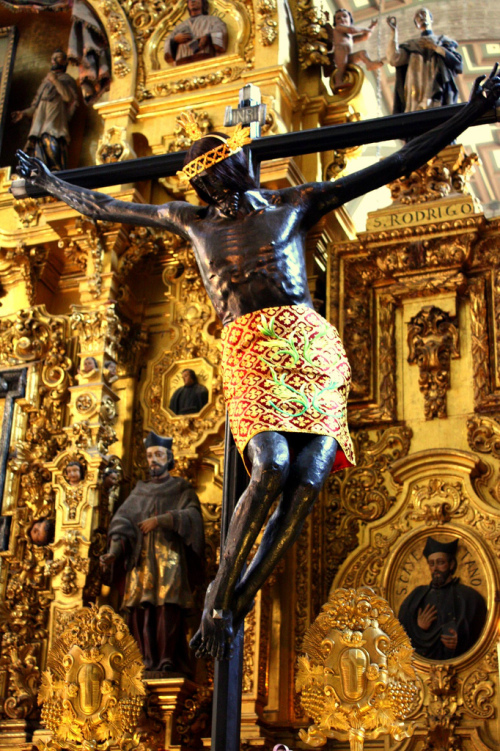
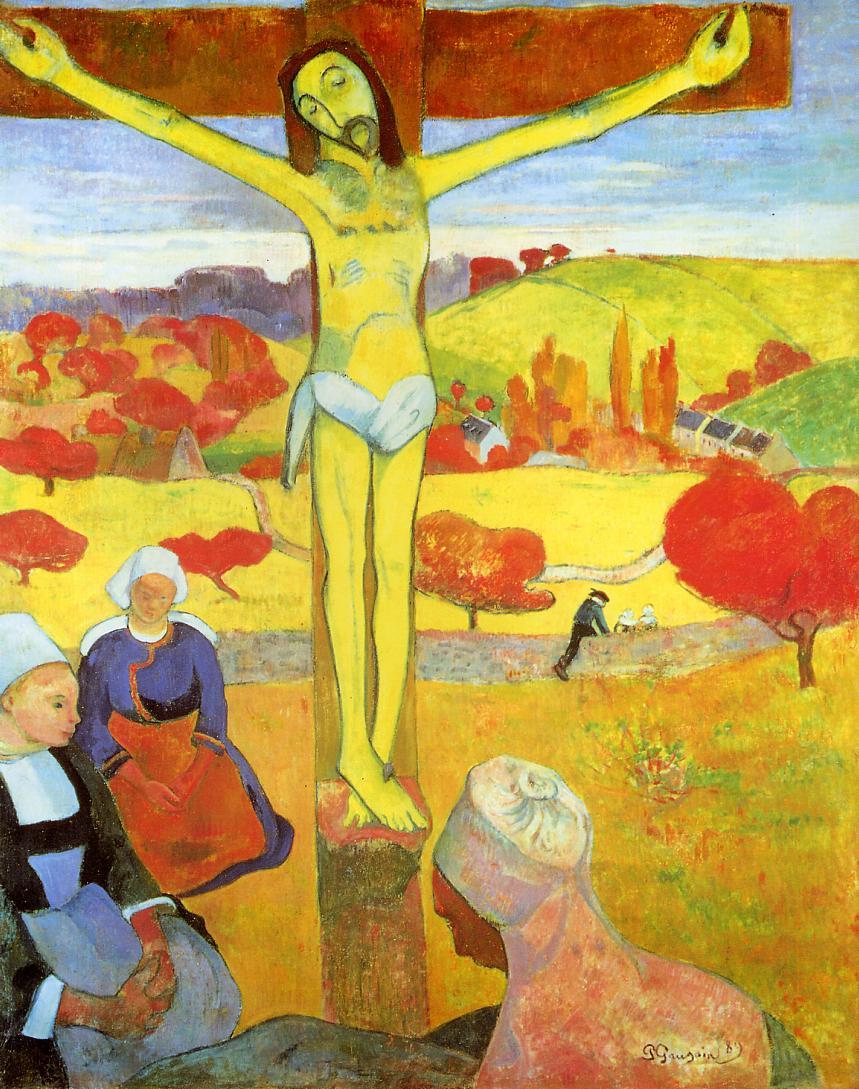
On Good Friday every year,* Christians around the world commemorate the death by crucifixion of Jesus of Nazareth, rabbi, prophet, Son of God, Son of Man, messiah, and all-around trouble-maker.
The truth is that very little is known of Jesus’ life and teachings from verifiable accounts, but this has not stopped generation after generation of Christians from telling his story, beginning with Jesus’ semi-official biographers, the evangelists of the New Testament. Almost everything we know about the life and teachings of the physical human being Jesus are in those writings, which do not portray him always in compatible ways, and which are almost entirely unconfirmed by any external source. The Roman historian Tacitus mentions (with disdain if not disgust) Jesus’ cult following, as does the Jewish historian and philosopher Josephus, but neither gives us anything to work with as historians (or, for that matter, as theologians). For the record, Suetonius and Pliny also talk about Christians, but these piecemeal sources tell us much more about Roman perceptions of Christians than about Christ and his teachings, or even necessarily Christian beliefs and practices.
What, then, can we reasonably say about Jesus?
It is almost impossible to find universal agreement around anything more than a few basics, including most importantly Jesus’ crucifixion. The Gospels narrate it; Paul the Apostle (who never met Jesus in the flesh, as it were) hangs his theology on it, together with the equally important resurrection; and no contemporary sources (Christian or otherwise) dispute it.
But it’s when we ask why Jesus was crucified that things start to get interesting.
What did he do? The two men he is traditionally said to have been crucified with are commonly understood to be “robbers,” but that they were common criminals is highly unlikely. Crucifixion is a horrible death designed to make a very public statement about the crucified, the sort of thing you use on gladiator-slave rebels like Spartacus, not on pickpockets and roustabouts. The Greek term used for these two men (lestai) is consistent with the description of the released Barabbas as one who had participated in rebellious activities, whose “criminality” was related to his revolutionary business. Moreover, the name “Barabbas” means literally “son of the father,” a purely symbolic and surely entirely fictional name, and that the people choose to have him released indicates their affinity for him as a thorn in the side of the Romans. He is thus contrasted with Jesus, the other son of the father, the peaceful (apocalyptic) revolutionary.
So Jesus would have been crucified as a political criminal, a rebel. This would make sense of accounts of his having been identified by the Romans as “Iesus Nazarenus Rex Iudaeorum”: “Jesus of Nazareth, King of the Jews.” Anyone claiming to be king (and “son of God” was a Jewish way of talking about the king of Israel recorded clearly in Psalm 2), would, if taken seriously, be understood as challenging Roman authority.
Insofar as Jesus seems to have been deliberately poking the Romans’ local running dogs, the Sadducees and the Temple priests, his seizure and termination were surely inevitable. If his teaching is as opposed to violence and unconcerned with “politics” as it seems to have been, it’s hard to believe the Romans would have noticed him without some prodding, this coming not from the “crowd,” but from the leadership (who in Mark and Matthew incite the crowd). Indeed, the priests and scribes look for ways to arrest him when the crowds are not around, because they fear a riot.
If we take the Gospel of Mark at all seriously, Jesus was preaching a new kingdom of God, an apocalyptic redemption of the people of the earth by God’s direct intervention (and with Jesus as the sacrificial pesach lamb). If we take the Gospel of Luke seriously, Jesus spoke in a classic prophetic mode, calling people — Jew and Gentile both — to care for the oppressed of the earth, the poor and the hungry and the helpless. Both Jesuses called for people to be better to each other, to love each other, and indeed to love each other when love was, according to common sense, the foolish thing.
Why would this get you executed?
Well, in itself, it wouldn’t. But the Gospel of Mark tells us of Jesus speaking with a man who realizes that all the animal sacrifices in the world don’t amount to a hill of beans (in that crazy world). When love counts more than sacrifice, we are undermining the Temple. When we go into the Temple, start knocking things over, and say it’s become about robbing the poor and not about loving God and one’s neighbor, we are undermining the Temple. And to undermine the Temple’s authority is also to undermine Rome’s authority, and Rome’s cash flow.
Jesus, like the Essenes he may or may not have associated with, was a purist.
The Temple was full of collaborators and exploiters, the kind seen before in the history of Israel (and berated by prophets like Isaiah and Amos), the kind hated also by the Dead Sea community of apocalyptic purists awaiting a final showdown between God and evil (i.e., the Roman Empire and their local potentates, the Temple authorities).
Jesus, like other Jewish prophets before him, thought that Judaism was about something. That it was somehow about justice and not just about following rules or waiting around for things to get better: that it was about our making the world a better place, and not just making our own lives better.
Start talking that way and get people on your side, and you’re fairly likely to get killed, even twenty centuries later.
* Though the actual date (even the year) of the execution marked by the movable feast of Good Friday is fundamentally unknowable, there are some present-day astronomer types who’d like to sell you April 3, 33 A.D.
A century go today, Korean independence martyr Ahn Jung-geun (or An Jung-geun) hanged at Port Arthur for assassinating Japanese statesman Ito Hirobumi.
Ahn Jung-geun, who was also a skilled calligrapher (his epigram, “Unless reading everyday, thorns grow in the mouth” is well-known in Korea), actually had a more visionary pan-Asianist agenda than his nationalist byline might initially suggest.
But he militantly opposed Japan’s annexation of the peninsula, and won his hero stature for gunning down Ito in Manchuria.
Ito, for his part, is a national hero in Japan for establishing that country’s parliamentary government and serving as its first Prime Minister.
Because the Japanese worried that “if Ahn Jung-geun’s body is handed over to the surviving family or impudent Koreans … it will not be good in the future,” its ultimate deposition has become an enduring historical mystery, with China the current likely suspect. Koreans’ intensified hunt for records pointing to Ahn’s grave has been much in the news during the centennial run-up.
Wherever his bones rest, the Korean patriot (as the saying has it) lives on. He’s even been posthumously promoted by the South Korean army to the rank of “General”.
The recent Korean film 2009 Lost Memories is premised on an radically different alternate timeline starting when Ahn is prevented from killing Ito. Here’s its aesthetically appealing climax, when history is righted.
Something of a career troublemaker, Murillo had had a few scrapes with the crown’s agents over his patriotic aspirations for the territory the Spanish called Upper Peru.
Unfortunately for the self-proclaimed Junta Tuitiva, neither masses nor elites really rallied to their side, and the Spanish swiftly crushed the uprising.
July 16, the date these dreamers declared independence, is still celebrated in La Paz.
And why not? Though militarily overwhelmed, this quixotic enterprise turned out to be one of the opening acts in a (largely successful) generation-long struggle for independence throughout the Spanish possessions in the New World.
(Thanks to Jonathan Shipley of A Writer’s Desk for the guest post. -ed.)
That Napoleon Bonaparte, he simply can’t leave well enough alone.
He already conquered Malta. Most of the Maltese were even okay with it. But then he started disassembling the Maltese nobility and restricting the church. This displeased Dun Mikiel Xerri, and it was on this date in 1799 that Xerri was shot dead for spearheading a Maltese revolt against the French.
Born on September 29, 1737 in Zebbug, Malta, Xerri studied as a young man at various universities throughout Europe. Learned, he becme a Roman Catholic priest and dabbled in both philosophy and mathematics, living warmly under the rule of The Knights of St. John. Then, Napoleon came.
It was 1798 and Napoleon’s fleet was traveling to Egypt on expedition. Napoleon asked for safe harbor on Malta to resupply his ships. The Maltese refused him water and so Napoleon ordered a division of troops up to Valletta, the Maltese capital city. Ferdinand von Hompesch au Bolheim, the 71st Grand Master of the Order of St. John, thought again on his stance on the water issue but Napoleon was already beginning to be entrenched in Maltese life, looting the Order’s assets and administering control. Not wanting to fight fellow Christians (the French), Hompesch did little to quell the influx of French soldiers. In fact, he quickly signed a treaty handing over sovereignty of the Island of Malta to the French Republic.
This initially pleased some Maltese, tired of Knight rule, but the honeymoon didn’t last long.
Xerri, and many others, believed a revolt was the only way to regain people’s rights due to the fact that the rights of Maltese nobility were figuratively stripped, and the treasures of the Maltese church literally so.
Outraged Maltese rose against the French garrison headquartered in Notabile. Outraged Maltese formed a National Assembly. Outraged Maltese raised open rebellion on the islands.
The French retreated to the fortified cities around the harbor where their ships were anchored. The Maltese, in arms, implored the Kingdom of the Two Sicilies (run by King Ferdinand I) and Great Britain (then under the rule of King George III).
It was to no avail. During the blockades, hundreds of people, Maltese and French alike, died from starvation and deprivation. Desperate, within the fortress, Xerri the patriot and others decided to attack French forces in Valletta and Cottonera. The plot, however, was discovered by the French and before it could be executed, 49 people were arrested for the plotted insurrection, Xerri among them.
The archbishop of Malta, Vincenzo Labini, met with Xerri and Xerri’s companions the morning of January 17, 1799. Prayers were offered, quiet words of salvation exchanged. Xerri was taken from Fort Saint Elmo to the Palace Square. French troops awaited him. Xerri, moments from death, gave a silver watch to the official on duty. He asked to be shot through the heart. “May God have pity on us!” he shouted with the others. “Long live Malta!” He was then shot dead, taken away, and buried near the Church of Saint Publius in Floriana.
Malta did not gain its independence until September 21, 1964.
On this date in 1825, Portuguese divine Joaquim do Amor Divino Rabelo e Caneca — more popularly and succinctly known as “Frei Caneca” — was executed along with seven others in Recife, Brazil for a short-lived revolt against the newly independent state.
The heir to the Portuguese crown,* Pedro I, made the unusual career choice of declaring Brazil’s independence from his own dad, costing the House of Braganza a good deal more than is usual for family therapy.
And of course one so often grows up into a belated appreciation of one’s parents’ formerly objectionable characteristics.
For Pedro’s new South American polity, there ensued the age-old conflict between federalism and centralization: having promised the one when in need of popular support for his revolution, Pedro delivered the other when securely lodged on the Brazilian throne.
And this triggered the short-lived breakaway attempt of the so-called Confederation of the Equator, centered in Pernambuco, an ornery northeastern province that had likewise abortively rebelled against Portuguese colonial administration in 1817.**
Liberal Carmelite intellectual Frei Caneca — “Father Mug”; here‘s his Portuguese Wikipedia page — had done four years in the clink for his support of that earlier revolt, but he did not hesitate to throw in with Manuel de Carvalho (Portuguese again) when the latter proclaimed independence from Brazil.
Pedro I, Emperor of Brazil, found this sort of behavior much less appealing done to him than by him.
What are the demands of the insults from Pernambuco? Certainly a punishment, and such a punishment that it will serve as an example for the future.
Having a lopsided advantage in the balance-of-force department, Pedro soon got the opportunity to set that example. (Though not on Carvalho, who escaped the roundup and long outlived his king.)
The story goes that Frei Caneca was doomed to hanging — the fate suffered by his fellow-martyrs this day — but so beloved was he that nary a Pernambucano could be found willing to stretch the friar’s neck. It’s a nice 19th century liberal-man-of-the-cloth twist on that ancient hagiographic trope, the “holy man (or woman) who defeats the execution device”.
Unfortunately for Father Mug, that’s usually only a one-device-per-execution deal. In this case, Brazil did locate personnel willing enough for a firing squad’s worth of guys to shoot Caneca dead.
* Pedro would inherit the Portuguese throne in 1826 on his father’s death, briefly and theoretically uniting the realms, but power players in the motherland gave him the boot within weeks.
** The flag of the 1817 Pernambucan Revolution is Pernambuca’s state flag today.
I saw a site today that made me feel mity Bad I saw a man shot for deserting there was twenty fore Guns shot at him thay shot him all to pease … he went home and thay Brote him Back and then he went home again and so they shot him for that Martha it was one site that I did hate to see it But I could not helpe my self I had to do Jest as thay sed for me to doo.
This unknown soldier shot “all to pease” had just run afoul of Gen. Braxton Bragg‘s draconian anti-desertion policy meant to crack down on soldiers going AWOL for casual leave, often to help the families they had left behind keep up the farm.
As Wiley points out, our letter-writer Private Warrick was himself planning to do just that.
Bragg’s little salutary bloodbath evidently had its effect, because he didn’t go AWOL. Wiley quotes Warrick, now in a more Joe Friday mode than when he had promised to “come home Eny how”, writing his parents in 1864,
I would be glad to see you all now but I recon that I have bin home my last time till this war closes.


 Nalyvaiko organized “unregistered” Cossacks in Poland’s eastern realms, modern-day Belarus and Ukraine, into what became a significant rebellion. (Poland’s efforts to “register” and thereby control Cossacks would



 Ahn Jung-geun, who was also a skilled calligrapher (his epigram, “Unless reading everyday, thorns grow in the mouth” is well-known in Korea), actually had a more visionary pan-Asianist agenda than his nationalist byline might initially suggest.
 He already conquered Malta. Most of the Maltese were even okay with it. But then he started disassembling the Maltese nobility and restricting the church. This displeased
 This revolt unfolded against the backdrop of Brazil’s