1951: Ospan Batyr, Kazakh freedom fighter

On this date in 1951, Kazakh national hero Ospan Batyr was executed in Urumqi.

Ospan — the second name is an honorific, not a family name — hailed from an ethnic Kazakh region in China’s eastern Xinjian region, noted today for its still-robust Uighur separatist movement.

Executed Today does not envy any ethnic group attempting to sort out its national aspirations on the frontiers of great powers, and this was the dangerous matter to which our day’s principal applied himself.

The powers in question here are the Soviet Union and China; their degree of sway over Xinjiang (or “East Turkestan”) shapes the parameters of the struggle.

During the early 1940’s, the Soviets’ dire wartime position gave them less weight to throw around; accordingly, the formerly Soviet-allied local warlord Sheng Shicai — an ethnic cleanser of Kazakhs from way back — made nice with the Koumintang.

As Moscow gained the upper hand over Berlin, however, it had leave to tend its eastern ambitions as well.

Since Sheng’s attempt to sell out to Stalin failed, he left Xinjiang with 50 trucks full of loot, and retired to Taiwan to write this 1958 volume on his erstwhile demesne.

When Sheng got bounced from his post trying to re-defect to the victorious Soviets, Ospan Batyr (alternatively, Osman or Uthman Batur) led Kazakh forces in a multi-ethnic Muslim rebellion that established a short-lived East Turkestan Republic, allied with the Soviet Union.

But what the political expediency of great powers giveth, it also taketh away.

The postwar partition of the globe left Xinjiang in China’s sphere of influence, drawing down the East Turkestan Republic’s Soviet support. When that state-like entity became involved in a border conflict with Soviet-backed Mongolia, Osman and the Kazakhs lined up with the Koumintang — not Russia.

As a matter of straight realpolitik, this was an inauspicious moment to get with Chiang Kai-shek since he was on the verge of finally losing China’s long civil war. But it’s a move that would be subsequently vindicated by the way Kazakhs voted with their feet under Mao.

Ospan Batyr had to settle for the judgment of history when the People’s Liberation Army absorbed Xinjiang, and in 1950 finally corralled the remnants of his Kazakh resistance. He repelled demands under torture that he sign on with the Reds and make an appeal to his people in their name: “I can give a life. My nation will continue the struggle.”


Ospan Batyr awaits execution.

Most of the information readily available online about this Kazakh martyr is not in English, and a good deal of it tends to the hagiographical — like this Turkish-language page, lavishly illustrated.

On this day..

2006: Ali Afrawi and Mehdi Nawaseri

Among the numerous ethnicities subject to rough treatment in Iran are Ahwazi Arabs, a minority concentrated in oil-rich Khuzestan, right on the border with southern Iraq. It was one of the bloodiest theaters of the Iran-Iraq War in the 1980’s.

17-year-old Ali Afrawi

On this date in 2006, two young Ahwazi Arabs were publicly hanged in Ahvaz (Ahwaz) for their alleged participation in a separatist bombing campaign there in 2005-2006.

Heady days for the dirty war unleashed by America’s Iraq invasion. Iranian officials slated the “treacherous and criminal Britain” (occupying the adjacent region of Iraq) for backing the Ahvaz bombings. Confessions to that effect extracted from today’s two principals were broadcast the evening before their execution.

Afrawi and Nawaseri, meanwhile, were only the tip of the iceberg for a spree of evidently political trials against Ahwazis that year.

The wider Ahwazi population continues to face a troubling human rights situation (pdf), seemingly subject to ethnic cleansing meant to scotch any potential for Ahwazi nationalist sentiment and keep oil wealth in the hands of Tehran.

On this day..

1815: José María Morelos, Mexican revolutionary

On this date in 1815, the Catholic priest turned revolutionary leader Jose Maria Morelos was shot for rebellion.

Morelos was born in New Spain — the town of his nativity was posthumously named in his honor — and entered adulthood a humble agricultural laborer* before engaging the career in letters necessary to undertake Holy Orders.

Designated to save his countrymen’s souls, he proposed instead to save their liberties and ungratefully joined up with fellow-priest Miguel Hidalgo when the latter sounded the tocsin for the Mexican War of Independence.

Morelos distinguished himself rapidly in the revolutionary army, and upon Hidalgo’s capture attained its leadership, complete with Generalissimo status.

Upon capture, he was handled first — and rather meticulously — by the Inquisition, which defrocked him in an auto de fe before relaxing him to the secular authority for the inevitable punishment.

Without a dissentient voice it [was] agreed that … [Morelos] be declared guilty of malicious and pertinacious imperfect confession, a formal heretic who denied his guilt, a disturber and persecutor of the hierarchy and a profaner of the sacraments; that he was guilty of high treason, divine and human, pontifical and royal … his property should be confiscated to the king … His three children were declared subject to infamy and the legal disabilities of descendants of heretics.

Source

Nobody said being a national hero was easy.

* “His morals were those of his class,” remarks our source on the Inquisition. “He admitted to having three children, born of different mothers during his priesthood, but he added that his habits, though not edifying, had not been scandalous, and the tribunal seemed to think so, for little attention was paid to this during his trial.”

On this day..

1957: Adolfas Ramanauskas-Vanagas

On this date in 1957, Lithuanian anti-Soviet partisan Adolfas Ramanauskas-Vanagas (Lithuanian link) was shot in Vilnius.

Ramanauskas-Vargas himself was born in the U.S., but his Lithuanian family soon returned to the motherland, where Adolfas grew up and supposedly just taught seminary during the war years. (Code for, he collaborated in the Holocaust.)

When the USSR finally broke the Siege of Leningrad and sent the Wehrmacht running west in 1944, it (re-)occupied the Baltic nations of Lithuania, Latvia, and Estonia. And the Soviets didn’t plan to leave.

Bands of anti-Soviet partisans formed in these anti-Soviet states, as elsewhere in Eastern Europe — the evocatively named Forest Brothers. Ramanauskas-Vanagas joined up.

Absent western support which was not forthcoming, these nationalist guerrillas were overmatched against the Red Army — but the movements held out in their secret wilderness fastnesses for years, and in the case of at least a few intransigent individuals, decades.

The Soviets answered with ruthless suppression to quell resistance, coupled (after Stalin’s death in 1953) with an amnesty offer that largely emptied the forests.

Ramanauskas-Vanagas, the South Lithuania commander, wasn’t captured until late in 1956. He enjoyed the customary favors of his KGB captors, and after torture, the Lithuanian SSR Supreme Court sentenced him to execution. (His wife got a trip to the gulag.)

There’s a Lithuanian biography of him here, and a few good photos in this forum thread.

A few topical books

On this day..

1676: Col. Thomas Hansford, the first American independence martyr

Col. Thomas Hansford was hanged “a loyal subject and a lover of my country” on this date in 1676 — America’s first executed political martyr, since that “country” was not England, but Virginia.

Robert Beverly‘s 1705 History of Virginia recalls the genesis of that milestone dispute between settlers and mother England.

The occasion of this rebellion is not easy to be discovered: but ’tis certain there were many things that concurred towards it. For it cannot be imagined, that upon the instigation of two or three traders only, who aimed at a monopoly of the Indian trade, as some pretend to say, the whole country would have fallen into so much distraction; in which people did not only hazard their necks by rebellion, but endeavored to ruin a governor, whom they all entirely loved, and had unanimously chosen; a gentleman who had devoted his whole life and estate to the service of the country, and against whom in thirty-five years experience there had never been one single complaint. Neither can it be supposed, that upon so slight grounds, they would make choice of a leader they hardly knew, to oppose a gentleman that had been so long and so deservedly the darling of the people. So that in all probability there was something else in the wind, without which the body of the country had never been engaged in that insurrection.

Four things may be reckoned to have been the main ingredients towards this intestine commotion, viz., First, The extreme low price of tobacco, and the ill usage of the planters in the exchange of goods for it, which the country, with all their earnest endeavors, could not remedy. Secondly, The splitting the colony into proprieties, contrary to the original charters; and the extravagant taxes they were forced to undergo, to relieve themselves from those grants. Thirdly, The heavy restraints and burdens laid upon their trade by act of Parliament in England. Fourthly, The disturbance given by the Indians.

Tobacco aside, these are grievances straight from the next century’s Declaration of Independence at the outset of the (more successful) American Revolution:

cutting off our Trade with all parts of the world:

… imposing Taxes on us without our Consent:

endeavoured to bring on the inhabitants of our frontiers, the merciless Indian Savages whose known rule of warfare, is an undistinguished destruction of all ages, sexes and conditions.

So, tax revolt + political self-determination + impatience about arrangements with Indians who could be wiped out instead. Eventually, this would germinate a mighty empire.

In 1676, it germinated a colonial rebellion against the mighty empire — Bacon’s Rebellion, an unsuccessful rising that is easily read in retrospect as a prototype for the more illustrious revolt one century later.

The suppression of Bacon’s Rebellion also involved a rash of executions, which we’ve touched on before. King Charles II would complain that his Virginia governor’s severity “has taken more lives in that naked country than I have taken for the murder of my father.”

The man dignified to be the first of these executions — and therefore, if you like, the first man put to death in the service of American liberty — was actually nabbed by our historian’s father, also named Robert Beverly, “a parson calculated to the Lattitude of the Servis, which required descretion, Curage, & Celerity, as qualetys wholly subservant to military affares.” (source)

snapt up one Coll: Hansford, and his party … It is saide that Hansford, at (or a little before) the onslaut, had forsaken the Capitole of Marss, to pay his oblations in the Temple of Venus; which made him the easere preay to his enemies; but this I have onely upon report, and must not aver it upon my historicall reputation: But if it was soe, it was the last Sacryfize he ever after offered at the Shrine of that Luxurious Diety, for presently after that he came to Accomack, he had the ill luck to be the first Berginian borne that dyed upon a paire of Gallows. When that he came to the place of Execution (which was about a Mile removed from his prisson) he seemed very well resalved to undergo the utmost mallize of his not over kinde Destinie, onely Complaineing of the manner of his death: Being observed neather at the time of his tryall (which was by a Court Martiall) nor afterwards, to suplicate any other faviour, then that he might be shot like a Soulder, and not to be hang’d like a Dog. But it was tould him, that whwat he so passionately petitioned for could not be granted, in that he was not condem’d as he was merely a Soulder, but as a Rebell, taken in Arms against the King, whose Laws had ordained him that death. Dureing the short time he had to live, after his sentance, he approved to his best advantage for the well fare of his soule, by repentance and contrition for all his Sinns, in generall, excepting his Rebelellion, which he would not acknowledg; desireing the People, at the place of execution, to take notis that he dyed a Loyall Subject, and a lover of his Countrey; and that he had never taken up arms, but for the destruction of the Indians, who had murthered so many Christians.

(A modernized, and less atmospheric, version of the same passage can be read here.)

Hansford’s story and the larger one of Bacon’s Rebellion are treated at second hand in several public-domain histories available online — see here, here, and here.

It also seems that, besides being the first martyr to American liberty, Hansford also had the distinction of being the first native-born Virginian (white Virginian, we presume) ever executed.

On this day..

1865: Henry Wirz, for detainee abuse

On this date in 1865, Henry Wirz was hanged in Washington, D.C. for running a notorious Confederate prison camp.

A Swiss-born doctor (“Henrich” was the real handle) whom time and tide found practicing in Louisiana at the onset of the Civil War, Wirz apparently got into the prison-guarding ranks when a war injury left him unfit for the front lines.

But it was front-line fitness in the northern army that would set the scene for his controversial hanging.

The North’s advantage in men and materiel shaped Union strategy as the war progressed, and it eventually caused the Union to halt prisoner exchanges. Exchanging casualty for casualty was a winning strategy on the battlefield, so why return to your enemy a man for a man? Besides,

[Grant] said that I would agree with him that by the exchange of prisoners we get no men fit to go into our army, and every soldier we gave the Confederates went immediately into theirs, so that the exchange was virtually so much aid to them and none to us.

Benjamin Butler (we’ve met him before)

As designed, then, the South began piling up more and more POWs to maintain with its ever-straitened resources late in the war. And if exchange was out, that really only left one form of “release”.


Andersonville Prison survivor John L. Ransom’s view of the prison, from the Library of Congress.

Andersonville — officially, Camp Sumter, located near the tiny Georgia town of Andersonville — was only established in 1864, but acquired considerable notoriety in northern propaganda for the year and change that Wirz ran it. The prisoners didn’t enjoy it much, either.

Wuld that I was an artist & had the material to paint this camp & all its horors or the tounge of some eloquent Statesman and had the privleage of expresing my mind to our hon. rulers at Washington, I should gloery to describe this hell on earth where it takes 7 of its ocupiants to make a shadow.

Union prisoner diary, July 1864. Note the prisoner’s anger at Washington — whose refusal to exchange naturally infuriated its stranded POWs

Out of some 45,000 prisoners held at Andersonville during its existence (not all at one time), nearly 13,000 succumbed to disease and malnutrition.* After the war, photos of wasted survivors inflamed (northern) public opinion, already tetchy over Abraham Lincoln’s assassination. Walt Whitman wrote of Andersonville,

There are deeds, crimes that may be forgiven but this is not among them. It steeps its perpetrators in blackest, escapeless, endless damnation.

Damnation is up to higher powers, of course, but the North wanted somebody to answer for Andersonville on this mortal coil. Lincoln’s successor Andrew Johnson overruled mooted charges against Confederate President Jefferson Davis and his Secretary of War James Seddon, leaving — in that great American tradition — Heinrich Wirz holding the bag.**

Shatner sighting!

The trial had an undeniable aspect of victor’s justice.† Even at the gallows, the Union guards chanted, “Wirz, remember Andersonville!” as the condemned man was readied for the noose, and then dropped. The hanging failed to break the man’s neck, and he strangled as the chant continued.

Southern efforts to reshape the story of Andersonville began in the lifetimes of Wirz’s contemporaries; this fulsome volume supporting the charges answered Jefferson Davis in terms that sound strikingly contemporary:

So long as Southern leaders continue to distort history (and rekindle embers in order to make the opportunity for distorting it), so long will there rise up defenders of the truth of history … To deny the horrors of Andersonville is to deny there was a rebellion. Both are historic facts placed beyond the realm of doubt.

But of course, it does not require denying the horrors of Andersonville to notice the circumstances — the privation of the entire South late in the war — and to wonder that Wirz and Wirz alone was held to account. Plenty of people think he got a bum rap.


Daughters of the Confederacy monument to Wirz. (cc) image from divemasterking2000.


Pro-Wirz marker in Andersonville, Ga. (Click for easier-on-the-eyes version, reading in part, “Had he been an angel from heaven, he could not have changed the pitiful tale of privation and hunger unless he had possessed the power to repeat the miracle of the loaves and fishes”). (cc) image from Mark D L.

Recommended for general reading: the UMKC Famous Trials page on this case, several of whose pages have been linked in this entry. A number of nineteenth-century texts by (or citing) Andersonville survivors are available from Google books, including:

Since this is a controversy of the Civil War — and one that can be engaged without having to get into that whole slavery thing — there have been thousands of published pages written about it, with many more sure to come in future years.

A few books about Henry Wirz and Andersonville

As an interesting aside, Civil War POW camps including Andersonville (but not only Andersonville) gave us the term “deadline,” which had a more startlingly literal definition in the 1860s — a perimeter beyond which prisoners would be shot on sight, which policy could make a handy stand-in for walls. Gratuitously killing an insane prisoner who crossed Camp Sumter’s “dead line” was one of the atrocities laid to Wirz, who we take it would not have been at home to the word’s decreasingly urgent appropriation in the wider culture.

* Wirz’s defense showed, to no avail, that the prisoners and the guards received the same rations, with similarly deleterious effects among both, and that the commandant was on record pleading with his superiors for more.

** Wirz’s attorney claimed that his man was offered (and refused to take) a last-minute pardon on November 9 in exchange for implicating Jefferson Davis.

† Wirz and borderlands guerrilla Champ Ferguson were the only Confederates executed for their “war crimes”. There was at least one other prison guard who faced similar charges of prisoner maltreatment, John Henry Gee; Gee was acquitted and released in 1866. (For more on the latter, see “A Little-known Case from the American Civil War: The War Crimes Trial of Major General John H. Gee” by Guénaël Mettraux in the Journal of International Criminal Justice, 2010.)

On this day..

1781: Isaac Hayne, paroled prisoner of war

On this date in 1781, South Carolina patriot Isaac Hayne was hanged for breaking his conditional British parole and re-enlisting in the American Revolution.

Though Hayne is not, to us, the most famous revolutionary executed by the British, he might have been considered by his contemporaries as the most prominent individual to go to the scaffold for the cause.

A wealthy planter (lots of slaves!) whose home and grave can still be toured in Jacksonboro, Hayne was among 5,000 to surrender to the British when the latter captured Charleston in 1780.

These prisoners were required to swear an oath of allegiance to the crown in exchange for their parole, which Hayne reluctantly agreed to do because his family had been hit with smallpox.

He declared to a friend that,

as they [the British] allow no other alternative than submission, or confinement in the capital, at a distance from my wife and family, at a time when they are in the most pressing need of my presence and support, I must, for the present, yield to the demands of the conquerors. I request you to bear in mind, that previous to my taking this step, I declare that it is contrary to my inclination, and forced on me by hard necessity. I will never bear arms against my country … I do not mean to desert the cause of America.

But as the British southern campaign foundered over the year ahead, the mother country eventually attempted to call him up to do just that: bear arms against his country.

Hayne thought his parole terms protected him from ever having to serve against the colonies, so he simply got back into the fight on the revolutionary side instead. He was captured in that capacity.

The British commander Francis Rawdon handled his relapsed prisoner with uncommon severity, putting him to a drumhead military tribunal with a preordained outcome and refusing the many public pleas for leniency.

The irregular and vengeful nature of these proceedings, and Hayne’s seemingly honorable conduct, raised hackles on both sides of the Atlantic; shortly after hanging Hayne, Rawdon returned to the British Isles to find a good deal of pointed criticism of his behavior. (Parliament quashed any damaging official inquiry, and Lord Rawdon actually extracted an apology from the peer who had the temerity to motion the investigation — an intolerable impeachment on Rawdon’s honor.)

The Hayne incident was widely understood to have been conditioned by British frustration at its failing fortunes in the war. By the time of the execution, the redcoats held nothing of South Carolina save Charleston itself. General Cornwallis had recently marched north from the Palmetto State; in a few weeks’ time, he would surrender his sword and the British cause alike after the decisive British defeat at Yorktown, Virginia.

And though the commandants at Charleston scarcely anticipated that stunning reversal, they had only a few months before suffered the upsetting (but more legally tenable) hanging of the honorable British Major John Andre as a result of the Benedict Arnold affair. British forces were reputedly on the lookout for any opportunity to trade tit for tat.

Continental Gen. Nathaniel Greene alleged that the British officer who received the petition for Hayne’s life simply wrote on it John Andre — and sent it back.


Isaac Hayne was the great-uncle of South Carolina pol Robert Y. Hayne, best remembered for a hot sectional debate with Massachusetts Sen. Daniel Webster. (Read it all here, if you must.)

It was during this exchange of Senatorial disquisitions that Webster delivered one of the noted orations of the antebellum era, the aptly-named Second Reply to Hayne:

I have not allowed myself, Sir, to look beyond the Union, to see what might lie hidden in the dark recess behind. I have not coolly weighed the chances of preserving liberty when the bonds that unite us together shall be broken asunder. I have not accustomed myself to hang over the precipice of disunion, to see whether, with my short sight, I can fathom the depth of the abyss below; nor could I regard him as a safe counselor in the affairs of this government, whose thoughts should be mainly bent on considering, not how the Union may be best preserved, but how tolerable might be the condition of the people when it should be broken up and destroyed. While the Union lasts, we have high, exciting, gratifying prospects spread out before us and our children. Beyond that I seek not to penetrate the veil. God grant that in my day, at least, that curtain may not rise! God grant that on my vision never may be opened what lies behind! When my eyes shall be turned to behold for the last time the sun in heaven, may I not see him shine on the broken and dishonored fragments of a once glorious Union; on States dissevered, discordant, belligerent; on a land rent with civil feuds, or drenched, it may be, in fraternal blood! Let their last feeble and lingering glance rather behold the gorgeous ensign of the republic, now known and honored throughout the earth, still full high advanced, its arms and trophies streaming in their original lustre, not a stripe erased or polluted, not a single star obscured, bearing for its motto, no such miserable interrogatory as “What is all this worth?” nor those other words of delusion and folly, “Liberty first and Union afterwards”; but everywhere, spread all over in characters of living light, blazing on all it sample folds, as they float over the sea and over the land, and in every wind under the whole heavens, that other sentiment, dear to every true American heart, – Liberty and Union, now and for ever, one and inseperable!

When not being rhetorically posterized by New England gasbags, Robert Hayne made time to pen a justification for his famous forebear’s conduct for the Southern Review in 1828 — comparing the British behavior of executing rather than detaining a prisoner who broke parole to the massacre at Jaffa Napoleon notoriously ordered in 1799.

(Actually, Isaac Hayne’s old nemesis Francis Rawdon had only died in 1826; Robert Hayne wrote his piece to confute a vindication of himself that Lord Rawdon — also recognized by his subsequent titles, Earl of Moira and Marquess of Hastings — had authored, decades after the fact, of his conduct in the Hayne matter.)

Though this 37-page slog of Robert Hayne’s is obviously in the public domain by now, it appears it is not yet freely available online. However, it’s the source of the otherwise unattributed quotes in this article.

Part of the Themed Set: The Empire Strikes Back.

On this day..

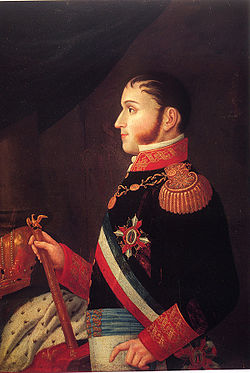
1824: Agustin de Iturbide, Emperor of Mexico

On this date in 1824, the Mexican officer who had made himself emperor was shot at the village of Padilla.

Iturbide‘s military acumen saw him through a meteoric rise in the service of what was then New Spain.

Iturbide rejected an early offer of generalship from the pro-independence leader Hidalgo in favor of spending the 1810s ably quashing the insurgency.

In a bizarre twist of fate, however, it would be Iturbide who would himself cement Mexican independence.

En route to try to finish off the last major rebel leader, Vicente Guerrero, Iturbide caught wind of the recent del Riego liberal revolt back in the mother country,* which had triggered civil war in Spain.

For the conservative royalist general, heir himself to a Basque noble lineage, the potential collapse of Bourbon authority in Spain raised the frightening specter of social upheaval.

All Iturbide’s work killing guerrillas for the sake of public order could come to naught if the Spanish monarchy collapsed or ceased projecting its power overseas … and then who knew what would emerge from the resulting power vacuum in Mexico?

So Iturbide cut a deal with Guerrero to consummate the Mexican War of Independence by separating from Madrid on an essentially conservative basis — a political breakaway without a social revolution. Independent Mexico would make nice with the Spaniards already living there, keep Catholicism as the official state religion, and get itself a constitutional monarchy of its own to insulate itself from the chance outcomes of continental politics across the ocean.

And when Iturbide marched into Mexico City and encountered a crowd conveniently imploring him to take the throne, well, who was he to deny them?

And so Iturbide transitioned smoothly from scourge of the revolution to its man on horseback,** immediately splintering the coalition that lifted him to power.


Contrary to this allegorical take on Iturbide’s coronation, he crowned himself — Bonaparte-like.

Only months after his July 1822 coronation, Iturbide shuttered Congress and began arresting the opposition. Meanwhile, Ferdinand VII had emerged from the Spanish fray as the (momentary) winner, leaving his upstart former subjects without international support.

A general that the freshly-minted emperor had himself had promoted, one Antonio Lopez de Santa Anna — yes, the Alamo guy — declared against Iturbide by the end of 1822, and come the following spring, Agustin I was a European exile, in the paradoxical position of drawing a pension from Mexico while also officially considered a traitor and outlaw.

In Tuscany and then England, Iturbide published an autobiographical justification — Statement of Some of the Principal Events in the Public Life of Agustín de Iturbide — then finally took up a much-asked-for invitation from Mexican conservatives to return and become the savior of his country against internal breakdown and a potential Spanish attack.

Founded on vainglory, this expedition was destined for fiasco; within five days of touching Mexican soil, Iturbide was serenading a firing squad with the last words, “Mexicans! I die with honor, not as a traitor; do not leave this stain on my children and my legacy. I am not a traitor, no.” Apparently they were serious about that injunction never to return.

When in Mexico City, relive happier times for our day’s subject at the Palace of Iturbide where he briefly maintained himself in the purple.


Iturbide’s palace. Creative Commons image from patricio00.

And do think twice about styling yourself Emperor of Mexico, since the only other person to claim that title also ended his reign in front of a firing squad.

* Ironically, it was a body of soldiers assembled for a reconquista of Spain’s independenceminded New World possessions that enabled del Riego to mutiny.

** Iturbide paused in the revolution’s good graces just long enough to design the Mexican flag.

On this day..

1916: Cesare Battisti and Fabio Filzi

On this date in 1916, the Austro-Hungarian empire executed Cesare Battisti and Fabio Filzi for treasonous Italian nationalism.

It was the multiethnic Habsburg state that was itself dying of its constituents’ national aspirations; in little more than two years, the state entity that carried out this day’s sentences would no longer exist at all.

Pre-World War I, Battisti (English Wikipedia entry | Italian) was actually a Socialist representative in the Austrian parliament.

When the unpleasantness broke out, though, he made a break for the peninsula where he agitated* (successfully) for Italian entry into the fray against Austria-Hungary. Irredentists had long coveted Habsburg properties with a heavy Italian population, like the Adriatic port of Trieste and Battisti’s own native Trento; the war offered an opportunity to swipe those territories, notwithstanding Italy’s putative prewar alliance with the Austrians.

Although already 40 years of age when Italy entered the war, the intrepid Battisti enlisted to fight. He was captured along with an otherwise obscure subaltern, Fabio Filzi, on the Alpine slope of Monte Corno (now known as Monte Corno Battisti) repelling the Austrian Strafexpedition.**

Austria did not stand on ceremony with these men; their capture took place on July 10, their trial on July 12, and their executions at the Castello del Buon Consiglio — an ironic Calvary, for a parliamentarian — later that same day. (To complete the scene, the strangulation-hanging was botched when Battisti’s first rope broke.)

The Austrian writer Karl Kraus would observe that “they thought they were hanging Italy, but it was really Austria on the gallows.”

Whichever one it was, they took a lot of pictures.


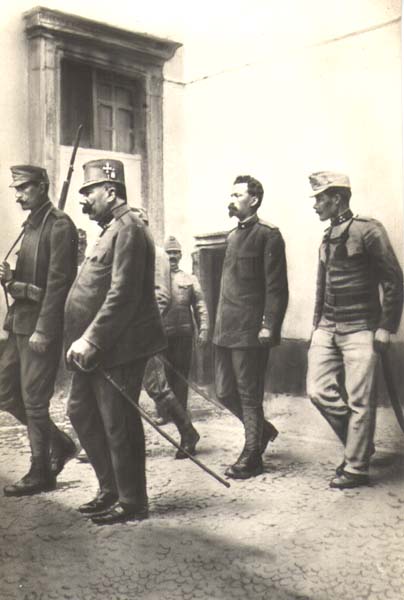
Battisti and Filzi as prisoners.


Battisti leaving the courtroom en route to his execution.


Battisti approaches the scaffold.


Battisti waiting at the scaffold as the sentence is read.


The Austrian army offers a prayer and salute to the shrouded body of Cesare Battisti.

* As a socialist who broke against the internationalist position and in favor of violent nationalism, Battisti was an ally of Benito Mussolini. It was Battisti, actually, who pioneered the socialist-nationalist-newspaperman act upon which Mussolini would later raise is own star, to such an extent that Battisti’s paper, Il Popolo — the apparent inspiration behind Mussolini’s own subsequent paper, Il Popolo d’Italia — gave the still-obscure future Duce some of his earliest gigs.

A martyr’s death during World War I fortuitously spares Battisti’s legacy the unpleasant association with his friend’s postwar turn towards fascism, so there are many streets and plazas named for Battisti, as well as a memorial in Trento. He’s also honored by name in the 1918 patriotic tune La Leggenda del Piave (lyrics).

** “Punitive expedition”.

On this day..

1816: Jorge Tadeo Lozano, Colombian Renaissance man

On this date in 1816, Jorge Tadeo Lozano was executed by firing squad in a Bogota temporarily reconquered for the Spanish crown.

Scientist, journalist, essayist and man-about-town Lozano (English Wikipedia entry | Spanish) sprang from the stock of New World Spanish nobility.

He studied literature, philosophy, medicine, chemistry, mathematics, mineralogy, botany; he served in the Spanish military and traveled in Europe; he returned to his native New Granada, where he became drawn into the liberal ferment with a celebration of the emerging bourgeoisie obviously contextualized by his scientific education.

Money, like the blood of a body, gives life and shares with each and every one proportionally the movement and robustness that it needs to freely comply with the action that it must complete as a member of society … This inistrumental motive of wealth can not be hushed, if it is to produce an effect … in the manner of electric flow [it] passes through bodies, leaving them with a glowing heat, also enlivens the arms and hands through which it passes… (Studies in the History of Latin American Economic Thought)

As a member of the constituent assembly, he helped draft an 1811 constitution that acknowledged the authority of the Spanish crown, but not of its viceroy, creating (so its signers thought) a new commonwealth state. Lozano thereupon became the first President of Cundinamarca, essentially the forerunner to the present-day Colombian presidency.

Since Lozano turned out to be a better botanist than executive, he resigned the office after a few months.

Only after Europe had sorted out the Napoleonic wars did the Spanish free up the resources for a brutal reconquista of their errant provinces. But when it came, under a general with the macho nickname El Pacificador, it had intellectuals just like Lozano right in its sights.

Even though he’d been back at lower-profile scribbling since his stint at the top, Jorge Tadeo was just the sort of guy Pablo Morillo targeted for demonstrative executions over the second half of 1816.

Thus perished the persons of the greatest wisdom, the most virtuous and wealthy, in New-Granada. The object which Morillo had in view, was to extinguish intelligence, remove men of influence, and destroy property, so that, in future, there should be none capable of originating or directing another revolution. (Source)

Thus perished Lozano this date, along with another intellectual, Miguel Pombo (Spanish link) among a whole train of patriotic martyrs over the months of Morillo’s rule.

The policy of killing these men to deprive New Granada of revolutionary potential was, however, an abject failure: just three years after these men were shot as traitors to that distant European line, Simon Bolivar detached Colombia from Spain at the Battle of Boyaca.

On this day..