On this date in 1865, the Confederate forces defending Galveston, Texas shot Antone Richers for desertion.
With the U.S. Civil War into its mopping-up phase, the Texas port was bracing for the Union to land an irresistible force. Many soldiers inclined less to brace than to bow: with the handwriting on the wall for any fool to see, the grey army suffered an epidemic of judicious desertions.
Antone Richers was one of these. Just, maybe not so judicious.
Richers was retrieved from the drink when the stolen boat he was attempting to ride out to the Union blockade capsized, and the upright Confederate officer who pulled him out wouldn’t take a bribe to keep keep quiet about it.
Condemned “to be shot to death with musketry” for his trouble, Richers died this date in especially pitiable fashion. According to Battle on the Bay: The Civil War Struggle for Galveston, a newspaper report of the execution ran thus:
A sharp rattle of musketry, and the prisoner fell dead, several balls having passed through his breast … The saddest part of the story remains to be told. The friends of [the prisoner] had sent Rev. Father Ansteadt on the day before the execution, by hand car, to Houston, as bearer of documents addressed to General Walker, showing that [Richers] was not of sound mind, and setting forth other reasons why he ought to be respited. The telegraph line between [Galveston] and Houston broke down the evening before the execution, and remained down [until] fifteen minutes after the execution. No intelligence from General Walker could therefore reach [Galveston]. But as soon as the telegraph operated, a dispatch was received from General Walker, dated the night before, containing an order for the respite of Anton [Richers]. It was too late — the man was dead.
It was Galveston’s second and last military execution of the war.
Detail view (click for the full image) of a mounted Charles the Bold under a forest of hanged men.
Charles — less generously known as “Charles the Rash” or “Charles the Terrible” — was the Duke of Burgundy, an ancient territory whose warlike inhabitants were celebrated back to The Nibelungenlied
Upon his single person the sword-strokes fell thick and fast. The wife of many a hero must later mourn for this. Higher he raised his shield, the thong he lowered; the rings of many an armor he made to drip with blood … Then men saw the warrior walk forth in full lordly wise. As the strife-weary man sprang from the house, how many added swords rang on his helmet! Those that had not seen what wonders his hand had wrought sprang towards the hero of the Burgundian land. (XXXII)
In the 15th century, the swords ringing on Burgundian helmets were those of the French and the Habsburgs, who squeezed the mighty duchy on either side.
Charles the Bold fought the expansionist Burgundian Wars as a project to strengthen his duchy’s independence. But it would have the exact opposite effect.
The Swiss had been pulled into the anti-Burgundian league, and taken the city of Grandson, inducing an irritated Charles to put it to a fearful bombardment that threatened to overrun the place in short order.
Sources vary by partisan affiliation as to whether the besieged garrison surrendered at its antagonist’s discretion (Burgundian version) or on a pledge of mercy (Swiss version). But in the actual event, no mercy at all was given. To a man, the prisoners were strung up on trees and drowned in the adjacent Lake of Neuchatel — a warning to the Swiss not to mess with Burgundy.
It was bluster that Charles’s men could not back up when their opponents fought back … and after this, who was going to surrender?
A couple days later, the Swiss relief force arrived too late to bail out the garrison. Instead, it trounced the Burgundians in battle, sending them fleeing “without looking back, helter-skelter” as Charles, “exasperated beyond measure by the stupid cowardice of his troops, rode amongst them with drawn sword, striking them furiously, in the vain effort to bring them to a standstill.”
The victorious Swiss made off with a fantastic booty from the abandoned Burgundian camp, but also recovered a more dolorous prize.
There were found sadly the honorable men still freshly hanging on the trees in front of the castle whom the tyrant had hanged. It was a wretched, pitiable sight. There were hung ten or twenty men on one bough. The trees were bent down and were completely full. There hanged a father and a son next to each other, there two brothers or other friends. And there came the honorable men who knew them; who were their friends, cousins and brothers, who found them miserably hanging. There was first anger and distress in crying and bewailing.
Charles was plenty distressed himself at his embarrassing reversal, and boldly (or rashly) regrouped, marched on the Swiss again — and had Burgundian power decisively shattered at the Battle of Murten that June. The following January, a dispirited Charles died in another losing battle, leading most of the once-imperious realm of Burgundy to settle into French hands, where it remains today.
“The sovereignty of a people cannot be argued about, it is defended with a gun in the hand.”
-Sandino
On this date in 1934, the first name in Nicaraguan anti-colonial resistance was abducted and summarily executed by the Nicaraguan National Guard.
From 1927 until his death, Sandino led an armed peasant insurgency from the Nicaraguan mountains against the Yankee imperialists and the domestic dictatorship they backed.
Washington had had its nose (and its marines) in Managua’s business for decades, continuously occupying the Central American country since 1912. The Marine Corps saw this country’s people as
Densely ignorant … little interested in principles … naturally brave and inured to hardships, of phlegmatic temperament, tough, capable of being aroused to acts of extreme violence, they have fought for one party or the other without considering causes since time immemorial … a state of war is to them a normal condition.*
All this was the time of Sandino’s own coming-of-age. The son of a wealthy landowner and his domestic servant, Sandino grew up with the unprivileged and the working classes, eventually asorbing an eclectic mix of that period’s revolutionary ideologies.
From 1927 he took to the Segovia and began writing the playbook for the 20th century guerrilla: mobile infantry irregulars, striking from familiar-to-them forest cover, melting away among sympathetic campesinos.
The “Colossus of the North” — Sandino made no bones about his foe; his personal seal showed an American marine being killed — invariably described him as a “bandit” because he also raided towns to commandeer food, clothing, and medicine.
“Washington is called the father of his country; the same may be said of Bolivar and Hidalgo; but I am only a bandit, according to the yardstick by which the strong and the weak are measured.”
-Sandino
The strong, in this case, found little public appetite for the steady attrition of servicemen, and the U.S. employed a familiar strategy of its own: “Nicaraguanizing” the conflict by building up a National Guard to do the dirty work domestically.
That Guard’s head was headed by Anastasio Somoza — the very son of a bitch of whom FDR said, “but he’s our son of a bitch.”
While it’s hardly the only country to have been favored with an American son of a bitch, you could say that Nicaragua has been the American empire’s very own heart of darkness. Washington’s initial interest in the place after the Spanish-American War concerned preventing a canal project to compete with Panama. It invented dive-bombing to hunt Sandino. And it ranged around the world and outside the law to battle Sandino’s successors under the aegis of a modern imperial presidency.
Small wonder that an official anthem of the movement denounces “The Yankee / The enemy of all humankind.”
In the immediate aftermath of the American departure in January 1933, Sandino began coming to terms with the the country’s new president: the Sandinistas disarmed in exchange for amnesty and land. But Somoza, who at this point was “only” the head of the National Guard, was building up his own power … and he meant to have done with this inconvenient insurgent.
After Sandino left a presidential meeting on this date, at which the erstwhile rebel negotiated for his continuing demand to disband Somoza’s Guardia, Sandino was stopped at the gates by Guardsmen. They took Sandino, his brother, and two of his generals and marched them off to be shot. Then the Guard forcibly broke up the Sandinista remnants. Somoza soon seized official power for himself; his family ruled, and plundered, Nicaragua until 1979. Washington never called them bandits.
While Sandino vanished (the whereabouts of his remains are unknown), his revolutionary vision and praxis also persist down to the present day.
Sandinismo (aging much better than Somocismo) would influence Fidel Castro and Che Guevara during the Cuban Revolution.
The United States, of course, went right back to war against its long-dead “bandit” foe.
* From Julian C Smith’s officially commissioned History of the Guardia Nacional de Nicaragua (1933), as quoted in Michael J. Schroeder’s “Bandits and Blanket Thieves, Communists and Terrorists: The Politics of Naming Sandinistasin Nicaragua, 1927-36 and 1979-90,” Third World Quarterly, Vol. 26, No. 1 (2005).
In the small hours this date* in 1907, Venezuelan Gen. Antonio Paredes was summarily shot for an abortive rising against dictator Cipriano Castro.
The Andean military governor Castro had overthrown the previous kleptocracy in the Restoration Revolution of 1899.
Castro’s state was racked by internal conflicts as Castro’s body was by collapsing organ systems. Both factors helped encourage malcontents towards designs upon his job.
Paredes was one of the regime’s chief opponents, an admired officer who had been the last holdout (Spanish link) against the 1899 revolt from his own base in the port city of Puerto Cabello, latterly knocking about in exile openly scheming against Castro. Paredes steamed in to New York in the summer of 1906 “to obtain arms and ammunition … for this movement against Castro,” he told the New York Tribune in a story wired from coast to coast. “I came here solely on that mission.”**
Paredes finally landed in his homeland in early February 1907, just as Castro was undergoing an emergency surgery. The Chicago Tribune Feb. 9, 1907 dispatch ran under a headline announcing “Paredes’ Long Planned Insurrection Begun”.
But long planned evidently wasn’t well planned.
Making landfall with a token force of retainers, he banked on “rally[ing] an army of 5,000 to 8,000 men.” (Chicago Tribune, op. cit.) But he in fact rallied zero, and was almost instantly intercepted by Castro’s troops. After a couple of days in captivity, the men in the field received a curt telegram over Cipriano Castro’s name — either dictated from the president’s hospital bed between chloroform stupors, or simply given in his stead by powerful Interior Minister Julio Torres Cardenas — ordering the summary execution (Spanish link) of the prisoners.
The whole lot of 17 or 18 prisoners (including two US expatriates, John Godskin and Thomas Lovelace), were accordingly dispatched (Spanish again) without color of law.
Venezuela had actually abolished capital punishment for all crimes in 1863. While extrajudicial executions are always in a gray area, this might be the last event in that country’s history that could clearly be classified as an execution.
* This memoirs of Paredes’ 1899-1903 imprisonment at one point states that the execution occurred in the small hours of Feb. 16, but I believe this is mistaken.
** Quotes from an A.P. story titled “Planning Revolution Against Gen. Castro” in the Los Angeles Times, Aug. 11, 1906.
Sartre published “The Wall” at almost the exact same time — summer 1937 — as Picasso finished Guernica. (Guernica was bombed in April 1937.)
“The Wall” is highly non-specific as to time and circumstance; a mention of “winter” — as of writing, the winter of 1937 was the only one yet elapsed in the conflict — and a few disembodied calendar indicators like “the 9th” and “Tuesday”.
Instead, it’s an existential reflection on the inscrutability of death. The narrator, one Pablo Ibbieta, awaits the morning’s firing squad with an International Brigade volunteer named Tom Steinbock and a Spanish innocent named Juan Mirbal.
All three of us watched [a Belgian doctor] because he was alive. He had the motions of a living human being, the cares of a living human being; he shivered in the cellar the way the living are supposed to shiver; he had an obedient, well-fed body. The rest of us hardly felt ours — not in the same way anyhow. I wanted to feel my pants between my legs but I didn’t dare; I watched the Belgian, balancing on his legs, master of his muscles, someone who could think about tomorrow. There we were, three bloodless shadows; we watched him and we sucked his life like vampires. …
In the state I was in, if someone had come and told me I could go home quietly, that they would leave me my life whole, it would have left me cold: several hours or several years of waiting is all the same when you have lost the illusion of being eternal. I clung to nothing, in a way I was calm. But it was a horrible calm — because of my body; my body, I saw with its eyes, I heard with its ears, but it was no longer me; it sweated and trembled by itself and I didn’t recognize it any more. I had to touch it and look at it to find out what was happening, as if it were the body of someone else. …
[Juan] wept: I could clearly see he was pitying himself; he wasn’t thinking about death. For one second, one single second, I wanted to weep myself, to weep with pity for myself. But the opposite happened: I glanced at the kid, I saw his thin sobbing shoulders and I felt inhuman: I could pity neither the others nor myself. I said to myself, “I want to die cleanly.”
Tom and Juan go to the wall that morning.
Pablo, an anarchist, is subjected to one last interrogation before he’s shot: the fascists are hunting a confederate of his, and they offer Pablo his life in exchange for giving up the whereabouts of this Ramon Gris. “His life had no more value than mine; no life had value,” Pablo muses. “They were going to slap a man up against a wall and shoot at him till he died, whether it was I or Gris or somebody else made no difference.” Impulsively, almost whimsically, he directs them to a cemetery as a bogus location: “It was a farce. I wanted to see them stand up, buckle their belts and give orders busily.”
Except … unbeknownst to Pablo, Ramon Gris had just moved his hiding place to that very cemetery. For reasons as nonsensical as Ibbieta’s own initial condemnation, his life is swapped for Gris’s at the last moment.
The effort saw stateside refugees of the Upper Canada Rebellion, also known as the Patriot War, organize an attempt to overthrow British-Canadian authority between Windsor and Niagara. But a brief incursion (a few houses were captured) failed to trigger a general response in a populace that was all risings’ed out, while United States authorities stayed well clear of these troublemakers. Officials had little difficulty mopping them up.
Six different people (named here) were executed at intervals in London, Ontario, beginning on January 7, 1839 — and ending with the two this date.
Amos Perley was a New Brunswick native who had been an American resident (citizenship status is unclear) for some time, but fell in with the Patriots.
Joshua Doane was a Quaker — a sect ordinarily leery of armed conflict and liable to be considered disloyal as a result — who abandoned the whole pacifism thing in favor of the Patriot cause. He’d had to beat it over the border when the last round of Upper Canada disturbances had been put down the previous winter: he wouldn’t get another chance after the 1838 invasion fizzled.
I am at this moment confined in the cell from which I am to go to the scaffold. I received my sentence today, and am to be executed on February 6th. I am permitted to see you tomorrow, any time after 10 o’clock in the morning, as may suit you best. I wish you to think of such questions as you wish to ask me, as I do not know how long you will be permitted to stay. Think as little of my unhappy fate as you can; as from the love you bear me, I know too well how it must affect you. I wish you to inform my father and brother of my sentence as soon as possible. I must say good-bye for the night, and may God protect you and my dear child, and give you fortitude to meet that coming event with the Christian grace and fortitude which is the gift of Him, our Lord, who created us. That this may be the case, is the prayer of your affectionate husband,
JOSHUA G. DOANE.
At this point, “people [in London] were so fed up” with the intermittent public hangings they’d been subjected to that the remaining condemned had their sentences commuted instead to penal transportation, and got shipped to Australia instead.
The disruptions did, however, help to contribute to the 1840 political unification of Upper and Lower Canada.
One was the Sun King, Louis XIV of France, whose decades-long rivalry with William tracked William’s interesting career all the way to the throne of England.
William III, equestrian. Consider yourself foreshadowed.
Another was Sir John Fenwick, an English nobleman whom William supposedly slagged* when they were fighting together in the Low Countries — and who likewise still carried the enmity when William had become his sovereign.
On this date in 1697, the latter rivalry came to a fatal end for John Fenwick on the headsman’s block. The funny thing was that the stroke turned out to cost King William III his own life as well.
You couldn’t say that Fenwick came late to the Jacobite cause; he’d been a strong adherent of the beleaguered Catholic-esque Stuart dynasty, and signed off on the 1685 execution of its previous Protestant challenger Monmouth.
But if it prosper, none dare call it treason. In 1688, the Low Countries prince with the low estimation of Baronet Fenwick hopped the channel and successfully overthrew the last Stuart monarchking James II.
With the Glorious Revolution, Fenwick’s personal and political were very conveniently aligned in loyalty to the exiled James … except that his formerly patriotic loyalty to James was now the traitorous cause of Jacobitism.
Fenwick kept up his Jacobiting in the 1690s, got arrested and released once, and then finally found himself implicated in a plot to murder William. Though his allies managed to spirit one of the potential witnesses against him away to the continent, Parliament passed — ever so narrowly — a bill of attainder to condemn Fenwick to death. (There’s a more detailed account of the legal and political maneuverings here and here.)
A failed assassin in life, Fenwick would blunder Gavrilo Princip-like into accidental success … but only after his own execution.
As a condemned traitor, Fenwick’s estate was seized by the crown, and the king personally claimed his prey’s equine ride (either a horse with a sorrel coat, or a horse named Sorrel, or both).** Not long after Fenwick’s death, this horse stumbled on a molehill, throwing its royal rider. William broke his collarbone in the accident, developed pneumonia, and died — leading Jacobite sympathizers to dote on the animals (both horse and mole) who had authored their enemy’s misfortune.
Illustrious steed, doubtless most worthy of the sky,
To whom the lion, bull, and bear would give place;
What happy meadows bore thee happily?
What happy mother gave you her nutritious teats?
Is it from the land of Erin you are come to oblige your country,
Or is it Glenco or the Fenwick race which produced you?
Whoever thou art, mayst thou prosper, I pray memorable one: and
May saddle never more press thy back, nor bit thy mouth.
Avenger of the human race, when the tyrant dies,
Mayst thou thyself enjoy the liberty thou wilt give to others.
A lovely sorrel enjoys the liberty of a happy meadow. (Nutritious teats not pictured.) (cc) image from SMALLORBIGOFMEN.
* During the Dutch campaign, William “had reflected very severely upon his [Fenwick’s] courage, which occasioned his making returns that provoked the Prince to say, that if he had been a private person he must have cut Sir John’s throat.” Just your basic primate poo-flinging.
** Leaving aside his ultimate fate, quite an understandable move by William: the Fenwicks were famous for their horse husbandry.
On this date in 1902, Kommandant Gideon Jacobus Scheepers was shot by the British for his exploits in the Boer War.
The young Dutch-descended Scheepers (here’s his Afrikaans Wikipedia page) was a soldier from the still-independent Boerstates which were being reduced in this war to British dependencies.
In 1901, late in the proceedings, Scheepers took a column of irregulars into the British Eastern Cape Province and wrought havoc behind the lines. Some exploits are the stuff of legend, like the time he rode into a town, released all the Boer prisoners, locked up the British magistrate, and hauled down the Union Jack — to the delight of the Boer locals.
He would spend that year giving the British much better than he got, but the war was also infamously dirty.
According to David Harrison’s The White Tribe of Africa: South Africa in Perspective, “Scheeepers’ men also flogged and shot natives who helped the British, looted as well as burned farms, and executed Boer ‘traitors’.”
Was any of that criminal?
Since Scheepers was over enemy lines, the Boers who joined him could be held liable for treason … but that didn’t hold for Scheepers himself. His execution turned on holding these unsavory acts as war crimes: his 30-count charge sheet included seven arsons, seven murders, and various and sundry abuses of prisoners and blacks. Scheepers was really sore about the last; natives were supposed to be kept out of the fighting, but the prisoner very credibly insisted that the ones he “murdered” were under arms as scouts for the British.
“We Afrikaners will never find justice under the English,” Scheepers wrote as a prisoner. “Everything is for the kaffirs.”
(There’s a vociferous defense of Scheepers from a pro-Boer history here, and a more sober one by a London press correspondent here.)
Scheepers is read the death warrant on January 17, 1902 — before Graaf-Reinet townspeople assembled by British orders.
For non-Loyalist Boers and for many throughout the world — the U.S. House of Representatives even moved a resolution calling for Scheepers to be accorded POW status according to the Geneva Convention — it smacked of a setup.
Gideon Scheepers (mostly obscured by his guards) tied to a chair for execution.
Just shot, Gideon Scheepers slumps backward in his chair.
While martyrdom guaranteed Scheepers a lasting legacy, bizarre posthumous turns helped elevate it into legend. When the dead man’s family turned up after hostilities to retrieve his bones, the grave turned out empty, leading to a years-long saga with colorful frauds presenting bogus remains, a mentally ill man doing the Grand Duchess Anastasia act and claiming to be Scheepers, and the actual corpse remaining stubbornly elusive.
The bereaved mother’s ultimately fruitless search for her son’s final resting place inspired the poem “Gebed om die Gebeente”(“Prayer for the Bones”), by D.J. Opperman. (Here’s a translated version.) That verse was recently set to music as a cantata by composer Hendrik Hofmeyr.
Scheepers’ allies, however, had simply been beaten in the field. On May 31, 1902 they capitulated to the British.
If we are asked why in 1978 a memorial should be erected for a man who died in 1902, then the answer is simple. The life and work of this man was such that history placed him in the heroes’ gallery and nothing and no one can deprive him of that place.
On this day in 1999, Serbian militants killed approximately 40 to 45 Kosovo Albanians near the village of Reçak in Kosovo. The victims allegedly included a twelve-year-old boy and at least one woman.
Depending on who you listened to, it was either a massacre against innocent civilians, or a military action against guerillas.
The New Kosova Report, adopting the former point of view, summarizes in a 2008 article:
In the early morning of 15 January, 1999, forces from Serbian Interior Ministry (MUP) and Yugoslav Army (VJ) moved into the village with tanks and began to shoot at houses sheltering civilians. After ransacking all the houses, they gathered 28 Albanian men and boys and ordered them to head towards a hill outside the village for questioning. There they were sprayed with machine guns and 23 of them died. Only five survived by pretending they were dead. Another 22 people were shot and/or decapitated at different places in the village. Some in a ravine behind the village, while others in front of their houses.
A local villager named Shefqet Avida gave photographer and BBC Radio reporter Melanie Friend an account which was later quoted in Friend’s book No Place Like Home: Echoes from Kosovo.
Policemen — Serbs — were hiding here, expecting them. I heard the Serbs saying, “Anyone under fifteen years old, don’t touch, but upwards of sixteen or seventeen years old, just kill them …” The people, when they were captured here, were made to stay in line, and every one of them was shot, and after that with a … very nice knife … they took eyes from the faces and hearts from the chest, and the Serbs later said, “That’s not true, we didn’t do that,” the mice, they’d eaten them. […]
Serbian police were shooting until four or five in the afternoon. When the observers arrived in the morning, we went with them to see the place where the people were murdered. Three of us stayed here all night to guard the bodies. […] Thirteen members of my family were killed there.
The Serbs denied having murdered civilians and claimed all those killed were all Kosovo Liberation Army fighters, shot during a skirmish with Serbian forces. To this day, many maintain the entire thing was staged, a hoax set up by the KLA in order to get support for their side.
Trying to sort the matter out, the European Union dispatched forensic experts to the scene from Finland. Helena Ranta, one of the experts, concluded that “There were no indications of the people being other than unarmed civilians.” When her opinion was broadcast in a press release, many mistook it for being the opinion of the entire group of scientists.
The Finns’ official report, however, has never been released. Dr. Ranta, a forensic dentist, later accused officials from the Ministry for Foreign Affairs of pressuring her to go against the Serbs.
Yugoslav and Belarusian scientists also examined the bodies and said they believed all the dead were KLA combatants. In response, critics blasted them for using allegedly out-of-date and unscientific testing methods.
News of the killings made headlines all over the world and incited NATO to finally get involved in the war. A couple of years later, Yugoslav dictator Slobodan Miloševic was brought up on war crimes charges; ordering the Reçak killings was one of them. It was later removed from the indictment for lack of evidence, however. (Miloševic died before his trial was concluded.)
In 2001, a Kosovo Serb police officer was sentenced to fifteen years in prison for participating in the killings. Outside observers, including the United Nations and Amnesty International, criticized the trial proceedings, accusing the Kosovo war crimes tribunal of ethnic bias and politically motivated decision-making. As of this writing, no one else has been called to account for what happened in Reçak.
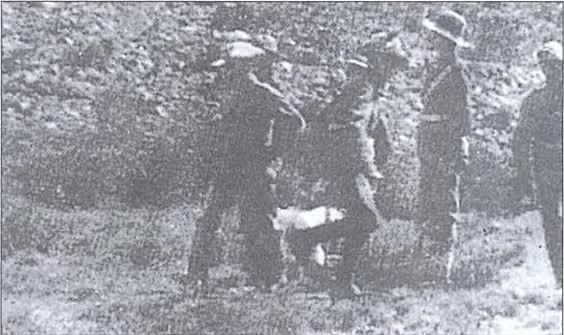
On this date in 1916, Sergeant John Robins of the 5th Battalion, Wiltshire Regiment — demoted for the occasion to Private — was shot “at a point on the beach 400 yards North of the mouth of the Gully Ravine” for disobeying orders.
This redundantly named topography was a feature of an ill-starred (for the British) peninsula Robins’s army was quite ready to see the back of: Gallipoli.*
Winston Churchill’s brainchild for a knockout punch in the First World War had long since come to grief — the enduring grief of the British, Australian, and New Zealand troops who died by the thousands under Ottoman guns whilst attempting to seize the Dardanelles, open the Black Sea, knock the Turks out of the war, and expose the Central Powers’ soft underbelly.
It didn’t do any of those things, but it did help Mel Gibson’s career.
The first days of 1916 were the very last days of the Gallipoli campaign, by which time the object was just to get out.
Actually, the invaders’ positions had been steadily, stealthily evacuated over the preceding weeks — successfully slipping away without alerting the Ottomans to the opportunity for a turkey shoot. The evacuation, at least, was a triumph.
Sergeant Robins was a part of this hot mess; he’d once had to flee from his bed when the Turks surprised his camp and overran it. But it didn’t seem to be jangled nerves that did him in so much as the everyday infirmity of the flesh.
By December 1915, a quarter of his unit was laid up on the sick rolls, but when Robins begged off a patrol assignment for unwellness, the powers that be didn’t reckon him among the legions of ill — but court-martialed him for refusing an order. A rather stunned Robins attempted to explain:
On the night in question I was not well enough to go out. I was eight and a half years in India where I suffered a good deal from fever and ague, and I still get fits of this. I had been suffering from this for several days off and on, and the wet weather had greatly affected me. I have been out here for nearly five months and this is the first trouble I have ever been in. I have always done my duty. This would not have happened if I had been quite well. At the time I did not realise the seriousness of what I did.
He realised the seriousness when he was shot at 8 a.m. on January 2, 1916. A week later, his unit — all his countrymen’s units — were out of Gallipoli.


 From 1927 until his death,
  The Andean military governor Castro had overthrown the previous kleptocracy in the Restoration Revolution of 1899.


 The young Dutch-descended Scheepers (


 On the night in question I was not well enough to go out. I was eight and a half years in India where I suffered a good deal from fever and ague, and I still get fits of this. I had been suffering from this for several days off and on, and the wet weather had greatly affected me. I have been out here for nearly five months and this is the first trouble I have ever been in. I have always done my duty. This would not have happened if I had been quite well. At the time I did not realise the seriousness of what I did.
