1860: John Moyse, the Private of the Buffs

“Our readers,” intoned the London Times on Nov. 5 of 1860, “will not have overlooked the behavior and fate of Private Moyse, of the Buffs, whose resolution, indeed, was not proof against the allurements of the grog-cart, but who actually faced death in cold blood rather than demean himself by prostration before ‘any Chinaman alive.'”

It was on this date that said Private Moyse, John to call him by his Christian name, died in captivity — allegedly because he refused to kowtow to a Chinese mandarin. “The Sikhs obeyed” this Asiatic command, goes the account. “But Moyse, the English soldier, declaring that he would not prostrate himself before any Chinaman alive, was immediately knocked upon the head and his body thrown on a dunghill.”

Kowtowing — Chinese insistence upon; British rejection of — was a touchy symbolic issue between the rising European hegemon and the ancient Chinese empire. It’s said (likely with more color than accuracy) that the British envoy Earl Macartney‘s 1790s trade mission to the east failed for want of a kowtow.

For the same reasons this legend became current, the Moyse tale made sensational propaganda during Britain’s Second Opium War intervention in China, valorized in this jingoistic tear-jerker.

The Private of the Buffs
by Sir Francis Doyle

Last night, among his fellow roughs,
He jested, quaffed and swore,
A drunken private of the Buffs,
Who never looked before.
Today, beneath the foeman’s frown
He stands in Elgin‘s place,
Ambassador from Britain’s Crown
And type of all her race.

Poor, reckless, rude, low-born, untaught,
Bewildered and alone.
A heart, with English instinct fraught,
He yet can call his own.
Aye, tear his body limb from limb,
Bring cord, or axe, or flame;
He only knows that not through him
Shall England come to shame.

Far Kentish hop fields round him seem’d
Like dreams, to come and go;
Bright leagues of cherry blossom gleam’d,
One sheet of living snow;
The smoke above his father’s door
In grey soft eddyings hung.
Must he then watch it rise no more,
Doomed by himself so young?

Yes, honour calls! With strength like steel
He puts the vision by.
Let dusky Indians whine and kneel;
An English lad must die.
And thus, with eyes that would not shrink,
With knee to man unbent,
Unfaltering on its dreadful brink
To his red grave he went.

Vain, mightiest fleets of iron framed;
Vain, those all-shattering guns;
Unless proud England keep, untamed
The strong heart of her sons.
So, let his name through England ring –
A man of mean estate,
Who died, as firm as Sparta’s King
Because his soul was great.

Moyse’s defiance and death make an appearance in this Flashman novel.

Aye, Moyse liked to get into the drink and had a discipline problem, but no matter. This fact was easily appropriated further to his bluff and earnest character in national martyrdom.

Getting a bit carried away with itself, the Times editorialized on Nov. 16,

We have no such visions of human perfectibility as to believe that all the young men of this country will be “respectable youth” looking for “honourable service.” … The English are a people endowed with superabundant energy, and energy must sometimes take an irregular and even a criminal form. The best use that can be made of a young man who will settle down to nothing is to get him to enlist as a soldier. He is kept under strict discipline at the same time that his love of activity and adventure is gratified. He becomes a first-rate fighting man, and fulfils splendidly the only duty which society can ever hope to obtain from him. There is no reason to wonder, with Colonel McMurdo, that acts of heroism have been performed by such men, for they have performed them in all ages and all countries. The “obstinate intemperate hero” is of all time, whether in the shape of Alexander or Lord Clive, or Private Moyse of the Buffs. There are two kinds of valour, belonging to two different classes of men, and a citizen-force may very usefully be employed side by side with the wildest lads who ever rioted in Tipperary or gambled in a London pothouse.

Basically forgotten now, this story can be fleetingly encountered among Anglophiles as an arcane indicator that the national character of Britain, or the West, or what have you, is not now what it once was, given all the kowtowing to mandarins going on in these debased times.

(Although this post amusingly juxtaposes the “commonsense prudence and practicality” of Wellington taking an expedient knee so that a military strategem would not be lost on account of bullheaded pride. Maybe it helped that Wellington was kneeling to a European.)

On this day..

1916: Private Billy Nelson

On this date in 1916, 19-year-old Durham Private William Nelson was shot for desertion by the British military.

The Pity of It
by Thomas Hardy

I walked in loamy Wessex lanes, afar
From rail-track and from highway, and I heard
In field and farmstead many an ancient word
Of local lineage like “Thu bist,” “Er war,”

“Ich woll,” “Er sholl,” and by-talk similar,
Nigh as they speak who in this month’s moon gird
At England’s very loins, thereunto spurred
By gangs whose glory threats and slaughters are.

Then seemed a Heart crying: “Whosoever they be
At root and bottom of this, who flung this flame
Between folk kin tongued even as are we,

“Sinister, ugly, lurid, be their fame;
May their familiars grow to shun their name,
And their brood perish everlastingly.”

According to the archive capture of the lamentably defunct Shot at Dawn site — which campaigned (successfully) for clearing the names of World War I soldiers who had been executed for military failings like desertion or cowardice — Nelson gave a pitiable account of his situation. It was less the horror of trench warfare and mustard gas than desperation on his own home front that undid Nelson’s “nerves”.

“I have had a lot of trouble at home, and my nerves are badly upset. My father is a prisoner in Germany and is losing his eyesight there through bad treatment. My mother died while I was still in England, leaving my sister aged 13 and my brother aged 10. I am the only one left. I had to leave them in charge of a neighbour. I had no intention of deserting. I did not realise what I was doing when I left the camp. When I did so I went and gave myself up. When I went to the store my object was to get a night’s sleep and then go and surrender in the morning. I thought it was too late to do so that night. I did not know when the battalion was coming out of the trenches.”

Hap
by Thomas Hardy

If but some vengeful god would call to me
From up the sky, and laugh: “Thou suffering thing,
Know that thy sorrow is my ecstasy,
That thy love’s loss is my hate’s profiting!”

Then would I bear it, clench myself, and die,
Steeled by the sense of ire unmerited;
Half-eased in that a Powerfuller than I
Had willed and meted me the tears I shed.

But not so. How arrives it joy lies slain,
And why unblooms the best hope ever sown?
–Crass Casualty obstructs the sun and rain,
And dicing Time for gladness casts a moan. . . .
These purblind Doomsters had as readily strown
Blisses about my pilgrimage as pain.

That 13-year-old sister whom Nelson worried over long suffered her brother’s senseless death. In 2004, that woman’s daughter (Billy Nelson’s niece), Nora High, told the Guardian:

Every Armistice Day, my mother shed buckets of tears. We’ve got Billy’s Bible, I got that when mother died. She used to lay that out on a piece of blue satin cloth, and she would cry. She always said: ‘I won’t cry any more because that only upsets Billy. He doesn’t want me to cry. Everything’s fine for him now.’

In Time of “The Breaking of Nations”*
by Thomas Hardy

Only a man harrowing clods
In a slow silent walk
With an old horse that stumbles and nods
Half asleep as they stalk.

Only thin smoke without flame
From the heaps of couch-grass;
Yet this will go onward the same
Though Dynasties pass.

Yonder a maid and her wight
Come whispering by:
War’s annals will cloud into night
Ere their story die.

* The title is a Biblical allusion to Jeremiah 51:20.

As a slight stretch, part of the Themed Set: Thomas Hardy.

On this day..

1781: Isaac Hayne, paroled prisoner of war

On this date in 1781, South Carolina patriot Isaac Hayne was hanged for breaking his conditional British parole and re-enlisting in the American Revolution.

Though Hayne is not, to us, the most famous revolutionary executed by the British, he might have been considered by his contemporaries as the most prominent individual to go to the scaffold for the cause.

A wealthy planter (lots of slaves!) whose home and grave can still be toured in Jacksonboro, Hayne was among 5,000 to surrender to the British when the latter captured Charleston in 1780.

These prisoners were required to swear an oath of allegiance to the crown in exchange for their parole, which Hayne reluctantly agreed to do because his family had been hit with smallpox.

He declared to a friend that,

as they [the British] allow no other alternative than submission, or confinement in the capital, at a distance from my wife and family, at a time when they are in the most pressing need of my presence and support, I must, for the present, yield to the demands of the conquerors. I request you to bear in mind, that previous to my taking this step, I declare that it is contrary to my inclination, and forced on me by hard necessity. I will never bear arms against my country … I do not mean to desert the cause of America.

But as the British southern campaign foundered over the year ahead, the mother country eventually attempted to call him up to do just that: bear arms against his country.

Hayne thought his parole terms protected him from ever having to serve against the colonies, so he simply got back into the fight on the revolutionary side instead. He was captured in that capacity.

The British commander Francis Rawdon handled his relapsed prisoner with uncommon severity, putting him to a drumhead military tribunal with a preordained outcome and refusing the many public pleas for leniency.

The irregular and vengeful nature of these proceedings, and Hayne’s seemingly honorable conduct, raised hackles on both sides of the Atlantic; shortly after hanging Hayne, Rawdon returned to the British Isles to find a good deal of pointed criticism of his behavior. (Parliament quashed any damaging official inquiry, and Lord Rawdon actually extracted an apology from the peer who had the temerity to motion the investigation — an intolerable impeachment on Rawdon’s honor.)

The Hayne incident was widely understood to have been conditioned by British frustration at its failing fortunes in the war. By the time of the execution, the redcoats held nothing of South Carolina save Charleston itself. General Cornwallis had recently marched north from the Palmetto State; in a few weeks’ time, he would surrender his sword and the British cause alike after the decisive British defeat at Yorktown, Virginia.

And though the commandants at Charleston scarcely anticipated that stunning reversal, they had only a few months before suffered the upsetting (but more legally tenable) hanging of the honorable British Major John Andre as a result of the Benedict Arnold affair. British forces were reputedly on the lookout for any opportunity to trade tit for tat.

Continental Gen. Nathaniel Greene alleged that the British officer who received the petition for Hayne’s life simply wrote on it John Andre — and sent it back.


Isaac Hayne was the great-uncle of South Carolina pol Robert Y. Hayne, best remembered for a hot sectional debate with Massachusetts Sen. Daniel Webster. (Read it all here, if you must.)

It was during this exchange of Senatorial disquisitions that Webster delivered one of the noted orations of the antebellum era, the aptly-named Second Reply to Hayne:

I have not allowed myself, Sir, to look beyond the Union, to see what might lie hidden in the dark recess behind. I have not coolly weighed the chances of preserving liberty when the bonds that unite us together shall be broken asunder. I have not accustomed myself to hang over the precipice of disunion, to see whether, with my short sight, I can fathom the depth of the abyss below; nor could I regard him as a safe counselor in the affairs of this government, whose thoughts should be mainly bent on considering, not how the Union may be best preserved, but how tolerable might be the condition of the people when it should be broken up and destroyed. While the Union lasts, we have high, exciting, gratifying prospects spread out before us and our children. Beyond that I seek not to penetrate the veil. God grant that in my day, at least, that curtain may not rise! God grant that on my vision never may be opened what lies behind! When my eyes shall be turned to behold for the last time the sun in heaven, may I not see him shine on the broken and dishonored fragments of a once glorious Union; on States dissevered, discordant, belligerent; on a land rent with civil feuds, or drenched, it may be, in fraternal blood! Let their last feeble and lingering glance rather behold the gorgeous ensign of the republic, now known and honored throughout the earth, still full high advanced, its arms and trophies streaming in their original lustre, not a stripe erased or polluted, not a single star obscured, bearing for its motto, no such miserable interrogatory as “What is all this worth?” nor those other words of delusion and folly, “Liberty first and Union afterwards”; but everywhere, spread all over in characters of living light, blazing on all it sample folds, as they float over the sea and over the land, and in every wind under the whole heavens, that other sentiment, dear to every true American heart, – Liberty and Union, now and for ever, one and inseperable!

When not being rhetorically posterized by New England gasbags, Robert Hayne made time to pen a justification for his famous forebear’s conduct for the Southern Review in 1828 — comparing the British behavior of executing rather than detaining a prisoner who broke parole to the massacre at Jaffa Napoleon notoriously ordered in 1799.

(Actually, Isaac Hayne’s old nemesis Francis Rawdon had only died in 1826; Robert Hayne wrote his piece to confute a vindication of himself that Lord Rawdon — also recognized by his subsequent titles, Earl of Moira and Marquess of Hastings — had authored, decades after the fact, of his conduct in the Hayne matter.)

Though this 37-page slog of Robert Hayne’s is obviously in the public domain by now, it appears it is not yet freely available online. However, it’s the source of the otherwise unattributed quotes in this article.

Part of the Themed Set: The Empire Strikes Back.

On this day..

1976: Valery Sablin, Hunt for Red October inspiration

On this date in 1976, the real-life Soviet political officer whose naval mutiny inspired Tom Clancy’s Cold War thriller The Hunt for Red October was shot in Moscow for treason.

No, unlike his fictional counterpart Marko Ramius (Sean Connery, in the 1990 cinema adaptation excerpted above), Valery Sablin didn’t make it to the West.

But the real Valery Sablin wasn’t trying to make it.

Sablin was the political officer aboard the submarine-killer Storozhevoy. He was also a dedicated Leninist incensed at the notoriously corrupt gerontocracy of the Leonid Brezhnev era.

When he led his mutiny in Riga, his plan was to take the Storozhevoy to St. Petersburg and, Aurora-like, sound the tocsin for a Soviet Tea Party to restore the ideals of the Revolution.

Basically, Sablin had the exact opposite intent of his literary offspring.

This being the 1970s, when figuring out what the devil was happening in the black box of the USSR constituted its own academic discipline, the incident was misinterpreted in the western media — but understandably so.


View Larger Map

The sea route from Riga to St. Petersburg begins in a westerly direction, towards Sweden, and the spectacle of Soviet fighters turning back a vessel steaming for Gotland (combined, of course, with the natural susceptibility of the western audience to the notion) suggested that the mutineers had aimed not at revolution, but at defection.

Under the headline “Newspaper Reports Soviet Ship Mutiny” sourced to Agence France-Presse and datelined Stockholm, Jan. 22, the Jan. 23, 1976 Washington Post reported:

Crewmen on board a Soviet coast guard vessel in the Baltic mutinied and tried to sail the ship into Swedish territorial waters in November, the evening newspaper Expressen said today.

Citing foreign visitors recently returned from Riga, the paper said the mutiny took place Nov. 7 after celebrations in Riga marking the Soviet revolution.

The paper said a Soviet submarine and a number of helicopters forced the ship to return to Riga.

This was the version of the story that aspiring spy novelist Tom Clancy encountered. In his reworking, it became the bold (and successful) defection of a state-of-the-art Soviet submarine and its deft commander … effected, of course, with a little help from the derring-do of the spooks at Langley.

Moscow was pleased to let this be the version that people heard, to the extent they heard anything at all of the incident. Though not exactly flattering, it was much less threatening than the potential storyline of “Soviet officers are so fed up with party corruption that they’re trying to revolt”.

Not until 1990 did the real story get out.

It’s pretty safe to say that the Valery Sablin who died this day would not have had a lot of sympathy for Marko Ramius,* and still less for the Reaganite writer who turned Sablin’s deed inside-out and made it the cornerstone of his own personal mint.

Trust the fact that history will judge events honestly and you will never have to be embarrassed for what your father did. On no account ever be one of those people who criticise but do not follow through their actions. Such people are hypocrites — weak, worthless people who do not have the power to reconcile their beliefs with their actions. I wish you courage, my dear. Be strong in the belief that life is wonderful. Be positive and believe that the Revolution will always win.

-Sablin’s last letter to his son

Russian speakers may enjoy this documentary about the Sablin mutiny.

* Another inversion: in order to make his break for the Free World, the fictional (and, significantly, ethnically Lithuanian) Ramius murders the ethnically Russian political officer, Ivan Putin, assigned to his ship; the real Sablin was himself that zealous political officer, and imprisoned the ship’s captain in the course of the mutiny.

On this day..

1582: Philippe Strozzi, corsair

On this date in 1582, Philippe Strozzi, the Florentine-born commander of a French naval expedition against the Spanish was summarily executed as a pirate.

The Strozzi were long one of Florence’s wealthy and powerful families, as evidenced by, say, the Strozzi Palace, or the Strozzi coat of arms on Michelangelo’s Doni Tondo.

That made the Strozzi sometime-allies, sometime-rivals* of Florence’s more famous powerbrokers, the Medici. It is in both capacities that we meet Philippe (English Wikipedia entry | Italian | French).

To cut a centuries-long story short, the Strozzi had basically come out on the wrong side of the power struggle in the 16th century.

Philippe’s father, Piero Strozzi, was the child of a Strozzi-Medici union, and Piero too married a Medici. He also fought the Medici for power and ended up in exile whereupon he gravitated to the French court of … Catherine de’ Medici. (Catherine had been educated at the home of Philippe’s grandfather, Filippo Strozzi.) Catherine then turned around and used Piero as a French Marshal, including sending him to back Tuscan city-state Siena in opposition to its (and France’s) rival, Florence.**

Your basic tangled geopolitical-genealogical web.

Bottom line, Piero’s son Philippe was born in Florence but grew up Gallic, and fought in the French army all over the continent from the time he was a teenager.

When France got involved in the War of Portuguese Succession, they put this warlike fellow aboard a boat and sent him to dispute Spanish King Philip II‘s attempt to claim the Portuguese throne and unify the Iberian peninsula.

Strozzi’s armada got its clock cleaned at the naval Battle of Ponta Delgada near the Azores, with devastating loss of life.


The Spanish galleon San Mateo, which did yeoman service at this battle.

Since Spain and France were putatively at peace, Spain treated its captives not as prisoners of war but as pirates, and proceeded to execute several hundred in Vila Franca do Campo. Strozzi didn’t even get that much ceremony, however; the day after the battle, he was mortally stabbed, then tossed into the waves.

Happily, the name and the fame of the Strozzi outlived Spanish justice. In the next century, a distant relative by the handle of Barbara Strozzi became one of the most renowned composers of Baroque vocal music. (As befits wealthy Italians of the Renaissance, the Strozzi were big on the arts; Philippe was supposed to be a fine musician himself.)

* The Strozzi-Medici conflict frames the action in the play Lorenzaccio, in which the titular Brutus-like character mulls assassinating the Medici dictator in order to restore the Republic, only to find no such restoration in the offing once he actually does the deed; the father and grandfather of our day’s protagonists are both principal characters.

** That didn’t work. Strozzi was trounced at the Battle of Marciano, which signaled the permanent demise of the ancient city-state‘s independence.

On this day..

1872: Jose Balta, former President of Peru

On this date in 1872, four days after he was deposed as President of Peru, Jose Balta was summarily shot by the would-be dictatorship of Tomas Gutierrez.

Balta (English Wikipedia entry | Spanish) made his name as a soldier, an ironic background for a martyr to constitutional government.

As a colonel, Balta in 1867 led a revolt against President Mariano Ignacio Prado in Chiclayo (mirrored by a similar revolt by Gen. Pedro Diez Canseco Corbacho in Arequipa). The resistance forced Prado’s resignation, and Balta won the ensuing 1868 election.

(Notably, it was under Balta’s administration that unprincipled American railroad speculator Henry Meiggs got his prolific track-building operations going in Peru. Basically, the government took all the capital it raised on its guano-export contract — appropriate source — and plowed it into Meiggs’ well-hyped railroads, whose returns rarely justified the outlay to construct them. Wealthy and influential at his zenith, this adventurer was widely considered culpable for the disastrous state of the Peruvian economy by the time of his 1877 death, since in the interim the guano market had crashed and Peru found itself buried in debt it would ultimately default on. Oh, and: reason Meiggs was in Peru? He had to flee California after perpetrating a real estate scheme.)

Back to Balta. The soldier-President was adamant about an orderly departure from office (with a handover to an opposition party*) when his term came up in 1872, but others around him were less keen on constitutional precedents when there was power to be kept or lost.

On July 22, 1872, War Minister Tomas Gutierrez and his brother, Col. Silvestre Gutierrez, arrested the president. Tomas Gutierrez proclaimed himself dictator.

He was surely expecting a more appropriately cowed reaction from the country than he got: the President-elect got away on a warship, whose crew declared for him; the Peruvian Congress passed a resolution outlawing the Gutierrez coup; and the public reaction against him was chilly enough that someone gunned down Silvestre Gutierrez in a railway station on July 26.

News of this turn for the worse reached brother Marcelino, who had (ex-)President Balta in his charge at Callao … and Marcelino had Jose Balta immediately shot. This event meets the definition of an execution better by its circumstances than by its ceremony, since there was none of the latter; Balta was simply blasted while lying sick in bed, perhaps even still asleep, and not with the least sense of occasion.

And by no standard did it meet the usurpers’ definition of utility.

Neither of the remaining two Gutierrezes would outlive Jose Balta by so much as a day, and news of Balta’s murder only helped fan the incipient uprising: both were killed by mobs as the would-be dictatorial party collapsed in the hours ahead. All three of Tomas, Silvestre and Marcelino wound up on lampposts in Lima (and then burned to ashes in a public square) as recompense for their four days’ sovereignty.

As one report given out in North America recounted it:

The events of the past week will forever be remembered in Peruvian history. The spectacle of a Constitutional President deposed and imprisoned by a military usurper; of a Congress dispersed at the point of the bayonet, after the members, irrespective of partisan feeling, had united in signing a solemn protest, declaring the new officers of the so-called Government criminals and outlaws; of an entire country gathering together its strength to repel the attack made upon its liberties and legal rights; of the rising of the people when their indignation could no longer be restrained on the news of the cowardly assassination of Balta by the Dictator; of the triumph of moral force and justice over bayonets and a bastard cause; of the terrible vengeance of the populace on their tyrants; of the final re-establishment of peace, order and good government. This wonderful series of events has been witnessed by Lima in the space of five days. The Peruvian people have nobly vindicated their name and their national honor; the country is now on a firmer basis, and presents greater hopes for prolonged tranquility, prosperity and progress than it has for many years past.

(Not exactly. The economy, as mentioned, crashed in the 1870s, and there was a successful coup in 1879.)

* The guy set to succeed Balta was Manuel Pardo — not to be confused with Mariano Prado, whom Balta had supplanted.

On this day..

1986: Vice-President Paulo Correia and five others

On this date in 1986, six people were executed by firing squad for attempting a coup in the West African state of Guinea-Bissau.

Correia, an ethnic Balanta war hero, was an African Party for the Independence of Guinea and Cape Verde (PAIGC) activist from the days of Portuguese colonial control — which only ended in 1974.

He was among the revolutionary council that governed the country after Joao Bernardo (Nino) Vieira‘s 1980 coup d’etat.*

This latter strongman was finally assassinated in 2009, but in the interim he was one of the world’s most plotted-against heads of state — in no small part because he came from a tiny ethnic group, and had a fraught relationship with military brass from the plurality (but not majority) Balanta. Vieira needed Balanta officers like Correia to keep the army on his team. Balanta officers like Correia had to wonder whether they needed Vieira.

Correia had perhaps been involved in a 1982 coup attempt that got a tank commander executed, but such was the danger to Vieira of alienating the Balanta (and Correia’s personal following in the military) that rather than face prosecution, he was simply shifted from Minister of the Armed Forces to the less martial post of Minister of Rural Development in the aftermath. Two years later, still trying to keep his treacherous officer inside the tent pissing out, Vieira took him on as Vice-President.

Despite these relative concessions, however, neither Correia nor his fellow military men were thwarted in their drive to augment their power, and in November I985 they planned to overthrow the regime and to install Correia as President and [Balanta lawyer] Viriato Pan as Vice-President. Correia and about one dozen Balanta were immediately arrested before their coup could be implemented; a total of 53 accused conspirators were later convicted, including Correia and Pan, who were both executed along with four others in July 1986.**

“This event,” reports Human Rights Library, “is vividly remembered in Bissau, where rumor has it that Correia’s eyes were gouged out before he was shot. True or not, this belief is clear evidence of the gruesome reputation of the security forces.”

* Just a captain at the time of the 1980 coup, Correia was a colonel at the time of his execution.

** Joshua B. Forrest, “Guinea-Bissau since Independence: A Decade of Domestic Power Struggles,” The Journal of Modern African Studies, March 1987.

On this day..

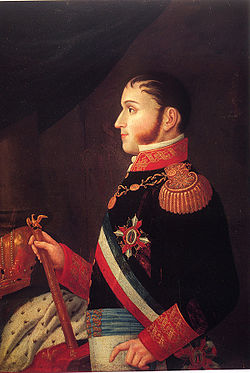
1824: Agustin de Iturbide, Emperor of Mexico

On this date in 1824, the Mexican officer who had made himself emperor was shot at the village of Padilla.

Iturbide‘s military acumen saw him through a meteoric rise in the service of what was then New Spain.

Iturbide rejected an early offer of generalship from the pro-independence leader Hidalgo in favor of spending the 1810s ably quashing the insurgency.

In a bizarre twist of fate, however, it would be Iturbide who would himself cement Mexican independence.

En route to try to finish off the last major rebel leader, Vicente Guerrero, Iturbide caught wind of the recent del Riego liberal revolt back in the mother country,* which had triggered civil war in Spain.

For the conservative royalist general, heir himself to a Basque noble lineage, the potential collapse of Bourbon authority in Spain raised the frightening specter of social upheaval.

All Iturbide’s work killing guerrillas for the sake of public order could come to naught if the Spanish monarchy collapsed or ceased projecting its power overseas … and then who knew what would emerge from the resulting power vacuum in Mexico?

So Iturbide cut a deal with Guerrero to consummate the Mexican War of Independence by separating from Madrid on an essentially conservative basis — a political breakaway without a social revolution. Independent Mexico would make nice with the Spaniards already living there, keep Catholicism as the official state religion, and get itself a constitutional monarchy of its own to insulate itself from the chance outcomes of continental politics across the ocean.

And when Iturbide marched into Mexico City and encountered a crowd conveniently imploring him to take the throne, well, who was he to deny them?

And so Iturbide transitioned smoothly from scourge of the revolution to its man on horseback,** immediately splintering the coalition that lifted him to power.


Contrary to this allegorical take on Iturbide’s coronation, he crowned himself — Bonaparte-like.

Only months after his July 1822 coronation, Iturbide shuttered Congress and began arresting the opposition. Meanwhile, Ferdinand VII had emerged from the Spanish fray as the (momentary) winner, leaving his upstart former subjects without international support.

A general that the freshly-minted emperor had himself had promoted, one Antonio Lopez de Santa Anna — yes, the Alamo guy — declared against Iturbide by the end of 1822, and come the following spring, Agustin I was a European exile, in the paradoxical position of drawing a pension from Mexico while also officially considered a traitor and outlaw.

In Tuscany and then England, Iturbide published an autobiographical justification — Statement of Some of the Principal Events in the Public Life of Agustín de Iturbide — then finally took up a much-asked-for invitation from Mexican conservatives to return and become the savior of his country against internal breakdown and a potential Spanish attack.

Founded on vainglory, this expedition was destined for fiasco; within five days of touching Mexican soil, Iturbide was serenading a firing squad with the last words, “Mexicans! I die with honor, not as a traitor; do not leave this stain on my children and my legacy. I am not a traitor, no.” Apparently they were serious about that injunction never to return.

When in Mexico City, relive happier times for our day’s subject at the Palace of Iturbide where he briefly maintained himself in the purple.


Iturbide’s palace. Creative Commons image from patricio00.

And do think twice about styling yourself Emperor of Mexico, since the only other person to claim that title also ended his reign in front of a firing squad.

* Ironically, it was a body of soldiers assembled for a reconquista of Spain’s independence–minded New World possessions that enabled del Riego to mutiny.

** Iturbide paused in the revolution’s good graces just long enough to design the Mexican flag.

On this day..

1943: Eight from the Krasnodar Trials

On July 18, 1943, eight Soviet citizens who were among 11 tried for collaboration with the recently expelled German occupiers were hanged before tens of thousands in the main square Krasnodar.

The proceedings from July 14-17 were the first major, open war crimes tribunals of World War II … which, of course, was still ongoing at this point.

But the previous winter, the Soviet Union had turned the tide by winning the Battle of Stalingrad, which victory presaged the liberation of the nearby north Caucasus city where we lay our scene.

The Russians proceeded to put the murderous Nazi occupation on trial, but did so not by trying Germans or their allies — but by trying eleven Soviet citizens for collaboration. Indeed, until the end of the war, thousands of Russians were prosecuted for crimes of collaboration, but only a relative handful of Germans for actually authoring those crimes.

These eleven were mostly* men who had served the Sonderkommando 10a (part of Einsatzgruppe D) in “guarding Gestapo buildings that held arrested Soviet citizens, executing arrests, going on military searches and expeditions against the partisans and peaceful Soviet citizens, [and] exterminating Soviet citizens by hanging, mass shootings, and use of poison gases.”

That “Soviet citizen” stuff, technically accurate, soft-pedaled the Einsatzgruppe‘s predictable primary target: local Jewry.

Sonderkommando 10a arrived in the town of Krasnodar when it fell to the Germans on August 12, 1942. On August 21 and 22, all the Jews were ordered to report for transfer to a certain neighborhood in the city. They were taken to the Pervomaisk woods, where they were shot. Many of the city’s Jews did not obey the order, but they, too, were eventually caught and shot. According to a Soviet committee of inquiry report, the number of civilians — women, old people, and children — murdered in Krasnodar was in excess of 13,000. Almost all were Jews. (Source)

This in a city that was occupied for only six months.

Under any description of the victims, these depredations were plenty to condemn collaborators with even the vaguest of associations. Only a few of the men had specific acts charged against them; evidence establishing frightful Nazi atrocities in the region (not hard to find) plus confessions to having worked for the Nazis (not hard to wring out) forged a sufficient evidentiary chain without getting lost in the weeds of such minutiae as: was the collaboration really voluntary? did these collaborators themselves actually carry out war crimes? was that confession actually reliable? (good luck with that one.)

In this military tribunal, the public prosecutor had a free hand for grandstanding, the defense had almost no scope of action, and (the USSR being an old hand at the show trial game) the accused knew their own part to play with craven self-denunciations and pleas for the “mercy” of being sent to the most dangerous part of the front. This made great headlines in Pravda and Izvestia (and update memos straight to the Kremlin) about Nazi bestiality,** and great copy with inquisitorial slam dunks like,

Today Soviet law will mete out justice to the traitors, fascist hirelings, and boot-lickers now in the prisoners’ dock. Tomorrow the court of history, the court of freedom-loving nations of the world, will pronounce its inexorable verdict on the bloodthirsty rulers of Hitlerite Germany and all its associates — on the enemies of mankind who have plunged the world into the welter of the present war. Not one of them will escape stern retribution! Blood for blood, death for death!

All were convicted; three drew long prison sentences and eight hanging, and since the tribunal permitted no appeal, those sentences were executed the day after the court finished its business.

The period quotes, and much of the information about this otherwise somewhat inaccessible trial, comes from Ilya Bourtman’s 2008 article for Holocaust and Genocide Studies, “‘Blood for Blood, Death for Death’: The Soviet Military Tribunal in Krasnodar, 1943.”


It may have been a first, but one need hardly add that it was hardly the last such prosecution.

Several others war crimes show trials took place in other Soviet cities over the next few months, and these would obviously continue after the war.

Long, long after the war.

* The one exception was a 60-year-old former kulak who had illicitly escaped the deportation prescribed for this class in the 1930s. His “collaboration” consisted of having been a doorman whom a German soldier asked a question of.

** e.g., “Death to Hitler’s Butchers and Their Vile Accomplices”

On this day..

1989: Arnaldo Ochoa and Tony de la Guardia

In the predawn hours this date in 1989, Cuban Gen. Arnaldo Ochoa was shot in a pasture at a West Havana military base along with Col. Antonio “Tony” de la Guardia and Captains Antonio Padrón and Jorge Martinez — all convicted of treason against the Cuban Revolution because of drug trafficking.

Before his abrupt fall just weeks before this date, Arnaldo Ochoa was one of the shining stars of Castro’s Cuba.

One of the Sierra Maestre guerrillas, Ochoa had fought with Che Guevara in the Battle of Santa Clara that toppled the Batista regime.

In the decades that followed, he rose to become one of the most powerful officers in Cuba, serving in Venezuela, Angola, Ethiopia.

But in early June 1989, and shortly after a Mikhail Gorbachev state visit to Cuba delivered the bad news that the crumbling Soviet Union would be withdrawing its subsidies to Havana, Ochoa and State Security officer Tony de la Guardia* were suddenly busted for running a drug-smuggling operation — essentially conspiring with the Colombian Medellion cartel to exploit Cuba’s position on the most direct routes to Florida, and corruptly skimming the proceeds in the process.

There seems to be little doubt among those in the know that they were doing exactly that, but endless speculation about what else they were up to — what the executions were really about.

There is the year, to begin with, which is why we’ve mentioned Gorbachev; Castro was hostile to the Soviet leader’s glasnost reforms, and could read well enough the dangerous direction of change in eastern Europe. He wanted Gorbachev to put the brakes on.

Ochoa was seen as a charismatic figure of a more liberal outlook and close to Russian officers to boot, and one school of thought has it that he therefore looked like the sort of man who might be able to mount a coup or serve as the KGB’s catspaw if it came to regime change.

Whether or not Ochoa was targeted on that basis, Castro surely did not regret during those dangerous transitional years as Russian patronage slipped away the salutary effect this day’s doings would have had on any other potential aspirants for his job.

That consideration, whether it was primary or tertiary, probably helps explain the purge’s old-school show trial vibe. On television, Ochoa confessed to it all, and assured the court,

If I receive this sentence, which might be execution … my last thought will be of Fidel, for the great revolution he has given our people.

(Although what that thought would have been is a different matter. After falling out with Ochoa over military operations in Angola, the Cuban dictator had bugged his general’s environs and thereby eavesdropped on numerous of caustic remarks about himself.)

The drug charges, too, point the way towards plausible hidden agendas.

Fidel and Raul generally took a cautious approach to the drug business — hardly virginal, but reputedly avoiding particularly egregious entanglements lest they gift-wrap the hostile Yankees a pretext for invading. (Given what happened to Panama later in this eventful year, that would have been a reasonable concern.)

At the same time, it’s all but inconceivable that they were taken completely unawares by “revelations” that their aides were up to something shady.

So the hypotheses in this area run the gamut from: Ochoa and de la Guardia taking an authorized but circumscribed covert operation and avariciously expanding it beyond any possible license; to, everyone at the top being up to his eyeballs and Ochoa and de la Guardia eliminated when it became expedient to bury their firsthand knowledge of Fidel’s firsthand knowledge. Timing, again, is suggestive; with the coming withdrawal of Soviet protection, this might have been seen in Havana a prudent moment to trim sails on narcotics transshipment.

Whatever Arnaldo Ochoa and Tony de la Guardia may have known or sensed about the wheels-within-wheels of Havana politics, they took it to their grave 21 years ago today. Perennial declarations of the Castros’ imminent fall have made the rounds ever since, but until that old stopped clock manages to tell the right time, it’s likely that the rest of us will have to content ourselves with guesswork.

* De la Guardia was a friend of the writer Gabriel Garcia Marquez. In this very year, Marquez dedicated The General in his Labyrinth to the soon-to-be-disgraced colonel.

Speaking of de la Guardia literary connections: Tony’s daughter, Ileana, has also published a book.

On this day..