1916: Cesare Battisti and Fabio Filzi

On this date in 1916, the Austro-Hungarian empire executed Cesare Battisti and Fabio Filzi for treasonous Italian nationalism.

It was the multiethnic Habsburg state that was itself dying of its constituents’ national aspirations; in little more than two years, the state entity that carried out this day’s sentences would no longer exist at all.

Pre-World War I, Battisti (English Wikipedia entry | Italian) was actually a Socialist representative in the Austrian parliament.

When the unpleasantness broke out, though, he made a break for the peninsula where he agitated* (successfully) for Italian entry into the fray against Austria-Hungary. Irredentists had long coveted Habsburg properties with a heavy Italian population, like the Adriatic port of Trieste and Battisti’s own native Trento; the war offered an opportunity to swipe those territories, notwithstanding Italy’s putative prewar alliance with the Austrians.

Although already 40 years of age when Italy entered the war, the intrepid Battisti enlisted to fight. He was captured along with an otherwise obscure subaltern, Fabio Filzi, on the Alpine slope of Monte Corno (now known as Monte Corno Battisti) repelling the Austrian Strafexpedition.**

Austria did not stand on ceremony with these men; their capture took place on July 10, their trial on July 12, and their executions at the Castello del Buon Consiglio — an ironic Calvary, for a parliamentarian — later that same day. (To complete the scene, the strangulation-hanging was botched when Battisti’s first rope broke.)

The Austrian writer Karl Kraus would observe that “they thought they were hanging Italy, but it was really Austria on the gallows.”

Whichever one it was, they took a lot of pictures.


Battisti and Filzi as prisoners.
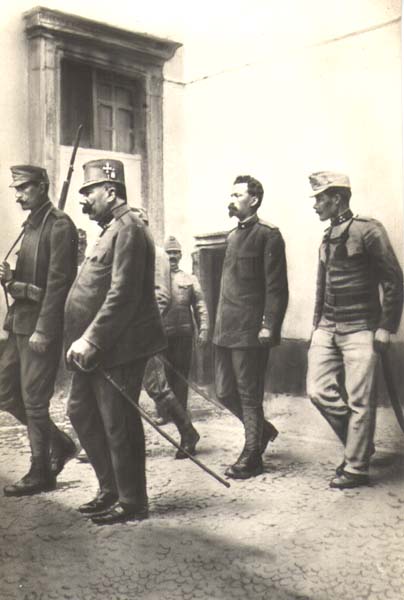

Battisti leaving the courtroom en route to his execution.


Battisti approaches the scaffold.


Battisti waiting at the scaffold as the sentence is read.


The Austrian army offers a prayer and salute to the shrouded body of Cesare Battisti.

* As a socialist who broke against the internationalist position and in favor of violent nationalism, Battisti was an ally of Benito Mussolini. It was Battisti, actually, who pioneered the socialist-nationalist-newspaperman act upon which Mussolini would later raise is own star, to such an extent that Battisti’s paper, Il Popolo — the apparent inspiration behind Mussolini’s own subsequent paper, Il Popolo d’Italia — gave the still-obscure future Duce some of his earliest gigs.

A martyr’s death during World War I fortuitously spares Battisti’s legacy the unpleasant association with his friend’s postwar turn towards fascism, so there are many streets and plazas named for Battisti, as well as a memorial in Trento. He’s also honored by name in the 1918 patriotic tune La Leggenda del Piave (lyrics).

** “Punitive expedition”.

On this day..

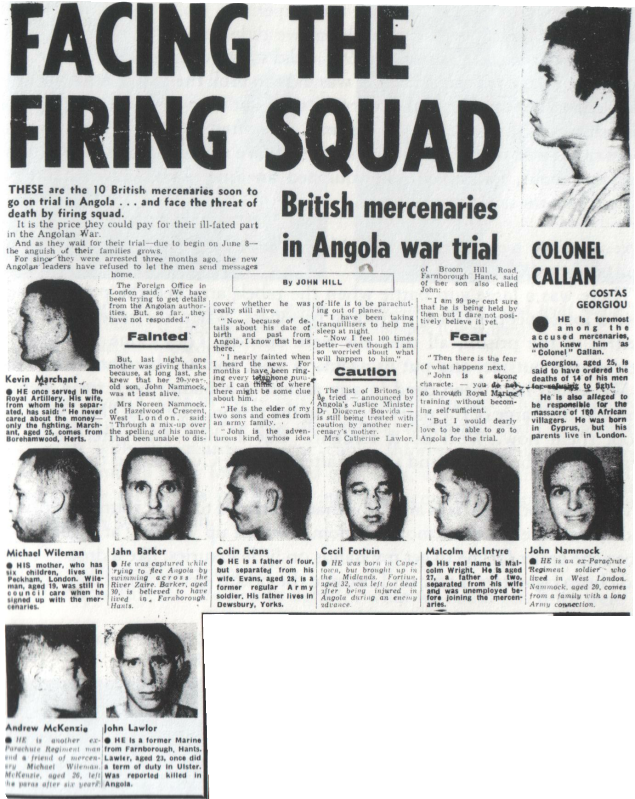
1976: Costas Georgiou and three other mercenaries in Angola

On this date in 1976, three Britons and one American were shot in Angola by a military police squad for murders committed as mercenaries earlier during the year.

Costas Georgiou.

They were among 13 foreigners sentenced at the Luanda Trial, which occurred on the pivot of Angola’s transition from generation-long anti-colonial insurrection on towards generation(s)-long civil war. Between them, more than half a million Angolans died, but this date belonged to a couple of unrepresentative Anglos.

Long story short, the immediate aftermath of Angolan independence in late 1975 was a scramble for control among the several factions who had been fighting the Portuguese … along with a scramble among interested outside states to line up their allies in this resource-rich Cold War prize.

Small wonder that foreign soldiers of fortune soon found their way into the chaotic scene.

Over the course of the first few months of independence, the Popular Movement for the Liberation of Angola (MPLA) more or less consolidated state power, and it proceeded to prosecute supporters of a rival guerrilla movement for their part in the conflict immediately after independence.

Thirteen foreign mercenaries who were captured by MPLA-supporting Cuban troops — the other nine drew long prison sentences — were charged in a show trial with war crimes for their conduct in the field in a case that made the western gun-for-hire an emblem of colonial depravity.

The most notorious of the bunch was Costas Georgiou. A Greek Cypriot emigre to Britain, he had gone to Angola as “Colonel Callan” and was wanted by Scotland Yard for there ordering a mass execution of other British mercenaries — an act he admitted at trial. Even the inevitable London Times editorial against the trial (June 29, 1976) agreed “the proceedings against Callan, if not the rigours of the sentence may be conceded.”

The others looked much less culpable, almost arbitrarily selected for death from among the ranks of unprepossessing, sometimes barely-there mercs. American Daniel Gearhart, a Vietnam veteran drowning in debt, had apparently been in the field for a mere three days and never so much as fired a shot; that he had advertised in Soldier of Fortune magazine was held to aggravate the charges against him, and in vain did the father of four insist that being tried for his life was enough to scare him straight out of the business.

Angolan defense attorneys, while also appealing against the legality of the trial on grounds of both international and domestic law, spoke that revolutionary language of decolonization in defending their charges. Georgiou, according to Maria Teresinha Lopes, was

“a colonized man … [treated in England as] a sub-human, just a Greek, just a ‘boy’.”

Another Angolan defense attorney argued against the death penalty because

“To condemn them to death while ignoring their social origin in terms of revolutionary justice would deny the theory which guided our revolution. My clients are an integral part of the exploited class.” (Both comments from London Times, June 19, 1976)

The era of decolonization was a time for idealism, but not the sort that would shrink from bloodshed.

In denying the doomed men clemency, Angola’s first independent president Agostinho Neto denounced

Mercenarism, instrument of the aggressive designs of imperialism … a scourge of the African continent and a grave threat to the peace, freedom and independence of the peoples …

It is imperative that the practice of mercenarism be banished once and for all from our planet. It is urgent that all states and peace-loving forces fight it most energetically.

We are applying justice in Angola not only in the name of our martyred people but also for the good of the brother peoples of Namibia, Zimbabwe and all the peoples of the world against whom imperialism is already getting ready to prepare new mercenary aggressions.

(Text dated July 9, and reprinted in the July 10 London Times)

You could just about substitute the word “terrorism” for “mercenarism” and read it on today’s campaign trail.

Juridically, Angola pursued these warriors as peoples who had fought unlawfully and could therefore be placed outside the protections conferred on soldiers by the Geneva Conventions — and subjected to the liberating power of revolutionary violence.

That this ad hoc concept of “mercenarism” could be exploited to license an outrage upon humanity was a notion relentlessly denounced by British and American officials,* who had not yet fully explored the utility of the “unlawful combatant” construct in extending the reach of their own security states.

As for all that peace-loving, brother-peoples stuff in the execution order?

What actually happened after the mercenaries were shot was that the two biggest former anti-colonial guerrilla movements in Angola morphed into Cold War proxies — the MPLA of the Warsaw Pact, supported by its control of the country’s oil; UNITA of NATO, supported by its control of the country’s diamonds — and bled the country dry in a horrific civil war.

* Henry Kissinger, then President Gerald Ford’s Secretary of State, complained that Angola’s decision

to ignore both the law and the facts … cannot help but affect adversely the development of relations between the United States and Angola.

On this day..

1538: Diego de Almagro, explorer of Chile

On this date in 1538, Spanish conquistador Diego de Almagro was executed* at Cuzco by his vengeful rivals, the Pizarro brothers.

Conquistadoring with the rapacious Pizarros was a good way to get rich, get dead, or possibly both.

Almagro, a soldier, got to the New World in 1514 and soon fell in with alpha male Pizarro Francisco.** He’d become an adjunct to the latter’s conquest of the Incan Empire in the 1520s and 1530s; sent to capture the Incan city of Quito, Almagro found it razed by its defenders, and he sycophantically re-founded it as San Francisco de Quito.†

Things weren’t buddy-buddy for long.

The Iberian mothership divided Spain’s putative New World possessions north and south, putting Almagro in command of the southern cone. Great news … now all he had to do was actually take control of it.

Personally financing an expedition on the expectation of fabulous riches to be seized, Almagro instead foundered in Chile’s northern valleys in a frustrating environment of natives equally hostile and impecunious. After a couple years, he gave up and returned to Peru, angrier and poorer for his trouble — and there found that he could exploit the Spanish preoccupation with intransigent Incan chief Manco Inca to nick the capital city of Cuzco for himself.

Almagro actually had the lesser Pizarros — Gonzalo and Hernando — prisoner for a while, but he bartered them away to Francisco for a hill of beans (that is, a promise not to attack), and the Pizarros took their city back by routing Almagro at the Battle of Las Salinas.

The sentence of death against as august a personage as the appointed ruler of Nueva Toledo shocked many, and it was carried out against Almagro’s own entreaties for an appeal to the crown.


Detail view of a print of Almagro’s capture and execution. (Click for the full image.)

Francisco Pizarro would redeem his want of clemency towards his former partner in his own blood: in 1541, Almagro’s son, Diego de Almagro II or el Mozo, murdered Pizarro in an attempted coup d’etat. (Almagro the Younger, too, would be executed for his trouble.)

Although he was an important conquistador who spent most of his time at points further north, Almagro is best remembered today not in Peru but in Chile — for his abortive and disappointing expedition made him that land’s first European “discoverer”.

* Either beheaded or garroted.

** Almagro also rubbed shoulders with Vasco Nunez de Balboa.

† He pulled a similar trick with Trujillo, naming it after Francisco Pizarro’s birthplace.

On this day..

1917: Gasim, by Lawrence of Arabia

“With Major Lawrence, mercy is a passion. With me, it is merely good manners. You may judge which motive is the more reliable.”

-Alec Guinness as Prince Faisal in Lawrence of Arabia

This date in 1917 was the eve of the Battle of Aqaba, wherein a force of Arabs with famous British officer T.E. Lawrence emerged from the desert to surprise and capture the Ottoman Red Sea port today located in Jordan.*

And that makes this, in the cinematic masterpiece Lawrence of Arabia, the date on which the titular character kept the peace within his fragile coalition by personally executing a malefactor to prevent a tribal blood feud.

The victim, Gasim, is a real figure described in the real T.E. Lawrence’s memoirs —

a gap-toothed, grumbling fellow, skrimshank in all our marches, bad-tempered, suspicious, brutal, a man whose engagement I regretted, and of whom I had promised to rid myself as soon as we reached a discharging-place.

Gasim is most famous as the beneficiary of the movie scene in which Lawrence boldly turns back into the desert to rescue this worthless retainer when Gasim’s camel is found riderless in the caravan. This, too, is based on an actual incident in Lawrence’s memoir, albeit heavily dramatized on celluloid.

In the film, Lawrence’s godlike power to give Gasim life is soon mirrored by the godlike power to deprive it.

Effectively exploiting dramatic license, Lawrence of Arabia portrays the Englishman surveying the scene of the coming triumph when a disturbance breaks out in his camp. Hastening thither, he discovers clan lining up against clan over the destructive right of blood vengeance because of a murder in the camp — a murder committed by the man he has saved.

To forestall a “tribal bloodbath” on the very eve of victory, Lawrence himself volunteers to execute the culprit. Having once risked everything to save Gasim, Lawrence sacrifices him ruthlessly when the occasion demands.** This act underscores the chameleon-like other-ness of the character, one of the film’s principal leitmotifs: “I have no tribe, and no one is offended!”

Though the real Lawrence did no such thing to the real Gasim, this astonishing scene is also related in the memoirs — just at an earlier point, and with a different, less dramatically integral character.

My followers had been quarrelling all day; and while I was lying near the rocks a shot was fired. I paid no attention; for there were hares and birds in the valley; but a little later Suleiman roused me and made me follow him across the valley to an opposite bay in the rocks, where one of the Ageyl, a Boreida man, was lying stone dead with a bullet through his temples. The shot must have been fired from close by; because the skin was burnt about one wound. The remaining Ageyl were running frantically about; and when I asked what it was Ali, their head man, said that Hamed the Moor had done the murder. I suspected Suleiman, because of the feud between the Atban and Ageyl which had burned up in Yenbo and Wejh; but Ali assured me that Suleiman had been with him three hundred yards further up the valley gathering sticks when the shot was fired. I sent all out to search for Hamed, and crawled back to the baggage, feeling that it need not have happened this day of all days when I was in pain.

As I lay there I heard a rustle, and opened my eyes slowly upon Hamed’s back as he stooped over his saddle-bags, which lay just beyond my rock. I covered him with a pistol and then spoke. He had put down his rifle to lift the gear; and was at my mercy till the others came. We held a court at once; and after a while Hamed confessed that, he and Salem having had words, he had seen red and shot him suddenly. Our inquiry ended. The Ageyl, as relatives of the dead man, demanded blood for blood. The others supported them; and I tried vainly to talk the gentle Ali round. My head was aching with fever and I could not think; but hardly even in health, with all eloquence, could I have begged Hamed off; for Salem had been a friendly fellow and his sudden murder a wanton crime.

Then rose up the horror which would make civilized man shun justice like a plague if he had not the needy to serve him as hangmen for wages. There were other Moroccans in our army; and to let the Ageyl kill one in feud meant reprisals by which our unity would have been endangered. It must be a formal execution, and at last, desperately, I told Hamed that he must die for punishment, and laid the burden of his killing on myself. Perhaps they would count me not qualified for feud. At least no revenge could lie against my followers; for I was a stranger and kinless.

I made him enter a narrow gully of the spur, a dank twilight place overgrown with weeds. Its sandy bed had been pitted by trickles of water down the cliffs in the late rain. At the end it shrank to a crack a few inches wide. The walls were vertical. I stood in the entrance and gave him a few moments’ delay which he spent crying on the ground. Then I made him rise and shot him through the chest. He fell down on the weeds shrieking, with the blood coming out in spurts over his clothes, and jerked about till he rolled nearly to where I was. I fired again, but was shaking so that I only broke his wrist. He went on calling out, less loudly, now lying on his back with his feet towards me, and I leant forward and shot him for the last time in the thick of his neck under the jaw. His body shivered a little, and I called the Ageyl, who buried him in the gully where he was. Afterwards the wakeful night dragged over me, till, hours before dawn, I had the men up and made them load, in my longing to be set free of Wadi Kitan. They had to lift me into the saddle.

Peter O’Toole’s Lawrence almost palpably manifests the conflicting aspects of his character as he shoots Gasim to death — and he confirms the transformative effect of his first homicide in subsequent dialogue with Gen. Edmund Allenby.

Lawrence: I killed two people. One was … yesterday? He was just a boy and I led him into quicksand. The other was … well, before Aqaba. I had to execute him with my pistol, and there was something about it that I didn’t like.
Allenby: That’s to be expected.
Lawrence: No, something else.
Allenby: Well, then let it be a lesson.
Lawrence: No … something else.
Allenby: What then?
Lawrence: I enjoyed it.

* Actually, Aqaba is Jordan’s only port. This battle was not so epic as the film depicts.

** In a bit of complex foreshadowing, the cinematic Gasim has told Lawrence at the outset of the expedition that “Allah favors the compassionate.”

On this day..

1972: Three Somali officers for an attempted coup

On this date in 1972, Somali Generals Muhammad Ainanshe Gulaid and Salad Gaveir, along with Col. Abdulkadir bin Abdulla,* were publicly shot in Mogadishu by a 90-man** (!) firing detail for attempting a coup the previous year.

Forged from the decolonized territories formerly known as British Somaliland and Italian Somaliland, Somalia had weathered a rocky 1960s before Siad Barre seized control in a 1969 military coup.

Muhammad Ainanshe Guleid had been Barre’s second vice-president (the first was also arrested for another supposed plot, though not executed), so the alleged conspiracy would have been treason at the very highest level. It’s obscure at this point to what extent the arrests might be attributed to an actual intended coup as against internecine politics within the ruling Supreme Revolutionary Council, or even whether those categories were wholly distinct.

“They were charged,” according to An Encyclopedic Dictionary of Conflict and Conflict Resolution, 1945-1966 (it makes great bathroom reading) “with treason in a plot to assassinate the president … and other high officials and to return the socialist country to capitalism.”

The Soviet-backed Barre had plenty of problems over the next two decades, but actually managed to hold the tumultuous country until 1991. Then rebels finally deposed the dictatorship. Neither those rebels nor anyone else, however, was able to establish an effective central government — leaving Somalia to become the anarchy/libertarian paradise it’s famous as today.

(Juxtapose: the Barre regime’s attempts (pdf) at establishing a more conventional tourist profile.)

* Each of these names have several possible transliterations. Actually, later this same year, Barre would announce an official choice of Latin script for the heretofore unwritten Somali language; schoolchildren at this time had to learn English, Italian, Arabic, and Somali.

** The source for the 90-man firing squad figure is I.M. Lewis, “The Politics of the 1969 Somali Coup” in The Journal of Modern African Studies, Vol. 10, No. 3 (Oct., 1972). As the title indicates, our day’s principals are not the author’s chief concern, but he adds apropos of Barre’s doomed efforts to shift loyalties away from tribes and towards the state that the massive fusillade party “was anti-tribal in composition, and that the Government would see to the funeral arrangements — traditionally a lineage responsibility.”

On this day..

1890: Major Panitza, by Stefan Stambolov

Sophia, June 28, 1890

With reference to my telegram of this day’s date, I have the honour to report that this morning Major Panitza was conducted from his place of confinement in town to the camp of Bali Effendi, close to Sophia, where the troops are quartered for the summer, and in presence of the whole brigade drawn up in military file he was shot by a peloton of twenty-four soldiers.

Major Panitza fell uttering the cry, “Long live Bulgaria.”

After the execution, Major Marinoff, the Commandant of the Sophia garrison, addressed a short speech to the troops, in which he said that Major Panitza had met his death in just punishment for treason against his Prince and country, and that a similar fate would be dealt out to whosoever should prove a traitor to the interests of the Fatherland.

The troops maintained a perfectly impassive attitude throughout the proceedings, and the execution of the condemned in the presence of the garrison shows that the Government wished to make an example which should be a warning to the officers to refrain from the political intrigues that had during the last few years become so prevalent, and that were dangerously undermining the discipline and loyalty of the army.

–British and foreign state papers, vol. 83

Having recently gained independence by backing its Slavic brethren against its longtime Ottoman master in the Russo-Turkish War, Bulgaria was enjoying all the perquisites of being a minor power pressed between major powers.

The leading concern of its able, authoritarian, and justifiably paranoid leader* Stefan Stambolov — “the only Prime Minister in Europe who receives his visitors with a revolver lying next to the ink-stand on his desk,” in the New York Times’ description — was the interest of Bulgaria’s “benefactors” in St. Petersburg in turning this breakaway Ottoman province into an ever more pliant Russian instrument.

Whether it was the coreligionists or their coin who inspired it, many in Bulgaria felt sincere loyalty to Russia; in an age of empires, it wouldn’t have been unreasonable statecraft to opt for the security of dependency.

With that object in mind, Major Panitza hatched a dangerous plot to overturn the Bulgarian government. His plot conjured an equally dangerous reprisal from Stambolov — who was determined to keep as much independence as Bulgaria could sustain.

Despite fairly widespread sympathy in the army and the populace for Panitza’s plot, and of course in the face of entreaties of Russia, Stambolov had the execution carried out with impolitic dispatch just weeks after the court-martial did its work.**

Many outside of Bulgaria saw statesmanlike quality in Stambolov, but his severe rule exemplified by his unpopular ruthlessness towards Major Panitza made him many enemies at home. Stambolov was himself assassinated shortly after resigning from government in 1895, and his corpse abused en route to its resting place.

* Generally transliterated “Stambouloff” or “Stambuloff” during his own lifetime, this gentleman got control of the state by mounting a counter-coup against a Russian putsch. Since the Russians still succeeded in definitively dethroning the sitting Bulgarian king, Stambolov’s hand alone guided the unsteady Bulgarian ship of state for a time.

Stambolov eventually installed an Austro-Hungarian noble as Prince Ferdinand I (the two came to hate each other). Later titled “tsar”, Ferdinand was the grandfather of Simeon II, who achieved the unusual distinction of becoming Prime Minister of Bulgaria through democratic election in 2001.

** Panitza’s co-conspirators got various prison terms, including the former Commandant of the Sofia garrison, a gentleman sporting the Strangelovian moniker Lieutenant-Colonel Kissoff.

On this day..

1940: Tirailleurs Senegalais, for France

On this date in 1940, German forces even then completing their rout of France — the humiliating capitulation was mere hours away — massacred a detachment of African soldiers who mounted a doomed resistance at Lentilly.

Tirailleurs Senegalais were recruited not only from Senegal but from throughout France’s domains in sub-Saharan Africa. (There were also Algerian, Tunisian, and Moroccan tirailleurs.)

Though these soldiers’ own lands were occupied, they were instrumental to defending the freedom of their occupier on European soil: over half a million African tirailleurs are thought to have served les couleurs in the two World Wars, and died in all the horrible ways those slaughterhouses could devise.

In 1940, black troops represented some 9% of the French army, a fact pilloried in German nationalist proaganda.

It’s hardly a surprise that the black man couldn’t catch a break from skull-measuring Aryan race warriors, but then, France too had its own less than comfortable relationship with these dark-hued citizens summoned from distant villages to bleed in the trenches of Europe. The military’s official guidelines emphasized (French link) the “Senegalese’s” special value as cannon fodder.

If a sacrificial mission is necessary, a defense to the death to provide cover for forces to regroup, appeal to the valor of the black fighter.

On the other hand, French authorities put up a monument to black soldiers in the aftermath of World War I. (The occupying Nazis vengefully dismantled it.) Such are the contradictions of colonialism.

Racial reservations notwithstanding, colonial troops were employed throughout the army if for no other reason than that they constituted nearly the tenth part of that army.

Their service record naturally included (French pdf) the over-before-it-started French defense against the Nazi blitz in 1940.

In this instance, knowing full well that the campaign was lost, French officers flipped open the “sacrificial mission” playbook and ordered their African charges to oppose a German march near Lyon “without thought of retreat.”

Since victory was equally out of the question, that left death. Wehrmacht troops duly prepared by Nazi racial typecasting to see their foes as savages were all too ready to wipe out African troops they greatly outclassed.


A monument to the Tirailleurs in Lentilly, France. Image (c) filoer and used with permission.

The Lentilly cemetery “Tata”, final resting place of 188 Senegalese riflemen who died under German artillery or were massacred after the battle by the 3rd SS Division Totenkopf June 19 and 20. Image (c) filoer and used with permission.

For more on the tirailleurs, there’s an extensive French-language blog.

On this day..

1979: Ignatius Kutu Acheampong, former dictator of Ghana

On this date in 1979, former Ghanaian military strongman Ignatius Kutu Acheampong was shot in the aftermath of Jerry Rawlings’ successful coup d’etat.

Acheampong had executed a coup of his own in 1972 and run the unsteady West African state for most of the 1970s — a period of economic and political crisis — until he himself was toppled by another General, Fred Akuffo.

Acheampong was retired to his home village by the new regime, but he would not enjoy such satisfactory treatment when a national revolution ended Akuffo’s reign and brought junior officer Jerry Rawlings to power.

Less than two weeks after Rawlings was installed as Ghana’s new head of state, Acheampong was executed on a charge of corruption. This would not sate the considerable popular anger at the outgoing military clique, which went on to gorge itself on Akuffo and five others later that same month.

Former NFL defensive back Charlie Peprah is Acheampong’s grandson.

On this day..

1441: Corrado Trinci, Lord of Foligno

On this date in 1441, Corrado Trinci was executed in Foligno.

Once the hereditary lord of that venerable town,* Trinci (English Wikipedia page | Italian), had turned tetchy with his Guelph family’s onetime papal patrons and suffered the consequences.

As the proper captain of an Italian city-state in the 15th century, Trinci had taken a few spins around the wheel of fortune in battle with his neighbors. He kicked off his reign in operatically sanguinary style when a neighboring town‘s castellan murdered Trinci’s brothers, suspecting one of them of adultery with his wife. Trinci revenged himself by sacking Nocera Umbra, which still holds a civic relay race (Italian link) commemorating the occasion.

Trinci didn’t fare as well when it came to picking on someone his own size.

For the next generation, Trinci would do the Machiavellian dance characteristic of his time and station — by turns allied with, at war with, or plotting with the papacy, Condottiero Francesco Sforza, the archbishop of Florence, and miscellaneous other peninsular neighbors and rivals. He was down. He was back up. He was beaten. He fought back. Etc.

Trinci pushed the wheel of fortune one turn too far by rebelling (again) against papal authority in the mid-1430s. His march on the Vatican-controlled Duchy of Spoleto was an initial success —

Corrado brought to Foligno four hundred youths of Spoleto, the standard of Spoleto, the chains, the locks from the city gates, the seal, and the clapper from the great bell of the commune.

–Durante Dorio, as quoted and translated by Sergio Bertelli

That was in 1436. By 1439, Foligno itself (with Trinci inside it) had capitulated to a papal siege. Spoleto really wanted its clapper back.

Trinci was imprisoned with his family, and after a couple years’ languishing, put to death on this date. While both the English and Italian Wikipedia entries currently assert that he was strangled, the principal source for this gentleman’s biography, the freely-available Istoria della Famiglia Trinci by Durante Dorio, flatly asserts that the washed-up brawler was dispatched by decapitato.

By whatever method Corrado laid down his life, he retired with it not only the fame of his family but its Lordship of Foligno. The title fell extinct: Foligno became part of the Papal States and remain so right up to Italy’s 19th century unification.

* When next in central Italy, be sure to visit the lovely Palazzo Trinci. Corrado commissioned the Ottaviano Nelli frescoes in the chapel.

On this day..

1956: Juan Jose Valle, Peronist putschist

On this date in 1956, the Argentine military junta crushed a Peronist revolt with the summary execution of its leader, Juan Jose Valle.

Gen. Pedro Eugenio Aramburu had overthrown the populist Juan Peron government in 1955, and now ruled Argentina as President.

General Valle was shouldered out for his affiliations with the former regime: throughout the months following the coup, the Peron party was systematically proscribed and its leaders barred from politics.

In exile, Peron urged radical action by these disenfranchised followers, and Valle attempted to mount a revolt in June 1956.*

This operation was well-scouted by the government, and crushed instantly — with a couple dozen of its adherents summarily shot. (Spanish link)

Well, the Peronist party slogan was, “Our Lives for Peron.”

Valle avoided the initial slaughter, but he was captured in an apartment in Buenos Aires on this date and shot at the city’s National Penitentiary in the evening.

“Shot for trying to overthrow the government” doesn’t quite sound off the scale of typical coup outcomes, but in Buenos Aires in 1956, these executions were shockingly disproportionate relative to the handling of many recent unsuccessful coups. Actually, the Aramburu government had just that February repealed the death penalty as a statutory option for plotting a coup.

But it wasn’t using statutes to handle the Valle coup: it declared martial law, and handled subversives at its own discretion. (It rescinded martial law and ceased any further executions on June 13.)

The authorities’ brutal response was something of a turning point in Argentine political relations and culture. Throughout the Peronist decade even the harshest critics of the regime could not accuse it of executions of this sort, even though coups had been attempted against it. Bloodshed on this scale for political reasons was unprecedented in the political and military history of Argentina.

–Politics and Education in Argentina

Aramburu himself would catch a bit of the blowback for authoring this “turning point”: in 1970, the former president was kidnapped (Spanish-language site) by the pro-Peron Montoneros guerrillas and himself summarily executed shortly thereafter — allegedly in specific retaliation for having shot Gen. Juan Jose Valle.

And the literary fallout was hardly more complimentary. Argentine writer Felix Luna penned La Fusilacion (The Firing Squad) the next year;** set during Argentina’s 19th century civil wars, it’s plainly informed by that country’s more contemporaneous problems.

* Valle’s top co-conspirator was another general, Raul Tanco. In a strange coda, Tanco managed to escape execution by claiming asylum in the Haitian embassy. Pro-government gunmen kidnapped him from that refuge and turned him over to the army, but in a gesture of diplomatic courtesy, Aramburu returned Tanco to the embassy unharmed, with apologies to the Haitians for the breach of decorum.

** It’s also a 1962 movie.

On this day..