Rufinus and Valerius, Roman tax collectors who converted to Christianity and were martyred at Soissons during the Diocletian persecution in 287, are honored by the Roman martyrology on this date.
They’re saints of a lesser firmament, although Rufinus has a spot of archaeological distinction as the intercessor honored on the Darenth Bowl, a beautiful fifth-century glass artifact that somehow survived to us intact. (Note, however, that there are 11 saints Rufinus.)
They figure indirectly in one of the martyrology’s recurrent themes, the Saul-like conversion of Roman persecutors to the Christian faith: Rufinus and Valerius were held to have been martyred by the Roman prefect Rictius Varus,* who presents as a recurrent tormenter of Christians and in the martyrology arrives to dispatch our taxmen straightaway after doing the same to future Shakespeare monologue superstars Crispin and Crispinian.
In fact, Rictius Varus figures in no fewer than nine late third century martyrologies, compassing 20+ champions of the faith … the last of whom was the great Saint Lucy who is said to have induced Varus to embrace the same persecution and suffer martyrdom right along with her.
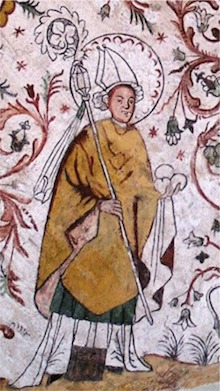
Ol’ “God-kettle” was one of several missionaries known to have been dispatched in the 11th and 12th century from England to Sweden, a traffic in religious conversion across the North Sea crossroads to invert the centuries-past course of Vikingers who put so many British sanctuaries to the sack.
The Northmen realms were ripe to join Christendom but sagas touching the time describe an uneven transitional period where the new and old faiths jostled for primacy.
“Ingi was king for a long time, well-liked and a good Christian; he put down [pagan] sacrificing in Sweden and ordered all the people of the land to become Christian,” runs The Saga of King Heidrek the Wise** (available in pdf translation here), about King Inge the Elder.
But the Swedes had too strong a belief in the heathen gods and held to their ancient ways … the Swedes thought that King Ingi had infringed their rights under the ancient law of the land, when he found fault with many things that Steinkel his [Christian] father had let be; and at a certain assembly which the Swedes held with King Ingi they gave him the choice of two things, either to observe the ancient laws or else to give up his throne. Then King Ingi spoke, and said that he would not leave the true faith; whereat the Swedes cried out, and pelted him with stones, and drove him from the law-assembly.
Svein, the king’s kinsman, remained behind at that assembly, and he offered to make sacrifice for the Swedes if they would grant him the kingdom; all agreed to Svein’s offer, and he was accepted as king over all the Swedish realm. Then a horse was led forth to the assembly, hewn in pieces, and divided up for eating, and the sacrificial tree was reddened with its blood. Thereafter all the Swedes cast off the Christian faith, and sacrifices were instituted, and they drove King Ingi away; he departed into western Gautland. For three years Svein the Sacrificer was king over the Swedes.
King Ingi went with his own bodyguard and some followers, though it was only a small force … into Sweden; he rode by day and night and came upon Svein unawares in the early morning. They seized the house over their heads and set it on fire, and burnt all the company who were inside … Svein came out and was cut down. And so Ingi took the kingship of the Swedes anew, and restored the Christian faith; he ruled the realm till the day of his death.
The “Svein” referred to here is a gentleman whom the historians recall as Blot-Sweyn — “Sweyn the Sacrificer” — and this Norse answer to Julian the Apostate apparently enjoyed his interregnum authority in about the 1080s thanks to Inge’s disrespect of the old rites still honored at the ancient Temple at Uppsala.
The timeline of high statecraft is extremely sketchy, and Saint Eskil’s relationship to events doubly so. Commonly recalled as a victim of the Blot-Sweyn period, Eskil is first marked in the 1120s annals of another Anglo-Saxon monk abroad in Scandinavia, Aelnoth from Canterbury — “Eschillus of sacred memory” who succumbed evangelizing to the “barbarorum feritate.” That’s the whole of it, with nothing like a year or a regnal era to hang one’s hat upon. In the 13th century, with Christianity truly triumphant, a hagiography of Eskil greatly embroidered the martyrdom story and tied it to the land’s most notorious rearguard ruling unbeliever, featuring a cast of heathens so nonplussed at the monk’s interruption of their feast that, notwithstanding his show of divine miracles, Blood-Sweyn has him sentenced to immediate stoning.
The town of Eskilstuna bears his name (it used to just be “Tuna”).
* Though it’s been bumped to June 12 everywhere else, the feast is still marked on its original June 11 date in the diocese Strängnäs, where the saint was supposed to have attained his martyr’s crown. (Strängnäs Cathedral is supposed to mark the very spot of his fatal confrontation with the Aesir followers.)
** This saga’s narrative stretches from an outright legendary prehistory to the Middle Ages. The Ingi-Svein affair is its last episode, but its first locates a more Wagnerian milieu: “Sigrlami was the name of a king who ruled over Gardariki; his daughter was Eyfura, most beautiful of all women. This king had obtained from dwarves the sword called Tyrfing, the keenest of all blades; every time it was drawn a light shone from it like a ray of the sun. It could never be held unsheathed without being the death of a man, and it had always to be sheathed with blood still warm upon it. There was no living thing, neither man nor beast, that could live to see another day if it were wounded by Tyrfing, whether the wound were big or little …”
June 11 is the feast date of St. Barnabas, St. Paul‘s New Testament wingman.
A Cypriot Jew named Joseph, “Barnabas” (“Son of Encouragement”) was so christened in the fourth chapter of the New Testament’s Acts of the Apostles because upon his conversion he sold his land for a donative to the Galileans.
After that, Barnabas reappears throughout Acts as one of the most important of the early Christian missionaries, usually joining St. Paul — whom Barnabas himself introduced to the Christians after Paul got religion — as emissary to the non-Jews, for which purpose the Holy Spirit itself demanded him by name. (Acts 13:2: “Set apart for me Barnabas and Saul for the work to which I have called them.”)
They’re frequently paired thereafter in the narrative although it’s invariably Saint Paul’s honeyed tongue that does the confounding before the companions flee this city or that ahead of a furious mob.* Evidently the Holy Spirit’s labor policies could have used some updating: Barnabas also features in a whinge by Paul in 1 Corinthians 9 against the excess sacrifices the Jesus sect is exacting from its most successful envoys, who get no wages and no sex and (so it seems) have to hustle side jobs to keep up their proselytizing.
Don’t we have the right to food and drink? Don’t we have the right to take a believing wife along with us, as do the other apostles and the Lord’s brothers and Cephas [St. Peter]? Or is it only I and Barnabas who lack the right to not work for a living?
Who serves as a soldier at his own expense? Who plants a vineyard and does not eat its grapes? Who tends a flock and does not drink the milk? … whoever plows and threshes should be able to do so in the hope of sharing in the harvest. If we have sown spiritual seed among you, is it too much if we reap a material harvest from you? If others have this right of support from you, shouldn’t we have it all the more?
But we did not use this right. On the contrary, we put up with anything rather than hinder the gospel of Christ.
Barnabas eventually parted ways with Paul, proceeding to Cyprus with the mysterious John Mark (possibly Mark the evangelist, author of the Gospel, or possibly a different guy) where hagiography holds that Jews angered by his preaching fell on Barnabas and stoned him to death, perhaps around the year 61.
Although obviously a consequential figure in early Christianity, Barnabas’s many Biblical appearances do not capture his voice. The apocrypha preserves at least two tracts** further animating this important character: the Epistle of Barnabas dating to the late first century or early second century; and, the Acts of Barnabas, a 5th century creation which purports to arise from the hand of John Mark and describes a martyrdom by fire, not stone:
And Barjesus, having arrived after two days, after not a few Jews had been instructed, was enraged, and brought together all the multitude of the Jews; and they having laid hold of Barnabas, wished to hand him over to Hypatius, the governor of Salamis. And having bound him to take him away to the governor, and a pious Jebusite, a kinsman of Nero, having count to Cyprus, the Jews, learning this, took Barnabas by night, and bound him with a rope by the neck; and having dragged him to the hippodrome from the synagogue, and having gone out of the city, standing round him, they burned him with fire, so that even his bones became dust. And straightway that night, having taken his dust, they cast it into a cloth; and having se cured it with lead. they intended to throw it into the sea. But I, finding an opportunity in the night, and being able along with Timon and Rhodon to carry it, we came to a certain place, and having found a cave, put it down there, where the nation of the Jebusites formerly dwelt. And having found a secret place in it, we put it away, with the documents which he had received from Matthew. And it was the fourth hour of the night of the second of the week.
Because June 11 formerly fell on/near Midsummer, ere the Gregorian reforms skipped the calendar 10-11 days forward, St. Barnabas’s Day has a festive agrarian history commemorated by the proverb, “Barnaby bright, Barnaby bright, the longest day and the shortest night.” The saint is also the patron of Cyprus, and may be invoked to protect against hailstorms or in service of peacemaking. Numerous schools, churches, and monasteries around the world bear his name.
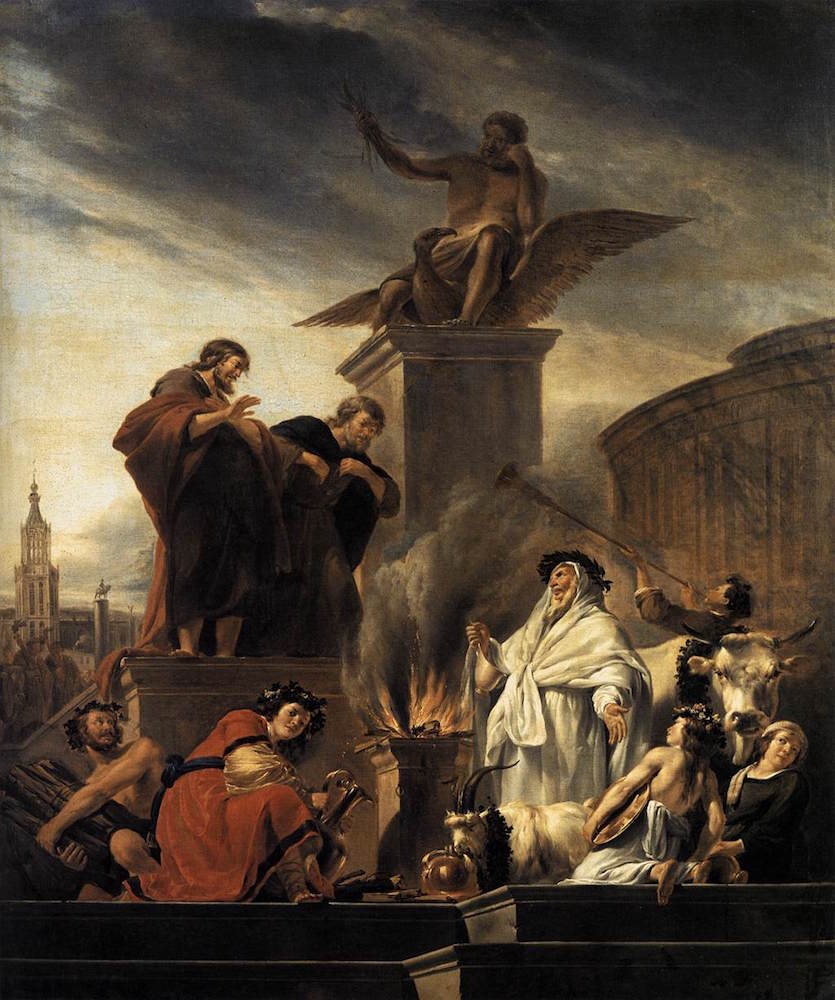
* There’s a comic touch to their preaching travails, too: in one exciting episode (Acts 14), Paul (of course) heals a cripple while the dynamic duo preaches in Lystra, leading excited witnesses to take them for Hermes and Zeus and start sacrificing to them.
No tips, please: Paul and Barnabas refusing the sacrifices of Lystrans in this detail (click for the full image) of a 1650 painting by Nicolaes Berchem.
** Beyond the Epistle and the Acts, there is also a very much later Gospel of Barnabas.
Mary Dyer was hanged in Boston on this date in 1660 — the most famous of that city’s four “Quaker martyrs”.
Monument in Boston to Mary Dyer as “witness for religious freedom”. (cc) image by Andrea Schwartz.
By the time of her last ordeal, Dyer already had a quarter century-old reputation for religious misbehavior in the New World.
She’d ditched England with her husband in 1635, part of that decade’s great outmigration of Puritan dissidents — “A Comely Grave Woman, and of a goodly Personage, and one of a good Report, having a husband of an Estate, fearing the Lord, and a Mother of Children,” according to an admiring account. Opinions varied: the colony’s governor found her “very censorious and troublesome, (she being of a very proud spirit, and much addicted to revelations).”
She brought with her a proclivity for the heretical: in Massachusetts, where the Puritan majority delivered the persecuting, Mary quickly fell foul of right-thinking folk by backing Anne Hutchinson in a theological controversy.* When Hutchinson was convicted by a church trial and banished, Mary Dyer cinematically walked hand-in-hand with her out of church. On top of everything else, she was known to have stillborne a deformed monstrosity (“a woman, a fish, a bird, & a beast all woven together”) which was the kind of thing these people understood as deadly serious.
Mary and her husband went to exile with Hutchinson, and were among the first English settlers of Rhode Island, before returning to spend most of the 1650s back in England. There, Mary Dyer converted to one of the new entrants to the Commonwealth’s welter of novel sects, Quakerism.
This new faith’s emphasis on egalitarian personal religious experience ungoverned by ordained clergymen met an instant ban once Massachusetts caught wind of it, with a statute imposing mutilated tongues and trips to the pillory for expounding the outlaw doctrine. To these would be added the threat of the gallows for repeat offenders with the temerity to return from banishment … and Mary Dyer is only the most famous of four Quakers who actually suffered this penalty.
The Heart of N-England Rent at the Blasphemies of the Present Generation: Boston Rev. John Norton‘s 1659 anti-Quaker tract advocates their execution.
Dyer’s defiance of the law was straightforward, keeping with the bold tradition of martyrdom in witness. Jailed in Boston in 1657, her husband (who had not yet followed his wife’s conversion) managed to arrange her release; she returned in 1659 to visit other imprisoned Quakers and they were all banished for their trouble. Shortly after, she returned to Boston with William Robinson and Marmaduke Stevenson: these were the first two Quakers put to death by the Puritans, but Mary Dyer was spared at the foot of the gallows and again expelled, finding temporary refuge in Rhode Island.
“I came in Obedience to the Will of God the last General Court, desiring you to Repeal your unrighteous Lawes of Banishment upon pain of Death; and that same is my work now, and earnest Request,” she told the court that doomed her. “If ye refused to Repeal them, the Lord will send others of his Servants to Witness against them.”
The very next day, she was drummed — to prevent her preaching — on a mile-long walk a gallows on Boston Common. This time there was no reprieve waiting: only immortality.
* This controversy drove the short-term governor Henry Vane back to England, and martyrdom during the interregnum.
On this date in 1528, the Augsburg Anabaptist Eitelhans Langenmantel was executed as a heretic, along with a servant and a maid. Langenmantel had used his own fortune to print several dissident tracts.
His infant grandson, Daniel Hoechstetter, would eventually emigrate to Cumberland where he did honorable business for England’s Royal Mines as part of a community of German miners.
On this date in 1643, all copies of the Book of Sports were publicly burned by the common hangman.
Product of the queer eddies of a century’s religious reformation, the 1617 edict commonly going under this winsome title was no athletes’ According to Hoyle; rather, it authorized for Sundays “any lawful recreation, such as dancing, either men or women; archery for men, leaping, vaulting, or any other such harmless recreation, nor from having of May-games, Whitsun-ales, and Morris-dances; and the setting up of May-poles and other sports therewith used.”
The day of the week was the decisive thing here. These traditional pastimes had long multiplied upon the numerous feast-days speckling the Catholic medieval calendar, but with the English Reformation this clutch of Papist holidays had been collapsed into just … Sundays. And so sportive Englishmen took their May-poles and Morris-dances to the Sabbath.
The Sabbath Breakers, by J.C. Dollman (1895)
By the late 16th and early 17th century the burgeoning Puritan movement was burnishing its sourpuss bona fides by — among other things — espousing a strict Sabbatarianism requiring that on their one day of rest from holiday-less labor people be “taken up the whole time in the public and private exercises of His [God’s] worship, and in the duties of necessity and mercy.” No vaulting or any other such harmless recreation for you!
I allowe not of such excesse of ryot & superfluitie as is there used. I thinke, it convenient for one Friend to visite another (at sometimes) as oportunitie & occasion shall offer it selfe, but wherfore shuld the whole towne, parish, village and cuntrey, keepe one and the same day, and make such gluttonous feasts as they doo? And therfore, to conclude, they are to no end, except it be to draw a great frequencie of whores, drabbes, theives and verlets together, to maintai[n] […] whordome, bawdrie, gluttony, drunkennesse, thiefte, murther, swearing and all kind of mischief and abhomination. For, these be the ends wherto these feastes, and wakesses doo tende.
As one might well suppose from the eventual alliances in the English Civil War, the sports stuff was one of the fault lines between high church and low, and between crown and Parliament. Like any proper inbred royal, King James I loved himself a good hunt, and not only of witches — so he was nonplussed when passing through Lancashire to discover citizen grievances over killjoy blackrobes shutting down their Maypoles. He issued the Book of Sports explicitly in response, “to see that no man do trouble or molest any of our loyal and dutiful people, in or for their lawful recreations.”* This gave leisure-seeking commoners something to throw in the faces of their neighborhood nabobs, and Puritans another abomination to grow incensed about.
The Book of Sports remained law of the realm into the reign of James’s Puritan-allergic son Charles I but Puritan muscle grew stronger all the while,** eventually becoming irresistible when Parliament was recalled in 1640 and the high church bishop William Laud was ousted.
The outcome in 1643 was the rough impeachment of the sports book and I don’t mean Vegas.
It is this day ordered by the Lords and Commons in Parliament, that the Booke concerning the enjoyning and tollerating of Sports upon the Lord’s Day be forthwith burned by the hand of the common Hangman in Cheape-side, and other usuall places: and to this purpose, the Sheriffs of London and Middlesex respectively are hereby required to be assistant to the effectuall execution of this order, and see the said Books burnt accordingly. And all persons who have any of the said Books in their hands, are hereby required forthwith to deliver them to one of the Sheriffes of London, to be burnt according to this Order.
John Browne, Cler. Parl.
Henry Elsynge, Cler. P.D. Com.
The Sheriffes of London and Middlesex have assigned Wednesday next the 10th of this instant May, at twelve of the clock, for the putting in execution of the foresaid Ordinance; and therefore doe require all persons that have any of the Bookes therein mentioned, to bring them in by that time, that they may be burned accordingly.
John Langham,
Thomas Andrewes
London
Printed for Thomas Underhill in Great Wood strete, May 9, 1643
Obviously this is not an “execution” even in the metaphorical sense of executions by effigy but part of the wider remit of the hangman, whose duties ran to all sorts of public law enforcement as well as to cajoling society’s untouchables.
Still, “purging by fire” of the printed word was extraordinary treatment reserved for blasphemous or seditious books, not uncommonly accompanied by corporal punishment or even death for their authors. It would not far stretch matters to see in the Puritan Parliament’s disdainful lese-majeste against the hand of the past king its imminent regicidal stroke upon the neck of the current one.
* The Book of Sports wasn’t all license; for the amusements it authorized, it prohibited them to those who “are not present in the church at the service of God, before their going to the said recreations.” Even for the godly it evinced explicit preference for “such exercises as may make [subjects’] bodies more able for war,” therefore excluding “all unlawful games to be used upon Sundays only, as bear and bull-baitings, interludes and at all times in the meaner sort of people by law prohibited, bowling.”
This was a man with a philosophy on exercise as rigorous as any personal fitness coach. James, who was a prolific scribbler, elsewhere “debarre[d] all rough and violent exercises, as the footeball; meeter for laming, than making able the users thereof.” In four centuries since James so pronounced, England have only ever won the football World Cup once.
** Numerous Puritans fled oppressively pleasurable off-days and took their dour Sabbaths to New England where their descendants could one day propound several of the world’s most obnoxious sporting concerns.
April 9 is the (Roman) feast date of the minor Cappadocian saint Eupsychius.
As martyr to the hated-of-Christians pagan throwback emperor Julian the Apostate, Eupsychius could perhaps be accounted an ironical late victim of the fratricidal family politics that consumed the heirs of the great Christianizer Constantine the Great.
When Constantine kicked off in 337, he left three sons of a disgraced empress whom he optimistically hoped would share rulership. What happened instead was that, inside of a generation, practically the entire Constantinian line laid one another in the earth by dint of bloodthirsty dynastic rivalries, leaving only two men standing.
And it so happened that those two kinsmen faced one another across late antiquity’s gaping spiritual chasm: one a Christian, the other a pagan.
Constantius was the surviving son of Constantine, and regardless his Christian affiliation had secured his initial control of his father’s new eastern capital by unsentimentally butchering the bulk of his extended family including his own uncle Julius Constantius, and Julius’s firstborn son. Two other sons of Julius Constantine, too young for the abbatoir, escaped their brother’s fate and so our future Julian the Apostate grew up under a perpetually dancing Damoclean sword, a bookish philosophizing type enchanted by classical learning — so enchanted that he would eventually, and at first very quietly, apostatize from his substantial Christian education and adhere instead to the old gods.
In the fullness of time, the remainder of Constantius’s family succumbed to various civil wars — including Julian’s only surviving brother, Gallus, executed for treachery in 354 in an incident that could very well have claimed Julian as well if for no other reason than proximity. A prolific writer, Julian would later recall that “if some God, to inure my safety, had not ingratiated me with his [Constantius’s] beautiful and excellent wife, Eusebia, I could not have escaped his resentment.” Perhaps the childless Constantius could foresee well enough that, resentment or no, his last relation would be required for imperial policy soon enough.
And indeed the very next year, having spent many months mulling over whether to kill him, Constantius instead elevated Julian as his junior co-emperor. The young scholar soon distinguished himself as a surprisingly competent leader and battlefield commander, pacifying Germania and Gaul before, almost inevitably, the two emperors turned on one another in civil war. Julian must have been well-favored of goddess Fortuna whom he will defend in this post, for he won that war before the first spear was chucked when Constantius took ill and died as the rivals steered their armies towards one another.
So suddenly, 40 years after the empire had officially gone Christian, it had a pagan ruler — the last pagan ruler it would ever know.
Julian was an intelligent and idealistic young man. Taking power before the age of 30, he set a bold course to massively remake the empire in the image of its most admirable anachronisms: living modestly, paring the bureaucracy, debating Senators as their equal instead of their overlord, and — the attempted rollback that would mark his nickname and his reputation — restoring a pre-Christian cosmology to philosophical preeminence.
A few books about Julian the Apostate
This could have been Julian the Apostate‘s life’s work, twenty or thirty of forty years dislodging Christianity from the official foothold it had only recently attained and creating the groundwork for a pagan-dominated middle ages: fine grist for speculative alternative history, since Julian actually died in 363 in war against the Persians.
Having learned from the failure of previous rulers’ persecutions, he deployed instead the devious and modern mechanic of liberal religious toleration, starving the “Galileans” of the galvanizing force of either state backing or state oppression while perhaps setting their orthodox edifice up to splinter over time as various heretical movements began freely venting their rival doctrines on one another.
Julian the Apostate presiding at a conference of sectarians, by Edward Armitage (1875).
His uniqueness and his erudition have made him an attractive character for modern interlocutors, especially those of the Christ-skeptic variety; Gore Vidal sympathetically centered Julian in an engrossing historical novel, and Gibbon warmly admired him:
The Christians, who had now possessed above forty years the civil and ecclesiastical government of the empire, had contracted the insolent vices of prosperity, and the habit of believing that the saints alone were entitled to reign over the earth. As soon as the enmity of Julian deprived the clergy of the privileges which had been conferred by the favour of Constantine, they complained of the most cruel oppression; and the free toleration of idolaters and heretics was a subject of grief and scandal to the orthodox party. The acts of violence, which were no longer countenanced by the magistrates, were still committed by the zeal of the people. At Pessinus the altar of Cybele was overturned almost in the presence of the emperor, and in the city of Caesarea, in Cappadocia, the temple of Fortune, the sole place of worship which had been left to the Pagans, was destroyed by the rage of a popular tumult. On these occasions, a Prince who felt for the honour of the gods was not disposed to interrupt the course of justice; and his mind was still more deeply exasperated when he found that the fanatics, who had deserved and suffered the punishment of incendiaries, were rewarded with the honours of martyrdom.
It is the last named of these incidents that finally brings us round to our date’s principal.
Like Julian himself, St. Eupsychius had no way of knowing that the new, old order would be a transient epoch. In his zeal to resist a rejuvenated paganism, Eupsychius led a riotous sack of a temple to Fortuna (Tyche). The church historian Sozomen gives us the primary-est historical record, and although it dates to several decades after Eupsychius’s martyrdom we can’t be picky when it comes to antiquity.
It is said that at this time were martyred Basilius, a presbyter of the church of Ancyra, and Eupsychius, a nobleman of Caesarea in Cappadocia, newly wed and in a manner of speaking still a bridegroom. As regards Eupsychius, I conjecture that he was executed because of the temple of Tyche, then destroyed, on account of which destruction, as has been said above, all citizens of Caesarea collectively experienced the emperor’s wrath, while those who personally took part in it were punished, some with death, some with banishment.
Later iterations would expand predictably on Eupsychius’s sufferings — tortures, miracle-making, blood and milk springing from his wound, and even eventually eliding the precipitating riot or arson — all of which conspires to pull a discernibly historical figure behind the dark glass of hagiography.*
Little more than a year later, Julian suffered a mortal wound in battle against the Sassanids. The Constantinian dynasty died with Julian, as did his signature project of Apostasy — a sudden volte-face of that fickle Fortuna whose memory and reputation would persist well beyond the twilight of paganism.
* See L.G. Westerink, “The Two Faces of St. Eupsychius,” Harvard Ukrainian Studies, Vol. 7, Okeanos: Essays presented to Ihor Shevchenko on his Sixtieth Birthday by his Colleagues and Students (1983).
(Thanks to Henry Charles Lea for the guest post, which first appeared in his The Inquisition in the Spanish Dependencies: Sicily – Naples – Sardinia – Milan – The Canaries – Mexico – Peru – New Granada. The Inquisition was abolished in Sicily in 1782, but an interesting Palermo museum preserves its artifacts. -ed.)
When, in 1718, Savoyexchanged Sicily with Austria for Sardinia, the Emperor Charles VI would not endure this dependence of the [Inquisition] tribunal upon a foreign power and procured, in 1720, from Clement XI a brief transferring the supremacy to Vienna. In accordance, however, with the persistent Hapsburg claims on the crown of Spain, the Inquisition remained Spanish. A supreme council for it was created in Vienna, with Juan Navarro, Bishop of Albarracin as chief who, although resident there gratified himself with the title of Inquisidor-general de Espana, but in 1723 he was succeeded by Cardinal Emeric, Archbishop of Kolocz.
Apparently it was deemed necessary to justify this elaborate machinery with a demonstration and, on April 6, 1724, an auto de fe was celebrated at Palermo with great splendor, the expenses being defrayed by the emperor.
Detail view (click for the full image) of a French print of the auto de fe.
Twenty-six delinquents were penanced, consisting as usual mostly of cases of blasphemy, bigamy and sorcery, but the spectacle would have been incomplete without concremation and two unfortunates, who had languished in prison since 1699, were brought out for that purpose. They were Geltruda, a beguine, and Fra Romualdo, a friar, accused of Quietism and Molinism, with the accompanying heresies of illuminism and impeccability. Their long imprisonment, with torture and ill-usage, seems to have turned their brains, and they had been condemned to relaxation as impenitent in 1705 and 1709, but the sentences had never been carried out and they were now brought from their dungeons and burnt alive.
Detail view (click for the full image) of an engraving, The Great Auto De Fe At Palermo Italy 6 April 1724
Less notable was an auto de fe of March 22, 1732, in which Antonio Canzoneri was burnt alive as a contumacious and relapsed heretic.
March 12 is the martyrdom date (in 295) and annual feast date of Saint Maximilian of Tebessa, Christianity’s protomartyr of conscientious objectors.
A Christian from Numidia (the Mediterranean coast of present-day Algeria), Maximilian presented himself to the African proconsul for mandatory conscription and refused in the name of Christ to bear arms.
The proconsul remonstrated with him, and in their interaction Maximilian espoused a vindication of pacifism so clear and timeless that a Vietnam War-era Catholic antiwar organization would take the name Order of Maximilian. “I will not be a soldier of this world, for I am a soldier of Christ.”
Maximilian That is their business. I also am a Christian, and I cannot serve.
Cassius Dion But what harm do soldiers do?
Maximilian You know well enough.
Cassius Dion If you do not do your service I shall condemn you to death for contempt of the army.
Maximilian I shall not die. If I go from this earth my soul will live in Christ my Lord.
Cassius Dion Write his name down … Your impetiy makes you refuse military service and you shall be punished accordingly as a warning to others. (Reading the sentence) “Maximilian has refused the military oath through impiety. He is to be beheaded.”
Maximilian God lives.
Unfortunately but unsurprisingly Maximilian’s historicity is quite questionable. He’s not to be confused with the remarkable and certainly real World War II martyr St. Maximilian Kolbe.
* 295 was a few years before Diocletian launched his great persecution of Christians.
Thomas Pormort (or Pormant) was hanged on this date in 1592 on a gibbet erected adjacent to a Paul’s Churchyard haberdashery whose proprietor had once entrusted the condemned Catholic priest with his confession.
Pormort was a priest trained on the continent who returned to native soil about the beginning of 1591 to brave the Elizabethan persecution, but managed only a few months in the field before his arrest.
He had the misfortune to face the personal interrogation of the vindictive inquisitor Richard Topcliffe, notorious even in his own day for his gleeful sadism. Topcliffe seems not to have even feigned a politic distaste for the breaking of bones and and of men and made a point to attend the executions his offices effected, including Pormort’s.
Now, back in the day such grim ministers of state could be empowered to toy with their prey in their very own lairs. Even the sainted Thomas More had kept a personal torture chamber at his own home.
So it was with Topcliffe, who inflicted his hospitality on Pormort in the intimacy of his own place, where he apparently had the facilities necessary to put a prisoner to the rack. According to Portmort, the torturer had another intimacy besides during their pain-wracked discourse, taunting or boasting to his victim of carnal indulgences he enjoyed from the queen herself. Pormort would allege at the bar that
Topcliffe told [Pormort] that he was so familiar with her Majesty that he many times putteth [his hands] between her breasts and paps and in her neck.
That he hath not only seen her legs and knees [but feeleth them] with his hands above her knees.
That he hath felt her belly, and said unto her Majesty that she had the softest belly of any woman kind.
That she said unto him, ‘be not these the arms, legs and body of King Henry?’ To which he answered: ‘Yea.’
That she gave him for a favour a white linen hose wrought with white silk, etc.
That he is so familiar with her that, when he pleaseth to speak with her, he may take her away from any company; and that she is as pleasant with everyone that she doth love.
This Penthouse letter for the queen has no factual plausibility, and nobody thought so in 1592. Whether the priest’s report of its utterance is an actual glimpse into a seditious perversion of the torturer, or a desperate attempt by a doomed man to smear his persecutor, Topcliffe took the matter seriously enough that he made Pormort stand on the ladder under his noose in freezing cold for two hours on execution day while Topcliffe browbeat him to withdraw the allegation. (Pormort didn’t budge.)

 Ol’
Ol’ 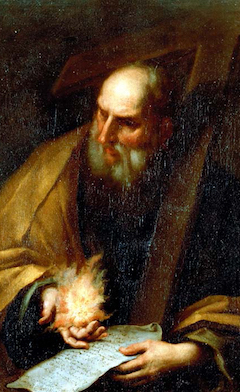 A Cypriot Jew named Joseph, “Barnabas” (“Son of Encouragement”) was so christened in the fourth chapter of the New Testament’s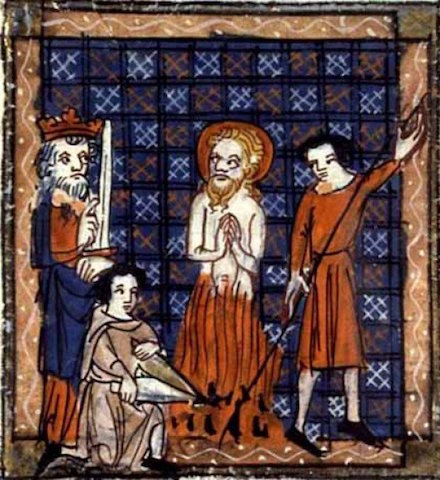

 His infant grandson,


 It is the last named of these incidents that finally brings us round to our date’s principal.

 A Christian from