1570: Aonio Paleario, Italian religious reformer

On this date, Antonio della Pagliara was hanged across the Tiber from the Castel Sant’Angelo in Rome for heresy.

The present-day view from the square where Paleario is thought to have been put to death, over the Ponte Sant’Angelo’s span across the Tiber to the Vatican’s imposing citadel.

Better known as Aonio Paleario (English Wikipedia entry | the considerably deeper Italian), the humanist scholar grew into his intellectual career just as Martin Luther’s doctrine was shaking Christendom.

Paleario’s positions were dangerously — and at length, fatally — close to Protestantism. He counted himself a humanist, a great admirer of Erasmus, who from the Low Countries managed to hold his critical positions without running afoul of the Catholic Church.

This would prove an increasingly difficult trick as the century unfolded … especially in the pope’s back yard.

Paleario’s most particular offenses were to take what amounts to the Lutheran side on the primacy of scriptural text over ecclesiastical tradition, and of salvation through Christ alone without the Church’s intermediation. (He also denied Purgatory.)

Since the Italian academic also cottoned to the Protestant-humanist critique of clerical corruption, he pitched Martin Luther and John Calvin on the notion of convening a Christendom-wide ecclesiastical council to reconcile competing sects. He seems to have wanted to reconcile the reformist current of humanism still within the Catholic tradition, and that of those critics who had broken, perhaps not yet irrevocably, with Rome.

The effort ultimately foundered. Instead, the curia-approved Council of Trent formulated a Roman Catholic doctrine that insured the permanent schism with Protestantism.

The Counter-Reformation was on. Still, with contending theologies — and contending polities — afoot in the Italian quiltwork plus his own towering reputation as the greatest orator in Italy, Paleario was able to find protectors and carry on. He taught in Siena, Lucca and Milan for more than three decades, surviving two bouts with the Inquisition before a Rome in crackdown mode finally pinned a heresy rap on him.

By that time, the septuagenarian didn’t much bother to fight it.

If your Eminences have so many credible witnesses against me, there is no need to give yourselves or me any further trouble … Judge, therefore, and condemn Aonio; satisfy my adversaries, and fulfil your office.

The office was fulfilled consuming the old man in flames, but they did extend the favor of hanging him (and apparently exposing the corpse for several days) first.

A book uncertainly attributed to Paleario, Beneficio di Criso (The Benefit of Christ’s Death) is available free at Google Books.

On this day..

1766: Jean-François de la Barre, freethinker martyr

On this date in 1766, a 20-year-old French chevalier’s freethinking proclivities got him beheaded and burned for impiety in one of Bourbon France’s most notorious episodes of religious chauvanism.

Check that date again. This is 69 years after the British Isles’ last execution for blasphemy; Voltaire was alive, and already in his dotage — and the fact that young Chevalier de la Barre was reading him was proclaimed as evidence. Such a benighted proceeding with the French Revolution on the horizon calls Dickens to mind:

it was the epoch of belief, it was the epoch of incredulity,
it was the season of Light, it was the season of Darkness

The luckless youth and a couple of friends had pissed off a local judge, which got ugly for them when the unexplained vandalism of a town crucifix availed the opportunity for the magistrate to wield a sledgehammer against a fly.

De la Barre’s volume of Voltaire was tossed onto the pyre with him. That Enlightenment colossus made a measured posthumous effort at having the boy rehabilitated* — primarily for the benefit of his more judicious friend, who had fled the country and required his death sentence in absentia be lifted in order to inherit the family estate — but the verdict was not set aside until the French Revolution, a few months after the end of the Terror.

France’s overall secular trajectory since has rendered this date a sort of national freethinkers’ holiday, Chevalier de la Barre Day. A statue of its namesake stands in Paris’ Montmarte:

* Voltaire’s writings on the case in the original French are collected by the Association Le Chevalier de la Barre here.

On this day..

1621: Bohemia’s “Day of Blood”

On this date in 1621, the Habsburg crown took 27 nobles’ heads in Prague’s Old Town Square for attempting to lead Bohemia to independence.

A century into the Protestant Reformation, the many conflicts between the prerogatives of princes and prelates were about to spawn the Thirty Years’ War — a settling of accounts eventually to lay the cornerstone of modern national sovereignty.

And it all got started in the mother of cities.

Predominantly Protestant Bohemia was at loggerheads with the doctrinaire Catholic slated to become the next Holy Roman Emperor, and as rising tensions in Prague between the faiths took on a patriotic tone, a mob chucked a couple of imperial representatives out the window of Prague Castle.

The Defenestration of Prague. It’s a great word for a great political tradition — there are multiple Defenestrations of Prague in Czech history.

The royal retainers survived the plunge, thanks to miraculous angelic intervention [Catholic version], or to fortuitously landing on a dunghill [Protestant version]. (Maybe the truth lies somewhere in between.)

Either way, it was game on. The Protestant nobility refused to recognize the Habsburg heir and offered the crown to a Calvinist toff instead.

This Frederick V, Elector Palatine answers to the nickname “the winter king” — because by the next winter, the Catholics had overrun Bohemia and driven Frederick off to the dissolute life of exiled nobility, where he anonymously knocked around the Low Countries and accidentally sired the modern line of British royalty.

Good choice: the Czech lands soon felt the monarch’s wrath.

J.E. Hutton’s History of the Moravian Church — which treats especially a distinctive strain of local Christianity with roots in the pre-Lutheran Hussite movement, and which although shattered by the failed revolt still persists today — narrates the result for the 27 unluckiest nobles:

There fell the flower of the Bohemian nobility … Among these were various shades of faith — Lutherans, Calvinists, Utraquists, Brethren; but now all differences were laid aside, for all was nearly over …


Detail view (click for the full image) of the Bohemian nobles’ execution. Note the block on the scaffold foreground for chopping off hands.

Swiftly, in order, and without much cruelty the gory work was done. The morning’s programme had all been carefully arranged. At each corner of the square was a squad of soldiers to hold the people in awe, and to prevent an attempt at rescue. One man, named Mydlar, was the executioner; and, being a Protestant, he performed his duties with as much decency and humanity as possible. He used four different swords … The first of these swords is still to be seen at Prague, and has the names of its eleven victims engraven upon it. … In every instance Mydlar seems to have done his duty at one blow. At his side stood an assistant, and six masked men in black. As soon as Mydlar had severed the neck, the assistant placed the dead man’s right hand on the block; the sword fell again; the hand dropped at the wrist; and the men in black, as silent as night, gathered up the bleeding members …

Much more general reprisals were in store, too. One of Europe’s most liberal writs of religious toleration was swiftly revoked. Catholicism was imposed from above, with Marian columns thrown up in every town. German became the official language. Books were burned by the thousand. Protestants fled or were expelled over the years to come in such numbers that (combined with the general devastation of a war that wrought famine on Europe), modern Czechia’s population had dropped by a third by the Peace of Westphalia.

And while the war the Bohemians helped touch off would win recognition for several small polities breaking away from dynastic imperial formations and cement the principle for other such states to follow, Bohemia itself would remain yoked to the Habsburgs until World War I.

Nobody’s nursing any grudges against the headless nobles for all this, however. Now that the Czech Republic has finally got a place to hang its hat in the community of nations, it keeps 27 white crosses in the Old Town Square bricks as homage to the Day of Blood.

On this day..

1593: John Penry, Shakespeare’s midwife?

On this date in 1593, a Welsh divine with a poor impression of the Church of England was hustled off from dinner to be strung up for sedition.

Dismayed by the poor quality of pastors in his native Wales — men of poor character, poor education, and poor command of Welsh — John Penry was one of many calling for a reformed Episcopal clergy. Critiques of his type formed the germ of the Puritan movement already underway, which would blossom after his death.

Penry would have been around to see all that if he hadn’t hacked off the realm’s chief vicar by running a salty underground press, most notably publishing the pseudonymous Martin Marprelate.

(These satiric treats can be savored here. The identity of their author(s) has always been debated — Penry himself is one candidate, though not a fashionable one today, as his attributed writing seems too earnest to have come from the same pen as Martin Marprelate.)

Hold the Dessert

The Oxford man dodged the law for a good three years in the Scottish reaches, until he couldn’t resist moving to London, where (fittingly) a local clergyman recognized him.

The mere draft — nasty, but uncirculated — of a petition sufficed for the condemnation on grounds of sedition, and the annoyed Archbishop had the pleasure of inking his John Hancock on the Welshman’s death warrant.

Penry seems to have had a few friends in high places and some hope of cheating the executioner; he must have been taken by surprise when the sheriff burst in during the late afternoon this day to haul him immediately to a gallows at St. Thomas a Watering — unannounced, the better to keep attendance down,* with the prisoner denied the customary parting speech.

“Hang him with his pen”

But was Penry’s ill turn a boon to the world of literature?

The day after Penry’s execution, star English playwright Christopher Marlowe was killed in a fray whose timing some find a bit suspicious.

Some enthusiasts think Marlowe faked his death and went on to write Shakespeare under a pen name. And if he did that, his confederates would have needed a body to pass off as Marlowe’s … the body, perhaps, of a man of Marlowe’s age and class who’d just been hanged a couple of miles up the road.

The Welsh Martyr

Shakespeare aside, Penry remains “the Welsh martyr” to this day, reckoned the greatest Protestant martyr of his land. (For more about him, a sympathetic 19th century tract, John Penry, the Pilgrim Martyr, is available free from Google books.)

The injury of his draconian sentence is so far from forgotten in Wales that — hot off the presses — the 21st century Archbishop of Canterbury is being asked for a mea culpa on behalf of his 16th century predecessor.

Coincidentally, John Penry is also the name of a murderer and longtime death row prisoner in the USA, once the subject of a landmark decision** permitting the execution of the mentally retarded. That modern Penry is now serving a life sentence.

* Penry’s family and friends didn’t know about the hanging until it had already happened.

** Since reversed.

On this day..

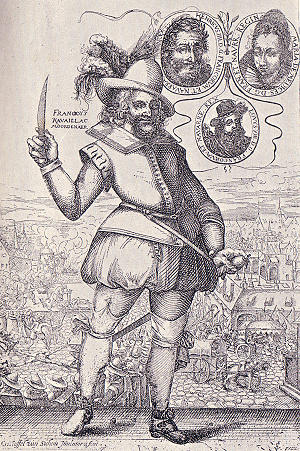
1610: Francois Ravaillac, because Paris was worth more than a mass

On this date in 1610, the fanatical Catholic who assassinated Henri IV of France was ripped apart on the Place de Greve.

The road to this man’s calvary begins long before his infamous crime, even long before the birth of his illustrious victim.

The Protestant Reformation — so richly represented in the executioner’s annals — had fractured France in the 16th century.

After decades of voluptuously indecisive Catholic-versus-Hugeunot slaughter, matters had finally been settled by the man upon whom French absolutism would erect its (ill-fated) edifice.

Henri IV, the first Bourbon monarch and a Huguenot, had unified the country by the sword, capped by his memorably politic conversion to Catholicism in 1593 to win over the holdout capital of Paris — the occasion of his understated declaration that “Paris is worth a mass”.

Let us tarry here to appreciate “the good king Henri” in a kaleidoscope of flattering artwork to the tune of Vive Henri IV, the monarchy’s unofficial anthem after its subject’s passing:

Did you catch that last image?

Henri’s fine gesture of sectarian triangulation and the reign of relative calm it inaugurated were naturally resented by godly partisans of both camps who either considered his conversion a betrayal or considered the king a closet Protestant.

At the crazed end of this latter spectrum, we meet our day’s principal, Francois Ravaillac.

Readers unconstrained by time may enjoy this Tolstoyan trek into the regicide’s mind and milieu, but it will suffice us to say that the modern shotgun-wielding postal clerk who just seemed like a quiet, harmless type to all his coworkers might like the cut of Ravaillac’s jib. A bit of a loner, a bit of a professional washout, with a penchant for religious visions and a passel of ill-arranged grievances … by this point in the movie, that’s about what you expect the police profiler to be reciting.*

It is only right that such a contemporary-sounding lone nut story ought to have a vigorous conspiratorial counternarrative.

There has always been a strong suspicion that behind Ravaillac’s hand was the work of the scheming Catholic Duc d’Epernon, perhaps even with the complicity of Henri’s wife Marie de’ Medici, who had conveniently been crowned as queen the day before the murder** and promptly teamed up with Epernon to cement an alliance with a traditional French rival, the ultra-Catholic Habsburgs.

Balzac, for one, had no doubt about it:

all of [her] actions were prejudicial to France … Marie de’ Medici wasted the wealth amassed by Henri IV.; she never purged herself of the charge of having known of the king’s assassination; her ‘intimate’ was d’Epernon, who did not ward off Ravaillac’s blow, and who was proved to have known the murderer personally for a long time. … [T]he victory Richelieu at last won over her (on the Day of the Dupes) was due solely to the discovery the cardinal made, and imparted to Louis XIII, of secret documents relating to the death of Henri IV.

The historical jury is out on that question, presumably for good.

If Ravaillac was a conspirator, he proved to be a damned good one, denying under repeated torture that he had any accomplices. On this date, the tortures reached their crescendo and conclusion — to the horrible delight of the Parisian mob, as reported by Alistair Horne (via The Corner):

On 27 May, still protesting that he had acted as a free agent on a divinely inspired mission, Ravaillac was put to death. Before being drawn and quartered, the lot of the regicide, on the Place de Grève scaffold he was scalded with burning sulphur, molten lead and boiling oil and resin, his flesh then torn by pincers. Then his arms and legs were attached to horses which pulled in opposite directions. One of the horses “foundered,” so a zealous chevalier offered his mount; “the animal was full of vigour and pulled away a thigh.” After an hour and a half of this horrendous cruelty, Ravaillac died, as the mob tried to prevent him receiving last rites. When he finally expired,

“…the entire populace, no matter what their rank, hurled themselves on the body with their swords, knives, sticks or anything else to hand and began beating, hacking and tearing at it. They snatched the limbs from the executioner, savagely chopping them up and dragging the pieces through the streets.”

Children made a bonfire and flung remains of Ravaillac’s body on it. According to one witness, Nicholas Pasquier, one woman actually ate some of the flesh. The executioner, supposed to have the body of the regicide reduced to ashes to complete the ritual demanded by the law, could find nothing but his shirt.

Ravaillac was the last Frenchman drawn and quartered for a century and a half — but his punishment as a regicide formed the precedent for that handed down in 1757 to Damiens.

* No need, though, as Francois wasn’t hard to catch: he stepped up to Henri’s carriage when it was caught in a traffic jam on May 14, 1610, and stabbed the king to death plain as can be. He was lucky (sort of) to avoid a lynching.

** Rubens later painted a gaudy celebration of this event.

On this day..

1498: Girolamo Savonarola, as he had once burned vanities

On this date in 1498, the Dominican friar who had once bent Florence to his austere will was hung in chains and burned.

Girolamo Savonarola preached standing-room-only, millenial sermons against worldly immorality, in the early 1490’s. By 1494, when peninsular politics chased a weak Medici scion from Florence, he had become its master.

He makes a complex character, with a streak of flawed greatness even his contemporary enemies recognized; his anti-Renaissance theology was severe but not dour, fired as it was by a genuine spiritual passion that spoke to real needs of his audience and a real crisis growing in the Church. And he did not disdain the revolutionary real-world implications of his faith.

Savonarola instituted Republican government with a touch of the Taliban — a vice squad of young hooligans to rough up rouged ladies and card-players;* a famous Bonfire of the Vanities in which Botticelli incinerated some of his own work — but also a populist economic touch.

For reasons both internal (the killjoy factor of busting up dice games wore out its welcome) and external (his French ally Charles VIII was driven from Italy, and Savonarola made a dire enemy of the corrupt Borgia pontiff Alexander VI), the priest’s grip on Florence weakened. In April 1498, he was arrested with two other clerics; all three were tortured into signing confessions, then hanged in the Piazza della Signoria by an insolent executioner.

The doomed Savonarola anguished that he had not been strong enough to resist the tortures of the rack, and penned in contrition the Latin meditation Infelix ego:

Alas wretch that I am, destitute of all help, who have offended heaven and earth — where shall I go? Whither shall I turn myself? To whom shall I fly? Who will take pity on me? To heaven I dare not lift up my eyes, for I have deeply sinned against it; on earth I find no refuge, for I have been an offence to it…

Like Savonarola’s memory and teachings, it spread — often illicitly — in a Europe ready for religious reform. Infelix ego has been frequently set to devotional music, like this version by Orlande de Lassus:

[audio:Infelix_Ego_Lassus.mp3]

Savonarola might have been in himself a dead end, an unsuccessful prophet quickly rolled back, but he nonetheless possesses a recognizable essence that distills both the Zeitgeist of his time and the immemorial hunger for simplicity and virtue that coexists with the equally human celebration of pleasure and beauty. He left complex legacies to both the Church and the city his reforms sought (and ultimately failed) to scourge.

In religion, his castigation of the vice and sin of the Church (a position of which he was an outstanding but hardly a lonely advocate) prefigured the coming Reformation. But Savonarola also never left off the most devout affiliation to Catholicism, nor sought institutional schism even when he had been excommunicated.** What to make of such a man? He is both depicted (at the base of a Martin Luther statue) at the Worms Reformation Monument, and proposed for present-day Catholic canonization.

So too his secular legacy — the theocrat who burned books and expelled the Medici and was reduced to ashes for his reactionary principles — merits a respectful recollection in Florence, even if few would actually want to live in his republic. He repelled Machiavelli, a libertine counselor of the post-Savonarola Florentine Republic, but perhaps fascinated him as well, as a prince with a precisely backward grasp of his own power.

This stone marking the site of the execution stands at a crossroads of tourist traffic in a thicket of statuary, mostly nude and/or classically inspired, outside the entrance to one of Europe’s principle collections of Renaissance art.

One wonders what the old Dominican would have made of it.

Books about Savonarola’s Florence

* Savonarola also made sodomy punishable by death.

** Alexander VI tried first to get him (in Lyndon Johnson’s fragrant phrase) inside the tent pissing out by making him a cardinal, which Savonarola spurned.

On this day..

1569: Dirk Willems, for loving his enemy

On this date in 1569, Dirk Willems paid the penalty for a famous act of charity.

Willems was condemned by the still-ascendant Catholic church as an Anabaptist, but escaped prison.

Fleeing a pursuer across a frozen pond, Willems had an opportunity to make good his escape when his persecutor crashed through the ice. But he turned back to save the drowning man:

One good turn did not deserve another: the man arrested Willems, and the compassionate Protestant found himself burned to death* this day at Asperen.

Hundreds of Anabaptists suffered similar fates, many of them registered in the Martyrs Mirror (available online here). But Dirk Willems’ story has always been one of the most affecting and popular with the Mennonite communities who trace their lineage to the Anabaptists:

[W]hen he fled he was hotly pursued by a thief-catcher, and as there had been some frost, said Dirk Willems ran before over the ice, getting across with considerable peril. The thief-catcher following him broke through, when Dirk Willems, perceiving that the former was in danger of his life, quickly returned and aided him in getting out, and thus saved his life. The thiefcatcher wanted to let him go, but the burgomaster, very sternly called to him to consider his oath, and thus he was again seized by the thief-catcher, and, at said place, after severe imprisonment and great trials proceeding from the deceitful papists, put to death at a lingering fire by these bloodthirsty, ravening wolves, enduring it with great steadfastness, and confirming the genuine faith of the truth with his death and blood, as an instructive example to all pious Christians of this time, and to the everlasting disgrace of the tyrannous papists.

(Bygones, tyrannous papists: last year, a Mennonite delegation to the Vatican gave Pope Benedict XVI a framed picture of Willems saving his romish persecutor.)

Few are the faiths that lack a martyrology, but notwithstanding the incendiary language of our 17th-century source, the place of martyrs (“Dirk Willems warns Mennonites not to expect to be rewarded for good works — a sharp contradiction to the American gospel of success”) and the right way to commemorate them without stoking confessional hostility occupy unusually nuanced places in Mennonite thought.

* The burning came off badly, the Martyrs Mirror records:

[A] strong east wind blowing that day, the kindled fire was much driven away from the upper part of his body, as he stood at the stake; in consequence of which this good man suffered a lingering death, insomuch that in the town of Leerdam, towards which the wind was blowing, he was heard to exclaim over seventy times, “O my Lord; my God,” etc., for which cause the judge or bailiff, who was present on horseback, filled with sorrow and regret at the man’s sufferings, wheeled about his horse, turning his back toward the place of execution, and said to the executioner, “Dispatch the man with a quick death.” But how or in what manner the executioner then dealt with this pious witness of Jesus, I have not been able to learn, except only, that his life was consumed by the fire.

On this day..

1685: Margaret McLachlan and Margaret Wilson, the Solway Martyrs

On this date in 1685, a woman of 63 and another of 18 were staked to the tidal channel of Bladnoch River near Wigtown and drowned by the rising waters.

Margaret Wilson remembered in heroic — and sexy — marble at Knox College in Toronto, Canada. (Larger version.)

They were holdout Covenanters — Scottish Presbyterians resisting English Episcopalian control in a struggle both theological and political (here’s a backgrounder).

To skip over much meaningful history, the Covenanter movement of local presbyter control had at this point been defeated politically and militarily, if not spiritually. The due demanded by the British crown was prayer for the king — an oath, in effect, of submission to the Episcopal hierarchy and, by the same token, to London. Many Scots remained obdurate, including children — the 18-year-old Margaret Wilson was arrested with her 13-year-old sister, though their father managed to scrape together a bond payment to save the younger girl.

And fiendish penalties were deployed to force their capitulation or cow their sympathizers. In this case, a recent law prescribed public drowning for Covenanter women, and the two Margarets were duly condemned to be

ty’d to palisados fixed in the sand, within the flood mark, and there to stand till the flood overflowed them and drowned them.

The ploy on this day was to put the old woman further out, where she would drown first, in hopes of terrifying the teenager into submission. The young Margaret held firm.

Here is the women’s end related in The History of the Sufferings of the Church of Scotland by Robert Wodrow, who dubbed the bloody suppression of the Covenanter movement in the 1680’s “The Killing Time”:

The two women were brought from Wigton, with a numerous crowd of spectators to so extraordinary an execution. Major Windram with some soldiers guarded them to the place of execution. The old woman’s stake was a good way in beyond the other, and she was first despatched, in order to terrify the other to a compliance with such oaths and conditions as they required. But in vain, for she adhered to her principles with an unshaken steadfastness. When the water was overflowing her fellow-martyr, some about Margaret Wilson asked her, what she thought of the other now struggling with the pangs of death. She answered, what do I see but Christ (in one of his members) wrestling there. Think you that we are the sufferers? No, it is Christ in us, for he sends none a warfare upon their own charges. When Margaret Wilson was at the stake, she sang the 25th Psalm from verse 7th, downward a good way, and read the 8th chapter to the Romans with a great deal of cheerfulness, and then prayed. While at prayer, the water covered her: but before she was quite dead, they pulled her up, and held her out of the water till she was recovered, and able to speak; and then by major Windram’s orders, she was asked, if she would pray for the king. She answered, ‘She wished the salvation of all men, and the damnation of none.’ One deeply affected with the death of the other and her case, said, ‘Dear Margaret, say God save the king, say God save the king.’ She answered in the greatest steadiness and composure, ‘God save him, if he will, for it is his salvation I desire.’ Whereupon some of her relations near by, desirous to have her life spared, if possible, called out to major Windram, ‘Sir, she hath said it, she hath said it.’ Whereupon the major came near, and offered her the abjuration, charging her instantly to swear it, otherwise return to the water. Most deliberately she refused, and said, ‘ I will not, I am one of Christ’s children, let me go.’ Upon which she was thrust down again into the water, where she finished her course with joy.”

Update: Gravestone photos and maps of the area can be found here.

On this day..

Unspecified Year: Faust’s Gretchen

In Goethe’s Faust (original German | English), the title character’s lover on this date spurns his rescue and is put to death for killing their illegitimate child.

In the text, Faust and Mephistopheles celebrate Walpurgisnacht. The next day — “dreary day,” Goethe has it — the hero realizes his Faustian bargain is coming due, to the indifference of his infernal patron. (This is the work’s only scene in prose.)

FAUST

In misery! In despair! Long wretchedly astray on the face of the earth, and now imprisoned! That gracious, ill-starred creature shut in a dungeon as a criminal, and given up to fearful torments! To this has it come! to this!—Treacherous, contemptible spirit, and thou hast concealed it from me!—Stand, then,—stand! Roll the devilish eyes wrathfully in thy head! Stand and defy me with thine intolerable presence! Imprisoned! In irretrievable misery! Delivered up to evil spirits, and to condemning, unfeeling Man! And thou hast lulled me, meanwhile, with the most insipid dissipations, hast concealed from me her increasing wretchedness, and suffered her to go helplessly to ruin!

MEPHISTOPHELES

She is not the first.

Faust nevertheless browbeats the devil into infiltrating him that night into the prison where Gretchen (a German nickname for Margaret, Margarethe, or Marguerite), terrified, mistakes him at first for the executioner who will come for her in a few hours:

Risen at Dawn, Gretchen Discovering Faust’s Jewels — a scene from Gretchen’s seduction by Pre-Raphaelite painter Dante Gabriel Rossetti.

GRETCHEN (on her knees)

Who, headsman! unto thee such power
Over me could give?
Thou’rt come for me at midnight-hour:
Have mercy on me, let me live!
Is’t not soon enough when morning chime has run?

(She rises.)

And I am yet so young, so young!
And now Death comes, and ruin!
I, too, was fair, and that was my undoing.
My love was near, but now he’s far;
Torn lies the wreath, scattered the blossoms are.
Seize me not thus so violently!
Spare me! What have I done to thee?
Let me not vainly entreat thee!
I never chanced, in all my days, to meet thee!

Yet she refuses to flee with him — sensing the change in his character, fearful of living as a fugitive, resigned to a death incurred by her own culpability.

Day? Yes, the day comes,—the last day breaks for me!
My wedding-day it was to be!
Tell no one thou has been with Gretchen!
Woe for my garland! The chances
Are over—’tis all in vain!
We shall meet once again,
But not at the dances!
The crowd is thronging, no word is spoken:
The square below
And the streets overflow:
The death-bell tolls, the wand is broken.
I am seized, and bound, and delivered—
Shoved to the block—they give the sign!
Now over each neck has quivered
The blade that is quivering over mine.
Dumb lies the world like the grave!

Faust has had innumerable interpretations in performance, typically omitting the intervening “dreary day” scene, which makes the prison sequence appear to take place at the conclusion of Walpurgisnacht. The prison confrontation, for instance, caps a Gounod opera:

In F.W. Murnau‘s masterful 1926 silent adaptation, the sentence is carried out by burning rather than beheading. This film is in the public domain and available in its entirety free online:

On this day..

1682: Avvakum Petrov, Old Believer

[audio:Old_Believer_chant.mp3]
(An Old Believer chant, via the Orthodox Church in America)

On this date in 1682, the Orthodox “Old Believer” priest Avvakum was burned at the stake in Pustozyorsk — part of Russia’s brutal crackdown on religious dissenters.

Old Believers rejected — with varying degrees of obstinacy, ranging at its most dramatic to communal self-immolation — liturgical reforms (and a concomitant expansion of central authority) forced by Patriarch Nikon. The conflict between the institutional church and Old Believers resulted in Orthodoxy’s great 17th-century schism, and persecution of the recalcitrants that waxed and waned for generations.

Avvakum, a protopope of one of the principal Moscow cathedrals, was at the forefront of the resistance as the schism opened, refusing to be reconciled with Nikon.

His tart autobiographical account — of miracles, devilry, preaching and persecution — captures an arresting, if obviously partisan, view of the situation.

Later they took the priest Lazar and cut his entire tongue from his throat. Just a bit of blood there was, and then it stopped. And he again spoke even without a tongue. Next they put his right hand on the block and chopped it off at the wrist, and lying there on the ground, of itself the severed hand composed its fingers according to tradition, and it lay that way a long time before the people. Poor thing, it confessed even in death the unchanging sign of the Savior.*

…

Wonderful are the works of the Lord and inexpressible are the designs of the Most High! He suffers punishment, but he has mercy and heals again. But why go on and on ? God’s an old hand at miracles, he brings us from nonexistence to life. And surely he will resurrect all human flesh on the last day in the twinkling of an eye. But who can comprehend this? For God is this: he creates the new and renews the old. Glory be to him in all things!

The “Life of the Archpriest Avvakum” is reprinted in Russian, English and Belgian here, and a slightly different English translation is extensively annotated here.

Old Believers (not excluding those in North America, though this trove of resources is not to be missed by anyone with an interest in Russian Orthodoxy, regardless of locale) still persist, unreconciled to the Orthodox establishment. This respectful photography project documents modern Old Believer life:

* One of the liturgical changes at issue was making the sign of the cross with two fingers (the old way) or three (the new way) — a particularly emblematic symbol of the conflict (notice Avvakum’s two-fingered blessing in the icon above). The dispute had a notable artistic use in Boyarina Morozova, a Vasily Surikov painting of an Old Believer defiantly holding up two fingers as she is hauled to exile.

On this day..