1660: Major-General Thomas Harrison, the first of the regicides

On this date in 1660, the restored House of Stuart began a week of bloody justice against Charles I‘s regicides by hanging, drawing and quartering Thomas Harrison at Charing Cross.

Stuart Little

Charles’ son and heir Charles II had been stuck on the continent during the 1650’s, until the Commonwealth came apart from its own internal contradictions after the death of Oliver Cromwell.

With anarchy looming, suddenly monarchy didn’t look so bad — and Charles II had a way back into the saddle.

Beheads I Win …

The first thing on everyone’s mind was what to do about the little matter of having lopped off his dad’s head.

Political reality drove the settlement: nearly everyone in the English gentry had in some manner acquiesced to the Commonwealth during its decade-plus turn steering the ship of state; an expansive line on treason would be a nonstarter. At the same time, His Soon-To-Be-Royal-Again Majesty expected a few examples made to do right by the old man and keep king-killing well off his future subjects’ agenda.

Result: the Indemnity and Oblivion Act, granting a free pardon to all supporters of the Commonwealth save a handful of those most directly implicated in Charles I’s execution.

Weeks of frantic negotiating between the parties and private settlements of borderline cases with the royalist camp preceded the action. But Thomas Harrison wasn’t part of any of it.

… Entrails you Lose.

The rigid Puritan, one of 59 who signed the last king’s death warrant and at one time the commander of England’s armies, had been on the outs with everyone since Cromwell set up the Protectorate in 1653. Godly Tom was a “Fifth Monarchist,” anticipating the imminent return of Christ perhaps in conjunction with the imminent year 1666 … and no government felt safe about these millenarians. He’d been imprisoned several times by the Protectorate, too.

Though many attainted regicides fled for Europe or America, Harrison (possibly motivated by age and infirmity) hung out, waited for arrest, and took his punishment stolidly.

God hath covered my head many times in the day of Battle. By God I have leaped over a wall, by God I have runned through a Troop, and by my God I will go through this death.

Specifically meaning, drawn on a hurdle from Newgate to Charing Cross (with a fine vantage for the doomed on Whitehall, where Charles I had met his end), hanged but revived, his genitalia cut off and bowels carved out and burned while still conscious, and finally beheaded and his body divided into quarters for gruesome public display around town.

You have selected regicide.

Harrison died on a Saturday, and his was the opening act of a busy week in the bowel-burning business; nine other fellow regicides condemned with him would share that fate during the week ahead:

  • John Carew, on Monday the 15th;
  • John Cook and Hugh Peters, on Tuesday the 16th;
  • Thomas Scot, Gregory Clemen, Adrian Scroop and John Jones, on Wednesday the 17th;
  • Francis Hacker and Daniel Axtel, on Friday the 19th.

Harrison was chosen as the first partly, perhaps, because the Fifth Monarchists were (justifiably) considered a still-extant menace, and partly because, as one account had it,

[h]e was a fierce and bloody enthusiast. And it was believed, that, while the army was in doubt, whether it was fitter to kill the king privately, or to bring him to an open trial, that he offered, if a private way was settled on, to be the man that should do it. So he was begun with. But, however reasonable this might be in itself, it had a very ill effect: for he was a man of great heat and resolution, fixed in his principles, and so persuaded of them, that he never looked after any interests of his own, but had opposed Cromwell when he set up for himself. He went through all the indignities and severities of his execution, in which the letter of the law in cases of treason was punctually observed, with a calmness or rather a cheerfulness that astonished the spectators.

“As cheerful as any man could do in that condition”

And this coda is attested by the age’s famous diarist, Samuel Pepys, whose neat and oft-quoted summation of Harrison’s fate runs thus:

I went out to Charing Cross, to see Major-General Harrison hanged, drawn, and quartered; which was done there, he looking as cheerful as any man could do in that condition … Thus it was my chance to see the King beheaded at White Hall, and to see the first blood shed in revenge for the blood of the King at Charing Cross.

Who overcomes by force hath overcome but half his foe

As might be expected, vindicated royalists sought more blood than the handful of exemplars could furnish. What compromise could expiate the sin of regicide?

Poet and polemicist John Milton, having been propagandist-in-chief for the now-abortive revolution, endured the jeers of his enemies for the conspicuously apolitical stuff (a grammar book!) by which he would set his table in the years ahead.

Upon John Milton’s not suffering for his traiterous Book when the Tryers were executed, 1660.

That thou escaped’st that vengeance, which o’ertook,
Milton, thy regicides, and thy own book,
Was clemency in Charles beyond compare:
And yet thy doom doth prove more grievous far.
Old, sickly, poor, stark blind, thou writest for bread:
So for to live thoud’st call Salmasius from the dead.

(Claudius Salmasius was a French intellectual whose defense of the Stuart royal rights had been savaged by Milton during the Protectorate.)

It’s thanks to the Indemnity and Oblivion Act’s not sending Milton the way of General Harrison that we have Paradise Lost.

On this day..

1396: Thousands of knights of the Last Crusade

On this date in 1396, Ottoman Sultan Bayezid I put thousands of Christian Crusaders to the sword — and with them, Christians’ zest for holy war against the Turk.

The day after crushing a European Crusading expedition at the Battle of Nicopolis — where Christ’s multinational divisions might have crippled themselves by opting for political reasons to go with gloryhounding French knights’ demand for a heavy cavalry charge as opposed to sneakier tactics — Bayezid was mighty sore to find that the invaders had executed en masse Muslim prisoners from their last engagement.

Barbara Tuchman’s A Distant Mirror relates the result:

The defeat was followed by a frightful sequel. As Bajazet toured the battlefield … he was “torn by grief” at the sight of his losses, which outnumbered the Christian. He swore he would not leave their blood unavenged, and the discovery of the massacre of the prisoners of Rachowa augmented his rage. He ordered all prisoners to be brought before him next morning. … [T]he leading nobles … were … spared [for ransom], as well as all those judged to be under twenty for forced service with the Turks.

The rest, an uncertain figure of several thousand, were marched naked before the Sultan, bound together in groups of three or four, with hands tied and ropes around their necks. Bajazet looked at them briefly, then signed to the executioners to set to work. They decapitated the captives group by group, in some cases cut their throats or severed their limbs until corpses and killers alike were awash in blood. [The Christian nobles being spared] were forced to stand by the Sultan and watch the heads of their companions fall under the scimitars and the blood spurt from their headless trunks…. The killing continued from early morning to late afternoon until Bajazet, himself sickened at the sight or, as some say, persuaded by his ministers that too much rage in Christendom would be raised against him, called off the executioners.

In truth, the era of the Crusade as most readily conceived — a bid to conquer the Holy Land — was long past by this time. But it had been under that tattered old banner that Christendom summoned its vassals to check the rising Ottoman Empire, which by this time had reduced Byzantium to a rump state around Constantinople.

The battle that precipitated this day’s* feast of carrion occurred in Bulgaria, where the Turks’ growing European footprint (and this affair essentially pinched out the Bulgarian Empire of the day) exercised the European courts in figurative as well as literal ways. Though other ventures would hoist the crusading pennant, there would be no major offensive incursions against the Turks until “crusades” had fallen well out of fashion.

None of this gory affair is to be confused with Indiana Jones and the Last Crusade, where a leap of faith proved more felicitous.

* Most sources place the Battle of Nicopolis at September 25, although some say September 28 — the latter date would obviously place this massacre on September 29.

On this day..

1589: Dietrich Flade, for leniency towards evildoers

On Sept 18, 1589, a magistrate and deputy governor in Trier, a city embroiled in a witch-burning campaign, was himself delivered that fate.

The winds of the Reformation swirled mercilessly at that time, and Dietrich Flade sat on the bench charged with maintaining order in Trier. Flade held a Doctorate of Civil and of the Canon Law, and he was well-connected in the magisterial Germany of the day. He just happened to be alive at the wrong time. George Lincoln Burr provides an extensive account of Flade’s ill-fated time on the bench, including this foreboding look:

But the storm that was to rob him of fortune, fame, and life was already brewing all along the horizon. The witch-trials, which, during the earlier part of the century, had appeared only sporadically, were settling here and there into organized persecutions. In the neighboring Lorraine, the terrible Nicolas Remy was already exercising that judgeship, as the fruit of whose activity he could boast a decade later of the condemnation of nine hundred witches within fifteen years; and just across the nearer frontier of Luxemburg, now in Spanish hands, the fires were also blazing. Nay, the persection had already, in 1572, invaded the Electorate itself.

In six years, the diocese of Trier oversaw the execution of 368 witches, many of whom confessed only under torture. The anti-witchcraft campaign was so expansive that some towns were left with few if any women. The hysteria was widely reviled by the academics of the time, including both Flade and Cornelius Loos.

Loos was so disturbed by the events occurring around him that he wrote a book in objection; before it could gain distribution, however, Loos was arrested and jailed. It was four years before he was released, only after recanting his entire treatise and acknowledging the authority of the Pope.

Flade (German Wikipedia link) was not as lucky.

As judge, he was too light with suspected witches and allowed many to go free or get off with light sentences. Worst of all, he let the unsettled Reformation continue without his intervention on behalf of the church. His “trial” was brutal*, with an extracted confession from five heinous torture sessions serving as evidence against him. As high-ranking as Flade was, though, he was executed rather mutedly in Treves.

Not without reason, Burr suspects the motive was entirely political on the part of Archbishop Johann von Schöneburg. Von Schöneburg immediately stepped up his campaign to ensure his dominion, moving to larger mass executions and damning the populace to a generation of loss — except the executioner, of course, who was paid handsomely for the deed.

The persecutions were spurred on by both similar events elsewhere in the world and the writings of those directly involved. France, and, of course, Spain both featured notable witchcraft courts. One bishop under Von Schoeneburg, Peter Binsfield, was tasked with scribing works to defend the practice, which he dutifully discharged in 1589 and 1591; these were followed shortly by Jesuit Peter Thyraeus** (1594) and the aforementioned Nicholas Remy (1595). By that time, however, the furor in Trier had, in more ways than one, burned itself out: by 1593, with too few people to tend the land and sustain the towns, the area around Trier had become an economic crater, and the persecutors put a reluctant end to the madness.

Badly damaged page from Flade’s original trial transcription, courtesy of the Cornell University Library’s Witchcraft Collection.

* One of the founders of Cornell University, A.D. White, joined forces with Burr to acquire the one known copy for that university’s library in 1883. Burr intended to transcribe the text but apparently never completed the job, instead delivering several talks and writing an tract on the subject that includes extensive footnotes.

** Thyraeus also wrote one of the age’s definitive considerations of lycanthropy, shapeshifting and werewolfism — another demonic manifestation simultaneously afoot in Germany.

On this day..

1560: Arnaud du Tilh, alias Martin Guerre

On this date in 1560, a French peasant was hanged outside the home he had made with another man’s wife in the southwestern French village of Artigat (or Artigues).

A poignant, perplexing tale of identity and social place — and possibly even of love — the story of Martin Guerre is at once exactingly local to its time and place, and timeless in its principals’ humanity.

As told in Natalie Zemon Davis’ captivating social history The Return of Martin Guerre, the restless (or ill-tempered) young titular peasant — impotent with his wife Bertrande, tense living with his father-in-law, chafing in rural Artigat — got out of town in 1548, joined one of the soldiering companies crisscrossing Europe, and was heard of no more.

In the centuries before fingerprints, credit cards, cell phones and Facebook, Guerre just disappeared. Constrained by Catholic law not to remarry without proof of his death, Bertrande just had to wait.

Until “Martin” returned in 1556 simply by reappearing at Artigat — moved in with Bertrande — resumed the vanished man’s name and with it his place in the village. There were suspicions from the first that he wasn’t quite right … but this man had Martin’s stories, and the villagers didn’t have so much as a photograph to test him against.

Martin was accepted in Artigat for three-plus years, fathered two children with Bertrande, and managed the estate as head of household. In Davis’s telling, he appears much the better husband and father than the pre-1548 version, and this bolsters her case that Bertrande must have been complicit in the fraud that unraveled in 1560.

Property and inheritance conflicts with Martin Guerre’s uncle (now married to Bertrande’s widowed mother) brought to the courts the novel case: was this man really Martin Guerre?

The inconclusive tools for establishing identity and a deft defense by “Martin” must have made for a riveting legal drama (French link) — with villagers taking up competing sides and the man put to the test of his memory of Martin’s life, which he impressively aced. So thoroughly did the man command the role that

the gesture, deportment, air, and mode of speaking of the prisoner were cool, consistent, and steady; while those who appeared in the cause of truth were embarrassed, hesitating, confused, and on certain points contradictory in their evidence. (Source)

On the point, perhaps, of acquittal, the case was resolved like any legal potboiler should be: with the dramatic reappearance of the real Martin — for so all the conflicting witnesses quickly agreed him to be, and so confessed the imposter husband, Arnaud du Tilh (or Arnaud du Tilb), a peasant from a nearby village also nicknamed “Pansette”. A onetime army buddy of Guerre’s, the enterprising du Tilh had been mistaken for Guerre, and had pieced together enough of the absconded husband’s life that by dint of total recall and superhuman audacity, he made for his own the place in the world that Martin Guerre disdained.

The sentence of the court was that Martin Arnaud

make amende honorable in the marketplace of Artigat, in his shirt, his head and feet being bare, a halter about his neck, and holding in his hands a lighted torch; to beg pardon of God, the king, and the justice of the nation; of the said Martin Guerre, and de Rols his wife; and this being done, the said du Tilh shall be delivered into the hands of the executioner, who after making him pass through the streets, and other public places in the said town of Artigat, with a rope about his neck, at last shall bring him before the house of the said Martin Guerre, where, on a gallows set up for that purpose, he shall be hanged and strangled, and afterwards his body shall be burnt. (Source of the translation, slightly tidied up based on the French version here)

Arnaud du Tilh, and Martin Guerre with him, passed thereupon into the historical memory, for in assigning names to bodies, had the court really sorted out who was who? What does it mean to drop out of one’s society … and what rights can one expect to command upon returning? What did it mean to be Martin Guerre but to live in the house of Martin Guerre and manage the affairs of Martin Guerre? And the characters: Arnaud with his mysterious spark of bravado; Martin and his sudden and unexplained reappearance; the two of them as if cast for one another’s roles in life and crossed up by the gods.

And the mysterious Bertrande — what did she do, and what did she want?

A bit of Rorschach history, then, which accounts for the still-robust liveliness the tale enjoys four and a half centuries later. And let’s admit: a bit of wistfulness for the time you could start on a clean sheet just by changing your name. (Although illiterate 16th century peasants had achieved TSA-quality security protocols in this respect.)

Natalie Zemon Davis, whose own account has been criticized for overclaiming Bertrande’s role and motivations, also consulted as she was writing it for a Gerard Depardieu film of the same title.

The same story transplanted to the Civil War United States yielded the 1993 film Sommersby:

And if you must, you can see Martin Guerre in show tunes.

(This medley sequence has second and third parts as well.)

On this day..

1642: Thomas Granger and the beasts he lay with

On this date in 1642, a teenager was hanged in the Plymouth colony for bestiality — in accordance with the law of the Pentateuch.

William Bradford — we just met him, trying to keep things cool with the Indians — relates the “very sadde accidente of the like foule nature in this govermente”:

Ther was a youth whose name was Thomas Granger; he was servant to an honest man of Duxbery, being aboute 16 or 17 years of age. (His father and mother lived at the same time at Sityate.) He was this year detected of buggery (and indicted for the same) with a mare, a cowe, tow goats, five sheep, 2 calves, and a turkey. Horrible it is to mention, but the truth of the historie requires it. He was first discovered by one that accidentally saw his lewd practise towards the mare. (I forbear perticulers.) Being upon it examined and committed, in the end he not only confest the fact with that beast at that time, but sundrie times before, and at severall times with all the rest of the forenamed in his indictmente; and this his free-confession was not only in private to the magistrates, (though at first he strived to deney it,) but to sundrie, both ministers and others, and afterwards, upon his indictemente, to the whole court and jury; and confirmed it at his execution. And whereas some of the sheep could not so well be knowne by his description of them, others with them were brought before him, and he declared which were they, and which were not. And accordingly he was cast by the jury, and condemned, and after executed about the 8 of Sept 1642. A very sade spectakle it was; for first the mare, and then the cowe, and the rest of the lesser catle, were kild before his face, according to the law, Levit: 20.15 and then he him selfe was executed.* The catle were all cast into a great and large pitte that was digged of purposs for them, and no use made of any part of them.

So, pilgrims: weird about sex, a bit rough with the punishment. No wonder they got a rep.

Granger is the first juvenile known to be executed in the territory of the modern United States — if you like, you could read it as the start of a pattern, even though almost a century would pass before the next such execution. “Juvenile” is a relative term, of course, since we see our day’s victim across a historical redefinition (arguably, outright creation) of “childhood” in the centuries to come: Granger left a wife and daughter.

“Sodomy, rapes, buggery,” were one of the five classes of crimes punishable by death according to the Plymouth Colony’s 1636 statutes. Still, Granger’s is the only one of ten recorded Plymouth Colony executions not imposed for murder (Source, via.) — not that other hot-blooded Puritans, including later zoophiles, didn’t get themselves into hot water.

American poet Charles Olson reimagined Thomas Granger in the 1940’s by remixing William Bradford’s narrative into a startlingly poignant piece, “There was a Youth whose Name was Thomas Granger”:

From the beginning, SIN
and the reason, note, known from the start

says Mr. Bradford: As it is with waters when
their streames are stopped or damed up, wickednes

(Morton, Morton, Morton)
here by strict laws as in no more,
or so much, that I have known or heard of,
and ye same nerly looked unto
(Tom Granger)
so, as it cannot rune in a comone road of liberty
as it would, and is inclined,

it searches every wher (everywhere)
and breaks out wher it getts vente, says he

Rest, Tom, in your pit where they put you
a great & large pitte digged of purposs for them
of Duxbery, servant, being aboute 16. or 17. years of age
his father & mother living at the time at Sityate

espetially drunkennes & unclainnes
incontinencie betweene persons unmaried
but some maried persons allso
And that which is worse
(things fearfull to name)

HAVE BROAK FORTH OFTENER THAN ONCE
IN THIS LAND

2
indicated for ye same) with
a mare, a cowe, tow goats, five sheep, 2. calves
and a turkey (Plymouth Plantation)

Now follows ye ministers answers

3
Mr Charles Channcys a reverend, godly, very larned man
who shortly thereafter, due to a difference aboute baptising
he holding it ought only to be by diping
that sprinkling was unlawful, removed him selfe
to the same Sityate, a minister to ye church ther

in this case proved, by reference to ye judicials of Moyses
& see: Luther, Calvin, Hen: Bulin:. Theo: Beza. Zanch:
what greevous sin in ye sight of God,
by ye instigation of burning lusts, set on fire of hell,

to procede to contactum & fricationem ad emissionem seminis,
&c.,
& yt contra naturam, or to attempt ye grosse acts of

4

Mr Bradford: I forbear perticulers.
And accordingly he was cast by ye jury,
and condemned.

It being demanded of him
the youth confessed he had it of another
who had long used it in old England,
and they kept cattle together.

And after executed about ye 8. Of Septr, 1642.
A very sade spectakle it was; for first the mare,
and then ye cowe, and ye rest of ye lesser catle,

were kild before his face, according to ye law
Levit: 20.15.

and then he him selfe

and no use made of any part of them

* The hangman, John Holmes — no, not that one — claimed a fee “for x weeks dyett for Granger £1., and for executing Granger and viij beasts, £2.10.0.” His count of executed beasts falls short of the total (12) enumerated by Bradford, presumably accounted by the difficulty in identifying the sheep.

On this day..

2003: Paul Hill, anti-abortion martyr

Five years ago today, minister Paul Hill was put to death by lethal injection for murdering an abortion provider and a clinic escort nine years before.

Hill rose to prominence in the early 1990’s as a fire-eating abortion foe, who openly preached the righteousness of defending unborn life by force — a divisive position among anti-abortion activists that got him excommunicated from the Presbyterian church.

On July 29, 1994, in the abortion conflict’s ground-zero of Pensacola, Fla., Hill put his theology into action by gunning down Dr. John Britton and his septuagenarian escort, along with Britton’s wife (who survived the shooting).

Creepy. It sure looks like the song and image pairings were done in earnest, not in irony.

He never betrayed the least scruple about his act, hoping only to use his trial to present a “justifiable homicide” defense; the judge’s suppression of this line was and remains a grievance of Hill’s fellow-travelers against the judiciary.

Nor did Hill betray the least concern to die for his beliefs; if anything, in dropping appeals that would at the least have prolonged his life, he cut a figure thirsty for the martyrdom he attained this day.

To what end?

Hill left a plentiful documentary record — like this manifesto, among the pro-Hill documents collected on the Army of God website:

I knew that [killing an abortion provider] would uphold the truths of the gospel at the precise point of Satan’s current attack (the abortionist’s knife). While most Christians firmly profess the duty to defend born children with force (which is not yet being disputed by the government) most of these professors have neglected the duty to similarly defend the unborn. They are steady all along the battleline except at the point where the enemy has broken through. I was certain that if I took my stand at this point, others would join with me, and the Lord would eventually bring about a great victory.

One can question whether this proved to be the case or not. The infamy (in most circles) of the killing arguably dampened enthusiasm for the cause, at least as measured by the sulfur level on clinic sidewalks. At the same time, Hill’s was only the most spectacular instance of a campaign to terrorize abortion providers that drove many out of business and made some areas of the country virtual abortion-free zones.

Whatever may have surprised him about the way the issue played out over the 1990’s, he was serene about his choices when interviewed the day before his execution.

To some in the movement, he’s a holy martyr, the John Brown of slavery’s modern-day parallel.

And even if Paul Hill’s name is taboo in the respectable public discourse of abortion today, with four relatively young rock-ribbed anti-Roe v. Wade votes now entrenched at the Supreme Court, it’s far from obvious that Hill won’t get what he was after all along … even if he didn’t live to see it.

Part of the Themed Set: Judging Abortion.

On this day..

2004: Enzo Baldoni

On this day four years ago, an Islamic militants in Iraq executed* hostage Enzo Baldoni, an Italian freelance journalist and Red Cross volunteer.


Baldoni had a variegated copyriting career, often working through his company Le Balene Colpiscono Ancora (“The Whales Strike Again”)

Baldoni (English Wikipedia page | Italian) made his writing chops with advertising copy, but also translated (notably the American comic strip Doonesbury, whose creator saluted him “Enzo the miraculous” in this FAQ) and segued into journalism. He was an early adopter of blogging and made a habit of traveling to the world’s hot spots; he had interviews with Subcomandante Marcos and Xanana Gusmao under his belt … but he was no scavenger of human misery.

Some people think I am some sort of a Rambo who loves strong emotions and seeing people die. I am miles away from that mentality. I am a convinced pacifist and for that reason I am curious to understand what make normal people brandish a gun.

Baldoni reported from Iraq for the Italian weekly Diario and kept a blog from the ground as well. On August 21, he was kidnapped after being caught in a firefight between Baghdad and Najaf.** Three days later, Al Jazeera aired his captors’ demand for Italian withdrawal within 48 hours; Baldoni was killed when that demand was ignored.

The day after Baldoni’s death, the black armband-clad Azzurri defeated the upstart Iraqi soccer team for the Olympic bronze medal.

The final legacies of Baldoni’s work well reflected his generous principles. The last entry on his blog Bloghdad (now defunct; here’s how it looked four years ago) was this picture:

And his (translated, obviously) “last testament” as released by a fellow journalist described a man who would not want this blog post to linger on mawkishly.

[At my funeral] I want people to smile — did you notice? Funerals always end up with someone smiling: it’s natural, it’s Life taking over Death. And let people smoke freely anything they like; I’d also be pleased if new love stories would come out, and I’d even consider some casual sex an offer to Life rather than an offense to Death.

At about eight or nine o’clock, with little or no ceremony, bring my coffin quietly to the crematorium, while the party and the music should last until late night.

About my ashes … throw them into the sea. Or do as you want, who fucking cares? Just nothing phony like in The Big Lebowski.

Ciao, Enzo.

* Obviously, this is a case of a borderline execution, owing to the Islamic Army in Iraq’s non-state credentials — in a legal sense, Enzo Baldoni was murdered. But it was precisely the point of his killing to contest legitimate state authority, and according to a later interview with an alleged spokesman of the faction, there was even a juridical proceeding “convicting” Baldoni of espionage.

** According to Reporters Without Borders, a stupefying 142 journalists — Baldoni among them — were killed in Iraq from 2004 through 2007, nearly half the worldwide total of 299 reporters who died in their line of work during that span.

On this day..

1573: Wigbolt Ripperda, Haarlem city governor

On this date in 1573, Wigbolt Ripperda was beheaded in Haarlem’s Grote Markt for having led a stubborn seven-month resistance to a Spanish siege.

Ripperda had been a Calvinist with a hand in the iconoclastic spasm against Catholic churches that had led to the beheadings of Counts Egmont and Hoorn a few years prior.

In the intervening years, relations between the Low Countries and the Spanish crown that ruled them had deteriorated into outright revolt — the germ of the decades-long struggle that would result in Dutch independence.

Haarlem had initially tried to keep its head down in the conflict, but had declared against Spain in 1572. That brought it into the sights of a vengeful Spanish army that greatly outnumbered Haarlem’s 4,000 defenders. Spurning any talk of compromise or capitulation, city governor Ripperda rallied his garrison and held out against the Spanish siege throughout the winter and spring.

In the end, starvation did the work that engines of war could not. Haarlem fell on July 12, 1573.*

Ripperda was beheaded with a lieutenant a few days later, but in winning the battle, Spain had suffered a setback in the war: besides the seven-month delay, other Calvinist strongholds took heart from the effective resistance and got a lot less cowed by the royal army.

While this day’s martyrdom made “Ripperda” a fixture in Haarlem place names, and despite a somewhat illustrious family tree that also includes a signatory of the Peace of Munster and a fascinatingly disreputable 18th century politician, actual Ripperdas are apparently hard to find in present-day Holland. According to American Tom Ripperda, who runs the family site ripperda.org, the name lives on only in the U.S. and Germany.

“In the 1830s the last of the Dutch Ripperdas died,” Ripperda told me. “There are no Ripperdas in the Netherlands since they moved to Germany (about 200 or so) and on to America (about 600 or so).”

* As to the vengeful mass executions visited on Haarlem, John Lothrop Motley conveys this anecdote.

Instead of Peter Hasselaer, a young officer who had displayed remarkable bravery throughout the siege, the Spaniards by mistake arrested his cousin Nicholas. The prisoner was suffering himself to be led away to the inevitable scaffold without remonstrance, when Peter Hasselaer pushed his way violently through the ranks of the captors. “If you want Ensign Hasselaer, I am the man. Let this innocent person depart,” he cried. Before the sun set his head had fallen.

On this day..

1850: The Bab, Prophet of Baha’i

On this date in 1850, a Persian merchant who claimed to be the Islamic messiah was shot in Tabriz for apostasy.

The Bab — the handle means “Gate”; he was born Siyyid `Alí Muhammad — started preaching as a young man in 1844 and attracted a following unwelcome to the orthodox Shi’a clergy and the powers that were.

The Bab would claim to be “that person you have been awaiting for one thousand years”: the Mahdi. And in a John the Baptist-like pose, he would also pledge to be preparing the way for another, “He whom God shall make manifest,” to follow his footsteps.

Authorities cracked down on this subversive faith and its heretical claim to have a divine messenger, hailing the Bab before a clerical tribunal that found him a blasphemer and an apostate. After dawdling a couple of years, the government finally ordered him shot … to which punishment a young disciplie submitted himself voluntarily as well.

Reputedly, the public execution by firing squad was quite a fiasco for the government, and/or a miracle for the Bab. It is said that the entire sizable regiment deployed to volley at the Bab and his devotee managed to miss everything, but to shoot through the rope that was holding the prophet suspended a few meters above the ground. In the Baha’i version, he miraculously disappears from the first execution attempt and is found later calmly conversing with a secretary in his prison cell, at which point he’s (successfully) executed a second time.

A less pious version of the story commencing from the same starting point of unmarksmanlike executioners has the Bab shot out of his rope and availing the smoke of the discharge to scramble out of the courtyard, only to be detained before he could make good an escape.

Inevitable disputes about the succession to this charismatic figure ensued his death, and several claimed to be the Bab’s Promised One. The main current of the tradition evolved into the Baha’i faith, accepting the claim of Baha’u’llah to this position. (A tiny remnant of Babism still persists who dispute Baha’u’llah’s legitimacy and still await the Promised One.)

July 9 is a major holiday for Baha’i, for whom the Bab is a revered figure.

On this day..

1535: Thomas More, the king’s good servant but God’s first

On this date in 1535, Sir — later Saint — Thomas More kept his conscience at the expense of his head on Tower Hill.

For all More‘s greatness — as intellectual, polemicist, lawyer, statesman, father — none of his many gifts at the end could avail him beside his commitment to Catholicism at the dawn of the English Reformation.

Yet it is for those gifts that he cut such a commanding presence in his times, for those very reasons that his sovereign hounded his first citizen to assent to the divorce and remarriage he was fixed upon.

A devotee and friend of Erasmus from years before, More was in Henry’s more orthodox youth the king’s very scourge of Protestantism. His scatological invective against Martin Luther in Responsio ad Lutherum — much in the impolite tenor of Catholic-Protestant rhetoric continent-wide, it should be noted — is of the sort to crimson the cheeks of the milquetoast modern:

Since he has written that he already has a prior right to bespatter and besmirch the royal crown with shit, will we not have the posterior right to proclaim the beshitted tongue of this practitioner of posterioristics most fit to lick with his anterior the very posterior of a pissing she-mule until he shall have learned more correctly to infer posterior conclusions from prior premises?

Over that hairshirt, he wore the robes of state. But his engagement with the world had a selective bent that must have exasperated his colleague and predecessor as Lord Chancellor, Cardinal Wolsey. Orson Welles and Paul Scofield spar here in the definitive More hagiography A Man for All Seasons over the intellectual’s delicate refusal to dirty his gloves with the great matter of state before them — the annulment the king demanded of his marriage to the Queen (and More’s friend) Catherine of Aragon:

Peas in a pod, these two: Wolsey, the cleric grounded in realpolitik; More, the barrister who trusts to God. (More considered holy orders as a young man.)

Our man’s reputation for honesty in a den of hypocrites has certainly outrun Wolsey’s. Still, all More’s disdain for the deal-making that invests the sovereign majesty and all his foreboding for the relationship he had with his dangerous king were not quite enough to stop him accepting the Chancellorship and the opportunity to stamp out Lutheranism … knowing perfectly well the simultaneous thrust of Henry’s boudoir policy.

It all cuts quite a contrast to More’s (barely) pre-Reformation text, Utopia (available free from Project Gutenberg), which named a literary genre and described an imagined society of tolerant primitive communism that surely would have blanched at its inventor’s coming role in the state’s machinations:

I can have no other notion of all the other governments that I see or know, than that they are a conspiracy of the rich, who, on pretence of managing the public, only pursue their private ends, and devise all the ways and arts they can find out; first, that they may, without danger, preserve all that they have so ill-acquired, and then, that they may engage the poor to toil and labour for them at as low rates as possible, and oppress them as much as they please

…

[E]very man might be of what religion he pleased, and might endeavour to draw others to it by the force of argument and by amicable and modest ways, but without bitterness against those of other opinions; but that he ought to use no other force but that of persuasion, and was neither to mix with it reproaches nor violence* …

It’s not a given that More himself agrees with every (or even any) sentiment expressed in Utopia, but his most famous work’s criticism of the death penalty too liberally applied makes interesting reading.

[E]xtreme justice is an extreme injury: for we ought not to approve of those terrible laws that make the smallest offences capital … God has commanded us not to kill, and shall we kill so easily for a little money [i.e., execute petty thieves]? But if one shall say, that by that law we are only forbid to kill any except when the laws of the land allow of it, upon the same grounds, laws may be made, in some cases, to allow of adultery and perjury: for God having taken from us the right of disposing either of our own or of other people’s lives, if it is pretended that the mutual consent of men in making laws can authorise man-slaughter in cases in which God has given us no example, that it frees people from the obligation of the divine law, and so makes murder a lawful action, what is this, but to give a preference to human laws before the divine? and, if this is once admitted, by the same rule men may, in all other things, put what restrictions they please upon the laws of God.

This insistence on the supremacy of divine law over human institutions forms the basis of his objection to parliament’s overthrowing the papacy — which he expressed openly only after he was convicted by obviously perjured “jailhouse snitch” testimony

[Y]ou have no authority, without the common consent of all Christians, to make a law or Act of Parliament or Council against the union of Christendom.

Paul Scofield bears enjoying in the role in A Man for All Seasons:

More is sometimes suspected of desiring martyrdom since he marched so unerringly into it, but he also made every attempt to survive Henry’s demand the he affirm the royal remarriage and the king’s ecclesiastical supremacy by withdrawing silently from the public sphere rather than openly opposing it. More had by every account an enviable, downright happy life at his own hearth, and a tender and intellectual relationship with his favorite daughter Meg. (Meg corresponded with her father in prison, collected his works, and retrieved his head from London Bridge.)

But by his way of thinking — Meg tried to talk him out of it — he couldn’t swear to the Act of Succession acknowledging the king’s right to divorce Queen Catherine and disinherit her daughter Mary if Henry decided to force the choice. And in the king’s eyes, there was no middle ground for someone of the ex-Chancellor’s stature.

Henry could see to it, though, to cut his old friend a break and commute the sentence from drawing and quartering to “mere” beheading, here depicted in the past season of the Showtime series The Tudors.

More’s last moments as rendered here — the ironic remark at the foot of the scaffold, “See me safe up: for my coming down, I can shift for myself”;** his generous answer to the headsman’s plea for forgiveness — are well-documented. Undoubtedly, his sturdy martyr’s bearing, the extension of a life of joyful piety, helped cement for posterity the fame he held in life.

And that dying address — “I die the King’s good servant, but God’s first” — gathers in one sentiment free of bombast or self-pity the irreconcilable demands of conscience that would lead many thousands besides More to Henry VIII’s scaffolds, and rings equally true to less lethal challenges to the conscience in every land and time since.

Anne Boleyn, who caused More’s fate, shared it less than a year afterwards.

Thomas More was canonized by the Catholic Church in 1935 — the patron saint of politicians. Rather bizarrely, July 6 is also his feast day on the Anglican calendar, a tribute to the nearly universal regard his memory enjoys.

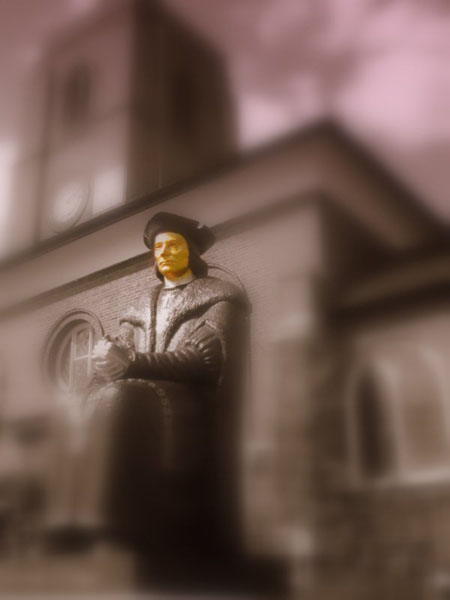
Thomas More's statue at the Chelsea Old Church

Chelsea resident Thomas More’s statue at the (Anglican) Chelsea Old Church.

* Despite its religious tolerance, More’s Utopia — anticipating Dostoyevsky — maintains:

a solemn and severe law against such as should so far degenerate from the dignity of human nature, as to think that our souls died with our bodies, or that the world was governed by chance, without a wise overruling Providence … since a man of such principles must needs, as oft as he dares do it, despise all their laws and customs: for there is no doubt to be made, that a man who is afraid of nothing but the law, and apprehends nothing after death, will not scruple to break through all the laws of his country, either by fraud or force, when by this means he may satisfy his appetites.

** According to the biography published by More’s son-in-law — who married More’s favorite, Margaret — the jest was occasioned by the rickety look of the scaffold. The Mirrour of Vertue in Worldly Greatness; Or, The Life of Sir Thomas More is available free on Google Books.

On this day..