1554: David van der Leyen and Levina Ghyselius, Anabaptist martyrs

On this date in 1554, Anabaptists David van der Leyen and Levina Ghyselius were burned at the stake in Ghent.*

Looks like it hurt.


In the year 1554, there was imprisoned at Ghent, in Flanders, for following Christ and living according to God’s commandments, a young brother named David, who, when examined, freely confessed his faith. Being asked what he thought of the sacrament, David said, that he considered it nothing else than idolatry. Then a priest said to him, “Friend, you err greatly, that you so readily confess your faith, for it will cost you your life, if you do not change your mind in time.” Thereupon David sweetly replied, “I am ready to shed my blood for the name of Christ, even though it should be here in this place; for God is my salvation, who will keep me, and preserve me from all evil.” The priest said, “It will not be as good as though you were put to death secretly here in this place; but you will be burnt publicly at the stake, for an everlasting reproach.” He was then brought into the court, where he was condemned to death, and his sentence was read, namely, that he had fallen from the true faith into heresy, and was therefore, according to the imperial edict, sentenced to be strangled and burned. David said, “No one will ever be able to prove by the Scriptures, that the faith for which I must now die is heresy.”

There was also sentenced to death with him a woman named Levina, who rather forsook, not only her six dear children, but also her temporal life, than her dear Lord and Bridegroom Jesus Christ. Arriving on the scaffold, David attempted to kneel down in order to offer up his prayer to God, but he was prevented, and they were immediately driven away to the stakes, standing at which, David said to Levina, “Rejoice, dear sister; for what we suffer here is not to be compared with the eternal good that awaits us.” (Rom. 8:18) When about to offer up their sacrifice, both exclaimed, “Father, into thy hands do we commend our spirits.” A little bag of gunpowder was tied to each of them, whereupon they were strangled and burned. But there happened a manifest miracle of God; for though they were completely burned, and the fire was as good as extinguished, David was seen to move his head, so that the people exclaimed, “He still lives.” The executioner seized the fork, and thrust it three times into his bowels, so that the blood flowed out; yet even after this he was still seen to move, hence, the executioner threw a chain around his neck, and bound him to the stake, and thus broke his neck.

Thus these two valiantly fought their way through, firmly trusting in God, who did not let them be confounded, since they had firmly built their building upon the only foundation; wherefore they shall never perish, but abide forever.

Martyrs Mirror

* The very birthplace of the then-sitting Holy Roman Emperor, Charles V.

On this day..

1539: Don Carlos Ometochtzin, Aztec heretic

On this date in 1539, the Spanish Inquisition had Aztec noble Don Carlos Ometochtzin (or Don Carlos Chichimecatecuhi, or Don Carlos Ahuachpitzactzin) burned at the stake for reverting to the pre-Columbian indigenous religion.

Just another Mesoamerican depredation?

Surprisingly, this execution stands out as an exception in the first generations of its conquest. It even cost the first bishop of Mexico, Juan de Zumarraga, a reprimand for his excess severity. Why?

Certainly any European Christian would have had trouble with the Inquisition if, like Don Carlos (Spanish Wikipedia entry | English), he had been caught with idols of Xipe Totec in his place.

But it was precisely the point that these weren’t Europeans. In 16th century “New Spain,” syncretisms of Christianity and the native Mexican cults still in living memory were the norm, a scenario recalling early Christianity co-opting the pagan rites it supplanted.*


Respect Xipe Totec’s authoritah!

And that created for the Spanish a problem: how stringently to insist upon an alien orthodoxy for its new subjects? The problem was pragmatic at least as much as it was theological, because the business of winning converts for Christ had to coexist with the business of running an empire. No sense provoking civil war just because the newest souls in the fold don’t have the Te Deum down; Cortes himself, in his initial conquest, had prohibited human sacrifice but not risked closing native temples.* That wasn’t done until 1525.

Over the 1530’s, a campaign unfolded to pare down the many holdover native behaviors — polygamy, idolatry — and cement Christianity. Of particular concern were the “converted” elites who had both means (their social position) and motive (privileges lost to the Spanish) to use nostalgia for the old ways to make trouble.

So, a powerful indigenous priest who “converted” and then went about preaching heretically was investigated by Zumarraga, wielding the Inquisitorial authority, in 1536.

But even that didn’t draw a death sentence.

In Zumarraga’s 19 Inquisitorial trials involving at least 75 suspects, the one and only instance of an Indian being “relaxed” to the secular authorities for execution came in 1539, when Zumarraga was tipped that the hereditary ruler of one of the Aztec Triple Alliance‘s principal city-states was a secret idolator, and a public declaimer of treasonable utterances like this:

Who are those that undo us and disturb us and live on us and we have them on our backs and they subjugate us? … no one shall equal us, that this is our land, and our treasure and our jewel, and our possession, and the Dominion is ours and belongs to us.

Don Carlos was ultimately acquitted of the idolatry stuff, but convicted of heretical dogmatizing.

So far, so good, right? Executions for heresy might be horrible in general, but if you live in a world where they’re routine, surely having your colonial satrap out there calling the empire parasitical, and telling the unwashed masses to go ahead and take multiple wives (Aztec elites seem to have been especially piqued by the lifestyle austerity preached by Franciscan missionaries) is the sort of thing that’ll get you burned at the stake.** And there were plenty more like him out there.

But though the Christianizing campaign of the 1530’s would continue in many forms for decades still to come, the bloodletting which Don Carlos figured to presage was abruptly canceled.

According to Patricia Lopes Don’s “Franciscans, Indian Sorcerers, and the Inquisition in New Spain, 1536–1543,” in Journal of World History, Vol. 17, No. 1,

[a] holocaust was most probably at hand in the spring of 1540. However, when the Council of the Indies in Spain learned of Don Carlos’s execution, they reprimanded Zumárraga, sent a visitador, an inspector-auditor, to New Spain to take away the bishop’s inquisitorial powers, and left him in a state of some humiliation until his death in 1548. All indications were that they feared further such executions would lead to widespread indigenous rebellion in New Spain. As was the case with the Muslims in the Old World, although orthodox Christianity was central to the concept of Spain and the monarchy, when the imperial Spanish needed to choose between religious orthodoxy and the security of the state, they could learn very quickly to be flexible and politique, yet express their concerns in judicious language. In a letter of 22 November 1540, Francisco de Nava, bishop of Seville, explained to Zumárraga that while he understood that he had executed Don Carlos “in the belief that burning would put fear into others and make an example of him,” the Indians, he suggested, “might be more persuaded with love than with rigor.”

When the Inquisition was formally instituted in New Spain in 1571, the native populace was explicitly outside its jurisdiction: its job was to monitor the European population for covert Protestants, Muslims, and Jews.

Although this development has to count as a break for the locals, it’s interesting to note that the theological superstructure of the Spanish policy tension between religious conformity and practical colonialism turned at least in part on a condescending dispute over the “capacity” of Indians to truly become Christian. In that dispute, Zumarraga and his Franciscan order were the ones who thought more highly of the indigenous “capacity”, as against the more skeptical Dominicans; the logical consequence of the Franciscan position was to impose upon those capacious natives the fullest severity of God’s law.

* Though not to be underestimated is the persistence within the citadel of Christendom of everyday folk beliefs, and occasional social movements, at odds with ecclesiastical dogma.

** Treasonous quote and details about the investigation and trial from Richard E. Greenleaf, “Persistence of Native Values: The Inquisition and the Indians of Colonial Mexico”, The Americas, Vol. 50, No. 3 (Jan., 1994)

On this day..

1659: The first two Boston Martyrs

October 27 is International Religious Freedom Day, dating to the execution this date in 1659 of Quakers Marmaduke Stephenson and William Robinson on Boston Commons. They were two of the four Boston Martyrs, Quakers whose necks were stretched in Massachusetts for failing to either keep quiet or stay out of town.

(Fellow Quaker Mary Dyer, perhaps the more famous martyr, was led out to execution with Stephenson and Robinson but reprieved at the last moment. Her time was still some months away.)

As Puritans had fled C-of-E persecution earlier in the 17th century, Quakers migrated to the New World with Cromwell‘s Puritan ascendancy.

And in the Massachusetts Bay Colony, the old dissidence had become the new orthodoxy — as described by the (obviously partisan) Horatio Rogers. (Via)

In June, 1659, William Robinson, a merchant of London, and Marmaduke Stephenson, a countryman of the east pan of Yorkshire, “were moved by the Lord,” in Quaker phrase, to go from Rhode Island to Massachusetts to bear witness against the persecuting spirit existing there; and with them went Nicholas Davis of Plymouth Colony, and Patience Scott of Providence, Rhode Island, a girl of about eleven years of age … During their incarceration Mary Dyer was moved of the Lord to go from Rhode Island to visit the prisoners, and she too was arrested and imprisoned. On September 12, 1659, the Court banished the four adults from Massachusetts upon pain of death

… On October 8, within thirty days of her banishment, Mary Dyer with other Rhode Island Quakers went to Boston, …where she was again arrested and held for the action of the authorities. Five days later William Robinson and Marmaduke Stephenson, who had been travelling about spreading their doctrines through Massachusetts and Rhode Island since their release from prison, also went to Boston to look the bloody laws in the face, in the words of the Quaker chronicler; and they too were arrested and cast into prison. …

The issue was now clearly made between Quaker and Puritan. The Quaker defied the unjust Puritan laws, and dared martyrdom. Dare the Puritan authorities inflict it?

On October 19 the three prisoners were brought before Governor Endicott and the Assistants, and demand having been made of them — Why they came again into that jurisdiction after having been banished from it upon pain of death if they returned? — they severally declared that the cause of their coming was of the Lord and in obedience to him. The next day they were again brought before the magistrates, when the Governor called to the keeper of the prison to pull off their hats, which having been done, he addressed them substantially as follows: “We have made many laws and endeavored in several ways to keep you from among us, but neither whipping nor imprisonment, nor cutting off ears, nor banishment upon pain of death, will keep you from among us. We desire not your death.” Notwithstanding which, he immediately added: “Hearken now to your sentence of death.” … When the Governor ceased speaking, however, Stephenson lifted up his voice in this wise: “Give ear, ye magistrates, and all who are guilty, for this the Lord hath said concerning you, who will perform this promise upon you, that the same day that you put his servants to death shall the day of your visitation pass over your heads, and you shall be cursed forevermore, the Lord of Hosts hath spoken it; therefore in love to you all take warning before it be too late, that so the curse might be removed; for assuredly if you put us to death, you will bring innocent blood upon your own heads, and swift destruction will come upon you.” …

Great influence was brought to bear to prevent the execution of the sentences. Governor Winthrop of Connecticut appeared before the Massachusetts authorities, urging that the condemned be not put to death. He said that he would beg it of them on his bare knees that they would not do it. … Governor Endicott, the Rev. John Wilson, and the whole pack of persecutors, however, seemed to thirst for blood; and it was determined that somebody must die.

The 27th of October, 1659, was fixed for the triple execution and elaborate preparations, for those days, were made for it. Popular excitement ran high, and the people resorted to the prison windows to hold communication with the condemned, so male prisoners were put in irons, and a force was detailed, in words of the order, “to watch with great care the towne, especially the prison.”…

The eventful day having arrived, Captain Oliver and his military guard attended to receive the prisoners. The marshal and the jailer brought them forth, the men from the jail, and Mary Dyer from the House of Correction. They parted from their friends at the prison full of joy, thanking the Lord that he accounted them worthy to suffer for his name and had kept them faithful to the end. The condemned came forth hand in hand, Mary Dyer between the other two, and when the marshal asked, “Whether she was not ashamed to walk hand in hand between two young men,” for her companions were much younger than she, she replied, “It is an hour of the greatest joy I can enjoy in this world. No eye can see, no ear can hear, no tongue can speak, no heart can understand, the sweet incomes and refreshings of the spirit of the Lord which now I enjoy.” The concourse of people was immense, the guard was strong and strict, and when the prisoners sought to speak the drums were caused to be beaten.

The method of execution was extremely simple in those days. A great elm upon Boston Common constituted the gallows. The halter having been adjusted round the prisoner’s neck, he was forced to ascend a ladder affording an approach to the limb to be used for the fatal purpose, to which limb the other end of the halter was attached. Then the ladder was pulled away, and the execution, though rude, was complete.

The prisoners took a tender leave of one another, and William Robinson, who was the first to suffer, said, as he was about to be turned off by the executioner, ‘I suffer for Christ, in whom I lived, and for whom I will die.” Marmaduke Stephenson came next, and, being on the ladder, he said to the people, “Be it known unto all this day, that we suffer not as evil-doers, but for conscience sake.”

Next came Mary Dyer’s turn. Expecting immediate death, she had been forced to wait at the foot of the fatal tree, with a rope about her neck, and witness the violent taking off of her friends. With their lifeless bodies hanging before her, she was made ready to be suspended beside them. Her arms and legs were bound, and her skirts secured about her feet; her face was covered with a handkerchief which the Rev. Mr. Wilson, who had been her pastor when she lived in Boston, had loaned the hangman. And there, made ready for death, with the halter round her neck, she stood upon the fatal ladder in calm serenity, expecting to die….

Just then an order for a reprieve, upon the petition of her son all unknown to her, arrives. The halter is loosed from her neck and she is unbound and told to come down the ladder. She neither answered nor moved. In the words of the Quaker chronicler, “she was waiting on the Lord to know his pleasure in so sudden a change, having given herself up to dye.” The people cried, “Pull her down.” So earnest were they that she tried to prevail upon them to wait a little whilst she might consider and know of the Lord what to do. The people were pulling her and the ladder down together, when they were stopped, and the marshal took her down in his arms, and she was carried back to prison. . .

It was a mere prearranged scheme, for before she set forth from the prison it had been determined that she was not to be executed, as shown by the reprieve itself, which reads as follows: “Whereas Mary Dyer is condemned by the Generall Court to be executed for hir offences, on the petition of William Dier, hir sonne, it is ordered that the sajd Mary Dyer shall have liberty for forty-eight howers after this day to depart out of this jurisdiction, after which time, being found therein, she is forthwith to be executed, and in the meane time that she be kept a close prisoner till hir sonne or some other be ready to carry hir away within the aforesajd tyme; and it is further ordered, that she shall he carrjed to the place of execution, and there to stand upon the gallowes, with a rope about her necke, till the rest be executed, and then to returne to the prison and remajne as aforesaid.

Mary Dyer once again returned from exile the following year, and was hanged in June 1660.

The hours were numbered, however, for New England Puritans in their most cartoonishly obnoxious form. Upon the restoration of the monarchy in the mother country, an edict forbidding the death penalty for Quakerism closed the doors to the Boston Martyrs club.

An Account of the Sufferings of Marmaduke Stephenson is available free on Google books.

On this day..

1689: Quirinus Kuhlmann, mystic poet

“Seldom is a poet burned alive, no matter how critics may roast his work!”

-Robert Beale

On this date in 1689, German poet and mystic Quirinus Kuhlmann was roasted in Moscow for heresy.

This Silesian millenarian (English Wikipedia entry | German) experienced a mystical conversion and spent his law school hours instead scribbling visionary poetry and devouring visionary texts.

Inflamed with Bohmian fire, I read Bohme with fiery eagerness and capacity. I did not know the Bohmian texts and I knew them the same day. What an admiration (o Jesus!) overcame me when I heard Bohme tell his revelations which I had learned from the universe of nature, with God as my teacher, it were the revelations the first outlines of which I just had begun to delineate in my own works.

-Quoted in Toward the Millennium: Messianic Expectations from the Bible to Waco

Quirinus’s particular vibe was an end-times kingdom of Jesus thing with the Catholic Church as the Antichrist. He cast about Europe vainly imploring princes to ally — Protestants with Orthodox with Mussulmen — to destroy the papal whore of Babylon. This

Prince of Fanatics … wrote a book, entitled Prodromus Quinquennii Mirabilis, and published at Leyden in 1674, in which he set forth his peculiar views. He stated that in that same year the Fifth Monarchy or the Christian Kingdom was about to commence, that he himself would bring forth a son from his own wife, that this son by many miracles would found the kingdom, and that he himself was the Son of God. On account of these mad ravings he was exiled by the Chief of the United Provinces of the Netherlands, and expelled with infamy from the University of Leyden. But his strange mission did not cease. He wandered for some time in France and England … He then proceeded to Turkey on his mission, and presented himself to the Sultan. Although ignorant of the language of the country, he persuaded himself that he could speak in any tongue; but when they led him into the presence of the Sultan he waited in vain for the burning words of eloquence to flow. The Turks dealt with him according to his folly, and bestowed on him a sound thrashing. Thence he proceeded to Russia …

Kuhlmann could have picked a better time to evangelize Russia than the reign of Peter the Great. This progressive despot did indeed look west for Russia’s future: in industry, in law, in war, even in fashion. But certainly not in holy alliances.

It was a fellow-German in Moscow, a Lutheran pastor, who denounced Kuhlmann as a dangerous heretic. He and a follower were duly burned as such.

On this day..

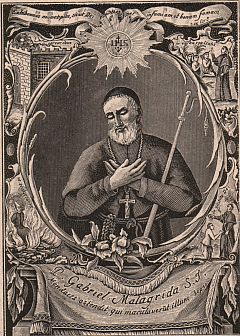
1761: Gabriel Malagrida, Jesuit nutter

On this date in 1761,* the Jesuit Gabriel Malagrida became a late casualty of the Tavora Affair and the Lisbon earthquake when he was garroted for heresy.

Malagrida (English Wikipedia entry | Portuguese) was a 72-year-old Italian with decades of missionary service to the Portuguese New World colonies under his belt.

He had, in his time, been a prominent exponent of the Jesuits missions’ policy in the Amazon, which amounted to asserting their own jurisdiction against the secular government’s attempt to order its overseas territories. (There’s more on that conflict here.)

And this only exacerbated his principal sin of being a Jesuit — an order whose diminution was eagerly sought by the rising statesman of Enlightenment Portugal, the Marquis of Pombal.

The shock of the 1755 Lisbon earthquake would deal Pombal the trump hand he needed to start reshaping both city and society to his liking.

Malagrida, meanwhile, carped that the earthquake’s causes

“are not comets, are not stars, are not vapors or exhalations,** are not phenomena, they are not natural contingencies or causes; but they are solely our intolerable sins … I do not know how a Catholic subject dares to attribute the present calamity of this tragic earthquake to causes and natural contingencies. Do not these Catholics understand this world is not a house without an owner?”

This published pamphlet merely echoed what many of the order were saying in the pulpits, and Pombal was not about to let the backwards, superstitious crowd** own the catastrophe.

Malagrida was banished from Lisbon: and, when the Tavora family was implicated in an attempt to assassinate the Portuguese king, Malagrida, their confessor, found himself clapped in prison.

Though the now-septuagenarian priest did not share the Tavoras’ grisly public butchery, he was left to molder. A couple years in a dungeon saw him go a bit strange, and supposedly he published treatises with such eccentric features as God’s personal instructions to Malagrida, and Malagrida’s fascination with St. Anne’s uterus. Catholic sources, which consider Malagrida a martyr, doubt that he ever published any such thing; if he did, it seems apparent that it was dementia rather than heresy that afflicted the old man.

But Pombal had installed his own brother as judge of the tribunal, so the matter was prearranged. The execution itself was

staged in a dramatic way, even to the point of Malagrida’s appearing on the scaffold in Jesuit habit, to impress upon the Portuguese and the world at large that an old order had come to an end and a new one was to be established … one might say that … symbolism at the cost of one human life was a relatively humane procedure in comparison with the symbolic elimination of whole classes of society in the twentieth century.


Detail view (click for the full image) of Malagrida executed at a Lisbon auto de fe. CC image from Ricardo Mealha, original provenance unknown.

Pitying the superstitious Jesuit at the stake, Enlightenment secularist Voltaire inveighed against Enlightenment secularist Pombal for conducting the execution … just part of Voltaire’s queer ideas about not killing people over their religious beliefs.

“It is all pity and horror,” Voltaire wrote in a private correspondence. “The Inquisition has found the secret to inspire compassion for the Jesuits.”

Voltaire’s appraisal in Candide (already published by this time) of a country in the grip of religious superstition unjustly stands as one of the lasting literary monuments to an event that actually rolled back clerical influence: “the sages of [Portugal] could think of no means more effectual to prevent utter ruin than to give the people a beautiful auto-da-fé; for … the burning of a few people alive by a slow fire, and with great ceremony, is an infallible secret to hinder the earth from quaking.” That the philosophe who penned those words waxed so immoderately outraged at the demonstrative chastisement of a man who preached precisely all that hocus-pocus — that Voltaire ascribed his execution to “the Inquisition” — plants the cherry on the irony sundae.‡

But Pombal’s expedient use of the Inquisition’s medieval machinery to make an example of Father Malagrida would not be the start of a pattern; the Pombaline reforms of the years to come brought the Inquisition sharply to heel, and it was Malagrida himself who was its last victim (pdf) in Portugal in its classical ecclesiastic form.


The house where Malagrida was born in Menaggio, Italy is marked with a plaque. Image (c) kallipyg and used with permission.

* Some sources give September 20 as the date.

** The “God is pissed” hypothesis was posited against theories of earth’s vapors promulgated by the Pombal-sponsored scientist Ribeiro Sanches.

† Anti-Jesuit sentiment was widely abroad in Europe at this time; increasingly resented as political manipulators, the Society would be suppressed by papal order in 1773, only to revive during the post-Napoleonic reaction.

‡ Malagrida was well-known to contemporaries in Europe, but that does not mean sympathy for him was universal. The British pol Lord Shelburne was satirized as “Malagrida” for his putative duplicity.

On this day..

1285: Tile Kolup, pretender

On this date in 1285, a pretender to the Holy Roman Empire* throne was burned at the stake in Wetzlar, Germany.

Kolup (English Wikipedia page | German) found room to perpetrate his fraud via the “King in the mountain” legend.

This myth of a past hero who sleeps out of sight, awaiting the opportune moment for return, has a wide cultural currency; King Arthur would be the readiest example for most Anglos.

In Germany from the 13th century, a similar myth attached to Emperor Frederick I “Barbarossa”, who had suddenly drowned during the Third Crusade in 1190 after reigning as Holy Roman Emperor for nearly 40 years. It’s a myth with enough resonance for this poem by 19th century German romantic Friedrich Rückert:

The ancient Barbarossa,
Frederich, the Kaiser great,
Within the castle-cavern
Sits in enchanted state.

He did not die; but ever
Waits in the chamber deep,
Where hidden under the castle
He sat himself to sleep.

The splendor of the Empire
He took with him away,
And back to earth will bring it
When dawns the promised day.

The chair is ivory purest
Whereof he makes his bed;
The table is of marble
Whereon he props his head.

His beard, not flax, but burning
With fierce and fiery glow
Right through the marble table
Beneath his chair does grow.

He nods in dreams and winketh
With dull, half-open eyes,
And once an age he beckons
A page that standeth by.

He bids the boy in slumber:
“O dwarf, go up this hour,
And see if still the ravens
Are flying round the tower.

“And if the ancient ravens
Still wheel above us here,
Then must I sleep enchanted
For many a hundred year.”

(To say nothing of the resonance for the Nazis who codenamed their invasion of the Soviet Union Barbarossa.)

Anyway, by the time we lay our scene late in the 13th century, when the Hohenstaufen line has tragically vanished, a version of this myth — the “Emperor of Peace” (German link) — has attached itself to Barbarossa’s grandson, Frederick II. Like Frederick I, he was a great and long-lived consolidator of the Empire; unfortunately, he’s been dead since 1250. Or has he?!

Tile Kolup appears in 1284 claiming to be this Frederick, who would have been going on 90 years old at this time. The good citizens of Cologne are his first audience, and he totally bombs with them; only their conviction that he’s more madman than usurper gets him run out of town with only a taunting.

But he finds a more receptive crowd in Neuss, and for a time keeps a court there and issues documents on Frederick II’s authority. Rudolph I, King of the Romans and butt of reindeer jokes, eventually nabs him in nearby Wetzlar and tortures him into admitting his imposture.

There are some succinct German biographies of this falsche Friedrich here and here.

* “This agglomeration which was called and which still calls itself the Holy Roman Empire was neither holy, nor Roman, nor an empire.” -Voltaire. (And the coffee talk lady.)

On this day..

1533: John Frith and Andrew Hewet, Protestants

Life is all about timing.

Death too.

This date in 1533 saw John Frith and Andrew Hewet burned to ashes at Smithfield for Protestantism … just a week before Henry VIII himself was excommunicated from the Catholic Church.

A Cambridge man who’d picked up some heresy in Lutheran Germany, Frith was a friend of William Tyndale and did a couple of turns in English prisons for his various transgressions of orthodoxy.

He was finally nabbed by a warrant of then-Chancellor Thomas More before he could escape to the continent, and hailed before a doctrinal court for sacramentarianism.

During his examination by the bishops, Frith stated that he could not agree with them that it was an article of faith that he must believe, under pain of damnation, that when a priest prayed during the mass, the substance of the bread and wine were changed into the actual body and blood of our Savior Jesus Christ, even though their appearance remained the same. And even if this was so, which he did not believe it was, it should not be an article of faith.

Foxe’s Book of Martyrs

(Said transubstantiation hypothesis remains Catholic doctrine to this day, but at least it’s no longer worth your life to dispute it.)

All the pieces were in place for this radical theology to become orthodoxy over the succeeding generation. The newly-designated Archbishop of Canterbury — still for the moment within the Catholic fold — was reformer Thomas Cranmer. Despite his sympathy for a shared evangelical cause, Cranmer passed a guilty verdict after trying to talk Frith out of his belief. In the event, however, it was the Inquisitor who was converted: Cranmer over the course of the 1530s adopted Frith’s own view. He would eventually enshrine it in the Book of Common Prayer.

All of which, of course, was made possible by Henry’s insistence on ditching his first wife in favor of Anne Boleyn, and Cranmer’s support for that action. On July 11, both the king and his pliant prelate were excommunicated by Pope Clement VII.

Still, it must be allowed that this fact scarcely gave carte blanche to Protestant reformers in England. Maybe Frith was made for the flames regardless: as timing goes, the 1530s were great for religious martyrdom.

Andrew Hewet, our poor footnote, had no part in these august affairs save the victim’s. Hewet was a tailor’s apprentice who was just caught up with an anti-heretical accusation at the wrong time. In prison, he too refused to acknowledge transubstantiation — saying, “I believe as John Frith believes.” For so believing, he burned as Frith burned.

On this day..

1222: An apostate deacon

Thirteenth century England was a dicey place for theological heterodoxy.

On this date in 1222, Archbishop of Canterbury Stephen Langton held at Oxford a provincial council that ordered for immediate execution

an apostate deacon, who for the love of a Jewess had circumcised himself. When he had been degraded he was burnt by the servants of the lord Fawkes.

The story of this nameless and foreskinless deacon — and the link includes several congruent descriptions from primary sources — is sometimes conflated with that of Robert of Reading, another Christian divine who converted in the late 13th century.

Robert’s fate — or Haggai’s, to use the new name he took — seems to be officially unknown, and might have unfolded overseas: Edward I expelled Jews from England in 1290. Nevertheless, the mixed Robert-anonymous deacon story was commemorated with a plaque at Osney Abbey.

Whomever this date’s deacon really was, he wasn’t the only one for whom this council ordained a dreadful end for having the wrong idea about the Almighty.

And there was brought thither into the council an unbelieving youth along with two women, whom the archdeacon of the district accused of the most criminal unbelief, namely that the youth would not enter a church nor be present at the blessed sacraments, nor obey the injunctions of the Catholic Father, but had suffered himself to be crucified, and still bearing in his body the marks of the wounds had been pleased to have himself called Jesus by the aforesaid women. And one of the women, an old woman, was accused of having long been given to incantations and having by her magic arts brought the aforesaid youth to this height of madness. So both being convicted of this gross crime, were condemned to be imprisoned between two walls until they died. But the other woman, who was the youth’s sister, was let go free, for she had revealed the impious deed.

Our source thinks this means life imprisonment rather than being bricked up behind the amontillado. Whatever. It’s not every day we get to use the “immured” tag.

On this day..

1314: Jacques de Molay, last Templar Grand Master

On this date in 1314, the last Grand Master of the Knights Templar was burned in Paris.


Illustration of Jacques de Molay and Geoffroi de Charney burning on Paris’s Île de la Cité.

In a boring materialist history, Jacques de Molay was simply the head of an overrich military order whose crusading raison d’etre had become passe* with the Templars’ expulsion from the Holy Land.

Scores of trumped-up heresy charges did the work of ecclesiastical assassination for this renowned brotherhood originally founded to safeguard pilgrims in the Holy Land. (There’s a fine podcast episode on the Templars’ history here.)

This appears to be some sort of legitimate history. How droll!

Ruthless French King Philip the Fair, who owed the Templar banks a ton of cash, mounted in 1307 a, um, surprise nationalization — with the magnificently coordinated arrest of hundreds of members of the order on Friday, Oct. 13, 1307.**

This was, on the face of it, quite an infringement by the secular power upon the Church, but since Pope Clement V was Philip’s very own sock puppet — to the extent of relocating the papacy to Avignon the better to attend to his master — it was all good. Plus, of course, everyone made out with a big pile of loot.

As the interested parties jockeyed over those confiscated estates, there ensued for the once-powerful, now-proscribed order a years-long saga of torture, burnings (of lower-ranking Templars), salacious Baphomet-worship revelations, juridical maneuvering, and, finally, a compromise life-saving confession which Molay and his associate Geoffroi de Charney dramatically spurned.

The cardinals dallied with their duty until March 1314, when, on a scaffold in front of Notre Dame, Jacques de Molay, Templar Grand Master, Geoffroi de Charney, Master of Normandy, Ilugues de Peraud, Visitor of France, and Godefroi de Gonneville, Master of Aquitaine, were brought forth from the jail in which for nearly seven years they had lain, to receive the sentence agreed upon by the cardinals, in conjunction with the Archbishop of Sens and some other prelates whom they had called in. Considering the offences which the culprits had confessed and confirmed, the penance imposed was in accordance with rule—that of perpetual imprisonment. The affair was supposed to be concluded when, to the dismay of the prelates and wonderment of the assembled crowd, de Molay and Geoffroi de Charney arose. They had been guilty, they said, not of the crimes imputed to them, but of basely betraying their Order to save their own lives. It was pure and holy; the charges were fictitious and the confessions false. Hastily the cardinals delivered them to the Prevot of Paris, and retired to deliberate on this unexpected contingency, but they were saved all trouble. ‘When the news was carried to Philippe he was furious. A short consultation with his council only was required. The canons pronounced that a relapsed heretic was to be burned without a hearing; the facts were notorious and no formal judgment by the papal commission need be waited for. That same day, by sunset, a pile was erected on a small island in the Seine, the Isle des Juifs, near the palace garden. There de Molay and de Charney were slowly burned to death, refusing all offers of pardon for retraction, and bearing their torment with a composure which won for them the reputation of martyrs among the people, who reverently collected their ashes as relics.’

A History of the Inquisition of the Middle Ages, Vol III

Not bad, but the for a real plot twist, check the Templars’ turn — most famously in Dan Brown’s leaden bestseller The Da Vinci Code, but more entertainingly rendered as nonfiction “speculative history” in Holy Blood, Holy Grail — as mystic guardians of Christological secrets.†

Their most sensational secret: the Holy Grail.

In this reworking, the Cup of Christ is not the San Greal but the Sang Real, God’s own royal bloodline, by way (for some reason) of the French Merovingian dynasty.

The Templars and Jacques de Molay himself, this story goes, are just part of a centuries-long vanguard of Christianity’s mystical underground. Say, is that Jacques on the Shroud of Turin?

Thither this blog dares not venture, but those with the requisite inclination towards the occult will find limitless explorations of the theme for ready sale. All we ask, gentle reader, is that you kindly cut us in on the action by using our handy affiliate links.

In what may be yet another mystical just-so story, Molay is said to have foretold, as the flames consumed him, the deaths of his persecutors.

Pope Clement, Chevalier Guillaume de Nogaret [the prosecuting inquisitor], King Philip! I summon you to the Tribunal of Heaven before the year is out!

The curse worked: none of those gentlemen lived to see 1315. Someone, somewhere, has also attributed every bum turn for the French crown since then to Molay’s anathema. There’s a legend that an onlooker at Louis XVI‘s execution dipped his handkerchief in Citizen Capet’s Sang Real and cried out, “Jacques de Molay, tu es vengé!”

* Other expeditions called “Crusades” did continue after the Templars, but Christendom’s occupation of the Holy Land was toast until Lawrence of Arabia days.

** The date of this action is a possible origin of the whole paraskevidekatriaphobia superstition, but probably not really.

† It is a fact that these guys liked sweeping their crusading conquests for supposed holy relics, like this Roman nail recently unveiled from a Templar fort that was reverentially “handled by a lot of people over a long period of time.”

On this day..

1619: Lucilio Vanini, aka Giulio Cesare

On this date* in 1619, Italian freethinker Lucilio Vanini was adorned with a placard reading ‘Ateiste et blasphemateur du nom de Dieu’ and taken to Toulouse’s Place du Salin where he had his blasphemous tongue cut out,** then was strangled and burned at the stake.

You can think of Vanini as a sort of Giordano Bruno mini-me — a bit less intellectually distinguished, a bit less famous, but doing the same peripatetic, pantheistic act before orthodoxy ran him down.

Ordained a priest (like Bruno), Vanini’s 34 years were spent perambulating (like Bruno): France, Switzerland, the Low Countries, even England, where he briefly auditioned Anglicanism.

Alas, (like Bruno) the libertine monk’s occult philosophy had no real home; he fled Paris for Toulouse (the place Bruno earned his doctorate), and was there charged with blasphemy.

Vanini veiled his dangerous speculations in nominally pietistic cant, but he probably could have done better misdirection than a title like De Admirandis Naturae Reginae Deaeque Mortalium Arcanis (Of the Marvelous Secrets of the Queen and Goddess Nature — available in Latin from Google books).

Vanini was bold enough to suggest an equivalency between human and animal souls, and reckon both mortal. Though his works purported to prove the existence of God, and he even made to his accusers a version of the “first cause” argument, they thought (probably rightly) he wasn’t being serious.

They also thought (again, probably rightly) Vanini and his aristocratic patrons were debauched; Vanini’s execution kicked off a dangerous crisis for hedonists in France and elsewhere in the 1620s.

There’s much more about Vanini in French here, and in English in this chapter of the public-domain The Skeptics of the Italian Renaissance.

* Some sources report Feb. 19. The source of this discrepancy isn’t clear to me; the then-10-day gap between the Julian and Gregorian calendars is an obvious suspect, but as this execution took place in Catholic France, the modern Gregorian calendar had been adopted decades before.

In any event, primary documentation appears to me to support the 9th.

” le samedi neuvième du mois de février … fut donné arrêt au rapport de M. de Catel, conseiller au parlement, par lequel il [Vanini] fut condamné à être traîné sur une claie, droit à l’Eglise Saint-Etienne, où il serait dépouillé en chemise, tenant un flambeau ardent en main, la hart [la corde avec laquelle on étranglait les criminels.] au col, et, tout à genoux devant la grande porte de la dite église, demanderait pardon à Dieu, au roi, à la justice, et de là … serait conduit à la place du Salin où, assis sur un poteau, la langue lui serait coupée, puis serait étranglé, son corps brûlé et réduit en cendres; ce qui fut exécuté le même jour.”

** “Before putting fire to the stake, Vanini was ordered to put forth his sacrilegious tongue for the knife. He refused; it was necessary to employ pincers to draw it forth, and when the executioner’s instrument seized and cut it off never was heard a more horrible cry. One might have thought that he heard the bellowing of an ox which was being slaughtered.” (Source) This account of the magistrate Gramont has to be considered in view of his interest in showing the condemned inadequate to his jaunty resolve, “Let us go, let us go joyfully to die, as becomes a philosopher.”

On this day..