You cannot do a kindness too soon, for you never know how soon it will be too late.
-Ralph Waldo Emerson
As of this date last year, the latterly deposed Hosni Mubarak still held power of life and death over subjects.
And on this date in 2010, he used it to turn thumbs-down to both Jihan Mohammed Ali and Atef Rohyum Abd El Al Rohyum.
Those two were condemned for the 2004 murder of Jihan’s husband, but Jihan apparently claimed to have acted alone, involving her lover only as an after-the-fact accessory to move the body.
(You know what they say … friends help you move. Good friends help you move bodies.)
Atef’s attempts to parlay this information into a new trial or some form of executive mercy fell on deaf ears, prompting a fruitless Amnesty International appeal that Egypt was risking a wrongful execution.
The two were executed on the same day, though not executed together; Jihan hanged in al-Kanater prison outside Cairo, while Atef was put to death in Isti’naf prison.
We suspect that ex-President Mubarak’s regrets, if any, run more to the prosaic opportunities missed in the maintenance and exploitation of power. But given the events of recent months, maybe his soul and his regime alike could have profited from fewer revengeful spirits like Atef.
On this date in 1968, Rhodesia earned global opprobrium with a triple hanging in Salisbury (today known as Harare).
Labour M.P. Anne Kerr lays a wreath at the Rhodesian embassy to protest this date’s hangings. A few months later, Kerr would be the one in the world’s headlines … when she was roughed up by Chicago police at the 1968 Democratic Convention.
This was the first “Rhodesian” execution, three years on into the white-supremacist (pdf) breakaway state — which had bucked orderly majority-rule decolonization by declaring independence under its settler government.
So it was hardly a matter of whether James Dhlamini, Victor Mlambo and Duly Shadrack were or were not “guilty”: springing the trap on the gallows was an act fraught with racial hostility within Rhodesia (today, Zimbabwe) and throughout a decolonizing world.
Queen Elizabeth II issued a royal reprieve and the British government warned of the “gravest personal responsibility” attaching to anyone who involved himself in the proposed hanging. Rhodesia royally ignored it.
I have been hanging people for years, but I have never had all this fuss before.
“This fuss” would encompass cross-partisan fury in the British House of Commons as well as a moment of silence in the Indian parliament, denunciations by both America and the Soviet Union … basically everybody. Tanzanian-born British M.P. Andrew Faulds called for criminal sanctions “not excluding the death penalty”. (London Times, , Mar. 7 1968)
There were even demands for humanitarian intervention — amounting to a British military occupation — to protect the other hundred-plus blacks then awaiting the gallows. Needless to say, that wasn’t about to happen, so in the face of Salisbury’s intransigence, was it all just sound and fury?
Does the Secretary of State recall that it was Winston Churchill who said: “Grass grows quickly over the battlefield; over the scaffold, never.”?
Rhodesia insisted on the point by hanging two more Africans five days afterwards … but it also announced 35 reprieves.
In its fifteen years, Rhodesia never did get itself clear of the fuss over white rule; it remained a global pariah and eventually succumbed to its long-running Bush War.
The main character of Richard Wright’s Native Son was condemned to a March 3 electrocution by the state of Illinois.
In Number 666-983, indictment for murder, the sentence of the Court is that you, Bigger Thomas, shall die on or before midnight of Friday, March third,* in a manner prescribed by the laws of this state.
The Court finds your age to be twenty.
The Sheriff may retire with the prisoner.
Readers are not treated to the actual execution scene, but the hopelessness of Bigger Thomas’s situation is the book‘s whole context and theme. There is little room to entertain a reprieve.
“In the first draft I had Bigger going smack to the electric chair,” the author remarked. “But I felt that two murders were enough for one novel. I cut the final scene.”
The first Book of the Month club selection by an African American author was an instant best-seller, but hardly easy reading. Wright tackles the catastrophic “hatred, fear, and violence” suffusing negro life.
Inspired in part by a real-life Windy City murderer, Bigger Thomas grows up wretched and impoverished in Depression-era Chicago and eventually commits an accidental homicide, then rapes and murders his girlfriend. Wright took some heat for staging a character seemingly written to whites’ darkest fears of African-Americans, but it was his object to force the reader to relate to a violent man whose brutality is conditioned by the world he inhabits.
Bigger Thomas’s trial has his lawyer present an overt indictment of structural oppression as the true cause of Bigger’s crime.
“I didn’t want to kill,” Bigger shouted. “But what I killed for, I am! It must’ve been pretty deep in me to make me kill! I must have felt it awful hard to murder … What I killed for must’ve been good!” Bigger’s voice was full of frenzied anguish. “It must have been good! When a man kills, it’s for something … I didn’t know I was really alive in this world until I felt things hard enough to kill for ’em. It’s the truth …”
Whether Wright truly broke out of the existing literary genres may be a matter of debate.
James Baldwin considered Native Son to be of the Uncle Tom’s Cabin tradition, “self-righteous, virtuous sentimentality … the one uttering merciless exhortations, the other shouting curses.”
All of Bigger’s life is controlled, defined by his hatred and his fear … elow the surface of this novel there lies, as it seems to me, a continuation, a complement of that monstrous legend it was written to destroy … Bigger’s tragedy is not that he is cold or black or hungry, not even that he is American, black; but that he has accepted a theology that denies him life, that he admits the possibility of his being sub-human and feels constrained, therefore, to battle for his humanity according to those brutal criteria bequeathed him at his birth. But our humanity is our burden, our life; we need not battle for it; we need only to do what is infinitely more difficult — that is, accept it. The failure of the protest novel lies in its rejection of life, the human being, the denial of his beauty, dread, power, in its insistence that it is his categorization alone which is real and which cannot be transcended.
“Protest novel” or otherwise, Native Son‘s mainstream success extended to the stage, where Orson Welles — fresh from the debut of Citizen Kane — directed a Wright-written adaptation in 1941. Less successfully, Wright himself played the title role in a 1951 Argentinian film.
Though the novel is not yet public domain in the United States, it is in some countries — and can be perused free here.
* For the finicky chronologist: Native Son was published in 1940. At that point, the most recent occasions March 3 had fallen on a Friday were 1939 and 1933.
A mysterious teenage accessory, “Jack”, was never found. Eva was picked up and extradited after the missing rancher’s remains turned up in a shallow grave.
The grizzled former frontierswoman — she followed the Klondike gold rush in her youth — took her fate nonchalantly.
“Wal, I’ll die with my boots on, an’ in full health,” she scolded her jurors. “An’ that’s more’n most of you old coots’ll be able to boast on.”
Eva Dugan’s health may have been full — though she bid unsuccessfully for clemency claiming mental illness — but her body was halved.
At 5 a.m. this date, wearing a homemade silk shroud, a composed Dugan mounted the gallows at the state prison in Florence.
Her death was instantaneous, for the rope, when it snapped at the end of the drop, severed her head from her body.
Five witnesses, two women, fainted. Altogether there were five women in the chamber at the time of the execution. It was the first time in the history of Arizona that an execution was witnessed by women.
Thanks in part to this ghastly scene, Arizona in 1934 replaced the gallows with the western states’ hot new killing technology, the gas chamber … leaving Dugan the last female client of that state’s hangman.
(Another woman, Ruth Judd, narrowly missed swiping Dugan’s distinction; Judd’s hanging sentence was commuted for insanity just days short of her scheduled 1933 hanging.)
New Zealand got itself permanently out of the execution business after hanging Walter Bolton this date in 1957 for the murder of his wife.
The 68-year-old farmer was condemned after his wife finally succumbed to a year-long bout with some mysterious recurring ailment — and the post-mortem revealed long-term arsenic poisoning. Since Bolton turned out to have been having an affair with his wife’s sister, the pieces just fell right into place.
Jurors found these circumstances credible enough to stretch Bolton’s neck, but there’s the small problem that Walter Bolton himself also tested for arsenic poisoning.
The defense argued that the farm’s wells must have soaked up the poison from sheep dip.
But if you like your wrongful executions more sinister than dunderheaded, you might turn a wary eye to that adulterous sister-in-law, Florence Doherty, who committed suicide a year after Bolton hanged. This 2001 Investigate magazine argues (beginning on p. 24 of the pdf) that Doherty may have been a serial arsenic poisoner.
(Bolton’s hanging was also botched, to complete the official dog’s breakfast.)
It was rather the First World’s collctive mid-20th century move away from capital punishment. Various abolition efforts building in the 1950’s finally led to a 1961 free vote on the matter, in which ten members of the conservative National Party broke party ranks to eliminate the death penalty for all ordinary crimes. (Decades later, a Labour government also eliminated the death penalty for treason; New Zealand has only ever hanged one person for that crime.)
On this date in 1939, the Canadian province of Manitoba carried out at Headingley Gaol the only triple execution in its history.
Peter Korzenowski and William Kanuka hanged side by side just after midnight that February 16, while their accomplice Dan Prytula waited 14 minutes for his turn on the gallows.
Less than a year before, drunk on moonshine, the trio beat and kicked 81-year-old Anna Cottick to death on her Dauphin-area farm in an attempt to plunder the place of a rumored $1,000. In fact, they only found twenty-three bucks.
The process of finding enough corroborating evidence to obtain murder convictions was the stuff of modern crime dramas.
As soon as the Royal Canadian Mounted Police arrived at the Cottick farm, members noticed fresh tire tracks entering and leaving the yard. They were tracked three miles west to within 150 yards of Kanuka’s residence, and from there to the Gilbert Plains home of Prytula’s sister. The tire marks were a perfect match to the treads on Prytula’s 1929 Ford. It was confiscated and, while casts were taken of its treads, Prytula was arrested and his blood-stained clothes, boots and three .32 calibre bullets were seized and sent to the RCMP crime lab for testing.
As one group of police officers were arresting Prytula and Korzenowski, another searched the Cottick residence for additional evidence. Almost immediately they noticed what appeared to be fingerprints on the glass smashed by the assailants. Fragments were sent to experts in Winnipeg, along with a window frame and piece of wall where the bullets fired by Korzenowski and Prytula lodged.
The RCMP also searched the residence and yard of Korzenowski, located a few hundred yards from where Kanuka had been staying. There they found the revolvers used in the break-ins, hidden in a pile of stones. Korzenowski was promptly arrested, and three days later he and his two friends were part of an identification line-up paraded in front of the hospital beds of the Cotticks.*
To top all that off, they bugged the men’s jail cell with a dictograph and snared them in several incriminating conversations. Representative remark: the lawyers are so expensive, “No wonder one has to go robbing.”
* Anna’s 91-year-old husband survived the home invasion.
Oh Gentlemen, see, see dead Henrys wounds,
Open their congeal’d mouthes, and bleed afresh.
Blush, blush, thou lumpe of fowle Deformitie:
For ’tis thy presence that exhales this blood
From cold and empty Veines where no blood dwels.
Thy Deeds inhumane and unnaturall,
Provokes this Deluge most unnaturall.
There long persisted superstition* of ancient vintage that the wounds of a murder victim will bleed in the presence of the murderer.**
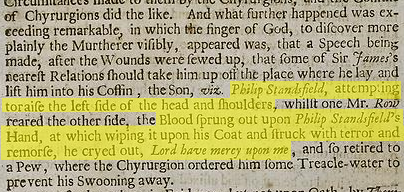
This date in 1688 saw the execution in Edinburgh of one Philip Standsfield (sometimes Stansfield or even Standfield) for parricide, his conviction being secured in part by the supposed accusation of his father’s corpse.
The prodigal firstborn of James Standsfield was an incorrigible scoundrel, and the state had a considerable circumstantial case to the effect that said scoundrel finally popped the old man to prevent disinheritance. (It also appeared that he’d tried to do it other times over the years.)
Circumstantial evidence is nice.
But how about some forensic evidence to really cinch a conviction? No DNA evidence here in the 17th century, so maybe something a little more … supernatural?
From A True Relation of a Barbarous Bloody Murther etc., available here.
The King’s Advocate insisted — over the objections of a defense attorney that “it was a superstitious observation, founded neither upon law nor reason” — that the corpse’s having bled on Philip Standsfield but none of the others in his party simultaneously attempting to move it “he must ascribe … to the wonderful Providence of God, who in this manner discovers murder.”
Divine forensics. That’s even better than the arson evidence Texas used to kill Cameron Willingham.
the said Philip Standsfield to be taken upon Wednesday next, being the 15th of February instant, to the Market-cross of Edinbrugh, and there, betwixt two and four o’clock in the afternoon, to be hanged on a gibbet till he be dead, and his tongue to be cut out and burnt upon a scaffold, and his right hand to be cut off and affixed to the east port of Haddingtoun, and his body to be carried to the Gallowlie betwixt Leith and Edinburgh, and there to be hanged up in chains; and ordains his name, fame, memory, and honours to be extinct, his arms to be riven forth and delete out of the books of arms …†
Well, you get the idea. Executed Today would like to apologize to the dempster of Edinburgh for keeping Philip Standsfield’s name, fame, and memory alive.
In our defense, we are hardly the only ones: this is thought to be the last time that Scottish law employed the bleeding-corpse “test”.
* Some other instances of purported “bleeding at the touch” may be perused here.
** In a 1927 piece in the Journal of the American Institute of Criminal Law and Criminology, Canadian jurist William Renwick Riddell says this folk belief “was wide spread and is not dead yet” and offers in a footnote (perhaps by way of explaining his interest) that “when at the Bar, I was once offered such evidence by my client; but I declined to use it.”
† The execution was botched, and the gibbeted body illicitly pulled down and tossed in a ditch — which is where the elder Standsfield’s had been discovered.
On this date in 1892, two outlaws were hanged (and a third spared at the last moment) in Gori, Georgia — part of the tsarist Russian Empire.
Josef Djughashvili, the future Stalin, was a teenager when he saw an 1892 public hanging in Gori.
The most noteworthy executioner present on this occasion was not on the scaffold, but in the audience: a 14-year-old student at an orthodox church school named Joseph Djugashvili. You know him by his later, steely revolutionist alias: Stalin.
This precocious, ferocious youth attended the public hanging with school mates to whom he was already a natural leader.
He and his friends sympathized with the doomed Caucasians, so insouciant at being strung up by the tsarist oppressor: conversing after the gruesome spectacle, Djugashvili would maintain that the men had not been consigned to hell, for they had suffered enough in the present.
But this boy was not made for theologizing; though he proceeded to seminary school in Tiflis — the best education prospect for an impoverished family — he disappeared thence into the life of professional revolutionary outlawry.
The recent (and well-received) biography Young Stalin recaptures this scene from Joseph Djugashvili’s youth.
The condemned men had stolen a cow and, in the ensuing pursuit, had killed a policeman. But the boys learned that the criminals were actually just three “peasants who had been so oppressed by landowners that they escaped into the forest,” petty Robin Hoods, attacking only local squires and helping other peasants …
The boys were fascinated. “Soso Djugashvili, me and four other schoolboys climbed a tree and watched the terrifying show from there,” remembers one of the group, Grigory Razmadze … Another spectator whom Stalin would later befriend and promote was Maxim Gorky, then a journalist, soon to be Russia’s most celebrated writer.
The Gorelis sympathized with these brave Caucasian bandits … The crowd became menacing; double ranks of Russian soldiers encircled the square. The drums began to beat. “The authorities in uniforms lingered around the scaffold,” wrote Gorky in his article. “Their dreary and severe faces looked strange and hostile.” They had reason to be nervous.
The three bandits in leg irons were marched onto the scaffold. One was separated from the others — he had been reprieved. The priest offered the two condemned men his blessings; one accepted and one refused. Both asked for a smoke and a sip of water. Sandro Khubuluri was silent, but the handsome and strong “ringleader,” Tato Jioshvili, smiled and joked valiantly before the admiring crowd. He leaned on the railings of the gallows and, noticed Gorky, “chatted to people who had come to see hi die.” The crowd threw stones at the hangman, who was masked and clad completely in scarlet. He placed the condemned on stools and tightened the nooses around their necks. Sandro just twirled his moustache and readjusted the noose. The time had come.
The hangman kicked away the stools. As so often with Tsarist repression, it was inept: Sandro’s rope broke. The crowd gasped. The scarlet hangman replaced him on the stool, placed a new noose round his neck and hanged him again. Tato also took a while to die.
Even Joseph Stalin was a child once.
One would have to really like the difficult-to-prove notion that executions have a brutalizing effect encouraging violence in others in order to see in this hanging the germ of the incomprehensiblesuffering young master Djugashvili would eventually unleash.
It’s not like this was Stalin’s only childhood exposure to brutality, and not too many of those buddies who watched this date’s hanging grew up to kill 20 million people.
Gori was one of the last towns to practise the ‘picturesque and savage custom’ of free-for-all town brawls with special rules but no-holds-barred violence. The boozing, praying and fighting were all interconnected, with drunken priests acting as referees… [At festivals during Stalin’s youth] the males in each family, from children upwards, also paraded, drinking wine and singing until night fell, when the real fun began. This ‘assault of free boxing’—the sport of krivi—was a ‘mass duel with rules’; boys of three wrestled other three-year-olds, then children fought together, then teenagers and finally the men threw themselves into ‘an incredible battle,’ by which time the town was completely out of control, a state that lasted into the following day—even at school, where classes fought classes.
This is Russia, not Georgia: festive Maslenitsa fisticuffs.
The small Georgian town that spawned the first name in Soviet terror actually maintained a public statue to its most famous son until 2010 — when it was finally removed in an apparent anti-Russian gesture in the wake of the South Ossetia war.
On this date in 1984, India hanged Kashmiri nationalist Maqbool Bhat.
A terrorist to his enemies and a freedom fighter to his friends, Bhat was born in the Kashmir region back when it “was ruled by the Dogra Family and the entire Kashmiri nation was living a life of slavery.”
When Bhat was a nine-year-old child, the prince of Jammu and Kashmir inked a bitterly controversial accession of his domain to the foundling independent nation of India. Kashmir has been hitched to the adjective “troubled” ever since.
The broader Kashmir region remains a warren of competing claims among Pakistan, India, and China. Bhat operated not for any of these governments, but for Kashmiri independence … and since he came of age in the revolutionary twilight of colonialism, he did not shy from putting the fight in freedom fighter. Bhat was an early exponent of an armed independence struggle.
Both India and Pakistan proscribed as terrorist Bhat’s Jammu and Kashmir National Liberation Front (forerunner of the still-extant JKLF, which is the same acronym less the middle letter); both those longtime subcontinent antagonists arrested Bhat at different times for subversive activities. The most notable: Bhat engineered an airplane hijacking in 1971 to push his cause onto the world’s front pages.
But the hostage-taking game came a-cropper for the Kashmiri rebel.
Languishing under a dormant death sentence for the 1968 murder of an Indian policeman,* Bhat unexpectedly became the focus of his fellow-travelers’ revolutionary ardor: in Birmingham, England, Kashmiri activists kidnapped Indian diplomat Ravindra Mhatre in an attempt to force a hostage exchange.
When Delhi refused to deal, the captors executed Mhatre. Within days, India traded tit for tat by stringing up Bhat — a man who in life had been known for his boast that “nobody has the rope which can hang men.”
They may not have got their man, but they sure got a martyr.
This morning in Dubai, Emirati sailor Rashid al Rashidi was executed by firing squad for raping and murdering four-year-old Moosa (Mousa) Mukhtiar Ahmed in a mosque washroom.
The pedophiliac crime on the first day of Eid al-Adha in 2009 shocked the United Arab Emirates. Eleven judges have okayed the death sentence; even one of al Rashidi’s own lawyers demonstratively resigned himself from the case of “the suspect who brought shame to mankind.”


 Bigger Thomas’s trial has his lawyer present an overt indictment of structural oppression as the true cause of Bigger’s crime.
 A



 The pedophiliac crime on the first day of