1852: John and Jane Williams, slaves

On this date in 1852, John and Jane Williams hung in Richmond for the hatchet-murder of the wife and infant child of their master.

This one was a sensation for the antebellum crime beat, the “deep brain-cuts” to the heads of Joseph Winston (who survived) and Virginia Winston and nine-month-old child (who, obviously, did not) administered in the small hours July 19th was just the sort of thing to tap white slaveholders’ fears. (Reportedly, they were cruel masters and had recently threatened to sell Jane without also selling her child.)

That the crime was authored by urban slaves assimilated to the money economy connected it directly with broader anxieties about social transformations, as explored by Midori Takagi in Rearing Wolves to Our Own Destruction:

[U]rban slaves who enjoyed a variety of privileges including hiring out, living apart, socializing without supervision, and cash bonuses. White Richmonders believed these privileges encouraged the slaves to be rebellious …

Although John belonged to the Winston household, he worked at the docks for John Enders during the day. Like most hired slave workers, John could move about the city before and after working hours with no supervision. He also probably received cash from his earnings and could earn extra by performing overtime work. John was not required to live in the Winstons’ house but chose to in order to be with his wife. Janes, on the other hand, was directly owned by the Winstons and most likely did not enjoy the same privileges as her husband. But she was able to move about in the city making trips to the market, did socialize with other slaves and possibly free blacks, and was well aware of the privileges and expectations of hired slaves including her husband.

White residents came to believe that these factors encouraged slaves to act violently by planting within them “the germ of rebellion.” One influential Richmonder, Joseph Mayo (who later became mayor), attributed the “glaring evils” of the slave population to “the system of board money … [and] the assumptions of equality exhibited by the blacks in riding in carriages contrary to law, and in dress and deportment.” Increasingly, white city dwellers began to wonder if they had been — in the words of one resident — “rearing wolves to our own destruction.”

These anxieties, piqued by crimes such as the Williamses’, would lead to a welter of new restrictions on the movement, behavior, and even attire of urban slaves in Richmond in the ensuing years.

But that was for the future. While Richmond had real-life master-murdering miscreants in its clutches, it gave vent to all its opprobrium.

Papers described the crimes as “hardly paralleled in history,” anticipated for Jane (who eventually copped to the crime and unsuccessfully tried to exculpate John) “the fires of her eternal doom,” and her execution “without the smallest particle of sympathy from any human being possessed of the ordinary feelings of justice.” The exhortations of her pastor, the Richmond Daily Dispatch opined, fell upon “unwilling ears. The thick-crowding thoughts of the diabolical murder of two innocent, guileless beings, committed by Janes with the coolness and deliberation of a fiend, rendered unimpressive, cold, and tedious, those ceremonies.”

It is to be hoped [the Dispatch concluded] that her merited and summary execution will operate as a warning to the fractious portion of our negro population.*

In a show of scrupulous regard for the inalienable rights endowed by the Creator, the state of Virginia compensated the convalescing Joseph Winston to the tune of $500 for expropriating and executing his property.

* (Second-hand) sources for the newspaper excerpts: The Penalty is Death: U.S. Newspaper Coverage of Women’s Executions by Marlin Shipman; and, “Black Female Executions in Historical Context” by David V. Baker, Criminal Justice Review, vol. 33, no. 1 (March 2008).

On this day..

1986: Andrew Sibusiso Zondo and two other ANC cadres

On this date in 1986, African National Congress cadre Andrew Sibusiso Zondo was hanged in Pretoria nine months after bombing a shopping center near Durban, with five white fatalities.

Zondo claimed he had intended to non-fatally target the South African Airways office at Amanzimtoti’s Sanlam Centre, but couldn’t find a functioning, available telephone in time to phone in his attempted bomb warning. Did we mention that he was 19?

Zondo, it turned out, had been radicalized by South African security forces’ indiscriminate violence against claimed ANC “strongholds” — and specifically by a still-infamous attack, the “Matola raids,” on neighboring Mozambique.

The apartheid regime wasn’t out to win hearts and minds. And it didn’t.

[T]here have never been any ANC bases or camps in Mozambique. There are residences … and if the qualification to make a home a base is only that the people in it can use a gun, then let us be told now: because every white man in South Africa can use a gun and there are weapons in every white household. Are these bases too? (ANC Acting President Oliver Tambo)

The bomb (actually a mine) was planted three days after a South African raid on Lesotho. One of Zondo’s accomplices later turned state’s evidence in exchange for immunity.

Both the ANC, which had an official policy of avoiding civilian casualties, and Zondo himself portrayed the affair as a regrettable rogue operation carried out unofficially by an understandably frustrated cadre.

It was not the last word in the bloody tit-for-tat

Two other persons suspected of being involved in the Amanzimtoti blast, Mr Phumezo Nxiweni and Mr Stanley Sipho Bhila, were [extrajudicially] executed by Security Branch members after they were acquitted in court … At Andrew Zondo’s memorial service, his brother was so severely assaulted that he developed epilepsy, which subsequently killed him. Two mourners were shot dead leaving his parents’ home after the memorial service. Lembede, one of the security policemen involved in the killing of Zondo’s alleged accomplice, was himself later killed, allegedly by members of MK.


Hanged along with Zondo were two unrelated ANC cadres, plus three unrelated common criminals.

I have no information about the criminals, but the other revolutionaries to swing were Clarence Lucky Payi and Sipho Brigitte Xulu (or Sipho Bridget Xulu — but a guy, by either name).

Payi and Xulu assassinated another ANC agent, Benjamin Langa, the brother of present-day South African Chief Jutsice Pius Langa.

South Africa’s post-apartheid Truth and Reconciliation Commission has officially attributed the murder to a false flag operation conducted by Pretoria — whereby a mole in the ANC ordered the killing and, with its perpetrators’ subsequent execution, achieved for the white government “a triple murder … without firing a single shot themselves.”

A murky affair by any standard, and one that may not be entirely buried. There’s been some attempt (hotly disputed) to establish a sinister (if vague) alternate hypothesis linking current South African President Jacob Zuma himself to the Langa murder.

On this day..

1984: Ernest Dobbert, child abuser

At 10:09 a.m. this morning in Starke Prison, 46-year-old Ernest Dobbert threw a wink to his minister and was electrocuted for torturing his nine-year-old daughter to death.

The gist of the offense is described by the Gainesville Sun:

He was a child abuser, dating back to 1969. With his wife in prison for kiting paper, his four children obviously got on his nerves. His daughter, age 9, he tortured by beating with boards and belts, by kicking, by poking in her eyes, and by holding her head underwater in the toilet. He celebrated New Year’s Eve of 1971 by dressing her poor abused body in the finest garb on hand, placing it in a garbage bag and concealing it in the attic.

No chauvinist, he. Within weeks, he had done much the same with his son, aged 7. With the help of another terrorized son, age 12, he buried them both out in the scrub somewhere, with their bodies not yet found.

An unsympathetic character deservedly forgotten a quarter-century later, Dobbert interestingly illustrates some of the wide legal and ethical gray area in the real-life application of the death penalty for the many prisoners who are guilty yet not the like of Ted Bundy.

The Sun editorial cited urges Dobbert’s commitment to a mental institution on the nicely circular grounds that “no person is truly sane who tortures — much less kills — the fruit of his own loins.” This might bespeak an impoverished appreciation of human psychology’s potential.

More legally serious is the matter of intent and premeditation, ambiguous here as it so frequently is in life. Dobbert was convicted of only second-degree murder for killing his son; for slaying his daughter, the jury convicted him of capital murder but recommended only a life sentence, unsure of his degree of calculation.

But Ernest Dobbert is on this blog because Florida law allowed a judge to overrule the jury’s recommendation, opining,

this murder of a helpless, defenseless and innocent child is the most cruel, atrocious and heinous crime I have ever personally known of — and it is deserving of no sentence but death.

Maybe so … maybe no. In a 2000 paper* that undoubtedly plays better for an academic audience than a popular one, death penalty expert (and opponent) Michael Radelet points out that if one does suppose Dobbert’s intent to be less than fully formed, a case like his could be held to constitute a species of “wrongful execution” notwithstanding his guilt for the crime.**

The cases of those wrongly sentenced to death and who were totally uninvolved in the crime constitute only one type of miscarriage of justice. Another (and more frequent) blunder arises in the cases of the condemned who, with a more perfect justice system, would have been convicted of second-degree murder or manslaughter, making them innocent of first degree murder. For example, consider the case of Ernest Dobbert, executed in Florida in 1984 for killing his daughter. The key witness at trial was Dobbert’s 13-year-old son, who testified that he saw his father kick the victim (this testimony was later recanted). In a dissent from the Supreme Court’s denial of certiorari written just hours before Dobbert’s execution, Justice Thurgood Marshall argued that while there was no question that Dobbert abused his children, there was substantial doubt about the existence of sufficient premeditation to sustain the conviction for first-degree murder. “That may well make Dobbert guilty of second-degree murder in Florida, but it cannot make him guilty of first-degree murder there. Nor can it subject him to the death penalty in that State” (Dobbert v. Wainwright, 468 U.S. 1231, 1246 (1984)). If Justice Marshall’s assessment was correct, then Dobbert was not guilty of a capital offense, and—in this qualified sense—Florida executed an innocent man.

For Justice Marshall, of course, all executions are wrongful.

For those otherwise inclined, like Joshua Marquis, an Oregon district attorney with a dim view of overhyped innocence claims, Marshall’s interpretation figures to look downright “startling”.

Florida Governor Bob Graham agreed.

Ernest Dobbert has been executed because of his brutal actions toward his own children. I hope that this indication of the seriousness of child abuse will be an example of the value which the people of Florida place upon the lives of infants and young people in our state, and a measure of the lengths the people of Florida are prepared to go to prevent and punish such crimes.

* “The Changing Nature of Death Penalty Debates,” Annual Review of Sociology, vol. 26, August 2000.

** Fellow anti-death penalty academic Hugo Bedau on people whose murders are “arguably not … capital murder”:

We rarely think about this category when discussing innocence and the death penalty, but it is relevant and extremely important. The problem has been with us for at least two centuries, ever since the invention of the distinction between first-degree (capital) murder and second-degree (noncapital) murder.

On this day..

2006: 27 at Abu Ghraib Prison

On this date in 2006, 27 hanged in Baghdad’s notorious Abu Ghraib Prison.

It was just days after the American occupation forces handed back to the Iraqi government control of Abu Ghraib, scene of such iconic contributions to the annals of human rights abuse as this:

Iraqi prisoners would soon miss the old boss.

In the first (known) mass execution since the reign of Saddam Hussein — whose own turn at the gallows was just a few months away — 26 men and one woman were hanged on a variety of terrorism, murder and kidnapping charges.

“This is the message I have for the terrorists,” Prime Minister Nouri al-Maliki said in announcing the executions. “We will see that you get great punishment wherever you are. There is nothing for you but prison and punishment.”

On this day..

2007: Duan Yihe, mistress-murderer

On this date in 2007, former senior Chinese lawmaker Duan Yihe was executed in Jinan along with the policeman nephew who had helped him spectacularly assassinate Duan’s mistress just two months before.

Taking up with a teenager 30 years his junior must have been an appealing perk of the job when Duan Yihe was a rising official in the early 1990’s.

Fast forward 14 years, and he’s in for several cars, a couple of apartments, and tired of the now 31-year-old Liu Haiping, who’s blackmailing him for more. Much less appealing.

Solution?

Why, detonate a remote-controlled explosive in her car.

“The blast was so powerful that her Honda sedan was ripped apart, her lower body was destroyed and her torso landed 30 metres away,” reported The Times.

The case helped crystallize growing official concern with the corrupting potential of senior officials’ ubiquitous mistresses. The day before the car-bombing, the Chinese Supreme Court issued a ruling extending anti-graft laws to mistresses.

The method of execution (either gunshot or — more likely — lethal injection) was not publicized.

On this day..

1942: Bishop Gorazd of Prague

On this date in 1942, the Orthodox Bishop Gorazd — Matej Pavlík is what his parents named him — was shot in Prague along with priests of Sts. Cyril and Methodius Cathedral for sheltering the Czechoslovakian resistance fighters who had lately assassinated Nazi Reichsprotektor Reinhard Heydrich.

After icing Heydrich, the assassins had taken shelter in the Cathedral basement … only to be betrayed by a onetime compatriot.

The Nazis besieged the church — fiercely, but hopelessly defended.

With the Germans already visiting unspeakable collective punishment for the murder, the act of sheltering the assassins had trouble written all over it.
The Serbian-consecrated first bishop of the Czech Orthodox Church, Gorazd sought to limit the potential scope of reprisals by writing the German authorities, directly claiming responsibility — even though, in fact, he hadn’t found out who his sanctuary was concealing until several days after they had already been installed by sympathetic priests.

He enjoyed the characteristic hospitality of the Gestapo, and was shot at Kobylisy along with priests Vaclav Cikl and Jan Sonnevend; theologian Vladimir Petrek followed them the next day.


From left to right (not counting the guards, of course): Jan Sonnevend, Vaclav Cikl, Vladimir Petrek, and the bearded Bishop Gorazd, at their public show trial September 3. From the Czech Ministry of Defense’s slick and well-illustrated publication (pdf) on Operation Anthropoid.

The Czech Orthodox Church was suppressed while the Germans held Czechoslovakia. Bishop Gorazd is recognized in the Orthodox martyrology on August 22nd (the date of his death per the Julian calendar).

On this day..

1918: Fanya Kaplan, Lenin’s would-be assassin

On this date in 1918, a 28-year-old Jewish revolutionary was shot in Moscow for attempting to murder Vladimir Lenin.

Fanya (“Fanny”) Kaplan had actually drawn a life sentence for trying the same trick on a tsarist official 12 years before, so you couldn’t say she was a reactionary element.

No, she was a member of the peasant-based Socialist Revolutionary Party, the SRs — the Bolsheviks’ onetime coalition partners who had splintered into left and right factions, the latter being shut out of power when the Constituent Assembly was closed.

A peasant herself, Kaplan was incensed at the Bolshevik power grab and shot Lenin twice at close range as he left a factory on August 30.

Taken immediately, Kaplan clammed up in interrogation.

My name is Fanya Kaplan. Today I shot at Lenin. I did it on my own. I will not say whom I obtained my revolver. I will give no details. I had resolved to kill Lenin long ago. I consider him a traitor to the Revolution. I was exiled to Akatoi for participating in an assassination attempt against a Tsarist official in Kiev. I spent eleven years at hard labour. After the Revolution I was freed. I favoured the Constituent Assembly and am still for it.

Realizing there was no information to be had from her, the Cheka had her executed four days after her crime — an affair organized by Yakov Sverdlov, the same guy who had recently disposed of the tsar.

On the same day Kaplan took her shots at Lenin, Bolshevik Moisei Uritsky was (successfully) assassinated. The two murders helped justify the Red Terror officially initiated on September 2 — which saw thousands of politically-motivated arrests and executions as the Bolsheviks consolidated their hold on power.


YouTube hosts a great many dreadful student dramatizations of historical events, but this one of Fanya Kaplan by Georgia Tech students is remarkably watchable.

On this day..

1685: Dame Alice Lisle, first victim of the Bloody Assizes

On this date in 1685, an infamous judicial bloodbath claimed its first and most controversial victim.

Dame Alice (or Alicia) Lisle (or Lyle) was beheaded in Winchester for harboring fugitives from the Battle of Sedgemoor, where pretender and fellow execution-fodder Monmouth was defeated.


Alice Lisle Concealing Fugitives, by Edward Matthew Ward. Detailed views here.

The aged woman had evidently taken in the fugitives John Hickes and Richard Nelthorpe as a humanitarian gesture when they happened to show up at her door; despite her late husband’s part in the regicide of Charles I, Alice Lisle doesn’t seem to have been the political type.

So the fact that Lisle was charged with treason was a national (indeed, transatlantic) controversy … and the fact that she was the first of the thousand-plus rebel prisoners tried set the tone for the legal circuit this month that became remembered as the Bloody Assizes.

In an attainder later reversed under William and Mary, Lisle was convicted and condemned to burn (the sentence was commuted to beheading) by notorious hanging judge Lord Jeffreys.

Macaulay describes this infamous landmark case.

If Lady Alice knew her guests to have been concerned in the insurrection, she was undoubtedly guilty of what in strictness is a capital crime … [t]he feeling which makes the most loyal subject shrink from the thought of giving up to a shameful death the rebel who, vanquished, hunted down, and in mortal agony, begs for a morsel of bread and a cup of water, may be a weakness: but it is surely a weakness very nearly allied to virtue … no English ruler who has been thus baffled, the savage and implacable James [II] alone excepted, has had the barbarity even to think of putting a lady to a cruel and shameful death for so venial and amiable a transgression.

Odious as the law was, it was strained for the purpose of destroying Alice Lisle … [T]he witnesses prevaricated. The jury, consisting of the principal gentlemen of Hampshire, shrank from the thought of sending a fellow creature to the stake for conduct which seemed deserving rather of praise than of blame. Jeffreys was beside himself with fury … He stormed, cursed, and swore in language which no wellbred man would have used at a race or a cockfight …

The jury retired, and remained long in consultation. The judge grew impatient. He could not conceive, he said, how, in so plain a case, they should even have left the box. He sent a messenger to tell them that, if they did not instantly return, he would adjourn the court and lock them up all night. Thus put to the torture, they came, but came to say that they doubted whether the charge had been made out. Jeffreys expostulated with them vehemently, and, after another consultation, they gave a reluctant verdict of Guilty.

Lisle was the only victim of the Assizes at Winchester, but her death would preview the wholesale slaughters to follow.

Jeffreys reached Dorchester the next day and his pitiless tribunal began its work of sentencing hundreds to the various modes of English execution, or else to convict transportation — a fate more lucrative for the crown, but little less terrible to its victims.

“More than three hundred prisoners were to be tried,” Macaulay noted. “The work seemed heavy; but Jeffreys had a contrivance for making it light. He let it be understood that the only chance of obtaining pardon or respite was to plead guilty.”

For all that, the Assizes greatly injured the Stuart cause, precisely because of indiscriminately butchering the likes of Alice Lisle.

Judge Jeffreys’ reputation as a vicious, politically-motivated jurist landed him in the Tower of London by 1689, when he, er, injudiciously stuck around after James II fled the country; reportedly, Jeffreys was lucky to make it to the Tower under guard from the mob that wanted to tear him apart.

Though posterity has the luxury of on-the-one-hand, on-the-other-hand assessment, he remains a villain to most accounts … like the vengeful verse to his memory that prefaces this Victorian text on the Assizes.

To Tyburn thee let carrion Horses draw,
In jolting Cart, without so much as straw;
Jaded, may they lye down i’ th’ road, and tyr’d,
And (worse than one fair hanging, twice bemir’d)
May’st thou be maul’d with Pulchers Sexton’s Sermon,
‘Till thou roar out for Hemp-sake, Drive on Car-man.
Pelted and Curst i’ th’ road by every one,
E’ne to be hang’d may’st thou the Gauntlet run.
Not one good Woman who in Conscience can
Cry out,–‘Tis pitty,–Troth, a proper Man.
Stupid and dull, may’st thou rub off like Hone,
Without an open, or a smother’d groan;
May the Knot miss the place, and fitted be
To plague and torture, not deliver thee;
Be half a day in Dying thus, and then
Revive like Savage, to be hang’d agen.
In Pity now thou shalt no longer Live,
For when thus satisfy’d, I can forgive.

Yikes. Jeffreys actually succumbed to a kidney disease a few months into his captivity. Close enough.

On this day..

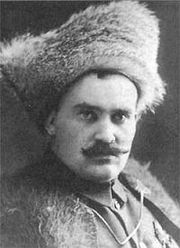
1946: Grigory Semenov, anti-Bolshevik

At 11 p.m. this date in 1946, White general turned Japanese collaborator Grigory Semenov (or Semyonov) was hanged for a generation’s worth of anti-Soviet depredations in the Far East.

The tsarist officer Semenov joined the Russian Civil War as a notoriously vicious White commander with the grandiosely retro title of Ataman of the Baikal Cossacks.

According to G. Patrick March, Semenov’s “penchant for killing, torturing, and looting” extended to executing a captured socialist by tossing the man into his locomotive’s fuel chamber.

Although also a rival in the suicidally fractious White political jostle, Semenov was the designated successor of Aleksandr Kolchak when the latter was shot in 1920, but by that time there wasn’t much left to succeed.

Knocking around the interwar era in gloryless exile, Semenov was an easy recruit for the Japanese war machine, which was in the market by the late 1930’s for locals with command experience and a grudge against Moscow and put him on retainer in Manchuria. Like the Soviet-Japanese front in general after Khalkin Gol, nothing much came of that enterprise; the Ataman’s last great hurrah was but a footnote for Japan, and his death would be a footnote in the annals of postwar victors’ justice.

Having picked a loser two wars in a row, Semenov was captured during the short-lived Soviet invasion of Manchuria at the tail end of the war and packed off for the inevitable. Five co-defendants, including Semenov’s son Mikhail, suffered death as well — although they were simply shot, while Semenov was ignominiously hanged. (According to White Terror: Cossack Warlords of the Trans-Siberian, the hanging was either botched or engineered to be an ugly strangulation job.)

On this day..

1906: Zinaida Konoplyannikov, assassin

On this date in 1906, less than three weeks after she had assassinated tsarist general Georgiy Alexandrovich Min (Russian biography), revolutionary Zinaida Vasilevna Konoplyannikov was hanged at Schlisselburg fortress near St. Petersburg.

Konoplyannikov is mostly noted in Russian sources online (for instance, here and here).

The daughter of a soldier and a peasant, she was educated — hardly a given for a low-born girl in the late 19th century — and taught in the Baltics and St. Petersburg around the turn of the century. By her profession, the plight of her similarly unprivileged students helped radicalize her.

She had a couple arrests for the usual subversive stuff (distributing illicit propaganda and the like) during Russia’s brief flowering towards liberalism in the 20th century’s early years. Those years would be bloodily reversed as tsarism reasserted itself after the revolutionary moment of 1905.

Konoplyannikov avenged herself on one of the great villains (from her standpoint) of that reversal, G.A. Min — commander of the Semenyovsky Life Guards regiment which bloodily bombarded Moscow’s Red Presnia working-class district to crush the last bastion of revolutionary sentiment in December 1905 at the cost of more than 1,000 lives.

Konoplyannikov gunned him down at a Peterhof train station the following August; in a closed military courtroom (giving her no opportunity to use the trial as an oratorical platform), the assassin was condemned to hang in less than an hour.

She was reported to have died calm, sure in the approaching victory of her cause:

the history of the Russian nation is a record of blood … the autocratic and bureaucratic structures are maintained only by violence … You cannot build anything upon the place of the old without first destroying the old. If it is impossible to catch ideas with bayonets, it is also impossible to resist bayonets with ideas only …

No repressions, no arrests, no prisons, no exiles, no shootings, no punitive expeditions, no pogroms, will stop the rising national movement.

I die with one thought: forgive me, forgive me, my people! I have so little to give you — only this, my life. I die full of faith in what will come … when the throne will crumble, and over the Russian plain, a broad, bright sun of freedom arise.

According to Abraham Ascher, Min’s assassination so spooked Tsar Nicholas II that for a time he refused to leave his room … a evocative and emblematic summary of the Romanov dynasty’s ultimately fatal dilemma.

On this day..