1876: James Murphy, gibbeted

On this date in 1876, a 19-year-old murderer was twice hanged in Dayton.

Lafcadio Hearn.

Attending John Murphy’s death was a young writer working the crime beat for the Cincinnati Commercial: Lafcadio Hearn.

This rootless Greek emigre, years and miles away yet from his best-remembered station as the Japanese folklorist better known as Koizumi Yakumo, produced for the next day’s edition a startling and evocative slice of Americana from an otherwise obscure hanging.

It also records the physical intrusion — not merely the psychological postulating — of the author himself, wandering the prison corridors in the dark, laying his hand (so it would seem) upon the condemned boy’s ebbing pulse.

“Gibbeted” ran in the August 26 Cincinnati Commercial:


GIBBETED.

EXECUTION OF A YOUTHFUL MURDERER.

SHOCKING TRAGEDY AT DAYTON.

A Broken Rope and a Double Hanging.

Sickening Scenes Behind the Scaffold-Screen.

The execution of James Murphy, yesterday afternoon, at Dayton, for the murder of Colonel William Dawson, in that city, on the night of August 31,1875, was an event, it must be said, which the people of Montgomery County had long looked forward to with no small degree of satisfaction. The murder was of itself peculiarly atrocious, from the fact that it was actually committed without a shadow of provocation. The victim was a worthy and popular citizen, and the feeling of the public in regard to the crime was sufficiently evinced in the fact that the city authorities, subsequent to the arrest of Murphy, were obliged to call out the militia that the claim of legal justice to deal with the criminal might be protected. Colonel Dawson, it may be remembered, was murdered apparently for no other reason than that he refused a drunken party permission to intrude upon the quiet enjoyments of a private wedding party. The Colonel was Superintendent of the Champion Plow Works, at Dayton, and the bridegroom being an employe of the company, the Colonel had, by request, assumed the management of the wedding ball. When Murphy was refused admittance, he induced one of his companions, Lewis Meyers, to entice the Colonel out of doors on the pretext of getting a drink; and soon after the invitation had been accepted. Murphy struck Dawson, and during the subsequent scuffle, suddenly plunged a long knife up to the halt in the Colonel’s left side. The victim of this cowardly assault lived but a few moments afterward, and died without being able to positively identify his assassin.

Circumstantial evidence, notwithstanding, clearly pointed to Murphy as the criminal, and to Meyers as his accomplice; the former being sentenced to death, and the latter, being convicted of manslaughter, to a term of two years in the State Penitentiary. Sentence was passed on the 28th of April, the jury having disagreed upon the first trial, in February, which necessitated a second.

The youth of the prisoner—he was only nineteen years of age—did not, strange as it may seem, excite any marked degree of sympathy for his miserable fate. He was a fair skinned, brown haired, beardless lad, with rather large features, a firm, vicious mouth; sullen, steady gray eyes, shadowed by a habitual frown; a rather bold forehead, half concealed by a mass of curly locks, brushed down, — a face, in short, that, notwithstanding its viciousness, was not devoid of a certain coarse regularity. His parents were hard-working Irish people, but his own features showed little evidence of Celtic blood.

Perhaps the dogged obstinacy of the prisoner in denying, almost to the last, his evident crime, had no little to do with the state of public feeling in regard to him. Moreover, he had long been notorious in the city as a worthless loafer and precocious ruffian, perpetually figuring in some street fight, drunken brawl or brutal act of violence. For a considerable period of time, previous to the murder of Colonel Dawson, he had been the boasted leader of a band of young roughs, from nineteen to twenty years of age, who were known in Dayton as the “chain-gang.”

The boy’s mother had died while he was yet young; but he did not lack a home, and the affection of an old father, and of brothers and sisters—the latter of whom he is said to have cruelly abused in fits of drunken passion. In this connection it of course be in order, religiously, to discourse upon the results of neglecting early admonitions; and, philosophically, upon the evidence that the unfortunate lad had inherited an evil disposition, whereof the tendencies were not to be counteracted by any number of admonitions. But the facts in the case, as they appeared to the writer, were simply that a poor, ignorant, passionate boy, with a fair, coarse face, had in the heat of drunken anger taken away the life of a fellow-being, and paid the penalty of his brief crime, by a hundred days of mental torture, and a hideous death.

Perhaps there are many readers of this article, who may have perused and shuddered at the famous tale of the “Iron Shroud.” You may remember that the victim, immured in the walls of a dungeon, lighted by seven windows, finds that each successive day of his imprisonment, one of the windows disappears forever. There are first seven, then six, then five, then four, then three, then two, then but one—dim and shadowy;—and then the night-black darkness that prefigures the formless gloom of the Shadow of Death. And through the thick darkness booms, hour after hour, the abysmal tones of a giant bell, announcing to the victim the incessant approach of the fearful midnight when the walls shall crush his bones to shapelessness. No one ever read that tale of the Castle of Tolfi without experiencing such horrors as make the flesh creep. Yet the agony therein depicted by a cunning writer is, after all, but a very slight exaggeration of the torture to which condemned criminals are periodically subjected in our prisons—not for seven days, forsooth, but for one hundred. This is the mercy of the law! – to compel the wretched victim to await the slow but inevitable approach of the grimmest and most ignominious of deaths for one hundred days. Fancy the ghastly mental computation of time which he must make to his own heart— “ninety-nine—ninety-eight—ninety-seven—ninety-six—ninety-five,” until at last the allotment of life is reduced to a miserable seven days, as frightfully speedy as those of the Man in the Iron Shroud. And then the black scaffold with the blacker mystery below the drop, the sea of curious and unsympathetic faces, the moment of supreme suspense after his eyes are veiled from the light of the world by the sable hood. But this pyramid of agony is not absolutely complete until apexed by the vision of a fragile rope, the sudden hush of horror, and the bitterest period of agony twice endured. It is cruel folly to assert that because the criminal be ignorant, uneducated, phlegmatic, unimaginative, he is incapable of acutely feeling the torture of hideous suspense. That was asserted, nevertheless, and frequently asserted yesterday, by spectators of the execution. We did not think so. The victim was young and strong, a warm-blooded, passionate boy, with just that coarse animal vitality which makes men cling most strongly to life, as a thing to be enjoyed in the mere fact of possession—he mere ability to hear, see, feel.

The incidents of the prisoner’s jail life during the last week—how he ate, drank, smoked, talked—might be very fully dwelt on as matters of strictly local interest, but may be briefly dismissed in these columns. There is, however, one story connected with that jail-life too strange and peculiar to be omitted. It seems that young Murphy learned to entertain a special affection for Tom Hellriggle, a Deputy Sheriff of Montgomery County, who had attended him kindly since his removal from the jail-room to a cell on the third floor, which opened in the rear of the scaffold. One night recently. Murphy said to Hellriggle, confidentially: “I knew I was going to be hanged, long ago. Do you know that I knew it before I was sentenced?”

“Why, how did you know that?” curiously asked the deputy.

Then the lad told him that during the intervals of the trials, one night between 12 and 1 o’clock, he heard the voice of a woman crying weirdly and wildly in the darkness, and so loudly that the sound filled all the jail-room, and that many of the men awoke and shuddered.

“You remember that, don’t you?” asked the lad.

“I do,” said the deputy; “and I also remember that there was no living woman in the jail-room that night.’

“So,” continued the boy, “they asked me if I heard it, and I said yes; but I pretended I did not know what it was. I believe I said no human being could cry so fearfully as that. But I did know what it was, Tom—I saw the woman.”

“Who was it?” asked Tom, earnestly.

“It was my mother. And I knew why she cried so strangely. She was crying for me.”

There are few men who enter the condemned cell and leave it for the gallows without having entertained during the interval a strong desire to take their own lives, and are for the most part deterred from so doing rather by the religious dread of a dim and vague Something after death, than by any physical fear. So it appears to have been with Murphy. When all hope, except the hope of pardon from the All-forgiving Father, was dead within him, and the Governor of Ohio had refused to grant a reprieve or commutation of sentence, then the prisoner listened much more calmly to the admonitions of Father Murphy, a fat, kindly, red-cheeked Irish priest, who took a heartfelt interest in the “spiritual welfare” of his namesake. He soon expressed repentance for his crime, and even agreed to confess all publically—an act, all the circumstances properly considered, which really evinced more manhood than the act of “dying game” with the secret.

Shortly afterward he handed to Deputy Sheriff Hellriggle a small, keen knife, which he had managed to conceal, despite all the vigilance of his guards “I would not take my own life, now,” he said, “though I were to be hung twice over.” Yet at the time the poor fellow probably had little idea that he would actually suffer the penalty of the law twice. It was evident, however, that he had frequently premeditated suicide, as in a further conversation with his guard he pointed out certain ingenious and novel modes of self-destruction which he had planned. That the criminal possessed no ordinary amount of nerve and self-control under the most trying circumstances, can not for a moment be questioned; nor can it be truthfully averred that his courage was merely the result of stolid phlegm and natural insensibility. None of the family, indeed, appear to inherit over-sensitive organizations, as a glance at the faces of the visitors to the condemned cell sufficiently satisfied us. When James’ oldest brother, a ruddily-featured young man of twenty, visited the prisoner day before yesterday, he mounted the black scaffold erected outside the cell-door, and, after a few humorous remarks, actually executed a double-shuffle dance upon the trap-door, until Sheriff Patton, hearing the noise, at once turned him out of the corridor. But James’ actions in jail, his last farewell to his relations, his sensitiveness in regard to certain reports afloat concerning his past career, and lastly, the very fact that his nerve did finally yield under a fearful and wholly unexpected pressure, all tend to show that his nature was by no means so brutally unfeeling as had been alleged.

The scaffold had been erected at the rear end of the central corridor of the jail hospital ward in the third story of the building, immediately without the cell-room in which the prisoner had been confined subsequent to his removal from the gloomier jail-room below, where he had heard the loud knocking of the carpenters’ hammers, and the hum of saws—sounds of which the grim significance was fully recognized by him without verbal interpretation. “Ah, they are putting up the gallows!” he said: “The noise don’t frighten me much, though.” To the reporter who visited the long, white corridors by lamp-light, with the tall, black-draped and ebon-armed apparition at its further end, these preparations for an execution under roof, instead of beneath the clear sky, and in the pure air, seemed somewhat strange and mysteriously horrible. It is scarcely necessary to describe the mechanism of the scaffold, further than to observe that the trap-door was closed by curved bolts, the outer ends of which were inserted into or withdrawn from shallow sockets in the framework at either side of the door, by foot-pressure upon a lever, which connected with the inner ends of the bolts, and worked them like the handles of huge pincers. The rope did, however, attract considerable attention from all who examined it previous to the execution. It seemed no thicker than a strong clothes-line, though actually three eighths of an inch, and appeared wholly unequal to the task for which it had been expressly manufactured from unbleached hemp. Yet Sheriff Gerard, of Putnam County, who had officiated at five executions, and was considered an authority upon such matters, had had it well tested with a keg of nails and other heavy weights, and believed it sufficiently strong. A bucket of water was suspended to it for some twenty-four hours, in order to remove its slight elasticity. But the bucket turned slowly around at intervals, and, under the constant pressure and motion, it seems that the rope became worn and weakened at the point of its insertion into the cross-beam. The drop-length was regulated to three feet and a half.

The unfortunate boy’ s mental impressions, yesterday morning, must assuredly have consisted of a strange and confused vision of solemn images and mysterious events. From the opening door of his cell he could plainly perceive every mechanical detail of the black gibbet, with its dismal hangings of sable muslin. Sisters of Charity, in dark robes; solemn-faced priests, with snowy Roman collars; Sheriffs and Deputy Sheriffs of austere countenance, which appeared momentarily to become yet more severe; policemen in full dress whispering in knots along the white corridor, a score of newspaper correspondents and reporters scattered through the crowd, writing and questioning and occasionally stealing peeps at the prisoner through the open door; calm-visaged physicians consulting together over open watches, as though eager to feel the last pulsations of the dying heart; undertakers, professional, cool and sad, gathered about a long, handsome black walnut coffin, adorned with silver crosses, which stood in the comer of one hospital room—these and other figures thronged the scene of death and disgrace while without a bright sun and a clear sky appeared for the last time to the wandering eyes of the condemned. He had early in the morning gone through the necessary formal preparations of being shaved, bathing, and putting on the neat suit of black cloth for which he had been measured a few days before. He had slept soundly all night; after having listened to the merry music of the city band, playing before the columned Court-house, but his sleep was probably consequent upon physical and mental exhaustion from haunting fear, rather than a natural and healthy slumber. He had risen at 7 o’clock, made a full confession in presence of the Sheriff, heard mass, listened to Father Murphy’s admonitions, ate a light breakfast, and smoked several cigars. Father Murphy’s admonitions, delivered in simple language, and a strong old-country brogue, seemed to us passive listeners somewhat peculiar, especially when he stated that the “flesh and blood of Jesus Christ, which not even the angels were worthy to eat,” would give strength to the poor lad “to meet his God at half-past 1 o’clock.” But if ever religious faith comforted the last moments of a young criminal, it did in this instance; and it was owing to the kindly but powerful efforts of the little priest that the youth made a full public confession of his crime. This is the confession:

MONTGOMERY COUNTY JAIL,

DAYTON, 0., August 24,1876.

To Warren Munger and Elihu Thompson, my Attorneys:

I will now say to you, and the public in general, that ever since you became my attorneys, at all times until to-day, I have denied that I struck and killed William Dawson, for which crime I am now under sentence of death. This statement I have made you in the mistaken hope and belief that it might do me some good, and I therefore put the blame on another person—Charles Tredtin. Now that all hope is gone, I have to say that you have done all you could for me as my attorneys, and that I feel satisfied with your efforts in my behalf. I am willing now to make public all I know about the murder of Colonel William Dawson. and I desire to make the statement, for I am now about to die, and do not want to die with a lie upon my lips. I do not wish Tredtin to be pointed out as long as he lives as the person who stabbed Colonel Dawson; and I desire also that justice may be done Meyers, who is entirely innocent, and was not connected in any way with the killing of Dawson. The following are the facts:

On the evening of the murder, Jim Alien, John Petty, George Petty, Charles Hooven and myself were at a dance on McClure street. From there I and Hooven and George Petty went down the street to Barlow’s Hall, where there was a dance going on, but of which we did not know until we arrived there. We went in and went up to the bar, and had a drink of beer. About fifteen minutes after this, Gerdes and I started up to get into the ball-room, but before we started Kline, Petty and Tredtin had gone up. When we got within two or three steps of the top of the first stairway I met Brunner there on duty as door-keeper, and he asked me if I had a pass. I told him no, and then he said, “You’ll have to go down stairs.” I said, “All right.” Then Dawson grabbed hold of me and said, “Get down, or I’ll throw you down.” I jerked away from him, laughed at him, and went down stairs. Then Gerdes and I went and saw the man who got married, and asked him if he couldn’t let me up stairs. He said, “Yes, of course I can;” and then I went up with Gerdes and the man who got married, and he told Brunner to let me in. We went into the ball-room, where Kline, Tredtin and Petty were standing. Then Kline said, “Where’s that big son of a bitch that was going to throw you down stairs?” and I said, “What do you want to know for?” He then said, “I want to know.” Then I said, “There he is; whatever you want to say to him, say it.” Then Kline said, “Oh, you big son of a bitch!” After about half an hour Petty and I went down stairs to the bar-room. Gerdes, Tredtin and Kline came down there, where I saw them, but whether they came together or not I don’t know. Kline, Petty and I drank beer together. We all five then went back up stairs. Dawson and Meyers went down stairs, into the bar-room; then we five followed on down, and went out at the side door on the street. We then began talking about the occurrence on the stairway between Dawson and myself, and some one said, but I don’t recollect who it was, “Damn him, we’ll get him before morning.” I don’t recollect that there was anything more said. Meyers was not with us then on the street, or at all in any way connected with us or our party that evening. All five of us then went back together up stairs, where we saw Meyers and Dawson. We staid there some five or ten minutes, when we saw Meyers and Dawson go down stairs and then we five followed after them, and saw them go out of the side door on to the street, and we followed them out. Kline said to me and Petty, near the comer of the side street and Fifth street, “You go down this side of the street and we’ll go down the other.” Petty and I followed after Meyers and Dawson, some distance behind them, while Kline. Gerdes and Tredtin went across to the north side of the street, and went down west on that side of Fifth street. We saw Meyers and Dawson try to get in at the big gate at Weidner’s, and Pearl street. When we came together Dawson sort of turned around, and I struck him with both fists in the breast; Petty struck Meyers, and Meyers caught hold of a post and prevented himself from falling into the gutter, and then straightened himself up and ran away eastward, and Petty started across the street as soon as Meyers ran. My strokes in Dawson’s breast staggered him, and he didn’t recover himself until after Meyers and Petty had left. About the time Dawson recovered himself, Kline and Tredtin run in and struck Dawson too. My passions were now aroused. I drew my knife out of my inside breast coat pocket and stabbed Colonel Dawson. I did it on the instant, and took no second thought about it. I do not remember of hearing Dawson say anything before or after I cut him. He may have said something, but I did not hear him. The purpose of our party of five in following Meyers and Dawson out was to lick them both. I saw Gerdes about the middle of the street coming towards us, but he didn’t get up to us. Which way Kline and Tredtin went I do not know. Dawson started east on Fifth street on a run. I was facing the east when I cut Dawson. After Dawson run I was alone on the sidewalk, when Frank came up and struck at me with his club. I dodged him and struck at him with my knife, but don’t know whether I cut his clothes or not. I then wheeled and started to run west, As I run he threw his club at me, and as I started to run across the street, I fell over the hitching-post in front of Weidner’s, and there I dropped my cap and knife. Frank fired at me with a pistol, and shot at me just as I fell. I got up and started to run across the street, and Frank fired a second time at me as I was about to enter the alley on the north side of Fifth street. I stood in the alley awhile, and then I went home to my father’s house, where I was afterward arrested by the police. Whisky and bad company have been the ruination of me, and the cause of all my bad luck. I had drank a good deal that night of beer and whisky.

This is a true and correct statement about the murder, and is all I wish to say about the matter.

JAMES MURPHY.

He also dictated a letter of thanks to Sheriff Patton. his deputies, and all who had been kind to him during his confinement. Sheriff Patton himself paid for the prisoner’s coffin, a very neat one.

At half-past one o’clock. Deputy Sheriff Freeman appeared at the door of the cell-room, which opened directly upon the ladder leading to the scaffold, and observed in a low, steady voice: “Time’s up, Jim; the Sheriff wants you.” The prisoner immediately responded, “All right; I am ready;” and walked steadily up the steps of the ladder, accompanied by Fathers Murphy and Carey. His arms had been pinioned at the elbows by a strong bandage of black calico. Probably he looked at that moment younger and handsomer than he had ever appeared before; and a hum of audible surprise at his appearance passed through the spectators. Accompanied by his confessor and Father Carey he walked steadily to the front of the platform; and after looking quietly and calmly upon the faces below, spoke in a deep, clear, bold voice, pausing between each sentence to receive some suggestion from the priest at his side.

“Gentlemen, I told a lie in the Court-house by saying Tredtin was guilty.”

“I think I am guilty”—with a determined nod of the head.

“I return thanks to Sheriff Patton, his deputies and all my friends.

“I forgive all my enemies and ask their forgiveness.

“If there is any one here who has any hard feelings toward me, I ask their forgiveness.

“This is my last request.

“Gentlemen, I want all young men to take warning by me. Drink and bad company brought me here to-day.

“And I ask the forgiveness of Mrs. Dawson and her children, whom I injured in passion, when I did not know what I was doing.

“I believe Jesus Christ will save me.”

Sheriff Patton then read in a quiet, steady voice, the death-warrant. It was heavily bordered in black, and bore a great sable seal. “It is my solemn duty,” said the Sheriff, “to execute the sentence passed upon you by the Court:

“State of Ohio, Montgomery County—To William Patton, Sheriff: Whereas, at the January Term, 1876, of the Court of Common Pleas, within and for the County of Montgomery and State of Ohio, to-wit, on the 28th day of April, 1876, upon a full and impartial trial, one James Murphy, now in your custody, was found guilty of deliberate and premeditated murder of one William Dawson, in manner and form as found in a true bill of indictment by the grand jury on the 30th day of October, 1875; and whereas the Court aforesaid, at the term aforesaid, to-wit: on the 12th day of May, 1876, upon the conviction aforesaid, ordered, adjudged and sentenced the said James Murphy to be imprisoned in the County jail until the 25th day of August, 1876, and that on that day, between the hours of 10

A.M. and 4 P.M., he be taken from said jail, and hanged by the neck until he be dead, this is therefore to command that you keep the said James Murphy in safe and secure custody until said day, August 25,1876; and that on said day, between said hours, you take said James Murphy, and in the place and manner provided by law, hang him by the neck until he be dead. Of this warrant, and all your proceedings thereon, you shall make due return forthwith thereafter.

“Witness: JOHN S. ROBERTSON, Clerk of said Court.

“And the seal thereof of the city of Dayton, in said county, this 20th day of June, 1876.

“[Seal Court of Common Pleas]”

“JOHN S. ROBERTSON, Clerk.”

In the meantime Deputy Sheriff Freeman adjusted the thin noose about the prisoner’s neck, and pinioned his lower limbs. “James Murphy, good-bye, and may God bless you!” observed Patton in a whisper, handing the black cap to a deputy. At this moment the representative of the Commercial succeeded in obtaining admittance to the little audience of physicians in rear of the scaffold; and took up his position immediately to the left of the trap-door. The next instant the Sheriff pressed the lever with his foot, the drop opened as though in electric response, the thin rope gave way at the crossbeam above, and the body of the prisoner fell downward and backward on the floor of the corridor, behind the scaffold screen. “My God. My God!” cried Freeman, with a subdued scream; “give me that other rope, quick.” It had been laid away for use “in case the first rope should break,” we were told.

The poor young criminal had fallen on his back, apparently unconscious, with the broken rope around his neck, and the black cap vailing his eyes. The reporter knelt beside him and felt his pulse. It was beating slowly and regularly. Probably the miserable boy thought then, if he could think at all, that he was really dead—dead in darkness, for his eyes were vailed—dead and blind to this world, but about to open his eyes upon another. The awful hush immediately following his fall might have strengthened this dim idea. But then came gasps, and choked sobs from the spectators; the hurrying of feet, and the horrified voice of Deputy Freeman calling, “For God’s sake, get me that other rope, quick!” Then a pitiful groan came from beneath the black cap.

“My God! Oh, my God!”

“Why, I ain’t dead—I ain’t dead!”

“Are you hurt, my child?” inquired Father Murphy.

“No, father, I’m not dead; I’m not hurt. What are they going to do with me?”

No one had the heart to tell him, lying there blind and helpless and ignorant even of what had occurred. The reporter, who still kept his hand on the boy’s wrist, suddenly felt the pulsation quicken horribly, the rapid beating of intense fear; the youth’s whole body trembled violently.

“His pulse is one hundred and twenty,” whispered a physician.

“What’s the good of leaving me here in this misery?” cried the lad. “Take me out of this, I tell you.”

In the meantime they had procured the other rope—a double thin rope with two nooses—and fastened it strongly over the crossbeam. The prisoner had fallen through the drop precisely at 1:44 1/2 P.M.; the second noose was ready within four minutes later. Then the deputies descended from the platform and lifted the prostrate body up.

“Don’t carry me,” groaned the poor fellow, “I can walk—let me walk.”

But they carried him up again. Father Murphy supporting his head The unfortunate wanted to see the light once more, to get one little glimpse at the sun the narrow world within the corridor, and the faces before the scaffold. They took off his ghastly mask while the noose was being readjusted. His face was livid his limbs shook with terror, and he suddenly seized Deputy Freeman desperately by the coat, saying in a husky whisper, “What are you going to do with me?” They tried to unfasten his hand, but it was the clutch of death-fear. Then the little Irish priest whispered firmly in his ear, “Let go, my son; let go, like a man – be a man – die like a man.” And he let go. But they had to support him at arm’s length while the Sheriff pressed the trap-lever—six and one-half minutes after the first fall It was humanely rapid work then.

The body fell heavily, with a jerk, turned about once, rocked backward and forward, and became almost still. From the corridor only the head was visible—turned from the audience. Father Murphy sprinkled holy water upon the victim. The jugular veins became enlarged, and the neck visibly swelled below the black cap. At this time the pulse was beating steadily at 100; the wrist felt hot and moist, and we noticed the hand below it tightly clutched a little brass crucifix placed there by the priest at the last moment. Gradually the pulse became fainter’ Five minutes later, Dr. Crum, the jail physician, holding the right wrist announced it at eighty-four. In ten minutes from the moment of the drop it sunk to sixty. In sixteen minutes the heart only fluttered, and the pulse became imperceptible. In seventeen minutes Dr. Crum, after a stethoscopic examination, made the official announcement of death.

The body was at once cut down by Sheriff Patton, and deposited in the handsome coffin designed for it. Half an hour later we returned to the jail, and examined the dead face. It was perfectly still, as the face of a sleeper, calm and undisfigured. It was perhaps slightly swollen, but quite natural, and betrayed no evidence of pain. The rope had cut deeply into the flesh of the neck, and the very texture of the hemp was redly imprinted on the skin. A medical examination showed the neck to have been broken.

On this day..

1751: Thomas Colley, witch-killer

Supposed witches are a staple of history’s scaffold-rolls, and we may well take relief at the passing of this superstition.

England’s last witchcraft executions were in 1682; the law that hanged them was repealed in 1736. But the human story is not confined to parliamentary parchment, and popular belief in witches was not instantly dispelled at the stroke of a pen. Indeed, the belief never has been dispelled altogether.

In our mid-18th-century scene, figures who might have once been thought “witch”-like can now achieve mass-market fame. But old traditions died hard — and on this date* in 1751, Thomas Colley died for believing them to the extent of killing a “witch” himself.

Aging beggar Ruth Osborne got herself on the bad side not of Colley but a Tring farmer prosperously named John Butterfield when she pooh-poohed his refusal to spare her some scraps, and Butterfield’s livestock thereafter got sick.

Obviously, witchcraft!

Whether Butterfield was animated by genuine supernatural paranoia or merely by dick-swinging, he organized a witch-ducking of Ruth and her husband John: organized to the extent of having criers announce it days in advance.

Now, granted, witch-ducking was now illegal. But Mr. Butterfield draws a lot of water in this community, and he turned out a mob to wreck a couple of suspected hiding-places before the two were captured, trussed-up, and paraded to Marlston Meer.**

Butterfield got local yokel Thomas Colley drunk and agitated enough to do for him the dirty work of casting two impoverished souls into a pond so shallow they could scarcely sink, and therefore were obviously guilty for floating. This public torture continued until Ruth died† — Colley prodding the victims with a pole and passing the hat for community underwriting.


“The Ducking of John Osborn”, as reprinted (pdf) by the Hertfordshire Countryside.

Colley was prevailed upon after his conviction to sign a recantation of the belief that had brought him to his inglorious end, a neat inversion of the forced confessions of previous generations’ “witches”, and no less indicative of the operations of power upon the mind as well as the body of the condemned.

GOOD PEOPLE!

I beseech you all to take warning by an unhappy man’s suffering; that you be not deluded into so absurd and wicked a conceit, as to believe that there are any such beings upon earth as witches.

It was that foolish and vain imagination, heightened and inflamed by the strength of liquor, which prompted me to be instrumental (with others as mad-brained as myself) in the horrid and barbarous murder of Ruth Osborne, the supposed witch, for which I am now so deservedly to suffer death.

I am fully convinced of my former error, and with the sincerity of a dying man, declare that I do not believe there is such a thing in being as a witch; and pray God that none of you, through a contrary persuasion, may hereafter be induced to think that you have a right in any shape to persecute, much less endanger the life of a fellow creature.

I beg of you all to pray to God to forgive me, and to wash clean my polluted soul in the blood of Jesus Christ, my saviour and redeemer.

So exhorteth you all, the dying

Thomas Colley

Whatever the state of Thomas Colley’s mind by the time it was strangled by the halter at Gubblecote Cross, Colley’s come-to-the-Enlightenment moment didn’t exactly impress his former audience.

[T]he infatuation of the greatest part of the country people was so great that they would not be spectators of his death (perhaps from a consciousness of being present at the murder as well as he); yet many thousands stood at a distance to see him go, grumbling and muttering that it was a hard case to hang a man for destroying an old wicked woman that had done so much damage by her witchcraft.‡

As if to prove the point, it is said that Colley’s spirit has haunted the area ever since — in the form of a big black dog. (Colley – collie, is that it?)

* Some sources (incorrectly) give August 22nd as the date of the hanging, which might be a confusion with April 22nd, the date of the crime. Similarly, the Newgate calendar dates Thomas Colley’s hanging to April 24th, which is certainly wrong.

** “It only became possible to restrain collective violence towards witches in England … when from 1856 onwards a paid and uniformed police force came into existence. Up to that point the elected, non-professional constable or his deputy had kept well out of incidents of this sort or had even supported his fellow villagers in their infamous activities.” (Source)

† John Osborne is often reported to have died hours after he was pulled alive from the pond, but at least some (pdf) contemporaneous sources seem to indicate that he lived on and even stayed in the area — where nobody would hire him because of his wizardry stigma.

‡ Cited in W.B. Carnochan, “Witch-Hunting and Belief in 1751: The Case of Thomas Colley and Ruth Osborne” Journal of Social History, Vol. 4, No. 4 (Summer, 1971).

On this day..

1909: Madanlal Dhingra, Indian revolutionary

A century ago today, the first Indian revolutionary martyr to be hanged in England was put to death at Pentonville Prison.

Madanlal Dhingra (or Madan Lal Dhingra) was a bright young scion of a loyalist Indian family that disowned him when he took to radical politics.

As an engineering student in London, Dhingra quaffed the martyr’s cup by assassinating Sir William Curzon Wyllie, a career imperial official spending his golden years keeping tabs on nationalist types among England’s Indian students. (Evidently, he could have been doing his job better.)

Dhingra rejected the legitimacy of the British court, disdained a defense, and was sentenced to death on the first day of trial. His martyrdom being the shared object of both the prosecutors and the offender, he was not long for the world — supposedly checking out with the well-turned last words,

My only prayer to God is that I may be re-born of the same mother and I may re-die in the same sacred cause till the cause is successful.

Dhingra is a noteworthy martyr to the cause of Indian independence now, but like anything else things weren’t so black and white at the time. Gandhi was not down with Dhingra — Gandhi’s own differences with Hindu extremists would eventually cost him his life — and plenty of Indian liberal types shared his abhorrence.

On the other hand, a subversive Brit like poet Wilfrid Scawen Blunt filled his blog-like diary with admiration for the assassin during the weeks of his celebrity — writing of this date, for instance:

They have done me the honour of choosing [my birthday] for Dingra’s execution, thus making of it an anniversary which will be regarded as one of martyrdom in India for generations.

And reflecting later, after the hanging:

People talk about political assassination as defeating its own end, but that is nonsense; it is just the shock needed to convince selfish rulers that selfishness has its limits of imprudence.

Other subjects of the Empire were inclined to agree.


From the Aug. 19, 1909 London Times.

On this day..

2004: Dhananjoy Chatterjee, the last hanged in India … for now

On this date in 2004, Dhananjoy Chatterjee hanged at Calcutta’s Alipore Central Jail for the 1990 rape-murder of 14-year-old Hetal Parekh.

Chatterjee’s hanging also brought into the limelight the garrulous, publicity-hounding 84-year-old executioner Nata Mallick, who conducted the hanging with his son and grandson and told anyone with a microphone stories of the hangman’s glory days.

Those days are long past on the subcontinent.

Among death penalty countries, India is the anti-Singapore: despite its billion-plus population, death sentences are vanishingly rare. Chatterjee is not only the most recent person hanged in India as of this writing, but the only one hanged there since 1995.

One actual hanging in fourteen years for a billion-person country? The only lower execution rate would be actual abolition.

Chatterjee may be relieved of his milestone distinctions in the not-too-distant future, however. (Where “not-too-distant” by the standards of the Indian death penalty might still mean years away.)

Mohammad Afzal, condemned for the 2001 terrorist attack on the Indian Parliament, has become a political lightning rod; India’s conservative Hindu party Bharatiya Janata Party (BJP) has made political hay pushing for Afzal’s execution.

Update: A different Pakistani terrorist, Ajmal Kasab, became the next hanged after Chatterjee in 2012. Afzal Guru got his in February 2013.

On this day..

1868: Thomas Wells, the first private hanging in England

The hanging this date at Kent’s Maidstone Prison of Thomas Wells for the murder of the Dover postmaster stamped the understated debut of England’s era of private executions.

It was a shift almost a century in the making; in 1783, Albion had eliminated London’s traditional, disorderly procession to Tyburn in favor of public hangings just outside the walls of the prison — to the chagrin of traditionalists like Samuel Johnson.

As the 19th century unfolded, even this compromised spectacle attracted increasing criticism, noticeably from literary types who decried the aesthetics, effectiveness, and/or morality of public execution.

Eventually, on May 29, 1868,* Parliament passed the Capital Punishment Amendment Act of 1868, also known as the Capital Punishment within Prisons Act. The public hanging was no more.

Our day’s otherwise mundane murderer became the first to answer for his crime in this brave new behind-prison-walls world. And if the objective was to banish the spectacle and theater of the scaffold — well, the report in next day’s London Times of Thomas Wells’ hanging would suggest the measure achieved its purpose.

Yesterday morning Thomas Wells, aged 18, who was found guilty at the last Kent Assizes of the wilful murder of Mr. Walsh, the master of the Priory Station on the London, Chatham, and Dover Railway, by shooting him in revenge for a reprimand which that gentleman, under whom he served as a porter, had given him for some misconduct, suffered the extreme penalty of the law. This was the first execution under the new Act requiring executions in future to be inflicted within the prison walls.

It was, of course, generally known that the execution would be conducted in private, and that the only sign would be the hoisting of a black flag outside the prison wall. At the moment of the falling of the drop there were very few, if any, strangers in the vicinity of the prison, and the town presented quite its ordinary appearance, presenting a marked and extraordinary contrast to that which it has hitherto exhibited on the occasion of a public execution. The scaffold was erected in a small yard adjoining the debtors’ portion of the gaol, which had at one time been used as an exercise yard for the prisoners. It is enclosed by four high walls. The apparatus is the same that was formerly used, with some slight alterations. The drop is on a level with the stone paving of the yard, and the executioner has to descend several steps to remove the bolt which supports the platform, and the latter then drops into a recess prepared for it. No one was present at the execution but the undersheriff, governor, sergeant, chaplain, and the representatives of the Press.

After his trial the culprit seemed to have been fully aware that there was no hope for him, but he expressed remorse for the act he had committed, and wrote a very penitent letter to Mrs. Walsh, the widow of the deceased, entreating her forgiveness. No efforts appear to have been made in any quarter to obtain a remission of the capital sentence.

The culprit prayed fervently with the Rev. Mr. Frazer, the chaplain, for a few seconds, and as the drop fell he was singing with a loud clear voice the 486th hymn. He appeared to die after two or three convulsive struggles.

Of course, not everything old can be new overnight; this hanging was carried out by longtime public hangman William Calcraft, who’d had his start in the trade back in 1829 and was renowned for unpleasantly strangling his charges with his itty-bitty drops. Though the Times report downplays the climax, other press attendees agreed that Wells died hard.

This day’s milestone, nevertheless, was a way station en route to further innovations, the decisive transition from an ancient form of public corporal discipline to the rational, calculated, mechanistic procedure meet for an industrial empire.

Behind prison walls, Calcraft would yield his own place to William Marwood’s precisely measured drops, and then to the 20th century’s coolly efficient Albert Pierrepoint. The changes may have been incremental, but by the end, little save the rope remained of England’s storied hanging era.

The natural end of that evolution, some would have us believe, is disposing the rope altogether. If Wells’s private hanging held the seed of capital punishment’s eventual abolition, it sprouted quite neatly indeed: it was this same date in 1964 that England conducted its last private hangings — or executions of any kind.

* The act was passed only three days after the last public hanging in England.

On this day..

1922: Joseph O’Sullivan and Reginald Dunne, helping spark the Irish Civil War

(Thanks to Rob at Another Nickel In The Machine, a delectable blog about 20th century London, for this post. It originally ran on Another Nickel October 4, 2008.)

“I do not approve, but I must not pretend to misunderstand” – Eamon de Valera

The arrest of Reginald Dunne and “James Connolly” (Joseph O’Sullivan) in 1922

On December 1921 at 22 Hans Place in Knightsbridge, a treaty was signed between a provisional Irish Government and the British to create what was called the Irish Free State. However only six months later, a few hundred yards away in Eaton Place, an assassination occurred, the reverberations of which could be said to have helped start the Irish Civil War in 1922.

Sir Henry Hughes Wilson in 1918

Sir Henry Hughes Wilson in 1921

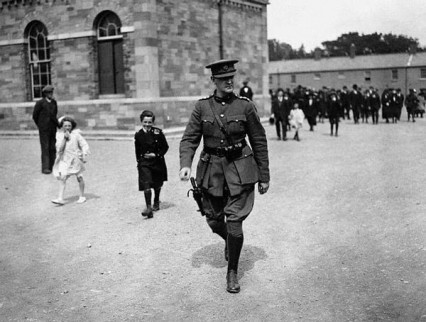
At around midday of 22 June 1922, Field-Marshall Sir Henry Wilson unveiled a war memorial at Liverpool Street Station. He made a speech, quoted some relevant Kipling poetry and soon after returned by taxi to his home at 15 Eaton Place in Knightsbridge. Two 24 year old men, Reginald Dunne and Joseph O’Sullivan, were surreptitiously waiting for his arrival. They watched while Wilson paid for his taxi before running up to him and killing him in cold blood on the footsteps leading up to his front door. In Dunne’s words:

I fired three shots rapidly, the last one from the hip, as I took a step forward. Wilson was now uttering short cries and in a doubled up position staggered towards the edge of the pavement. At this point Joe fired once again and the last I saw of him he (Wilson) had collapsed.

Joseph O’Sullivan

Reginald Dunne

The Field Marshall had half withdrawn his sword in a futile effort to protect himself but after being shot seven times he fell face first on to the pavement with blood running profusely from his body and mouth. Dunne and O’Sullivan started to run but O’Sullivan had been seriously wounded at Ypres during WW1 (both men had fought for the British) and his wooden leg severely hindered their escape. Dunne and O’Sullivan both attempted to shoot their way out of trouble and shot and injured two policemen and a civilian in the process but were soon surrounded by an angry and hostile crowd and the two men were quickly arrested. They actually had to be protected by the police from a mob who wanted instant revenge for Wilson’s death.

The steps of 36 Eaton Place where the Field Marshall fell fatally wounded.

The killing of Field-Marshall Wilson in Eaton Place turned out to be pivotal in an extraordinarily complex political period of Ireland’s history when a national liberation struggle turned into a civil war. However much of Britain was outraged with the murder and The Times wrote:

Field-Marshall Sir Henry Wilson, the famous and gallant soldier, was murdered yesterday upon the threshold of his London home. The murderers were Irishmen. Their deed must rank among the foulest in the foul category of Irish political crimes.

Six months earlier at 2.20 am 6th December 1921 the Anglo-Irish Treaty was signed between an Irish delegation, led by Michael Collins, and the British Government at 22 Hans Place. Incidentally, there is nothing on the outside of the building commemorating the historical event and today, in what is probably one of the most expensive property areas of London, seems to be unused and empty with security boards up in the windows.

22 Hans Place in Knightsbridge and where the Anglo-Irish Treaty was negotiated

Signing the Anglo-Irish treaty in 1922

Michael Collins in London October 1921

11th October 1921

Collins outside Downing Street 1921

The treaty envisaged an independent Ireland that would be known as the Irish Free State but the agreement was hugely controversial, especially back in Ireland. For a start, de Valera, the President of the Irish Republic and who had a difficult relationship with Collins at the best of times, was angry that the treaty was signed without his authorisation (although it was at his insistence that Collins went, with de Valera considering it wrong to be involved in the negotiations if Britain’s King George V wasn’t either). Also controversial was both the British insistence that they continued to control a number of ports, known as the Treaty Ports, for the Royal Navy and that Northern Ireland (which had been created in the Government of Ireland Act 1920) was able to leave the Irish Free State within one month, which of course it duly did.

In April 1922 a group of 200 anti-treaty IRA men had occupied the Four Courts in Dublin in defiance of their Government. Collins, wanting to avoid Civil War at all costs, decided to leave them alone. However after the Field Marshall’s assassination and the subsequent Fleet Street outrage this all changed. It was assumed by the British that Dunne and O’Sullivan were anti-treaty IRA men and after the shock of the Field Marshall’s murder Winston Churchill wrote to Collins threatening that unless he moved against the Four Courts anti-treaty garrison he (Churchill) would use British troops to do so for him. After a final attempt to persuade the men to leave the Courts, Collins borrowed two 18 pounder Artillery guns from the British and bombarded the Four Courts until it’s garrison surrendered. A surrender which almost immediately led to the Irish Civil War with fighting breaking out over Dublin and subsequently the rest of the country.

The Four Courts siege, Dublin 1922

Sackville Street, Dublin 1922

Meanwhile back in London at the Old Bailey, and before Mr Justice Shearman, Dunne and O’Sullivan were both tried together for the murder of Sir Henry Wilson on 2 July 1922. Dunne stood with his arms folded while the charge was being read while O’Sullivan stood stiffly at attention. When Dunne was asked, “Are you guilty or not guilty?” he replied “I admit shooting Sir Henry Wilson.” “Are you guilty or not guilty of the murder?” the Clerk of Arraigns repeated. “That is the only statement I can make,” was the response. O’Sullivan made a similar reply and after some discussion the plea was treated as one of “Not guilty.”

Towards the end of the trial, which lasted just three hours, the defence Counsel handed the judge a double sheet of blue official paper given to him by Dunne. After perusing the contents Mr Justice Shearman said – “I cannot allow this to be read. It is not a defence to the jury at all. It is a political manifesto…I say clearly, openly, and manifestly it is a justification of the right to kill.”*

Dunne’s hand written statement

Dunne and O’Sullivan were sentenced to death by hanging and sent to Wandsworth gaol where they were both hanged together by the executioner John Ellis on the 10th August 1922.

Less than two weeks later Michael Collins was ambushed and shot dead in his home county of Cork by anti-treaty IRA members.

Commander in Chief Michael Collins in July 1922, two or three weeks before he was assassinated in Cork.

Michael Collins' funeral, O'Connell Street August 1922

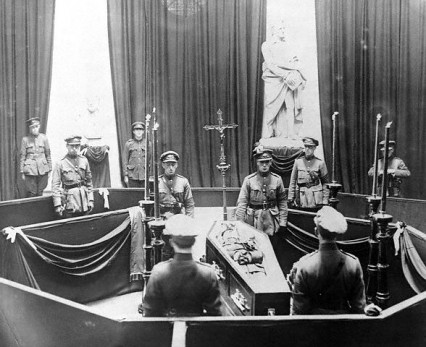
The coffin bearing the body of Michael Collins lying in state in the City Hall, Dublin. September 2, 1922 Dublin, Ireland

Michael’s brother Sean Collins

It was never really established whether Dunne and O’Sullivan acted on their own (the assassination seemed pretty badly organised for an official assassination so this was likely) or with the approval and help of Michael Collins. Collins had been a friend of Dunne’s while Sir Henry Wilson was responsible for establishing the Cairo Gang (a group of experienced British Intelligence agents who met frequently at Dublin’s Cairo Cafe) twelve of whom were murdered by the IRA acting under Collins command in 1920. The Cairo Gang killings provoked the British Auxiliaries in Dublin to shoot trapped innocent civilians at Croke Park in not the bloodiest but perhaps the nastiest of the various historical Bloody Sundays.

The infamous Cairo gang

Perhaps the ironic aspect to the story of the murder of Sir Henry Hughes Wilson was that Reginald Dunne and Joseph O’Sullivan were both born and bred in London, whereas Field-Marshall Wilson was born smack bang in the middle of Ireland at Ballinalee in County Longford.

A letter sent to O'Sullivan while waiting for his execution

Sinéad O’Connor – She Moves Through The Fair

* The text of Dunne’s intended last statement, as transcribed from the images in this post.

Lord and Members of the Jury. My friend and I stand here before you today charged with the offense of murder; and I have no doubt that, from the evidence placed before you by the prosecution, you will find us both guilty. With respect to the charges of attempted murder, we merely tried, as everyone must know, to try and escape arrest.

The offence of murder is a very serious matter; so much so, that any act which results in loss of human life requires very grave and substantial reason. We have never until now been charged with any crime. As you have heard from the Police Officer, who gave evidence as to our character and our previous records, we have both been in the British Army. We both joined voluntarily, for the purpose of [making Europe safe?] in order that the principles for which this country stood, should be upheld and preserved. These principles, we were told, were Self-Determination and Freedom for Small Nations. We both, as I have said, fought for these principles, and were commended for doing so; and I imagine that several of you gentlemen of this jury did likewise. We came back from France to find that Self-Determination had been given to some Nations we had never heard of, but that it had been denied to Ireland, We found, on the contrary that our Country was being divided into two Countries; that a Government had been set up for the Belfast district, and that under that Government outrages were being perpetrated, that are a disgrace to civilization — many of the outrages being committed by men in uniform and in the pay of the Belfast Government. We took our part in supporting the aspiration of our fellow Countrymen, in the same way as we took part in supporting the nations of the world who fought for the right of small nationalities.

Who was Sir Henry Wilson? What was his policy? And what did he stand for? You have all read in the newspapers lately, and been told, that he was a great British Field Marshal; but his activities in other fields are unknown to the men of the British public. The nation to which we have the honour to belong, the Irish nation, knows him, not so much as the British Field Marshal, but as the man behind what is known in Ireland as the Orange Terror. He was at the time of his death the Military Advisor to what is colloquially called the Ulster Government, and as Military Advisor he raised and organized a body of men known as the Ulster Special Constabulary, who are the principle agents in his campaign of terrorism.

My Lord and Members of the Jury, I do not propose to go into details of the horrible outrages committed on men, women and children of my race in Belfast and other places under the jurisdiction of the Ulster Government. Among Irishment it is well known that about 500 men, women and children have been killed within the past few months, nearly two thousand wounded, and not one offender brought to justice. More than 9000 persons have been expelled from their employment; and 23,000 men, women, and children driven from their homes. All the big cities of this country and even those of Northern France are now receiving these refugees. Sir Henry Wilson was the representative figure and the organiser of the system that made these things possible.

At his suggestion and advice the Ulster Parliament passed an Act authorising the [purging?] of political opponents and this power is now exercised and enforced by the Courts in Ulster.

There is and can be no political liberty in a country where one political party outrages, oppresses, and intimidates not only its political opponents, but persons whose religious opinion differ from those of the party in power. The same principle for which we shed our blood on the Battle Field of Europe led us to commit the act we are charged with.

My Lord and Members of the Jury, you can condemn us to death today, but you cannot deprive us of the belief that what we have done was necessary to preserve the lives, the homes, and the happiness of our countrymen in Ireland. You may by your verdict find us guilty, but we will go [to] the scaffold justified by the verdict of our own Conscience.

Dunne truncated his statement to “cut out the patriotic adjectives I feel inclined to use under the present circumstances” (as well as his specific delineation of the atrocities of Henry Wilson and the Ulster government). -ed.

On this day..

1904: Heinrich, a Herero

The Times of London reported thus, on Aug. 30, 1904:

GERMAN SOUTH-WEST AFRICA.

(FROM OUR OWN CORRESPONDENT.)

BERLIN, AUG. 29.

It is intended to hold Courts-martial in German South-West Africa for the trial of natives who have been implicated in the massacre of German colonists or who have rendered assistance to the insurgents. The first of these trials resulted in the condemnation of a Herero named Heinrich, alias Egbert, who had been concerned in the murder of a German farmer, and who had also acted as a spy in the interest of the rebels. Heinrich, who is described as “a schoolmaster and Evangelist,” was sentenced to death, and, according to intelligence just received, was hanged at Swakopmund on August 2. This case will produce a painful impression in German missionary circles, which have lately been in bad odour with the Government owing to the criticisms they had passed upon the conduct of some of the whites.

This “Heinrich” was thereby the first judicial execution for the January 1904 Herero raid that touched off the Herero genocide. Germany would secure the military scene just nine days later by routing Herero warriors at the Battle of Waterberg … and then proceed to drive almost the whole of the Herero nation into the deserts on pain of instant execution. (Jolly postcards were made of such scenes.)

Estimated body count: tens of thousands. Germans feel just awful about it.

On this day..

1997: Norio Nagayama, spree killer and author

On this date in 1997, the wait was over for a writer who had spent his entire adult life awaiting the noose.

Norio Nagayama witnessed another (eventually executed) murderer‘s Tokyo shooting spree in 1965, and three years later popped four people (two security guards and two cabbies) himself. The killing spree shocked Japan.

Only 19 at the time, which made him a juvenile by Japanese law, Nagayama was sentenced, unsentenced, re-sentenced. Twenty-eight years he spent from his arrest until his execution, not necessarily an atypical span for Japan.

It’s what Nagayama did with those years that makes him so remarkable: entering the criminal justice system from an impoverished background, Nagayama became a literary figure and a prominent public spokesman for social justice. He’s still commemorated years after his death.

Nagayama is credited with nine works, the first (Tears of Ignorance) about the poverty he blamed for his murders; the last (Hana) published posthumously from his manuscripts; he donated proceeds to victims’ families and poor children, especially in Peru. In fact, all these years dead, he’s still raising money for children.

Some books by Norio Nagayama
(all in untranslated Japanese)

Nagayama’s death was triggered, at last, by apprehension of a 14-year-old for a sensational crime barely a month prior to this date; in hanging Nagayama, the government aimed “to foster support for legislation that would ‘get tougher’ on juvenile offenders. Indeed, in 2000 Japan’s Juvenile Law was revised to make it easier to transfer minors to adult court.”

Nagayama was hanged in Tokyo with another murderer, Hideki Kanda; a husband-wife convict couple were executed the same day in Sapporo.

On this day..

1941: Paul Ogorzow, the S-Bahn Murderer

On this date in 1941, Nazi Berlin disposed of its railway killer.

Roger Moorhouse, author of a forthcoming book about Ogorzow, tells the story of this unjustly neglected homicidal maniac on his blog, and in a BBC History Magazine interview:

[audio:http://content.bbcmagazinesbristol.com/bbchistory/audio/BBC_History_May09_Pt2.mp3]

Paul Ogorzow (German link) plied his trade in a city blacked-out against British bombing, but he provides an illuminating glimpse at criminal investigation.

While Ogorzow benefited from Berlin’s preternatural darkness, he didn’t go greatly out of his way to cover his tracks otherwise. At least four of his eight murders were within a mile of his house; one woman who survived his attack reported the assailant was wearing German Railways kit.

The police, prone then as now to (sometimes hastily) settle on a theory and seek evidence to confirm it, remained blind to the seemingly obvious possibility that a railway worker was the culprit … even if he also happened to be a Nazi party member in good standing.

The official fixation on Untermenschen may not be surprising given the ideological climate, but Germany had had its share of noteworthy murderers in the interwar years who were neither Jews nor foreign laborers nor British agents — the suspect profiles favored by German investigators while Ogorzow continued his killing spree.

With the slightest measure of care, the S-Bahn Murderer might have plied his hobby unmolested until the wartime manpower shortages started making him look like an attractive bit of cannon-fodder for the eastern front. Alas for him, his voracious appetite for murder — eight victims with similar m.o. in just a few months — eventually made him so obvious that even the police could no longer overlook him.

Although the government kept the crime and its unedifying investigation fairly quiet, it was known. There was even a 1944 true crime potboiler by Wilhelm Ihde (pseudonymously writing as “Axel Alt”), Der Tod fuhr im Zug (Death Rode the Train). According to Todd Herzog,

Alt’s novel is representative of the dominant tendency of the period to celebrate the work of the criminal police while avoiding any portrayal of the totalitarian apparatus that surrounded criminal politics in the Third Reich.

Little surprise there.

Alt’s novel ultimately aligns itself with [Fritz] Lang’s film [M] in showing the methodical work of professional detectives to be ineffective in capturing the modern killer and explicitly calling for … recruitment of the public to aid the police in fighting crime.

On this day..

1942: Joan Peiro i Belis, Catalan anarchist

On this date in 1942, anarchist, trade unionist and anti-fascist Joan Peiro was shot with six others at Paterna, Spain.

Joan (or Juan) Peiro (English Wikipedia page | Spanish) was a Barcelona glassworker of anarcho-syndicalist politics.

As Secretary General of the Confederacion National del Trabajo (CNT) and editor of the anarchist rag Solidaridad Obrera, Peiro mixed it up in the rough-and-tumble interwar political scene, eventually becoming Minister of Industry for Republican Spain — an untoward position to more orthodox anarchists.

When the Spanish Republic lost the Civil War, Peiro fled to France, where he was nabbed and extradited.

The nationalist general Emilio Mola had said before the war’s conclusion,

Whoever is, openly or secretly, a supporter of the Popular Front, must be shot … we must sow terror … eliminating without scruple or hesitation those who do not think as we do. (Source)

In practice, reprisals weren’t that vicious (maybe because Mola himself had died in a plane crash and wasn’t managing them) — but the leadership and intelligentsia who could rally an anti-Franco political bloc were purged ruthlessly.

The imprisoned Peiro was offered — repeatedly — a sellout package to oversee Franco’s house unions, and he repeatedly refused.

He earned martyrdom for his troubles, and after Franco’s death re-entered the public sphere as the sort of bloke to name streets after. (As an anti-Stalinist, Peiro had had all the right enemies.)


Placa Joan Peiro, a major square in Barcelona.

The Spanish judiciary, however, has thus far declined (Spanish link) to overturn his sentence.

Peiro is saluted in Catalan here.

On this day..