1977: Marta Taboada and Gladys Porcel, Argentina revolutionaries

Early in the morning on this date in 1977, Argentinian revolutionaries Marta Angélica Taboada de Dillon and Gladys Porcel were shot by the junta.

Essentially all the information available about these Dirty War murders is in Spanish, as are most of the links in this post. The preceding October, Argentina’s new military junta — having just a few months previous seized power by deposing Juan Peron’s widow — raided the Buenos Aires house shared by the pregnant Marta Taboada with Gladys Porcel and the latter’s boyfriend Juan Carlos Negro Arroyo, all of them adherents of the October 17 Revolutionary Movement.*

They vanished into the shadow ranks of the “disappeared” — the women shot on February 3 in Ciudadela, Negro Arroyo executed separately with some other male activists that same month, all to be dumped into the mass graves that became the usual repose of the junta’s enemies.

Taboada’s children, notably including journalist and activist Marta Dillon, who was 10 at the time, witnessed their mother’s abduction. In 2000, all four children marked the anniversary of that terrible night — a night, Marta Dillon described, after which there was “nothing left of the world that I had known” — by publishing a letter in a newspaper pledging militancy in their mother’s memory.

Mama, in your name and in that of all the compañeros, we uphold the joy of standing and fighting. We do not forget, we do not forgive, we do not reconcile, we judge and punish the genocides and their accomplices.

-Marta, Santiago, Andrés and Juan Dillon.

The remains of Taboada, Porcel, and Negro Arroyo were identified by forensics teams in 2011 and interred with honor.

* The name alludes to the date in 1945 when popular protests forced the army to release Juan Peron from custody.

On this day..

1715: Ann Wright, branded

On this date in 1715, a longtime petty thief named Ann Wright — or was it Martha Wright? or Ann Hutchins? or Elizabeth Jolly? — hanged at Tyburn.

In the absence of modern trappings like a standing police force, criminal dossiers, and systematic record-keeping — innovations that lay decades into the future — small-time criminals could float at the margins for the duration of many years and many offenses by relying on the forgetfulness of the legal apparatus: with nothing but a casual alias, one might hope to appear over and over again as a new offender.

Here we see Ordinary of Newgate Paul Lorrain deploy his own investigative acumen to trace for us one woman’s career, a very much more penetrating biography of an Early Modern commoner than we can usually access. We can see from his account of offenses — for how many crimes must Lorrain be omitting in this register? — that he was greatly aided by Wright’s own body which bore the mark of our Old Offender’s repeated brandings. That included scars earned during the brief period from 1699 to 1707 when brands could be applied to an offender’s cheeks, a fate which apparently befell Ann Wright on no fewer than five occasions.*

By the time he came to Wright’s terminal adventure, Rev. Lorrain had held the post of ministering to convicts for fifteen years and could probably boast as expert an acquaintance with London’s criminal underworld as any square; whether he knew Ann Wright on sight or knew her by reputation, he knew her.

Ann Wright, condemn’d for breaking the Lock of Eliz. Barrot’s Chamber-Door, with an intent to rob her, on the 30th of October last. She was about 38 Years of age, and liv’d in the Parish of St. Dunstan, Stepney. She would hardly confess her self guilty of the Crime for which she was justly Condemn’d; neither did she readily acknowledge, that she had done several other Facts of the like heinous nature, and was an old Offender: But when I laid before her, and charg’d her with diverse Burglaries and Robberies, which I knew she had committed, then she could not deny her being Guilty of them.

Here I shall give the Reader a Particular of some of those wicked Facts of hers, and the several Punishments she receiv’d for them, the Time when, and the various Names she went by.

1st, She was (under the Name of Martha Wright) Burnt in the Cheek at the Old-Baily, on the 10th of July, 1702, for entring the House of Mr. James Gee, and taking thence 4 Muslin-Neckcloths, 2 Holland-Aprons, a Hol-Smock, a Cloth-coat, Wastcoat and Breeches, with diverse other Goods, on the 2d of the said Month of July.

2dly, She was (under the Name of Ann Rebel alias Ann Hutchins, which latter, as she said, was her Maiden-Name) also Burnt in the Chek at the Old-Baily, on the 11th of September, 1702, for Robbing the House of Mr. Joseph Lineum, on the 7th of August before, and taking thence 6 Hempen-Aprons, 6 Dowlas-Shirts, 6 Smocks, &c.

3dly, She was again (under the same Name of Ann Hutchins) Burnt in the Cheek, at the Old-Baily, on the 9th of July, 1703, for stealing 5 ounces of China-Silk from Mr. John Sheppard, and other Silks from Mr. Nathanael Wichel, on the 19th of May before.

4thly, She was in like manner (under the Name of Ann Hutchins) Burnt in the Cheek, at the Old-Baily, on the 2d of June, 1704, for stealing 4 Buck-Skins from Mr. Tho. Boddington, on the 4th of May preceding.

5thly, She was (under the Name of Elizabeth Jolly alias Hodges, which latter she said was her Husband’s Name) again Burnt in the Cheek, at the Old-Baily, on the 17th of January, 1704/1705, for stealing 16 yards of Silk, a Stuff-Gown and Petticoat, 12 ells of Holland, 26 yards of Lace, and diverse other Goods of Mr. Edward Kenworthy’s, on the 14th of June, 1704.

6thly, She was (under the Name of Eliza. Wright) on the 6th of July, try’d at the Old-Baily, and order’d to be whipt, for stealing a Silver-Spoon and a Cambrick-Handkerchief, from Mr. Anthony Moreing, on the 17th of June before.

7thly, She was (under the Name of Ann Hicken) Burnt in the Hand, at the Old-Baily, on the 26th of February, 1707/1708, for stealing 10 ounces of Silver Orrice-Lace, and 12 ounces of Gold-Lace, from Mrs. Margaret Tiplady, on the 3d Day of the same Month.

8thly, She was again (under the Name of Ann Hutchins) Burnt in the Hand at the Old-Baily, on the 9th of July, 1708, for Robbing Mrs. Mary Collier’s House, and taking from thence 1 pound 15 ounces of Raw-Silk, on the 26th of the preceding June.

9thly, She did (under the Name of Ann Hodges alias Hodgkins) receive Sentence of Death, at the Old-Baily, on the 6th of May, 1709, for Breaking the House of Mr. John Marsh, and taking from thence a Psalm-book, two Cloth-Coats, a Diaper Table-cloth, 10 Napkins, and several other things, on the 11th of April before; for which having obtain’d a Reprieve, and afterwards a Pardon, which she pleaded in Court at the Old-Baily, on the 8th of December, 1710, (at which time she was order’d to the Bridewell of Clerkenwell for 2 Years) she no sooner had her Liberty (which she got by breaking out of that House of Correction) but she return’d to her former wicked Way of Robbing. So that,

10thly, She was again (under the Name of Ann Hutchens) Burnt in the Hand at the Old-Baily, on the 12th of April, 1711, for stealing 4 Holland-Smocks that hung up a drying in the Yard of Mr. William Baker, on the 28th of March preceding.

11thly, She was (under the Name of Ann Hodges) Burnt in the Hand at the Old-Baily, on the 28th of February, 1711/1712, for Stealing a Coat, Wastcoat, and Breeches, Linnen, Gold-Rings, and other Goods, of Mrs. Susannah Butterwick, on the 12th of the same Month.

12thly, and Lastly, (to mention no more of these sad Particulars) She was again (under the Name of Ann Hodges, alias Jenkins, alias Jeatzin) Burnt in the Hand, at the Old-Baily, on the 2d of May, 1712, for a Felony, in stealing Pewter and other Goods out of the House of Mr. John Simmonds, on the 5th of the ‘foregoing March.

All these her notorious Facts, of which I had taken a particular Account, I laid before her, together with some others she had been try’d for, but acquitted of, for want of positive Evidence to convict her, tho’ there was no great reason to doubt her being guilty of ’em: And moreover, I put her in mind of her having frequently broke out of the Workhouse, to which she had several times been sent, for her Correction and Amendment; the former whereof she would not receive, nor bring her self to the practice of the latter, but plainly shew’d her ill Disposition and wicked Desire of returning (as she did so fast as she could) to her sinful Course of Life; of which I exhorted and press’d her to make a free Confession, and repent. Whereupon she acknowledg’d her Guilt in these Matters, saying, (in general) That she had done many ill things, but her discovering them in particular (were she able fully to do that) would be now of no use to the World. Having some just Suspicion that she had been concern’d in Facts committed in Surrey, and try’d for them in that County, I put the Question to her, which she answer’d in the Negative, thinking (I suppose) that those Facts could not so easily be known to me, being done not only at a distance, and in a County where I have nothing to do, but also under Names which she thought fit at times to take and shift, as suited best her Occasions of disguising her self, and concealing Who and What she was. I found her all along very stupid, and insensible both of her sad Condition, and the Cause of it. When I examin’d her in private, she was very sullen, spoke but few (and those angry) Words, and shed fewer Tears: What her inward Thoughts were, I can’t tell; but she gave little sign of true Repentance. As I observ’d her in that harden’d Temper, so I told her, That she behav’d her self just as I had seen others do, who were guilty of Murder, whom (above all other Sinners) the Devil does what he can to hinder from repenting; and therefore I must needs plainly say this to her, That I was afraid she had been concern’d in some Bl[oo]dy Fact or other; for she seem’d to me to be more than a common Sinner. To this she answer’d, That she never committed any Murder in her Life. No? said I to her; Did you never kill a Bastard-Child, to hide your Shame when you were in Service? (for I knew she had been a Servant in some Families in and about London.) At this Question she startled, and after a Pause (not without some discomposure) said, She was very clear of that Crime. However I gave her to understand I greatly suspected she was not, for she had been a very wicked, lewd, and debauch’d Woman; and so I offer’d her some ghostly Advice herein. Then I further ask’d her, Whether she knew any thing of the Murder of Esq. Hanson and Mr. Carlton, who (some Years ago) were found murder’d, viz. the first near the Vinegar-house beyond Moorfields, and the other between Rosemary-branch and Cambray-house, in Islington Parish. To which she reply’d, That she had indeed heard of those Murders, but was not in the least concern’d in ’em, nor knew who had committed them. This is all I could get from her, who (as I observ’d with great Concern) instead of making a right use of the long Time and good Instruction she had under this Condemnation, seem’d (all the while) to have nothing so much at Heart as getting a Reprieve, and avoiding this Death; tho’ I endeavour’d to make her sensible, there was no manner of ground for her Hope of Life in this World; and, that if she were wise she would (as ’twas infinitely better she should) seriously consider her sad and miserable Condition by reason of her Sins, and so by all the Acts of Repentance she was capable of exerting, prepare herself for her great Change that was approaching and inevitable. And this important Consideration I urg’d to her, to the very last.

At the Place of Execution (whither both she and George Hynes were this Day carried from Newgate in a Cart, and where I attended them for the last time) she seem’d to be much dejected and sorrowful; and no Wonder, for she had great Cause to be so. Hynes likewise cry’d bitterly, lamenting and bewailing his past sinful Life. Here I gave them proper Admonitions; and after I had pray’d, and sung some Penitential Psalms with them, and made ’em rehearse the Apostles Creed, I advis’d, that they would (and accordingly they did) desire the Spectators to pray for them, and take Warning by their Fall; To keep the Sabbath-day, serve God, and live honestly. Then I withdrew from them, recommending their Souls to God, and leaving them to their private Devotions, for which they had some Time allotted. After this the Cart drew away, and they were turn’d off, crying all the while to God for Mercy, Pardon, and Salvation.

* We’ve previously seen that London authorities didn’t mind applying the brand several times to a habitual offender.

On this day..

1782: Jose Antonio Galan, for the Revolt of the Comuneros

Ni un paso atrás, siempre adelante, y lo que fuere menester … sea!

-Jose Antonio Galan

On this date in 1782, Comunero rebel Jose Antonio Galan was executed in Bogota, New Grenada (present-day Colombia).

Spain’s New World precincts had risen in response to intensified taxation exacted by the empire’s modernizing reforms and particularly accelerated when Spain went to war against Great Britain in 1779; similar pressures likewise helped to trigger the 1780-1781 Tupac Amaru insurrection in Peru.

In New Grenada, spontaneous resistance to new viceregal edicts coalesced into one of the most serious rebellions of the Spanish colonial era — albeit one that aimed at reform, not revolution.

Shouting demands for tax reductions and greater local autonomy, a force of 10,000-20,000 rebels marched on Bogota in the spring of 1781, routing a column of government soldiers sent to disperse them and forcing authorities to terms that the latter had no intention of honoring. This is one of the oldest ploys: offer concessions to end the rebellion, then declare the concessions null and void as obtained under duress when the rebels are safely out of arms.

An illiterate mestizo peasant, our man Galan (the cursory English Wikipedia entry | the much more satisfactory Spanish) was not the principal captain of this rebellion but he seems to have exceeded them in foresight — for Galan and his more radical followers continued the revolt even after the main body of Comuneros went home satisfied with the government’s specious pledges. North of Bogota, Galan threatened a more Tupac Amaru-like experience, attracting a multi-racial lower-class force* which he turned against hacienda landowners.

Captured in October of that same year after reinforcements arrived at Bogota to begin laying down imperial law, Galan was so popularly admired that no free blacksmith would accept the contract to forge his irons — all the more reason for his exemplary sentence:

We condemn José Antonio Galán to be removed from jail, dragged and taken to the place of execution, where he is hanged on the gallows until dead; when lowered, his head is to be cut off, his body divided into four parts and passed through the flames (for which a bonfire will be lit in front of the scaffold); his head will be taken to Guaduas, theater of his scandalous insults; the right hand placed in the Plaza del Socorro, the left in the town of San Gil; the right foot in Charalá, place of his birth, and the left foot in the place of Mogotes; his descendants are declared infamous, all his goods are confiscated to the treasury; his house is to be pulled down and sown with salt, so that his infamous name may be lost and consigned to such a vile reputation, such a detestable memory, that nothing remains of him but the hate and fright that ugliness and crime inspire.

Despite the sentence, it’s said that an unskillful executioner not knowing how to hang his man shot him dead instead, so that he could proceed to the butchery.

* The main insurrection that had so meekly disbanded itself was heavily led by Creole local elites with a clear inclination towards deal-making.

On this day..

1851: Ruben Dunbar, Destructiveness and Combativeness

On this date in 1851, Ruben Dunbar hanged in New York for murdering two little boys: the 8- and 10-year-old nephews to his widowed mother’s second husband. Thanks to the mother’s remarriage, these boys had supplanted Dunbar as the heirs to his mother’s property.

We’re indebted for highlighting this case to our crime-blogging friends at Murder by Gaslight, who also call attention to a short pamphlet entitled “Phrenological Character of Reuben Dunbar, With a Short Treatise on The Casuses and Prevention of Crime”. This item is available free from Google Books and contains the findings of a phrenologist — Margaret Thompson — who examined Dunbar. (Phrenology was already into an advanced stage of disrepute by the 1850s.)

We begin with the core metrics:

His physiology is sound and good. He has a fair proportion of all the temperaments, with a predominance of the vital. The size of his head is 22 3/4 inches in curcumference, over the organs of Individuality and Philoprogenitiveness; and 13½ inches over the top, from Destructiveness to Destructiveness, over Firmness. The size of his phrenological developments, on a scale of from one to seven, are as follows:

Amativeness, 5; Philoprogenitiveness, 4; Adhesiveness, 6; Inhabitiveness, 5; Concentrativeness, 4; Vitativeness, 6; Combativeness, 6; Destructiveness, 6; Alimentiveness, 6; Acquisitiveness, 6; Secretiveness, 7; Cautiousness, 6 to 7; Approbativeness, 7; Self-Esteem, 4; Firmness, 7; Consceintiousness, 4; Hope[,[ 5; Marvellousness, 4; Veneration, 4; Benevolence, 5; Constructiveness, 5; Ideality, 4; Sublimity, 5; Imitation, 5; Mirthfulness, 5; Individuality, 6; Form, 6; Size, 6; Weight, 6; Color, 6; Order, 6; Calculation, 5; Locality, 6; Eventuality, 6; Time, 5; Language, 5; Causality, 5; Comparison, 6

Several pages then elucidate the weight and combination of these figures in the estimation of the examiner, also neatly retrofitting the crime that she knows Dunbar stands accused of.

Philoprogenitiveness is only average. He might love his own children, but would not care for the children of others; and his large Destructiveness and Combativeness would incline him naturally to be impatient, severe, and even cruel with children over whom he has control.

His selfish propensities are large, while his moral faculties are between full and average. In such an organization the selfish feelings have a very powerful influence, and without great care and constant exercise of the moral organs, will be sure to gain the ascendancy. Acquisitiveness is large and very active. This gives him a strong desire to obtain money, property, &c.; and with his inferior moral brain, would lead him to be penurious and covetous. Secretiveness is very large. He is exceedingly cunning, and capable of acting artfully and deceitfully; has uncommon power to conceal his real feelings. Seldom discloses his plans to others; is secretive and says little. Destructiveness and Combativeness are large also; so is firmness. These, with his other combination of organs, make him quarrelsome, harsh, severe, self-willed, tenacious of his rights, wilful, and desperately determined.

All told, she reckons, Dunbar labored under “an unfortunate organization; one in which the animal propensities govern, because the moral faculties are not sufficiently large to balance and control them.”

Thompson’s pamphlet then pivots curiously from her diagnosis of Dunbar to that of his entire society, and reaches her own science’s strange circuits a familiar conclusion:

Crime is caused by an abuse or perverted action of the animal propensities, owing principally to education, and partly to the hereditary transmission of those faculties from parents to their children … It is a fact which comes within the range of our observation daily, that the faculties of Destructiveness and Combativeness are almost universally strengthened and encouraged in children by severe and coercive measures … Punishment with the rod invariably tends to give a highly stimulated and perverted action to Destructiveness and Combativeness … by repeated whippings an increased quantity of blood is sent to the base of the brain, and it is thereby inflamed and excited, and increased in size and activity. If children are punished in anger, and from a spirit of retaliation, we may reasonably expect to see in them, when full grown and matured, an abnormal exercise of Destructiveness and Combativeness.

Thompson recommends a more rehabilitative approach to criminal justice, a combination of instruction and what she calls “the law of love” — “of the efficacy and power of kindness over man, even when in ruins, and sunk to the lowest depths of sin and degradation. However far he may have wandered from the paths of truth and virtue, still he is a man and a brother — an immortal being, having claims on our sympathy, and our best efforts to reform him and make him happy.”

On this day..

1937: Georgy Pyatakov, Anti-Soviet Parallel Trotskyist

On this date in 1937, Georgy Pyatakov was condemned to death and shot in Moscow as a Trotskyist conspirator.

Pyatakov (English Wikipedia entry | the more detailed Russian) was a young Bolshevik activist not long out of his schooling — and his de rigueur Siberian sentence — when the Russian Revolutions of 1917 overturned tsarism. He played an important role in the Communist revolution in Ukraine but his political opinions come the 1920s essentially aligned with Trotsky’s and we know where that will land a Bolshevik once Koba has the state in hand.

Pyatakov would die in the second of the so-called “Moscow Trials”, which was the third of the signal deadly show trials that would herald the frightful acme of Stalinism: preceding it was the First Moscow Trial or the Trial of the Sixteen in August 1936, in which Old Bolsheviks Zinoviev and Kamenev were executed as supposed Trotskysts; it was followed in November 1936 by the Kemerovo Trial in Western Siberia, in which a mining disaster was pinned not on shoddy industrial management but on a Trotskyist “wrecking” conspiracy to sabotage the Soviet economy.

Gleefully did these trials compound upon the web that Trotsky was spinning from exile in Mexico. In principle, Stalin could have chosen simply to purge Zinoviev and Kamenev as rival aspirants and have done with it: in practice, these were merely early stones of an avalanche. The Kemerovo trial expanded the grasp of the Trotskyist conspiracy to compass orchestrating terrorist cells among the whole populace; and even as arrests in locales throughout the USSR vindicated this theory, the Second Moscow Trial — our focus — made the next round of doomed elites the “reserve center” backing up the Zinoviev-Kamenev guys “in case the main center was arrested and destroyed.” It was this junior varsity that had been coordinating for several years “the main work of wrecking, which ruined much in our economy” in coordination not only with Trotsky but with insidious capitalist rulers. (The comments are from the report that secret police chief Yezhov prepared for them, as quoted in 1937: Stalin’s Year of Terror) Hey, Trotsky in his day had put together the Red Army on the fly: the man knew how to organize.

The progress of these official lines put any real or alleged opposition to Stalin on the same plane as treason against the state, the people, Communism, and with links reaching from the humblest disgruntled kulak all the way to a distant demon figure the parallel to Europe’s witch hunts is difficult to resist. The Soviet Union’s burning times would ensue with seasons of wild purging in 1937 and 1938.

The Second Moscow Trial — or, as you might have guessed it is also called, the trial of the “Anti-Soviet Parallel Trotskyist Center” — unfolded from January 23 to 30 of 1937, and featured the entirely fictional tale that Pyatakov had secretly flown to Oslo to huddle with Trotsky on their wrecking strategy. Not everyone suffered Pyatakov’s summary fate at the end; the most famous defendant in this affair, Karl Radek, got a penal labor sentence and was later murdered in the camps.

The “Anti-Soviet Parallel Trotskyist Center” types were posthumously rehabilitated during the Mikhail Gorbachev era.

On this day..

1696: Thomas Randal, obstinate

On this date in 1696, Thomas Randal was executed and hanged in chains for the robbery-murder of a Quaker named Roger Levens or Leavens.

Despite what the broadsheet below would have you believe, Randal never acknowledged the crime and begged forgiveness, at least not outside the confines of his own soul. The Ordinary of Newgate devotes a considerable portion of his 29th January 1696 account to his thorough but unavailing work on Randal’s conscience.

“On Wednesday in the Afternoon I took him aside,” he recounts — seemingly referring to a conversation a week prior to the hanging, which took place on Wednesday the 29th.

and for a considerable time endeavour’d to perswade him, no longer Athiestically [sic] to deny the Crime; but he stood out in the denial of it, whereupon I read to him, what was sworn against him at his Tryal, and that the Jury was fully convinced in their Consciences that he was guilty. Which they declared, when they gave their Verdict. He reply’d, That he did not matter that, being clear in his own Conscience. Then I told him, that he obstructed any Rational Hopes of his Salvation, and that all Persons who read the Book of Tryals, whom I met with, believ’d him to be guilty.

I pray’d, that God would work him to a free and full acknowledgment of his Crime, and grant him Repentance for it. Yet he deny’d it, and said, That he was resolved to to so at the time of his Death. I told him of a Person who Murther’d his Wife, and deny’d it several times at the place of Execution, wishing Damnation on himself, if he knew any thing of it. After I had pray’d thrice, that God would perswade him to declare the Truth; I told him, If I went out of the Cart any more, he would be presently Executed, and then he could not be Saved, dying in his Atheistical Impenitency. At last he call’d me back and said, I Murthered my Wife with a Pistol, and shot her in the Head; but let not the People know it. I said, your self shall declare, that you Murthered her. Then he said, All you that behold me pray for me, that God would Pardon my great Provocation of him denying my Crime against my Conscience; for had I died with a Lye in my Mouth, I had been damned. This Account somewhat startled Randal, and altred his Countenance; then I pray’d again, that God would not leave him to dye in so barbarous a Crime, but to confess it, and to Repent of his former Obstinacy. After this he said not any word by way of reply: Then I told him, that he ought to consider of whatsoever I had said, and I hoped that he would confess the Crime before he dy’d. He said, that he had lived in much Sinning, but would not acknowledge any particular.

Breaking down the obstinance of the doomed was one of the Ordinary’s core competencies but he never managed to add Randal’s soul to his ranks of sheep stealers made saints: the man went to the gallows with the same story on his lips.

On Wednesday the 29 January, Thomas Randal who killed Roger Levens the Quaker, was put into a Cart and conveyed by the Deceased’s Door at White-Chappel, and from thence to the Place of his Execution at Stone-bridge by Kingsland, where he is to hang in Irons, on a Gibbet, till his Body be consumed. He did confess that he was at the Marshalsea with Lock and Green but denied that he never spoke any such Words, that he did kill the Quaker: he acknowledged that he did say to the Serjeant when he was Taken, that he was a Dead Man, and that he had been a very wicked Sinner, and had been Guilty of all manner of Sins in general; (except that of Murder) He owned a Burglary that he committed at Linton, near Saffron Walden in Essex; but would not confess any of his Accomplices. He said that Hunt and he had been in many Robberies. The Worthy Sheriffs did exhort him with Spiritual Council, that he should make an Ingenious Confession, and not to perfist in his Obstinacy, and Dye with a Lye in his Mouth, but to have regard to his precious soul; it wrought nothing upon him, his Heart being so hardened, he would not discover any thing of the Murder; nor any of the Persons that was with him at the time; but hoped that he had done his Work with God-Almighty. Then Mr. Ordinary pressed him, and told him that Confession was the first step to Repentance; and without that he could hardly make his Peace with God; but it did avail nothing with him, he still persisting in the same, till the Cart Drew away; He was turned off.

On this day..

1591: Agnes Sampson, North Berwick witch

On this date in 1591, Agnes Sampson, the “Wise Wife of Keith”, went to the stake at Edinburgh during the North Berwick Witch Trials.

Perhaps Scotland’s most notorious witch hunt, the 1590-1591 sweep caught up something approaching 70 supposed sorcerers thanks to the king’s security panic after dangerous North Sea storms had beset the sea voyages uniting King James VI of Scotland and his new wife Queen Anne of Denmark. An inquisition in Denmark had made witches the culprit, and the young James — amusingly described by one commenter as “a superstitious and distrustful poltroon”* — opened an inquiry of his own as soon as he returned to native heather. His subsequent obsession with witchcraft is one of the signal characteristics of his reign, immortalized in literature via Shakespeare’s Macbeth.

James turned 24 in the summer of 1590, his short life already buffeted by fratricidal court politics (his mother, Mary Queen of Scots, lost her head; the regents who subsequently jostled over control of James had a frightening tendency to violent death). However misplaced upon magicians, his fear was well-founded; James’s cousin Lord Bothwell, himself escaped from arrest during the North Berwick scare, openly plotted against James throughout the early 1590s — one occasion coming “with fire to the king’s door, with hammers to the queen’s door” and on another surprising him in a vulnerable position during his morning toilet, causing the king to exclaim, “Came they to seek his life? let them take it — they would not get his soul.”

Peril to life and soul everywhere stretched into James’s world from the world beyond. “Our enemie is over craftie, and we over weake,” James would write in his remarkable 1597 disquisition on black magic, Daemonologie: Satan’s earthly minions so mighty that “They can rayse stormes and tempestes in the aire, either upon Sea or land.”


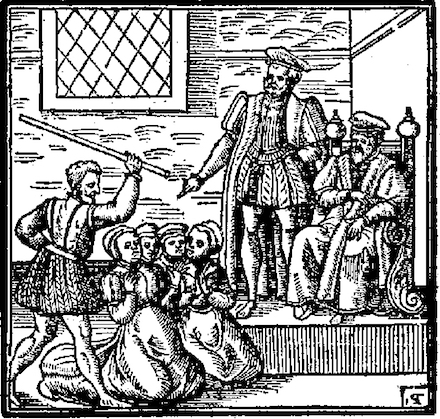
In an illustration from Daemonologie, James personally interrogates witches.

A woman named Geillis Duncan, maid to the deputy mayor of a small town near Edinburgh, was the fountainhead of the the North Berwick trials, when her suspicious master tortured her into admitting to witchcraft. King James personally joined the ensuing interrogations which saw her denounce several dozen Edinburghers as fellow necromancers, among them our day’s principal — a matronly widow named Agnes Sampson, who was a respected “wise woman” and folk healer much in demand among Edinburgh’s elites.

In Duncan’s involuntary narration, this woman “was the elder Witch” and when she “stood stiffely in the deniall of all that was laide to her charge” they dragged her to prison and put her to torture, also shaving her hairless in search of the inevitable small disfigurement that would be prejudicially construed her witches’ mark — “and forasmuch as by due examination of witchcraft and witches in Scotland, it hath latelye beene found that the Deuill dooth generallye marke them with a priuie marke, by reason the Witches haue confessed themselues, that the Diuell dooth lick them with his tung in some priuy part of their bodie, before hee dooth receiue them to be his seruants, which marke commonly is giuen them vnder the haire in some part of their bodye.”

We’re quoting here the 1591 pamphlet Newes from Scotland, one of the key primary sources (and justifications) of the witch trials which was issued from a pen very near to the king’s own hand. Having endured the cruel torture of having her hair wrenched (“thrawn”) by ropes for an hour, Newes from Scotland reports, Sampson broke down when an incriminating wart was discovered upon her bared pudenda.

the said Agnis Tompson confessed that the Divell being then at North Barrick Kerke attending their comming in the habit or likenes of a man, and seeing that they tarried over long, he at their comming enjoyned them all to a pennance, which was, that they should kisse his Buttockes, in signe of duetye to him: which being put over the Pulpit barre, everye one did as he had enjoyned them: and having made his ungodly exhortations, wherein he did greatlye enveighe against the King of Scotland, he received their oathes for their good and true service towards him, and departed: which doone, they returned to Sea, and so home againe.

At which time the witches demaunded of the Divel why he did beare such hatred to the King, who answered, by reason the King is the greatest enemy he hath in the worlde: all which their confessions and depositions are still extant upon record.

Item, the saide Agnis Sampson confessed before the Kings Majestie sundrye thinges which were so miraculous and strange, as that his Maiestie saide they were all extreame lyars, wherat she answered, she would not wishe his Maiestie to suppose her woords to be false, but rather to beleeve them, in that she would discover such matter unto him as his majestie should not any way doubt off.

And therupon taking his Majestie a little aside, she declared unto him the verye woordes which passed betweene the Kings Majestie and his Queene at Upslo in Norway the first night of their mariage, with their answere eache to other: whereat the Kinges Majestie wondered greatlye, and swore by the living God, that he beleeved that all the Divels in hell could not have discovered the same: acknowledging her woords to be most true, and therefore gave the more credit to the rest which is before declared.

One can see the work this tract — circulated as its title implies in England, where James was already being set up to inherit rule from the aging Queen Elizabeth — effects as propaganda: James as “the greatest enemy [the Devil] hath in the worlde”; James as the savvy and thorough interrogator too worldly to be taken by Agnes Sampson’s crazy stories until she proved them with a conveniently unfalsifiable private conference. Definitely no superstitious poltroon! Why, it was only by his superlative faith that James earned the divine favor required to overcome his adversaries’ weather machinations.

She confessed that she tooke a blacke Toade, and did hang the same up by the heeles, three daies, and collected and gathered the venome as it dropped and fell from it in an Oister shell, and kept the same venome close covered, untill she should obtaine any parte or peece of foule linnen cloth, that had appertained to the Kings Majestie, as shirt, handkercher, napkin or any other thing which she practised to obtaine by meanes of one John Kers, who being attendant in his Majesties Chamber, desired him for olde acquaintance betweene them, to helpe her to one or a peece of such a cloth as is aforesaide, which thing the said John Kers denyed to helpe her too, saying he could not help her too it.

And the said Agnis Tompson** by her depositions since her apprehension saith, that if she had obtained any one peece of linnen cloth which the King had worne and fouled, she had bewitched him to death, and put him to such extraordinary paines, as if he had beene lying upon sharp thornes and endes of Needles.

Moreover she confessed that at the time when his Majestie was in Denmarke, she being accompanied with the parties before specially named, tooke a Cat and christened it, and afterward bound to each parte of that Cat, the cheefest partes of a dead man, and severall joynts of his bodie, and that in the night following the saide Cat was conveied into the midst of the sea by all these witches sayling in their riddles or Cities as is aforesaide, and so left the saide Cat right before the Towne of Lieth in Scotland: this doone, there did arise such a tempest in the Sea, as a greater hath not beene scene: which tempest was the cause of the perrishing of a Boate or vessell comming over from the towne of Brunt Iland to the towne of Lieth, wherein was sundrye Jewelles and riche giftes, which should have been presented to the now Queen of Scotland, at her Majesties comming to Lieth.

Againe it is confessed, that the said christened Cat was the cause that the Kinges Majesties Ship at his comming foorth of Denmarke, had a contrary winde to the rest of his Ships, then being in his companye, which thing was most strange and true, as the Kings Majestie acknowledgeth, for when the rest of the Shippes had a faire and good winde, then was the winde contrarye and altogither against his Majestie: and further the saide witche declared, that his Majestie had never come safelye from the Sea, if his faith had not prevailed above their ententions.

Moreouer the said Witches being demaunded how the Divell would use them when he was in their company, they confessed that when the Divell did receive them for his servants, and that they had vowed themselues unto him, then he would Carnallye use them, albeit to their little pleasure, in respect of his colde nature: and would doo the like at sundry other times.

The History of Witchcraft podcast does a deep dive on the North Berwick trials in episode 9 which indulges detail (from about 25:40) on the logistics of witch-burning executions. This episode is part of a whole series on witchy King James that also compasses episodes 7, 8, and 10.

* Ray Defalque and A.J Wright, “In the Name of God: Why Agnes Sampson and Eufame McCalyean were burned at the stake” in Bulletin of Anesthesia History, July 2004. The interest in the case from this unusual-to-Executed Today source is that the charges against Sampson included those of witcherous midwifery, to wit, “remov[ing] Lady Hirmestone’s pain and sickness the night of her labor” and doing the same for Eufame McCalyean. As a result, “several authors have suggested that obstetrical analgesia started in Edinburgh in 1591,” an interpretation that Defalque and Wright, both anesthesiologists, reject.

** Newes from Scotland puts this part of the confession into the mouth of a more historically elusive woman called “Agnis Thompson”: many scholars believe that Sampson and Thompson are the same person.

On this day..

1725: James Casady, aged beggar

Original Dublin broadsheet via James Kelly’s Gallows Speeches: From Eighteenth-Century Ireland:


THE LAST SPEECH AND DYING WORDS OF
JAMES CASADY

Beggar Man who was Executed this Day, being the 27th of this Instant January, 1724-5* at Kilmainham, for Robbing on the High-Road.

Good People,

I was Born in Artlow in the County of Wicklow, and had very honest Parents, who gave me good Edication.

When I came to my Tryal before the Judge at Kilmianham, one Margaret Nowland and Owna Callahan, Swore I was a Robber these thirty Years past, and they also said that I was concern’d in Robbing the Bishop of Dublin, for which I was Try’d and Clar’d; the above Witness also Swore that I was concerned in a Robbery of a Gentlemans House in Great Britain Street, about three Years ago; The said Owna also Swore that I, one O’Neil, and a Piper was concern’d the last Robbery, and that she was one of their Comrades then, and watch’d in the Street while the said Robbery was doing.

They also swore that I had plates and Dishes in my Custody; which I brought out of the sd. House, Also that the above Margaret swore that when she heard the great dogg bark, that she came down stairs, and seeing me and agove 3 Men coming out of Capt. Gratons House, she heard the sd. Casady speak to the rest of his Comrades to Murder her, to which the said Ona Cry’d out and spoke to ’em, and begg’d that there should be no murder, Committed where she was, this is what the above Per-[sons?] swore against me at the Sessions-House in Kilmainham.

Now I do hereby Declare before God, the sheriff, and all the rest of my Spectators, that as I am here to suffer this untimely Death; tho’ I cou’d not live much longer, for I am about 80 years of Age.

As for what Money I had by me, it was very honestly got, and I design’d it for my Son, but having an extravagant Wife, was the reason that I always carried the sd. money always with me, wherever I went a begging, or to work any where, which I am sure that the sd. money is the cause of this my untimely end.

I James Cassedy do further declare at this my Dying Minute, that I do not know any of these my Prosecutors, and on the Dying Words of one who expects Salvation I know nothing of the matter that I am Charg’d with.

I do not blame the Judge nor Jury, and I forgive all the World, I would die a Roman Catholick, and the Lord have Mercy on my poor Soul.

He was buried under the Gallows in his Cloaths.

* 1725 by our present-day reckoning; because England’s new year at this time did not officially occur until March 25, it was still legally 1724. Many documents of this period write dates in this manner (“1724-5”) for clarity, since it was a potential confusion to contemporaries as well. Calendars are aggravating sometimes.

On this day..

1830: Benito de Soto, a pirate hanged at Gibraltar

On this date in 1830, the Galician or Portuguese pirate Benito de Soto was hanged at Gibraltar.

One of the very last of the dying breed of high-seas pirates, de Soto mutinied aboard an Argentine slave smuggler in 1827, re-christened her Burla Negra (“Black Joke”), and ran up the black flag.*

The pirates now entered freely into their villianous [sic] pursuit, and plundered many vessels; amongst others was an American brig, the treatment of which forms the chef d’oeuvre of their atrocity. Having taken out of this brig all the valuables they could find, they hatched down all hands to the hold, except a black man, who was allowed to remain on deck, for the special purpose of affording in his torture an amusing exhibition to Soto and his gang. They set fire to the brig, then lay to, to observe the progress of the flames; and as the miserable African bounded from rope to rope, now climbing to the mast head — now clinging to the shrouds — now leaping to one part of the vessel, and now to another, — their enjoyment seemed raised to its highest pitch. At length the hatches opened to the devouring element, the tortured victim of their fiendish cruelty fell exhausted into the flames, and the horrid and revolting scene closed amidst the shouts of the miscreants who had caused it.

Of their other exploits, that which ranks next in turpitude, and which led to their overthrow, was the piracy of the Morning Star. They fell in with that vessel near the Island Ascension, in the year 1828, as she was on her voyage from Ceylon to England. This vessel, besides a valuable cargo, had on board sevreal [sic] passengers, consisting of a major and his wife, an assistant surgeon, two civilians, about five and twenty invalid soldiers, and three or four of their wives. As soon as Benito de Soto perceived the ship, which was at day-light on the 21st of February, he called up all hands, and prepared for attacking her; he was at the time steering on an opposite course to that of the Morning Star. On reconnoitring [sic] her, he at first supposed she was a French vessel; but Rabazan, one of his crew, who was himself a Frenchman, assured him the ship was British. “So much the better,” exclaimed Soto, in English, (for he could speak that language,) “we shall find the more booty.”

The Burla Negra was much the faster and better-armed ship — in fact the Morning Star was completely unarmed, with not even a store of small arms for her frightened passengers — and soon corralled her prey, murdered the captain and mate, plundered the ship, and gang-raped the women aboard. The only mercy was that the marauders, out of tenderness or drunkenness (having also helped themselves to the Morning Star‘s wine), only imprisoned the human cargo below when they scuttled the ship and sailed away — and the passengers and crew were able to free themselves before they drowned and return safe home to tell the tale of their outrage.

Benito de Soto sailed next for his home port of Corunna, with the aid of a hostage navigator commandeered from his next prize. (The captain ruthlessly shot said unwilling helmsman dead upon arrival.) This adventure, however, marked the last of his career for on the way back to sea the corsairs were shipwrecked and had to take refuge at British Gibraltar where, after residing some time under false identities, a survivor of the Morning Star recognized them.

Easy come, easy go. “Adeus todos!” were his understated last words, not counting those syllables whistled by the salt winds through his posthumous pike-mounted skull.

However, British authorities — who were very conscious that they had detected the villain by pure chance — were not at all amused by the ease with which he had set up in Gibraltar. His legacy would be an impetus to Gibraltar officials to tighten up entrance regulations and, later that same year of 1830, to institute the Royal Gibraltar Police — the oldest police force in the Commonwealth outside the British isles.

* The slaver was full of African slaves, so the first profitable thing the buccaneers did was complete the vessel’s “legitimate” purpose by smuggling them to the West Indies. A black cabin boy that de Soto chose to retain would be captured with the rest and give evidence against the pirates. “The black slave of the pirate stood upon the battery trembling before his dying master to behold the awful termination of a series of events, the recital of which to his African countrymen, when he shall return to his home, will give them no doubt, a dreadful picture of European civilization,” muses our reporter.

On this day..

1981: Not Kim Dae-jung, South Korean president and Nobel laureate

South Korea’s dictator reluctantly commuted the death sentence of democracy activist Kim Dae-jung on January 24, 1981 … a gesture that would eventually enabled Kim to return the same favor to the dictator.

A farmer’s son who became a wealthy businessman and a charismatic orator, the Catholic Kim had been a fixture of the political opposition since the 1960s which was a dangerous profession. In his address accepting the Nobel Peace Prize for 2000, Kim reflected that

five times I faced near death at the hands of dictators. Six years I spent in prison, and 40 years I lived under house arrest or in exile and under constant surveillance. I could not have endured the hardship without the support of my people and the encouragement of fellow democrats around the world. The strength also came from deep personal beliefs.

I have lived, and continue to live, in the belief that God is always with me. I know this from experience. In August of 1973, while exiled in Japan, I was kidnapped from my hotel room in Tokyo by intelligence agents of the then military government of South Korea. The news of the incident startled the world. The agents took me to their boat at anchor along the seashore. They tied me up, blinded me and stuffed my mouth. Just when they were about to throw me overboard, Jesus Christ appeared before me with such clarity. I clung to him and begged him to save me. At that very moment, an airplane came down from the sky to rescue me from the moment of death.

His life on that occasion was saved by the aggressive intervention of U.S. ambassador Philip Habib.

South Korean politics went on tilt after the ruler who nearly had Kim “disappeared” in 1973 was himself bizarrely assassinated by the country’s intelligence chief in late 1979. Emboldened democracy movements raced into the ensuing power vacuum, roiling cities and universities and culminating in May 1980 when a popular uprising in Kim’s native Jeolla was crushed with hundreds of deaths, bringing martial law in its wake. This was the Kwangju or Gwangju Rising (and/or -Massacre), and it led to Kim’s condemnation for sedition.


Kim Dae-jung in the front row of prisoners on trial after Kwangju.

The U.S. Carter administration, and (from November of 1980) the transition team for the incoming Reagan administration, worked strenuously behind the scenes to effect a commutation;* hanging Kim, Reagan foreign policy advisor Richard Allen warned a Korean intelligence delegation, “would be like a bolt of lightning out of the heavens that will strike you.”

The dictator Chun Doo-hwan eventually traded Kim’s life — he’d be sent into exile in the United States under the pretext of going abroad for medical treatment — for an official visit in the first weeks of the incoming president. Reasoning that

Kim’s execution would inflict long-term damage on Chun’s rule, which by this time had stabilized … On January 24, 1981, Chun commuted Kim’s death sentence to life imprisonment and lifted martial law. On February 3, Reagan warmly welcomed Chun to the White House for a summit meeting. He was the second foreign head of state Reagan met after his inauguration. This meeting was important in enhancing the legitimacy of Chun’s leadership both at home and abroad.

-Chae-Jin Lee, A Troubled Peace

Kim returned to South Korea in 1985 as a closely-monitored opposition figure and re-entered politics, repeatedly seeking election to the presidency — which he finally won in 1997, earning not only executive power but the rare opportunity to repay Chun Doo-hwan’s bygone act of grace.

Earlier in 1997, Chun had been convicted by the post-dictatorship courts on a number of capital charges relating to his reign in the 1980s, and himself sentenced to die. President-elect Kim coordinated with his predecessor Kim Young-sam to have Chun’s sentence commuted during the transition.

“In all ages, in all places, he who lives a righteous life dedicated to his people and humanity may not be victorious, may meet a gruesome end in his lifetime, but will be triumphant and honored in history; he who wins by injustice may dominate the present day, but history will always judge him to be a shameful loser. There can be no exception.”

-Kim

* For period context, recall that in April of 1979 the Pakistani military government had hanged the former prime minister, over Washington’s objections.

On this day..