1995: Franklin Thomas, David Thomas, and Douglas Hamlet, the last in Saint Vincent and the Grenadines

Early on Monday, February 13 in 1995, the eastern Caribbean nation of Saint Vincent and the Grenadines carried out a surprise triple hanging.

Brothers Franklin and David Thomas, and Douglas Hamlet, all condemned for murders, went to SVG’s gallows with no more than a weekend’s notice.

Both executions, effected during the brief mid-1990s death penalty spasm in the region, were troubling. In the case of the Thomases, this speedy execution appeared designed to balk the men of their right of appeal to the British Privy Council (SVG is a Commonwealth country). Hamlet, for his part, was noosed by a single questionable eyewitness whose testimony he always disputed. Human rights organizations were “appalled” by the circumstances of the executions, including their near-secrecy.

As of this post’s writing, these are the most recent hangings in SVG’s history.

On this day..

1584: Five Catholic priests

John Hungerford Pollen collected and translated this document in Unpublished Documents Relating to the English Martyrs. It comprises the testimony of a friendly Catholic witness to the martyrdom of five priests at Tyburn on this date in 1584, as conveyed to another priest, the future martyr Robert Southwell. The historical moment for these martyrdoms was the weeks following the exposure of the Catholic Throckmorton Plot; most of the priests had been in prison many months, but appear to have their martyrdoms catalyzed by a seemingly perilous security situation.

The Martyrdome of Mr Haddock, Emerford, Fenn, Mutter, priests.

The 6 day of February Mr Heywood and five other priests were brought to the Kings-bench barre, indited of high treason for conspiring at Rhemes and Rome, as it was surmised against F. Campian. They all pleaded not guilty and so were conveyed to the Tower. F. Haywood was in Jesuit’s weed, so grave a man as ever I sett my eyes upon, he wore a coate of black very low and upon the same a cloke of black, downe almost to the grownde. He had in his hand a black staff and upon his head a velvet coyfe and there upon a broade seemly black felt.

The 9 [sic] of February the five priests were brought againe to the barre, and arrained upon the former endightment: they pleaded and protested innocency. Their old friend [Charles] Sledd [an informer noted, like George Eliot, for turning in Catholic priests -ed.] gave in evidence against them: The Jury found them out of hand Guilty, and the Judge gave sentence of death. Whereupon the priests soung Te Deum and such like godly verses.

Upon Wednesday being the last day of the Terme, these five priests were drawen from the Tower to Tyborne upon hurdles; the first that was brought into the cart under the gibbet was Mr Haddock, a man in complexion fayre, of countenance milde, and in professing of his faith passing stoute. One of the Sherifs called Spencer much incensed against them, together with certaine ministers bad Mr Haddock confesse the fact and ask the Queen forgivenesse. Whereupon Mr Haddock calling God to witnesse, protested upon his soule that he was not guilty of the treason, and therfore would not aske the Queen forgivenesse: and further sayd, ‘I take her for my lawfull Queen, I have seyd this morning these many paternosters for her, and I pray God she may raigne long Queene. If I had her in the wildernesse I would not for all the world putt a pinn towards her with intent to hurt her.’

Then seyd the Sherif Spenser, ‘There is since thy arrainment worse matter found against thee [by Munday the spye]’: Whereunto answered Mr Haddock, ‘You have found nothing since; and soe belyke I was wrongfully arrained.’

Then Antony Munday was brought in, who uttered these speeches, ‘Upon a time you and I, with another whose name I have forgotten, walking together at Rome, the other wished the harts [Munday actually said ‘heads’ -ed.] of 3 of the nobility being of her counsell. Whereupon you sayd, M. Haddock, To make up a masse, I would we had the hart [head] of the Queen.’

Then sayd Spenser and other of his officers, ‘Away with the villaine traytor.’

But Mr Haddock, moved with these foresaid talke and speeches sayd as followeth. ‘I am presently to give an account [of all that I have done during life before the tribunal of God]; and as before God I shal answer, I never spake nor intended any such thing. And Munday, if thou didst heare me speak any such thing, how chanced it thou camest not to the barre to give this in against me upon thy othe.’ ‘Why,’ sayd Munday, ‘I never heard of your arraingement.’

Then said Spencer, ‘Didst not thou call the Queen heretick?’ ‘I confesse,’ sayd Haddock, ‘I did.’ Whereupon Spencer together with the ministers and other of his officers used the aforesaid speeches of treason, traytor, and villaine.

Mr Haddock sayd secretly a hymne in latin and that within my hearing, for I stood under the gibbet. A minister being on the cart with him, requested him to pray in English that the people might pray with him. Where upon Mr Haddock put the minister away with his hand, saying, ‘Away, away, I wil have nothing to doe with thee.’ But he requested all Catholics to pray with him and for his country. Where upon sayd one of the standers-by, ‘Here be noe Catholicks’: ‘Yes,’ sayd another, ‘we be all Catholics.’ Then sayd Mr Haddock, ‘I meane Catholicks of the Catholick Roman Church, and I pray God that my bloud may encrease the Catholick faith in England’: whereunto sayd Spenser: ‘The Catholic faith, the devel’s faith. Away with the traytor Drive away the cartel’ And so Mr Haddock ended his life, as constantly as could be required.

When the cart was dryven away, this Spenser presently commanded the rope to be cut, but notwithstanding the officer strock at the rope sundry times before he fell downe; and the reporte of them that stood by the block was that at what time the tormenter was in pulling out of his bowells, Mr Haddock was in life. By his own confession he was 28 yeares of age.

After Mr Haddock was taken to the block Mr Hemerford was brought unto the cart; he was very milde, and sometime a scholler of St John’s College in Oxford. Spenser bad him confesse and aske forgivenesse as before: but he protested innocency as Mr Haddock had done; yet sayd, ‘Where in I have offended her, I ask her forgivenesse, but in this fact of treason alleaged against me, I never offended.’

Then sayd a minister, master of art of St John’s College of Oxford, ‘You and I ware of old acquaintance in Oxford, by which I request you to pray openly and in English, that the people may pray with you.’ Then said M Hemerford, ‘I understand latin well enough, and am not to be taught of you. I request only Catholicks to pray with me.’ Where upon answered the minister, ‘I acknowledge that in Oxford you were alwaies by farre my better. Yet many times it pleaseth God, that the learned should be taught by the simple.’ One Risse termed a Doctor of Divinity, asked Mr Hemerford whither he would hold with the Pope or the Queen, in case the Pope should send an army into England. Whereunto Mr Hemerford answered, That in case they were sent in respect of the Pope’s own person, then he would holde with the Queen; but if it were sent to suppresse heresy or to restore the land to the catholick faith, then he would holde with the Pope. His speech was short being not permitted to speak much, and in substance the rest of his speech, not here sett down verbatim, was to the same effect that Mr [Haddock’s] was. He was cutt downe half dead: when the tormentor did cutt off his membres, he did cry ‘Oh! A!’ I heard my self standing under the gibbet.

Mr Fenn was the third that suffred, being bidd to doe as before, answered as his fellows did & sayd. ‘I am condemned for that I with Ms Haddock at Rome did conspire, & at which time Mr Haddock was a student at Rome and I a prisoner in the Marshalsea, or at the lest I am sure that I was in England, but to my remembrance, I was a prisoner in the Marshalsea. Therefore good people judge you whether I am guilty of this fact or noe.’

A minister called Hene avouched a place of St Paul whereunto Mr Fenn said: ‘I am not to be taught my duty by you.’

The rest of his speeches were to the same effect his fellows were. Before the cart was driven away, he was stripped of all his apparell saving his shirt only and presently after the cart was driven away his shirt was pulled of his back, so that he hung stark naked, where at the people muttered greatly, and the other sherif, called Massam, sayd to the officers, ‘You play the knaves. They be men. Let them be used like men,’ and alwaies commanded that they should hang until they were dead. Notwithstanding the other sherif commanded that they should be cut downe presently, and soe was Mo Fenn, but his companions following him were permitted to hang longer.

Mr Nutter was the 4th man, sometime schollar of St John’s College in Cambridge, and Mr Munden was the fifth & last: they denyed the fact, acknowledged the Queen Majesty to be their Queene and prayed for her, as the former had done, and soe in most milde and constant manner ended their life. Many a one in my hearing sayd, ‘God be with their sweet soules.’

What I have putt downe I hard myself, and therefore I may boldly speake it. If you please, you may shew it to your friends, provyded alwaies you tell not my name.


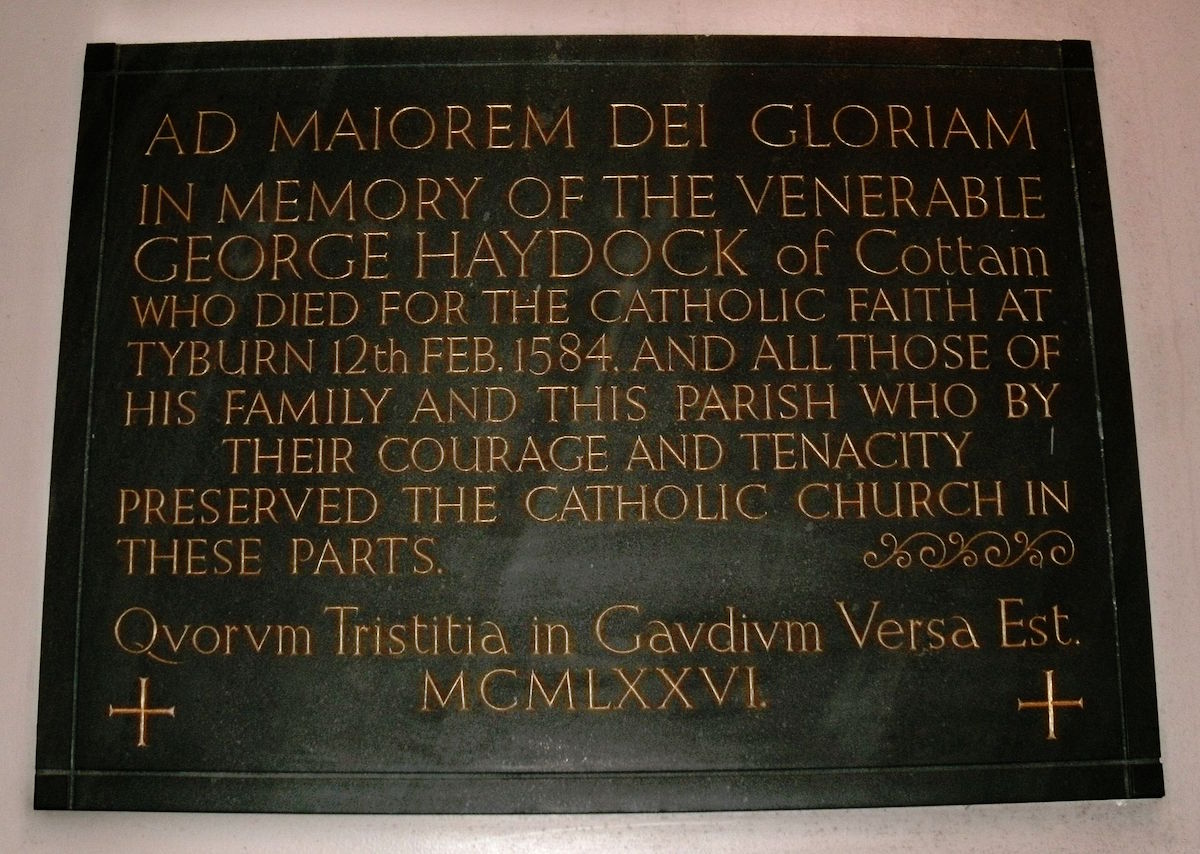
Plaque honoring George Haddock/Haydock at St. Andrew’s & Blessed George Haydock’s Catholic Church, Cottam, Lancashire. (cc) image by Skodoway.

On this day..

1751: William Parsons, Grub Street fodder

We return for this post to a hanging we have previously attended, an uncommonly interesting February 11, 1751 dectuple execution at Tyburn.

Hulking pugilist turned Hogarth allegory James Field was one featured attraction in this batch; the other was the Eton-educated, dissolute son of a baronet, one William Parsons.


This is considerably higher society than a baronet, but we don’t need much excuse hereabouts for a Barry Lyndon tribute.

In the broadest strokes he was the sort of parasitic failson whom the more common stock have long loved to detest, his dissipation having seen him first disinherited, then sent abroad with the Royal Navy (he washed out), then rescuing his situation with a favorable marriage and an army appointment before “the extravagant manner in which he lived, and the loss of large sums of money in gambling, compelled him to throw up his commission, and to return … to his country, a beggar and a vagabond.”

Sentenced by a lenient court to the hard New World frontier of Maryland, Parsons leveraged his family’s good name to escape almost immediately from the drudgery of indentured servitude and risked a return to the mother country where he took to the roads to espouse the classic profession of the embarrassed gentleman, and made men stand and deliver.

It sufficed in the end to recognize him returned from transportation to secure his condemnation, at which Parsons excites the loathing of contemporaries and posterity alike by making bold to beg mercy of his judge “in regard to the family to which I belong, who never had a blot in their escutcheon.” Escutcheon this.

In the scheme of things, his career of self-destruction makes the man nothing but a minor malefactor. However, at least for a season his precipitation — because nine Britons in ten would have looked with envy on his situation even as a disinherited ensign or for that matter as a man with the pull to self-parole from penal transportation — made for the sort of morality play ideally suited to the mass print culture burgeoning in the gallows’ shade.

As we have previously noted in an Irish context, the scrabbling biographers of the latest doomed criminal themselves forever arrived at loggerheads, their rival pamphlets chasing preeminence in authority and rapidity before yesterday’s outrage could be displaced in the public memory by tomorrow’s.

The institutional voice of this racket was of course the Ordinary of Newgate, who by this point had for decades been gobbling up publishing residuals thanks to his didactic and ever more embroidered Ordinary’s Accounts. His entry for February 11, 1751 is a fine exemplar of the genre, running to 19 pages of which the last two are taken up with revenue-pumping advertisements.* With apologies to James Field, the Parsons narrative entirely overawes that of his nine fellow-sufferers, with six full pages devoted to lovingly reminiscing this one man’s tragedy.

Among those lines, we find our divine has relaxed his focus on the salvation of his patients long enough to throw an elbow in the direction of the independent hustlers who will be contesting the marketplace against the Ordinary’s own forthcoming Parsons biography.

N. B. If a certain independent Teacher, or any one else intends to print a Life of Parsons write by himself, take Care left he has imposed upon your Credulity, as he has done to all that had any Thing to do with him.

The “teacher” referenced here is probably Grub Street hack Christopher Smart, who had abandoned a praelectorship at Pembroke College for the charms of movable type … but it’s likely the Ordinary merely selected this allusion because his happened to be the flashiest brand at that moment among the scabrous-broadsheet set, like a present-day critic might metonymize media with the name of Rupert Murdoch.** Richard Ward has argued in his Print Culture, Crime and Justice in 18th-Century London that this moment occurs amid an “explosion in printed crime reporting in London in the years 1748-55 … created in large part by [publishers’] efforts to generate and sustain public interest in crime.”

The Rev. John Taylor would indeed like any self-respecting scribe collect a second purse on his prose by recycling his Ordinary’s Account version (prepended with the trial transcript) into a distinct standalone publication — “The Trial and Remarkable Life of William Parsons” &c., which Taylor authenticates on the title plate with the notation, “Publish’d by the Minister who attended him while under Sentence of Death, and at the Place of Execution”.

We have nothing like an exhaustive catalogue of the print ephemera swarming Old Blighty in those days, but at least one rival publisher attempted to “impose upon the Credulity” of Parsons gawkers. Francis Stamper’s† “Memoirs of the Life and Adventures of William Parsons, Esq.” claims to have been “Written by Himself [i.e., Parsons], and Corrected (with Additions) at his own Request by a Gentleman.” It runs upwards of 60 picaresque pages.

In a like vein is “A Genuine, Impartial, and Authentick Account of the Life of William Parsons, Esq.” &c. promulgated by Thomas Parker, a regular haunt of the Old Bailey crime blotter; however, close readers might notice that Parker is also one of the publishers of the Ordinary’s Accounts‡ and for that reason his edition is presumably more commercially congenial to that clergyman. Parker promises besides the expected biography a trove of correspondence to and from Parsons in the dungeons — we might well suspect whose hand has procured it — a good deal of which is taken up in Parsons imposing pleas for intercession upon a friendly earl, on his prosecutor, and upon his family to pull whatever strings they might.

* One of those ads hyped publication of “A COMPLEAT HISTORY OF JAMES MACLEAN, The GENTLEMAN HIGHWAYMAN”; that man had just hanged four months previous. This volume went abroad under the imprimatur of Charles Corbett, who shared with Thomas Parker the contract to publish the Ordinary’s Accounts.

** A satirical poem called “Old Woman’s Dunciad”, itself a travesty of Pope’s “Dunciad”, was in those weeks burning up the London bestseller lists. Smart is targeted for satire in the poem but was also suspected to be the author. In fact, it was the work of another knight of the low literature called William Kenrick — but both Kenrick and Smart intentionally muddied the authorship lurking behind the pen name “Mary Midnight”, which both men employed. (For context on the dizzying 1750-1751 publishing scene, see Christopher Smart: Clown of God.)

† Stamper was a collaborator of William Kenrick’s (see preceding footnote).

‡ Look for it on the first page of the Ordinary’s Account: “Printed for, and sold by T. PARKER, in Jewin-street, and C. CORBETT, over-against St. Dunstan’s Church, in Fleet-street, the only authorised Printers of the Dying Speeches.” This notice is to be found repeatedly in Ordinary’s Accounts of the period; moreover, Corbett and Parker sometimes advertise their potboilers in those same accounts, in language that makes explicit their alliance with the Ordinary. For example, we have this from the March 23, 1752 Account:

In a Few Days will be Published, The Only Genuine and Authentic NARRATIVE OF THE PROCEEDINGS Of the Late Capt. LOWREY, Both before and after he became Commander of the Ship MOLLY: As the same was delivered by himself, in Manuscript, into the Hands of the Rev. Mr. TAYLOR, Ordinary of NEWGATE, some short Time before his Execution.

Printed only for T. PARKER, in JEWIN-STREET, AND C. CORBETT, in FLEET-STREET.

On this day..

1938: Vladimir Antonov-Ovseyenko, Winter Palace stormer

Communist revolutionary and Soviet military leader Vladimir Antonov-Ovseyenko (or -Ovseenko) was purged on this date in 1938.

Portrait of Antonov-Ovseyenko by Yuri Annenkov.

The Ukrainian was a radical agitator from youth; he was expelled from military college in 1901 at age 17 for refusing to swear loyalty to Nicholas II and proceeded thereafter upon a cursus honorum of revolutionary tribulations — albeit, until World War I, as a Menshevik.

He stood in some danger of achieving these pages by the hand of the tsarist government rather than the Soviet one, on account of helping orchestrate the Sebastopol mutiny during the 1905 revolution, but his death sentence was commuted to hard labor.

Nothing chastised, Antonov-Ovseyenko escaped and returned to that life of militancy suitable to his badass underground nickname “Bayonet”, organizing workers and publishing illegal newspapers while dodging Stolypin‘s police. After several arrests, he finally fled for exile abroad.

According to Harold Walter Nelson’s Leon Trotsky and the Art of Insurrection, 1905-1917, it was in Paris writing for the red paper Nashe Slove (aka Golos) that the former cadet drew close to Trotsky, finding a common “conviction that the relationship between military events and the development of the revolution was critical,” and thereafter “Antonov-Ovseenko’s enthusiasm for columns on military topics opened the pages of Nashe Slovo to Trotsky’s articles” ultimately amounting to “several hundred pages of commentary on the war [World War I].” Ere long both figures would have opportunity to implement their doctrines on the battlefield.

Nashe Slovo was suppressed in 1916 after mutinying Russian soldiers were found to have read it, an event that also led to Trotsky’s being expelled from France to New York City.*

But the time for revolutionists’ exile was drawing to a close. Barely a year after the indignity of having his subversive exile ‘zine shuttered by the Third Republic, Antonov-Ovseenko — as secretary of the Petrograd Military Revolutionary Committee — led a posse of soldiers and sailors into the Winter Palace and arrested the Provisional Government, consummating the October Revolution.


Despite Sergei Eisenstein‘s epic re-creation in October: Ten Days That Shook the World, and the 1920 live re-enactment staged by Nikolai Evreinov, the Winter Palace was barely defended and Antonov-Ovseenko entered and found the Provisional Government without meeting resistance. He offered amnesty for the surrender of the remaining Winter Palace holdouts, and the offer was accepted.

Now a key military figure in the infant Communist state, Antonov-Ovseyenko helped clinch Soviet victory in the ensuing civil war, routing White armies in the Ukraine in 1918-1919 and putting down the Tambov Rebellion of peasant anti-Bolsheviks in 1920-1921.


Antonov-Ovseyenko (center) chills with Red Army officers.

By the later 1920s his Trotsky affiliation had significantly dimmed his star,** though he was still entrusted in the 1930s as a Soviet consul to several countries — the last of them the Spanish Republic during the Spanish Civil War, before falling prey to the purges mere months after his return.

His son, the lately deceased Anton Antonov-Ovseyenko, survived 13 years in the Gulag to become a dissident historian; his The Time of Stalin, published abroad in 1981 after being smuggled out of the USSR by Russia scholar Stephen Cohen, was one of the milestones along the way toward the public reckoning with Stalinism. “An embattled personality and fearless” in Cohen’s estimation, Anton Antonov-Ovseyenko died in 2013, still directing a Gulag museum in Moscow even though he had long since gone blind.

* Via Spain.

** In The Time of Stalin, Anton Antonov-Ovseyenko alleges that his father considered betting on the loyalty of the army in a coup against the Stalin faction, back when control of the post-Lenin state was still uncertain. “This cannot go on for long,” runs one letter the young Antonov-Ovseyenko quotes. “There remains one alternative — to appeal to the peasant masses dressed in Red Army greatcoats and call to order the leaders who have gone too far.” Trotsky also wrote in his memoir that such a coup was mooted within their circle.

On this day..

1866: Dr. John Hughes, Cleveland bigamist

From America’s State Trials, vol. II, whose “Narrative” excerpted here continues in the form of trial transcripts explicating the particulars of this sad and banal stalker-murder situation. (As a juridical matter, Hughes’s fate hinged on finely measuring his degree of premeditation and intent — and drunkenness — at the moment that he shot his 17-year-old other wife; however, once the decision was in, even Hughes called “the verdict of the jury, just; the sentence of the law, inevitable … I know that I deserve death.”)

THE TRIAL OF DR. JOHN W. HUGHES FOR THE MURDER OF TAMZEN PARSONS, CLEVELAND, OHIO, 1865

THE NARRATIVE.

Dr. Hughes To His Friends
(one of several poems Hughes wrote as he awaited hanging -ed.)

Of trifles the world is composed,
Like minutes that grow into years;
So friendship, in pity reposed,
Allays our most troublesome fears.

Away from all comforts at home,
From all the desires of my heart,
Not building on pleasures to come,
With feelings of hope I must part.

A moment of phrenzy, unthought,
A second of madness defined —
What change in the creature is wrought.
The soul in such horror entwined!

To review the dear scenes of the past,
Is but a renewal of strife
To a mind so constant o’ercast
In weighing the issues of life.

Grateful thanks is all I can give
For mercies which others deny.
Oh! that I were destined to live
To recompense you bye and bye.

Your efforts are sadly in vain;
The plea was a day or two late.
Remonstrance its malice to rain
Had hopelessly finished my fate.

Yet your prayers shall be to my death
Like the hidden treasure of leaven,
My spirit to raise by their breath
To waft it to Jesus in heaven.

I pray, and I never forget
To ask of my best friend above,
For blessings on those in whose debt
I am bound by their pitying love.

On the ninth of August, 1865, John W. Hughes, physician and surgeon, of Cleveland, Ohio, committed a murder in the small neighboring village of Bedford, which, from the nature of the case, the character of the parties to the tragedy, and the antecedents of the deed, forced him upon the attention of the people of Cleveland and of the whole of the State of Ohio. The public was shocked on the following morning by the publication in the newspapers that Miss Tamzen Parsons, a young lady of seventeen years of age, had been shot down in the streets of Bedford by this man, who had been her lover, and who, under cover of a forged decree of divorce from his wife, had married her in Pittsburgh, in December, 1864, and suffered in the Pennsylvania penitentiary, the penalty attaching to the crime of bigamy.

Dr. Hughes was born in the Isle of Man, educated at a Scotch University, and emigrated with his wife to the United States in 1862. After practicing his profession of a physician for a few months in Chicago and Cleveland, he enlisted in an Ohio regiment as a private, but was very soon promoted to the position of Assistant Surgeon of the 48th United States Infantry. After serving for about a year he resigned on account of the illness of a son in November, 1864. He now began the practice of medicine in Cleveland, but making the acquaintance of Tamzen Parsons, he induced her to go with him to Pittsburgh, after showing her a paper which he persuaded her was a decree of divorce from his wife. For this he was convicted and sentenced to one year’s imprisonment in a Pennsylvania penitentiary, but was pardoned after serving five months. Returning to Cleveland, he resumed the practice of medicine and after having sent his wife and child back to the Isle of Man on a visit, he endeavored to win again the affections of Tamzen, who refused to have anything more to do with him. One night in July after drinking deeply, he went to the house of her father in the village of Bedford at night and, by his noise, aroused the old gentlemen, who tried to eject him. Hughes refused to leave the house, and objected with sufficient force to give ground for a charge of assault and battery, which was brought on the following day, Tamzen herself appearing and making the affidavit against him, an act which enraged him. Personal differences, however, were at length adjusted and legal proceedings stayed, the Doctor solemnly promising that he would thenceforth have nothing to do with the Parsons family.

But, alas! a drunken revel with a companion, Oscar Russell, on the night of the eighth of August, ended in their driving to Bedford and drinking at all the road houses on the way. Hughes, Russell and their driver, Carr, issued from a hotel in Bedford, and drove to the house of Mr. Parsons. Dr. Hughes entered the house and learned that Tamzen and her mother had gone blackberrying. They drove on, but soon met the women, and the Doctor sought a private conference with Tamzen. A neighbor, however, came along in a wagon and took her home, while the men drove to the grocery, where they held a drunken revel for two hours. Hughes learning that all the Parsons family had gone to Bedford for safety and to arrest him, started to the village and, seeing Tamzen coming out of the house, he ran after her, calling on her to stop. She flew up the walk, saying, “No, I will not stop,” and rushed through the gate, endeavoring to reach the front door. But before that asylum was reached, the pursuer laid hands on her, and shouting, “You won’t stop, will you?” fired his revolver. The ball glanced off her head, she screamed, but the piteous cry was instantly hushed by a second and fatal discharge of the deadly weapon.

The noise attracted a number of persons, who pursued Hughes, who jumped into the carriage with Russell and Carr, and, menacing the crowd with his revolver, succeeded in getting a good start of his pursuers. But he was captured in a few hours and landed in jail.

Indicted by the Grand Jury for murder, after a trial lasting eighteen days, he was convicted, though his counsel tried very hard to prove that he was insane at the time he committed the act. On February 9th, 1866, he was hanged in the yard of the Cleveland jail.

On this day..

1804: Ann Hurle, forger

(Thanks to Richard Clark of Capital Punishment U.K. for the guest post, a reprint of an article originally published on that site with some explanatory links added by Executed Today. CapitalPunishmentUK.org features a trove of research and feature articles on the death penalty in England and elsewhere. -ed.)

Ann Hurle was one of twelve people to be hanged for forgery in 1804. The law took a very severe view of this offence at the time and few forgers were reprieved.

Ann was an educated young woman of twenty-two, living in London, who had devised quite an elaborate plan to defraud the Bank of England of £500, which was a very large sum in those days and would now be the equivalent of over a quarter of a million pounds. The crime was perpetrated on Saturday the 10th of December 1803 when she met Stock Broker, George Francillon, at the Bank Coffee House and persuaded him to obtain a power of attorney for her to enable her to sell some Bank of England 3% stock belonging to one Benjamin Allin, an elderly gentleman from Greenwich. Mr. Francillon had known Ann for some six months and therefore was not overly suspicious. She told him that she had lived in Mr. Allin’s house as a child, where her aunt was the housekeeper, and that he had given her this stock in return for the aunt’s service to the household and the kindnesses she had shown him. Mr. Francillon obtained the power of attorney for Ann on the Saturday, and she told him that she was then going to take it Greenwich to get it signed by Mr. Allin.

Ann returned on Monday morning with the document purportedly signed and witnessed by Thomas Noulden and Peter Verney, who both ran small businesses in Greenwich. Ann met Mr. Francillon at the Bank of England where he took the document to the Reduced Office for verification. Ann meanwhile went off to sell the stocks. Mr. Thomas Bateman, the Clerk in charge of powers of attorney, asked to see George Francillon with Ann and informed them that Benjamin Allin’s signature on the power differed from that on the specimen held by the bank. Ann told Mr. Bateman that she knew Mr. Allin and that as he was nearly ninety years old, in poor health and nowadays wrote very little, it was not surprising that his signature differed. She also offered to take out another power of attorney and obtain a new signature on it. Mr. Bateman did not feel that this was necessary but wrote a letter to one of the witnesses to the document.

During the conversation in Mr. Bateman’s office, Ann mentioned that she had recently married and asked by Mr. Bateman why she had not taken out the power in her married name, she told him that she feared her marriage to one James Innes was not a good one. She suggested that he had stolen her money and then boarded a ship at Bristol and that he was already married to another.

Ann left the bank and returned on the following Tuesday. In the meantime, Mr. Francillon had become suspicious when he checked the document. He put their main meeting off to the following day while he did some further research, including going to see Benjamin Allin. As arranged, Mr. Francillon met Ann on the Wednesday morning at the Bank of England. He had previously had a meeting with Mr. Newcomb the principal clerk in the Reduced Office and explained his suspicions. He and Mr. Newcomb had a meeting with the Governors. Ann came to the Bank with a young man and must have realised from the delays in seeing her that all was not well and left. She was arrested the following day in Bermondsey and taken to the Mansion House for questioning. The young man turned out to be James Innes, who was also questioned. She was charged with the forgery and he with being an accessory to the crime, although it seems that his case was dropped as there is no record of a trial for him. The case was obviously unusual and of some public interest as it was reported in The Times of Wednesday, the 21st of December 1803. Ann was committed for trial at the next Sessions of the Old Bailey in London.

These Sessions opened on the 11th of January 1804, before the Lord Chief Baron of the Exchequer, Sir Archibald Knight. Ann was charged with four offences. The first was “feloniously, falsely, making, forging, and counterfeiting, on the 12th of December, a certain instrument, or letter of attorney, with the name Benjamin Allin thereunto subscribed, purporting to have been signed, sealed, and delivered, by one Benjamin Allin, of Greenwich, in the county of Kent, gentleman, a proprietor of certain annuities and stock transferable at the Bank of England, called Three per Cent. Reduced Annuities, to sell, assign, transfer, and convey, the sum of five hundred pounds of the said transferable annuities, the property of the said Benjamin Allin, to her, the said Ann Hurle , with intent to defraud the Governor and Company of the Bank of England.” The second count was, “For uttering and publishing as true a like forged deed, knowing it to be forged, with the like intention.” There were two further counts on the indictment against her, being the same offences against Benjamin Allin. Mr. Garrow led for the prosecution and Mr. Knapp for the defence.

George Francillon and Benjamin Allin were the principal prosecution witnesses. Mr. Francillon related the above story to the court and Mr. Allin examined the power of attorney document and declared that the signature was not his and that he had never signed such a document. Thomas Bateman, Peter Verney and Thomas Noulden also testified against her. Ann’s aunt, Jane, told the court that Ann had not visited Mr. Allin’s house recently and neither had Messrs. Verney and Noulden, the two purported witnesses to his signature on the document.

The witnesses’ testimonies were cross examined at this time but Ann offered no actual defence, leaving this to her counsel. She was thus convicted and remanded to Tuesday, the 17th of January 1804 for sentence. Four men and three women were bought before the court to received their death sentences that Tuesday, with the Recorder of London making particular reference to the gravity of Ann’s crime and the fact that she preyed upon “an infirm and imbecile old man”. He opined that only death was sufficient punishment for such a crime. He then proceeded to pass sentence on each prisoner. When Ann’s turn came, she was asked in the normal way if their was any reason why sentence of death should not be pronounced against her and replied that she thought she was “with child” (pregnant). She did not make this claim with any apparent confidence so no further enquiry into its validity was made. Sarah Fisher, another of the condemned women, also claimed to be pregnant but did so much more forcibly, thus requiring the court to empanel a Jury of Matrons, who examined her and declared that she wasn’t. It is feasible that both women could have been in the early stages of pregnancy, although neither was “quick with child”. Only if the prisoner was obviously pregnant was her execution respited until after she had given birth. In most cases she was reprieved altogether and her punishment commuted to transportation. “Pleading the belly” as it was called was a frequently used tactic at this time by women desperate to avoid the noose.

The Recorder of London reviewed the cases of those condemned to death and made a recommendation in each one. He then presented his recommendations in person to the Privy Council, which was chaired by King George III. In Ann’s case, there could be no recommendation for a reprieve. She was therefore scheduled for execution, along with Methuselah Spalding who had been convicted of sodomy at the previous Sessions held on the 30th of November 1803. It is interesting to note that Spalding was the only one of five condemned men at that Sessions not to be reprieved and that Ann was the only one out of the six men and three women at the January 1804 Sessions not to get a reprieve. Non-murderers normally had a period of two to three weeks before execution at this time and Ann’s execution was set for Wednesday, the 8th of February.

For reasons that are unclear, the normal “New Drop” style gallows at Newgate was not to be used for these two hangings. A simple gallows was erected at the top of the Old Bailey, near to St. Sepulchre’s Church.

On the morning of execution, Ann and Spalding were brought from their cells and pinioned in the Press Room. They were then taken out into the yard and loaded into a horse drawn cart covered in a black cloth which emerged from the prison at about 8.10 a.m. for the short ride to the gallows. The cart was backed under the beam and the two prisoners were allowed to pray with Ordinary and make their last statements. Ann was dressed in a mourning gown and wore a white cap. She made no address to the multitude who had come to see her die but prayed fervently with the Ordinary for five minutes or so. William Brunskill, the hangman for London & Middlesex, placed the rope around her neck and when she had finished praying, pulled the white cap down over her face. The cart was now drawn away leaving them both suspended. It was recorded that Ann let out a scream as the cart moved and that she struggled hard for two to three minutes before becoming still, her hands were observed to move repeatedly towards her throat and her un-pinioned legs kicked and padded the air. No doubt the eyes of the crowd were riveted on her poor writhing form. After hanging for the customary hour, they were taken down and returned inside Newgate from where they could be claimed by relatives for burial.

An angry letter appeared in The Times newspaper the following week castigating the authorities for the execution on the grounds of cruelty compared with the New Drop and the difficulty in seeing the prisoners and thus taking a moral lesson from their demise. It was alleged in the letter that the reason for the change of gallows was that the Newgate staff were too lazy to assemble the New Drop gallows. Whether this was true or whether the drop mechanism had become defective we will never know, but it was returned to service for the next execution, that of Providence Hansard for the same crime on the 5th of July 1805.

It seems surprising looking back two centuries that Ann, acting alone, would have devised such an ambitious plan to obtain this large sum of money. However, no evidence was offered at her trial to show that anyone else was involved, other than perhaps James Innes on the periphery of the crime. It must have taken quite some time to think through and make the necessary contacts, such as George Francillon, who would be able to obtain the power of attorney for her. It is hard to believe she was not aware of the risk of failure and the deadly consequences that would follow it. In the period 1800 – 1829, an amazing 218 people were to die for forgery in England and Wales. Another two women were to follow Ann to the gallows outside Newgate over the next two years, Providence Hansard mentioned earlier and Mary Parnell on the 13th of November 1805. Forgery ceased to be a capital crime in 1832 and the last execution for it took place on the 31st of December 1829, when Thomas Maynard was hanged at Newgate. Over two centuries attitudes have altered; had a modern day Ann committed the crime in the 21st century, she would have got somewhere between four and five years in prison and have been released on licence half way through this sentence.

On this day..

1885: August Reinsdorf and Emil Kuchler, Kaiser Wilhelm I bombers

On this date in 1885, anarchists August Reinsdorf and Emil Küchler were guillotined for a failed attempt on the life of Kaiser Wilhelm I.

The King of Prussia turned Emperor of the newborn (in 1871) Deutsches Reich, Wilhelm was honored by assassins equal in enthusiasm to his distinctive whiskers.* The versions distinguished by this post had the cheek to contemplate exploding the Kartätschenprinz** just as he ceremonially inaugurated an important national monument.


The Niederwalddenkmal still stands to this day. (cc) image from Philipp35466

The day was wet, and the dynamite fizzled. Everybody departed none the wiser but police spies later caught wind of the attempt, apparently when the would-be bombers Emil Küchler and Franz Reinhold Rupsch asked reimbursement from leftist typesetter August Reinsdorf, the plot’s mastermind.

Eight were eventually rounded up, secretly at first but later publicized to the prejudice of leftist parties.

Reinsdorf, Küchler and Rupsch all received death sentences; Rupsch’s was commuted in consideration of his youth.

The workers build palaces and live in miserable huts; they produce everything and maintain the whole machinery of state, and yet nothing is done for them; they produce all industrial products, and yet they have little and bad to eat; they are always a despised, raw and superstitious mass of servile minds. Everything the state does tends toward perpetuating these conditions forever. The upper ten thousand rest on the shoulders of the great mass. Is this really going to last? Is not a change our duty? Shall we keep our hands in our laps forever?

-Reinsdorf at trial

* We have in these pages already met one such predecessor who went under the fallbeil in 1878; the zeal of such men had given the Reich pretext to ban the Social Democrats.

** “Prince of Grapeshot”, a bygone nickname that paid derisive tribute to Wilhelm’s mailed fist in the Revolutions of 1848.

On this day..

2013: Kepari Leniata burned as a witch

On this date in 2013, villagers at the Papua New Guinea village of Paiala tortured their neighbor Kepari Leniata into confessing the witchcraft murder of a local child, then burnt her alive in a trash dump. Sorcery is widely feared and practiced in PNG.

Kepari Leniata, 20, ‘confessed’ after she was dragged from her hut, stripped naked and tortured with white-hot iron rods.

She was then dragged to a local rubbish dump, doused in petrol and, with hands and feet bound, thrown on a fire of burning tyres. As the mother-of-two screamed in agony, more petrol-soaked tyres were thrown on top of her.

The tragedy unfolded after Miss Leniata’s young neighbour fell sick on Tuesday morning. He complained of pains in the stomach and chest and was taken to Mt Hagen hospital where he died a few hours later.

Relatives of the boy were suspicious that witchcraft was involved in the death and learned that two women had gone into hiding in the jungle.

After they were tracked down, the pair admitted they practised sorcery but had nothing to do with the boy’s death. Miss Leniata, they said, was the person responsible.

The boy’s family went to her hut at 7am on Wednesday, stripped her and dragged her away to torture and death. (Source)

Horrific pictures circulated in the international media.

On this day..

1892: A day in the death penalty around Kentucky

The Bluegrass State had what one paper jokingly called a “hanging match” with hangings in the towns of Stanton, West Irvine, and Henderson on this date in 1892 — as we see from this economical entry from the Chicago Daily Inter Ocean of Feb. 6, 1892:

Although not the most historically consequential hangings, uxoricide was good enough to earn Mr. Bush (he’s also called “Simpson Bush” in some accounts) a murder ballad.

… They say he tried to drown her, but in that did not succeed
But with the fatal pistol he carried out the deed
The babe was in its mother’s arms, Up to them he did creep
The demon pulled the trigger and killed her while asleep.

[He stepped] up to her bedside, [and] shot her through the head
The infant drank its mother’s blood, while the woman lay there dead
They say that he was jealous when he done this cruel crime
He shall stand before his Maker and answer another time …

On this day..

1707: Baron Otto Arnold Peikel

A few line breaks have been removed for readability, and most of the author’s original footnotes excised, from this source text.

CHARLES XIIS TREATMENT OF
LIEUTENANT-GENERAL BARON PEIKEL.

By Charles Dalton, Esq.,
Editor of English Army Lists and Commission Registers, 1661-1714.

BARON PEIKEL (or Pykul) has been mistaken by several writers for his kinsman the better-known Count Patkul, the famous Livonian patriot, who was executed, after being mercilessly broken on the wheel, at a village near Casimir, in Great Poland, October 10th, 1707, by order of Charles XII. The confusion occasioned by the similarity in names may also be traced to the remarkable fact that both Peikel and Patkul held the rank of lieut.-general in the Polish Army; and the former succeeded the latter in command of the Saxon contingent which fought on the side of Augustus, King of Poland, against Charles XII. Fate decreed that both Peikel and Patkul should fall into the hands of the iron-hearted King of Sweden, and after a long imprisonment be executed within a few months of each other.

Here the parallel between these two Livonian patriots stops, as Peikel (English Wikipedia entry | Latvian) was neither a great commander nor a diplomatist, but he possessed one remarkable talent which alone makes him intrinsically interesting and worthy of a niche in the Temple of Fame. Baron Peikel claimed, and was allowed by impartial and trustworthy witnesses, to have discovered the secret of making gold!

The Province of Livonia [present-day Latvia and Estonia -ed.], which had been a bone of contention between the northern countries of Europe for centuries, was ceded by Poland to Sweden in 1660. The confiscation of Livonian estates, and the heavy taxes imposed by Charles XI, alienated the Livonian nobility and people from Sweden and Swedish rule.

The sympathies of the conquered province were with Poland, and thus it came to pass that when Russia and Poland engaged in war with Sweden, in 1700, some of the leading Livonian noblemen were found ranged against Charles XII, whose proclamation summoning them to return to their allegiance was treated with open defiance. Prominent among the Livonian revolters was Baron Peikel, who sided with Augustus II, King of Poland and Elector of Saxony.

Passing over the fluctuating fortunes of the Polish arms under Augustus the Strong (who was deposed in 1704, but re-elected some years later to the Polish Crown), we find that a battle was fought near Warsaw, in the summer of 1705, between the Saxons and Poles on one side, and the Swedes on the other. In this engagement the Saxons are said to have fought well, but not being supported by the Poles, who fled on the first discharge, had to retire. The loss on both sides was equal. General Bond (the Swedish commander) was killed, and Baron Peikel (the Saxon general) was taken prisoner. Peikel and several other Saxon officers taken on this occasion were sent to Stockholm, where they suffered a rigorous imprisonment.

In November, 1706, a treaty was concluded between Charles XII and Augustus II The cessation of hostilities only hastened Peikel’s doom. He was tried by the Advocate Fiscal in Stockholm as a traitor to his country, and being found guilty was sentenced to death. On the face of the evidence against Peikel, this sentence was doubtless a just one. But the prisoner had a strong argument in his favour against his condemnation, as appears from a contemporary MS.

Peikul (sic) happened to be born in Poland about three miles from the Livonian border, and this fact was used against him in a law-suit he had with an uncle for a considerable estate. After going through all the Livonian Courts it was, as is customary, brought to the King for decision, for to him is the last appeal in all civil causes. The King gave judgment against Peikul for this only reason because he was an alien and not his natural-born subject. However, this determination, unjust as it was, afterwards was brought as a good argument for Peikul against the King, when his Majesty condemned him as a natural-born subject of Sweden. But it seems, though his being born out of the King’s dominions proved a good reason for depriving him of his estate, it proved ineffectual to the saving of his life.

The sympathy of the Queen of Sweden (who was acting as Regent of the Kingdom during her grandson’s absence with the army), her ineffectual efforts to obtain a pardon for Peikel, the condemned nobleman’s extraordinary offers to the Queen and Senate for filling the Swedish Treasury, then at a very low ebb, provided his life were spared, and the remarkable proof he gave before witnesses of his ability to perform what he promised, are fully and graphically detailed by the British Envoy at Stockholm in his official letters to the Right Hon. Robert Harley, Secretary of State:

Mr. Robert Jackson to the Secretary of Stale.
Stockholm, January 5th, 1707.

An order is now come from the King to suffer all the Saxon officers now prisoners in Sweden to go where they please, except one Lieutenant General Pykull (sic), a native of Liefland [Livonia], who was taken about two years ago in Poland, and in November last was condemned here as a traitor for serving against this Crown, which sentence the King not only lately confirmed, but gave also at the same time express order for his execution as on the 7th instant; but the Queen-Mother and all the Royal family here having interceded for him, and not yet got his Majesty’s answer, her Majesty has therefore by her own authority reprieved him for a month, yet it is thought his pardon will not be granted at last.


Mr. Robert Jackson to the Secretary of State.
Stockholm, January 30th, 1707.

The King has renewed his former orders for the execution of Lieutenant-General Pykull, not having thought fit to hearken to the Queen-Mother’s intercession on that gentleman’s behalf.


Mr. Robert Jackson to the Secretary of State.
Stockholm, February 9th, 1707.

The Saxon Lieutenant-General Peikel was beheaded on Monday last;* he chose to be executed with an axe (though it be esteemed very dishonourable in this country) rather than with a sword, by reason of the unskilfulness of the executioner. There was no other crime laid to his charge in the Fiscal’s accusation than that he, being a native of Liefland, presumed in disobedience to his Majesty’s avocatoria** to serve his enemy, wherefore it was thought here that the King’s neither hearkening to the many high intercessions made on his behalf, nor the advantageous proposals he made to save his life, proceeded from the knowledge his Majesty must have of some other crimes of a blacker nature.

But the morning Peikel suffered he told the divines which assisted him, and administered the Sacrament to him, that having heard of a report spread as if he had been one who had particularly encouraged King Augustus to begin this war, on the prospect of the Lieflanders, his countrymen, revolting from Sweden; and also of another that he had been engaged in a design upon the King of Sweden’s person, he therefore took that opportunity to declare in that solemn manner that all such reports were false, and that he never had acted anything against his Swedish Majesty’s person, or Kingdom, contrary to the principles of a man of honour. And since his one crime was that he was born in the Swedish dominions, he could not allow to have deserved death merely for that reason.

But he added that it having pleased God some time ago to bring him wonderfully to the knowledge of a great secret in Nature, whereby he could not only himself have lived in the greatest happiness, but likewise have been capable of doing much good in the world. Yet he nevertheless suffered his ambition to prevail against his reason, which led him to accept the command of those troops amongst which he was taken prisoner, and for that he said he had justly incurred the punishment which was to be inflicted on him.

The secret he speaks of was making gold to a prodigious advantage; and he actually gave such proofs to the archiater at the Court, as well as some other knowing persons, of his profound knowledge in chemistry, that nobody now doubts of his having been able to perform what he pretended, and also proposed in case the King would have given him his life; and for your Honour’s curiosity I shall presume in my next humble account to send your Honour an extract of the said proposals (whereby, if he could have fulfilled his promise, would have arose a yearly revenue of five hundred thousand ducats to this Crown), and also an authentic relation of an experiment of his having had that secret performed by the Advocate Fiscal, and one Colonel Hugo Hamilton, a native of Ireland, who is Commandant of this city, and had the custody of Monsr. Peikel during his imprisonment, which papers being but lately come to my hands I have not yet had time to translate them.


Mr. Robert Jackson to the Secretary of State.
Stockholm, February 16th, 1707.

Having in my last presumed to mention several things relating to the lately executed Baron Peikel, I therefore now further presume to transmit, along with this, the translation of his proposals together with Colonel Hamilton’s relation of the experiment he made, both which papers I humbly take the liberty to beg may be managed with a little secrecy for fear of injuring some persons here, who are thought to have employed themselves too much in favour of the said Baron.

Translation of the extract of Lieut.-General Peikel’s proposals to the Queen and Senate.

That it having pleased God to bless his study and labour for bringing him to the knowledge of a great secret; and he now laying under sentence of death was willing, in case he could thereby save his life, not only to reveal the said secret to any one person, to be under an oath of secrecy, whom his Majesty should think proper to appoint, but would likewise oblige himself to make at his own charge this year four hundred thousand ducats for his Majesty; and in case he performed not he then desired no mercy, but that not only the punishment of death might be inflicted upon him by virtue of the sentence lately pronounced against him, but that also there might be added any further punishment, as a just reward, for his demerits in presuming to abuse his Majesty.

He further obliged himself to make yearly, so long as he lived, the same quantity of gold for the King’s use, his Majesty building only a proper house for carrying on the work, and being at the charge of providing materials, and maintaining the servants which should be found necessary to be employed therein, the whole charge of which he computed would not amount to twenty thousand ducats yearly.

When he had performed what he thus proposed two years he then desired to have a reasonable enlargement, but in the meantime to be under the strictest confinement that was possible, and besides he would bind himself by the most solemn oath never to endeavour to make his escape, neither during the time of his confinement nor when he should have his liberty; and for further security he would forthwith dispose of his estate in the Brandenburg country and buy other lands of like value in Sweden and establish his family here.

And to confirm the probability of his being able to perform what he proposed, he desired that Colonel Hugo Hamilton and the Advocate Fiscal might be commanded to give an account of the experiment they were eye-witnesses to, or rather had themselves performed by his directions, he only having now and then been present during the operation. The whole charge of which operation cost not above twelve crowns and yet produced the weight in gold of forty-nine ducats, and the officers of the Mint attested the gold to be perfectly fine as any they ever saw.

These proposals were presented along with a petition to the King, January 4th, 1707.

Translation of Colonel Hugo Hamilton’s relation.

To the Queen’s Majesty most humble relation:—

Whereas Peikel, who lies under the sentence of death, has, in all humility, informed your Majesty of his having the knowledge of making gold and likewise offered to reveal the said secret, agreeable to what I also in all humility lately had the honour to acquaint your Majesty; wherefore in obedience now to your Majesty’s most gracious commands that I should in writing give a further humble account of that matter, therefore with the same humble intention for the service and advantage of my most gracious Sovereign as in all humility I formerly represented, I do now, by the oath and duty wherewith I am bound, declare that when Peikel first intimated to me his having that secret I suspected the truth of it a long time, and looked on his making me that confidence as a design he had the better by one means or other to make his escape.

Wherefore I also took care to have him the better guarded; but he several times after repeating the matter, and withal offering in my presence to make a proof thereof, to convince me that what he said was a real truth, I thought that such an opportunity of serving my most gracious King ought not to be neglected, and therefore I asked him if he was willing that I might take a second person to be also present, whereto he agreeing I thought none could be more properly employed than the Advocate Fiscal, Thomas Fehman, his accuser, whom, Peikel approving of, I acquainted the said Advocate Fiscal therewith and requested him to be a witness at the operation, who thereupon expressed himself that in case there was any reality in the thing he could not be a faithful subject who would not endeavour to forward so important a work; yet for his own person he was unwilling to be concerned therein lest he should thereby incur too many undeserved censures, however I importuned him till he at length promised to be present.

I forthwith permitted Peikel to begin the operation, which he did by dissolving of a powder of mineral antimony and winestone from Montpelier; this was set forty days in digestion, and afterwards was burnt with a prepared spirit that produced a greyish-coloured metal, which being beaten to powder was likewise set forty days in fermentation; when that time was expired it was taken out and mixed with powdered common antimony, brimstone, and a little lead, and was afterwards melted in a melting-pot and cast into a pot of brass metal, at the bottom whereof it left a weighty and substantial white metal, which being afterwards again melted in a melting-pot produced the same pure and fine gold that I showed your Majesty; and lest that any other than the true powder should be conveyed into the said pot, the Advocate Fiscal and I did by ourselves make the experiment, and found that the like quantity of the powder by us weighed produced the same effect as when Peikel was present.

I must acknowledge that during this operation I always suspected some deceit would be therein practised, and therefore more narrowly observed everything that Peikel undertook, as did likewise the Advocate Fiscal, whereto we frequently admonished each other. And whereas the best opportunity to practise the deceit seemed to be by conveying gold among the common antimony wherewith the chemical prepared powder was to be mixed, I therefore directed Peikel, the evening before, to weigh the same, but when he was gone I cast it away and took the same quantity of other common antimony, and the effect the virtue of the other powder produced both the Advocate Fiscal and I were witnesses to; and I do further declare upon my salvation, and the disfavour of my most gracious Master, that I do firmly believe, and do not otherwise know, but he the said Peikel is really possessed of the knowledge he pretends, and this the Advocate Fiscal must likewise, as a faithful servant of his Majesty, confirm whenever he is called upon.†

It was further between us agreed and resolved on, according to the oath and duty wherewith we are bound, to make a discovery of this affair, whatever sentence Peikel should receive; that this has thus been transacted I own, but the great secret, which consists in a very small composition, and which he prepared in an hour’s time, and is laid at the last melting amongst the other powder, I neither know, nor desire to know, it only having been both our sincere intentions to promote what we judged might conduce to the advantage and service of our most gracious King.

(Signed) Hugo Hamilton.‡

The refusal of Charles XII to entertain the proposals made to him by Baron Peikel, or to allow the Queen Regent’s intercession to turn him aside from his fixed resolve, does not in any way throw discredit on Peikel’s honesty of purpose or belief in his ability to carry out what he had undertaken. Charles’s utter recklessness where money was concerned is a matter of history. When this monarch ascended the throne in 1697, at the age of fifteen, he found a full treasury and the country at the height of prosperity. In a few years’ time the treasury was well-nigh exhausted, and Sweden was engaged in a gigantic struggle with Russia.

Any other monarch, at the period in question, would have taken Peikel at his word and put him to the crucial test. Had the promised gold not flowed from Peikel’s crucible, Charles could have satisfied his own revengeful spirit by putting Peikel to death in the same barbarous manner that disgraced the execution of the unfortunate Count Patkul. The Lutheran minister who attended Patkul in his last hours, and who wrote a MS. narrative of the Count’s chequered career and miserable death, has left on record the following anecdote regarding Baron Peikel, which story, if true, leaves an indelible stain on the character of Charles XII whose many noble qualities were marred by an implacable spirit which neither knew how to forgive nor how to forget.

After King Charles had entirely got the better of Augustus (King of Poland), and the latter was forced to comply with everything required of him, Augustus, in order to put the best face he could on a bad matter, made great entertainment for the King of Sweden at a very fine pleasure-house not far distant from Dresden. Peikul’s poor lady and children had taken a great journey from Stockholm, on purpose to solicit for her husband’s pardon; and King Augustus with his courtiers, as well as several of the King of Sweden’s officers, had promised her to make use of the utmost of their interest in his behalf; and had contrived the matter so, that after the usual jollity and good humour, caused by a great feast, she, with her children, should unexpectedly come into the dining-room, and fall at the King of Sweden’s feet, imploring his mercy for her husband; to which King Augustus, with all the other noble guests, were to join their intercession.

So far matters were well concerted; but the King of Sweden, having by some means or other got an inkling of this design, after he was come to the place appointed for the feast, and being resolved that nothing should prevent his intention, desired leave to retire for a few minutes before dinner, into a private closet, where he called for pen, ink, and paper, and wrote and signed an order which he sent by express for Peikul’s immediate execution upon receipt of it. After this he came out to dinner, which being ended, the poor woman and her children came in and flung herself at King Charles’s feet, as it had been forecasted, in the midst of the mirth, King Augustus with all the company mixing their intercessions with her tears.

The King of Sweden, after some seeming struggle, granted the pardon which was desired, and signed an instrument to that purpose, which by Peikul’s friends was presently despatched away. But the King’s courier arrived first at Stockholm, and poor Peikul was beheaded about four hours before the second got thither.§

Voltaire tells us in his History of Charles XII that when King Augustus (whose Saxon subjects had been heavily subsidised by the Swedish monarch) heard that Peikel had been executed, he said “he did not wonder that the King of Sweden had so much indifference for the Philosopher’s Stone as Charles had found it in Saxony.”

Baron Peikel’s great secret died with him. By his own showing he had expected the greatest happiness from his chemical discovery, but the path he pursued was not the “golden mean” which Horace recommended when he wrote the lines:—

Auream quisquis mediocritatem
Diligit, tutus caret obsoleti
Sordibus tecti, caret invidenda
Sobrius aula.

[Whoever cultivates the golden mean avoids both the poverty of a hovel and the envy of a palace. -ed.]

* We’ve grappled often with calendar ambiguity in these pages, but this one is a fun case. England was still on the Julian calendar at this point so the most recent Monday as of Jackson’s letter would have been Monday, February 3.

However, Sweden in the first years of 18th century was trying its own calendar: a strategy to “catch up” to the Gregorian calendar gradually over a period of 40 years instead of all at once. So, locally in Sweden, the calendar was off from both the Julian (one day ahead) and the Gregorian (ten days behind) and the beheading occurred on Monday, February 4. This is also the date supplied by Swedish volumes that have primary source access; by the same token, correspondence on the same event from a German perspective reports (p. 234) the equivalent Gregorian date of Monday, February 14. (Protestant German states, together with Denmark and the Netherlands, had adopted the Gregorian calendar in 1700.) Any of the 3rd, 4th, or 14th are defensible as the execution date from these various perspectives; this post is riding with the local-to-the-execution-jurisdiction date.

Incidentally, Sweden’s strange attempt at calendar incrementalism proved a massive bust. A few years after Baron Peikel lost his head, Charles XII gave the Nordic calendar the chop too — ordering Sweden reverted back to the Julian schedule by the expedient of doubling the next leap-day. As a result, Sweden had a February 30, 1712. A free pack of Executed Today playing cards for anyone who can document a February 30 execution for the annals!

** Dalton’s original footnote on this word reads: “Royal Proclamation for all the King of Sweden’s subjects to return out of foreign service.”

† Sweden’s Royal Coin Cabinet still preserves the medal that was struck by the triumphant alchemist or prestidigitator out of his transmutation, stamped hoc aurum arte chimica conflavit holmle 1706 O. A. V. paykhull. (O. A. Von Paykhull cast this gold by chemical art at Stockholm, 1706.) This post badly wants an image of said artifact.

‡ A Scots-Irish officer, heir to the long tradition of Celtic involvement in Sweden.

§ Dalton’s footnote sources this anecdote to vol. 13 of Lord Somers’s Tracts by Walter Scott.

On this day..