On this date in 1799, the Bishop of Potenza was lynched by the faithful.
Andrea Serrao English Wikipedia entry | Italian) was a late disciple of the reformist Jansenist movement which tended among many other things to such Enlightenment-friendly notions as liberty of conscience, the reduction of the papal authority, and “regalism” — the doctrine of secular supremacy over ecclesiastical.
found a cathedral in disrepair, a seminary closed for the last eleven years. He raised the money for a rebuilding of the cathedral, reopened the seminary, of which the products were suspect for their ideas of liberty. He was as strong a reformer as [fellow Jansenist Bishop Scipione de’]Ricci,* and with many of the same ideas. He held a diocesan synod which is unknown because the acts were afterwards destroyed by government; but evidently its conclusions resembled those of Ricci’s Synod of Pistoia. He may have been more radical than Ricci, for he wanted clergy to be allowed to marry.
In December of 1798, Bourbon authority collapsed in the Kingdom of Naples — which ruled all of southern Italy, including Potenza — leading to the formation of the Parthenopean Republic. Serrao fully embraced it, “and urged them to obey the new government; and at the end of his address the people cried ‘Long live the French government. Long live liberty!’ and rushed out into the piazza to plant a tree of liberty. Bishop Serrao then accepted the office of civil commissioner of Potenza.” (Chadwick again)
But this Republic was destined for an imminent and bloody conclusion.
The most immediate reaction, and the one that led to Serrao’s abrupt death, was the summons of Fabrizio Cardinal Ruffo to a popular anti-Republican movement, called Sanfedismo (“Holy Faith”). In early February, a bare two weeks after the Parthenopean Republic’s establishment, Ruffo ventured from the royal refuge on Sicily and landed at his native Calabria like Che Guevara, with nothing but a handful of companions.
“Brave and courageous Calabrians, unite now under the standard of the Holy Cross and of our beloved sovereign,” Ruffo’s summons to a resistance implored. “Do not wait for the enemy to come and contaminate our home neighbourhoods. Let us march to confront him, to repel him, to hunt him out of our kingdom and out of Italy and to break the barbarous chains of our holy Pontiff. May the banner of the Holy Cross secure you total victory.”
Ruffo’s message was a winner and almost instantly began attracting holy guerrillas by the hundreds; in a few months’ time, Ruffo secured the surrender of the Republicans in Naples itself, by which time his army is reputed to have numbered 17,000.
And even in its earliest promulgation, it attained — seemingly to Andrea Serrao’s surprise — strength enough to overwhelm that tree of liberty stuff in Potenza within days of Ruffo’s landing. Back to Chadwick:
When Ruffo’s bands drew near to Potenza, many peasants and some priests regarded Bishop Serrao as ‘the enemy of the Pope, the king, and God’. Warned to escape, he said that he trusted his fellow-citizens. When the professors and students at the seminary wanted to make a bodyguard, he forbade them to arm.
Very early on 24 February 1799 soldiers of the Potenza guard smashed the tree of liberty, and raided the bishop’s palace. They came upon Serrao still in bed, and killed him with two shots of a pistol. Bleeding to death, he uttered the words ‘Long live the faith of Jesus Christ! Long live the Republic!’ The guards broke into the seminary next door, and murdered the rector as his students fled. After sacking palace and seminary they cut off the heads of bishop and rector and carried them in triumph round the city on pikes.
* There’s an interesting public domain biography of Ricci which, without any direct reference to Serrao, delves into the theological and political conflicts of the age that would have been of interest to our principal.
Fourteen years the novelist’s senior, Eliza was born in India to Jane’s Aunt Philadelphia who went abroad seeking a mercenary marriage and landed an unhappy one to a surgeon twice her age, Tysoe Saul Hancock. Eliza Hancock might possibly have been the illegitimate daughter of colonial administrator Warren Hastings, who stoked rumors by establishing a trust for the young woman. (Eliza also later named her only son “Hastings”.)
Either way, she didn’t grow up in the colonies but in England and France, where her vivacity conquered the heart of a prosperous French officer on the make, a barrister’s son who self-aggrandized his rank of Comte de Feuillide. As a gadabout exile “French countess” during the French Revolution, the charming Eliza de Feuillide was a hit both with London society and with her debutante cousin Jane, “whose kind partiality to me” Eliza would write in a letter “indeed requires a return of the same nature.”
Back in France, where he served in the army, the hubby with an emigre wife and an aristocratic pretension made a decidedly poorer impression upon the Jacobins, as Maggie Lane observes in Jane Austen’s Family:
On 22 February 1794 the Comte de Feuillide fell victim to the guillotine. He had foolishly, if gallantly, tried to bribe one of the Secretaries of the Committee of Safety to secure the liberty of the widow of an army colleague, Jacques Marboeuf, Marquis and Marechal-de-camp. The fifty-five-year-old Marquise stood accused of laying down certain arable lands on her estate to fodder crops, with the idea of producing a famine in an effort to undermine the Republic.
De Feuillide was double-crossed by the Secretary and arrested at his lodging in the rue Grenelle et St Honore, where incriminating documents and sums of money parcelled up for the bribery were seized. The Marquise, the Comte and the Marquise’s man of business who had acted as a go-between in the attempt, all were sentenced to death.
After a few years as a merry widow, Eliza wed her cousin Henry Austen — Jane’s brother and Eliza’s “perpetual sunshine”. Eliza Austen died in 1813, with Jane Austen at her bedside.
* In Jane Austen and the French Revolution, Warren Roberts argues that the Comte de Feuillide has his own literary doppelganger in the unfinished Austen novel Catherine, in the form of Edward Stanley.
They might have met Anton Chekhov when he visited in Sakhalin in 1890 to compose the investigative articles that would become his book Sakhalin Island, one of the great pieces of journalism of his time. “Utter hell,” the great playwright mused of that brutal and befogged colony. “I feel that if I were a convict, I would escape immediately, whatever the consequences.”
Kovalev and nine mates felt exactly the same and they did it in the form of a downright suicidal flight from Sakhalin’s abyss in an open launch ventured into the Pacific in hopes of reaching Japan. They were on the brink of succumbing to their privations when they were miraculously picked up by a San Francisco-based whaler, the Charles W. Morgan.**
The convicts claimed that they were escaped political prisoners, a demographic that enjoyed western sympathy; there’s every chance that they were actually violent criminals but their tale of woe in the bowels of tsardom was persuasive and times being what they were a background check with the nearest consulate was not an option. The Sakhalin escapees were allowed to stay in California.
On December 30, 1894, about sixteen months after they drew their last moldy Sakhalin rations, Kovalev with two accomplices† bashed the brains out of the aged grocer F.H.L. Weber and his wife with an axe so that they could rob his store. Chekhov? Make that Dostoyevsky.
It took several months to zero in on the perpetrator but once the conviction was secured, indignant Sacramentans applied in record numbers for passes to attend the hanging, such “a spirit of enmity and hatred toward this son of far-away Russia” having been aroused by the horrid circumstances of the butchery that “it is evident that a spirit of satisfaction is abroad in the community at the thought that … Ivan Kovalev will expiate that crime with his life.”
* The New York Public Library hosts a digital collection of photos of the Sakhalin penal colony, here. Others can be browsed at the Sakhalin Regional Museum site.
1971 U.S. postage stamp commemorating the Charles W. Morgan‘s preservation.
† The accomplices don’t figure in the execution story: one was mortally wounded in an unrelated subsequent robbery, prior to Kovalev’s arrest; the other wound up serving time for burglary.
The Latin legal term corpus delicti literally translates to “the body of the crime,” and many people are under the impression that it means the actual corpse of a murdered person and that no one may be convicted of murder without the victim’s body.
This is erroneous. Although it is true that no person can be convicted of murder without the corpus delicti, the term doesn’t mean the murdered person’s body but rather the body of evidence that proves a crime has been committed. Every criminal case must have the corpus delicti and, in most murder cases, that includes the victim’s body … but it doesn’t have to.
On this day in 1948, Thomas Henry McGonigle was executed in California’s gas chamber in what was one of the earliest, perhaps THE earliest no-body homicide prosecution in the state. His victim was a fourteen-year-old high school sophomore named Thora Afton Chamberlain, and her body was never found and is believed to have been washed out to sea.
The prosecution would later call the case “one of the best organized and most intense investigations in the annals of the crime of kidnapping and murder.”
McGonigle, a married construction laborer with an arrest record for a variety of crimes including assault with intent to commit rape, was waiting in his car outside Campbell High School when classes ended for the day on November 2, 1945. Thora’s classmates saw her talking to him, and he offered her a job: he needed someone to babysit his sister’s children. It would only be for half an hour, he said.
For whatever reason, Thora trusted the stranger. Perhaps it was because he was dressed respectably in a Navy uniform with medals, including a Purple Heart. She didn’t know they weren’t his, that he’d never been in any branch of the military. He’d stolen the clothes and medals six weeks earlier.
Thora Chamberlain was never seen again after she got into the strange man’s car. McGonigle was an immediate suspect because of his record, and several witnesses identified him from a photo lineup, but in the immediate aftermath of Thora’s disappearance he skipped town.
Murderer and victim.
McGonigle told his wife he was taking a bus to Los Angeles, but in fact he hitchhiked to Illinois where his father lived. The FBI kept on his trail as he drifted across the country, registering in hotels under alias names. Finally he took an overdose of sleeping pills while on a bus bound for San Francisco, and was semiconscious on arrival. The Feds were waiting for him, but instead of jail they had to take him to the hospital for treatment. He was arrested upon discharge.
In custody, McGonigle gave a series of statements admitting culpability but providing wildly differing details as to what happened. He’d stabbed Thora. He’d shot her. He’d strangled her. She’d jumped from his car and was fatally injured. Her death was an accident. He hadn’t killed her at all; she was alive and well and working as a prostitute.
Although the entire truth about what happened is only known to Thora and her killer, the shooting story has the most evidence to support it.
McGonigle said he had shot Thora in his car and the bullet passed through her and got stuck in his car door. He said he’d removed the bullet and buried it under a certain tree in his yard, and also ripped out the vehicle’s bloodstained padding and upholstery and buried it near the construction site where he worked. There was a bullet hole in the door of McGonigle’s car, police recovered the bullet from under the tree where he said it would be, and ballistics later proved it had been fired from a .32 caliber revolver he owned. The police also found the ripped car upholstery at the indicated spot, and it was stained with human blood.
McGonigle lead the authorities to a coastal cliff in San Mateo County known as the Devil’s Slide. He said he’d thrown Thora’s body off the cliff, 350 feet down into the ocean. An extensive search revealed important, chilling evidence that may well have been the clincher: on the day of her abduction, Thora was dressed in her school colors of red and blue, including one pair of red socks and one pair of blue socks, one on top of the other. Searchers found both pairs wedged in separate crevices on the cliff face, and Thora’s parents identified them.
At the trial, prosecutor John McCarthy told the jury how it might have happened, painting a word picture of McGonigle killing Thora in a rape or attempted rape, then lifting her from his car by her armpits and dragging her along the ground to the edge of the Devil’s Slide. In the process her loafers come off and her socks are pulled down her feet. As she falls, they come off entirely and get stuck in the crevices of the cliff.
“In finding the socks,” McCarthy concluded, “the crime was solved.”
Given McGonigle’s string of confessions — which continued even at his trial — and the eyewitnesses who identified him, and the physical evidence that backed it all up, it’s no wonder the jury only deliberated half an hour. He was convicted on March 1, 1946.
While his conviction was under appeal he retracted his previous statements and denied everything. It was a frame-up, he said, all of it: he’d never confessed to anything and the FBI had planted all the evidence and the witnesses had lied. The police, meanwhile, stated he’d also confessed (over and over again…) to the murder of an unnamed “Negro waitress” from San Francisco and the only reason they weren’t going to charge him was because he was already under sentence of death.
The day he was executed, McGonigle wrote down a statement in longhand and left it with the warden:
I, Thomas Henry McGonigle, in this last testimony to the people declares [sic] that I did not shoot Thora Chamberlain and did not throw her body over a cliff and I have never made any such confession that I shot Thora Chamberlain in Santa Cruz County.
Santa Cruz County Sheriff Wallace P. “Bud” Hendrick didn’t agree. He witnessed the execution and later told reporters, “He threw his head back and gasped three times. Every time he gasped with that look of pain and death about him, I smiled. He was the most despicable … that ever walked the face of the earth. I only wish it could have taken longer.”
(Robert E. Cornish, a mad scientist and former child prodigy who made various Frankensteinian attempts to raise dead animals, wanted to try reviving a death row inmate after an execution. McGonigle volunteered himself for the experiment, but permission was denied.)
As for Thora, her body is presumed to have washed out to sea. She remains listed in missing persons databases, however, in the unlikely event that it turns up.
(Thanks to Richard Clark of Capital Punishment U.K. for the guest post, a reprint of an article originally published on that site with some explanatory links added by Executed Today. CapitalPunishmentUK.org features a trove of research and feature articles on the death penalty in England and elsewhere. -ed.)
Jean Lee, an attractive 31-year-old redhead, made history as the last woman to hang in Australia when she went to the gallows in Pentridge prison in the Coburg suburb of Melbourne in Victoria state on the morning of Monday, February 19th, 1951. She and her two male companions were hanged for the murder of 73-year-old dwelling house landlord and bookmaker, William “Pop” Kent.
Jean Lee was apparently quite intelligent and a bit rebellious at school and had a succession of dead end jobs from which she soon left or was fired.
She married at 18 and lived with her husband for about nine years before leaving him and entrusting her daughter to her mother. She had a relationship with a petty criminal who got her into prostitution with American servicemen. He acted as her pimp whilst she worked to support them both.
She left him for another professional criminal, Robert David Clayton, with whom she fell deeply in love. As is so often the case, she became caught in a downward spiral. She was in love with a criminal who abused her and used her in his criminal activities.
These centered principally on what was known as the “badger game.” Lee, at the time, a voluptuous and attractive woman would pick up men and get them to a hotel room, their own home, or a car where she would appear to be about to have sex with them. Once they were semi-naked and vulnerable, Clayton would appear in the role of outraged husband and demand money from them. Usually the victims handed over their ready cash but kept quiet for fear of their wives finding out or of being ridiculed — so it was a fairly safe bet. If they were not forthcoming Clayton would beat them up. It was a scheme that had worked well, although at least two previous cases had been reported to the police.
On the evening of November 7th, 1949, Lee, Clayton and a third accomplice, Norman Andrews, whom Clayton had met in prison, saw William Kent in a Melbourne hotel lounge. Jean Lee had several drinks with Kent and soon succeeded in persuading the old man to take her back to his apartment where she tried to pick his pockets.
However, Mr. Kent, although inebriated and quite elderly, was of sterner stuff. He put up a fight with Lee which was ended when Clayton and Andrews entered his room. Mr. Kent was systematically kicked, beaten and tortured over the next hour in an attempt to get him to reveal where he kept his money. His hands had been tied behind his back and his thumbs tied together with bootlaces. He had been repeatedly stabbed with a small knife and was finally manually strangled.
The trio were soon arrested at their hotel and bloodstained clothing was found in Lee’s and Andrew’s rooms. At police headquarters, they were questioned in separate rooms where each initially denied their involvement and then started to blame the others.
They came to trial on March 20th, 1950 at Melbourne’s Criminal Court and the proceedings lasted six days. As each had tried to shift the blame on to the others in their statements to the police, the trial judge Mr. Justice Gavan Duffy explained the law of “common purpose” to the jury, i.e. that when three people take part in a violent robbery and murder they are all equally guilty, irrespective of which one had actually strangled Mr. Kent. The jury took less than three hours to find them all guilty and they were sentenced to death. Lee became hysterical whilst Clayton shouted abuse at the jury.
Their appeal was heard by the Court of Criminal Appeal and was upheld by a two to one majority decision on the 23rd of June 1950. The Appeal Court ruled that their statements to the police had been obtained improperly as the statement of one was used to extract confessions from the other two. They were thus granted a retrial. However, this was not to be as the High Court overturned the Appeal Court and reinstated the convictions and sentences.
There was considerable protest, led by left-wing and feminist groups, when Lee was sentenced to death. However, it seemed to primarily be against the execution of a woman by hanging, rather than the execution of women per se.
Lee would became the first woman to be hanged in Victoria since Emma Williams in November 1895. She had aged noticeably during her time in prison and suffered violent mood swings — now abusing her wardresses, next begging them for an alcoholic drink. She told one of her wardresses: “I just didn’t do it. I haven’t enough strength in my hands to choke anyone. Bobby was stupid but the old man was trying to yell for help. None of us meant to kill him.”
It was decided that Lee should be the first to hang at 8 am, the two men being executed two hours later.
She was heavily sedated as she shuffled under escort to a double cell near the gallows. Her weight was recorded as 7 stone 6 lbs, her height as 5′ 7″ and the drop was set at 8 feet exactly.
Sheriff William Daly was required to read the death warrant to her. She collapsed on seeing the hangman and his assistant — both wearing “massive steel rimmed goggles [with a] soft felt hat … to ensure that they were not recognised in the future”. A doctor examined her and found she was unconscious. However, the execution had to proceed so Daly continued to read out the details of her conviction and sentence although she would not have heard a word of it — if she had, she would have spotted a mistake (the date on which she had been sentenced).
Because of her state of collapse, the executioner pinioned her arms in front of rather than behind her back as was normal. His assistant then pinioned her legs with a strap whilst he put the white hood on her head, and they carried her from the cell the few yards to the gallows where she had to be placed on a chair on the trap. Her head drooped to her chest and the executioner had to pull it back in order to adjust the noose correctly.
The flap of the hood, which was to cover her face, had been left open. At a signal from the sheriff, the executioner dropped the flap to obscure her face, stood back from the trap and pulled the lever. The trap fell and both she and the chair plummeted through. The chair had been secured to the gallows by a cord and although it fell with her, the two parted company at the end of the drop leaving her suspended normally. Her weight was recorded as 7 stone 6 lbs, her height as 5’ 7” and the drop was set at 8 feet exactly. The knot was positioned under her left ear and death was said to be “instantaneous”. At 8.05 am the prison doctor found no heartbeat. The death certificate was signed at 8.20.
Two hours later Clayton and Andrews, both mildly sedated, shared her fate.
Capital punishment ended in Australia with Victoria’s next execution, that of Ronald Ryan on the same gallows at Pentridge prison on the 3rd of February 1967.
A recent book, Jean Lee: The last woman hanged in Australia by Paul Wilson, Don Trebl and Robyn Lincoln casts doubt on the justice of her conviction and execution based upon the police interrogation methods and her part in the murders.
Death is our most modest gift to the people. Each death is a small window closing on nihilism. And each death is a panel of mystery closing on lies, corruption, poverty, and hunger. Thus, a window will open that lets in the light of life. Let us sacrifice our life for this light — this light.
[Signed,]
People’s Fadaee, Keramat Daneshian
February 8, 1974
Khosrow Gol(e)sorkhi* and Keramat Daneshian, poets and revolutionaries, were shot on this date in 1974 by the Shah of Iran.
Stock of a provincial family with ties to the Communist Tudeh party, Golsorkhi — much the more famous of the two — became a noted writer of radical prose and poetry in the 1960s and 1970s.
Their defiance — Golsorkhi’s especially — of a military court trying them on a trumped-up charge of attempting to kidnap Shah Mohammad Reza Pahlavi‘s son made them Che Guevara-like figures for young Iranian leftists of the time.**
Badly misreading the direction of the wind, the Shah televised their prosecution as a show trial — and the poets used the platform to completely upstage not only their judges but the rotting monarchy they were there to uphold. Farsi speakers can enjoy Golsorkhi on video —
— while this version has English subtitles:
“Equality”
by Khosrow Golsorkhi
(translated by Sherry Laici)
The teacher was shouting at the board.
He flushed angrily
and his hands were covered with chalk dust.
The students in the last row of seats were eating fruits and making noises;
on the other side of the class a student was flipping through a magazine.
None of the students were paying attention
because the teacher was shouting and pointing to the algebraic equations.
The teacher wrote on the blackboard, which reminded us of darkness and cruelty,
1=1
one is equal to one.
One of the students rose
(always one must rise)
and said softly,
“The equation is a blunder.”
The teacher was shocked
and the student asked,
“If one human being was one unit
Does one equal one, still?”
It was a difficult question and the students were silent.
The teacher shouted,
“Yes, it is equal!”
The student laughed,
“If one human being was one unit,
the one who had power and money would be greater than the poor one
who had nothing but a kind heart.
If one human being was one unit,
the one who was white would be greater than the one who was black.
If one human being was one unit,
equality would be ruined.
If one were equal to one
how would it be possible for the rich to get richer?
Or who would build China’s wall?
If one were equal to one,
who would die of poverty?
or who would die of lashing?
If one were equal to one,
who would imprison the liberals?”
The teacher cried:
“Please write in your notebooks
one is not equal to one.”
Abdy Javadzadeh notes in Iranian Irony: Marxists Becoming Muslim that Golsorkhi’s lyrical self-vindication — one could hardly call it a “defense” addressed to the parameters of a court that he openly scorned — “spoke volumes on how Marxism developed within the Iranian opposition,” marrying the language of revolution with that of Islam.
“Life is nothing but a struggle for your belief.”
I will begin my talk with a quotation from Hussein, the great martyr of the people of the Middle East. I, a Marxist-Leninist, have found, for the first time, social justice in the school of Islam and then reached socialism. In this court, I am not bargaining for my life or even my life span. I am but a drop in the great struggle of the Iranian people … I am not bargaining for my life, because I am the child of a fighting people.
The real Islam in Iran has always played its part in liberation movements … When Marx says, in a class society, wealth is accumulated on one side and poverty, hunger, and misery on the other, whilst the producer of wealth is the poor, and Ali says, a castle will not be built unless thousands become poor, we cannot deny that there are great similarities. This is the juncture of history in which we can claim Ali to be the world’s first socialist … and we too approve of such Islam, the Islam of Hussein.
Golsorkhi also scored points by dunking on the military brass sitting in judgment — shooting back at the chief judge when admonished to stay on topic, “Don’t you give me any orders. Go and order your corporals and squadron leaders.”
The more you attack me the more I pride myself, for the further I am from you the closer I am to the people. The more your hatred for my beliefs, the stronger the kindness and support of the people. Even if you bury me — and you certainly will — people will make flags and songs from my corpse.
For his part, Daneshian kept to a more straightforward secular-revolutionary tone.
Millions of people in the armed forces, without having an active role in society or production, are busy in a useless game … such force has no other purpose than the suppression of people’s voice of liberation. The shootings of farmers, peasants, and people’s fighters are their principle duty … Liberated people, social movements on their way to liberation, reverberates the news of shedding poverty, corruption and injustice in the world.
Three others condemned with them were not so eager as our principals to embrace revolutionary martyrdom, and bent the knee to the Shah in exchange for their lives.
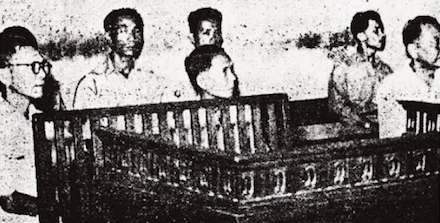
On this date in 1955, Thai royal secretary Chaliew Pathumros and royal pages Butr Patamasarin and Chit Singhaseni were shot as regicides. (Many other transliterations of these names, and the other Thai names in this post, are possible.) Few now believe that it was they who killed the young King of Thailand, Ananda Mahidol … but who really did it?
The defendants left to right across the front row: Chit Singhaseni, Butr Patamasarin, and Chaliew Pathumros.
Inheriting the throne of Siam — it became Thailand in 1939* — as a nine-year-old expatriate student in Switzerland, the wispy King Ananda would be described by Lord Mountbatten as “a frightened, short-sighted boy … a pathetic and lonely figure.” Some questioned whether he wanted to be king; others, whether monarchy would or should survive in Thailand at all. (Absolute monarchy had given way to constitutional monarchy in 1932.) Ananda’s own deceased father, a prince who had gone to Harvard, studied medicine, and married a commoner, seemed to model a different direction altogether, and Ananda’s legally questionable selection in 1935 might have been designed intentionally to enthrone a figure with no capacity for governance.
In any event, he would not bear this strange burden for very long — for his reign ended at 9:20 in the morning on June 9, 1946, announced by the single report of His Majesty’s own Colt .45 in Boromphiman Throne Hall. Ananda Mahidol was 20 years old, and he’d been expecting within a few days to fly back to Switzerland and wrap up his law degree. Instead, shot dead in the head at point-blank range, he was the vortex of a murder(?) mystery that continues to this day to elude a satisfactory accounting. His younger brother immediately succeeded him as King Bhumibol Adulyadej and would reign for 70 years** but even he couldn’t say what happened in this 1980 BBC interview.
The palace initially announced that the king had killed himself accidentally while toying with his gun but as more information leaked out it speedily rubbished the hypothesis of accidental or suicidal self-infliction. According to a British forensic pathologist who examined the evidence,†
The pistol found at the King’s side was by his left hand, but he was right-handed. The wound, over the left eye, was not in one of the elective sites, nor a “contact” discharge. The direction of fire was not inward towards the centre of the head.
Such findings pointed to the more politically explosive possibility that someone else shot King Ananda, which was also the conclusion of an official Thai inquiry late in 1946.
Soon, charges that the late king had been murdered at the behest of Prime Minister Pridi Banomyong — a republican who in his student days had been prominent in the successful movement to overthrow royal absolutism — were being aggressively bandied by his opposition. This rumor would eventually be enlisted as justification for a 1947 military coup that forced Pridi to flee Thailand.
Having made the punishment of Ananda’s assassins part of his putsch’s raison d’etre, the authoritarian former Axis collaborator Field Marshal Phibun now fixed his gaze on three palace servants who had been close to the young king in his last hours. Through them, Phibun’s new regime could condemn Pridi in absentia.
In a bizarre and ridiculous legal saga that began in 1948, the trio would be depicted as part of a sinister plot under Pridi’s direction to slay the king — Chaliew as Pridi’s instrument, and the two pages, who were in personal attendance upon Ananda at the time of his death, as complicit witnesses/accessories. (The judgment never quite says directly who pulled the trigger.) Over the course of the legal odyssey, two of the scapegoats’ defense attorneys were murdered, and two more arrested for treason: representing these regicides was such a dangerous task that by the end their team comprised only two young attorneys, one of whom was Chaliew’s freshly-graduated daughter.
Even so, only Chit was convicted in the first go-round but prosecution appeals against the verdict succeeded in condemning both of the other men, too. (One can read the full verdict in English here.) They would be executed one by one via a machine gun fusillade to the back, delivered through a screen — the distinctive local method. Bhumibol could have spared them. He didn’t.
But talk of these men as arch-traitors faded as political exigencies shifted in the subsequent decades. Their alleged conspiracy was incoherently depicted from the start, and nothing of direct evidence really implicated them: one can see in the BBC clip above that King Bhumibol doesn’t even bother discussing them when asked about Ananda’s death. It’s left the rather consequential question of who killed the king in a puzzling irresolution, a situation compounded by Thailand’s expansive lèse majesté law which renders taboo many obvious lines of inquiry when a royal is slain in a closed residence peopled by other royals. Speculation still centers on the three main scenarios considered from the outset: suicide, homicide, and accident.
Suicide
South African historian Rayne Kruger examined the obscure event in The Devil’s Discus: The Death of Ananda, King of Siam and concluded that it might have been suicide after all. In Kruger’s conception, it would have been occasioned by the young king’s mooning over a fellow law student back in Switzerland (Marylene Ferrari) who was forbidden him by his royal station.
William Stevenson’s The Revolutionary King postulates that fugitive Japanese war criminal Masanobu Tsuji, who was hiding out in Thailand at the time, masterminded the king’s assassination.
Bhumibol and the Thai court permitted Stevenson intimate access for several years researching this volume, although this did not prevent the book from also meeting a chilly reception in Thailand. (It’s unclear to me whether it was in fact ever formally banned, as some sites assert.) Although Stevenson’s theory about the killer doesn’t have many adherents, one supposes that in view of the author’s access, Bhumibol must have suggested it or assented to it during their private conversations.
Accident
Scottish journalist and former Reuters Bangkok correspondent Andrew MacGregor Marshall, author of another book banned in Thailand (A Kingdom in Crisis: Thailand’s Struggle for Democracy in the Twenty-First Century), has argued that the only plausible inference from the strange pattern of circumstantial evidence is that King Bhumibol himself — then an 18-year-old — pulled the trigger, likely by accident while horsing around with Ananda.
If Ananda was not assassinated by an intruder, did not shoot himself by accident, and did not commit suicide, that means he was shot by somebody known to be at the Barompiman Hall that morning. And only one person was not able to fully account for their movements that morning: Bhumibol. In particular, his testimony to investigators appeared to conflict with that of the royal nanny …
Discrepancies in the accounts of what happened when Bhumibol went to see Ananda at 9 a.m. are also telling. Investigators began to suspect the most likely scenario was that Bhumibol had indeed gone to see Ananda, but had not been turned away by the pages as he and they were later to claim. He went into Ananda’s room.
What happened there over the next 20 minutes, only Bhumibol knows for sure.
Bhumibol and Ananda both owned several guns and enjoyed playing with them. Indeed, Bhumibol had been known in the past to playfully point a gun at his brother. This has led many people to speculate privately that Bhumibol and Ananda were playing some kind of game in the bedroom that morning and that something had gone terribly wrong. The forensic evidence suggests Ananda was asleep when he was killed, however, although there remains the likelihood that, as the British ambassador’s secret cable suggests, the scene was rearranged after Ananda’s death. In any event, no credible explanation for the death of Ananda has ever been proposed other than this: between 9 a.m. and 9:20 a.m. Ananda’s Colt .45 was taken out from his bedside cabinet, and somehow Bhumibol came to shoot his brother with it, with the muzzle very close to Ananda’s forehead. Perhaps they were playing, or perhaps Ananda was still dozing and Bhumibol wanted to wake him with a practical joke, holding the gun to his head and pulling the trigger. Most probably, he removed the magazine from the Colt .45 automatic, put it to his brother’s head, and pulled the trigger, forgetting that even with the magazine removed, one round remains in the breech. Less likely, but possible, is that they argued about something and Bhumibol brandished the gun in a fit of anger. Bhumibol alone has the answer, and he seems unlikely to ever give us the truth.
Marshall’s website zenjournalist.org touches this event in a number of posts; he makes the case most directly and thoroughly in “The Tragedy of King Bhumibol”, Part III and Part IV. These and other posts also marshall diplomatic cables and intelligence reports showing that Bhumibol as the killer was common private scuttlebutt among both Thai and foreign officials from the very first days to the point of being received, albeit publicly unutterable, wisdom. For example, American diplomat Kenneth Landon‡ casually remarks as fact that King Ananda was “killed by his brother, either intentionally or accidentally, by the gun the OSS guy had given them to play with” in this recording made by his son for a family history. (It occurs in passing at 4:48)
Rumor is not proof, of course, but this theory would certainly account for the shroud of permanent mystery surrounding June 9, 1946, not to mention the king’s own grave public persona (“The King Never Smiles …”). For Marshall, Bhumibol — a fun-loving, jazz-playing sprite at the time he allegedly shot his beloved older brother — was a figure of monumental tragedy and, at least before he got to the point of allowing innocent people to take the fall for it, his dissembling about Ananda’s death
was not a way of shirking responsibility. Quite the reverse: his failure to confess was in many ways a profound sacrifice. Had he told the truth about the death of Ananda, he could have escaped back to Switzerland for a very comfortable life as a playboy prince, albeit a notorious one. Instead, he lied, and accepted the crushing burden of kingship, a role that he had never wanted. He resolved to devote himself tirelessly to royal duty for the rest of his life. It probably seemed the only way he could even begin to make amends.
* Thailand was again Siam from 1946 to 1948. I’ve simply used “Thai” and “Thailand” throughout this post about events overlapping this period, the better to avoid confusion.
† The palace immediately took control of, and meddled with, the scene, so the available evidence falls very far short of what a crime scene investigator might wish for.
‡ Kenneth Landon’s wife Margaret, his longtime companion in Siam/Thailand since the two first went as missionaries in 1927, is noteworthy as the author of Anna and the King of Siam, which is the basis for (among other adaptations) the Rodgers and Hammerstein musical The King and I and the Jodie Foster film Anna and the King.
The story of the crime was that seven negroes boarded an eastbound freight train on the Great Northern railway at Nihil on Oct. 5 with the intention of beating their way. They found the car they boarded, a gondola loaded with lumber, already occupied by three white men. The deceased [Michael Freeman] and two companions, Earl Fretwell and Claud C. Campbell. The negroes first went through the white men, obtaining a small sum of money and some trinkets, and then directed them to get off the train, which was going at the rate of 30 miles an hour. The men begged to be allowed to remain on the train until it stopped or slowed down. Fretwell started to comply, being urged by blows, and was struck on the head with a revolver and fell from the car. Campbell jumped from the train, followed by a fusillade of shots. Freeman was shot from behind, the bullet entering his back, and his body thrown from the train, being found alongside the track the next morning.
“I was curiosity with a ‘C.’ I just started to pepper him with questions — ‘Oh, Grandpa, what was it like? Did they lose their heads? Did their eyes bug out? Did everybody cheer? Did everybody cry?'” Zachary says.
“And he raised a hand, which told me to shut up. And he said three words: ‘It was awful.'”
On this date in 1673, Indians named Kaelkompte and Keketamape were sentenced to hanging and gibbeting for the murder of an English soldier near Albany, New York. (The date this sentence was executed, if it was not immediate, has been lost to history.)
This place had been known as Beverwijck up until a few years prior, when the English gave it its new and still-current christening* after taking it away New Netherland during the Second Anglo-Dutch War. The transition of its legal organs was a more gradual process — with a long survival of Dutch practices upon which the English were gradually overlaid.
The case at hand was a milestone in that jurisprudence: it appears to be the first documented jury trial (pdf) in Albany — a practice imported from England and reflective of the growing sway of the new boss.
Jury trials did not from that point become universal practice, however, and their use in this instance might have connected to the unusual nature of the prosecution.
Lying at the most northerly navigable point of the Hudson River, at the frontier of the powerful Mohawk and dependent upon they and other friendly indigenes to facilitate its fur trading, Albany kept a practiced blind eye when it came to Indian crimes. The 1665 murder of a Dutchman, the last previous documented homicide between the peoples, appears to have gone completely unpunished: in practice, intercultural grievances were settled privately, if at all.
But English law at least aspired to a more totalizing view and when one of the King’s subjects was murdered by natives who were not members of the powerful Iroquois confederation, it found its ideal test case — as we see in Courts Minutes of Albany, Rennselaerswyck and Schenectady, 1668-1673 (landing page | specific pdf volume). The ability of Albany to impose not only hanging but a potentially provocative gibbeting in this instance essentially confirmed the precedence of colonial jurisdiction over the smaller Hudson tribes. (The Iroquois were quite a different question and maintained expansive rights against the European encroach even into the post-colonial era.)
Kaelkompte, a northern Indian, from Narachtack castle, appearing in irons before the court, was asked whether he had any objection against any of the 12 jurymen standing before him?
Answered, that none of them had done him any harm.
Thereupon 12 jurors were sworn, as shown by the list, to do justice between the king and the prisoner.
As to the first point of the preliminary examination, as to conspiracy, etc., Kaelkompte answers that Keketamape asked him in the woods whether Stuart had any goods? To which he replied that some time ago he had seen three blankets and some coats there. Also, that Keketamape, sitting with him near the fire in the woods, said to him: “I shall kill Stuart.”
Whereupon Kaelkompte, saying that he did not quite understand, asked him: “W hat did you say? You wish to kill Stuart? If you kill him, you will kill yourself.”
Nota Bene. Here followed the further circumstances of the case. From the proceedings and the further documents it appears that Keketamape confessed that he was guilty of the murder.
Dirck Wessels, Meyndert Hermansz, Johannes Wendel, Willem Nottingam and Jan Jacobsz declare under oath that some time ago, being with the prisoners, listening to their caviling, [they heard] Keketamape say to Kaelkompe: “You killed Stuart and you say that I did it all.” Kaelkompe replied to this: “You did too.”
Kaelkompte acknowledges that he said it, but [declares] that it was longer ago than they say.
Indictment read to Keketamape and Kaelkompte
Keketamape admits that he had a hand in the murder and that he is guilty of having killed Stuart.
Kaelkompte admits that he consented by using these words: “There he is now. First kill him!” But he denies that he is guilty of the killing and says that he is not a bit afraid. He admits further, upon conviction by the interpreters, that he helped to kill Stuart by [the words of] his mouth.
The jury, having carefully weighed and considered the case according to the evidence, informations and confessions, conclude and decide that Keketamape and Kaelkompte are guilty of the murder of the person of Mr Stuart.
Sentence
Therefore, their honors sitting as this Special Court of Oyer and Terminer, having duly taken into account and considered the proceedings and also the verdict of the twelve jurymen that according to the documents placed into their hands the said Kaelkompte and Keketamape are guilty of the murder of the aforesaid Jan Stuart, condemn them both, as they condemn them hereby in the name of his Royal Majesty of Great Britain, under the government of the Right Honorable Colonel Francis Lovelace, to be brought together to the place of execution to be hanged by the neck until they are dead, dead, dead, and thereafter to hang in chains. Actum in Fort Albany, the 15th of February 1672/73.
By order of the honorable Court of Oyer and Terminer
Ludovicus Cobes, Secretary
One of the jurors in this trial, Willem Teller, might have been the same man at issue in a case five years later when “a certain squaw was shot dead at the house of Teller, burgher of this city.” The court found it an accident and ordered him to pay the Mahican nation fifty florins: laying aside any question of proportionality, this later case also demonstrates English courts successfully asserting their rights over violence between peoples that formerly would have been settled in private.
* The name “Albany” honored the Duke of Albany, the man who would eventually be King James II … until he was deposed by a Dutchman.
Who fain at Pindar’s flight would aim,
On waxen wings, Iulus, he
Soars heavenward, doom’d to give his name
To some new sea.
Pindar, like torrent from the steep
Which, swollen with rain, its banks o’erflows,
With mouth unfathomably deep,
Foams, thunders, glows,
All worthy of Apollo’s bay,
Whether in dithyrambic roll
Pouring new words he burst away
Beyond control,
Or gods and god-born heroes tell,
Whose arm with righteous death could tame
Grim Centaurs, tame Chimaeras fell,
Out-breathing flame,
Or bid the boxer or the steed
In deathless pride of victory live,
And dower them with a nobler meed
Than sculptors give,
Or mourn the bridegroom early torn
From his young bride, and set on high
Strength, courage, virtue’s golden morn,
Too good to die.
Antonius! yes, the winds blow free,
When Dirce’s swan ascends the skies,
To waft him. I, like Matine bee,
In act and guise,
That culls its sweets through toilsome hours,
Am roaming Tibur’s banks along,
And fashioning with puny powers
A laboured song.
Your Muse shall sing in loftier strain
How Caesar climbs the sacred height,
The fierce Sygambrians in his train,
With laurel dight,
Than whom the Fates ne’er gave mankind
A richer treasure or more dear,
Nor shall, though earth again should find
The golden year.
Your Muse shall tell of public sports,
And holyday, and votive feast,
For Caesar’s sake, and brawling courts
Where strife has ceased.
Then, if my voice can aught avail,
Grateful for him our prayers have won,
My song shall echo, “Hail, all hail,
Auspicious Sun!”
There as you move, “Ho! Triumph, ho!
Great Triumph!” once and yet again
All Rome shall cry, and spices strow
Before your train.
Ten bulls, ten kine, your debt discharge:
A calf new-wean’d from parent cow,
Battening on pastures rich and large,
Shall quit my vow.
Like moon just dawning on the night
The crescent honours of his head;
One dapple spot of snowy white,
The rest all red.
–Horace, celebrating Iullus Antonius‘s verse in verse. The latter’s verse has not reached posterity, though he was a well-regarded poet in his time.
Contrary to what one might expect, Augustus didn’t hold the kid’s parentage against him* and “not only granted him his life, but after honouring him with the priesthood, the praetorship, the consulship, and the governorship of provinces, had admitted him to the closest ties of relationship through a marriage with his sister’s daughter.” (Per Marcus Velleius Paterculus**)
But at some point Iullus took his relations rather too far for the old man by achieving the favors of Augustus’s only daughter, Julia — notorious of ancient scribes for her promiscuity and eventually destined to be murdered off when her crusty, cuckolded husband Tiberius attained the purple.
There is nobody party to this event that comes out the better for it; Augustus for his part really cemented his uptight prig reputation for the history books, and Tacitus censures him because in “[c]alling, as he did, a vice so habitual among men and women by the awful name of sacrilege and treason, he went far beyond the indulgent spirit of our ancestors, beyond indeed his own legislation.”
when [Augustus] at length discovered that his daughter Julia was so dissolute in her conduct as actually to take part in revels and drinking bouts at night in the Forum and on the very rostra, he became exceedingly angry. He had surmised even before this time that she was not leading a straight life, but refused to believe it. For those who hold positions of command, it appears, are acquainted with everything else better than with their own affairs; and although their own deeds do not escape the knowledge of their associates, they have no precise information regarding what their associates do. In the present instance, when Augustus learned what was going on, he gave way to a rage so violent that he could not keep the matter to himself, but went so far as to communicate it to senate. As a result Julia was banished to the island of Pandateria, lying off Campania, and her mother Scribonia voluntarily accompanied her. Of the men who had enjoyed her favours, Iullus Antonius, on the ground that his conduct had been prompted by designs upon the monarchy, was put to death along with other prominent persons, while the remainder were banished to islands. And since there was a tribune among them, he was not tried until he had completed his term of office. As a result of this affair many other women, too, were accused of similar behaviour, but the emperor would not entertain all the suits; instead, he set a definite date as a limit and forbade all prying into what had occurred previous to that time. For although in the case of his daughter he would show no mercy, remarking that he would rather have been Phoebe’s father than hers, he nevertheless was disposed to spare the rest. This Phoebe had been a freedwoman of Julia’s and her accomplice, and had voluntarily taken her own life before she could be punished. It was for this that Augustus praised her.

 Andrea Serrao English Wikipedia entry | Italian) was a late disciple of the reformist Jansenist movement which tended among many other things to such Enlightenment-friendly notions as liberty of conscience, the reduction of the papal authority, and “regalism” — the doctrine of secular supremacy over ecclesiastical.
When Ruffo’s bands drew near to Potenza, many peasants and some priests regarded Bishop Serrao as ‘the enemy of the Pope, the king, and God’. Warned to escape, he said that he trusted his fellow-citizens. When the professors and students at the seminary wanted to make a bodyguard, he forbade them to arm.


 Kovalev and nine mates felt exactly the same and they did it in the form of a downright suicidal flight from Sakhalin’s abyss in an open launch ventured into the Pacific in hopes of reaching Japan. They were on the brink of succumbing to their privations when they were miraculously picked up by a San Francisco-based whaler, the Charles W. Morgan.**


 Jean Lee was apparently quite intelligent and a bit rebellious at school and had a succession of dead end jobs from which she soon left or was fired.