1866: Anton Probst, “I only wanted the money”

(Thanks to Meaghan Good of the Charley Project for the guest post. -ed.)

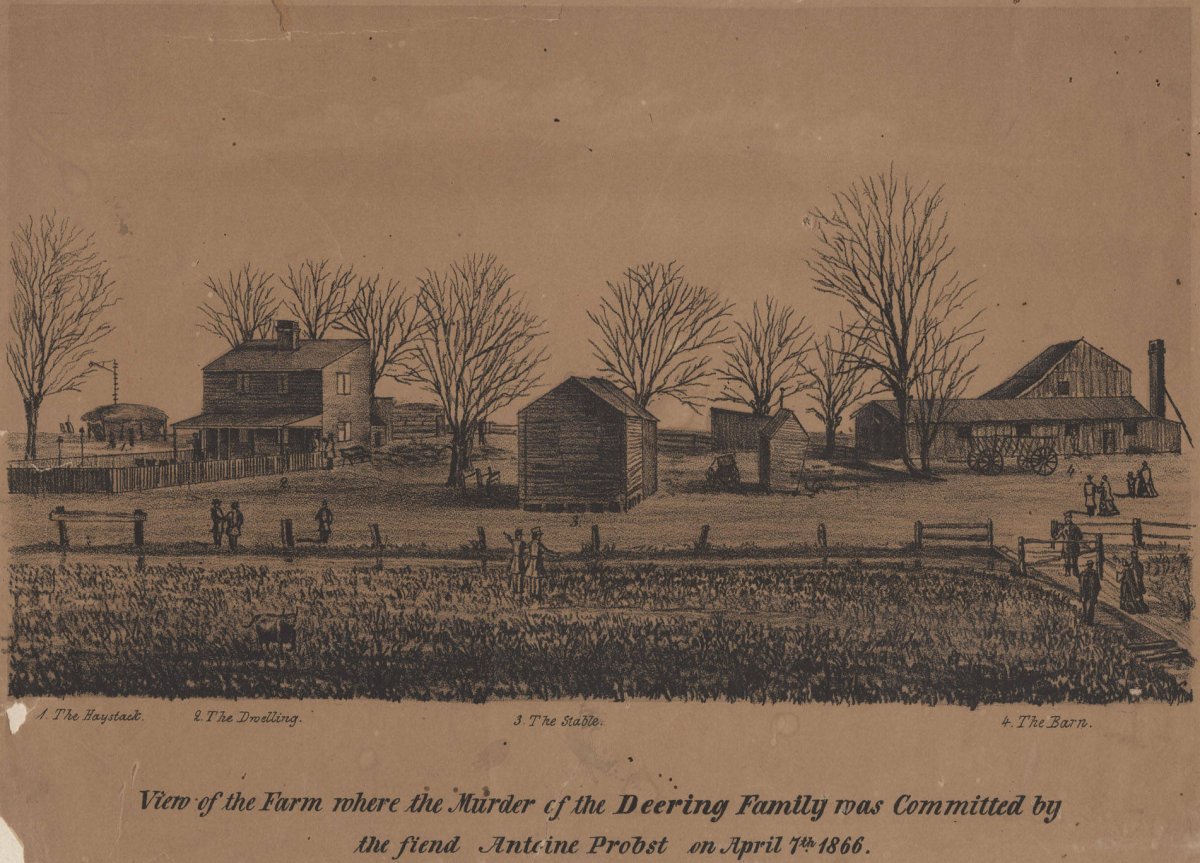
On this date in 1866, mass murderer Anton Probst (sometimes called “Antoine”) was hanged in Philadelphia, Pennsylvania. He made national headlines in its time, but today he is forgotten except among serious students of violent crime.

Probst was a native of Germany, the son of a carpenter. He later claimed he had a normal childhood and “never did anything wrong” until after he had left his home country.

He moved to the United States in 1863, in the middle of the Civil War, and became a professional “bounty jumper”: he would join up with a Union Army regiment, collect the $300 enlistment bonus, desert as soon as he could, then enlist with another regiment and start the cycle over again. He made a tidy living for himself this way until 1865, when he accidentally shot his thumb off and was discharged from the military for good.

Probst squandered his enlistment bounties on liquor and and rapidly fell into post-discharge penury. This was why, in the fall of 1865, he hired himself out as a farmhand to Christopher Deering, an Irish immigrant who lived in a rural part of Philadelphia with his wife and five children.

Deering offered Probst a salary of $15 a month plus room and board. Probst quit after only a few weeks, though, not being accustomed to honest labor.

He soon fell ill and, without a source of income, wound up in the workhouse. In dire straits, he returned to the Deering farm on February 2, 1866 and begged for his job back. And, although Probst’s behavior from before had given Christopher’s wife the creeps, the farmer took pity on him and re-hired old Thumbless.

Things went well for the next two months. But unbeknownst to his employer, Probst had thought of another way to get money.

Christopher’s nearest neighbor, Abraham Everett, lived a quarter of a mile away. Everett subscribed to several local weekly newspapers and, every weekend, Christopher would send his son to borrow the previous week’s editions.

One Saturday, the boy never showed up.

Nor did he arrive on Sunday.

Or for the next several days after.

By Wednesday, Everett was getting worried and decided to go to the Deering place and see if they were all right. He found the farm deserted and the horses inside the barn, nearly dead of thirst and starvation. After giving food and water to the distressed animals, he went and looked through the window into the Deering family’s house and saw it had been ransacked.

Seriously alarmed now, Everett forced the window open and climbed inside, and found every room in the house in a state of disarray. In the bedrooms, the beds had been torn and flipped upside down, dresser drawers had been rifled through and clothes were scattered everywhere. There was not a soul to be seen.

At this point, Abraham Everett went off to get help, summoning another neighbor and then the police. Inside the barn they found something Everett had missed while he was helping the horses: Christopher Deering’s body, partially covered in hay, alongside the body of a cousin visiting from New Jersey.

“His head,” crime historian Harold Schechter reports in his book Psycho USA: Famous American Killers You Never Heard Of, “was crushed to pieces, almost to powdered bone, and his throat was cut … from ear to ear.” Christopher’s cousin had similar injuries. A search of the barn turned up the bodies of Christopher’s wife, Julia, and four of the couple’s five children, stacked in the corncrib.

All of them had their throats cut and their skulls bashed in.
The only survivor in the family was the oldest child, ten-year-old William Deering, who had been staying with his grandparents at the time of the murders. And so the family line did not die out: according to this Philadelphia Inquirer article, William has 60 descendants.

The murder weapons were lying around bloodstained and in plain sight on the property: a hammer, a small hatchet and a full-sized ax. Hours later, the police found the last body hidden in a haystack a few hundred yards from the barn: seventeen-year-old Cornelius Carey, one of the Deerings’ farmhands.

The other farmhand was missing and, under the circumstances, had to be viewed as the prime suspect in this massacre. Nobody knew much about him, but the neighbors recalled that missing right thumb, spoke poor English with an accent, and was called something like “Anthony.”

Fortunately, he would not prove hard to find. “It might be supposed,” Harold Schechter says,

that a man who had methodically slaughtered eight people, including three prepubescent children and a fourteen-month-old infant, would lose no time in putting as much distance between himself and the crime scene as possible. For all his low cunning, however, Anton Probst was incapable of prudent calculation. Indeed, from all available evidence, he thought of nothing beyond the gratification of his immediate physical needs.

Hours after the murders, Probst was no further away than a house of ill repute on Front Street in Philadelphia, where he spent the night with a $3 prostitute. For the next few days he hung around his favorite bars drinking, making occasional excursions to pawn items he’d stolen from the Deering farm. He was in no hurry to leave.

Only the day after Probst’s grisly crimes were discovered, a police officer named James Dorsey spotted him strolling around near Market Street. Something about his bearing, and the way his hat was pulled low over his eyes, made the lawman suspicious. He walked up to him and noticed the stranger’s right thumb was missing.

Dorsey pulled Probst’s hat off to have a look at his face and said, “Good evening.” Probst mumbled a reply and Dorsey, noting the accent, said, “You’re a Dutchman?”

“No,” Probst answered. “Me a Frenchman.”

“You are, are you? Take a walk with me.” Dorsey grabbed the murderer’s arm and hauled him off to the nearest station house. There the police searched him and determined he was wearing Christopher Deering’s clothes, and carrying the farmer’s snuffbox and pistol. Probst had left Elizabeth Dolan’s carpetbag at a tavern earlier that day; it contained a number of small items, including cheap children’s toys, all of which were from the Deering farm.

The police had to transfer Probst from the Philadelphia City Jail to Moyamensing State Prison for his own safety, after a would-be lynch mob stormed the jail. Probst claimed he had only killed Cornelius Carey and tried to blame the other murders on an imaginary accomplice; at his trial (which began on April 25, less than three weeks after the murders) his lawyers argued that the case against him was strictly circumstantial and not proved beyond a reasonable doubt. But the trial’s outcome was clear from the beginning. The jury deliberated for only twenty minutes before convicting.

Death row agreed with Probst; he seemed at ease and actually gained twelve pounds in the five weeks between his trial and execution. On the morning of May 7, exactly one month after the murders, he finally confessed that his accomplice didn’t exist and he’d acted alone. He was “quiet, undemonstrative, cool and unembarrassed” as he told his story, “without the least trace of shame or remorse.”

You can read it all here in his very own words, or below, in mine. At first his intention had just been to rob the family of everything they had, then flee. But he found himself unable to accomplish this because there were always too many people around.

About a week before the murders, it occurred to Probst that perhaps murder might be necessary to facilitate the robbery. At first he thought he could just kill Christopher Deering, but as he mulled the matter over he decided the rest of the household would have to die as well.

First to go was Cornelius Carey as they were working together in the field. Then Probst went into the barn and lured the others in one by one, killing them as they each came inside: eight-year-old John Deering, then the mother, Julia, then the rest of the children: six-year-old Thomas, then four-year-old Annie, and finally the baby, Emma. Probst estimated that it all took about half an hour.

Christopher Deering was off picking up that visiting cousin from the ferry, and they didn’t arrive back at the farm until the afternoon. Probst was waiting for them. While the guest Elizabeth Dolan went into the house, Probst told Christopher one of the animals was sick and he had to go inside the barn. There he killed him like the others, then called Miss Dolan to the stable. She was the last one to die.

If we are to believe the killer’s account, the victims all died quickly and quietly, and did not suffer. None of them, he said, so much as cried out after the first blow.

Once finished, Probst tore the house upside down looking for things to steal, washed, shaved, changed out of his bloody clothes and put on some of Christopher’s, and had himself a snack of bread and butter. At sunset he headed off to town.

Schechter records:

When asked by Chief Franklin why on earth he had perpetrated such an atrocity, Probst gave a little shrug. “I only wanted the money,” he said. “I killed the boy Cornelius first so that he could not tell on me. I killed the two oldest children so they would not afterwards identify me. I killed the two youngest as I did not wish to leave them in the house alone without someone to care for them. I had no ill feeling to anyone in the family. They always treated me well.”

Probst submitted meekly to his execution, which went off without a hitch. The public understandably rejoiced at his death and the New York Times, in its report of how Probst “shuffled off his mortal and disreputable coil,” called him “the greatest criminal of the nineteenth century.”

Probst was permitted to write to his family in Germany. He told them of “the terrible fate which has befallen me,” admitted to the eight slayings, and blamed his bad behavior on his experiences in the Union Army, where he “heard nothing but cursing and swearing, and soon became a sharer in every wickedness.”

Whatever, Anton.

After his death, Probst’s body was handed over to the physicians at Jefferson Medical College, who subjected it to a series of bizarre experiments with electricity. When they finished with their fun they performed an autopsy. Probst’s brain turned out to be unusually small, almost a full pound lighter than average. What, if anything, this has to do with his apparent psychopathy is anyone’s guess. His head and arm were later displayed in the Jefferson Medical College museum.

On this day..

1868: Joseph Brown, for arson, murder, and money

On this date in 1868, Joseph Brown hanged in Hudson, N.Y..

He and his wife Josephine had recently moved to the hamlet of Canaan just this side of the Massachusetts border. With them was a twelve-year-old daughter.

On the night of December 5, 1867, they left little Angie in their basement rental and called on neighbors for the evening — and the house went up in flames. Neighbors rushing to the emergency had to force their way through the doors to extinguish the blaze, and discovered the Angie’s scorched remains amid several bushels of suspiciously flammable rubbish. Some neighbors thought the Browns had not hurried to the scene as they ought, and found their expressions of grief unconvincing.

These dubious circumstances could hardly help but lift an eyebrow, but in the end there was little for it and a coroner ruled the death accidental, perhaps caused by the unattended child attempting to fill a lighted kerosene lamp.

However, the fate of “poor little Angie” took on a decidedly more sinister cast when the Browns turned around and filed for a $5,000 life insurance benefit on Angie’s bones — a short-term, three-month policy due to expire in two weeks. A suspiciously dead child was one thing, but now there was money at stake. Travelers Insurance — the present-day corporate conglomerate then in its infancy, carving out its titular niche with innovative policies insuring against once-dangerous rail travel — put some real investigative muscle into the situation before it paid up.

The facts as developed by Travelers made a damning circumstantial case against the couple that was soon taken over by the criminal authorities: “a reflected glow of guilt,” in the summing-up of the state’s attorney who prosecuted Joseph.

Angie turned out not to be the couple’s own child at all, but a loaner from a woman in their hometown of Dayton, Ohio. She had given permission for her daughter to accompany the couple on a trip to Connecticut. (A weird arrangement in which the child was to call them “mother” and “father”, but one made innocently by the victim’s natural mother so far as anyone could determine.)

En route, Joe and Jo insured the life of this child who was not their own. And by the time they got to Canaan, Joseph had indiscreetly negotiated to purchase some property, intimating an ability in no way justified by his pre-fire resources to pay several thousand dollars cash on the nail.

To cinch Joseph’s conviction, physicians hired by Travelers testified that Angie had not inhaled smoke … meaning that she was dead before the fire started at all.

“I have told the insurance company that I would give them the policy if they would let me go,” a desperate Joseph at one point said in a police interview. He should have thought of that sooner.

But he was, as he said on the scaffold, “not an accomplished man” and he could only complain confusedly about minor points of the trial he considered prejudicial while maintaining a general insistence upon his innocence that persuaded nobody.

At the time of this hanging, Josephine Brown still lay in the Columbia County jail awaiting her turn at the bar in the same affair. But despite the sense among many participants in the case that it was she who instigated her cloddish husband to the lucrative homicide, the prosecution couldn’t assemble a satisfactory case and dropped charges later that year.

On this day..

1958: Vivian Teed, a first and a last

The last person hanged in Wales was Vivian Teed on this date in 1958; he was also the first hanged (in Wales or anywhere) under the new Homicide Act of 1957.

Teed went to rob a Fforestfach post office and was surprised to find 73-year-old postmaster William Williams not only present but in a mood to resist him. The thief had brought along a hammer in case he needed to force a door or something, so he grabbed it and hammered Mr. Williams … over and over and over. Twenty-seven times. Then he rifled the station as planned while the mortally wounded old man moaned and twisted, unable to come to his feet because the floor was so slick with his own blood.

“The defence is not that this man did not kill the unfortunate postmaster,” his attorney told the jury. “That tragic fact is true. The defence is that when the accused did it he was suffering from abnormality of the mind which impaired substantially his mental responsibility for what he did when he killed the postmaster.”

After many decades when hanging was the mandatory sentence for the crime of murder (even though in practice not every murder resulted in an execution), public consternation at certain sensitive cases like those of Ruth Ellis and Derek Bentley had driven a legal reform whose intended upshot was confining the death sentence to the proverbial worst of the worst.

The Homicide Act created a new subcategory “capital murder” — especially heinous murders, such as killing a policeman or committing murder in the course of a theft. Vivian Teed went to the gallows under the latter statute.

But the Homicide Act also removed certain types of homicide from the murder category altogether — notably for Teed’s purposes, a new defense of “diminished responsibility” was explicitly authorized and defined. This defense would have saved the mentally impaired Bentley. Now Teed tried to claim that an “abnormality of the mind which impaired his mental responsibility” was what really hammered William Williams’s skull.

Only one holdout member of the jury bought this, but after a number of hours and a couple of separate attempts by the panel to declare itself deadlocked, she or he finally came around and voted to convict. Teed hanged at Swansea Prison seven weeks later.

On this day..

1567: Wilhelm von Grumbach, Landfrieden-breaker

On this date in 1567, Wilhelm von Grumbach was dismembered along with two of his followers in the marketplace of Gotha.

Grumbach (English Wikipedia entry | German) was the cantankerous German instigator of the aptly-named Grumbachsche Handel, a messy clash of rights and prerogatives at the hinge of the old feudal order and centralized princely authority.

Grumbach was a knight who’s invariably described as an “adventurer”. As a young man he fought in the Peasants War, but as he headed into middle age he became your basic penniless minor nobleman chafing at the failures and obstructed opportunities life threw at him.

The thing he could not abide losing was the disappearing right of the nobility to enter into a feud or vendetta. This scans to the modern like rank anarchy, but feuds were part of the tapestry of medieval German society, long codified in law — an obvious descendant of clan and tribal obligations out of which the muddle of feudal vassalage had formed. “The passion for liberty and rights,” says this volume, “ran amok in Germany. Churchmen, princes, burghers, and peasants all wanted their independence and readily resorted to declarations of feud to secure and defend their rights.”

The standing right for miscellaneous minor lords to start miscellaneous private wars was quite naturally one that princes were ever keen to restrict. After centuries of two-steps-forward, one-step-back efforts to deal with the feud, the 1495 Imperial Diet formally codified a ban on feuding known as the Ewiger Landfriede, or “perpetual peace”. In Poli Sci 101 terms, this is the state finally monopolizing legitimate violence.

As with dueling, however, official proscription did not end the practice. It was, indeed, Grumbach’s defeat and execution that would eventually be remembered as the decisive nail in the coffin for knightly feuds.

And so in Franconia where we lay our scene will civil blood make civil hands unclean …

Grumbach’s liege was Melchior Zobel von Giebelstadt, the Prince-Bishop of Wurzburg. (Still another confusing dimension of the political map, some princes of Germany’s many statelets were simultaneously ecclesiastical authorities. For purposes of this post, the “-Bishop” part doesn’t enter into it.)

Knights’ basic problem — the reason they were vulnerable to losing their wacky old-time rights — was poverty, and it was in money that Grumbach’s feud was rooted. Grumbach’s personal twist on this was being the sort of irascible coot who could carry a grudge so far as to get himself sawed into pieces over it.

Immediately upon assuming the Prince-Bishopric in 1544, Melchior Zobel von Giebelstadt forced Grumbach to return an unauthorized cash gift his predecessor had paid to the knight, and then stiffed said knight out of six villages whose revenues Grumbach sought by way of compensation.

He had to deal with Grumbach’s feud for the remainder of his term, which was also the remainder of his life … right up until Grumbach murdered him.

The disaffected knight hooked up with the margrave* Albert Alcibiades and started making a right mess in the middle of Europe with a 1552-54 mini-war. When Albert got thumped, Grumbach had to evacuate to France, and his holdings outside Wurzburg were plundered and/or destroyed by his foes.

So now the guy was even more aggrieved, and even more pfennigless.

He was downright vengeful about his feud at this point, although it’s noteworthy relative to that monopolization-of-violence trend that he was still the only one: in days of yore, intra-elite wars might have spawned multiple self-reproducing vendettas.

The grumpy Grumbach now gravitated to another patron,** the deposed elector of Saxony Johann Friedrich II — another dude who felt hard done by in the Holy Roman Empire.

Grumbach evened his score with Melchior von Zobel by having the Prince-Bishop killed in Wurzburg in April 1558. (In present-day Wurzburg, three Zobelsaulen markers commemorate the Prince-Bishop’s assassination, one on the very spot of the murder.)

But that still left the money, and we know Grumbach wasn’t the type to write off a debt. In 1563, he successfully invaded Wurzburg with 1,300 soldiers and at swordpoint forced from the city a concession restoring his property.

For Grumbach, it was to prove a Pyrrhic victory.

In principle, he had achieved a great vindication of the ancient right of the feud, and for the hard-pressed nobility against the realms’ many princes. If others of his station had rallied to that banner, what a whirlwind Germany would have reaped.

According to Hillay Zmora’s State and Nobility in Early Modern Germany: The Knightly Feud in Franconia, 1440-1567, however, Grumbach’s fellow-knights looked into this particular abyss and said “nein, danke.”

Grumbach was in fact hatching an extravagant scheme† to liberate the entire German nobility … from the yoke of the princes. It was a radical aristocratic utopia … nobles were not only to be protected by the [Holy Roman] emperor from the princes, but to help him subdue them once and for all and to establish an hereditary monarchy in Germany. But despite Grumbach’s best efforts to incite the Franconian nobility, they did not line up behind him. Guidied by the captain of the Franconian Circle (Kreis), Georg Ludwig von Seinsheim, who denounced Grumbach’s undertaking as ‘against God, law and the emperor’, they formally turned away from him in 1564. In the view of the majority of them, the Knighthood was to maintain its autonomy by respecting the equilibrium between emperor and princes, not by irresponsibly challenging the latter. And it was this view, reassuringly transmitted to the princes, which carried the day.

Grumbach was outlawed by the empire and in 1566-67 was overcome with his protector Johann Friedrich at Gotha. Both men spent he remainder of their lives as imperial prisoners, with the notable difference that Johann Friedrich had the pull to live out his natural ration of days while Grumbach went straight to the dungeon for torture and thence to the scaffold in the town that had lately been his last redoubt. There, Grumbach was ripped apart — his dying eyes beheld the executioner wrench the heart out of his very chest and taunt him: “Behold, Grumbach, thy false heart!” The late knight’s rotting quartered remains got nailed up around town to broadcast the unmistakable message:

The noble right to feud was dead.

* Hereditary military commander.

** Among their other capers, Grumbach and his patron Johann Friedrich conspired with Torben Oxe‘s nephew Peder Oxe to depose the Danish king Frederick II in favor of the king’s grand-niece, Christina. (Christina will be known to Tudor-philes as the young woman who scuttled Henry VIII’s post-Anne Boleyn suit with the sharp remark, “If I had two heads, one should be at the King of England’s disposal.”) Nothing came of the plot. (Source)

† Christian Wieland writes that Grumbach deployed — unsuccessfully but still impressively — a 16th century multimedia propaganda campaign to state his case to the “common nobleman”: woodblock-illustrated printed leaflets, songs valorizing the attack on Wurzburg (sample verse: “Violence may be averted by violence / According to natural law”).

On this day..

1921: Mailo Segura, a Montenegrin in Alaska

(Thanks to Meaghan Good of the Charley Project for the guest post. -ed.)

At noon on this day in 1921, Mailo Segura was hanged in Fairbanks, Alaska.

In 1918 he had murdered a miner, J.E. “George” Riley, near the gold rush town of Flat, in a dispute over money. His was the second execution in Fairbanks history.

George Riley was in charge of the mining operations along Orter Creek near Flat. Segura was a lumberjack and, together with some other men, had sold $300 worth of cordwood to Riley on credit.

In early 1918, Segura confronted Riley with the bill and demanded to be paid. By then, the bill had been outstanding for two years. Riley, however, refused to pay. He said he wasn’t going to hand over any money until Segura either brought his wood-chopping partners along with him to collect the sum in person, or brought a statement from his partners authorizing Segura to take the full amount.

As witnesses at his trial later testified, Segura was furious with Riley and said he would kill him if Riley didn’t give him the $300. On March 2, he withdrew his life savings of $1,800 from his bank account and later that day went looking for the deadbeat.

Segura found his quarry at the mining claim and waited patiently, assisting with the mining work so he wouldn’t look suspicious.

When all the other miners had gone inside the boiler house, Segura shot Riley in the back without warning. The miners heard the shots — there were three, any one of which would have been fatal — and ran outside to find their employer lying stone dead on the ground and Segura running away.

It didn’t take much effort to catch him. Once he was surrounded, Segura raised his hands in surrender and shouted, “Me no kill no more.”

Seeing as how Mailo Segura had repeatedly threatened Riley’s life and then shot the unarmed man from behind, his claim of self-defense didn’t go very far at his trial. He was convicted of first-degree murder on July 18 and was supposed to be hanged on October 8, but Segura put his $1,800 life savings to use filing appeals, and thereby prolonged his life by three years.

When his time came, he was terrified and unable to walk to his death. The authorities had to strap him to a board to keep him upright while they fastened the noose around his neck.

A matter of minor interest: Mailo Segura hailed from halfway around the world in the tiny Balkan kingdom of Montenegro; he might be the only Montenegrin ever executed in North America. (Montenegrins were then and still are today a sizable minority in Alaska.) In spite of his European descent, in trial documents he was referred to as “black,” and possible racial prejudice on the part of the jury was an issue in his appeals.

On this day..

1934: Georges-Alexandre Sarrejani, vitriolic

On this date in 1934, Georges-Alexandre Sarrejani (alias Sarret) became the last person guillotined at Aix-en-Provence

This charmer — most of the links today are in French — ticked one off the bucket list by seducing a pair of sisters, Catherine and Philomene Schmidt.

These he used as partners in a simple insurance scam way back in 1920: get them to marry a couple of men at death’s door, produce bogus medical exams declaring them to be in robust health, and pocket the proceeds when they kick the bucket. Sarrejani got the lion’s share because he threatened to denounce the Bavarian sisters as World War I spies. Insurers had their suspicions but couldn’t prove anything.

In 1925, a defrocked priest and said priest’s mistress threatened to turn in the scam artists.

Sarrejani, again with the full complicity of his women, horrifyingly disposed of the threat.

After shooting both dead, he ducked off to Marseilles to pick up a bathtub and 100 liters of vitriol (aka sulfuric acid). With this, Sarrejani and his mistresses marinated their victims until they had dissolved into a foul brackish puddle, which was nonchalantly poured out into the garden.

It’s this stomach-turning crime that Sarrejani is most famous for, and got the “trio infernale” immortalized on the silver screen in a gruesome 1974 film.

However, this murder was unknown for six years and might have gone permanently undetected had not the infernales attempted an even more primitive insurance scam in 1931. How many victims, one wonders, have been successfully acid-bathed by murderers restrained enough to get away with it.

At any rate, in 1931 Catherine Schmidt insured herself and faked her own death, substituting a tuberculotic corpse. She had the carelessness to show herself in Marseilles where someone recognized her as a “dead” woman … and in the ensuing interrogation, she turned the denunciation game right around on Serrejani. I’ll show you a Bavarian spy, mister.

The result was France’s most headline-grabbing trial since the bluebeard Henri Landru, pictures of which can be gawked at this French forum thread. Sarrejani had some legal training, enabling him to drag out the melodrama even further to the great delight of the nation’s editors.

When all was said and done, Sarrejani was set to lose his head; the Schmidts got just 10 years in prison. Call it the dividend on that insurance-fraud money he’d muscled out of them.

The whole ghastly affair had one last horror when Sarrejani met the blade this morning just outside the prison walls: the blade stuck halfway down, leaving embarrassed executioners to do 10 minutes of live troubleshooting while their patient below (justifiably) fulminated against their incompetence.

On this day..

1752: Mary Blandy, “forgiveness powder”

(Thanks to Meaghan Good of the Charley Project for the guest post. -ed.)

On this date in 1752, 32-year-old Mary Blandy was hanged for the murder of her father, Francis. He had died in agony on August 14 the previous year, having been sick for months.

That Mary had poisoned her father with arsenic was not in dispute; the evidence proved it and she admitted it herself, even before he died.

The question was as to her motive, and her intentions. Mary conceded she had caused Francis’s death, but denied having ever meant to harm him.

The events that lead to Francis Blandy’s demise at the age of 61 began in 1746. Mary was Francis’s beloved only child and an old maid by the standards of day. They lived in Henley-Upon-Thames, Oxfordshire, UK.

Although scarred from a bout with smallpox, she was well-educated, witty and intelligent, and advertised a dowry of £10,000. But she had never been able to find a suitor her father approved of, until Captain William Henry Cranstoun came along.

Cranstoun was several years older than Mary, short, ugly, a compulsive gambler and not terribly bright, but he was a member of the Scottish aristocracy, the younger son of an earl. When he proposed in 1747, both father and daughter happily said yes.

Unfortunately for the two lovers, Francis Blandy soon learned that Cranstoun was already encumbered with a wife and child back in Scotland. Cranstoun swore (falsely) that he was not legally married to the woman and she’d only ever been his mistress; smitten Mary believed him, but Francis didn’t take kindly to the deception and he showed his would-be son-in-law the door.

Cranstoun, however, was not going to let a £10,000 dowry slip through his fingers so easily.

While he tried (unsuccessfully) to annul his existing marriage, he remained in touch with Mary for years and told her about a special powder made by wise women in Scotland, which caused those who took it to forgive their enemies.

Mary was skeptical, but Cranstoun swore it really worked and said he’d taken it once himself and felt its effects. He obtained some of the powder and convinced Mary to start slipping it into her father’s food and tea, so his heart would soften and he would allow his daughter to marry the man she loved.

Such was Mary’s story, at any rate, and she stuck with it until her dying day.

She swore she did not realize the magic powder was toxic. Sure, Francis rapidly became sick with heartburn and stomach pains, but he had suffered these symptoms before. Then his condition worsened. He vomited constantly and all of his teeth fell out. Mary finally summoned a doctor.

By then it was too late, for both father and daughter. The family servants became suspicious after several of them got violently sick when they drank tea intended for Francis.

One of them noticed a white grainy substance in the bottom of a bowl of gruel Mary had fed her ailing father. The servants took the substance to Francis’s doctor, who determined it was arsenic. Around the same time, another servant saw Mary throw a bundle of Cranstoun’s letters into the fire. She also tried to burn a packet which the servant rescued from the flames; it contained white powder identical to the arsenic that was rapidly burning through the old man’s entrails from the inside out.

When he was informed his daughter had poisoned him and guessed why, Francis refused to be angry with her, saying, “Poor love-sick girl! What will a woman not do for the man she loves?”

As he lay in extremis, Mary rushed to his bedside and begged her father to forgive her. An indulgent parent to the very end (or perhaps the “forgiveness powder” really had worked), he blessed his wayward child and told her he would “pray to God to bless thee, and to amend thy life.” He blamed Cranstoun for everything.

A few days later he was dead.

Mary ran from the house after his death, pursued by an angry mob, and took refuge in the Little Angel Pub. Eventually she was persuaded to surrender herself to the authorities. On August 17, she was arrested.

When Francis’s estate was settled, its worth was determined to be only about £4,000. Cranstoun would have never gotten that £10,000 dowry: it didn’t exist.

James C. Whorton discusses her trial in his book The Arsenic Century: How Victorian Britain was Poisoned at Home, Work and Play:

‘A vast concourse of people’ gathered for the trial, including many students from the university (whom one prosecutor could not resist lecturing ‘See here the dreadful consequences of disobedience to a parent’). The proceedings lasted but a single day, albeit a long one, running from eight in the morning till nine at night. Conducting herself ‘with more than masculine firmness’, Mary continued to insist that she was the victim of a cruel deception (‘What women can withstand the arguments and persuasions men will make of us?’), but the jury would have none of it. Devoting only five minutes to deliberation, not even retiring from the courtroom, they pronounced the defendant guilty.

Just before her execution, Mary wrote out her side of the story, which can be read in full online. Whorton records her death:

The prisoner was hanged five weeks later, on 6 April 1752, still avowing her innocence: ‘May I not meet with eternal salvation,’ she declared from the scaffold, ‘nor be acquitted by the almighty God, in whose awful presence I am instantly to appear,’ if guilty. Then, ‘without shedding one tear,’ Mary Blandy pulled her handkerchief over her face and dropped into eternity.

Her last words were, “For the sake of decency, gentlemen, don’t hang me high.”

There was a lot of public sympathy for Mary, particularly after her execution, but none for Captain Cranstoun.

The Newgate Calendar called him a “profligate wretch” and “a disgrace to the noble blood from which he derived existence.” He escaped the grip of British justice by the skin of his teeth, going into hiding in the Continent when he found out about his fiancee’s arrest.

In the end, however, he got what was coming to him: nine months after Mary’s death, in Belgium, he was stricken by an unspecified intestinal ailment and met much the same end as Francis Blandy.

There was plenty of news coverage about Mary’s case, which had all the hallmarks of a morality play, and which was, in fact, made into one titled The Fair Parricide: A Tragedy in Three Acts. On top of this was the controversy over Mary’s intentions: was she was a conniving and ruthless little minx, a lovesick and pathetically naive girl, or something in between? The Newgate Calendar summed it up thusly:

With regard to Miss Blandy, the public have ever been divided in opinion on her case. Those who have presumed on her innocence have tacitly acknowledged that she was very weak, which contradicts the accounts we have of her genius and mental acquirements. On the contrary, those who have insisted on her guilt, have made no allowances for the weakness of the female mind; nor considered the influence of an artful man over the heart of a girl in love.

Her solemn declaration of her innocence would almost tempt one to think that she was innocent; for it is next to impossible to suppose that a woman of her sense and education would depart this life with a wilful lie in her mouth.

Be all this as it may, an obvious lesson is to be learnt from her fate. — Young ladies should be cautious of listening to the insidious address of artful love as they know not how soon, and how unsuspectedly, their hearts may be engaged to their own destruction, founded on the violation of all their nobler duties.

Mary Blandy was buried between her parents in the Henley Parish Church. There is no trace of her grave today, but her ghost is said to haunt the Little Angel Pub and also the site of her execution, which is the present-day Westford shopping center.

She would be remembered for hundreds of years after her death. Scottish lawyer and true crime writer William Roughead published an examination of her case, The Trial of Mary Blandy, in 1914; it is available free online here. Roughead concluded Mary had deliberately murdered her father. The case was made into a BBC miniseries, and in 1950, Joan Morgan published a novel based on the story, called The Hanging Wood, later retitled simply Mary Blandy.

Update: Because you can find anything on the Internet: the story of Mary Blandy in shadow puppetry.

On this day..

1897: Ernest and Alexis Blanc, brothers in blood

On this date in 1897, some 4,000 residents of Lafayette turned up to watch the hanging of two Parisian-born young men.

It had been nearly a full year since Martin Begnaud was discovered bound, gagged, and stabbed over 50 times in his general store at Scott, Louisiana, just outside Lafayette. That was on April 22, 1896.

The motive was self-evident: the prosperous late burgher had been plundered of several thousand dollars. But who did it?

The matter remained a mystery for many months, although two men were indicted for the deed — and blessedly never brought to trial.

But a few days after the murders, brothers Ernest and Alexis Blanc, teenage French orphans who were sharecropping on a plantation in April 1896 also abruptly disappeared without even bothering to sell their crop shares. This naturally raised suspicion as well, but their whereabouts were totally unknown and as months passed any hope of finding them had practically vanished.

Just after New Year’s 1897, the Blancs made a slight miscalculation: they turned up again in Scott and applied to work at their old plantation.

They were swiftly arrested and questioned separately. It did not take long for them to crack; indeed, full of guilt as they were, one might speculate whether these young Catholics didn’t return with the subconscious desire to purge themselves.

The older sibling Ernest explained that they had

secured the loan of a book treating of the daring deeds of Jesse James. From reading this book originated the idea and our plans for the murder. Seeing how poor we were, and how difficult to otherwise better our situation, we made up our minds to emulate the examples inculcated by the book.

(In those days, television was called ‘books’.)

The boys executed this plan with something less than the steel-hearted aplomb of a seasoned outlaw, however. Having gained access after hours to Begnaud and his store on the pretext of making a purchase, the brothers nervously bought tobacco … and then sardines … and then made small talk about mouse traps … all the while trying to screw up the nerve to do the deed, and get Begnaud to turn his back on them so they could have the advantage. When Ernest (as he claimed) finally murdered the shopkeep, “my hand trembled. The triangular instrument burned my hand. I shut my eyes.”

(Both of the previous two quotes are as per the January 9, 1897 Lafayette Advertiser.)

After that, they took off on a travel spree which ought to have carried them safely away from the scene of their crime for good. Instead they returned, like a dog to vomit, and gave up their lives to unburden their hearts. “We have talked too much,” Alexis said matter-of-factly to a reporter before their sentencing. “That is all. Had we kept the secret and not confessed, we would not be here.”

The fact that there was a sentencing at all was a bit of an achievement, and the Blancs have generally been considered the first legal hangings in Lafayette Parish. Actual or suspected malefactors were typically handled with more dispatch and fewer legal niceties previously (also making it something of a miracle that the original, wrongly-accused pair was still around to draw breath). Both Ernest and Alexis spent a good deal of their time jailed in New Orleans for their own protection.

But that protection ran out today.

The boys went to their death in good humor, never adding a failure of nerve to their account of sins. Ernest even joked on the platform at the sight of so many people scrambling up trees to catch a glimpse of the hanging that “There are some who will surely have their necks broken in advance of ours.”

The Lafayette Gazette scored a coup by securing a lengthy confessional from the hands of the doomed lads themselves, which ran on April 3 and reiterated the role of leisure reading in the crime spree.*

It was a life of tranquility, sweet and honest, which we regret having discarded to follow the evil promptings of ambition; the love of fortune, and the desire for gold which the devil suggested to us through the leaves of a book entitled the “James Boys.”** It was by reading this book we were lead to steal. Why work in the field? Why walk behind a plow? And at the end of the year receive not enough to buy clothes to put on our backs?

To rob one of his gold in a single night appeared to us much easier. The birds had eaten the crops and we were discouraged.

The murder itself, they said, had not been premeditated. But

[w]e were discussing the manner in which we would tie [Begnaud] so that he could not give the alarm before morning, when he said:

“Do not destroy my account books nor my private papers, without which I cannot make a living.”

In the silence of the night this sonorous voice appeared probably stronger than it really was and impressed us with a feeling impossible to express, and we rushed to his room and I (Ernest) stabbed Martin who was sitting on his bed. How many times I stabbed him I know not, nor did I ever know.

The Blancs logged some serious mileage in their months living on the Begnaud score. But Catholic guilt aside, it sounds as if their capture might really be attributed more to the country’s miserable economic situation.

After visiting Belgium and England we boarded a steamer for New York City arriving there on the 12th of July. We had already spent the greater portion of the $3,000 [stolen from Begnaud]. Then we commenced our journey across the United States, visiting Chicago, St. Paul, Helena, Portland, Sacramento, San Francisco, Los Angeles, El Paso, Salt Lake City, Ogden, Omaha, Council Bluffs and St. Louis. In the latter city we spent the remainder of our money. Each one having ten dollars, we took the Frisco line on foot, passing through Missouri, Arkansas, Indiana Territory and Texas, and followed the Texas Pacific as far as Mexico, where we rested a few days. All along the route we tried to get work, but failed. There was nothing for strangers to do. It is in this manner that we reached Lafayette on January 2, 1897. Knowing so many people there we thought it would be easy to find employment. We knew that we were risking our necks, but being so miserable, did not care very much.

And this decision to risk returning in preference to starvation is, after all, nothing but the same calculation of risk and reward that people at the economic margins have always made: to descend a lethal mine to feed one’s family; to seek one’s fortune on the treacherous seas; or if it should come to that, not to walk behind the plow but to follow the lead of the James boys and make one’s bread by banditry.

* According to No Spark of Malice: The Murder of Martin Begnaud, the Gazette cleverly obtained the full rights to all the Blancs’ prison writings, and were able to turn them into a 23-page French pamphlet La Vie, le Crime et les Confessions d’Ernest et Alexis Blanc; ou, L’Histoire d’un Crime Horrible. This sold like hotcakes after the hangings and would now be in the public domain; sadly, it does not appear to be available online as of present writing.

** There were probably several books of this title then, just as there have been several since. This volume has a 1911 copyright, but if it is not a version of the same book the Blancs read, it’s surely not too far distant.

On this day..

1811: Adam Lyal, highwayman

On this date in 1811, Adam Lyal was hanged as a highwayman in Edinburgh.

Adam Lyal went on trial with his brother John on January 3.

John’s counsel went with the insanity defense — you know, the classic; he’d been raving incoherently in prison and seemed not in his right mind. A doctor ruled that John “laboured under a state of idiotism … incapable of knowing the right hand from the left.”

So, despite the jailer’s suspicion that Lyal was simulating (he testified that John Lyal knew a hawk from a handsaw when he was first captured and didn’t start with the crazy talk for a few days), John Lyal was ruled unfit for trial.

That left Adam alone to answer for both. Maybe he should have requested a psychological evaluation too, because he was crazy to go on trial.

In that proceeding, he faced the detailed testimony of Matthew Boyd that on Oct. 25 previous, he was returning from the fair when the pair approached him.

On coming up, one of them laid his arm over the bridle, and having both pistols in their hands, they presented them, and desired him to deliver up his pocketbook, or they would blow his brains out.

Boyd boldly tried to bluff his way out of this at the risk of his life, but the robbers thrashed him until he coughed up a parcel of small notes … and then, most begrudgingly, another £100 of large notes he had stashed in his vest.

He’d relinquished his cash, for now, but this Matthew Boyd was an intrepid soul.

As he had been robbed in broad daylight, Boyd had plenty of time to get to Stirling, procure a warrant, and track Boyd’s assailants all the way to Edinburgh where the next day he finally found them in the streets and personally collared them.

Conclusion: do not rob Matthew Boyd.

Adam Lyal’s defense, considerably less effective than that of his brother, was to argue that the indictment charged a robbery in the shire of Perth, but it was actually done in the county of Stirling.

That … did not help.

Adam Lyal’s unfortunate fate has not precluded his latter-day career as an Edinburgh tour guide with an active Twitter account.

On this day..

1945: Karl Hulten, for the Cleft Chin Murder

On this date in 1945, Karl (or Carl) Hulten, a 22-year-old American paratrooper, hanged in Pentonville Prison for murdering an English taxi driver for £8.

The “cleft chin murder” — so dubbed because the victim had this feature — is explored as extensively as anyone need know about it in George Orwell’s curmudgeonly 1946 essay “Decline of the English Murder”.

Orwell posited the passing of “our great period in murder, our Elizabethan period, so to speak … roughly 1850 and 1925” featuring magnetic, literary-quality criminals whose misdeeds had “stood the test of time”: “Dr. Palmer of Rugely, Jack the Ripper, Neill Cream, Mrs. Maybrick, Dr. Crippen, Seddon, Joseph Smith, Armstrong, and Bywaters and Thompson.”

For Orwell, the “great period” elapsed in part because the 20th century’s monumental destruction of human life dwarfed the meaning of individual homicides, and in part because the crimes themselves (and even their frequent medium, arsenic) connected to frustrated (usually domestic) Victorian passions and imbued “dramatic and even tragic qualities which make [them] memorable and excite pity for both victim and murderer.”

But that was then. Orwell wants these newfangled atavistic hoodlums and their crummy American films to get off his damn terrace.


Sure, but where’s the heart? (London Times, Jan. 24, 1945)

Now compare the Cleft Chin Murder. There is no depth of feeling in it. It was almost chance that the two people concerned committed that particular murder, and it was only by good luck that they did not commit several others. The background was not domesticity, but the anonymous life of the dance-halls and the false values of the American film. The two culprits were an eighteen-year-old ex-waitress named Elizabeth Jones, and an American army deserter, posing as an officer, named Karl Hulten. They were only together for six days, and it seems doubtful whether, until they were arrested, they even learned one another’s true names. They met casually in a teashop, and that night went out for a ride in a stolen army truck. Jones described herself as a strip-tease artist, which was not strictly true (she had given one unsuccessful performance in this line); and declared that she wanted to do something dangerous, “like being a gun-moll.” Hulten described himself as a big-time Chicago gangster, which was also untrue. They met a girl bicycling along the road, and to show how tough he was Hulten ran over her with his truck, after which the pair robbed her of the few shillings that were on her. On another occasion they knocked out a girl to whom they had offered a lift, took her coat and handbag and threw her into a river. Finally, in the most wanton way, they murdered a taxi-driver who happened to have £8 in his pocket. Soon afterwards they parted. Hulten was caught because he had foolishly kept the dead man’s car, and Jones made spontaneous confessions to the police. In court each prisoner incriminated the other. In between crimes, both of them seem to have behaved with the utmost callousness: they spent the dead taxi-driver’s £8 at the dog races.

Judging from her letters, the girl’s case has a certain amount of psychological interest, but this murder probably captured the headlines because it provided distraction amid the doodle-bugs and the anxieties of the Battle of France. Jones and Hulten committed their murder to the tune of V1, and were convicted to the tune of V2. There was also considerable excitement because — as has become usual in England — the man was sentenced to death and the girl to imprisonment. According to Mr. Raymond, the reprieving of Jones caused widespread indignation and streams of telegrams to the Home Secretary: in her native town, “SHE SHOULD HANG” was chalked on the walls beside pictures of a figure dangling from a gallows. Considering that only ten women have been hanged in Britain this century, and that the practice has gone out largely because of popular feeling against it, it is difficult not to feel that this clamour to hang an eighteen-year-old girl was due partly to the brutalizing effects of war. Indeed, the whole meaningless story, with its atmosphere of dance-halls, movie-palaces, cheap perfume, false names and stolen cars, belongs essentially to a war period.

Perhaps it is significant that the most talked-of English murder of recent years should have been committed by an American and an English girl who had become partly Americanized. But it is difficult to believe that this case will be so long remembered as the old domestic poisoning dramas, product of a stable society where the all-prevailing hypocrisy did at least ensure that crimes as serious as murder should have strong emotions behind them.

On this day..