1673: The effigy of Charles Alexis dit Dessessards

According to this registry of events in French Quebec before the English conquest, one Charles Alexis dit Dessessards was ordered broken on the wheel by Quebec’s high executioner on this date in 1673.

He had been convicted of murdering a fur-trapping buddy named Herme, and plundering his pelts.

In the terrifying words of the sentence, he was at 3 p.m. to have “arms and legs broken with four blows, then be strangled and thrown on a wheel to remain there until seven o’clock in the evening. His body will then be brought to the gallows, there to remain until entirely consumed” by the elements. On top of everything, he had a 200-livre fine to pay.

There was just one bit of good news for the murderer Charles Alexis dit Dessessards:

“Until the said Charles Alexis is apprehended, the aforesaid sentence will be executed upon his effigy.”

MARS

Le 6. — “Charles Alexis dit Dessessards, convaincu d avoir tué de guet-à-pens le nommé Herme, son camarade de voyage, et d’avoir volé ses hardes et pelleteries, sera conduit sur la grande place de cette vile (Québec), par l;exécuteur de la haute justice, un lundi, à trois heures après-midi, et là, sur un échafaud qui y sera dressé à cet effet, y aura les bras et les jambes rompues de quatre coups qu’il recevra vif; sera ensuite étranglé et jeté sur une roue pour y demeurer jusqu’à sept heures du soir. Son corps sera porté sur les fourches patibulaires pour y demeurer jusqu’à parfaite consommation. Condamne en outre à deux cents livres d’amende envers le Roy, à la restitution des choses volées et le surplus de ses biens confisqué. Et en attendant que le dit Charles Alexis soit appréhendé, sera exécuté en effigie aux fourches patibulaires, un lundi, à l’heure que dessus.

On this day..

1751: James Field, pugilist

On this date in 1751, Irish boxer James Field was hanged at Tyburn.

He had ditched his criminal record in Dublin for the burgeoning London metropolis and hung out a shingle at a pub on Drury Lane. (Perhaps he knew the Muffin Man.)


“dustmen, scavengers, flue-fakers, gardeners, fish-fags, and brick-layer’s labourers … the Hibernian was relating the ill usage he had been subjected to, and the necessity he had of making a hasty retreat from the quarters he had taken up” (Description of Drury Lane … from 1821. Close enough.)

Field soon developed a blackhearted reputation in London, and because he was a big bad boxer on the brute squad, constables were known to “fail to recognize” him the better to get home safe to dinner.

Even in a city without a professional police force, though, that’s a thin reed to rest one’s liberty upon. Eventually the mighty British Empire marshaled the marshals necessary to run Field to ground for a violent heist. This time, his hulking build clinched his sure identification, and he earned the hemp for his felonies.

Field lives on in William Hogarth‘s anti-animal cruelty engravings Four Stages of Cruelty, published later in 1751. He’s the model for the hanged corpse being carved apart in the dissection theater in the last plate.

Second Plate:


In Hogarth’s Second Stage of Cruelty, a small poster in the background advertises a James Field bout against George Taylor.

Fourth Plate:


In Hogarth’s Reward of Cruelty, the hanged corpse laid out for dissection (and dog food) is modeled on James Field.

On this day..

1909: Remy Danvers

On this date in 1909, French double-murderer Remy Danvers was guillotined in Carpentras.


From Le Matin, January 27, 1909.

Danvers, already a career criminal, signed on as a farmhand at age 22 in 1907 — a period when capital punishment in France was in abeyance owing to the presidency of a death penalty opponent who systematically blocked executions.

On February 1, 1908, he shot that farmer dead to steal some money he learned was available in the house … and for good measure shot his wife too, as she begged him on her knees for her life. He got caught trying to dump the burlap-sacked corpses in the Rhone. (Here’s a French-language summary, from the original Le Figaro report.)

Because of the de facto death penalty moratorium, Danvers didn’t sweat his death sentence too much. However, the outrages of the Pollet gang finally restored the guillotine to the French criminal justice scene earlier in January of 1909. Danvers turned out to be the very next victim in its path.

Shortly before the sentence was carried out, the public prosecutor appeared in Danvers’ cell to advise the doomed man of his appeal’s rejection, and the consequent imminent removal of his head. Fortified by rum, a visibly upset Danvers managed to get through it, but execution-starved French folk crowded a scene that authorities attempted to restrict. Someone snapped this photo:

The unruly public, the New York Times opined, “undoubtedly will hasten Parliamentary action toward making future executions private.”

That date was still some years away, but a France increasingly discomfited by its history of public executions did institute laws forbidding attendees from filming or photographing executions. (Those laws didn’t work, but there they were just the same.)

There’s more about Remy Danvers in this guillotine.cultureforum.net thread (French).

On this day..

1979: Pin Peungyard, Gasem Singhara, and (twice) Ginggaew Lorsoungnern

For this date’s entry we turn to The Last Executioner — the memoirs of Chavoret Jaruboon, who was the last prison executioner in Thailand.


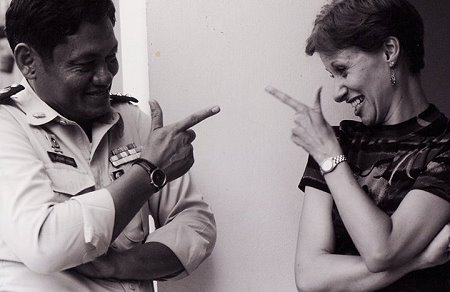
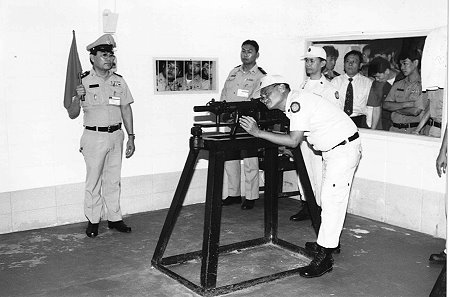
Bang. The late (he died in 2012) Chavoret Jaruboon, on the left.

Thailand uses lethal injection today, but our narrator here was the last to conduct executions by that country’s previous execution method, a unique shooting arrangement that prevailed through 2002.*

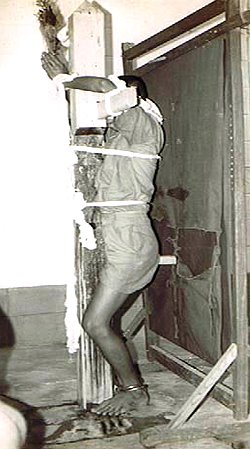
The prisoner to be executed was tied to a wooden cross, hands pinned in a prayerful position (wai), and facing a wall; behind him (or occasionally, as in today’s post, her), a screen; behind the screen, Chavoret Jaruboon with a mounted automatic rifle that would discharge a burst of up to 15 bullets into the vicinity of the heart, generally terminating life immediately.

The clientele this date were three members of a kidnap gang. Ginggaew Lorsoungnern, a former domestic for a Pathumwan, Bangkok family, had picked up from school the six-year-old child who was her former charge and delivered her to a bunch of toughs. When the ransom delivery went awry — the parents were supposed to toss the money out of a moving train at the spot of a flag, but missed the flag owing to darkness — the enraged kidnappers stabbed the little boy to death. Ginggaew allegedly flung herself over the child in a vain effort to protect him.

Inasmuch as her inside position was the lynchpin for the whole operation, however, these hystrionics would not save her from reprisal. (It wasn’t quite judicial reprisal since the execution was carried out by executive decree: not uncommon in dictatorial 1970s Thailand.) It probably didn’t help that coroners discovered soil in the victim’s lungs … meaning that when they’d dumped his body into its grave, he wasn’t yet dead.

The case was a media sensation. The late executioner’s 21st century book (copyright date: 2006) says that he was even then still “constantly asked about Ginggaew.” For what it’s worth, he thought the sentence was too harsh for her part in the crime. But executioners don’t get to make these decisions.

Ginggaew was the first woman shot in Thailand since 1942, and the first that Chavoret Jaruboon ever saw executed. In his time, he shot three women; Ginggaew is not among their number because in 1979, he was only a member of the execution team, not the man with his finger on the trigger. He was an “escort”, part of the team that brought the doomed from their cell to the execution chamber and then removed the corpse.

Escort duty was “one of the most emotional roles in the whole process of execution,” he writes. “Even the executioner does not have to see the body after he has done his job.”

And on January 13, 1979, the day Ginggaew died followed by two of her collaborators, the escorts had especially unpleasant duty.

While the men died stoic, Ginggaew was frantic, and fainted repeatedly over the hours before execution. “I didn’t do it, I didn’t kill the boy,” she pleaded. “Please don’t kill me, I didn’t kill him.”

Worse was to come.

At 5pm Ginggaew was selected to be brought to the execution room first. The escorts helped her to her feet but she immediately crumpled to the ground. She sobbed that she felt too weak to stand … As she approached the room she had to be revived from another faint.

I found this very difficult to deal with. Between us [escorts on the execution team] we finally got the stricken woman to the cross. She cried while they bound her at the waist, shoulders, and elbows. Her arms were brought up over the beam in a position of prayer. Still, she struggled and tried vainly to break free. The escorts pulled across the screen and fixed it so that the white square indicated where her heart was. Then they stepped out of range. I walked to the gun to load it and aim it at the target on the screen. I was aware that Ginggaew was still struggling. Normally once the prisoner was fixed to the cross they gave up fighting, but this was not the case with her. I secured the gun over her stifled sobs, locking it into position. When I was satisfied, I nodded at Prathom to take over. He took his position and at 5.40pm exactly he released ten bullets into Ginggaew’s body.

Doctor Porngul went up to her and checked for the pulse and retina response. As expected, he confirmed her dead. The escorts quickly untied her body, which was bleeding profusely from the chest, and laid her face down on the floor. She jerked and twitched a little. This wasn’t out of the ordinary but was distressing to witness. Her chest burst open and the blood looked like it would never stop flowing. They carried her into the morgue, the tiny room that we used just off the execution hall. I followed them just to make sure everything was alright. They placed her gently on the bed and we went out to prepare for the next one. What happened then will never leave me.

As the second prisoner, Gasem, was brought into the execution room, there was a sound from the morgue. I could see everything from where I was standing as the door was wide open — Ginggaew was trying to get up. The shocked escorts and I ran back to her. There was blood everywhere. One of the escorts rolled her over and pressed down on her back to accelerate the bleeding and help her die. Another escort, a real hard man, tried to strangle her to finish her off but I swept his arms away in disgust. We stood there watching her gasp for breath for I don’t know how long, but it could only have been a minute or two. I was filled with pity for her. I couldn’t help thinking that she was dying the way that little boy had died — except suffocating from blood instead of earth.

Meanwhile, Gasem had been shot. He died instantly from ten bullets. He had not resisted his death in any way, and spoke to nobody on the way to the cross. After the doctor confirmed that Gasem was definitely dead he checked on Ginggaew. Amazingly she was still breathing. It was a horrible, horrible situation. He told the escorts to put her back on the cross. The men complied, somewhat relieved to be able to just follow orders. It was a grim, nauseating job and they were covered in her blood when they turned to pull the screen across. This time the full quota of 15 bullets were used, and finally, she was dead.

You might wonder why we didn’t just shoot her where she lay, but it would have been against the regulations. Also, I don’t know that any of us could have stood so close to the young girl and pulled the trigger. As it was, the escorts moved as quickly as possible, each of us was concerned that her suffering should not be prolonged.

Pin had had to wait outside for ten minutes until Ginggaew was carried to the morgue for the second time. He was then brought in and tied to the cross. At 6.05pm Prathom pulled the trigger, sending 13 bullets into his back. The doctor went to check on him and discovered that he too was still alive, only just, but still breathing all the same. I loaded the gun again and Prathom shot a further ten bullets, this time killing him instantly. We were all in need of more than one stiff drink that evening.

There are a couple of reasons why Ginggaew had such a terrible death. Firstly her heart wasn’t on the left side as with most people. She most probably had Kartagener’s Syndrome, which is when a person is born with their heart on the right-hand side instead of the left. And even if it was she wasn’t secured firmly enough to the cross so she was able to move around, therefore the bullets would miss their target. It showed the importance of binding the prisoner as tightly as possible, for their own sake. I had my doubts when she was first pronounced dead. I thought I could detect some strain in her neck, and maybe that’s why I followed the escorts to the morgue. The head should normally flop backwards with the cross being the only support for the limp body.


Ginggaew, Gasem, Pin, and all others who were executed by shooting entered the execution building through this red door … now disused and overgrown since Thailand scrapped shooting. Pic from this Norwegian Amnesty International page.

After Thailand switched to lethal injection, Chavoret Jaruboon retired to a monastery. His books show no disquiet about his career. He explicitly supported the death penalty.

“What I do is empty this story (the executions) from my mind. If I don’t do that I don’t know what (the executions) will do to me.”

-Chavoret Jaruboon

* We’ve previously written about a 2001 execution by gunfire in Thailand.

On this day..

1879: Benjamin Hunter, in the Hunter-Armstrong Tragedy

(Thanks for the guest post to Robert Wilhelm of the Murder By Gaslight historic crime blog, and author of the book Murder And Mayhem in Essex County. Executed Today readers are sure to enjoy Wilhelm’s detailed investigations into long-lost historic crime. This post, reprinted with permission, first appeared last February on Murder By Gaslight. -ed.)
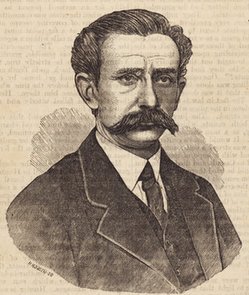
John Armstrong

The night of January 23, 1878, a man was found on the ground with a serious head wound, not far from the home of Ford W. Davis in Camden, New Jersey. Near the wounded man, a hammer and a hatchet were found, each marked with the initials F. W. D. The man was identified as Philadelphia music publisher, John M. Armstrong and when it was learned that he owed Ford W. Davis a sizeable amount of money, Davis was arrested. But Armstrong also owed $12,000 to Benjamin F. Hunter who had insured Armstrong’s life for more than double that amount.

Date: January 23, 1878

Location: Camden, New Jersey

Victim: John M. Armstrong

Cause of Death: Blows from a hammer and an axe

Accused: Benjamin F. Hunter

Synopsis:

Benjamin Hunter

Armstrong was taken to his home in Philadelphia, across the Delaware River from Camden, to be treated for head wounds. As a friend of the Armstrongs, Benjamin Hunter was among the first sent for by the stricken family. In the guise of helping, Hunter suspiciously rearranged the bandages on Armstrong’s head, reopening the wound. But when Armstrong died, Ford Davis was charged with his murder.

Some days later a young man named Thomas Graham was drowning his sorrows in a Philadelphia saloon. Laden with guilt, Graham made statements about the Armstrong murder that were incriminating enough to have him arrested. In jail, Graham made a full confession. Graham was an employee at Benjamin Hunter’s hardware concern and Hunter had offered him $500 to kill John Armstrong. Graham was in need of money and readily agreed.

They made a plan and set a date for the murder and Hunter made arrangements to be in Virginia that day. But Hunter returned to find Armstrong still alive — Graham’s nerve had failed him. Undaunted, Hunter came up with a more detailed plan to murder Armstrong. He gave Graham a hammer which bore the initials F. W. D. then had Graham mail a postcard to Armstrong, purporting to be from Ford Davis, asking Armstrong to meet him in Camden. Graham was to kill Armstrong with the hammer then leave it behind to frame Davis. Graham lost his nerve again but this time lied and said Armstrong never showed up.

Thomas Graham

Hunter decided not to leave anything to chance and met Armstrong, face to face, and persuaded Armstrong to accompany him on the ferry from Philadelphia to Camden. Graham, armed with the hammer and a hatchet that Hunter had given him, also initialed F.W.D., followed after them, riding in a different section of the boat. In Camden they took a streetcar and Graham followed on foot. They got off the car on Vine Street and Hunter left Armstrong and went back to give Graham the signal.

Graham hit Armstrong once with the hammer, but lost heart before he was able to finish the job. He threw the hatchet away and ran back to the ferry. Hunter grabbed the hatchet and attacked Armstrong, striking him on the head. He left Armstrong severely wounded, with a fractured skull.

After Graham’s confession, Ford Davis was released and Benjamin Hunter was arrested for murder.

Trial: June 10, 1878

Benjamin Hunter pled not guilty to the murder of John Armstrong. The defense asserted that there was no evidence that Hunter was in Camden that night. They also provided numerous witnesses that testified to Hunter’s good character. And they challenged the indictment on the grounds that since Armstrong died in Philadelphia, the murder could not be prosecuted in New Jersey.

It came out in court that Hunter had loaned Armstrong a total of $12,000 and to insure his loan Hunter had persuaded Armstrong to agree to a life insurance policy with Hunter as beneficiary. The amount of the policy was $26,000.

Thomas Graham had turned state’s evidence and it was his eye-witness testimony which tightened the noose around Hunter’s neck. The trial lasted 23 days and at the end the jury, with almost no deliberation, found Hunter guilty.

Verdict: Guilty of first degree murder

Aftermath:

Hunter’s attorneys appealed the verdict on the grounds that since Armstrong died in Philadelphia, Hunter could not be convicted of murder in Camden, New Jersey. The appeal was denied and Hunter was sentenced to hang on January 10, 1879.

With all hope gone, Benjamin Hunter confessed. The amount of money he had loaned Armstrong had been so large that he had been losing sleep worrying about it. Armstrong appeared to be using the money to maintain a lavish lifestyle rather than improving his failing business. Hunter’s only hope of retrieving his money was Armstrong’s death.

A week before the execution, Hunter attempted suicide, trying to spare his family and himself the indignity of a hanging. He was not allowed a knife or fork when eating, but he was able to tear away the top of a tin cup and used sharp edge to cut into his leg. Under a blanket he was able to cut an artery without the knowledge of the jailers on his deathwatch, and he had lost a pint and a half of blood before passing out and alerting them. He was saved from death and the execution went on as scheduled.

It was reported that Hunter, due to weakness from the loss of blood, and fear of death had to be carried to the gallows; though some claimed he had been given brandy and was dead drunk when carried in.

The hanging was to be done using a method adopted by the state of New Jersey — used in the case of Antoine La Blanc, among others — in which, rather than falling through a trap, the condemned man is pulled upward when a counterweight is dropped. Hunter’s execution was horribly botched as this eye-witness account attests:

“There was no scaffold. He was hanged in the corridor of the Court House, with a rope reaching up into the Court House over a pulley and to a weight in the cellar below. He was hanged at a cross-like arrangement, made by two corridors populated by men from some of whom the Sheriff demanded ten dollars apiece, and Eli Morgan, Deputy Sheriff to Sheriff Daubman, was to cut a little rope that held a stronger rope that controlled a three-hundred pound weight that was intended to hoist up the murderer into the air. The narrator was within two feet of Hunter when he was hanged. The rope was so long that it failed of its purpose and stretched, and the man went up in the air for but a few feet then tumbled down like a bunch of wet rags. Then Eli Morgan grabbed the rope and hauled him up hand over hand and held him there until he was throttled to death.”

It took Hunter at least fourteen minutes to die of strangulation.

Benjamin Hunter’s brother tried to collect on the life insurance policy and agreed to give the money to the Armstrong family. The insurance company refused to pay and Armstrong’s wife and administratrix of his estate, sued the company. The court sided with the insurance company saying they did not need to pay. The case was appealed all the way to the U.S. Supreme Court who overturned the verdict and called for a new trial. If the insurance company could prove that the policy had been taken out by Hunter as part of the crime of murder, then policy need not be paid, if there was no fraud, then the money must be paid.

The false accusation and imprisonment of Ford Davis had completely prostrated him. Shortly afterwards, partly out of consideration for his innocent sufferings, Davis was appointed crier of the Camden Courts, and he held that position for many years.

Resources:
Books:

Hunter, Benjamin F., and Thomas Graham. Hunter-Armstrong tragedy the great trial : conviction of Benj. F. Hunter for the murder of John M. Armstrong. Philadelphia: Barclay, 1878.

Lawson, John Davison. American state trials: a collection of the important and interesting criminal trials which have taken place in the United States from the beginning of our government to the present day. St. Louis: Thomas Law Books, 1921.

Seen & heard by Megargee, Volume 4, Part 1. Philadelphia: Louis N. Megarcee, 1904.

The Medico-legal journal … New York: Medico legal journal, 1886.

On this day..

2010: Zeng Jinchun, corrupt anti-corruption official

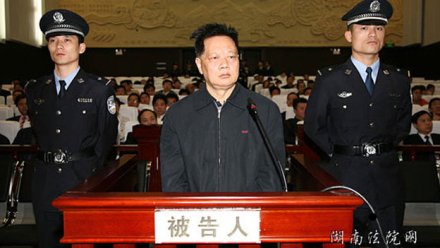
On this date in 2010, a former Communist Party of China (CPC) anti-corruption official was shot … for corruption.

Zeng, former secretary of the Chenzhou Municipal Commission for Discipline Inspection of the CPC and vice secretary of the CPC Chenzhou Municipal Committee, gorged on 31 million yuan ($4.7 million) in bribes from 1997 to 2006, doling out lucrative mining contracts and sinecures in exchange.

Although known in the Hunan coal-mining city as “a modern-day Heshen” — Chenzhou residents whose businesses had been widely subject to Zeng’s crude protection-racket shakedowns set off fireworks to celebrate his arrest — Zeng was all but impossible to dislodge.

Zeng bribed up to higher officials for protection as effectively as he squeezed those below. It’s just another piece of the graft so endemic in China that it’s frankly represented in popular literature. (And has often appeared on the execution grounds, too.)

“Officials, especially high-ranking ones, are basically not held accountable for paying bribes,” a journalist who wrote a book about Zeng told NPR. “This is because China’s judiciary is not independent enough.” Zeng wasn’t even charged with this crime — just extortion.

Zeng’s well-placed protectors defeated at least three investigations. He was only overcome by an order from the very top: President and Party Chairman Hu Jintao, who scribbled onto a secret report of Zeng’s antics,

“To Comrade Wu Guanzheng: Put more effort into investigating corruption in Chenzhou. Signed, Hu Jintao, July 19, 2006.”

Three months later, Zeng was under arrest.

The effects of power, corruption, privilege, and cutthroat economies did not go with him. After all, on the same date Zeng was put to death, officials elsewhere in Hunan province also announced the execution of one Chen Haitao for torching an airport shuttle bus. The blaze killed two and seriously injured three others.

Chen committed the arson to revenge society as he had “blamed his business failure on social injustice,” the court said in a statement.

On this day..

2001: Kojiro Asakura, frustrated realtor

(Thanks to Meaghan Good of the Charley Project for the guest post. -ed.)

On this day in 2001, 66-year-old Kojiro Asakura was executed by hanging at the Tokyo Detention House for the murders of almost an entire family eighteen years before.

In June 1983, he had killed Akira Shirai, age 45, and Shirai’s wife, one-year-old son and two daughters aged six and nine by beating them to death with a hammer and an ax. He then dismembered three of the bodies.

The only survivor was the family’s oldest daughter, age ten, who was away at summer camp at the time of the murders.

The motive for Asakura’s crimes lay in frustrations related to his job. A property assessor, he had bid successfully on the Shirai family’s house and land in Tokyo when they came up for public auction. He planned to resell the property at a profit, but the deal stalled when the Shirais refused to move out. Four months after the auction, they were still residing in the house illegally.

Enraged, Asakura beat the wife and children to death, then waited for the husband to come home and killed him too.

At his trial, the defense argued insanity or at least diminished capacity, pointing out that normal, sane people do not go on gruesome murder sprees. The court didn’t buy it.

Asakura was hanged on the same day as another Japanese multiple murderer, Toshihiko Hasegawa, who breathed his last at the Nagoya Detention House. These were the first executions in Japan in eleven months, and thirteen months more would pass before anyone else stepped up to the scaffold.

On this day..

1929: Myles Fukunaga

This date in 1929 saw the hanging of a Shakespeare-quoting, suicidal kidnapper for “the most brutal murder in the history of Hawaii”. It was among the last civil executions in Hawaii.

As detailed in the 1991 essay “A Short History of Hawaiian Executions, 1826-1947” (pdf) by Joseph Theroux, a resource we’ve touched on before and which also includes a full list of 75 known legal executions in Hawaii during that period:*

[I]n the death of Gil Jamieson, who had been kidnapped by a mad youth who filled his ransom letters with quotations from the Shakespearen play [Macbeth]: “Life’s but a walking shadow, a poor player / that struts and frets his hour upon the stage / and then is heard no more …”

The victim had his skull chiseled in and was strangled and left near Seaside Avenue in Waikiki.

The murderer and author of the letters was captured some days later, tried, convicted, and sentenced to hang, all within three weeks. This feat was facilitated because his lawyers, Beebe and Huber, offered no defense and called no witnesses. The jury included members who were part of the search party and the victim’s bodyguard and gravedigger. A Navy psychiatrist offered to testify for the defense but was rebuffed. The medical examiner was also the prosecution psychiatrist, Doctor Robert Faus. He testified that past suicide attempts by Miles Fukunaga were “normal.” Despite protests and appeals, Fukunaga was hanged.

Ten years earlier, a well-known local haole athlete, David Buick, found himself down on his luck. He ordered a taxi driver, one Ito Suzuki, to drive out of Honolulu proper to a place called Red Hill. He ordered the man to stop the car and get out. He pointed a gun at the driver and robbed him of one dollar. When Suzuki turned to flee, Buick shot him in the back. Before he died, the taxi driver identified Buick a the gunman. The charge was eventually reduced to second degree murder, and Buick is said to have returned to the Mainland following his jail time.

In both cases, there was premeditation, kidnapping, murder, and flight. Fukunaga willingly confessed and indeed showed extreme remorse. Buick never confessed or showed the slightest regret over his actions. But Fukunaga had murdered a fine boy of a prominent haole family.** Buick had only murdered a middle-aged Japanese taxi driver.

This shocking crime — Fukunaga openly cited the notorious Leopold and Loeb murder and the more recent Hickman kidnapping as his models — ratcheted up ethnic tensions in Hawaii between whites, especially elite whites, and Japanese.

The Japanese community’s newspaper Hochi mounted a vigorous clemency campaign emphasizing sentencing differences like that vis-a-vis Buick. “If Myles Fukunaga is hanged it will not be because he killed a human being,” the paper editorialized. (pdf) “It will be because he killed the son of the vice-president of one of our big trust companies and because his victim was a white boy.”

* Ethnic data of those 75 executed: 24 Hawaiian; 24 Filipino; 9 Japanese; 6 Korean; 5 Chinese; 3 Puerto Rican; 3 unknown; 1 Caucasian.

** Gill Jamieson’s father, Frederick Jamieson, was a vice president of the Hawaiian Trust Company (since folded into the Bank of Hawaii). According to Kokugo Gakko in, the targeting of a bankster family by a frustrated working-class youth (Fukunaga was reportedly logging 80-hour weeks in menial jobs, having been forced to quit school in his teens to support his family) was no coincidence at all.

In terms of his motives he said that revenge had been foremost in his mind. In 1928 his parents had been unable to meet monthly rental payments. The Hawaiian Trust company served as the collecting agent for their landlord and had sent a rent collector to the Fukunaga family to demand full payment of back rent. Humiliated and ashamed, Fukunaga bitterly resented the bank’s action and, on learning that Vice President Frederick W. Jamieson had a son, he decided to seek revenge … by kidnapping and murdering the boy. Fukunaga also confessed to another motive. As the eldest son of seven children, Fukunaga stated that he had felt a filial obligation to help his poor parents … he had hoped to accomplish this filial act with the ransom money.

All this might tend to militate against the “insanity” defense, which Fukunaga himself energetically rejected.

On this day..

1724: Willem Mons, head grafter

On this date in 1724, Willem Mons was beheaded in St. Petersburg for peculation.

Mons was the brother of the German commoner Anna Mons, a beautiful young woman who segued from being the May-December lover of Peter the Great‘s trusted admiral Franz Lefort to the mistress of the teenage emperor himself. Peter and Anna had a famous (famously scandalous) romance through her twenties, but as she entered her thirties and heard the clock ticking, her bid to make Peter put a ring on it by flirting with a Prussian diplomat came to grief and got her briefly tossed in prison.

Willem Mons was still a minor when his big sister fell from Peter’s graces. He would prove to have an equally adroit instinct for imperial bedchamber politics.

“One of the best-made and most handsome men that I have ever seen,” in the French ambassador’s estimation, Mons hustled his way into the train of the woman Peter had married instead of Anna — Catherine.

There Willem Mons and his other sister Matryona Balk monopolized the access routes to the empress and lucratively tolled all petitioners who traveled them. Wealth and status accumulated; the immigrant bourgeois’s son even stopped going by William in favor of the more impressive “Moens de la Croix”.

Not surprisingly, the emperor himself was the last to discover the open secret of his wife’s household’s river of graft.* Peter, who could be quite the moralist, was incensed; he interrogated the chamberlain so terribly that the young man fainted dead away.

“Moens de la Croix” was no longer. In both senses.

Having issued the confessions to condemn himself under the very credible threat of torture, Mons was socked away in Peter and Paul Fortress. Catherine made bold to defy Peter’s edict that nobody petition him for Mons’s life; in response, the enraged tsar smashed a Venetian mirror with his bare hand and roared, “thus I can annihilate the most beautiful adornment of my palace!” Court observers reported that marital relations between the two were visibly strained well after the scandal.

These weren’t happy days for the oft-sickly Peter; indeed, they were the last months of his life. Early the next year, he would succumb to a gangrenous bladder and leave the throne to this very Catherine. Perhaps his decrepit state accounts for the likely scurrilous rumor that the handsome chamberlain’s real offense wasn’t so much corruption as cuckoldry. It’s fair to say that such an affair would have been an extraordinarily reckless thing for Catherine.

On November 16, 1724, William Mons and Matrena Balk were taken in sledges to the execution site. Mons behaved courageously, nodding and bowing to friends he saw in the crowd. Mounting the scaffold, he calmly took off his heavy fur coat, listened to the reading of the sentence of death and laid his head on the block. After his death, his sister received eleven blows of the knout, very lightly administered so that not much harm was done, and was exiled for life to Tobolsk in Siberia. Her husband, General Balk, was given permission to marry again if he wished. (Source)

The late courtier’s severed head was preserved in alcohol (legend says that the fuming Peter made Catherine contemplate it). It was eventually deposited in the Kunstkamera museum, famous for housing Peter’s gross horde of collected pickled fetuses, dwarves, and other medical curios. Mons’s head still resides there today.

On this day..

1912: George Redding, making Emile Gauvreau’s career

On this date in 1912, investigative reporter Emile Gauvreau saw George Redding hanged at the Connecticut State Prison in Wethersfield.

“When I left the prison to write my story,” Gauvreau later wrote in his memoir My Last Million Readers,* “I found out why newspapermen drank and I had my first half tumbler of cognac.”

Gauvreau was 21 years old, and he wasn’t a pup any longer.

This hard-charging journo from a rough-and-tumbler age would later make a name for himself pioneering the lowbrow Big Apple tabloid style with his New York Graphic. (“The PornoGraphic”, it was nicknamed.)

And he made his bones for that classic career in newsprint — from high school dropout to cub reporter to the heights of the profession — by making bones of George Redding.

The case was the mysterious February 1912 murder of a Hamden produce peddler by the name of Morris Greenberg. Greenberg was lured to a wooded area en route to buy from a local farmer and shot dead there for his cash. Police were stumped.

Gauvreau at the time was busting hard at the police desk of the New Haven Journal-Courier (since merged into the New Haven Register). He took a page from Sherlock Holmes and went to work on the sensational case freelance … painstakingly eliminating Hamden residents until he was left with George Redding.

Redding was a young man on the make himself, a charming 21-year-old playwright who’d been throwing a lot of money around lately and was known to carry a sidearm.

Circling his friends and paramours, Gauvreau sealed the young man’s fate by laying hands on a damning confessional that Redding had sent a friend. Gauvreau even stage-managed the arrest so that he could shock rival papers and police detectives by breaking the whole story in his paper. All that was left for police was extracting Redding’s confession.

(According to Legal executions in New England: A Comprehensive Reference, 1623-1960, the perp at first denied the crime. “By the following day, however, there was a marked change in Redding. He said that Greenberg’s ghost had appeared to him in the night and so he dare not deny his guilt any longer.”)

* Quote via this Columbia Journalism Review profile.

On this day..