1885: George Miller, Inkster axster

This date in 1885 saw the hanging in Grand Forks, North Dakota* of 19-year-old farmhand George Miller for butchering his employer’s wife and child in order to loot the farmhouse while the patriarch was away.

For this terrible American Gothic crime, we turn to the American Press.

Miller was the first person hanged in North Dakota and the local Grand Forks Herald marked the date with a voluptuous recounting (occupying an entire page, plus two more columns on the next page) of the late scandal all the way to the felon’s scaffold accusation. Here it is, in its entirety …

In the middle of last January when all the earth was wrapped in a mantle of purity, an esteemed minister of the gospel, the father of a bright family of children and a devoted husband with a loving wife, resided on his prosperous farm in the township of Inkster, this county, surrounded with the 320 broad and fertile acres, horses and cattle and improved farming implements he called his own. His earthly possessions he had acquired by industry, thrift and economy, with the wifely assistance and the aid of the little boys and girl that had blessed their union. This gentleman was Rev. C. Y. Snell at one time minister of the Baptist church in Grand Forks, but who had, like nearly all settlers in Dakota taken advantage of his rights and acquired a farm, which had brought a handsome return. His summer’s work done, his grain garnered, he had sent three of his children to Grand Forks to acquire a good education in her public schools, and remaining at the farm, was his wife Abbie and little son Herbie, aged eleven, and the hired man George Miller, a young man of quiet demeanor, aged about 19 years, who had helped to garner the summer’s fruits and whom both Mr. and Mrs. Snell had implicitly trusted.

Thus situated on the 16th of January, Rev. Snell bade his wife and son good-be, little dreaming that the

SHADOW OF THE DEMON

was in his door and before another fortnight his loved ones would be prone, stark and mangled in the icy embrace of blood and horrid death. He went on his errand of good will to Mayville where he was engaged in missionary labor for his Lord and Master. On the 31st of January, two weeks after his absence, he received a telegram informing him of the doleful event — the murder of his wife and boy, and he hastened with bowed form and bleeding heart to the spot where the light of his joy had been ruthlessly extinguished.

OH RUEFUL SCENE!

The demon had done his worst! Have not the details of that heartless butchery been told again and again? Why not draw the veil upon the foul deed? The ghastly corpses of the innocent and unsuspecting sleepers — mother and son, hurled into eternity in a moment while taking the repose of the righteous — as found there by the neighbors a week after the tragedy — divulged the heartlessness of the assassin whoever he might be, and the thorough depravity of the soul that could impel the ruthless ax to deeds of death.

THE VILLAINOUS SHREWDNESS

with which the murderer had avoided suspicion was manifest in the fact that so long a time had elapsed before the discovery of the crime, and will be further apparent as the story progresses. He had been a companion of Henry Rutherford and to avoid immediate discovery, Miller the confessed criminal, had told the nearest neighbors that he intended to give Mrs. Snell a drive on Sunday and that he would haul wood the following week. Thus no suspicion was aroused until late in the week. Friday, Rutherford a simple, untutored laborer who lived alone at Bennett’s place about 60 rods from the Snell residence, thought it strange that there was no stir or animation about the place, and after finding the stock nearly famished, and watering it, alarmed the neighbors and the dreadful truth was discovered. The neighbors H.P. Reiton, Simeon, Miller, C.G. Gordon, Mr. Vietch, Henry Blakely and others found the dead bodies undisturbed and the rifled trunk with its empty money box and the robbed children’s bank just as the murderer had left them. Thus it was plain

THE MOTIVE WAS MONEY —

the sordid lust for gold that causes men to imperil their souls and makes of earth a probationary sheol for evil minds. Mr. Snell had sold considerable grain and when he left he took $300 with him, leaving some money, together with some keep-sakes and the children’s savings in the cash-box in the trunk. After he had gone, Miller sold more wheat and received from agent Holden $205, which he may have turned over to Mrs. Snell or not. But that the robbery of Mr. Snell in some way, was in his mind for a week before the crime was committed is shown by the testimony of Mr. Holden to the fact that Miller asked him a week before, whether he could deliver a load of wheat unknown to Mr. Snell and it further shows that the idea of robbery did not originated with Rutherford at a dance on the 20th of January, only four days before the murder as Miller claimed in his statement before the judge. It shows that the robbery was in contemplation by him without an accomplice and, being ignorant of the fact that Mr. Snell had taken $300 with him to Mayville, he doubtless committed the crime for more money that he received —

FLEEING FROM JUSTICE

After committing the crime, he hastily placed the ax beneath the bed, threw up the bedclothes over the faces of the dead, robbed the trunk of its keep-sakes, harnessed the best pair of horses in the stable, took Snell’s driving gloves and drove forty miles over the cold bleak prairie with the thermometer at 30 degrees below zero, arrived in Grand Forks at break of day Sunday morning in front of the Northwestern Hotel and ordered the team put away and his breakfast prepared. In the sled-box was an overcoat of the boy he had murdered which had probably been left there when the unsuspecting youth last accompanied him in the delivery of the wheat the proceeds of which he contemplated stealing. There was also left there the overalls which Miller had worn and upon which bright specks of blood had been discovered and whose dumb voices cry out testimony against the last black lie of the series which the obdurate murderer coined in the cell against poor simple Rutherford. With the team was Snell’s faithful dog, which followed the fleeing assassin. Upon his arrival here, he commenced a series of ingenious but

BASE COINAGES TO EVADE PURSUIT.

He told Powery, the clerk at the Northwestern Hotel, that he had come to meet his brother at the train and he might go to Winnipeg for a week. He also exhibited some gold pieces which he wanted changed, but the clerk had no change. The design of this story was too evidently to direct pursuit towards Winnipeg, if the team were soon identified as Snell’s. He soon walked off seemingly unconscious of any obligation to pay for his breakfast and next called at the Chicago clothing house, rousing Mr. Ephraim out of his late Sabbath repose. He told Mr. Ephraim a different tale. He was thrown of[f] his guard by the sharp questioning of Ephraim, while selling him the buffalo overcoat, black valise, pocket book, and other out-fit that later led to the capture and identification. He explained the possesion of his roll of bills, amounting to several hundred dollars by saying that he had sold a team of horses receiving $275 for it and intended to go to Turtle Mountain, thus evading the true objective point. He also got rid here of the tell-tale keep-sakes, the gold dollars which Mr. Snell had treasured for years, and the nickles, dimes and quarters which the little Snells had perhaps been years in gathering. Being shown the way to the barbershop of Mr. Kruger by Mr. Ephraim, after he had bought his disguise, he further changed his apperance by getting his hair cut close and his face shaved. Here he left the only clue to the direction in which he was intending to go, by inquiring whether a train left for Crookston, and up to the discovery of this fact by a HERALD representative, the officers seemed to be impressed with the fact that he had really gone to Winnipeg to which point as well as others they telegraphed as soon as it was learned that the team was left in this city. It must be remembered that it was not until the following Saturday that the tragedy was made known and in that time the murderer might have left the country, if he had not been paralyzed by his own wickedness and depravity. Learning at the barbershop that no train left for Crookston on Sunday, he walked to the station on the railroad track and bought a ticket for Fargo, displaying the new red pocket book to the agent. After spending a few days at Fargo among variety women, and having had his picture taken by a photographer, he went to Brainerd, Minn., where he stopped at the house of Malcolm McLaren for a few days more.


I’d be very surprised if our suspect was from Brainerd.

While at Brainerd, he associated with women of loose character and spent considerable money lavishing presents upon them. It seems that he met a female there whom he had formerly known in Iowa. At first he talked to Mr. McLaren about going into business. He wanted to do chores, when he learned that his money was nearly all gone. The St. Paul papers on Sunday morning following the discovery contain accounts of the murder with description of the hired man of Snells, but imperfect, as his disguise was not known, but when the statement of the Northwestern clerk about the gold pieces was published, Mr. Ephraim at once reported the Sunday morning transaction and it was thus that

HIS SIN FOUND HIM OUT.

His new outfit together with the way he had disguised himself were immediately telegraphed to the associated press by the HERALD and with it a statement of the reward offered. When the papers arrived at Brainerd, Miller had quietly decamped, realizing that he was too near the scene of the tragedy. But McLaren, an old detective immediately concluded that the fellow who had staid [sic] at his house was the person sought, and securing a deputization from the sheriff, he drew money for an indefinite trip, learned that Miller had boarded the train with a ticket for Anoka, and followed him up. On the same train went Hartley and another, bent on the same errand and watching McLaren. At Anoka, McLaren happened to strike the bus for the very hotel at which Miller was stopping and he now felt certain of

ARRESTING HIS MAN.

Miller was in his room and armed. McLaren knew the character of the brute better than the inexperienced who put any faith in his pretences during his last days. He concluded to wait till Miller came down, and while McLaren was at breakfast, he heard the murderer’s foot-falls on the stairs and entering the washroom. McLaren immediately left the table and coming up behind Miller with his pistol cocked arrested him, but as he did so, Miller laid his hand on the revolver in his hip-pocket, but the gun of the sheriff had the desired effect and he was disarmed. His attempt to get away from McLaren on various pertexts [sic] and his denial of all knowledge at the start are remembered. It was not until they were in the cars and coming back to Brainerd, that he

CONFESSED HE DID IT ALONE.

The way he happened to weaken was this, McLaren said to him, “Now you may as well tell all about it. I can tell you of a place in the forests where you will never be found, if you get away at the next station.” Miller then told his first story about how he was crazed with drink after being chid by Mrs. Snell, and killed her and the boy, and after getting over his stupor, and seeing what he had done, he stole the money and tried to get away. He reiterated this oft-told tale to Sheriff Jenks and others at Brainerd and again to reporters of Fargo papers, who managed to get up a considerable maudlin sentimentality for him. For prudential reasons, there having been a great deal of feeling that he should be given short shrift and a stout rope, he was kept at Fargo for several days, and finally brought here very quietly and lodged in jail. When it was known that he was in jail and likely to be tried speedily and executed according to law, popular excitement over the enormity of the crime subsided. The Rev. J.T. Davis and Rev. Snell, at an early day obtained an interview with Miller, and he reiterated the intoxication story as before in their presence, calling upon God to strike him dead if his story was not true. He also as positively stated to the gentelemen that he alone did the crime and no one was concerned with him in it.

It was not until after the Grand Jury had found a bill that this mild, child-like and bland assassin,

CHANGED BASE.

He then asserted that Henry Rutherford was with him, concocted the idea of robbery and urged it against his wishes, until he was finally persuaded to connive and assist, although Rutherford he said, actually did the horrible deed, while he did the running away to South America. In the face of his former statements this story only seemed to aggravate his villainy. However, able counsel, Judge C.B. Pratt, was assigned him and every thing that legal subtlety and experience could avail, was rallied to save his neck from the law’s penalty. The people, however, were fortunate in having so learned and able a coadjutor as District Attorney W.A. Selby and so just and firm a judge as Hon. W.B. McConnell; for, notwithstanding the able, artful and persistent defense made by Judge Pratt, justice was vindicated. Upon the defendant’s own plea of “guilty,” ascertained, verified and corroborated by all the witnesses, who fully and completely exonerated Rutherford from the suspicions cast upon him, and satisfied the conscience of the court, sentence of death was passed upon him and his appeal to the higher court sent back with an approval of the action of the District Court. His statement to the Judge, when informed of this action, suggesting some new matters not before mentioned, is still fresh in the recollection of everybody.

The last few days of his life seemed to have passed by him in a happy, careless, indifferent and easy frame of mind. He talked freely about his own execution, expressed no great sorrow or penitence for, at least the part he played in the atrocious crime, but pretended that he was glad the end was so near. His spiritual advisor, Rev. F. Doran conversed and prayed with him and did all in his power to turn his thoughts towards that awful Judge who hath decreed that “whoso sheddeth man’s blood, by man shall his blood be shed.”

HIS LAST NIGHT

on earth was uneventful. About eight o’clock he was left alone for a time in his cell and was seen from Bruce avenue to perform various antics, rising suddenly from his chair and jesticulating wildly with his arms as if again swinging the baleful ax which brained his helpless victims. He was restless and this has been observed that when left to himself and his thoughts, he was not the calm, self-possessed person he appeared to be when in the presence of visitors. During the evening, Rev. Snell had an interview with him for about an hour and a half. The prisoner claimed to others that he had succeeded in persuading Mr. Snell of the correctness of his last story. He was set up with by Deputy Sheriff Ackerman and others until after midnight. At one o’clock he retired and at 7:30 this morning he arose apparently refreshed. He ate a hearty breakfast consisting of beefsteak, potato, cake, etc. His cell has a window pane out and the wind being in the south, Miller was cold and was brought down into the office where he smoked a cigar, one of a number left him some days ago by some women who called upon him and were recognized by the prisoner as old acquaintances. The district attorney was present and inquired further about portions of Miller’s statement made to Rev. Doran. Presently Sheriff Pierce of Nelson county and friends came in, also County Commissioner Steele, Henry Rutherford and Mr. Vietch. Rutherford was told that Miller still insisted upon his story and was asked what he thought of it. He said, “then Miller lies. That is all.” Soon after an interview was had between

MILLER AND RUTHERFORD

in the presence of District Attorney. Miller said to Rutherford: “You know you had a hand in this thing as I have said.” Rutherford, without any trepidation replied: “It is a lie and you know it. I don’t like to be lied about.” Subsequently the statement in the nature of a history of his career and the crime was read in the presence of Rutherford who said nothing. When asked about it, he said it was “no such thing. It was all a dang’d lie!” When asked about the part in which Miller alludes to the false mustache, Rutherford said he had such a mustache but did not think Miller had ever seen it. He said he kept it in his trunk and described it to the district attorney corresponding with the description given by Miller. This circumstance and one in respect to changing wagon boxes, also a statement now made that the Snell stock was not famished, although the witnesses testified that it was, were industriously emplyoed [sic] last night and this morning to weaken the district attorney and cause him to apply for the respite of Miller. Mr. Snell himself after his interview with Miller last night seemed to have been influenced by his story and urged and begged the district attorney to intercede for Miller. Mr. Selby said he could do nothing unless Mr. Snell or some one on his behalf, would swear that Rutherford was an accomplice, when he would take such action as was proper in the cause of justice. Up to noon, Snell had done nothing of the kind. There was also pressure brought to bear from various sources to effect the same purpose, but none were willing to assume any responsibility.

THE LAST HOUR

was spent in the parlor of Sheriff Jenks with Revs. Currie and Doran who administered all the Christian consolation the solemnity of the occasion could afford. They talked to him, prayed for him and he himself made a fervid prayer. His nerve maintained his head erect to the end, which did not seem to fear.

ASCEND THE SCAFFOLD.

At 1:30 accompanied by Sheriff Jenks, he ascended the scaffold. The Sheriff suggested that if he had anything to say he should speak. Miller stood with the rope almost danging in his face, his hands clasped, and his body slightly bent. About two feet in front of him stood Henry Rutherford who, during Miller’s 15 minute talk, kept his gaze firmly fixed on Miller’s face. Rutherford looked like a person suffering great mental strain and slightly changed color at times while Miller was speaking, but his eyes never flinched. Rev. Mr. Snell occupied a position to the left of Rutherford, almost touching him and when Miller alluded to Rutherford’s alleged connection with the murder, Mr. Snell gazed almost fiercely into Rutherford’s face, Rutherford meanwhile keeping his eyes fixed on the doomed man. C.B. Pratt, Miller’s counsel, during the recital of the murderer’s statement, watched Rutherford closely.

Miller spoke with apparent effort and several times during the recital of his story had occasion to put his handkerchief to his eyes.

HIS LAST WORDS.

Gentlemen: — I am accused of the crime of murder which I did not commit. I have not committed murder. I was in company with the party and gave my consent, but gentlemen, I never committed the murder myself.

On the 30th day of January I was in Inkster with Mr. Rutherford. He and I sold 100 bushels of Mr. Snell’s wheat and we divided the money. That night we got home between eight and nine o’clock and Rutherford asked me how much wheat Mr. Snell had and I told him over 200 bushels besides a few loads which I had drawn. He wanted to know how much money was in the house and I told him as near as I could. He wanted to know how we could get it and I told him we could chloroform the folks and get it and he said he would do it. The 22nd, 23rd and 24th we were hauling grain to town and we talked again about getting the money. That night I went down to his house to supper and Mr. Blakely came in and that stopped our talk there. I went to Mr. Snells and that night I had a long conversation with Mrs. Snell and when it got about bed time I went to my room with my lantern and sat down on the bed and pulled off my rubbers when I heard a knock at the back door and went and opened it and Rutherford sad, George are you ready to do that? I said no, I hae had a long talk with Mrs. Snell and she is so good and kind to me that I cannot do it. He says you said you would do it and now you got to do it. He said dead folks tell no tales. He said he would do it and handed me a mustache to put on so folks would not know him and took the axe and went in and I went to the barn and harnessed one horse and was just putting one collar on the other when he came out and said, hurry up George I have done it. I tied the horse and I went in and found them dead. He says hurry up let us get away before anyone happens to catch us moving around so he hurried and got the team hitched up and I went to the house and got the money and gave him an even $100 and took $115 mysel and got what clothes I wanted. I wanted to change my clothes and put on a white shirt, but he said hurry up for I could get what clothes I wanted at Grand Forks. He brought the team up and tied them and I got what things I wanted and he helped me fasten up the storm door. He wanted me to go direct to South America and go right through. Said for me to write him when I got there and he would write me the circumstances here. At this ponit Miller was overcome with emotion and stopped a while.

Now gentlemen, every word hat I have told you is true and now as dear as that family was to me, I never could have consented to murder them as I was used there as their son. I was always treated well; they thought the world of me and I did of them but by the hands of another man’s deed I am to be hung and I am going to my grave and I am thankful that I can trust in God and feel that my sins have been pardoned.

And now I feel that the other party shall receive the same punishment that I have. It is not because I am down on him and it is not for malice but it is just what should be done. As dear and as good as that family was to me I could not go in and murder them. But thank heaven I am willing to die. This world would be no pleasure to me after this and I do not want to go to penitentiary. I am better satisfied to go to my grave. I am fully satisfied and feel that what has been done is just, as that family always used me like a son, always good, always dear in every shape, never refused me money, never refused me anything.

Now, gentlemen, I want you all to remember that this is the truth and nothing else. I won’t meet you any more in this world face to face but I hope we can all meet in the world to come.

When Miller had finished Henry Rutherford turned to District Attorney Selby and asked that he might make a statement of denial.

ADJUSTING THE ROPE.

Sheriff Jenks, who occupied a position on the scaffold just behind Miller, then approached and commenced binding the wretche’s [sic] hands and limbs with straps, and while placing the cap, which was of brown worsted, Miler again commenced to speak, and even while the sheriff was placing the noose around his neck Miller asked his executioner to say “good bye” for him to his friends.

THE DROP.

Barely a second’s time had elapsed from the moment the noose was adjusted before the trap was sprung, so adroitly and neatly did Sheriff Jenks do his work. Miller’s body shot down at 1:45 o’clock with a sickening thud, his neck being broken by the fall. A few moments after the drop the body quivered and the legs were slightly drawn up several times. Life was pronounced extinct 15 minutes after the fall by Coroner Roundwell and at 2:10 the body was cut down and carried into an adjoining cell, where the straps were removed. Shortly afterwards undertaker Caswell took charge of his remains which were interred this afternoon in the cemetery among the unknown sleepers. Thus ends this chapter of the bloodiest and most heartless murder in the annals of Dakota and the murder’s just doom, should be a warning to all evil-doers that there is no mercy for the slayers of the innocent.

MILLER’S STATEMENT.

Following is a statement prepared by Miller and given to Rev. Doran several days since. He swore to it this forenoon before Judge Cochrane, in presence of several gentlemen.

TERRITORY OF DAK.
GRAND FORKS, Oct. 30, 1885.

The last statement and confession of Geo Miller, before his execution in Grand Forks, Oct. 30, 1886.

TERRITORY OF DAK.,
COUNTY OF GRAND FORKS.

I, George Miller, was born in Toledo, Ohio February 17, 1866. My father and mother are both dead; about 12 years ago my mother died and my father 2 years later; have one brother, four years older than myself named Frank, two sisters both younger than I, two and four years; father was Bohemian; mother French; came from Iowa to Casselton last June, 1884, remained there 2 days; from Casselton to Larimore, arriving about the 13th of July, 1884, left there on the 11th, arriving at Mr. Snell’s that evening; at the expiration of four months hired to him for $30.00 a month; never refused to pay me; liked the family; first got acquainted with Henry Rutherford in Mr. Snell’s harvest field. He and I thrashed wheat together in August, 1884; often I met him at Mr. Bennet’s place in the evenings and was with him all through thrashing. Had hauled wheat once or twice before the dance by Brothrs [sic?] Bogs and also by Rutherford; went from Rutherford’s house; I furnished the cutter and he the horse; went together; he and I began to drink together; on the 1st of January took four or five drinks together that day in three different saloons and each took a pint of liquor home with us. The next day Rutherford went to Inkster; came back to “Vietches” where Mrs. Vietch was doctoring him, when Mrs. Snell and Essa Vickery saw him and told me that he was drunk; drank almost every time we went to Inkster; on the 20th of January, 1885, we sold five sacks of Mr. Snell’s wheat; I had 35 sacks of Mr. Snell’s wheat; Rutherford had 20 sacks of his own, we called it 10 bushels; spent most of it for liquor and cigars; changed sacks between the livery stable and saloon; he gave me half the money.

The dance was on Tuesday, the 20th of January; got to the dance about 8 or 9 o’clock, left about 3:30 a.m.; Rutherford asked me how much wheat I had hauled off; told him over 2000 bushels; he asked how much money there was about the house; I told him 6, 7, 8 or 9 hundred dollars; he said can’t we get it; I did not think we could, the trunk was too near the bed; he said we could kill the folks and get it; I did not want to do that, I said wait until we go to town and get some chloroform; Rutherford did not want to do this for fear we would be caught; nothing more was said about it for two days; coming from town I rode with him; he asked me what I thought about what we had talked about; told him it was not right to kill them for a little money;


And for what? A little bit of money.

he said we must work some plan to get it; I told him nothing must be done at this time. Nothing more was said until the Saturday it was done; we went to town together and on returning, when about to separate to go to our homes he asked me to come over that afternoon and help him sack up wheat, I told him I would; he said we would talk over this other thing, referring to the money of Snell’s.

In the afternoon I went over and we worked at the wheat and made all the arrangements to kill the folks; I was to leave with the team either for Larimore or Grand Forks and then take the first train for South America, we were both to go in and do the killing, I stayed at Rutherfords for supper, Harry Blakely came to call on Rutherford, we stayed and talked until eight or nine o’clock, then I started hom and Rutherford and Blakely started to go to Abner Veitches. I went to Mr. Snell’s and did the chores, Mrs. Snell was pleasant and talked pleasant, the last thing I did was to bed the horses and nail up the granary, that was about ten o’clock at night, I then went to the house and whittled my shavings and left them by the stove, pulled my rubbers off my felts and went into my room and set down on the front side of my bed, and was just going to pull of[f] my felts when Rutherford knocked at the kitchen door, I went to let him in, he says are you ready to do that, I told him no I was not, he said it had to be done, you gave your consent at the granary, “dead folks tell no tales.” I said if you want to do it you can, I won’t, he says all right, get me the ax, I went out and got it and when I gave it to him he pulled a false mustache out of his pocket and told me to put it on him, it was black and fastened in the nose with two wires, he had on woolen mittens. I think I got my coat, cap and mittens from the dining room and went to the barn while he did it and had one horse harnessed when he came out and said hurry up I have killed both of them, let us [get out of] the place before anyone sees us moving around, he led out one horse and took the other and hitched on to the sleigh, drove to the front door to hitch both horses, we both went in the house, I went into the bed room and got the money and took it into the dining room and divided it. He had $100, two $20, one $10 and one $50 bill, I had one hundred and fifteen dollars, he put his in his pocket and I put mine in my coat pocket, then I went into the bed room and changed coat and vest, then I got my overcoat and scarf and a large pair of mittens, fine boots and overshoes and handed them to him to carry to the sleigh for me. I took two or three blankets off my bed and took them with me. I got the key and locked up the door, he held up the storm door while I put the blocks against it, we got into the sled and rode up to his corner, he told me to go to South America, I told him I would, when he got to the corner we stopped and bid each other good-bye by shaking hands, he said as soon as I got there I was to write to him and he would let me know how things were, I told him I would.

GEO. MILLER.

Signed in the presence of

JAMES A. JENKS.
GEO. B. WINSHIP

TERRITORY OF DAK.,
COUNTY OF GRAND FORKS.

I, George Miller being first duly sworn on his oath says that I have heard read the foregoing statement by me subscribed and know the contents thereof and the whole thereof and that the statements therein made are true of my own knowledge.

GEO. MILLER.

Subscribed and sworn to before me this 30th day of October, 1885.

J. M. Cochrane,
Judge of Probate.

* At the time, not North Dakota but the Dakota Territory; North and South Dakota would attain statehood four years later.

On this day..

1489: Domenico Gentile and Francesco Maldente, Bull-shitters

From Pope Alexander VI and his court: extracts from the Latin diary of Johannes Burchardus (line breaks added for readability):


On the Sunday night, 15th September, 1489, Signor Domenico Gentile of Viterbo, apostolic writer, Francesco Maldente, canon of Forli and Conrado, also Battista of Spell, notary of the Apostolic Camera, Lorenzo Signoretto, writer in the Register of Bulls, and Bartolommeo Budello, procurator of the Penitentiary, were successively taken and detained in the Castle of San Angelo on a charge of forging apostolic letters.

The Lord Domenico aforesaid confessed that he had forged about fifty apostolic letters or bulls, containing various matters, in the following way: The Lord Francesco would discover matters to be despatched and agree with the parties upon the sum which they were to pay after the despatch of letters. When the agreement had been made and a bank named by the party for paying the sum agreed upon to be paid when the letters were presented to the bank, then he would despatch one that was expected, or some matter that would pass easily through all the offices by the royal way.

When this was done, the Lord Domenico aforementioned washed out all the writing of the bull, or that part which he did not want, with a certain fluid, restored the paper with flour and stiffened it again. Afterward he wrote on it the matter concerning which Francesco had agreed with the party, leaving in the bull the names of the rescribendary, computators, and other officials.

More often he changed the stamp, and put on another, according to the nature of the matter. He also used different inks. That with which he wrote the first matter to be despatched in the proper way was made of gum or some other material, but was certainly indelible. But the other, which he used to write over the bull that had been erased, was ordinary ink. In this way they gave forged bulls to the parties.

Within about two years they had despatched divers matters, for example, dispensations to one or two benefices for Friars of the Orders of Mendicants, unions of many benefices to the incomes of certain abbots with permission to rule these in an order changeable at pleasure, a dispensation for a certain priest of the Diocese of Rouen, who had married a wife, to the effect that he might lawfully keep her and many others for which they had received sometimes a hundred, two hundred, two hundred and fifty, and two thousand ducats, as is related in the process instituted against them.

The said Francesco also made confession, and on Sunday, the 18th of October, at about nine in the evening, they both were led from the castle aforementioned to the Castle of Soldano, and before they reached that place they believed they were condemned to death. For the auditor of the Camera, the Bishop of Cesena, and the Lord Bartolommeo Deolpito, first apostolic notary and governor of the city, who in their official capacity had prosecuted them, told the said Francesco that if he named his fellow accomplices our Most Holy Lord would be pleased to bestow the office of abbreviator upon him and set him at liberty, and he believing that he would do this accused the above named and several others.

On behalf of the Lord Domenico, his father who had attended our Most Holy Lord in the first illness of his pontificate, and his two brothers interceded most earnestly with the cardinals and other influential men in the city for his life. But no one could prevail upon our Most Holy Lord. So, after they had been established in the said castle, they were told that they were to die on the morrow; and therefore were bidden to take heed to the salvation of their souls, and priests were sent to them to hear their confession and strengthen them in the faith.

On Monday, the 19th of October, 1489, there was a consistory and the auditor of the Camera aforesaid with the governor came to the Castle of Soldano where they passed definite sentence against the said Domenico and Francesco, degraded them, deprived them of office and emoluments, and handed them over to the secular court.

Then mass was celebrated in the said castle, at which the said Domenico and Francesco were present, and at the close they received the holy communion from the hands of the celebrant; after this they were led to the Piazza di San Pietro, where a platform had been erected in a space not far from the lowest step, four rods long, three wide, and one high, or thereabouts.

There the said Francesco who was a priest was robed in full vestments in the usual way. Then the summary of the case was read by the notary, Antonio of Paimpol. After the reading of it, Francesco was degraded and given over to the secular court into the hands of Ambrosino, the apparitor.

After he had been given over, Domenico who had only the first tonsure was robed in a surplice and degraded from that rank by the Father Pietro Paolo, Lord Bishop of Santa Agata, who vested himself in stole and cope upon the platform, and put on in front a plain alb over the rochet. After his degradation Domenico was given over to the court and the said apparitor.

Their heads were not shaved otherwise than they had been before, nor were they stripped of the clothes in which they came from the castle, because of their office and because such was the pleasure of the Bishop of Cesena, the auditor.
After this the aforesaid having been degraded were placed upon a chariot which stood ready there, Domenico on the right and Francesco on the left.

In front of them were seated a friar of the Order of Minors, their confessor, in accordance with the observance in parts of France, and another of the society of the Misericordia who held a crucifix and was robed in the garb of that society with his face covered. Behind the degraded ones were erected two rods, and to the top of them cords were fastened, on which were hung four of the bulls despatched and forged by them.

In this way they were conducted by the Bridge of San Angelo past the Castle of Soldano and hard by the house of the Cardinal of Ascanio, past the Hospital of the Germans, close to the house of the Lord Falco by the Pario straight to another street, thence by the bridge to the Campo dei Fiori, where near the corner by the steps and the Taberna Vacca, so-called, the place of execution had been prepared in the form of a hut, having a wooden pillar erected in the center, and surrounded by piled-up faggots. To the upper part of the column had been fixed two ropes. Below the ropes two stools were placed upon the ground for the accused and another on the other side of the column for the lictor, and around the shed outside many piles of logs.

When the aforementioned degraded persons reached the said place of execution, they got down from the cart, and entered the hut, where in the guise and clothes in which they were brought there, they ascended the two stools prepared for them.

The lictor put ropes upon their neck of which they were scarcely conscious, for the confessor and the other friar who bore the crucifix were continually strengthening them in Christ. When the ropes had been placed in position, the lictor’s assistants drew away the stools from beneath their feet and thus they were hanged and gave up the ghost.

After they were dead they were taken down from the pillar, stripped to their shirts and placed in a sitting position upon the said stools, propped against the pillar, and bound to the column with the chain beneath their arms. Then the fire was kindled and their bodies burned. The lictor heaped up the logs many times until after the hour of vespers, that the bodies might be entirely consumed, and thus the fire lasted until the following morning.

On the following day, about the hour of vespers, ashes, in which many of the bones were still found, were collected by certain of the society of Misericordia with a broom, placed in a sack in a new chest, and with the cross and the usual procession was borne by the said society to the church appointed for the purpose and buried.


As shockingly impious as the forgery of papal bulls sounds (and was), this sort of fraud was very much a thing. Papal bulls were never confined to only grand matters, but issued for all sorts of everyday reasons. In a world where nobody could shoot an email to the Holy See to confirm this or that declaration, a document blazoned with the papal keys which asserted some local monastic prerogative or personal perquisite could be law for a good long time.

(In maybe the most notorious case, the penultimate Count of Armagnac obtained a forged papal dispensation permitting an incestuous marriage to his sister.)

Innocent VIII, born Giovanni Battista Cibo, is scarcely the most egregiously disreputable cleric* of the age — the guy after him was a Borgia, after all — and as may be seen from today’s entry had a care for at least the public relations debacle of particularly flagrant abuses.

But as a Renaissance pontiff, Innocent had a brood of illegitimate children and a view of St. Peter’s Throne as a seat for nakedly worldly ambition — marrying, for instance, one son to the daughter of Lorenzo de’ Medici in a deal that also obtained a cardinal’s hat for a Medici relation who in time would become Pope Leo X. Wholesale ecclesiastical corruption, including the market in bulls-to-order, was simply part of this world; Domenico and Francesco notwithstanding, Innocent did little to tame it.

The Florentine priest Savonarola first rose to prominence thundering against (and supposedly predicting the death of) this guilty Innocent. But that later Medici pope Leo X would in a few decades’ time meet the more serious challenge to ecclesiastical corruption. When that day came, Martin Luther initially suspected that the papal bull Leo X issued denouncing Luther’s theses might be … a forgery. (The reformer even published a short 1520 manifesto to that effect, “Against the New Bull forged by Eck“.)

* Innocent may be best known as the guy who fired up the coming age of wholesale witch persecutions.

On this day..

1898: Alfred C. Williams

(Thanks for the guest post to Robert Wilhelm, author of the Murder By Gaslight historic crime blog, and author of the book Murder And Mayhem in Essex County. Executed Today readers are sure to enjoy Wilhelm’s detailed investigations into long-lost historic crime. -ed.)

When Alfred C. Williams was arrested for the murder of John Gallo, his conviction seemed highly unlikely. There appeared to be no direct link between Williams and Gallo. There was no absolute proof that Gallo had been murdered, or even that he was dead. But in this case, circumstantial evidence, rather than increasing doubt, actually succeeded in dispelling doubt, bringing investigators closer to the truth and drawing the noose ever tighter around Alfred Williams’s neck.

John Gallo was a young Italian immigrant who worked on a farm in Lynnfield, Massachusetts. He was industrious and popular with the other workers, but kept to himself and very seldom left the farm. Gallo lived alone in a small shack in the rear of the farm. In the early hours of July 28, 1897, the shack caught fire and burned with flames so high they could be seen in neighboring towns. The shack was leveled, leaving nothing but ashes and the charred remains of a body, so badly burned that it could not be identified.

The body was so charred that it took two examinations to verify that it was, in fact, the body of a human. The head and neck were gone, both arms and both legs had been completely consumed, bone and all, by the fire. The spinal column remained with some back muscle attached; the heart, liver, kidneys, and bladders remained, but were badly burned. Everything else was completely gone. The medical examiner could state that the body was that of an adult human being, but nothing more.

With the destruction so complete, it appeared to investigators that nothing could be learned to explain what had happened that night. But as the investigation progressed, details began to emerge, like an image developing on a photographic plate. The fact that there was too little information became a clue in itself, and soon investigators were able to compile a list of facts that pointed to foul play:

  1. The body had been destroyed to a greater extent than would be expected from a fire in such a small building.
  2. The deceased had not been burned in bed. The bedsprings had survived the blaze but the body was found several feet away.
  3. The victim had not been dressed. Some buckles, metal buttons, a few coins and the clasp of a pocketbook were found by the side of the bedsprings, none were found near the body.
  4. The body lay in the doorway between rooms with the head back in the room toward the bed, not falling forward as a person naturally would if trying to escape from a burning room.
  5. A kerosene-oil can, which was usually kept near the stove, was found in the middle of the floor
    next to the body.

It was believed that the victim had been murdered before the fire started. His body was doused with kerosene and ignited, which would account for the severe damage to the body. The flame then quickly spread to the rest of the house.

John Gallo had earned $1.50 a day at Phillips’s farm and was paid monthly, always in five dollar bills. He spent very little and at the time of his death, it was suspected that he had around one hundred dollars earned on the farm. It was also well known that Gallo always carried three twenty dollar gold pieces that he had earned on a construction job prior to coming to the farm. No trace of the gold pieces or any melted gold were found.

Another crime had allegedly been committed near Lynnfield in the early morning of July 28. That afternoon, Alfred C. Williams reported that he had been held up near his rooming house in Wakefield. He had been unable to sleep and went outside to smoke a cigar. As he stood with one foot on the rail fence by the road, someone struck him on the head from behind. He turned to fight back, striking his assailant on the nose causing it to bleed. He was knocked unconscious, robbed of his watch and a small amount of money, and then thrown down the banks of Wakefield Pond.

He told his story to the police, showing them bruises on his neck and face from the fight, and bloodstains on his clothing from the assailant’s nose. The officers were skeptical of his story and held Williams for questioning. Unlike most holdups, Williams apparently had more money in his possession after the crime than he did before. On July 27, Williams had not had enough money to buy a meal or even pay a five-cent streetcar fare. The morning of July 28, he paid his back board bill and made some purchases. The police found seventy-five dollars, in five dollar bills, on his person.

The police learned that Williams had previously worked as a laborer on Phillips farm and knew the habits of the deceased. They searched Williams’s room and under the carpet, they found two twenty dollar gold pieces. When Williams was told where they found the coins he responded, “I know, I put them there.” They also found a bloodstained coat and vest in his room. Alfred C. Williams was arrested for the murder of John Gallo.

At the trial, the prosecution presented a case against Williams that was based entirely on circumstantial evidence. While there was nothing to directly link Williams to the fire, his familiarity with Gallo’s habits, his possession of money — including gold pieces — the day after the fire, the bloody clothing, and Williams’s inconsistent stories, taken all together were incriminating.

The defense challenged the very core of the evidence. There was no proof that the body found in the ashes was John Gallo’s; it could not be proven that a murder was committed or that the fire was not started accidentally; there was no proof that Alfred Williams was anywhere near the fire that night. But Williams was sticking to the story that he was held up on the night of July 28, so his alibi was also a matter of circumstantial evidence, and no one seemed willing to believe it. The jury deliberated for six hours before returning a verdict of guilty, first degree murder.

Alfred C. Williams was hanged in the yard of Salem jail on October 7, 1898. It was not a public hanging; the sheriff issued a few invitations, but only for the purpose of providing legal witnesses. Williams’s arms and legs were bound and his head was covered as he stood on the gallows. At 10:01 a.m. the trap was sprung and Williams dropped six feet, one inch. His neck was broken and he died within seconds. Williams professed innocence to the end.

Get Murder and Mayhem in Essex County here.

On this day..

1900: Coleman Gillespie

(Thanks to Meaghan Good of the Charley Project for the guest post. -ed.)

The story behind Coleman Gillespie’s execution on this day in 1900 actually begins on February 21, 1856: on that winter’s day, a small group of hostile Rogue River Indians murdered more than half of Christina Edson’s family at their home in what would become the state of Oregon.

The victims included John Geisel, Christina’s husband of 13 years, and their sons Andrew, 5, Henry, 7, and John, 9.

Christina, her three-week old infant Annie and her thirteen-year-old daughter Mary were spared and force-marched into captivity at an Indian camp twelve miles away. Along the way they had to pass the burning houses and dead bodies of their neighbors. 24 people were killed and 60 homes burned in all.

The pioneers wanted vengeance and they got it: the rebellious Indians were defeated in May 1856 and mobs lynched more than a dozen of them, including the man who betrayed the Geisel family. In July of that year, more than 700 Indians were forced to relocate to two different reservations.

All in all, it was a terrible tragedy.

And four decades later, indirectly, it claimed its last victim.

Long-suffering: Christina Edson

Christina, somehow, put her life back together after surviving two weeks in captivity with her daughters. She never had any more children, but she remarried three times (divorcing twice, and being left a widow with her final husband’s death in 1883).

In 1887, Christina filed a claim with the federal government seeking compensation for the loss of her first husband and sons and their farm, which the Indians had burned down. It took twelve years to get through all the red tape. In the end her application was successful and she was granted a monthly pension.

Christina turned 77 years old in 1899. Although her grown-up daughters wanted her to move in with them, she cherished her independence and lived alone in a cabin in Gold Beach, Oregon. Her very first pension check, for $75, arrived Monday, September 18, 1899.

On September 19, her cabin burned to the ground.

The postman found her charred corpse lying sprawled on her bed in the ruins. She’d been tortured and strangled. The fire was arson, and authorities presumed Christina had been killed for her money; her pension check was missing.

The brutal murder of this elderly pioneer horrified the community. As Diane Goeres-Gardner explains in her book Necktie Parties: Legal Executions in Oregon 1851-1905,

Christina Edson had seen her husband and sons tortured and burned by the Indians. The savages could be excused because they were fighting for their rights to the land they once owned. [Christina’s murder] was even more horrifying because it was done in cold blood for a few dollars.

The police got a lead when the check was cashed in Roseburg by one C.O. White, who was brought in for questioning. He said he’d bought the check at a discount from Coleman Gillespie, a known criminal with two prior convictions for theft.

Arrested a few days later, Gillespie quickly broke down and confessed in writing to Christina Edson’s murder. He named his co-conspirator as Charles Strahan, a commercial salmon fisherman who had mysteriously disappeared. There were rumors that he’d tried to flee the area but had drowned in the Rogue River, and other reports that he’d drowned in an ordinary fishing accident: whatever the case, he was never seen again, neither alive nor dead.

Authorities thought the fisherman a red herring — that Gillespie had acted alone and, having heard of Strahan’s disappearance, tried to share the blame with the convenient phantom. Gillespie’s statements about Christina Edson’s murder over time evolved to shift ever more responsibility onto the missing “accomplice”, until Gillespie was all but denying his own presence at the murder scene. He didn’t really seem to realize that, at the end of the day, he was legally just as guilty whether or not he himself had done the killing.

He found out on August 23, 1900, when he was condemned to die for robbery and murder.

When Coleman Gillespie was hanged six weeks later — the first and last legal execution in Curry County — his neck didn’t break. He expiated every penny of the discounted $75 pension check slowly strangling at the end of the rope.

On this day..

1927: Huibrecht Jacob de Leeuw, dynamiter

On this date in 1927, Huibrecht Jacob de Leeuw was hanged for blowing up the mayor of Dewetsdorp, South Africa.

This 26-year-old town clerk had spent himself into debt and started dipping his beak in the public finances to tide him over. Unfortunately for him, the malfeasance was detected.

On April 7, 1927, Mayor von Maltitz openly accused him of corruption at a meeting with the town’s finance committee; the session was adjourned for lunch pending the apparently imminent sack of the young wastrel.

When the committee reconvened (less de Leeuw), it was suddenly blown to smithereens by an explosion.

All three died, but two survived long enough to tell investigators what they’d been working on. As Robin Odell observes in his Mammoth Book of Bizarre Crimes,

De Leeuw had succeeded in destroying his accusers, along with the damning evidence of the account books but was now a prime murder suspect. He was sent for trial at Bloemfontein in August 1927. A town hall employee testified that he saw two cans of petrol in the town clerk’s office on the day of the explosion. And a local shopkeeper described how de Leeuw had appeared in her shop that afternoon in an agitated state saying, “I only want some matches.”

Clearly, what de Leeuw’s crime packed in megajoules it lacked in subtlety. Even had he made clean kills and left no deathbed implications, it’s hard to imagine how the trail wouldn’t have led right back to the guy who was just in the room with all the victims.

There’s a chapter on this fellow (more words than this author has found for him anywhere else) in a long-out-of-print 1951 South African volume, The Evil that Men Do, by Benjamin Bennett.

On this day..

1767: Elizabeth Brownrigg

On this date in 1767, a jeering mob damning her to hell* saw Elizabeth Brownrigg hang at Tyburn.

“The long and excruciating torture in which this inhuman woman kept the innocent object of her remorseless cruelty, before she finished the long-premeditated murder,” says the Newgate Calendar, “more engaged the attention and roused the indignation of all ranks, than any criminal in the whole course of our melancholy narratives.” Hers is a very rich text.

As a middle-class midwife, Brownrigg mined the Foundling Hospital for young girls whom she would take on as apprentice domestic servants.

Brownrigg was far from the only one exploiting this ready pool of virtual slave labor, but it was her home’s marked sexualized sadism that really moved copy (pdf pamphlet). And Chateau Roissy it was not.

Elizabeth liked to keep the servants locked up, starving, usually naked, and would pinion their hands and inflict merciless corporal punishment for the least transgression against rules like “having any more bread”. The Old Bailey Online preserves one servant’s trial testimony:

Q. In what manner did she use to beat her?

M. Mitchel. She used to tie her up in the kitchen; when first she began to be at her, she used to tie her up to the water-pipe, with her two hands drawed up above her head.

Q. Describe that water-pipe.

M. Mitchel. That goes across the kitchen; the hooks that hold it are fastened into a beam.

Q. Had she used to have her clothes on when your mistress tied her up in this manner to beat her?

M. Mitchel. No, no clothes at all.

Q. How came that?

M. Mitchel. It was my mistress’s pleasure that she should take her clothes off.

Q. What had she used to beat her with?

M. Mitchel. She beat her most commonly with a horse-whip.

Q. How long did she use to beat her in this manner?

M. Mitchel. I cannot justly say, but she seldom left off till she had fetched blood.

This witness Mary Mitchel(l) was the lucky one of the Brownriggs’ last two Foundling Hospital charges: both girls had been stripped and horsewhipped so regularly that ulcerating, infectious sores — never able to heal before the next thrashing — pocked their bodies.

But Mary Mitchell at least survived. Her fellow-sufferer Mary Clifford was flat beaten to death, the body stuffed in the family coal-hole like so much rubbish. (In life, Mary Clifford was sometimes made to sleep there, too.)**


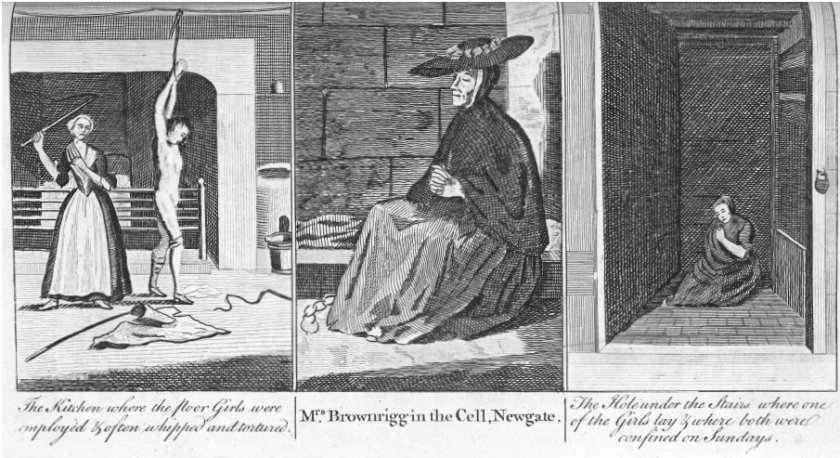
Detail view (click for a larger, three-panel image) of Elizabeth Brownrigg and her crimes illustrated in the Newgate Calendar.

For working-class Londoners struggling to navigate the dislocations of the Industrial Revolution, here was a villainess indeed. London was swelling, urbanizing, bustling with vulnerable orphans and abandoned children like our foundling Marys; all its working classes, for that matter, had reason to feel endangered in the face of fights for their lives against emerging commercial powers working hand in glove with the state — not excluding the ubiquitous threat of the gallows for pitiable property crimes.

And as Peter Linebaugh observes, “apprenticeship” by the 18th century “was less likely to involve the development of highly qualified, skilled labour power than to be the means of organizing the exploitation of young labour power.”† Like it’s not enough working your crappy dead-end unpaid internship; now, it comes with flogging?

Somehow, Brownrigg’s husband and son were convicted only of a misdemeanor and got off with a few months in prison, but Elizabeth bore all the hatred of Londoners more used to seeing apprentices swing than even the vilest master. The Murder Act which had appropriated even the corpses of London’s marginal people was applied to anatomize our former midwife; her skeletal remains were long displayed in a niche at the Royal College of Surgeons.

Oh, and the Foundling Hospital — which had cautioned the Brownriggs before about their excessive abuse of servants but not actually stopped sending them young girls to abuse — started finally instituting some oversight.


There’s a vicious and unsigned satire, “Elizabeth Brownrigge”, published in the September 1832 Fraser’s magazine. Over the years, it has occasioned a great deal of dispute among Thackeray scholars as to whether it might not have been an early creation of that master satirist’s pen. (Thackeray would have just turned 21 when it published.)

We’re not qualified to render judgment on the literary forensics, but the skewering of a murderess through the author’s mock-sympathy has a deliciously Thackerian flavor about it: the world was “incapable of understanding the height of her virtue.” It also underscores the continuing resonance of Elizabeth Brownrigg to Londoners 65 years after her execution.

The magnanimity of her soul, like Mr. Smeaton‘s pharos on the Eddystone, was firmly fixed upon the rock of the soundest principles, and diffused a light around it, for the guidance of those who were beating the waves upon the dark and troubled ocean of adversity, but was itself unshaken by the storm … [in prison] the fair and excellent Elizabeth adopted, as nearly as circumstances would allow, the same admirable disposition of her time to which she had been accustomed when inhabiting her own romantic bower in the village of Islington. She completed a large stock of baby-linen for the poor; she perused new publications of the day; and she composed an elaborate parallel between the characters of Socrates and Lady Jane Grey, after the manner of Plutarch. These are the two distinguished personages, in the whole range of authentic history, who in their strength of mind, purity of life, and extensive accomplishments, bore the strongest resemblance to herself; and to them, perchance, the attention of our heroine was more particularly directed in the quiet and retirement of her cell by the many points of similarity which subsisted between their destiny and her own.

Later, the fictional Elizabeth mounts a defense of such oblivious loathsomeness that it naturally impresses the judge:

“… punishment is a moral medicine. I may, perchance, actuated by too eager a desire for the rapid cure of my little and much-cherished patient, have dispensed my alternatives too liberally, and produced and untoward, an unexpected, and a most deeply-lamented consequence; but am I, therefore, to be condemned as guilty? In the analogous case of the physician, whose too-abundant anodynes may have lulled the sufferer to endless slumbers, or whose too copious phlebotomy may have let out the fever and the life at one and the same moment from the veins, would this most harsh and unmerciful measure be applied? … I demand from the justice of your lordship and a jury of my countrymen — as a matter not of mercy, but of right — the same impunity in my case which would be accorded, freely an unasked, under parallel circumstances, to the medical practitioner.”

Thackeray or whomever lay behind this pasquinade had a wider literary target in mind than simply Elizabeth Brownrigg(e)’s class. The short story is prefaced with a dedication to “the author of Eugene Aram“, meaning the popular novel published earlier in 1832 by Edward Bulwer-Lytton — a lifelong Thackeray bete noir. That novel concerned another renowned 18th century murderer, and it’s safe to say from the dedication that our satirist considered Bulwer-Lytton’s empathetic portrayal of the titular homicide a little, er, soft on crime.

I have been taught by Eugene Aram to mix vice and virtue up together in such an inextricable confusion as to render it impossible that any preference should be given to either, or that the one, indeed, should be at all distinguishable from the other … I had, indeed, in my dramatic piece, been guilty of an egregious and unpardonable error: I had attempted to excite the sympathies of the audience in favour of the murdered apprentices, but your novel has disabused me of so vulgar a prejudice, and, in my present version of her case, all the interest of the reader and all the pathetic powers of the author will be engaged on the side of the murderess.

* The Newgate Calendar: “On her way to the place of execution the people expressed their abhorrence of her crime in terms which, though not proper for the occasion, testified their astonishment that such a wretch could have existed: they even prayed for her damnation instead of her salvation: they doubted not but that ‘the devil would fetch her,’ and hoped that ‘she would go to hell.’ Such were the sentiments of the mob.”

** Elizabeth Brownrigg admitted to the Ordinary of Newgate the truth of Mary Mitchell’s horror testimony.

† Conversely, rogues who took to the highway and became working-class heroes were very often men who had absconded from their apprenticeship — for instance, Jack Sheppard and Dick Turpin.

On this day..

1887: Henri Pranzini, repentant?

On this date 125 years ago, a notorious French triple murderer was guillotined outside La Roquette Prison.

This condemned murderer, so infamous that anarchist bomber Ravachol planned to invoke his name as an emblem of crime in a suppressed courtroom speech, slaughtered a prostitute, her maid, and the maid’s child so that he could plunder the apartment’s jewelry.

Your basic sensational common butchery, given added legs by comparison to the next year’s apparition across the channel of the Whitechapel murderer.*

That’s just one of several more famous (or infamous) contemporaries for whom Pranzini was a sort of subplot character.

The artist Paul Gauguin — though he couldn’t quite remember the name right — suspected that this particular killer plotted his crime at the cafe that both he and Vincent Van Gogh frequented. (Van Gogh painted the proprietress, who was also possibly his lover.)

According to Van Gogh, the whole Pansini [Pranzini] affair, as well as many others, was hatched in this place … From this Pansini case sprang another case, also, according to Van Gogh, hatched in this famous cafe, the Prado case

We’ve noticed in these pages Gauguin’s disturbing severed-head jug, and its seeming inspiration from that other guillotinee, Prado.

While Gauguin’s meditations on the guillotine veered to the grotesque, a Norman teenager fresh off an apparition of Jesus Christ found spiritual sublimity in this villain. The woman eventually known as St. Therese of Lisieux later recollected

I heard talk of a great criminal just condemned to death for some horrible crimes; everything pointed to the fact that he would die impenitent…. I felt in the depths of my heart certain that our desires would be granted, but to obtain courage to pray for sinners I told God I was sure He would pardon the poor, unfortunate Pranzini; that I’d believe this even if he went to his death without any signs of repentance or without having gone to confession. I was absolutely confident in the mercy of Jesus. But I was begging Him for a “sign” of repentance only for my own simple consolation.

My prayer was answered to the letter! In spite of Papa’s prohibition that we read no papers, I didn’t think I was disobeying when reading passages pertaining to Pranzini. The day after the execution I found the newspaper “La Croix.” I opened it quickly and what did I see? Ah! my tears betrayed my emotion and I was obliged to hide. Pranzini had not gone to confession. He had mounted the scaffold and was preparing to place his head in the formidable opening, when suddenly, seized by an inspiration, he turned, took hold of the crucifix the priest was holding out to him and kissed the sacred wounds three times! Then his soul went to receive the merciful sentence of Him who declares that in heaven there will be more joy over one sinner who does penance than over ninety-nine just who have no need of repentance.

I had obtained the sign I requested.

Nameless citizens on the square when the blade fell settled for less exalted signs, like the ancient superstition of dipping into the spattered blood. (“Such scenes would disgust the black savages of Dahomey and the Gold Coast,” the London Times sniffed (September 1, 1887), and in vain urged the French government to take up legislation for private executions.)

* Pranzini found himself in Madame Tussaud’s for a spell.

On this day..

1934: Anna Antonio, enough for a million men

(Thanks to Meaghan Good of the Charley Project for the guest post. -ed.)

On this date in Sing Sing Prison in New York, Italian-American Anna Antonio was electrocuted for murder.

She’d been convicted of hiring two hit men, Sam Ferraci and Vincent Saetta, to kill her husband Salvatore for his $5,000 in life insurance. The dirty deed was done at Easter in 1933: Salvatore’s body turned up beside a country road, full of holes. He’d been shot five times and stabbed fifteen times.

When Saetta and Ferraci were picked up, they implicated Anna. All three conspirators were convicted and sentenced to death. They spent sixteen months on death row, where Anna was the sole female inmate, attended by three matrons.

As chronicled in Geoffrey Abbott’s book Amazing Stories of Female Executions, Anna had been originally scheduled to die with Ferraci and Saetta at 11:00 p.m. on June 28. The executioner, Robert G. Elliott, arrived, set everything up and waited … and waited … and waited …

No one appeared.

It wasn’t until 1:15 a.m. that he was told to just go home: no one would die tonight.

Just ten minutes before eleven on that night, Saetta had had a talk with the prison warden, unburdened himself and signed an affidavit. He admitted he and Ferraci had killed Salvatore, but he said the motive was a $75 drug debt. He swore Anna had had no part in the crime.

In an earlier conversation with a prison clerk, Saetta had said he and his partner in crime had only said Anna was involved because they thought this would save their own lives: “They’ll never send me to the hot seat. Not while there’s a dame in the case. In New York they don’t like to send a woman to the chair and they can’t send me and not her.”

The governor, Herbert Henry Lehman, thought it prudent to issue a 24-hour stay for all three of the condemned in order to investigate this new evidence. Anna Antonio fainted with relief at hearing the news.

Twenty-four hours later, she was again facing the chair. Again, Executioner Elliott showed up at Sing Sing, and again he was turned away: the stay had been extended by a week.

At the end of the week, a further stay was granted; the state was still mulling over what to do.

Meanwhile, the suspense was, pun intended, killing Mrs. Antonio. Abbott records:

At that stage the state of the condemned women can hardly be imagined; suffice it to say that her wardresses reported their prisoner’s condition alternated between bouts of hysteria and collapsing into a semi-coma. Eventually the decision was issued that all executions would take place on 9 August and all hopes were dashed.

She had weighed 100 pounds on June 28, but in the interim she stopped eating and dropped fifteen pounds in six weeks: she was probably among the smallest people to ever sit in the electric chair.* At one point she cried in anguish, “I have already died enough for a million men!” The Crime Library provides a detailed account of her execution.

On the last day of her life (which, horribly enough, was also her daughter’s birthday), Anna told the prison warden she was innocent. She reminded the warden that her late husband had been a drug dealer and said if she had wanted him dead, she could have just killed him with one of the guns that were lying around the house.

She did, however, admit that prior to the murder, Ferraci and Saetta had told her they intended to kill Salvatore. She said she had chosen not to try to prevent it because she was afraid for herself and her three children. Anna didn’t particularly care much for Salvatore anyway; he was violent and abusive.

Anna spent the day of August 9 playing with her children. She may have been expecting yet another reprieve; when she was told the execution was definitely on this time, she seemed stunned.

When asked about a last meal, she said simply, “I want nothing.”

She walked calmly into the death chamber at 11:12 p.m. and was pronounced dead four minutes later. Ferraci came after her, and Saetta was last.

* Even 14-year-old George Stinney, who was too small for the electrocution mask, weighed in at 90 pounds.

On this day..

1759: Eugene Aram, philologist

On this date in 1759, Eugene Aram was hanged at York for murder.

Aram was the son of a gardener, but taught himself Latin and Greek and made himself a respected schoolteacher.

Aram had a special gift for languages, and began research on a never-completed comparative lexicology of the Celtic tongue — correctly intuiting, if not the identity of the distant common mother tongue, the concept of what is now understood as the common progenitor of the related Indo-European languages.

the ancient Celtae, by the numberless vestigaes left behind them, in Gaul, Britain, Greece, and all the western parts of Europe, appear to have been, if not the aborigines, at least their successors, and masters, in Gaul, Britain, and the west; — that their language, however obsolete, however mutilated, is at this day discernible in all those places which that victorious people conquered and retained: — that it has extended itself far and wide, visibly appearing in the ancient Greek, Latin, and English, of all which it included a very considerable part; and, indeed, it still unquestionably, forms a most important ingredient in all the languages of Europe. (Source at archive.org | Google books)

His might have been an illustrious name in linguistic history. Instead …

In 1745, when Aram was already 40 and teaching in Knaresborough, a strange event occurred: a friend of Aram’s named Daniel Clark made the rounds of local merchants “buying” (on credit) a variety of portable valuables … and then promptly disappeared. Aram was suspected of some part in this sketchy affair and detained using the expedient of an outstanding debt pending investigation that would yield a more satisfactory charge.

Aram, however, paid off his arrears in cash. Since no real grounds existed to hold him, he walked away, and immediately left Knaresborough.

There the matter rested for 13 years, time that Aram spent immersed in his language work.

Justice delayed was not to be denied, however. Finally, in 1758, the accidental discovery of a body in Knaresborough rekindled interest in the case (even though the body turned out not to be Clark’s). Thirteen years on, the matter unlocked with amazing ease; Aram’s wife (left behind in Knaresborough when our man blew town) had her suspicions, which led to a mutual friend of Aram’s and the victim, who gave authorities the correct location of Clark’s theretofore undiscovered body. (Namely, St. Robert’s cave.) Upon that considerable credibility the mutual friend (Houseman by name) accused Aram of the murder. Since the wife was also prepared to swear she had heard all these men, and Clark among them, conspiring shadily together, Aram was in the stew.

As a proper Enlightenment man, learner of languages, inquirer of science, writer of poetry, and author of dark and vengeful deeds, Aram didn’t bother with a barrister but defended himself, and very ably in the judgment of his observers.

“His defense was an ingenious plea of the general fallibility of circumstantial evidence,” records this encyclopedia. But he had to stick to generalities because (as he admitted after conviction) he was actually quite guilty, and Aram “seemed really more carried away by the abstract philosophy of his argument, than impressed by the terrible relation it bore to his fate.” The lengthy Newgate calendar entry on his case preserves some of these sorties.

He would eventually ascribe his own motive not to greed of gold but suspicion of cuckoldry. Houseman, who was probably just as involved (and probably in his part for greed) appears to have escaped the noose.

Aram became a potent literary reference for his countrymen as a partially sympathetic, Janus-faced creature: the thoughtful scholar encumbered by his guilty conscience, or one whose potential gift to all mankind is undone by his injury to one man.

Edward Bulwer-Lytton wrote a novel about Aram. In Thomas Hood‘s poem “The Dream of Eugene Aram”, the titular killer is tormented by the recollection of what he has done.

“Oh God! that horrid, horrid dream
Besets me now awake!
Again — again, with dizzy brain,
The human life I take:
And my red right hand grows raging hot,
Like Cranmer‘s at the stake.

“And still no peace for the restless clay,
Will wave or mould allow;
The horrid thing pursues my soul —
It stands before me now!”
The fearful Boy looked up, and saw
Huge drops upon his brow.

That very night while gentle sleep
The urchin’s eyelids kissed,
Two stern-faced men set out from Lynn,*
Through the cold and heavy mist;
And Eugene Aram walked between,
With gyves upon his wrist.

Wodehouse, Orwell, W.G. Wills all also dropped Eugene Aram literary references in their day.

* The town in Norfolk where Aram was hanging his hat when he was finally arrested.

On this day..

1789: Joseph-Francois Foulon, corrupt financier, lynched

On this date, just days after the Bastille fell, so did the head of widely-loathed ancien regime pol Joseph-Francois Foulon (or Foullon) de Doue.

“This is that same Foulon,” says Carlyle, “named ame damnee du Parlement; a man grown gray in treachery, in griping, projecting, intriguing and iniquity: who once when it was objected, to some finance-scheme of his, ‘What will the people do?’ — made answer, in the fire of discussion, ‘The people may eat grass:’ hasty words, which fly abroad irrevocable, — and will send back tidings!”

Marie Antoinette, eat your cake out.

Foulon’s grass tidings would arrive courtesy of the king‘s July 11, 1789 dismissal of Finance Minister Jacques Necker and attempt to rule through an ultra-royalist government. It was fury over this apparent reactionary coup that led to the storming of the Bastille and catalyzed the French Revolution.

Foulon, now the Controller-General of Finances — and as Carlyle puts it, “a scoundrel; but of unmeasured wealth,” who had gorged himself at the public trough while the kingdom’s finances grew thin, and who was widely suspected of having manipulated the food supply out of cruel rapacity — apprehended the danger and fled town. He even staged a lavish funeral to put about word that he had died suddenly.

But “some living domestic or dependant, for none loves Foulon,” betrayed him (Carlyle’s version) — or by whatever means, the Parisian mob sniffed him out. Then it quickly did to him what the Parisian mob would soon become famous for. “His old head, which seventy-four years have bleached, is bare; they have tied an emblematic bundle of grass on his back; a garland of nettles and thistles is round his neck: in this manner; led with ropes; goaded on with curses and menaces, must he, with his old limbs, sprawl forward; the pitiablest, most unpitied of all old men.”

Carlyle spares little but the most animal pity for Foulon, but the mob did not even muster that. Summoned to be judged at the Hotel de Ville — the Marquis de Lafayette and the new mayor of Paris, Bailly, unsuccessfully attempted to intercede for proper procedure — Foulon found himself instead subject to the revolutionary judgment of the masses.

For Dickens, in A Tale of Two Cities, this incident forms one of the mileposts of the Revolution, when the waiting sans-culottes of Saint Antoine are transfigured, and leads the fictional long-time revolutionary conspirator Defarge to sigh to his even more implacable wife, “At last it is come, my dear!”

“Does everybody here recall old Foulon, who told the famished people that they might eat grass, and who died, and went to Hell?”

“Everybody!” from all throats.

“The news is of him. He is among us!”

“Among us!” from the universal throat again. “And dead?”

“Not dead! He feared us so much—and with reason—that he caused himself to be represented as dead, and had a grand mock-funeral. But they have found him alive, hiding in the country, and have brought him in. I have seen him but now, on his way to the Hotel de Ville, a prisoner. I have said that he had reason to fear us. Say all! Had he reason?”

Wretched old sinner of more than threescore years and ten, if he had never known it yet, he would have known it in his heart of hearts if he could have heard the answering cry.

A moment of profound silence followed. Defarge and his wife looked steadfastly at one another. The Vengeance stooped, and the jar of a drum was heard as she moved it at her feet behind the counter.

“Patriots!” said Defarge, in a determined voice, “are we ready?”

Instantly Madame Defarge’s knife was in her girdle; the drum was beating in the streets, as if it and a drummer had flown together by magic; and The Vengeance, uttering terrific shrieks, and flinging her arms about her head like all the forty Furies at once, was tearing from house to house, rousing the women.

The men were terrible, in the bloody-minded anger with which they looked from windows, caught up what arms they had, and came pouring down into the streets; but, the women were a sight to chill the boldest. From such household occupations as their bare poverty yielded, from their children, from their aged and their sick crouching on the bare ground famished and naked, they ran out with streaming hair, urging one another, and themselves, to madness with the wildest cries and actions. Villain Foulon taken, my sister! Old Foulon taken, my mother! Miscreant Foulon taken, my daughter! Then, a score of others ran into the midst of these, beating their breasts, tearing their hair, and screaming, Foulon alive! Foulon who told the starving people they might eat grass! Foulon who told my old father that he might eat grass, when I had no bread to give him! Foulon who told my baby it might suck grass, when these breasts were dry with want! O mother of God, this Foulon! O Heaven our suffering! Hear me, my dead baby and my withered father: I swear on my knees, on these stones, to avenge you on Foulon! Husbands, and brothers, and young men, Give us the blood of Foulon, Give us the head of Foulon, Give us the heart of Foulon, Give us the body and soul of Foulon, Rend Foulon to pieces, and dig him into the ground, that grass may grow from him! With these cries, numbers of the women, lashed into blind frenzy, whirled about, striking and tearing at their own friends until they dropped into a passionate swoon, and were only saved by the men belonging to them from being trampled under foot.

Nevertheless, not a moment was lost; not a moment! This Foulon was at the Hotel de Ville, and might be loosed. Never, if Saint Antoine knew his own sufferings, insults, and wrongs! Armed men and women flocked out of the Quarter so fast, and drew even these last dregs after them with such a force of suction, that within a quarter of an hour there was not a human creature in Saint Antoine’s bosom but a few old crones and the wailing children.

No. They were all by that time choking the Hall of Examination where this old man, ugly and wicked, was, and overflowing into the adjacent open space and streets. The Defarges, husband and wife, The Vengeance, and Jacques Three, were in the first press, and at no great distance from him in the Hall.

“See!” cried madame, pointing with her knife. “See the old villain bound with ropes. That was well done to tie a bunch of grass upon his back. Ha, ha! That was well done. Let him eat it now!” Madame put her knife under her arm, and clapped her hands as at a play.

The people immediately behind Madame Defarge, explaining the cause of her satisfaction to those behind them, and those again explaining to others, and those to others, the neighbouring streets resounded with the clapping of hands. Similarly, during two or three hours of drawl, and the winnowing of many bushels of words, Madame Defarge’s frequent expressions of impatience were taken up, with marvellous quickness, at a distance: the more readily, because certain men who had by some wonderful exercise of agility climbed up the external architecture to look in from the windows, knew Madame Defarge well, and acted as a telegraph between her and the crowd outside the building.

At length the sun rose so high that it struck a kindly ray as of hope or protection, directly down upon the old prisoner’s head. The favour was too much to bear; in an instant the barrier of dust and chaff that had stood surprisingly long, went to the winds, and Saint Antoine had got him!

It was known directly, to the furthest confines of the crowd. Defarge had but sprung over a railing and a table, and folded the miserable wretch in a deadly embrace—Madame Defarge had but followed and turned her hand in one of the ropes with which he was tied—The Vengeance and Jacques Three were not yet up with them, and the men at the windows had not yet swooped into the Hall, like birds of prey from their high perches—when the cry seemed to go up, all over the city, “Bring him out! Bring him to the lamp!”

Down, and up, and head foremost on the steps of the building; now, on his knees; now, on his feet; now, on his back; dragged, and struck at, and stifled by the bunches of grass and straw that were thrust into his face by hundreds of hands; torn, bruised, panting, bleeding, yet always entreating and beseeching for mercy; now full of vehement agony of action, with a small clear space about him as the people drew one another back that they might see; now, a log of dead wood drawn through a forest of legs; he was hauled to the nearest street corner where one of the fatal lamps swung, and there Madame Defarge let him go—as a cat might have done to a mouse—and silently and composedly looked at him while they made ready, and while he besought her: the women passionately screeching at him all the time, and the men sternly calling out to have him killed with grass in his mouth. Once, he went aloft, and the rope broke, and they caught him shrieking; twice, he went aloft, and the rope broke, and they caught him shrieking; then, the rope was merciful, and held him, and his head was soon upon a pike, with grass enough in the mouth for all Saint Antoine to dance at the sight of.

That grass-stuffed head on a pike was there waiting when the bloody banquet’s digestif arrived later that evening in the form of Foulon’s son-in-law Louis-Jean Bertier de Sauvigny: another government official arrested that day and drug to the same place, for the same fate.


Bertier de Sauvignon, Intendant of Paris, Is Led to His Punishment (Source, specifically image 25)

On this day..