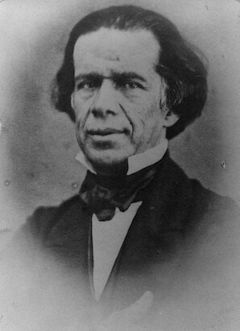
1839: Domingo Cullen, Santa Fe governor

Domingo Cullen, the governor of the Argentine province of Santa Fe, was extrajudicially executed on this date in 1839.

Cullen (English Wikipedia entry | Spanish) succumbed to Argentina’s lethal rolling civil conflict between political Unitarians (strong central state) and Federales (distributed federal power).

The reader will be unsurprised to find a provincial governor to be an exponent of federalism, and this put him at loggerheads with the ferocious Buenos Aires dictator General Juan Manuel de Rosas.

He logged a more specific head about a year before his death by attempting to negotiate a province-level arrangement with the French fleet blockading Argentina,* for which extravagance of federalism Rosas forced him to vacate his office and conceal himself in internal exile. Eventually Cullen was betrayed, and his arrestors putatively escorting him to the capital for trial rudely informed him once they reached the soil of Buenos Aires province that they were in fact licensed to shoot him out of hand.

Cullen’s son, Patricio, served as Santa Fe governor from 1862 to 1865, and also met a violent death.

* In response to a law that permitted the Argentine armed forces to conscript foreign nationals, including Frenchmen.

On this day..

1771: Daskalogiannis

The Crete patriot Ioannis Vlachos — better known as Daskalogiannis — lost his skin to the Turks on this date in 1771.

Statue of the D-man at Anopolis, Crete. (cc) image by AWI.

A wealthy shipping magnate, Daskalogiannis led the Cretan arm of the nationalist Orlov Revolt, which also featured on the Peloponnese. This affair is named not for any Greek but for the Russian admiral Alexei Orlov, who brought his fleet into the Mediterranean to engage the Turks during the 1768-1774 Russo-Turkish War, inspiring the Greek rising in the process.

Unfortunately for the rebels, some initial successes failed to catalyze a national revolution and Russian aid for the breakaway regions came up considerably short of what was pledged. While Orlov’s navy still harried Constantinople, Daskalogiannis for several months maintained a sort of autonomous redoubt from the mountain fastnesses around Sfakia with about 1,300 followers. By early 1771, he was forced to surrender himself at a gorgeous old Venetian fortress, then was taken to Heraklion and a horrific execution by flaying alive.

He’s commemorated in many street names in Crete, the name of the Chania International Airport, and a number of poems and folk ballads.

On this day..

1492: Jan van Coppenolle

On this date in 1492 the Flemish rebel Jan van Coppenolle was beheaded at the Vrijdagmarkt in Ghent.

When the formerly doughty duchy of Burgundy faltered as an independent polity after the death of Charles the Bold in 1477, Ghent and its sister Low Countries trading cities had forced upon Charles’s heir Mary an expansive recognition of those cities’ rights.

It was known as the Great Privilege, and it was greatly dependent on the political weakness of the recognizing authority.

Mary expressed this weakness in another way as well: with her marriage to the Habsburg heir Maximilian I of Austria — tying her patrimony to the Austrian empire. Upon this marriage did the House of Habsburg found a redoubling of its already expansive holdings, for Mary herself brought the wealthy Low Countries into the fold while the couple’s son Philip married a Spanish infanta and founded the line of Habsburg Spanish monarchs.* Apt indeed was the House Habsburg motto: “Leave the waging of wars to others! But you, happy Austria, marry; for the realms which Mars awards to others, Venus transfers to you”

Mary, unfortunately, was not around to enjoy the triumph of her matrimonial arrangements, for in early 1482 a horse threw her while out on a ride, breaking her back. Philip might have had a bright future ahead, but he was only four years old.

It was Maximilian’s flex on direct power in the Low Countries — and in particular his ambition to raise taxes to fund expansionist wars — that brought to the stage our man van Coppenolle (German Wikipedia entry | Dutch). He became a preeminent popular leader of a decade-long Flemish rebellion against the future Holy Roman Emperor that verged towards a war of independence.

Briefly forced to flee to exile in France after Maximilian quelled the initial resistance in 1485, van Coppenolle returned with French backing and controlled Ghent from 1487 when the rebellion re-emerged. This second installment had some legs, especially since Maximilian was imprisoned several months by the city of Bruges, allowing van Coppenolle leave enough to even mint his own coinage, the Coppenollen … before the Habsburgs finally suppressed the risings.

* The present Spanish king, Felipe VI, is a descendant of Philip I.

On this day..

1884: Seven anarchists of La Mano Negra

On this date in 1884, seven alleged terrorists of the Black Hand* were garroted in Jerez (Xeres), Spain.

This frightening organization was announced to the public via Spanish police discovery of documents purporting to outline their murderous perfidy and conveniently justifying a crackdown on restive Andalusia, then plagued (so the crown saw it) with a burgeoning labor movement.

Whether La Mano Negra (English Wikipedia entry | Spanish) truly existed as an organization has been subject to debate from that day to this, but anarchist worker militants had undoubtedly moved in 1881-82 towards overtly violent confrontation with landowners — bread riots during an agricultural crisis paired with robbery and arson. It was by no means merely adventurism. A Madrid newspaper reporting the sack of a bakery saw for the starving looters only three options: “O la limosna, o el robo, o la muerte” … alms, theft, or death.

Three thousand or more of protesting workers would be arrested in those months, and bound over to be used at the discretion of torturers; in the main, they affiliated to the labor union FTRE rather than anything so exotic as a Black Hand. But several murders that took place during or at least proximate to the Andalusian labor disturbances would be attributed to that sinister appendage and bring seven men controversially to execution in Jerez’s market squae on June 14, 1884.

As for others made to prefer alms or theft, hundreds were burdened with judicial penalties of various sorts and deported to Spanish colonies. A successful clemency campaign in the early 1900s reversed a number of those sentences, finally permitting these anarchists or “anarchists” to return to Spanish soil.

* This fell moniker refers to a number of distinct movements with a violent cast of mind sufficient to expose them to the predations of this very blog — notably, the Serbian terrorists who assassinated Archduke Ferdinand

The successors of the Jerez Black Hand that is the subject of this post also paid their own subsequent notable visit to the scaffold in the 1890s.

On this day..

1861: Melchor Ocampo, liberal statesman

On this date in 1861, the Mexican statesman Melchor Ocampo was summarily executed by right-wing guerrillas.

Once a seminarian, Ocampo (English Wikipedia entry | Spanish) turned his face towards public life, becoming a most eloquent exponent of the era’s movement of liberalism and anticlericalism.

He was among the faction who rebelled in 1854 against recurrent strongman Santa Anna; he served in the ensuing epochal presidency of Benito Juarez and helped to draft the liberal constitution that governed Mexico until 1917. Secular, egalitarian marriage vows promulgated in 1859 by Ocampo are still used in many marriage ceremonies to this day.

The revolutionary social reordering of these years was achieved only by civil war, a conflict remembered as the Reform War which ended only when the conservatives surrendered Mexico City on New Year’s Day of 1861.* Ocampo, who had the stature to stand for president himself, preferred to consolidate the victory by throwing his support to Benito Juarez in the ensuing elections.

Retiring thereafter to private life, he was targeted by one of the numerous remnant right-wing militias that still persisted in the countryside months after the putative conclusion of the Reform War. These abducted him from his home in Michoacan on May 30 and held him for some days, permitting him to write his last letters, before having him shot and strung up on June 3. His remains currently repose in honor at Mexico City’s Rotunda of the Illustrious … as do those of Ocampo’s longtime comrade Santos Degollado, who undertook to hunt down and revenge himself upon his friend’s killers but instead became their prey.

The town of Melchor Ocampo is, quite obviously, named for the man; his surname has been attached as an honorific to his home region of Michoacan, one of Mexico’s 32 states (officially called Michoacan de Ocampo) and to Tepeji del Rio de Ocampo, the place where he was executed.

On this day..

1798: The Carnew executions

The Carnew Massacre blackened this date in 1798, in the Irish village of the same name.

It was the morrow of the outbreak of Ireland’s 1798 rebellion against British rule. This rising commenced on May 24 and foundered within weeks leaving a harvest of patriotic martyrs in its wake but those in the moment had not the advantage of hindsight — so as news of the fighting reached County Wicklow, adjacent to the rebel epicenter of Wexford, loyalists there authored a couple of notable summary atrocities by way of pre-emption.

On May 25, the British garrison at Carnew took 28 United Irishmen prisoners already being held in Carnew Castle and had them shot out of hand in an alley.

A similar mass execution of 36 nationalist prisoners occurred on the following day, May 26, at Dunlavin Green.

On this day..

1952: Jan Bula, Czechoslovakian priest

Catholic priest Jan Bula was hanged on this date in 1952 at Jihlava

A Rokytnice pastor, Bula (English Wikipedia entry | the more detailed Czech and German) put himself in the gunsights of the postwar Communist state by defying its strictures on proselytization and commenting publicly against them.

Although perhaps a gadfly from the state’s perspective he was by no means a dissident consequential enough to have merited his eventual treatment; however, he was cruelly rolled into a notorious 1951 show trial called the Babice Case. Occasioned by a fatal raid launched by anti-Communist terrorists, the Babice trials targeted a huge number of ideological enemies and eventually resulted in 107 convictions and 11 death sentences.* Bula was among them, speciously condemned a traitor for complicity in the attack — a move that also opportunistically accelerated a case that state agents had for some time been attempting with little success to construct by means of entrapment.

“We human beings do not love God enough,” he wrote in a letter to his parents before his hanging. “That is the only thing for which we must ask forgiveness.”

The Catholic Church is currently considering this modern martyr for beatification.

* After the Cold War these sentences were retrospectively overturned or reduced, and a judge in the Babice case, Pavel Vitek, was prosecuted for his role in it.

On this day..

1632: Topal Recep Pasha, Grand Vizier

Ottoman Grand Vizier Topal Recep Pasha was put to death by Sultan Murad IV on this date in 1632.

Come to the throne as a mere boy of 11, Murad’s early reign was long constrained by the rivalries and factions of the court — not to mention a huge war with Persia.

A sovereign endures such a contingent existence at his own peril, as could be attested by no small number of deposed sultans including Murad’s own teenage predecessor, who was murdered by his Janissaries.

A 1631-1632 revolt by this same corps might have done for Murad, too; indeed, it so menaced him that he was forced to give over Grand Vizier Hafiz Ahmed Pasha to their fury early in 1632. Instead, it catalyzed Murad’s capture of absolutist power — as experienced to his distress by the subsequent Grand Vizier, who was also Murad’s brother-in-law.

For some two months the janissaries and the sipahis of the Porte gave free rein to their licence and indiscipline at Istanbul. Murad IV waited until the time was opportune and then struck hard, removing from the scene Rejeb Pasha, whom he considered to be one of the most active personalities behind the recent troubles. The execution of Rejeb Pasha was carried out on 18 May 1632 — a date which saw the sultan liberated once and for all from the tutelage of the great officials and which marked the real beginning of his reign. He had grown to manhood in a world of danger and duress. His character was tempered to the hardness of steel in the harsh and bitter experiences of his youth. A ferocious and inexorable resolve to be the master in his own house would henceforth dominate his actions. It is not surprising that in the eight years of life remaining to him he was to become perhaps the most feared and terrible of all the Ottoman sultans. (Source)

The reputations for brutality and efficacy earned by Murad for the balance of his reign until cirrhosis of the liver claimed his life in 1640 were inextricably linked to one another, a fact amply underscored by the fate of the libertine brother who succeeded him and was, yes, overthrown and murdered by the Janissaries.

On this day..

1872: Matias Salazar

Venezuelan caudillo Matias Salazar was shot on this date in 1872.

A commander who had adhered himself to Antonio Guzman Blanco‘s 1870 “April Revolution”, Salazar gradually became alienated from his chief and in 1871 orchestrated an unsuccessful assassination attempt on Guzman.

The resulting exile Salazar used as an opportunity to mount an invasion — but he was intercepted trying to march into Venezuela through Colombia’s bordering Arauca region and given over to a war council for his fate.

There’s a Spanish-language public domain biography of Salazar here.

On this day..

1903: Victoriano Lorenzo, cholo

Panamanian indigenous leader Victoriano Lorenzo was shot on this date in 1903.

He was a cholo (mixed-race; Lorenzo had both African and Amerindian ancestry) peasant who in the 1890s rose to become the most prominent indigenous leader in Cocle, a Pacific-facing province on the isthmus back when Panama was still a part of Colombia.

Lorenzo (English Wikipedia entry | Spanish) would lead indigenous forces in the Thousand Days’ War — a civil war between Colombia’s Conservative and Liberal Parties. Lorenzo fought in alliance with the Liberals; they lost the war, and with it the native land rights that Lorenzo fought for.

While the war was settled by the last days of 1902, the now-ascendant Conservative government accused Lorenzo and followers of continuing to fight and put him to a rial on grounds of murder and robbery that culminated in his public shooting in Panama City. The affair was so irregular that it’s commonly maligned as an “assassination”.

Scholars have interpreted the strange circumstances of his death as Conservative vengeance, the destruction of a hero and powerful symbol for impoverished people, the establishment of oligarchy, and as the forgetting of indigenous people as emblematic in the new Republic of Panama. Lorenzo has been interpreted as a martyr and the first victim of North American imperialism related to the Canal because he was held aboard the United States ship Bogota before his assassination. Seven days before his assassination, Esteban Huertas publicly announced that there was nothing more dangerous for the Canal construction than “guerrillas” and their activities in the mountains of Cocle …

The Conservative narrative of Lorenzo as “guerrilla” fighter permeated Panamanian national history, and schoolchildren learned to see Lorenzo negatively. National Panamanian history depicted Lorenzo shamefully as a “dirty cholo” …

In contrast, northern Cocle oral history memorializes, in cyclical time, Lorenzo as a cultural hero who continues to live, and understands his fight for land rights and political autonomy as the same fight of Urraca that is still ongoing today. People identify strongly with a liberation theology quote attributed to Lorenzo shortly before his death, “I forgive all. I die like Jesus Christ died,” wherein the cultural hero continued the cycle of death to defend land in this epoch. Rufino Peres J., born in 1941, recalls:

My people were illiterate, when he lived. They wore plant fiber loincloth (pampanillas) to go to Penonome … Why did they kill Victoriano Lorenzo? He died fighting for our land, and they formed a war, and that Victoriano Lorenzo, a cholo, won that war! It was not the president who won the war; it was Victoriano Lorenzo. They could never kill him: they used machetes, sticks, smoke, and they didn’t kill him. How was that? Then Victoriano Lorenzo went to the Presidency, and there they killed him. But Victoriano Lorenzo has stayed in History. So, now, whenever a campesino starts any kind of movement, they are scared because because we are the blood of Victoriano Lorenzo.

He uses the word blood (sangre) to mean how much someone is dedicated to the land and lineages in struggle, and adds, “Now youth don’t have blood like before, they have to be ready to die.” (from The Blood of Victoriano Lorenzo: An Ethnography of the Cholos of Northern Cocle Province, Panama)

Panama broke away from Colombia later that same year of 1903, and its new constitution abolished the death penalty outright. Independent Panama has never conducted an execution — so Lorenzo’s appears to be the isthmus’s last.

On this day..