1388: Sir Simon Burley

Sir Simon Burley lost his head on this date in 1388 to the fury of the Lords Appellant.

The childhood tutor of the young King Richard II, Burley had come up in the world as a bosom friend and comrade in arms to Richard’s uncle, Edward the Black Prince. A few years prior it had been entrusted to Burley to sojourn on the continent and arrange Richard’s wife, Anne of Bohemia — and a good job it was for him too since he was away when his head might have wound up on a pike during the 1381 peasants’ rebellion.

Instead, it would be peers in the court who dished out that treatment.

Over the course of the 1380s, Richard’s relationship with the top nobility progressively worsened and finally came to civil war in 1386-1388. The king’s foes, the Lords Appellant prevailed in that fight and with the young king in their power forced him to seat a parliament at which the Lords Appellant would scourge the king’s former allies. It’s called the Merciless Parliament; the reader may judge the reason.

We have already in these pages met several casualties of this purge; even within the context of the bloody intra-elite purge, Burley’s persecution struck a painful chord; two of the Lords Appellants’ junior affiliates, Thomas Mowbray, Duke of Norfolk and Henry Bolingbroke, who in time would depose Richard and seat himself on the throne as King Henry IV, both opposed killing Burley.* The queen, as powerless as her husband, prostrated herself before the implacable senior magnates on behalf of the old man who had escorted her from Bohemia.


Nineteenth century illustration of Queen Anne begging the Earl of Arundel to spare Simon Burley. Arundel refused her entreaties; a decade later, it was he who got no mercy.

All was for naught. Chronicler Jean Froissart, confesses himself “exceedingly vexed” at Burley’s execution, “and personally much grieved; for in my youth I had found him a gentle knight, and, according to my understanding, of great good sense.”

On this day..

1766: Edmund Sheehy, James Buxton, and Buck Farrell, Whiteboys

This account from the London Chronicle, June 5, 1766 refers to the disappearance and alleged murder of the informer John Bridge. We’ve visited this case previously, in the form of Father Nicholas Sheehy, who had also been drawn and quartered a few months previous for the Bridge affair; collectively, these cases are pretext for state reprisal against the Irish Whiteboys movement, which opposed large landholders’ moves to consolidate estates, expel tenants, and let people starve while the land that once fed them was shifted towards commercial agriculture.


The Trials of Mr. Edmund Sheehy, Mr. James Buxton, and Mr. John Farrell, at Clonmel Assizes in Ireland, for the Murder of John Bridge, on the Night of the 18th of October, 1764

Mr. Edmund Sheehy being put to the bar, the lawyers for the crown first called upon John Toohy, who declared, that the prisoner was within two or three yards of John Bridge, when he received the fatal blow from John Mechan.

Mary Brady swore that she came up immediately after the murder, and that the prisoner was present, together with the Rev. Mr. Sheehy, and Edmund Mechan, and that the latter held in his hand a bill hook all bloody, and that the Priest commended the action.

Mr. James Herbert, Farmer, declared, that on Sunday Oct. 28, 1764, he was called upon by Roger Sheehy, then on horseback, behind whom he rode to a meeting of twenty or thirty persons, on the lands of Shanbally, near Clogheen, where they were sworn by Father Sheehy to murder John Bridge, John Bagwell, Esq; William Bagnell, Esq; the Rev. Dr. Hewetson, and every other person who should oppose them; that they would be faithful to the French King, and conquer Ireland.

After having thus sworn, they came to the house of one English, on the lands of Shanbatly, where Bridge was; they took him to a field, where was another party of about a hundred and thirty; here they accused him of giving information against the White Boys, and insisted that he should by oath contradict whatever he had given information of, which he refused to do; hereupon one Byrne made a stroke at him with a turf-slane, which he kept off with his arm; then Edmond Meehan took a bill hook from under his coat, with which he struck Bridge on the back part of his head, which so cleft his scull, that he instantly expired; that the Priest was then within the distance of two yards, with a hook in his hands. After this (being first sworn not to divulge what had been done) they put the body in a blanket, which they conveyed to a ploughed field, where they buried it; but in about eight days after, lest the plough should turn up the body, it was taken up and carried to a church-yard about two miles off.

John Lenorgan swore, that being sent by his uncle, Guynan, to the house of English, where the Bridge had been, between ten and twelve at night, he heard the noise of a number of people; that not caring to be seen, he concealed himself in a ditch, where he was discovered by Thomas McGrath, who put him on horseback behind the Priest, with whom he rode some time, and on the way discovered the body of a dead man, wrapt up in a blanket, before a person on horseback, and through a hole in the blanket, saw the head bloody, and that there was a number of persons attending it, both on foot and horseback, of whom he knew Father Sheehy, Edmond Meehan, Buck Sheehy, Thomas McGrath, Bartholomew Kenneley, and John Toohy; and that when they came to the turn of the road, the Priest let him down, directing him the shortest way home, and gave him three half crowns, charging him not to mention to any one what he had seen; and that he understood the dead body was that of John Bridge.

Here was closed the evidence for the crown. James Prendergast, Esq, attempted to prove an alibi, by swearing that, on the 28th of October, 1764, he and the prisoner, with their wives, dined at the house of Mr. Joseph Tennison, near Ardfinan, in the county of Tipperary; where they continued until after supper, and that it was about eleven o’clock when he and the prisoner left the house of Mr. Tennison, and rode a considerable way together on their return to their respective homes, and that the prisoner had his wife behind him; that when they parted, he (Mr. Prendergast) rode directly home, where, on his arrival, he looked at the clock, and found it to be the hour of twelve exactly, and as to the day he was positive, the 29th being the fair day of Clogheen; that he had desired the prisoner to sell some bullocks for him at the fair, not being able to give his attendance; and that Paul Webber, of Cork, Butcher, was in treaty for the said bullocks with the prisoner, on the 29th.

Mr. Tennison declared he remembered the prisoner and Mr. Prendergast dining with him some time in the month of October, 1764, but was inclined to believe it was earlier in the month than the 28th, for that on the 29th he dined with the Corporation of Clonmell; that on the Wednesday following he dined with the prisoner and Mr. Prendergast, at the prisoner’s house, and that day he invited the prisoner and his wife, with Mr. Prendergast and his wife, to dine with him the Sunday following, and was positive that company did not dine with him on any other day in October.

Paul Webber, of Cork, Butcher, swore, that he was at the fair of Clogheen on the 29th of October, 1764, where he saw the prisoner, but was not in treaty with him for any bullocks belonging to Mr. Prendergast, but the prisoner told him, that Mr. Prendergast had some bullocks on his hands to dispose of, on which he sent a person to Mr. Prendergast’s house, who bought them for him.

Thomas Mason, Shepherd to the prisoner, swore to the night and hour of the prisoner’s return abovementioned, and that he took him from his master his horse, and turned him out to the field. The following persons were also produced to discredit the testimony of John Toohy: viz. Bartholomew Griffith, Surgeon, Daniel Griffith, and John Day, servants to Brooke Brasier, Esq.

The purport of the evidence given by Bartholomew Griffith was to confront Toohy, who, being asked by the prisoner, who gave him the new cloaths he then had on, answered they were given him by his uncle Bartholomew Griffith, who being examined, denied it. Daniel Griffith declared, that Toohy was, on the 28th and 29th of October, 1764, at his house at Cullen.

John Day swore, that Toohy lived for six weeks with his master Brooke Brasier, Esq, when he behaved very ill, and was a person of bad characer; but Mr. Brasier declared he did not know the said Toohy, but that a person was in his family, for that time, of a very bad character, but that he did not know him.

The evidence of James Herbert, for the Crown, was not attempted to be invalidated. Mr. Herbert came to the Assizes, in order to give evidence in favour of Father Sheehy; the Grand Jury, who before had found bills of high treason against him, sent for Toohy, who said he knew him very well, and would assist to take him; upon this William Bagnell, Esq, attended Toohy, with some of the light-horse, went and took him; when being told on what occasion he was secured, he said he would discover the rise and meeting of the White Boys, and their intentions; and acknowledged himself guilty of what he was accused.

Mr. James Buxton, commonly called Capt. Buxton, on account of the power he had over the people he commanded, was the next person put to the bar to be tried. The testimony, which has been already related, was in every particular supported by the additional evidence of Mr. Thomas Bier, who was an accomplice, and acknowledged being present when they all swore allegiance to the French King, and to murder John Bridge, &c. and that too in consequence of a letter he received from Father Sheehy. Mr. Bier declared, that, at the time Bridge was murdered, the Priest was within two or three yards of the unfortunate man, holding the book, on which he a little before pressed and exhorted him to swear for the purpose, as has been mentioned.

Mr. James Farrell, commonly called Buck Farrell, a young man of a genteel appearance, was the last convicted, and on the joint evidence of the prosecutors.

Tuesday, the 15th of April, they received sentence to be executed the 3d of May, at Clogheen.

The general characters of the prisoners, until this unfortunate affair, were very respectable. Their influence must have been considerable, otherwise they could not have brought after them, and inlisted, the number of people they did, who were subject to martial law, by which they were tried on misbehaviour. It was in resentment of a whipping, which was inflicted on John Bridge with remarkable severity, to which he was sentenced by one of the Court-martials, that he was led to give evidence against them, by which he lost his life.

On this day..

1804: Hans Jakob Willi, Bockenkrieger


(cc) image by Paebi

“We are free Swiss, completely equal citizens. That government that will not hear the voice of the people is a tyranny.”
Hans Jakob Willi, leader of the Bockenkrieg, who was executed on 25 April 1804.

The defeat of the Old Swiss Confederacy by Napoleon had shaken up political arrangements in Switzerland, creating the successor Helvetic Republic. As Napoleonic revolutions were wont to do, this new state aimed to centralize, universalize, and rationalize, having done with archaic redoubts of canton authority and ancient feudal privileges.

This new Republic was a short-lived affair, held up only by French bayonets; upon their withdrawal in 1802, it succumbed quickly to civil strife which necessitated the Corsican’s mediation — and a new political order which restored some powers of the prostrated cantons.

It was the consequent flex of Zurich upon its former provincial domains that brought about the Bockenkrieg insurgency — a rural rebellion near Horgen requiring Zurich to impose its will by means of a very picturesque suppression.


The Bocken estate after the battle for the manor during the Bockenkrieg, 28 March 1804 by Johann Jakob Aschmann (c. 1804)

Hans Jakob Willi, a cobbler turned soldier who gave the insurgency a veteran military man at its fore, was injured in battle, resulting in the speedy collapse of the rising. A court martial declared his death, despite Napoleon’s attempted intercession on Willi’s behalf.

German speakers might enjoy this public domain history on the rebellion.

On this day..

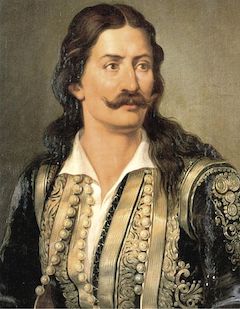
1821: Athanasios Diakos, Greek War of Independence hero

Greek independence hero Athanasios Diakos died by Ottoman impalement on this date in 1821.*

Though he acquired his nickname Diakos (“deacon”) from a youthful spell in a monastery, this fellow Athanasios (English Wikipedia entry | Greek) while the Turks still governed Greece made his way as a klepht — Greece’s version of the Balkan hybrid outlaw/guerrilla archetype, similar to the hajduk figures among the South Slavs. All of these outlaw types took to the mountains where they could subsist as brigands and mercenaries beyond the reach of the Porte, and seek opportunities where they might to strike at Ottomans. Many of the Greek persuasion, Diakos included, adhered to the Filiki Eteria secret society that aspired to liberate Greece.

With the onset of the Greek War of Independence in early 1821, Diakos jumped right into the fight. Picturesquely, he met a much larger Turkish detachment in battle at Thermopylae where he made like Leonidas and with a handful of companions heroically held out against impossible odds at the Alamana Bridge.

Captured wounded, Diakos spurned the temptation of an officer’s commission in the Turkish army should he but switch sides with words that remain legendary in his homeland to this day: “I was born a Greek, I shall die a Greek.” He was impaled at the city of Lamia, fearlessly musing, “Look at the time Charon chose to take me, now that the branches are flowering, and the earth sends forth grass.”

He’s a very famous and beloved figure in Greece, albeit much less so in parts beyond. The village where Diakos was allegedly born has been renamed for him full stop.

* The narratives I’ve seen run a bit hinkie between the Battle of Alamana on April 22 and the great klepht’s death on April 24 since there’s a two-day gap and everyone seems to agree that he was ordered for execution “the next day”. I’m sticking to the agreed death date here, which is universal, but as best I can discern the timeline alternatives for accounting the missing day appear to break down between the notion that Diakos was impaled on the 23rd and lingered on his spike overnight before death, and that it was not until the 23rd that the Ottoman commander had the opportunity to interrogate him and decide his fate and thus “the next day” was the 24th. I haven’t located a source that appears dispositive on this issue.

On this day..

1975: Nine Iranian communists

On this date in 1975,* Iran extrajudicially executed nine political prisoners.


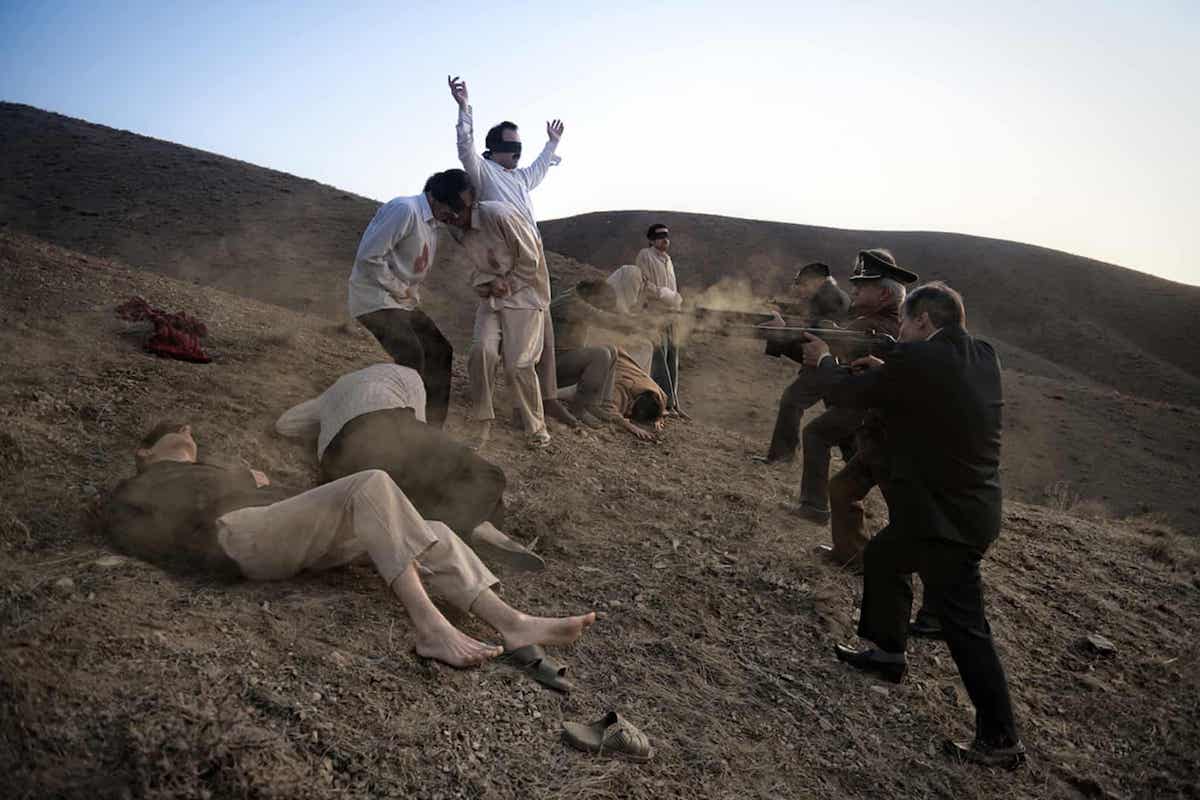
This photo is a dramatic re-staging — evocative of a famous photo of executions in revolutionary Iran a few years later, or perhaps in the white-clad central prisoner’s raised arms, the Goya painting that forms this very blog‘s frontispiece. (Contrary to the reconstruction, the executioners had just one Uzi and took turns spraying it at their victims.) It’s part of a fascinating project by Azadeh Akhlaghi to portray 17 pivotal deaths in Iran’s history.
We took the prisoners to the high hills above Evin. They were blind-folded and their hands were tied. We got them off the minibus and had them sit on the ground. Then, [SAVAK agent Reza] Attarpour told them that, just as your friends have killed our comrades, we have decided to execute you — he was the brain behind those executions. Jazani and the others began protesting. I do not know whether it was Attarpour or Colonel Vaziri who first pulled out a machine gun and started shooting them. I do not remember whether I was the 4th or 5th person to whom they gave the machine gun. I had never done that before. At the end, Sa’di Jalil Esfahani [another SAVAK agent, known as Babak] shot them in their heads [to make sure that they were dead].

Account of a former Savak agent, Bahman Naderipour, who was executed after the Iranian Revolution. The New York Times report of Naderipour’s public trial has him recounting:

“We took them out of the jail and put them in a minibus and drove them to the hills. We had only one submachine gun, an Uzi, among us, so we took turns shooting them … we didn’t give them a chance to make a last declaration. We blindfolded them and handcuffed them and then shot them. I think was the fourth to shoot. We took the bodies back to the prison. and we had the newspapers print that they were killed during a jailbreak. We had the coroner confirm this version.”

The victims were Ahmad Jalil-Afshar, Mohammad Choupanzadeh, Bijan Jazani, Mash’oof (Saeed) Kalantari (Jazani’s maternal uncle), Aziz Sarmadi, Abbas Sourki, Hassan Zia Zarifi, Mostafa Javan Khoshdel and Kazem Zolanvar.\
The last two named were members of the People’s Mujahedin of Iran, the still-extant MEK back when it was still a standard Marxist revolutionary movement and not a cult.

The first seven named were members of the Organization of Iranian People’s Fedai Guerrillas, a proscribed Communist guerrilla organization.

One of those seven, Bijan Jazani, was a co-founder of that organ and one of the greatest Communist intellectuals Iran ever produced. (For a flavor of his thought kick back with the Jazani collection in Capitalism and Revolution in Iran.) With him was Hassan Zia-Zarifi, long a collaborator in leftist circles.

The proceedings that had landed them in prison in the first place had already put them in the global spotlight especially given the horrific torture applied to the defendants. (Among other things, these seven were adopted by Amnesty International as watchlist political prisoners.) International pressure had staved off juridical death sentences … so the matter was handled extra-juridically instead, with the standard insulting cover story, “shot trying to escape.”

Iran reaped a considerable diplomatic fallout from these murders. Its embassies around the world were rocked by protests of emigres and human rights campaigners in the ensuing weeks; that May, a team of communist assassins gunned down two American Air Force officers stationed in Tehran to train the Shah’s security forces — claiming responsibility “in retaliation for the murder of nine of our members.” (UPI dispatch from Boston (US) Globe, May 21, 1975)

There’s a lengthy lecture on Jazani et al by Communist historian Doug Greene.

* Some sources give April 19 instead. I have not been able to resolve the discrepancy to my satisfaction.

On this day..

1939: Aleksei Gastev, Soviet scientific manager

On this date in 1939, the Old Bolshevik Aleksei Gastev, a theorist of scientific management for the Soviet state, was shot in Stalin’s purges.

Expelled in his youth from tsarist teaching ranks due to his radicalism, Gastev (English Wikipedia entry | Russian) traced his revolutionary bona fides back to the 1905 Revolution (he fought in it) and even before (as an ally and correspondent of Lenin).

With the advent of the latter’s revolution, Gastev founded the Central Institute of Labor (CIT), and CIT’s training firm Ustanovka (“setup” or “installation”) — organs dedicated, respectively, to the study of work, and to the promulgation of the new science of the workplace throughout the Soviet economy.

It was a socialist perspective on Taylorism, that practice of scientific management that was also transforming capitalist production; like Taylor, Gastev aimed to systematize the routine operations on the factory floor, to learn the most efficient way to wield a hammer or a shovel and expel from the labor force the indulgence of artisanal idiosyncracy and rule-of-thumb work; more broadly, Gastev aimed to revolutionize the way work was conceptualized by Soviet people, bending the mental and behavioral orientation of workers to optimize them for the demands of industrial production.

“Even when we exit the gates of the factory, still we carry the factory,” he wrote, positing a question that demanded “a cultural ustanovka.”

Fear of this very thing haunted Europe in this moment and has never left her nightmares in the century since. The CIT juxtaposed curiously with the almost simultaneous publication of some of the seminal dystopian mechanization literature — like Yevgeny Zamyatin‘s We (1921), in which the rational ordering of society annihilates freedom, and Karel Capek‘s R.U.R. (1920), the play that borrowed a Czech term for unfree work to give the world’s lexicon that wonderful word “robot”. Unsettling to many, this twining of man and machine was understood by Gastev as an emancipatory vista.

Gastev’s ideal worker is neither the oxen brute of Taylor’s dreams, nor the lifeless robot of Capek’s nightmare. He is rather an active, sentient, and creative part of the productive process who behaves like a seasoned, conscious, and well-trained warrior. Armed with sharpness of vision, acute hearing, attentiveness to environment and detail, precision and even grace of movement, and “scoutlike” inquisitiveness about the relationship and locations of things and peoples, he enters the factory as though it were a battle-field with commander-like briskness, regimental routine, and a martial strut. For him, no romance, no heroic individual deeds — only a relentless battle waged scientifically for production.

But the robot is present in Gastev’s vision nonetheless: it is the machine itself, not the man. For Gastev, the machine also takes on a life that gives it not only the power to produce and enrich, but also to train, to inspire, to organize. His wildest visions of 1918-19 are previsions of Capek and Zamyatin and celebrations of a coming event often warned about in science fiction: the takeover by machines. Gastev could never quite decide whether the machine was to be the master or the servant of man. Since he continued to use the machine metaphor, he eventually opened himself to attack by those who opposed his policies on other grounds. But Gastevism differed from administrative utopia — the heavy-handed martialing and mobilization of raw labor in a palpably unequal hierarchy. Gastev’s man-machine meant a symbiosis of the two, interacting in a way never wholly understood even by himself. It clearly contained fearful elements. But Gastev himself, by all accounts, was not a cold-hearted machine-like fanatic but a warm and engaging person. He did not fear the power of the machine. He feared backwardness, passivity, and sloth. (Source)


Dziga Vertov‘s 1929 classic Man with a Movie Camera captures the excitement of industrialization and industrial workers.

On the side — to stave off the sloth — Gastev kept up an artistic output of his own as a poet of the Proletarian Culture movement; this exemplar (Order No. 2 from a work called “Ten Orders”) comes to us via Wonderlands of the Avant-Garde: Technology and the Arts in Russia of the 1920s, which notes that “what is produced is never specified; the emphasis rather is on the establishment of a certain pace of work, as if machines manufacture a new time — the rhythm of the new life.”

Chronometer, report to duty.
To the machines.
Rise.
Pause.
A charge of attention.
Supply.
Switch on.
Self-propulsion.
Stop.

The chronometer stopped for Gastev with his fall in late 1938, and he proceeded thence to the familiar fate of Stalin’s prey amongst the intelligentsia. As he associates with the positive, modernizing, and utopian strain of the Soviet experiment but not its failures or horrors his name is not blackened to posterity and the present-day Russian Federation’s Ministry of Economic Development sponsors an “A.K. Gastev Cup” award to honor advances in production.

On this day..

1683: John Nisbet the Younger


Marker located at the entrance to the Burns Mall from Kilmarnock Cross. (cc) image from @mafleen.

John Nisbet was hanged on this date in 1683 for having participated four years prior in the Battle of Bothwell Bridge that shattered the Covenanter rebellion.

“Here lies John Nisbet, who was taken by Major Balfour’s party, and suffered at Kilmarnock, 14th April, 1683, for adhering to the word of God and our Covenants,” reads his grave.

Come, reader, see here pleasant Nisbet lies,
His blood doth pierce the high and lofty skies;
Kilmarnock did his latter hour perceive,
And Christ his soul to heaven did receive.
Yet bloody Torrence did his body raise,
And buried it in another place;
Saying, ‘Shall rebels lye in graves with me?
We’ll bury him where evil-doers be.’

Nisbet, we learn from Robert Wodrow, “sang the 16th Psalm, from the 5th verse to the close, with a great deal of affection and joy; and then read the 8th chapter to the Romans, and prayed again.”

When he had delivered his bible to his uncle, he made himself ready for the executioner, not expecting to get leave to say any thing to the specattors; but essaying to speak, and not being interrupted, he continued a good while in an extemporary discourse, pressing them to godliness, and recommending religion to them, from his own feeling and experience. He notices, that this is the first execution of this kind at that place, and is of the opinion, it is not like to be the last; he tells them, death is before them all, and if it were staring them in the face, as nearly as it was him at present, he doubts not there would be many awakened consciences among them; but as for himself, though death be naturally terrible, and a violent death yet more terrible, yet the sting of it is taken away, and he can say, he reckons every step of the ladder to be a step nearer heaven.

He’s not to be confused with his more famous uncle, John Nisbet of Hardhill, who suffered as a Covenanter martyr in 1685. (He surely cannot be the uncle referenced by Wodrow.) The Nesbitt Nisbet Society has more on this family’s role in the Covenanter movement.

On this day..

1818: Josiah Francis and Homathlemico, false flagged

On this date in 1818, Andrew Jackson had two Creek leaders summarily hanged in Florida.

The Creek in the American Southeast were a longtime thorn in the side of the young United States, and Andrew Jackson personally; Old Hickory was one of the chief American commanders in the Creek War several years before, a sort of subplot of the War of 1812 with Creek throughout the Gulf Coast aligning themselves with the British against American colonists.

One source of inspiration: the mighty Tecumseh, who assembled an ambitious native Confederacy to check Europeans’ advance. Although centered in the Great Lakes area, Tecumseh’s defeated vision was very broad, and he made a diplomatic visit to the American South seeking to bring the major tribes of that region into his alliance. Some Creeks saw a lot to like about Tecumseh’s line; they would become known as Red Sticks, for they raised the symbolic “red stick of war” against the whites, and announced it by massacring the entire population (about 500 souls) of Fort Mims, in Alabama.

Further south, in Florida, the Creek prophet Josiah Francis* was likewise stirred by Tecumseh; two days after Fort Mims, he led an attack on Fort Sinquefield that saw a dozen women and children killed and scalped. General Jackson suppressed that rising, forcing upon the Creek a victor’s peace that pushed that nation off 23 million acres in an L-shaped swath comprising much of Alabama and southern Georgia.** Jackson earned his nickname “Old Hickory” in this campaign, by conquering the Creek Hickory Ground.

Josiah Francis was among the many Red Sticks who took refuge in Spanish Florida after this defeat, but they could read a map like anyone else and understood that their respite from settlers would not last long here. Francis made a fascinating sojourn to England in 1815 where he vainly sought crown recognition of the Creek as British subjects, as a deterrent against Yankee aggression. Unsuccessful in his primary objective, Red Sticks returned carrying a ceremonial commission as a brigadier general. (The British Museum still has some of his kit in its possession to this day.) He did not have long to wait before tensions between whites and Creeks ignited the First Seminole War.†

As the clinching maneuver of this conflict — an act that would ultimately force Spain to cede Florida to the United States — the future U.S. president grossly exceeded the authority granted him by Washington to up and invade the Florida Panhandle with 3,000 men. They arrived at Fort St. Mark’s on April 6, there capturing two British subjects whom Jackson designated for an illegal court martial that would eventually hang them. But even this much due process was more than Creeks could expect.

An American warship had sauntered up to St. Mark’s ahead of its conflict, disguising its purpose by flying the British Union Jack and successfully extending the bluff to a Spanish officer who rowed out to greet them. Josiah Francis and another chieftain named Homathlemico or Homollimico, lurking in the bush nearby the conquered settlement, grabbed a canoe and rowed themselves out to these fortuitous allies only to find himself instantly made a prisoner. Jackson exulted in the duplicitous capture in an April 8 note to his wife: “Capt McKeever who coperated [sic] with me, was fortunate enough to capture on board his flotilla, the noted Francis the prophet, and Homollimicko, who visited him from St marks as a British vessell [sic] the Capt having the British colours flying, they supposed him part of Woodbines Fleet from new providence coming to their aid, these were hung this morning.”


An 1818 print depicts the captured natives.

* As he was known to whites. Hillis Hadjo (“crazy-brave medicine”) was his Creek name.

** And freeing Jackson to pivot to the defense of New Orleans.

† During this war, Josiah Francis’s daughter, Milly Francis, became famous throughout the continent as the “Creek Pocahontas” — literally doing what Pocahontas had done, talking her people off executing a captured white man named Duncan McCrimmon. Francis declined McCrimmon’s grateful offer of marriage, but let it not be said that an American soldier does not know how to return a boon: it was McCrimmon who set up the pivotal events of this post by tipping General Jackson to the presence somewhere nearby of his benefactress’s father. Milly presumably witnessed her father’s execution; she wound up deported to Oklahoma like much of the region’s Native American populace.

On this day..

1477: Hugonet and Humbercourt, in the wreck of Burgundy

Willem Hugonet and Guy van Brimeu, officials of the collapsing Burgundian polity, were executed in Ghent on this date in 1477 for their failed diplomatic intrigue.

This moment fell just weeks after Burgundy itself had received her own fatal blow, at least as far as independent political standing goes: the death in battle on January 5 of Charles the Bold, Duke of Burgundy. Charles had proven himself an energetically expansionist prince.

Charles’s dominions compassed not only Burgundy itself, but a swath of territory running up to Flanders and the Low Countries, a strip that was being squeezed by the rising powers of France to the west and Austria to the east. He had no male heir, so his 19-year-old daughter Mary succeeded him in title — but not in power. France and Austria immediately began sizing up Burgundy for dismemberment, a mission they accomplished within a few short years. And while both dynasties sought Mary’s inheritance via matrimony, more direct methods were also employed.

Before January was out, the French king Louis XI had already pressed into Picardy and Artois* with a scheming mix of armed intimidation and invocation of feudal rights — seeking Flanders and its rich trading cities like Ghent, where our executions will take place. These places, too, saw their opportunity to seek their own advantage; Burgundy had enforced its authority in Ghent at the point of the sword, bloodily crushing a revolt not 30 years before. In Flanders and Brabant, “the confirmation of the tidings of [Charles the Bold’s] death had been received with general feelings of relief and joy,” according to the Cambridge Modern History. “And throughout the Netherlands it was resolved to make the most of the opportunity.” There was no love lost between these locales and their Burgundian overlords, yet these places also feared the potential domination of Burgundy’s rivals. As a first step, the principal cities of the Low Countries immediately forced the weakened sovereign — who was personally stuck in Ghent when the dread news of her father’s fate arrived — to cede them a wide grant of privileges.

Meanwhile, Mary herself extended feelers to the neighboring empires, and it is here that our principal characters enter the story. Charles’s old chancellor, Willem Hugonet and the Picardy-born knight Guy of Brimeu, Sire of Humbercourt** — French-friendly Burgundians both reviled of Ghent — prevailed on Mary to seek what terms they could France. Returning to the Cambridge Modern History,

Louis seems to have, by private communications with Hugonet and d’Himbercourt, secured their adherence to the marriage-scheme [between Mary of Burgundy and the six-year-old French Dauphin]. At Arras, of which he took possession in March, 1477, he received a deputation from Ghent, and — playing the kind of double game which his soul loved — revealed to them the confidence reposed by Mary in the privy councillors detested by the city.

Thus, on the return of the civic deputies to Ghent, the storm broke out. The city was already in a condition of ferment; some of the partisans of the old regime had been put to death; and the agitation, which had spread to Ypres and as far as Mons, was increased by the claims put forward at Ghent on behalf of the restoration of Liegeois independence by the Bishop of Liege … distracted by her fears, Mary seems actually to have countenanced Hugonet’s final proposal that she should quit Flanders and place herself under the protection of the French King, when at the last moment Ravenstein induced her to reveal the design. He immediately informed the representative of the vier landen, and the deans of the trades of Ghent, and on the same night (March 4) Hugonet, d’Himbercourt and de Clugny were placed under arrest. A rumour having been spread that their liberation was to be attempted, and news having arrived of the resolute advance of the French forces, new disturbances followed; and Mary issued an ordinance naming a mixed commission of nobles and civic officials to try the accused with all due expedition (March 28). She afterwards interceded in favour of one or both of the lay prisoners (for de Clugny was saved by his benefit of clergy), and at a later date expressed her sympathy with the widow and orphans of d’Himbercourt, the extent of whose share in the Chancellor’s schemes remains unknown. After being subjected to torture, both were executed on April 3. They met with short shrift at the hands of their judges; but they cannot be said to have been sacrificed to a mere gust of democratic passion; and Mary and her Council, and the other Estates of the Netherlands assembled at Ghent, were with the city itself and the sister Flemish towns one and all involved in the responsibility of the deed.

This backlash closed all avenues to French nuptials; within weeks, Mary was engaged to the Habsburg Archduke Maximilian (they wed that August) and France and Austria fell into outright war over the Burgundian patrimonies, the resolution of which boiled down to Habsburg authority in the Low Countries and French absorption of most of the rest, including Burgundy proper.

* As well as, further inland, Franche-Comte, bordering the Duchy of Burgundy itself.

** Two years before this, Guy had personally extradited the rebellious Louis of Luxembourg to France for execution.

On this day..

889: Qin Zongquan, late Tang warlord

Tang Dynasty warlord Qin Zongquan was beheaded on this date in 889.

A military governor under Emperor Xizong, Qin made common cause with the rebel/usurper Huang Chao, who briefly established himself in the capital during the early 880s where he asserted himself as the Emperor of Qi. Huang was defeated and killed in 880, but his rebellion proved a mortal blow to the Tang, which succumbed by 907 to a transitional era of unstable dynasties and fractured, rivalrous kingdoms.

Qin Zongquan helped to assure that was so, by carrying on the insurrection after Huang’s death that kept China embroiled in civil war for the remainder of the decade, until a subaltern turned Judas and overthrew him for the benefit of the Tang. (Who by now had a new emperor themselves.) He’s said to have left onlookers in stitches with his last words shouted to the official orchestrating his beheading: “Minister, I, Qin Zongquan, was not committing treason. It was just that my faithfulness was not expressed well.”

On this day..