1977: Marta Taboada and Gladys Porcel, Argentina revolutionaries

Early in the morning on this date in 1977, Argentinian revolutionaries Marta Angélica Taboada de Dillon and Gladys Porcel were shot by the junta.

Essentially all the information available about these Dirty War murders is in Spanish, as are most of the links in this post. The preceding October, Argentina’s new military junta — having just a few months previous seized power by deposing Juan Peron’s widow — raided the Buenos Aires house shared by the pregnant Marta Taboada with Gladys Porcel and the latter’s boyfriend Juan Carlos Negro Arroyo, all of them adherents of the October 17 Revolutionary Movement.*

They vanished into the shadow ranks of the “disappeared” — the women shot on February 3 in Ciudadela, Negro Arroyo executed separately with some other male activists that same month, all to be dumped into the mass graves that became the usual repose of the junta’s enemies.

Taboada’s children, notably including journalist and activist Marta Dillon, who was 10 at the time, witnessed their mother’s abduction. In 2000, all four children marked the anniversary of that terrible night — a night, Marta Dillon described, after which there was “nothing left of the world that I had known” — by publishing a letter in a newspaper pledging militancy in their mother’s memory.

Mama, in your name and in that of all the compañeros, we uphold the joy of standing and fighting. We do not forget, we do not forgive, we do not reconcile, we judge and punish the genocides and their accomplices.

-Marta, Santiago, Andrés and Juan Dillon.

The remains of Taboada, Porcel, and Negro Arroyo were identified by forensics teams in 2011 and interred with honor.

* The name alludes to the date in 1945 when popular protests forced the army to release Juan Peron from custody.

On this day..

1782: Jose Antonio Galan, for the Revolt of the Comuneros

Ni un paso atrás, siempre adelante, y lo que fuere menester … sea!

-Jose Antonio Galan

On this date in 1782, Comunero rebel Jose Antonio Galan was executed in Bogota, New Grenada (present-day Colombia).

Spain’s New World precincts had risen in response to intensified taxation exacted by the empire’s modernizing reforms and particularly accelerated when Spain went to war against Great Britain in 1779; similar pressures likewise helped to trigger the 1780-1781 Tupac Amaru insurrection in Peru.

In New Grenada, spontaneous resistance to new viceregal edicts coalesced into one of the most serious rebellions of the Spanish colonial era — albeit one that aimed at reform, not revolution.

Shouting demands for tax reductions and greater local autonomy, a force of 10,000-20,000 rebels marched on Bogota in the spring of 1781, routing a column of government soldiers sent to disperse them and forcing authorities to terms that the latter had no intention of honoring. This is one of the oldest ploys: offer concessions to end the rebellion, then declare the concessions null and void as obtained under duress when the rebels are safely out of arms.

An illiterate mestizo peasant, our man Galan (the cursory English Wikipedia entry | the much more satisfactory Spanish) was not the principal captain of this rebellion but he seems to have exceeded them in foresight — for Galan and his more radical followers continued the revolt even after the main body of Comuneros went home satisfied with the government’s specious pledges. North of Bogota, Galan threatened a more Tupac Amaru-like experience, attracting a multi-racial lower-class force* which he turned against hacienda landowners.

Captured in October of that same year after reinforcements arrived at Bogota to begin laying down imperial law, Galan was so popularly admired that no free blacksmith would accept the contract to forge his irons — all the more reason for his exemplary sentence:

We condemn José Antonio Galán to be removed from jail, dragged and taken to the place of execution, where he is hanged on the gallows until dead; when lowered, his head is to be cut off, his body divided into four parts and passed through the flames (for which a bonfire will be lit in front of the scaffold); his head will be taken to Guaduas, theater of his scandalous insults; the right hand placed in the Plaza del Socorro, the left in the town of San Gil; the right foot in Charalá, place of his birth, and the left foot in the place of Mogotes; his descendants are declared infamous, all his goods are confiscated to the treasury; his house is to be pulled down and sown with salt, so that his infamous name may be lost and consigned to such a vile reputation, such a detestable memory, that nothing remains of him but the hate and fright that ugliness and crime inspire.

Despite the sentence, it’s said that an unskillful executioner not knowing how to hang his man shot him dead instead, so that he could proceed to the butchery.

* The main insurrection that had so meekly disbanded itself was heavily led by Creole local elites with a clear inclination towards deal-making.

On this day..

1937: Georgy Pyatakov, Anti-Soviet Parallel Trotskyist

On this date in 1937, Georgy Pyatakov was condemned to death and shot in Moscow as a Trotskyist conspirator.

Pyatakov (English Wikipedia entry | the more detailed Russian) was a young Bolshevik activist not long out of his schooling — and his de rigueur Siberian sentence — when the Russian Revolutions of 1917 overturned tsarism. He played an important role in the Communist revolution in Ukraine but his political opinions come the 1920s essentially aligned with Trotsky’s and we know where that will land a Bolshevik once Koba has the state in hand.

Pyatakov would die in the second of the so-called “Moscow Trials”, which was the third of the signal deadly show trials that would herald the frightful acme of Stalinism: preceding it was the First Moscow Trial or the Trial of the Sixteen in August 1936, in which Old Bolsheviks Zinoviev and Kamenev were executed as supposed Trotskysts; it was followed in November 1936 by the Kemerovo Trial in Western Siberia, in which a mining disaster was pinned not on shoddy industrial management but on a Trotskyist “wrecking” conspiracy to sabotage the Soviet economy.

Gleefully did these trials compound upon the web that Trotsky was spinning from exile in Mexico. In principle, Stalin could have chosen simply to purge Zinoviev and Kamenev as rival aspirants and have done with it: in practice, these were merely early stones of an avalanche. The Kemerovo trial expanded the grasp of the Trotskyist conspiracy to compass orchestrating terrorist cells among the whole populace; and even as arrests in locales throughout the USSR vindicated this theory, the Second Moscow Trial — our focus — made the next round of doomed elites the “reserve center” backing up the Zinoviev-Kamenev guys “in case the main center was arrested and destroyed.” It was this junior varsity that had been coordinating for several years “the main work of wrecking, which ruined much in our economy” in coordination not only with Trotsky but with insidious capitalist rulers. (The comments are from the report that secret police chief Yezhov prepared for them, as quoted in 1937: Stalin’s Year of Terror) Hey, Trotsky in his day had put together the Red Army on the fly: the man knew how to organize.

The progress of these official lines put any real or alleged opposition to Stalin on the same plane as treason against the state, the people, Communism, and with links reaching from the humblest disgruntled kulak all the way to a distant demon figure the parallel to Europe’s witch hunts is difficult to resist. The Soviet Union’s burning times would ensue with seasons of wild purging in 1937 and 1938.

The Second Moscow Trial — or, as you might have guessed it is also called, the trial of the “Anti-Soviet Parallel Trotskyist Center” — unfolded from January 23 to 30 of 1937, and featured the entirely fictional tale that Pyatakov had secretly flown to Oslo to huddle with Trotsky on their wrecking strategy. Not everyone suffered Pyatakov’s summary fate at the end; the most famous defendant in this affair, Karl Radek, got a penal labor sentence and was later murdered in the camps.

The “Anti-Soviet Parallel Trotskyist Center” types were posthumously rehabilitated during the Mikhail Gorbachev era.

On this day..

1981: Not Kim Dae-jung, South Korean president and Nobel laureate

South Korea’s dictator reluctantly commuted the death sentence of democracy activist Kim Dae-jung on January 24, 1981 … a gesture that would eventually enabled Kim to return the same favor to the dictator.

A farmer’s son who became a wealthy businessman and a charismatic orator, the Catholic Kim had been a fixture of the political opposition since the 1960s which was a dangerous profession. In his address accepting the Nobel Peace Prize for 2000, Kim reflected that

five times I faced near death at the hands of dictators. Six years I spent in prison, and 40 years I lived under house arrest or in exile and under constant surveillance. I could not have endured the hardship without the support of my people and the encouragement of fellow democrats around the world. The strength also came from deep personal beliefs.

I have lived, and continue to live, in the belief that God is always with me. I know this from experience. In August of 1973, while exiled in Japan, I was kidnapped from my hotel room in Tokyo by intelligence agents of the then military government of South Korea. The news of the incident startled the world. The agents took me to their boat at anchor along the seashore. They tied me up, blinded me and stuffed my mouth. Just when they were about to throw me overboard, Jesus Christ appeared before me with such clarity. I clung to him and begged him to save me. At that very moment, an airplane came down from the sky to rescue me from the moment of death.

His life on that occasion was saved by the aggressive intervention of U.S. ambassador Philip Habib.

South Korean politics went on tilt after the ruler who nearly had Kim “disappeared” in 1973 was himself bizarrely assassinated by the country’s intelligence chief in late 1979. Emboldened democracy movements raced into the ensuing power vacuum, roiling cities and universities and culminating in May 1980 when a popular uprising in Kim’s native Jeolla was crushed with hundreds of deaths, bringing martial law in its wake. This was the Kwangju or Gwangju Rising (and/or -Massacre), and it led to Kim’s condemnation for sedition.


Kim Dae-jung in the front row of prisoners on trial after Kwangju.

The U.S. Carter administration, and (from November of 1980) the transition team for the incoming Reagan administration, worked strenuously behind the scenes to effect a commutation;* hanging Kim, Reagan foreign policy advisor Richard Allen warned a Korean intelligence delegation, “would be like a bolt of lightning out of the heavens that will strike you.”

The dictator Chun Doo-hwan eventually traded Kim’s life — he’d be sent into exile in the United States under the pretext of going abroad for medical treatment — for an official visit in the first weeks of the incoming president. Reasoning that

Kim’s execution would inflict long-term damage on Chun’s rule, which by this time had stabilized … On January 24, 1981, Chun commuted Kim’s death sentence to life imprisonment and lifted martial law. On February 3, Reagan warmly welcomed Chun to the White House for a summit meeting. He was the second foreign head of state Reagan met after his inauguration. This meeting was important in enhancing the legitimacy of Chun’s leadership both at home and abroad.

-Chae-Jin Lee, A Troubled Peace

Kim returned to South Korea in 1985 as a closely-monitored opposition figure and re-entered politics, repeatedly seeking election to the presidency — which he finally won in 1997, earning not only executive power but the rare opportunity to repay Chun Doo-hwan’s bygone act of grace.

Earlier in 1997, Chun had been convicted by the post-dictatorship courts on a number of capital charges relating to his reign in the 1980s, and himself sentenced to die. President-elect Kim coordinated with his predecessor Kim Young-sam to have Chun’s sentence commuted during the transition.

“In all ages, in all places, he who lives a righteous life dedicated to his people and humanity may not be victorious, may meet a gruesome end in his lifetime, but will be triumphant and honored in history; he who wins by injustice may dominate the present day, but history will always judge him to be a shameful loser. There can be no exception.”

-Kim

* For period context, recall that in April of 1979 the Pakistani military government had hanged the former prime minister, over Washington’s objections.

On this day..

1716: Stefan Cantacuzino, Wallachian prince

On this date in 1716, the Ottomans extinguished their Wallachian (Romanian) client king — and with him native rule on that soil.

The Cantacuzino family has bequeathed Romania no small quantity of notables down to our present time. Our man Stefan Cantacuzino (English Wikipedia entry | Romanian) got the throne of the Ottoman satellite principality of Wallachia via intriguing against a cousin whom the Ottomans deposed and executed in 1714. That guy is a saint today for refusing to convert to save his life.

Stefan Cantacuzino aimed perhaps at a more secular apotheosis, tipping the Austrians to Turkish battle plans as the frontier slid into war between those empires. Who knows what reverential murmurs would attend his name had he been able to attach the Danubian Principalities to Christendom?

But considering that summary death at the command of dissatisfied sultans was an occupational hazard for Wallachian princes, he can’t have been surprised to find the bowstring around his own neck instead.

“With him terminated the rule of the native princes,” notes this 19th century history — and began that of “the so-called Phanariote governors,” a class of Greek magnates initially resident in Istanbul. The Porte’s arbitration among these as deputies for Wallachia enabled it to maintain much better control of the troublesome province than entrusting succession to the treacherous local boyars.

On this day..

1811: The slaves of the German Coast Uprising

Villainous blacks, and MORE VILLAINOUS WHITES who have reduced to the level of the beasts of the field these unhappy Africans — and are now obliged to sacrifice them like wild beasts in self preservation! The day of vengeance is coming!

-Marietta, Ohio Western Spectator, March 5, 1811

On this date in 1811, Louisiana planters commenced their executions of rebel slaves involved in the German Coast Uprising.

Also known as the Deslondes rebellion after the surname of its mulatto commander, this was a larger insurrection than the better-known Nat Turner rebellion: in fact, it was the largest slave rebellion in U.S. history. Louisiana at this point was still new to the Union courtesy of the 1803 Louisiana Purchase; Congress in 1811 would take up the question of statehood for the former French colony and its liability to slave rebellions stoked by Gallic sugar magnates offered no small store of vehemence for the Republic’s orators. (Louisiana was admitted as a state in 1812.)

On January 8 of that same year of 1811, some 60 to 125 black men and women — slaves of Louisiana’s brutal sugarcane economy, as well as runaways and maroons lurking in nearby river swamps — rebelled at Col. Manuel Andry’s plantation 36 miles from New Orleans. Andry was wounded but miraculously escaped, leaving behind a son whom his slaves were energetically stabbing and axing past death.

Under the improbable leadership of Charles Deslondes, who had enjoyed so much trust as to be a Andry’s slave overseer, the slaves stripped the plantation of gunpowder, weapons, horses, liquor, and the like, and began following the Mississippi along River Road — drumming, chanting, exulting with cries of “On to Orleans!”

American Uprising Book CoverWhether they knew it or not, they had selected an auspicious moment for their uprising: New Orleans lay practically defenseless, its regular garrison off augmenting the realm via the conquest of adjacent West Florida.* The rebels multiplied several times over as they marched, swelling to perhaps 500 strong over two days as they rolled through plantations — each one a sea of servile labor vastly outnumbering its white household. Yet only one more white man besides Col. Andry’s son died during the German Coast Uprising as, forewarned, planters’ families were able to flee ahead of the Jacquerie.

The Louisiana territory skirted the volcano’s mouth in this moment and everyone realized it: New Orleans, the slaves’ avowed target, was itself two-thirds black. Had the rebels reached it, something cataclysmic might have begun.† “Had not the most prompt and energetic measures been taken, the whole coast would have exhibited one general scene of devastation,” Navy Commodore John Shaw wrote to Washington, having dispatched a company of marines to shore up New Orleans’s defenses. “Every description of property would have been consumed, and the country laid waste by the Revolters.”

Instead, and as was always eventually the case, the volcano swallowed the slaves instead. Sixteen miles from the Big Easy, a scrambled militia of New Orleans volunteers and some federal dragoons and infantry pulled from Baton Rouge managed

to meet the brigands, who were in the neighbourhood of the plantation of Mr. Bernoudi [present-day Norco -ed.], colors displayed and full of arrogance. As soon as we perceived them we rushed upon their troops, of whom we made considerable slaughter.

Not a single white person lost his life in the fray but scores of slaves were either killed in fighting, were summarily executed upon capture, or, fleeing from the carnage, were hunted to their deaths in the following days. The exact butcher’s bill is unknown; Louisiana officials counted 66 dead slaves in the immediate aftermath of action, including those executed, but this certainly understates the figure.

Where principal rebels were known, the revenge was exemplary. Pierre Griffe and Hans Wenprender, who were said to have personally imbrued their hands with the blood of the two dead white planters at the outset of the rebellion, were killed on the spot, mutilated, and their heads cut off as trophies for Colonel Andry.

Decapitation and worse was also the fate awaiting captives, at least 21 of whom were ordered for immediate death on January 15 by a tribunal of planters hastily assembled for the task. “By the end of January, around 100 dismembered bodies decorated the levee from the Place d’Armes [Jackson Square -ed.] in the center of New Orleans forty miles along the River Road into the heart of the plantation district,” in the words of a recent book about the affair. Such decor cost the territory $300 per piked head in compensation to the dead slaves’ former owners.

We excerpt the sentence from the tribunal’s own hand, as published in Louisiana History: The Journal of the Louisiana Historical Association, Autumn 1977.

The Tribunal assembled on the 14th and called before it the Negroes: Jean and Thomas, belonging to Mr. Arnauld; Hypolite, belonging to Mr. Etienne Trepagnier; Koock, belonging to Mr. James Brown; Eugene and Charles, belonging to the Labranche brothers; Quamana and Robaine, belonging to Mr. James Brown; Etienne, belonging to Mr. Strax; Louis and Joseph, belonging to Mr. Etienne Trepagnier; the mulatto Guiau, belonging to Messrs. Kenner and Henderson; Acara, belonging to Mr. Delhomme; Nede, belonging to Mr. Strax; and Amar, belonging to Widow Charbonnet; all of whom confessed and declared that they took a major part in the insurrection which burst upon the scene on the 9th of this month.

These rebels testified against one another, charging one another with capital crimes such as rebellion, assassination, arson, pillaging, etc., etc., etc. Upon which the Tribunal, acting in accordance with the authority conferred upon it by the law, and acting upon a desire to satisfy the wishes of the citizenry, does CONDEMN TO DEATH, without qualifications, the 18 individuals named above. This judgment is sustained today, the 15th of January, and shall be executed as soon as possible by a detachment of militia which shall take the condemned to the plantation of their owners and there the condemned shall be shot to death. The tribunal decrees that the sentence of death shall be carried out without any preceding torture.

It further decrees that the heads of the executed shall be cut off and placed atop a pole on the spot where all can see the punishment meted out for such crimes, also as a terrible example to all who would disturb the public tranquility in the future.

Done at the County of the Germans, St. Charles Parish, Mr. Destrehan’s plantation, January 15, 1811, at 10 o’clock in the morning.

Signed,
Cabaret
Destrehan
Edmond Fortier
Aud. Fortier
A. Labranche
P.B. St. Martin

We know for sure that the militia effected these grisly sentences with dispatch because this same body condemned three more slaves to the same fate later that same day, ordering that “their heads shall be placed on the ends of poles, as those of their infamous accomplices, who have already been executed.” Yet even this was better due process than a number of other prisoners enjoyed at the hands of angry white men; the Maryland-born naval officer Samuel Hambleton recorded the “characteristic barbarity” of the French oligarchy with disgust:

Several [slaves] were wrested from the Guards & butchered on the spot. Charles [Deslondes] had his Hands chopped off then shot in one thigh & then the other until they were both broken — then shot in the Body and before he had expired was put in a bundle of straw and roasted!”‡

The shock prompted an immediate tightening of security, and not only in Louisiana — where militia conscription became enforced more rigorously, both slaves and free blacks were encumbered with new restrictions on their movements, and a larger federal military presence was deployed at Louisiana’s own request. The legislatures of Kentucky, Tennessee, and the Mississippi territory — Mississippi wasn’t admitted to statehood until 1817 — all likewise buffed up their militias in the wake of German Coast.§

* Latterly Spanish, West Florida is no part of the present-day U.S. state of Florida; rather, Florida’s former littoral extrusion towards the Mississippi was annexed by Louisiana itself.

** When the U.S. went to war with Great Britain in 1812, Louisiana’s huge servile population made it an obvious vulnerability if the British were to land and arm the slaves. Summoning him from his Alabama stomping-grounds to his date with American folklore, Edward Livingston wrote to Andrew Jackson on behalf of the New Orleans Committee of Safety on September 18, 1814, imploring him to aid the outnumbered sugar planters:

This Country is strong by Nature, but extremely weak from the nature of its population, from the La Fourche downwards on both sides the River, that population consists (with inconsiderable exceptions) of Sugar Planters on whose large Estates there are on an average 25 slave to one White Inhabitant the maintenance of domestic tranquility in this part of the state obviously forbids a call on any of the White Inhabitants to the defense of the frontier, and even requires a strong additional force, attempts have already it is said been detected, to excite insurrection, and the character of our Enemy leaves us no doubt that this flagitious mode of warfare will be resorted to, at any rate the evil is so great that no precautions against it can be deem’d superfluous.

† The rising’s Spartacus, Charles Deslondes, was himself an import from the insurrectionary Caribbean Santo Domingo colony, which suggests a probable link by inspiration to the Haitian Revolution. Santo Domingo slaves were thought so seditious that their importation was periodically banned. However, and perhaps this is no accident, no documentation survives to elucidate the rebel slaves’ ideology, or what triggered them to rise at this particular moment.

‡ Letter to David Porter, January 25, 1811 as quoted by Robert L. Paquette in “‘A Horde of Brigands?’ The Great Louisiana Slave Revolt of 1811 Reconsidered,” Historical Reflections / Réflexions Historiques, Spring 2009. Deslondes was captured on January 11th but as far as I can ascertain, we don’t have a precise date on record for his savage extrajudicial execution/murder. It obviously falls within this same short mid-January span.

§ See Thomas Marshall Thompson, “National Newspaper and Legislative Reactions to Louisiana’s Deslondes Slave Revolt of 1811,” Louisiana History: The Journal of the Louisiana Historical Association, Winter, 1992. Thompson notices that “the Tennessee law specified, as had the one in the Orleans Territory, that blacks, mulattoes, and Indians could not be members of the militia.”

On this day..

1400: Thomas le Despenser, for the Epiphany Rising

On this date in 1400, the Thomas le Despenser was beheaded — as much a lynching as an execution — by a mob at Bristol.

“I have to London sent
The heads of Salisbury, Spencer, Blunt, and Kent.”

-Henry’s loyal (for now) nobleman Northumberland summing up the destruction of the Epiphany Rising in the last scene of Shakespeare’s Richard II

House Despenser had painstakingly rebuilt its position in the three generations since Thomas’s great-grandfather, the notorious royal favorite Hugh Despenser, was grotesquely butchered for the pleasure of Roger Mortimer. (Readers interested in a deep dive should consult this doctoral thesis (pdf))

By the end of the 14th century, the family patriarch, our man Thomas, had by 1397 parlayed his firm support of Richard II against the Lord Appellant into elevation to a peerage created just for him, the Earldom of Gloucester.

The “Gloucester” sobriquet had just gone onto the market thanks to the beheading that year of the attainted Duke of Gloucester and the consequent revocation of that patrimony. This ought to have been a hint, if his ancestors’ fate did not suffice, that such glories are fleeting. Thomas le Despenser had barely two years to enjoy his newfound rank before Richard II was deposed by Henry Bolingbroke who now styled himself Henry IV.

Despite initially making his terms with the new regime, Despenser joined a conspiracy of nobles that contemplated a coup d’etat during the 1399-1400 holidays — the Epiphany Rising, whose misfire has brought other victims to our attention previously.* Titles are the least of what one forfeits in such circumstances; Thomas managed to grab a boat for Cardiff and possible refuge but to his unhappy surprise the ship’s captain put in at Bristol to deliver him to his enemies: death was summary, his head posted to the capital for duty on the London Bridge.

The Despensers had already proven the resilience of their line in the face of the violent death of this or that scion and although this was a rough coda for their century of glory they were not done for the English political scene by a long shot. Thomas’s widow Constance** got her own plotting afoot by conspiring unsuccessfully in 1405 to kidnap Richard II’s heir from Henry’s custody as an instrument to leverage for political realignment. (Constance, Executed Today is grieved to report, was not executed for this.)

* Episode 134 of the History of England podcast grapples with the Epiphany Rising.

** Constance’s brother is popularly believed to have betrayed the Epiphany Rising.

On this day..

1957: Geza Szivos

From the London Times, Jan. 5, 1957:

VIENNA, Jan. 4 — Budapest radio said to-day that the Budapest military court had sentenced a 25-year-old Budapest transport worker, Geza Szivos, to death for illegal possession of arms. The sentence had immediately been carried out. The report said that Szivos had obtained a machine pistol on October 30 and with this had taken part in the attacks on the Budapest Communist Party headquarters. He had confessed to firing more than 100 rounds. As a result of the attacks several people were killed.

Szivos was said to have hidden the weapon, and others he had found, when the group was broken up. On December 18 he was betrayed to the police and arrested. The weapons were found in his house.

The radio also said that a summary tribunal at Debrecen had sentenced Gyoergy Tajko to 15 years in prison and Kalman Koris, aged 19, to 10 years. They were said to have been carrying loaded pistols and ammunition when stopped by a street patrol.

The Government newspaper Nep Szabadsag said to-day that the Hungarian police had seized “great quantities” of arms at Var Palota, in west Hungary, and were searching for a band of “blackmailers.” The arms were hidden near a pit shaft entrance and included sub-machine guns, rifles, hand grenades, and about 500 cartridges.

The newspaper also reported that small armed groups had caused disturbances in Transdanubia, in west Hungary, after the Hungarian rising. -Reuters

From the Monroe (Louisiana) News-Star, Jan. 4, 1957:

VIENNA (AP) — Budapest Radio reported today that a 25-year-old Hungarian rebel against the Communist regime was executed for hiding arms.

This brought the admitted number of rebels executed to six, although the actual number is believed to be much higher.

The broadcast said Geza Szivos, a teamster, was convicted and sentenced by a military court in Budapest. The Red radio gave these details:

Szivos got hold of an automatic pistol Oct. 30 and joined the rebel group which stormed the Communist party headquarters in Budapest.

He admitted having fired 100 shots at the building, and “several persons were killed in the building.”

On Nov. 4, the day of the Russian assault on Budapest, Szivos obtained two more automatic pistols, ammunition, eight hand grenades and two incendiary bombs. Tenants in the house where he lived informed on him to the police, and he was arrested Dec. 18. The arms were found in his quarters the next day.

On this day..

1066: Joseph ibn Naghrela

On this date in 1066, the Jewish vizier of Granada Joseph ibn Naghrela was lynched during a notorious pogrom.

His (more illustrious) father, the scholar, courtier, and battlefield commander Samuel ibn Naghrela (or Naghrilla, or Ha Nagid), had become the trusted vizier to the Berber emirs of the taifa of Granada in Islamic Spain. Samuel helped to manage the transition to the (present-day, for purposes of this post) emir Badis or Badus when the latter was a whelp of 18.

This was the golden age of Jewish culture in Spain, thriving in an atmosphere of relative tolerance. Needless to say, the nature and extent of this religious harmony and the weight of contrary but uncommon events like that of today’s post are fodder for lively contemporary debate that gores oxes both historiographical and geopolitical.


A Jew and a Muslim play a nice game of chess in this 13th century illustration commissioned by the Christian King Alfonso X. It’s an exemplar of the late Middle Ages era of interreligious “Convivencia”.

After his father’s passing, Joseph became a powerful vizier for Badis: maybe too powerful, or at any rate so indiscreet about his influence that the Jewish Encyclopedia knocked him as “haughty”. A poem by an enemy named Abu Ishaq, whom Joseph had balked of a sinecure, has been credited with triggering the riot and it certainly plays a few timeless leitmotifs. (The translated poem is as published in Medieval Iberia: Readings from Christian, Muslim, and Jewish Sources)

Go, tell all the Sanhaja
 the full moons of our time, the lions in their lair
The words of one who bears them love, and is concerned
 and counts it a religious duty to give advice.
Your chief has made a mistake
 which delights malicious gloaters
He has chosen an infidel as his secretary
 when he could, had he wished, have chosen a Believer.
Through him, the Jews have become great and proud
 and arrogant — they, who were among the most abject
And have gained their desires and attained the utmost
 and this happened suddenly, before they even realized it.
And how many a worthy Muslim humbly obeys
 the vilest ape among these miscreants.
And this did not happen through their own efforts
 but through one of our own people who rose as their accomplice.
Oh why did he not deal with them, following
 the example set by worthy and pious leaders?
Put them back where they belong
 and reduce them to the lowest of the low,
Roaming among us, with their little bags,
 with contempt, degradation and scorn as their lot,
Scrabbling in the dunghills for colored rags
 to shroud their dead for burial.
They did not make light of our great ones
 or presume against the righteous,
Those low-born people would not be seated in society
 or paraded along with the intimates of the ruler.
Badis! You are a clever man
 and your judgment is sure and accurate.
How can their misdeeds be hidden from you
 when they are trumpeted all over the land?
How can you love this bastard brood
 when they have made you hateful to all the world?
How can you complete your ascent to greatness
 when they destroy as you build?
How have you been lulled to trust a villain [Joseph]
 and made him your companion — though he is evil company?
God has vouchsafed in His revelations
 a warning against the society of the wicked.
Do not choose a servant from among them
 but leave them to the curse of the accursed!
For the earth cries out against their wickedness
 and is about to heave and swallow us all.
Turn your eyes to other countries
 and you will find the Jews are outcast dogs.
Why should you alone be different and bring them near
 when in all the land they are kept afar?
–You, who are a well-beloved king,
 scion of glorious kings,
And are the first among men
 as your forebears were first in their time.
I came to live in Granada
 and I saw them frolicking there.
They divided up the city and the provinces
 with one of their accursed men everywhere.
They collect all the revenues,
 they munch and they crunch.
They dress in the finest clothes
 while you wear the meanest.
They are the trustees of your secrets
 –yet how can traitors be trusted?
Others eat a dirham’s worth, afar,
 while they are near, and dine well.
They challenge you to your God
 and they are not stopped or reproved.
They envelop you with their prayers
 and you neither see nor hear.
They slaughter beasts in our markets
 and you eat their trefa
Their chief ape [Joseph again] has marbled his house
 and led the finest spring water to it.
Our affairs are now in his hands
 and we stand at his door.
He laughs at us and at our religion
 and we return to our God.
If I said that his wealth is as great
 as yours, I would speak the truth.
Hasten to slaughter him as an offering,
 sacrifice him, for he is a fat ram
And do not spare his people
 for they have amassed every precious thing.
Break loose their grip and take their money
 for you have a better right to what they collect.
Do not consider it a breach of faith to kill them
 –the breach of faith would be to let them carry on.
They have violated our covenant with them
 so how can you be held guilty against violators?
How can they have any pact
 when we are obscure and they are prominent?
Now we are humble, beside them,
 as if we had done wrong, and they right!
Do not tolerate their misdeeds against us
 for you are surety for what they do.
God watches His own people
 and the people of God will prevail.

The enraged mob stormed the palace where Joseph vainly hid himself in a coal pit — murdering the hated counselor and displaying his corpse on a cross. A general pogrom has been credited with killing some three thousand Jews around Granada.

On this day..

1680: William Howard, Viscount Stafford

(Thanks to Scottish Enlightenment titan David Hume for the guest post on William Howard, 1st Viscount Stafford — a Catholic peer who fell victim to the hysteria of Titus Oates‘s “Popish Plot”. It takes some time to build into the execution itself, since Hume in his History of England narratively locates it in the proto-Whig party’s frustrated parliamentary efforts to exclude from the succession the king’s Roman Catholic brother, the eventual King James II who at this time was the Duke of York. -ed.)

Besides friendship for his brother, and a regard to the right of succession, there were many strong reasons which had determined Charles to persevere in opposing the exclusion. All the royalists and the devotees to the church, that party by which alone monarchy was supported, regarded the right of succession as inviolable; and if abandoned by the king in so capital an article, it was to be feared that they would, in their turn, desert his cause, and deliver him over to the pretensions and usurpations of the country party. The country party, or the whigs, as they were called, if they did not still retain some propensity towards a republic, were at least affected with a violent jealousy of regal power; and it was equally to be dreaded that, being enraged with past opposition, and animated by present success, they would, if they prevailed in this pretension, be willing, as well as able, to reduce the prerogative within very narrow limits.

All menaces, therefore, all promises were again employed against the king’s resolution: he never would be prevailed on to desert his friends, and put himself into the hands of his enemies. And having voluntarily made such important concessions, and tendered, over and over again, such strong limitations, he was well pleased to find them rejected by the obstinacy of the Commons; and hoped that, after the spirit of opposition had spent itself in fruitless violence, the time would come, when he might safely appeal against his Parliament to his people.

So much were the popular leaders determined to carry matters to extremities, that in less than a week after the commencement of the session, a motion was made for bringing in an exclusion bill, and a committee was appointed for that purpose. This bill differed in nothing from the former, but in two articles, which showed still an increase of zeal in the Commons: the bill was to be read to the people twice a year in all the churches of the kingdom, and every one who should support the duke’s title was rendered incapable of receiving a pardon but by act of Parliament.

The debates were carried on with great violence on both sides. The bill was defended by Sir William Jones, who had now resigned his office of attorney-general, by Lord Russel, by Sir Francis Winnington, Sir Harry Capel, Sir William Pulteney, by Colonel Titus, Treby, Hambden, Montague. It was opposed by Sir Leoline Jenkins, secretary of state, Sir John Ernley, chancellor of the exchequer, by Hyde, Seymour, Temple. The arguments transmitted to us may be reduced to the following topics.

In every government, said the exclusionists, there is somewhere an authority absolute and supreme; nor can any determination, how unusual soever, which receives the sanction of the legislature, admit afterwards of dispute or control. The liberty of a constitution, so far from diminishing this absolute power, seems rather to add force to it, and to give it greater influence over the people. The more members of the state concur in any legislative decision, and the more free their voice, the less likelihood is there that any opposition will be made to those measures which receive the final sanction of their authority. In England, the legislative power is lodged in King, Lords, and Commons, which comprehend every order of the community: and there is no pretext for exempting any circumstance of government, not even the succession of the crown, from so full and decisive a jurisdiction. Even express declarations have, in this particular, been made of parliamentary authority: instances have occurred where it has been exerted: and though prudential reasons may justly be alleged why such innovations should not be attempted but on extraordinary occasions, the power and right are for ever vested in the community. But if any occasion can be deemed extraordinary, if any emergence can require unusual expedients, it is the present; when the heir to the crown has renounced the religion of the state, and has zealously embraced a faith totally hostile and incompatible. A prince of that communion can never put trust in a people so prejudiced against him: the people must be equally diffident of such a prince: foreign and destructive alliances will seem to one the only protection of his throne: perpetual jealousy, opposition, faction, even insurrections will be employed by the other as the sole securities for their liberty and religion. Though theological principles, when set in opposition to passions, have often small influence on mankind in general, still less on princes; yet when they become symbols of faction, and marks of party distinctions, they concur with one of the strongest passions in the human frame, and are then capable of carrying men to the greatest extremities. Notwithstanding the better judgment and milder disposition of the king, how much has the influence of the duke already disturbed the tenor of government? how often engaged the nation into meaures totally destructive of their foreign interests and honour, of their domestic repose and tranquillity? The more the absurdity and incredibility of the popish plot are insisted on, the stronger reason it affords for the exclusion of the duke; since the universal belief of it discovers the extreme antipathy of the nation to his religion, and the utter impossibility of ever bringing them to acquiesce peaceably under the dominion of such a sovereign. The prince, finding himself in so perilous a situation, must seek for security by desperate remedies, and by totally subduing the privileges of a nation which had betrayed such hostile dispositions towards himself, and towards every thing which he deems the most sacred. It is in vain to propose limitations and expedients. Whatever share of authority is left in the duke’s hands, will be employed to the destruction of the nation; and even the additional restraints, by discovering the public diffidence and aversion, will serve him as incitements to put himself in a condition entirely superior and independent. And as the laws of England still make resistance treason, and neither do nor can admit of any positive exceptions; what folly to leave the kingdom in so perilous and absurd a situation, where the greatest virtue will be exposed to the most severe proscription, and where the laws can only be saved by expedients, which these same laws have declared the highest crime and enormity.

The court party reasoned in an opposite manner. An authority, they said, wholly absolute and uncontrollable is a mere chimera, and is nowhere to be found in any human institutions. All government is founded on opinion and a sense of duty; and wherever the supreme magistrate, by any law or positive prescription, shocks an opinion regarded as fundamental, and established with a firmness equal to that of his own authority, he subverts the principle by which he himself is established, and can no longer hope for obedience. In European monarchies, the right of succession is justly esteemed a fundamental; and even though the whole legislature be vested in a single person, it would never be permitted him, by an edict, to disinherit his lawful heir, and call a stranger or more distant relation to the throne. Abuses in other parts of government are capable of redress, from more dispassionate inquiry or better information of the sovereign, and till then ought patiently to be endured: but violations of the right of succession draw such terrible consequences after them as are not to be paralleled by any other grievance or inconvenience. Vainly is it pleaded that England is a mixed monarchy; and that a law assented to by King, Lords, and Commons, is enacted by the concurrence of every part of the state: it is plain that there remains a very powerful party, who may indeed be outvoted, but who never will deem a law, subversive of hereditary right, any wise valid or obligatory. Limitations, such as are proposed by the king, give no shock to the constitution, which, in many particulars, is already limited; and they may be so calculated as to serve every purpose sought for by an exclusion. If the ancient barriers against regal authority have been able, during so many ages, to remain impregnable; how much more those additional ones, which, by depriving the monarch of power, tend so far to their own security? The same jealousy too of religion, which has engaged the people to lay these restraints upon the successor, will extremely lessen the number of his partisans, and make it utterly impracticable for him, either by force or artifice, to break the fetters imposed upon him. The king’s age and vigorous state of health promise him a long life: and can it be prudent to tear in pieces the whole state, in order to provide against a contingency which, it is very likely, may never happen? No human schemes can secure the public in all possible imaginable events; and the bill of exclusion itself, however accurately framed, leaves room for obvious and natural suppositions, to which it pretends not to provide any remedy. Should the duke have a son, after the king’s death, must that son, without any default of his own, forfeit his title? or must the Princess of Orange descend from the throne, in order to give place to the lawful successor? But were all these reasons false, it still remains to be considered that, in public deliberations, we seek not the expedient which is best in itself, but the best of such as are practicable. The king willingly consents to limitations, and has already offered some which are of the utmost importance: but he is determined to endure any extremity rather than allow the right of succession to be invaded. Let us beware of that factious violence, which leads to demand more than will be granted; lest we lose the advantage of those beneficial concessions, and leave the nation, on the king’s demise, at the mercy of a zealous prince, irritated with the ill usage which he imagines he has already met with.

In the House of Commons, the reasoning of the exclusionists appeared the more convincing; and the bill passed by a great majority. It was in the House of Peers that the king expected to oppose it with success. The court party was there so prevalent, that it was carried only by a majority of two, to pay so much regard to the bill as even to commit it. When it came to be debated the contest was violent. Shaftesbury, Sunderland, and Essex argued for it; Halifax chiefly conducted the debate against it, and displayed an extent of capacity, and a force of eloquence, which had never been surpassed in that assembly. He was animated, as well by the greatness of the occasion, as by a rivalship with his uncle Shaftesbury; whom, during that day’s debate, he seemed in the judgment of all to have totally eclipsed. The king was present during the whole debate, which was prolonged till eleven at night. The bill was thrown out by a considerable majority. All the bishops, except three, voted against it. Besides the influence of the court over them; the church of England, they imagined, or pretended, was in greater danger from the prevalence of presbyterianism than of popery, which, though favoured by the duke, and even by the king, was extremely repugnant to the genius of the nation.

The Commons discovered much ill humour upon this disappointment. They immediately voted an address for the removal of Halifax from the king’s councils and presence for ever. Though the pretended cause was his advising the late frequent prorogations of Parliament, the real reason was apparently his vigorous opposition to the exclusion bill. When the king applied for money to enable him to maintain Tangiers, which he declared his present revenues totally unable to defend; instead of complying, they voted such an address as was in reality a remonstrance, and one little less violent than that famous remonstrance, which ushered in the civil wars.

All the abuses of government, from the beginning almost of the reign, are there insisted on; the Dutch war, the alliance with France, the prorogations and dissolutions of Parliament; and as all these measures, as well as the damnable and hellish plot, are there ascribed to the machinations of Papists, it was plainly insinuated that the king had, all along, lain under the influence of that party, and was in reality the chief conspirator against the religion and liberties of his people.

Portait of William Howard as a young man by Anthony van Dyck, ~1638-1640. Howard was born in 1614, and beheaded at the age of 66.

The Commons, though they conducted the great business of the exclusion with extreme violence and even imprudence, had yet much reason for the jealousy which gave rise to it: but their vehement prosecution of the popish plot, even after so long an interval, discovers such a spirit, either of credulity or injustice, as admits of no apology. The impeachment of the Catholic lords in the Tower was revived; and as Viscount Stafford, from his age, infirmities, and narrow capacity, was deemed the least capable of defending himself, it was determined to make him the first victim, that his condemnation might pave the way for a sentence against the rest. The chancellor, now created Earl of Nottingham, was appointed high steward for conducting the trial.

Three witnesses were produced against the prisoner; [Titus] Oates [conjurer of the Popish Plot panic -ed.], [Stephen] Dugdale, and [Edward] Turberville.* Oates swore, that he saw Fenwick, the Jesuit, deliver to Stafford a commission signed by De Oliva, general of the Jesuits, appointing him paymaster to the papal army, which was to be levied for the subduing of England: for this ridiculous imposture still maintained its credit with the Commons. Dugdale gave testimony, that the prisoner at Tixal, a seat of Lord Aston‘s, had endeavoured to engage him in the design of murdering the king; and had promised him, besides the honour of being sainted by the church, a reward of five hundred pounds for that service. Turberville deposed, that the prisoner, in his own house at Paris, had made him a like proposal. To offer money for murdering a king, without laying down any scheme by which the assassin may ensure some probability or possibility of escape, is so incredible in itself, and may so easily be maintained by any prostitute evidence, that an accusation of that nature, not accompanied with circumstances, ought very little to be attended to by any court of judicature. But notwithstanding the small hold which the witnesses afforded, the prisoner was able, in many material particulars, to discredit their testimony. It was sworn by Dugdale, that Stafford had assisted in a great consult of the Catholics held at Tixal; but Stafford proved, by undoubted testimony, that at the time assigned he was in Bath, and in that neighbourhood. Turberville had served a noviciate among the Dominicans; but, having deserted the convent, he had enlisted as a trooper in the French army; and being dismissed that service, he now lived in London, abandoned by all his relations, and exposed to great poverty. Stafford proved, by the evidence of his gentleman and his page, that Turberville had never, either at Paris or at London, been seen in his company; and it might justly appear strange that a person, who had so important a secret in his keeping, was so long entirely neglected by him.

The clamour and outrage of the populace during the trial were extreme: great abilities and eloquence were displayed by the managers, Sir William Jones, Sir Francis Winnington, and Serjeant Maynard. Yet did the prisoner, under all these disadvantages, make a better defence than was expected, either by his friends or his enemies: the unequal contest in which he was engaged was a plentiful source of compassion to every mind seasoned with humanity. He represented, that during a course of forty years, from the very commencement of the civil wars, he had, through many dangers, difficulties, and losses, still maintained his loyalty: and was it credible that now, in his old age, easy in his circumstances, but dispirited by infirmities, he would belie the whole course of his life, and engage against his royal master, from whom he had ever received kind treatment, in the most desperate and most bloody of all conspiracies: He remarked the infamy of the witnesses; the contradictions and absurdities of their testimony; the extreme indigence in which they had lived, though engaged, as they pretended, in a conspiracy with kings, princes, and nobles; the credit and opulence to which they were at present raised. With a simplicity and tenderness more persuasive than the greatest oratory, he still made protestations of his innocence, and could not forbear, every moment, expressing the most lively surprise and indignation at the audacious impudence of the witnesses.

It will appear astonishing to us, as it did to Stafford himself, that the Peers, after a solemn trial of six days, should, by a majority of twenty-four voices, give sentence against him. He received, however, with resignation the fatal verdict. God’s holy name be praised! was the only exclamation which he uttered. When the high steward told him, that the Peers would intercede with the king for remitting the more cruel and ignominious parts of the sentence, hanging and quartering, he burst into tears: but he told the Lords that he was moved to this weakness by a sense of their goodness, not by any terror of that fate which he was doomed to suffer.

It is remarkable that, after Charles, as is usual in such cases, had remitted to Stafford the hanging and quartering, the two sheriffs, Bethel and Cornish, indulging their own republican humour, and complying with the prevalent spirit of their party, ever jealous of monarchy, started a doubt with regard to the king’s power of exercising even this small degree of lenity. “Since he cannot pardon the whole,” said they, “how can he have power to remit any part of the sentence?” They proposed the doubt to both Houses: the Peers pronounced it superfluous; and even the Commons, apprehensive lest a question of this nature might make way for Stafford’s escape, gave this singular answer: “This House is content that the sheriffs do execute William, late Viscount Stafford, by severing his head from his body only.” Nothing can be a stronger proof of the fury of the times than that Lord Russel, notwithstanding the virtue and humanity of his character, seconded in the House this barbarous scruple of the sheriffs.

In the interval between the sentence and execution, many efforts were made to shake the resolution of the infirm and aged prisoner, and to bring him to some confession of the treason for which he was condemned. It was even rumoured that he had confessed; and the zealous party-men, who, no doubt, had secretly, notwithstanding their credulity, entertained some doubts with regard to the reality of the popish conspiracy, expressed great triumph on the occasion. But Stafford, when again called before the House of Peers, discovered many schemes, which had been laid by himself and others for procuring a toleration to the Catholics, at least a mitigation of the penal laws enacted against them: and he protested that this was the sole treason of which he had ever been guilty.

Stafford now prepared himself for death with the intrepidity which became his birth and station, and which was the natural result of the innocence and integrity which, during the course of a long life, he had ever maintained: his mind seemed even to collect new force from the violence and oppression under which he laboured.

When going to execution, he called for a cloak to defend him against the rigour of the season: “Perhaps,” said he, “I may shake with cold; but I trust in God, not for fear.” On the scaffold he continued, with reiterated and earnest asseverations, to make protestations of his innocence: all his fervour was exercised on that point: when he mentioned the witnesses, whose perjuries had bereaved him of life, his expressions were full of mildness and of charity. He solemnly disavowed all those immoral principles, which over-zealous Protestants had ascribed, without distinction, to the church of Rome: and he hoped, he said, that the time was now approaching, when the present delusion would be dissipated; and when the force of truth, though late, would engage the whole world to make reparation to his injured honour.

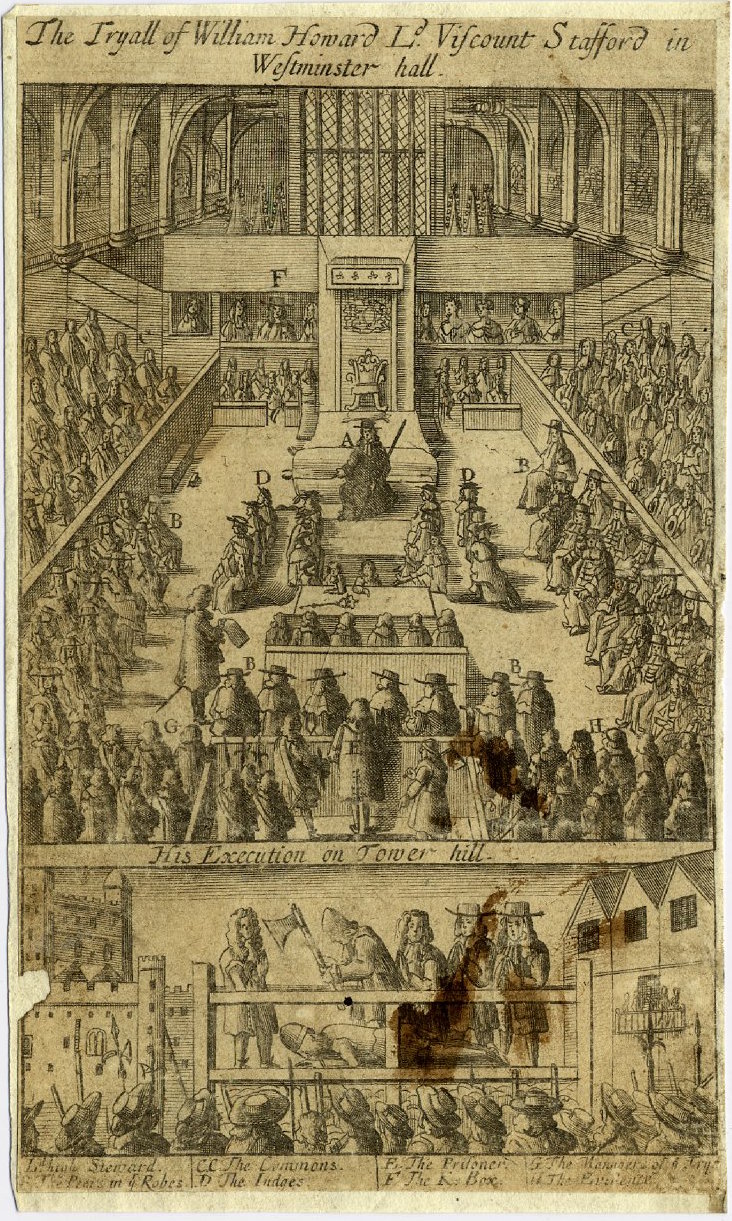
The populace, who had exulted at Stafford’s trial and condemnation, were now melted into tears at the sight of that tender fortitude which shone forth in each feature, and motion, and accent of this aged noble. Their profound silence was only interrupted by sighs and groans. With difficulty they found speech to assent to those protestations of innocence which he frequently repeated: “We believe you, my lord! God bless you, my lord!” These expressions, with a faltering accent, flowed from them. The executioner himself was touched with sympathy. Twice he lifted up the axe, with an intent to strike the fatal blow; and as often felt his resolution to fail him. A deep sigh was heard to accompany his last effort, which laid Stafford for ever at rest. All the spectators seemed to feel the blow. And when the head was held up to them with the usual cry, This is the head of a traitor! no clamour of assent was uttered. Pity, remorse, and astonishment, had taken possession of every heart, and displayed itself in every countenance.


Detail view (click for the full image) of an engraving of the trial and execution of Viscount Stafford. (via the British Museum).

This is the last blood which was shed on account of the popish plot: an incident which, for the credit of the nation, it were better to bury in eternal oblivion; but which it is necessary to perpetuate, as well to maintain the truth of history, as to warn, if possible, their posterity and all mankind ever again to fall into so shameful, so barbarous a delusion.

The execution of Stafford gratified the prejudices of the country party; but it contributed nothing to their power and security: on the contrary, by exciting commiseration, it tended still farther to increase that disbelief of the whole plot, which began now to prevail.

* Channeling Jacques de Molay, Stafford prophesied that Turberville, the perjured witness against him, would not outlive him by so much as a year. Turberville obligingly dropped dead of smallpox late in 1681, after falling out with his former Popish Plot conspirator Titus Oates.

On this day..