1440: Gilles de Rais, unholy

On this date in 1440, the wealthiest man in France, a noble who had once fought under Joan of Arc‘s banner, was hanged for an outlandishly demonic crime spree.


This dashing Gilles opposite Milla Jovovich in The Messenger; you’d never think he would sodomize hundreds of children.

Rivaling Hungarian blood-bather Erzsebet Bathory for the reputation of most bewitchingly depraved aristocratic sex-killer of early modern Europe, Gilles de Rais (or de Retz) hanged for abducting numberless legions of anonymous young commoners (boys, mostly) for rape and murder.

It’s a rap sheet trebly astounding given that a decade before, de Rais’s reputation for posterity would have figured to be his role as Saint Joan’s chief lieutenant when she raised the siege of Orleans, culminating with elevation to the rank of Marshall of France on the very day Charles VII was crowned in Reims. Talk about a fall from grace.

A 1440 investigation triggered by de Rais’s attack on a priest during an intra-aristocracy dispute turned up a Gacy‘s floorboards’ worth of Nantes-area kids allegedly disappeared into the Marechal’s creepy castle. Remarkably detailed trial records preserve a heartbreaking cavalcade of parents who entrusted their children to de Rais’s service or just sent them out one morning never to be heard from again. “It is notorious,” one added, “that infants are murdered in the said chateau.” (Many of these depositions and other original trial records can be read here.)

His servants and co-deviants Henriet and Pouitou admitted the most shocking stuff —

that de Rais then raped [the typical captive] as he was hanged from a hook by the neck. Before the child died, Gilles took him down, comforted him, repeated the act and either killed him himself or had him slain.

Poitou testified that the child victims were murdered sometimes by decapitating them, sometimes by cutting their throats, sometimes by dismembering them, sometimes by breaking their necks with a stick …

Gilles de Rais rarely left a child alive for more than one evening’s pleasure, Poitou claimed.

Now, it needs to be said that the servants were induced to these confessions by the threat of physical harm — and that when de Rais reversed his own denials he had likewise been menaced with torture. Nobody had been tortured, mind. But they had been given to understand that they would be corroborating the witnesses with self-incriminating statments, and we can do this the easy way or the hard way. In a world without dispositive forensics, confessions were the evidentiary gold standard … and torturing to obtain them was standard operating procedure.

It’s for that reason that there has also long persisted a revisionist thesis that de Rais was actually innocent, framed up by elite rivals who cannibalized the man’s estates. A 1992 “rehabilitation tribunal” re-tried the affair, and returned an acquittal.

Arguably, the populace — font of all those damning accusations — did likewise on the day de Rais hanged with his two servants. A crowd one might expect to be frenzied with rage actually sympathized with the doomed noble, even rescuing his hanged body from the fire. A monument his daughter put up became an unsanctioned popular pilgrimage site until it was destroyed during the French Revolution.

Whether as fact or fable, there’s something gorgeously baroque about de Rais’s dungeon mastering — especially when considered vis-a-vis his historical casting call opposite the abstemious Maid.

As a text for our latter-day edification, de Rais appears a carnivore devoured by his own appetites (and not only sexual: he also blew through the gargantuan family fortune). Reduced from hero to beast, he’s almost a literal werewolf or vampire; he’s often cast as such in video games and the like.

And he transfixes us because he personifies this uncanny bridge from the atomized digital age with its iconic serial killers, alone and psychologically deconstructed, back into the medieval — feudal, irrational, communal, violent and physical but also suffused with an omnipresent alien-to-us paranormal spirit world. It is enough to glance to experience the pull of the abyss gazing back.

Sabine Baring-Gould anticipated the modern afterlife of Gilles de Rais in the mid-19th century Book of Were-Wolves — which incorporated an extended account of de Rais’s trial into a wider narrative of folklore shapeshifting.

De Rais himself shapeshifts even within the brief arc of his dramatic trial: from indignant defendant into contrite supplicant, every drop sincere so far as one can perceive. His very prosecutors, indeed his very victims, wept for the fallen Marechal, and the “monster” reversed with this display his excommunication. (This may have been the part of the punishment de Rais feared most: again, we encounter the alien cosmology.)

“Nothing seems to me to be more beautiful –- and farthest away from our mentality of today — than the crowd of parents of the victims praying for this soul’s salvation,” one modern observed. “That is spiritual nobility.”

Agonizing ecstacist Georges Bataille wrote a whole book about de Rais, characteristically taken by the intersection of repugnance and transcendence. For Bataille, Christianity even reconciles our prisoner’s stupendous villainy with his unfeigned anticipation of spiritual salvation that “ultimately summarize the Christian situation.”

“Perhaps,” Bataille mused, “Christianity is even fundamentally the pressing demand for crime, the demand for the horror that in a sense it needs in order to forgive.”

A Few Books About Gilles de Rais

There are also several free public-domain books, such as Bluebeard: an account of Comorre the cursed and Gilles de Rais, with summaries of various tales and traditions and (already alluded to, the one with the original trial documents) Blue-beard, a contribution to history and folk-lore. Gilles de Rais is popularly, though I think not very persuasively, believed to have helped inspire the “Bluebeard” legend of the murderous aristocrat.

On this day..

1675: Samuel Guile, Puritan rapist

(Thanks to Meaghan Good of the Charley Project for the guest post. -ed.)

On this day in 1675, in the then-Puritan Massachusetts Bay Colony (now Essex County, Massachusetts), 27-year-old Samuel Guile was hanged for “violently and forcibly” raping Mary Ash on Christmas Day the previous year.

What little is known about the case comes from the Records of the Court of assistants of the colony of the Massachusetts bay, 1630-1692, which is available for free with Google Books.

Samuel Guile of Hauerill being Committed to Prison in order to his trial for Comitting a Rape was presented & Indicted by the Grand Jury, was brought from prison to the bar where holding up his hand was Indicted by the name of Samuel Guile for not hauving the feare of God before his eyes & being instigated by the divill did on or about the 25th day of December last in the woods violently and forcibly seize on & Comitt a rape on the body of Mary Ash the wife of John Ash of Amesbury Contrary to the peace of our Soueraigne Lord the King his Croune & dignity the lawes of God & of this jurisdiction — to which he pleaded not Guilty and put himself on God & country. After the Indictment and eudicenes were Read Comitted to the Jury & are on file with the Records of this Court the Jury brought in y’r verdict they found the prisoner at the barr Guilty & he accordingly had sentenc pronounct ag’ him yow Sam Guile are to Goe from hence to yo place from whence yo came & thence to yo place of execution & there be hang till yow be dead wch was accordingly donn 16 october 1675.

His estate paid six pounds, eighteen shillings in court costs and five pounds in damages to Mary.

Although rape was a capital crime, it was inconsistently punished in the Massachusetts Bay Colony. In 1680, five years after Guile swung, William Nelson was convicted of raping a girl under ten and he was only whipped.

Nearly forty years earlier, in 1642, Daniel Fairfield, John Hudson and Jenkin Davis were found guilty of gross immorality for molesting and raping two sisters over a period of years, starting when they weren’t even seven years old. The men confessed to everything but penetration, but the girls’ statements and a physical examination contradicted the suspects’ statements.

Governor John Winthrop was horrified and wrote at length about the case, calling it “a very foul sin.” Fairfield was whipped twice and had his nostrils slit, Hudson and Davis were also whipped and Davis had to wear a halter for life (like a scarlet letter, it would remind everyone of his crime), and all three men were fined heavily … but they were not executed.

One wonders, then, why Samuel Guile was. Did he have a bad reputation? Were Mary and John Ash prominent people? Or did the colonial court just decide they’d better exercise the law to its full extent for once?

On this day..

1999: Chen Chin-hsing, Taiwan’s most notorious criminal

On this date in 1999, Taiwan put to death a man who, as the Reuters story about his case led it, “shook public confidence in law and government with the kidnap-murder of a TV celebrity’s daughter and a string of subsequent gun battles, killings, rapes and a hostage drama.”

Dramatic enough for you?

This operatic crime spree was the work of three men, Chen Chin-hsing, Lin Chun-sheng, and Kao Tien-min.

They punched their ticket to popular infamy when they snatched 16-year-old schoolgirl Pai Hsiao-yen in New Taipei City on April 14, 1997.

Her family received terrifying photos of the girl stripped naked and bound, a severed pinkie finger, and a demand for $5 million U.S. And they were in a position to get it, because Pai’s mother was celebrity singer and TV personality Pai Ping-ping. (Alternatively: Bai Bing-bing.)

However, despite multiple attempts to drop the ransom, the kidnappers kept not showing up, and the captive, who’d been brutalized and raped during her captivity, was eventually murdered and dumped in a drainage ditch.

Pai Hsiao-yen’s murder not only captivated media but crystallized public backlash against politicians and police who showed as ineffective in the midst of a massive crime wave. It helped cave in the government of Taiwan’s first democratically elected president.

The criminals themselves magnified the case by drawing out the initial public horror into a seven-month drama as they eluded police manhunts. At one point, they forced a plastic surgeon at gunpoint to alter their appearances, then murdered him after he was finished.

Chen Chin-hsing was finally captured (after the other two had judiciously committed suicide when about to be apprehended) after a televised standoff wherein Chen gave self-valorizing media interviews while holding a South African ambassador’s family hostage.

All this made Chen a dead man, and few in the Republic of China much pitied the serial rapist and spree killer’s fate of taking a magazine of automatic rifle ammunition in the chest. (Several others in this dreadful affair also got non-capital sentences for various forms of aiding and abetting.)

It also made Pai Ping-ping into a tough-on-crime social activist. Taiwan’s death penalty has been in the news recently with the government’s admission that it executed an innocent man in an unrelated case. Pai vehemently opposes the resulting abolition efforts that other case has helped along; in 2010, she helped to break a 52-month death penalty moratorium and force a resumption in executions when she threatened to commit suicide if Taiwan went through with abolition. That would be operatic indeed.

On this day..

1938: Albert Dyer, sex killer (presumably)

On this date in 1938, Albert Dyer hanged at California’s San Quentin prison for a triple rape-murder.

Dyer is a very modern bugbear, a monster right out of cable news and amber alerts and stranger danger.

As often with those, his path to infamy began with disappeared white girls — Jeanette Stephens, Melba Everett, and Madeline Everett, all ages 7 to 9 — who went to picnic at an Inglewood park one summer afternoon and never came home.

The police set about hunting for any known sex offenders in the area, but the offense would ultimately be attributed to a neighbor who was active with the concerned search parties that scoured the area.

Induced by a police threat to deliver him into the hands of a lynch mob, Dyer admitted to having lured the girls off on the pretext of catching rabbits, then strangling them to death and raping their corpses.

(Here’s a disturbing set of photos of the girls’ bodies.)

Dyer attempted to repudiate these confessions, which you’d have to say were obtained under a bit of duress. The case against him apart from self-incrimination was a tissue of meager circumstantial evidence; Dyer’s persona smacks of mental deficiency that might have left him easy prey for manipulation by his captors.

Newspapers described Dyer as “dull” and “stupid”, and in fact the defense attempted to cast doubt on the prisoner’s mental competence and the reliability of his confessions. The jury took agonizing days to reach a consensus, and the last man holding out against conviction would later say that he finally gave in after being led to believe that the judge considered Dyer guilty. (This revelation was among the defense’s last arguments for executive clemency, at the end of the process.)

In short, for all the horror of the crime, the case was not cut and dried in 1938. The passage of time — with our latter-day awareness of false confessions and developmental disability — will hardly make it more so, unless some forgotten crime locker still preserves a testable genetic sample. But no surprise, the popular press had a different take. The Los Angeles Times editorialized (Aug. 27, 1937) anticipating that

[t]he verdict of a jury that Albert Dyer must die for the murder of three Inglewood children is a long step toward the eradication of sex crime in California. It is the only outcome of the case that public opinion could afford to sanction.

The evidence against Dyer was overwhelming; and there could be no mitigating circumstance which could justify this State in letting such a miscreant go on living.

Even if Dyer is mentally defective, there is no reason for his continued existence. He could never be safe to have at large. Legally, his condition is not insanity; he knew what he was doing and that it was wrong. Eradication of such types is necessary for public safety.

And the death penalty is the best deterrent. If others have this criminal tendency, his fate may cause them to repress it. Dyer, hanged, may save the lives of countless California innocents. In any scale, the safety of children must weigh more heavily than his forfeited right to live.

Dyer was the second-last person hanged by the Golden State before the gas chamber came online to replace the gallows. His legacy was California’s 1939 passage of a law governing (pdf) the handling of “Sexual Psychopaths”. (This site suggests he was also posthumously exploited for the cause of marijuana criminalization.)

Part of the Themed Set: Americana.

On this day..

1900: William Black, nearly lynched

“Not only the citizens of Aberdeen,” began the Feb. 23, 1900 Baltimore Sun, “but practically those of the whole of Harford county are wrought up to a high degree by the assault which was committed here upon Miss Jessie Bradford, the 15-year-old daughter of Mr. Edward Bradford, a well-to-do and respected farmer.”

A posse of mounted men was even then abroad hunting the suspect, a black shantytown dweller said to have assaulted the “prepossessing, well developed” girl with the “clear, wax-like complexion” as the latter returned on the train tracks to her uncle’s home. A conductor on a passing train had seen them struggling in the ditch and left a note (“Negro raping a white woman”) at the next stop; Miss Bradford, too, survived the trauma and gave an eyewitness description of her assailant that pointed at William Black.*

“The inhabitants of the county will spare no pains nor sacrifices to run down the miscreant,” the Sun concluded.

And we think we have a pretty good idea just what this running down would be liable to entail, since it was only days after Black’s capture that residents of a Harford county town went and lynched another African-American accused of attacking a white woman.

Black had managed to keep on the run for a week and get himself out of Harford County to Baltimore before he was arrested. He certainly owed his lease on the last few months of his life to eluding the outraged citizens.

Indeed, three months after the rape, the state’s attorney filed to handle the case in Baltimore rather than in Harford county on account of the continuing “probability of the negro being lynched had he been brought [to Harford county] for trial … it would only be the work of a few short minutes if he landed here.” (Sun, May 24, 1900) Passions had not cooled: to the contrary, it had since become known that Black had already been released from a previous prison term for a similar crime in neighboring Cecil County, and the law-and-order set was up in arms with the hempen fin de siecle version of a three strikes law.

Baltimore Sun, March 6, 1900

Black’s professed relief at evading the rigors of lynch law was to be short-lived.

A steady drumbeat of coverage for the “Aberdeen Outrage,” the “Miss Bradford Assault”, or whatever other salacious description could be conjured, kept him in papers as public enemy number one; Jessie Bradford, so very young and so very white, tearfully testified against Black in a scene that cannot have failed to stir the three-judge tribunal. (Black sensibly opted against a jury trial.)

He would remain lodged in Baltimore right up until his hanging in Bel Air back in Harford county, as a precaution against the mob. He was there long enough to see another of his race precede him: one Amos Smith, who hanged in Baltimore City Jail on August 3, fraternally comforting his fellow-sufferer that “I am only going ahead of you a few days and will be in the other world to meet you when you come.”** (Sun, Aug. 3, 1900)

Actually getting Black across that Styx in the legally prescribed fashion would require some craft on the part of the lawmen.

Even though the sentence was sure, the good folk of Harford County were feared violently inclined to prefer personally administering the judgment. Harford Sheriff Andrew Kinhart, said the Sun (Sep. 1, 1900), “stole a march on the watchful public” anticipating its potential victim arriving on a 9:30 train by racing his “exceedingly nervous” prisoner from Baltimore to Bel Air under cover of darkness, arriving at 5:40 a.m. in time for Black’s hearty if secretive last breakfast in the company of his wife, and then proceeding swiftly to the scaffold before the rabble could get wind of what was going on. It was a high-risk ploy as it entailed leaving behind in Baltimore Black’s armed escort in the interests of stealth — but it did work, our scribe judging the unhappy business to have been conducted “creditably”.

* Black persisted in his innocence at trial, and up to his execution. Though condemned prisoners’ assertions of virtue are hardly the most reliable gauge, neither are eyewitness statements … although in this case, Black reportedly admitted to the crime in the last hours before his death.

** Both Smith and Black also shared (Sun, July 11, 1900) the same spiritual advisor whilst awaiting execution: Methodist Episcopal preacher Ernest Lyon, later the U.S. ambassador to Liberia.

Part of the Themed Set: Americana.

On this day..

1930: Thomas Shipp and Abram Smith, strange fruit

On this date in 1930, two black youths were lynched in Marion, Indiana for murdering a white man and raping his girlfriend.

(The rape allegation — although it, and not the homicide, seems to have been the thing that triggered the lynching — was subsequently withdrawn, and there were even rumors that the white girlfriend was a lover and confederate of one of the lynched men. It’s just one strand in the very human tapestry around the “last classic lynching north of the Mason-Dixon line” explored by Cynthia Carr in Our Town: A Heartland Lynching, a Haunted Town, and the Hidden History of White America.)

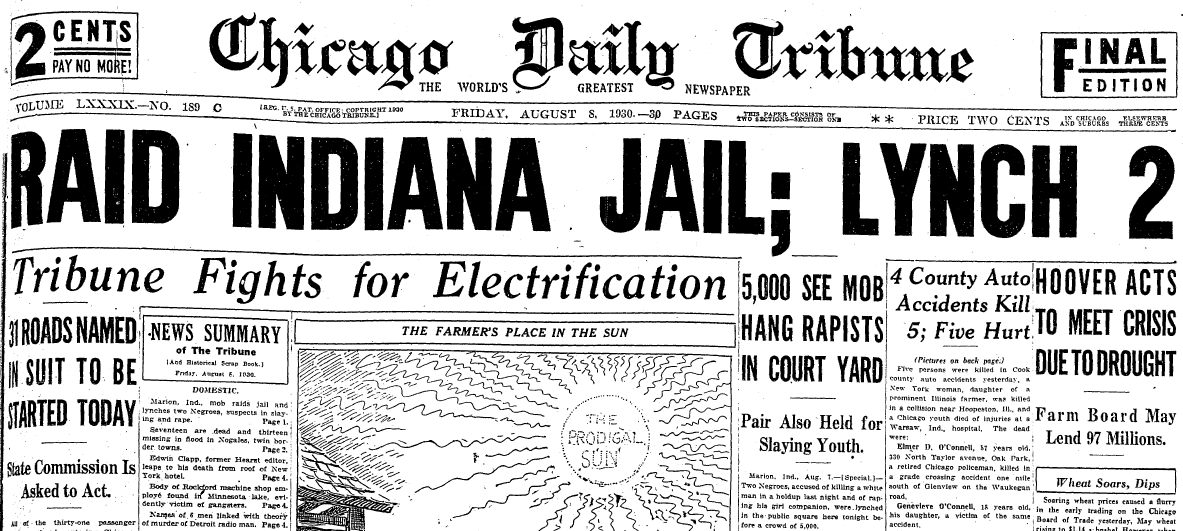
Thomas Shipp and Abram (or Abraham) Smith had been taken just the day before. The Chicago Daily Tribune (Aug. 8, 1930), for whom this event was banner news, reported that

Shipp, who is said to have confessed killing the white man, Claude Deeter, 23, of Fairmount, Ind., was hanged from an elm tree in the courthouse yard. Smith, whom the girl identified as her assailant, was thrown from a third floor window of the jail with a noose around his neck and strangled.

Reports of the crimes and confessions, published in Marion newspapers this afternoon, stirred this quiet community of 23,000 to intense excitement. There was no hint of the impending violence, however, until 8:30 p.m., when a motorcade of Deeter’s fellow townsmen arrived from Fairmount.

The Fairmount delegation, numbering about 100, gathered in the public square, openly displaying their guns and shouting for a lynching … The sheriff led his deputies to the front door, argued a moment with the leaders of the mob and then ordered the tear bombs thrown. Blinded, the lynchers fell back for a few minutes, but returned and began the sledge hammer siege which forced the jail doors within ten minutes. No shots were fired on either side.

Following the lynching the mob gathered in the square for an hour, some proposing to drive the 2,000 members of the Negro colony from the city and burn their dwellings. Peace officers from Indianapolis, Kokomo, Fort Wayne, and other towns were arriving however, and gradually the mob broke up.

The corpses hung in the square for hours, attracting throngs of gawkers — including a photographer able to snap this picture:


Teacher/poet Abel Meeropol ran across this photo of the Shipp-Smith lynching a few years later in a magazine, and it so “haunted” him — his word — that he penned the anti-lynching poem “Strange Fruit”. You know it from Billie Holiday‘s arresting vocal rendition.

Southern trees bear strange fruit
Blood on the leaves
Blood at the root
Black bodies swinging in the southern breeze
Strange fruit hanging from the poplar trees

Pastoral scene of the gallant south
The bulging eyes and the twisted mouth
The scent of magnolia sweet and fresh
Then the sudden smell of burning flesh

Here is a fruit for the crows to pluck
for the rain to gather
for the wind to suck
for the sun to rot
for the tree to drop
Here is a strange and bitter crop

Abel Meeropol was no passing sentimentalist himself, but a prolific left-wing activist. During the McCarthy years, he adopted the children of the Rosenbergs when the latter were electrocuted as Soviet spies. As faithfully as those two orphaned boys have carried the torch for their lost birth parents, they also still carry an adoptive surname: Michael Meeropol and Robert Meeropol.


A third person was almost lynched in the same Marion, Ind., incident, but 16-year-old James Cameron (sometimes called “Herbert” or “Robert” in the 1930 news reports) managed to convince the mob that he wasn’t involved. Just how he managed this feat and what he’d really been up to is another strand of Carr’s tapestry: many of the Marion blacks as well as whites she interviewed overtly mistrusted Cameron.

At any rate, the crowd let him off with a beating, and Cameron served time as an accessory to the crime.

After release, he became an anti-lynching activist in Indiana and, later, Wisconsin — where he founded a (since-shuttered) Black Holocaust Museum. He started several NAACP chapters.

Cameron was pardoned by Indiana Gov. Evan Bayh in 1993, and authored a memoir titled A Time of Terror: A Survivor’s Story.

In the more immediate aftermath, it was far from a given that this date’s effusion of summary justice wouldn’t cascade into a generalized racial pogrom.

As the Tribune article notes, the lynch mob mulled attacking the black community, ultimately dissuaded by the gradual arrival of lawmen. By the next day, the Indiana national guard had occupied Marion. The Tribune on Aug. 10 reported the town “peaceful to all outward appearances but acutely aware of an undercurrent of racial antagonism that it feared might flame into open warfare at any moment.”

Lest this seem a bit over-the-top, recall that all this went down just a few years since a lynch mob in Tulsa had metastasized into one of America’s most notorious race riots. The prospect of wholesale bloodletting was very real.

When the local attorney general and grand jury waved away the small matter of punishing mob leaders, several of whom were publicly known by name, Indianapolis attorney general (and Marion native) James M. Ogden drove up to town and personally filed indictments, to the fury of white residents.

“It was astonishing to see and feel the mob atmosphere that still prevailed nearly seven months after the murder,” wrote a correspondent for The Nation. Ogden’s deputies were “looked upon as enemies of the community, not only by the mob, but also by most of the court officials.” After all-white juries acquitted the first two people tried, the state dropped its remaining indictments.


The maelstrom of race and politics and history that emerged from that first fatal transaction — a brutal but banal Lover’s Lane heist — grew so far beyond the original cast of criminal and victim that they practically became secondary to the story.

On August 8, 1930, a wire story datelined Fairmount, Ind., ran in the Indianapolis Star (but not the Marion papers):

Deep regret that the negro slayers of their son Claude, were lynched in Marion last night by a mob, was expressed today by Mr. and Mrs. William Deeter, members of the Apostolic faith, a sect similar to the Quakers.

“God should have been the judge,” said the elderly Deeter. “They had no right to do it,” his wife assented.

Both are opposed to capital punishment and did not want to see the negroes put to death for their crime.

On this day..

1983: Aleksandr Kravchenko, in Chikatilo’s place

On this date in 1983, Aleksandr Kravchenko was executed in the Soviet Union.

Kravchenko attempted to rape and then brutally strangled to death nine-year-old Lena Zakotnova in December 1978, dumping her body in a nearby river.

Oh … wait, no. That turned out to have been done by later-infamous serial killer Andrei Chikatilo: actually, Zakotnova was Chikatilo’s very first victim.

Sorry about beating that confession out of you, Sasha.

As for Russia’s present-day criminal justice system, there’s no more death penalty. But, “if a person ends up in a police cell as a suspect, he will find himself in court no matter what, and the court will find him guilty, guaranteed. And everyone knows it … you’ll end up in court, then straight to jail. The machine works automatically. It happens all the time.”

On this day..

1951: Willie McGee

As of today, it is sixty years since the Laurel, Mississippi execution of Willie McGee for rape — a lightning rod for controversy over race, crime, and justice in one of the Cold War’s principal antagonists.

McGee died silent in the state’s portable electric chair, rigged up in the very courtroom of his trial, right in front of the box from whence his all-white jury had retired two and a half minutes before convicting him. Fifty or so observers were there with him — plus those of the hundreds of local residents milling around outside intrepid enough to scale a tree for an illicit view through the courthouse windows.*

(Given the setting, some sources call this a “public execution,” which is not technically correct. This courtroom tableau was actually a standard deployment for the mobile electric chair.)

But McGee’s own silence hardly muted global outrage: for years, appeals for McGee’s life had deluged Mississippi and the White House from Europe, the Soviet Union, and what was quaintly known as “Red China.”

Oh, yes. The Reds.

Willie McGee’s case popped out of backwoods obscurity when he got from the pinko Civil Rights Congress a leftist young attorney — future U.S. Congresswoman Bella Abzug.

Once it got out there, it became the Free Mumia case of the nascent civil rights movement and the nascent Cold War. Its appeal to communist countries and cadres only raised the hackles of American establishment types. This was a Negro raping a white housewife literally and metaphorically.


Author Jessica Mitford (The American Way of Death) campaigning to save Willie McGee’s life. William Faulkner, Albert Einstein, and Josephine Baker also publicly supported McGee.

Whether there actually was a literal rape is the enduring mystery — the enduring Rorschach blot — of the McGee case. The accused himself remained silent on the matter for years; eventually, he claimed that the two were having a consensual but forbidden interracial affair and that he had been brutalized into a confession.

McGee’s defenders believed that the “victim” herself initiated the affair, and

threatened to cry rape if he refused her flirtatious advances … McGee reluctantly went [along] with Hawkins, fearing the tragic consequences of turning her away. “People who don’t know the South don’t know what would have happened to Willie if he told her no,” [Willie’s wife] Rosalee told a friend. “Down South you tell a woman like that no, and she’ll cry rape anyway. So what else could Willie do?”

At the Dark End of the Street: Black Women, Rape, and Resistance

(In this version, the manipulative Hawkins executed the threat when her husband — who later witnessed McGee’s electrocution — found out. McGee’s cited reason for changing his story was the very plausible fear of lynching.)

A Laurel African-American who was then a child remembers being taken by his family to view the body, and impress upon him the lesson of its electrical burns: “Don’t mess with white girls.”

McGee’s persecutors considered all that miscegenation stuff so much subversive rubbish, a “revolting insinuation,” in the words of the Mississippi Supreme Court.**

And if at its apex the controversy generated more heat than light, its historical fade to embers has not sufficed to resolve the factual questions.

McGee has benefited from a recent rediscovery — one that indicates such memories of the McGee case as persevere in Laurel still divide starkly along racial lines.

Explore this case and its many resonances (without the Perry Mason big reveal) in Alex Heard’s 2010 The Eyes of Willie McGee (review); and, in a spellbinding NPR series on “My Grandfather’s Execution” by Bridgette McGee-Robinson, which is exactly what it sounds like. (Direct links to several Radio Diaries mp3 episodes can be found from the RSS feed here.)

Both were facilitated by a recording of execution-night radio news coverage fortuitously preserved by a young Hattiesburg reporter.

Book Cover

* New York Times, May 8, 1951.

** McGee did at least win two retrials in Mississippi; federal courts gave him short shrift, with anti-civil rights judge Sidney Mize — later memorable for fighting the legal rearguard against integrating Ole Miss — lecturing Abzug in a last-ditch appeal that McGee’s “guilt is plain” and that “courts ought to rise up and defend themselves.” (Source)

Taken as an obvious given: “actually guilty” or not, a defendant executed for rape in the American South is certainly a black man with a white accuser.

On this day..

1830: The slave Jerry, the last American execution by burning?

On this date in 1830,* a slave named Jerry was executed in Abbeville, South Carolina … by burning to death.

The slave was the property of a Miss Elizabeth McQuerns, a schoolteacher who hired him out — in which capacity he raped the wife of his subcontracted master.

This case is treated in an April 1990 piece for The South Carolina Historical Magazine by Lowry Ware, titled “The Burning of Jerry: The Last Slave Execution by Fire in South Carolina?” But in addition to being the last execution by fire in South Carolina, it might well be the last in the United States. (The quotes below are all via Ware.)

“Judicial,” for slaves, was of course something less than a robust vindication of the defendant’s rights — and burning sentences imposed in colonial and antebellum America were almost universally used against black slaves. One pictures a context not unlike that of extrajudicial burnings to follow in the decades yet to come.

According to a copy of the trial transcript McQuerns later filed for compensation (the original trial record is lost, Ware says),

the Court acquainted [Jerry] that they were to proceed immediately upon trial and would hear his answer to the charge against him and whatever witnesses he had to produce in his behalf as well as against him.

The witness produced to support the charge against the prisoner was heard and examined and there being no witness in behalf of the prisoner, the court after mature consideration of the case found the prisoner guilty … [and was condemned to] be sent to the Gaol of the said District and there remain until the first day of May next and then be brought back to an old field above West Donald still house, and there burnt to death between the hours of twelve and two o’clock.

But previous to awarding and ordering said sentence to be executed appraised and valued said Negro slave man named Jerry at four hundred dollars and direct the sum of ____ to be paid to Elizabeth McQuerns the owner of said Negro and the remainder of the sum of ____ dollars to ____ agreeably to the Act of Assembly made and provided.

Such a dramatically anachronistic sentence surely made its impression.

As remembered, decades later, by a minister named Samuel Leard who witnessed the execution as a teenager,

thousands of men, women and children, both white and colored, assembled together in an old field not far from the residence of Mr. Donald to witness the execution of a beastly criminal by burning alive at the stake. The crime cannot with propriety be named — the name and the memory of the criminal ought to be consigned to eternal oblivion. But there sat the prisoner, the waiting impatient crowd, the immense pile of pitch pine logs and kindling wood scattered around, the sheriff and his posse, the temporary platform for the preacher … for it was determined that the fiendish criminal should hear his own funeral sermon pronounced … As the poor doomed man ascended the pile, he began to pray audibly and this was kept up continuously during the process of chaining him to the stake, and until the mounting flames deprived him of a wretched life. This was the last execution by fire ever seen in South Carolina.

Abbeville Press & Banner, July 2, 1879

In 1833, the Palmetto State humanely legislated that “that “on the conviction of a slave, or a free person of color, for a capital offence, the punishment shall be by hanging, and not otherwise.”

* The scanty documentation remaining of this case leaves the date less than completely ironclad, but the one issued in sentence attested in this piece will have to do.

On this day..

1689: Patrick O’Bryan, like a dog to his vomit

From the Newgate Calendar:


PATRICK O’BRYAN

Hanged once for Highway Robbery, but lived to rob and murder the Man for whom he had been executed. Finally hanged 30th of April, 1689

The parents of Patrick O’Bryan were very poor; they lived at Loughrea, a market-town in the county of Galway and province of Connaught in Ireland. Patrick came over into England in the reign of King Charles II, and listed himself into his Majesty’s Coldstream Regiment of Guards, so called from their being first raised at a place in Scotland which bears that name. But the small allowance of a private sentinel was far too little for him. The first thing he did was to run into debt at all the public-houses and shops that would trust him; and when his credit would maintain him no longer, he had recourse to borrowing of all he knew, being pretty well furnished with the common defence of his countrymen — a front that would brazen out anything, and even laugh at the persons whom he had imposed on to their very faces. By such means as these he subsisted for some time.

At last, when he found fraud would no longer support him, he went out upon the footpad. Dr Clewer, the parson of Croydon, was one of those whom he stopped. This man had in his youth been tried at the Old Bailey, and burnt in the hand, for stealing a silver cup. Patrick knew him very well, and greeted him upon their lucky meeting; telling him that he could not refuse lending a little assistance to one of his old profession. The doctor assured him that he had not made a word if he had had any money about him, but he had not so much as a single farthing. “Then,” says Patrick, “I must have your gown, sir.” “If you can win it,” quoth the doctor, “so you shall; but let me have the chance of a game at cards.” To this O’Bryan consented, and the reverend gentleman pulled out a pack of the devil’s books; with which they fairly played at all-fours, to decide who should have the black robe. Patrick had the fortune to win, and the other went home very contentedly, as he had lost his divinity in such an equitable manner.

There was in Patrick’s time a famous posture master in Pall Mall; his name was Clark. Our adventurer met him one day on Primrose Hill, and saluted him with “Stand and deliver.” But he was mightily disappointed, for the nimble harlequin jumped over his head, and instead of reviving his heart with a few guineas, made it sink into his breeches for fear, he imagining the devil was come to be merry with him before his time, for no human creature, he thought, could do the like. This belief was a little mortification to him at first; but he soon saw the truth of the story in the public prints, where Mr Clark’s friends took care to put it, and then our Teague’s qualm of conscience was changed into a vow of revenge if ever he met with his tumblership again; which, however, he never did.

O’Bryan at last entirely deserted from his regiment, and got a horse, on which he robbed on the highway a long time. One day in particular he met Nell Gwyn in her coach on the road to Winchester, and addressed himself to her in the following manner: “Madam, I am a gentleman, and, as you may see, a very able one. I have done a great many signal services to the fair sex, and have in return been all my life long maintained by them. Now, as I know you are a charitable w— —e, and have a great value for men of my abilities, I make bold to ask you for a little money, though I never have had the honour of serving you in particular. However, if an opportunity should ever fall in my way, you may depend upon it I will exert myself to the uttermost, for I scorn to be ungrateful.” Nell seemed very well pleased with what he had said, and made him a present of ten guineas. However, whether she wished for the opportunity he spoke of, or no, cannot be determined, because she did not explain herself; but if a person may guess from her general character, she never was afraid of a man in her life.

When Patrick robbed on the highway he perverted several young men to the same bad course of life. One Claudius Wilt in particular was hanged at Worcester for a robbery committed in his company, though it was the first he was ever concerned in. Several others came to the same end through his seducements; and he himself was at last executed at Gloucester for a fact committed within two miles of that city. When he had hung the usual time, his body was cut down and delivered to his acquaintance, that they might bury him as they pleased. But being carried home to one of their houses, somebody imagined they perceived life in him; whereupon an able surgeon was privately procured to bleed him, who by that and other means which he used brought him again to his senses.

The thing was kept an entire secret from the world, and it was hoped by his friends that he would spend the remainder of his forfeited life, which he had so surprisingly retrieved, to a much better purpose than he had employed the former part of it. These friends offered to contribute in any manner he should desire towards his living privately and honestly. He promised them very fairly, and for some time kept within due bounds, while the sense of what he had escaped remained fresh in his mind; but the time was not long before, in spite of all the admonitions and assistance he received, he returned again to his villainies like a dog to his vomit, leaving his kind benefactors, stealing a fresh horse, and taking once more to the highway, where he grew as audacious as ever.

It was not above a year after his former execution before he met with the gentleman again who had convicted him before, and attacked him in the same manner. The poor gentleman was not so much surprised at being stopped on the road as he was at seeing the person who did it, being certain it was the very man whom he had seen executed. This consternation was so great that he could not help discovering it, by saying: “How comes this to pass? I thought you had been hanged a twelvemonth ago.” “So I was,” says Patrick,” and therefore you ought to imagine that what you see now is only my ghost. However, lest you should be so uncivil as to hang my ghost too, I think it my best way to secure you.” Upon this he discharged a pistol through the gentleman’s head; and, not content with that, dismounting from his horse, he drew out a sharp hanger from his side and cut the dead carcass into several pieces.

This piece of barbarity was followed by another, which was rather more horrible yet. Patrick, with four more as bad as himself, having intelligence that Lancelot Wilmot, Esq., of Wiltshire, had a great deal of money and plate in his house which stood in a lonely place about a mile and a half from Trowbridge, they beset it one night and got in. When they were entered they tied and gagged the three servants, and then proceeded to the old gentleman’s room, where he was in bed with his lady. They served both these in the same manner, and then went into the daughter’s chamber. This young lady they severally forced one after another to their brutal pleasure, and when they had done, most inhumanly stabbed her, because she endeavoured to get from their arms. They next acted the same tragedy on the father and mother, which, they told them, was because they did not breed up their daughter to better manners. Then they rifled the house of everything valuable which they could find in it that was fit to be carried off, to the value in all of two thousand five hundred pounds, After which they set the building on fire, and left it to consume, with the unhappy servants who were in it.

Patrick continued above two years after this before he was apprehended, and possibly might never have been suspected of this fact if one of his bloody accomplices had not been hanged for another crime at Bedford. This wretch at the gallows confessed all the particulars, and discovered the persons concerned with him; a little while after which, O’Bryan was seized at his lodging in Little Suffolk Street, near the Haymarket, and committed to Newgate; from whence before the next assizes he was conveyed to Salisbury, where he owned the fact himself, and all the other particulars of his wicked actions that have been here related.

He was now a second time executed, and great care was taken to do it effectually. There was not, indeed, much danger of his recovering any more, because his body was immediately hung in chains near the place where the barbarous deed was perpetrated. He was in the thirty-first year of his age at the time of his execution, which was on Tuesday, the 30th of April, in the year 1689.

On this day..