On this date in 1916, Thomas Kent was shot in Cork, Ireland — the only person executed that May for the Easter Rising outside of Dublin.*
The Kents were were prominent nationalists of several generations’ standing in County Cork and were all set to join the Easter Rising until the last-minute countermanding order went out.
When the Rising happened anyway in Dublin — a day later and numerically much smaller than originally intended — the constabulary was preventively dispatched throughout the island to arrest known fellow-travelers … like the Kents.
The constabulary’s attempted raid on the Kent property May 2 met armed resistance that became an hours-long siege; Constable William Rowe was shot dead, as was Richard Kent.
The surviving Kent brothers, William and David,** along with our man Thomas, were all tried for affair: William was acquitted, David condemned but the sentenced commuted, and only Thomas actually executed.
Cork’s main railway station was in 1966 re-christened Kent Station in his honor.
* In August of that year, Roger Casement hanged in London for treason in connection with the Easter Rising. Casement had not taken any direct part in the fighting, but had worked to arrange the (attempted) support of Britain’s wartime enemy, Germany.
** Both David and William Kent later sat in the Irish parliament.
On this date in 1916 — following a Sunday respite — executions in the aftermath of the Irish Republican Easter Rising against British power resumed with four more shootings at Dublin’s Kilmainham Gaol.
never to treat with the enemy, never to surrender at his mercy but to fight to a finish. I see nothing gained but grave disaster caused by the surrender which has marked the end of the Irish Insurrection of 1916 — so far at least as Dublin is concerned. The enemy has not cherished one generous thought for those who, with little hope, with poor equipment, and weak in numbers, withstood his forces for one glorious week. Ireland has shown she is a nation. This generation can claim to have raised sons as brave as any that went before. And in the years to come, Ireland will honour those who risked all for her honour at Easter in 1916 …
I wish to record the magnificent gallantry and fearless, calm determination of the men who fought with me. All, all, were simply splendid. Even I knew no fear, nor panic ,nor shrank fron no risk [sic], even as I shrink not now from the death which faces me at daybreak. I hope to see God’s face even for a moment in the morning. His will be done.
His firing squad failed to kill him cleanly, necessitating a gory coup de grace.
A devout Catholic as well as a revolutionary militant, Mallin’s last letter to his family urged two of his children to take up holy orders. They indeed did so, and his youngest son, Father Joseph Mallin SJ, died only days ago as of this writing at the age of 104.
Con Colbert was another deeply religious rebel; an Irish Republic Brotherhood officer, he commanded rebels at several locations including the Jameson’s whiskey distillery at Marrowbone Lane.
The youngest of the group — who were, like all the Easter Rising rebels, shot sequentially rather than en masse — was 25-year-old Sean Heuston, also known as Jack or J.J. James Connolly had dispatched him to hold the Mendicity Institution for a few hours to delay the British advance; Heuston’s garrison of 26 ended up defending it for two days against several hundred enemy troops until, food and ammunition exhausted, they surrendered at British discretion.
His confessor cast the young patriot in a positively beatific light at the end:
A soldier directed Seán and myself to a corner of the yard, a short distance from the outer wall of the prison. Here there was a box (seemingly a soap box) and Sean was told to sit down upon it. He was perfectly calm, and said with me for the last time: ‘My Jesus, mercy.’ I scarcely had moved away a few yards when a volley went off, and this noble soldier of Irish Freedom fell dead. I rushed over to anoint him; his whole face seemed transformed and lit up with a grandeur and brightness that I had never before noticed
…
Never did I realise that men could fight so bravely, and die so beautifully, and so fearlessly as did the Heroes of Easter Week. On the morning of Sean Heuston’s death I would have given the world to have been in his place, he died in such a noble and sacred cause, and went forth to meet his Divine Saviour with such grand Christian sentiments of trust, confidence and love
On this date in 1916, the British field court meting out death sentences to Irish Easter Rising rebels announced eighteen commutations — most notably including Countess Constance Markievicz.
Markievicz has long been one of the most remarkable and compelling personalities of the Irish independence struggle. As her biographer noted, many other women of that cause are best-known “mainly because of their connection with more famous men.” Markievicz, notably, “stood alone, self-driven and self-confident. She was more than a muse or an enabler or a facilitator, the preferred roles for women to play.”
She was the privileged daughter of a baronet turned polar explorer who came to her distinctive name by marrying a Polish nobleman.** In her girlhood, she’d been presented at court to Queen Victoria.
She trained as a painter and her material circumstances put within her reach that charmed state of comfortable avant-garde consciousness. The Countess gave that up, for Ireland. The abhorrence of the daughter of the Provost of Trinity College Dublin is perhaps her most definitive epitaph: “the one woman amongst them [Irish republicans] of high birth and therefore the most depraved … she took to politics and left our class.”
By the late 1900s and into the 1910s she was a mainstay of hydra-headed radicalism: nationalist, suffragist, socialist. (She was a close friend and comrade of James Connolly.) In those years she could have spent in a pleasant Left Bank garret, she walked picket lines, burned flags, faced arrest, and sold jewelry to fund the soup kitchen she worked in.†
Markievicz co-founded the Fianna Eireann youth organization as a response to Baden-Powell‘s imperial scouting project. It would become an essential feeder for the republican organs (like the Irish Volunteers); Fianna itself was also well-represented among the Easter Rising fighters, and contributed that conflagration’s youngest martyr.
Bust of Constance Markievicz on St. Stephen’s Green, where she served in the Easter Rising.
But for her sex Markievicz would probably have been among the martyrs herself for her role on the St. Stephen’s Green barricade, and perhaps she wished it were so; she greeted the news of her May 6 commutation with the retort, “I do wish your lot had the decency to shoot me.” She’s been slated with having personally shot a constable during the Rising, although her defenders consider this a baseless smear.
While again in prison — she’d been amnestied from the Easter Rising stuff, but was arrested anew for anti-war activism — Markievicz successfully stood for election to Parliament, and in fact has the distinction of being the first woman elected a British M.P. … although she complied with Sinn Fein policy and refused to take the seat. She was also a member of the First Dail (parliament) of the revolutionary Irish Republic and was the first Irish female cabinet minister (Ministry of Labour).
Constance Markievicz died in 1927 at the age of 59, penniless in a public ward having disbursed the entirety of her wealth. A quarter-million of her fellow peoples of the Irish Free State thronged the streets of Dublin for her funeral.
* The other commutations (with their associated non-capital sentences) as published by the London Times of May 8, 1916:
Three years’ penal servitude. — R. Kelly, W. Wilson, J. Clarke, J. Marks, J. Brennan, P. Wilson, W. Mechan, F. Brooks, R. Coleman, T. Peppard, J. Norton, J. Byrne, T. O’Kelly.
** It turned out that although Casimir Markievicz went by “Count Markievicz” there wasn’t actually any such title. But “Count” and “Countess” stuck nevertheless.
† She does perhaps forfeit some wokeness points for complaining of her post-Easter Rising imprisonment at Aylesbury that she was lodged with “the dregs of the population … no one to speak to except prostitutes who have been convicted for murder or violence. The atmosphere is the conversation of the brothel.”
Major John MacBride was shot on this date in 1916 for his improvised role in the Easter Rising.
A doctor by training and a republican by heart, MacBride earned his officer’s commission when, as an emigre to South Africa, he raised the Irish Transvaal Brigade to fight against the British during the Second Boer War. (The Boer nationalist cause was wildly popular among Irish nationalists: they had the same enemy.)
The British during that conflict were aggressive about treating as “rebels” even guerrillas whose nationality was in question, so the fact that the Irishman MacBride accepted citizenship from the Transvaal Republic and went to war against the Crown made him a right traitor in London’s eyes. After the war, he laid low in Paris and married Maud Gonne to the annoyance of the lovestruck poet W.B. Yeats who had unsuccessfully wooed Gonne.*
Back in Ireland once gone from Gonne, MacBride’s Boer War bona fides made him such an obvious locus of sedition that the Easter Rising conspirators kept him entirely away from their plot for fear of inviting the attention of whomever was watching MacBride. Instead, he walked into events accidentally, finding the rising occurring while he was in town to meet his brother.
A proper Irish patriot with military experience that the revolutionaries sorely needed,** MacBride recognized what was happening and presented himself to Thomas MacDonagh — who gave him a snap appointment to the command team occupying Jacob’s Biscuit Factory.
After events had run their course, MacBride embraced his martyrdom with such equanimity that some wondered whether he hadn’t tired of life. More likely, he was just being realistic: as he halloed to another prisoner who hailed him, “Nothing will save me, Sean. This is the end. Remember this is the second time I have sinned against them.” His dignified and fatalistic final address to the court that condemned him concluded,
I thank the officers of the court for the fair trial I have had, and the Crown counsel for the way he met every application I made. I have looked down the muzzles of too many guns in the South African War to fear death, and now please carry out your sentence.
* The two married in 1903 and divorced in 1905. Yeats alleged in private correspondence that MacBride had molested Gonne’s daughter, Iseult. (Repeatedly rebuffed by Maud Gonne, Yeats later also proposed to Iseult, who was 30 years his junior. There’s a lot going on here.) This allegation has blackened MacBride’s name down the years although its credibility remains in question since the jealous Yeats was an extremely hostile observer.
After the Easter Rising was crushed, Yeats spared some verse in his poem “Easter, 1916” to throw some (qualified) shade at his dead rival, which drew him a rebuke from Maud.
This other man I had dreamed
A drunken, vainglorious lout.
He had done most bitter wrong
To some who are near my heart,
Yet I number him in the song;
He, too, has resigned his part
In the casual comedy;
He, too, has been changed in his turn,
Transformed utterly:
A terrible beauty is born.
** General Charles Blackader, who suppressed the Easter Rising and presided over the ensuing courts-martial, reportedly admired “the most soldierly” MacBride: “He on entering the court stood to attention, facing us. In his eyes, I could read: ‘You are soldiers, so am I. You have won. I have lost. Do your worst.'” (From Secret Court Martial Records of the Easter Rising)
Journalist/novelist Michael O’Hanrahan was the close friend and aide-de-camp of one of those May 3 executees, Tom MacDonagh — the two of them directing the rebel occupation of the Jacob’s Biscuit Factory during the week of April 24.
Edward Daly was the brother-in-law of Fenian ultra Tom Clarke, another man who had been shot on May 3.
Daly, at least, was a battalion commander during the Easter Rising and a part of the rising’s leadership; sculptor Willie Pearse was a mere run-of-the-mill rebel of the type that the British were not executing … save for that surname which he shared with his brother Patrick, the third Republican ringleader shot on May 3. Having seemingly absorbed an extra ration of fury intended for his brother, Willie Pearse’s execution was keenly felt as an injustice from the first.
But perhaps none of the Easter Rising executions tugged the heartstrings quite like that of Joseph Plunkett, a poet and Esperantist who was also one of the signatories of the seditious Proclamation of the Irish Republic. Plunkett had been one of the conspiracy’s secret emissaries to Germany, arranging shipments of arms that the British ultimately intercepted.
At midnight, due to be shot in a few hours with the day’s first light, Plunkett was married by a prison chaplain to his sweetheart, artist and Sinn Fein activist Grace Gifford. This tragic union made Grace Gifford and her sister Muriel double widows, for Muriel’s husband was Tom MacDonagh — the aforementioned already-executed associate of Michael O’Hanrahan.
There are roads, railway stations, football clubs, and the like named for all four of these men at various places in Ireland.
Thomas MacDonagh, Padraig (Patrick) Pearse, and Thomas Clarke — three of the principal Irish Republican leaders of the Easter Rising against British domination that had been crushed just days before — were shot in Dublin’s Kilmainham Gaol on this date in 1916.
His songs were a little phrase
Of eternal song,
Drowned in the harping of lays
More loud and long.
His deeds were a single word,
Called out alone
In a night when no echo stirred to laughter,
To laughter or moan.
But his songs new souls shall thrill,
The loud harps dumb,
And his deeds the echoes fill
When the dawn is come.
MacDonagh and Pearse were contemporaries of one another: poets, progressive educators, Gaelic revivalists; men who girded for battle “with a revolver in one hand and a copy of Sophocles in the other.” Each dreamer commanded a unit of Irish Volunteers during the week of April 24-30, MacDonagh occupying Jacobs Factory and Pearse the iconic General Post Office, in which post it was Pearse’s sorrow to issue the surrender order by the end of the quixotic week.
Clarke, cut from another cloth, was a Fenian revolutionist of an older vintage, who had disappeared into British prison after trying to bomb London Bridge in the 1880s, then emigrated for a time to the United States. Drawn to a reviving nationalist movement, Clarke had the honor of affixing his name first upon the Rising’s Proclamation of the Irish Republic. Pearse and MacDonagh signed it too: a fatal endorsement for they three and for each of the other four men to lend it their signatures.
“My comrades and I believe we have struck the first successful blow for freedom,” Clarke said via a statement given out by his impressive wife Kathleen. “And so sure as we are going out this morning so sure will freedom come as a direct result of our action … In this belief, we die happy.”
Juan Jose Carrera and Luis Carrera were shot together in Mendoza as traitors on this date 200 years ago.
They two of the Hermanos Carrera, a generation of siblings that played a prominent role in the Chilean War of Independence during the 1810s. We have already detailed them through the entry on their more notable brother Jose Miguel Carrera … who would go on to share their fate in 1821.
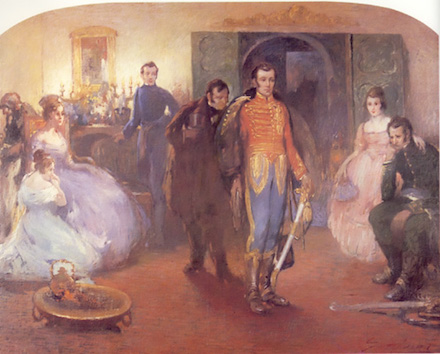
The Carrera Family, by Arturo Gordon Vargas (early 20th c.) features patriarch Ignacio, who was part of Chile’s first independent junta, along with Jose Miguel, flanked by brooding brothers Juan Jose and Luis, as well as their sister Javiera Carrera, the “Mother of Chile” and creator of the Chilean flag.
Said Jose Miguel had established a dictatorship in 1811-1812, with his brothers as trusted lieutenants. But Chile’s initial flower of independence from 1810-1814 was crushed by Spanish reconquest thanks in part to a deadly rift that had opened between the Carreras and fellow independentista Bernardo O’Higgins: prior to the decisive loss to the Spanish, Luis Carrera and O’Higgins had fought a literal battle with one another. They patched things up well enough to fight the Spanish together a few weeks later, but once in exile in Mendoza, Argentina, after their defeat they hurled recriminations at one another for the outcome. Luis even killed O’Higgins’s aide Juan Mackenna in a duel.
In the fullness of time it was the destiny of O’Higgins to be the father of a (permanently) independent Chile … and the destiny of the Carreras to be antagonists he overcame to do it.
O’Higgins attained leadership of the independence movement from exile and after elevated himself to dictator of free Chile in 1817. The Carreras promptly began scheming against him lead in old times, resulting in the arrest of Luis and Juan Jose in Mendoza. They were executed there hours after word reached the city that the Chilean patriot army had finished off the royalists.
On this date in 1592, the bell of Uglich had its “tongue” cut out, then was sent to Siberian exile — the crowning indignity of the collective punishment visited on that Volga River town for the murder of Tsarevich Dmitri.
Eight years on from the death of the ferocious and epoch-making Ivan the Terrible, Russia was under the rule of the boyar Boris Godunov, governing in the stead of his brother-in-law, etiolated Ivan heir Tsar Feodor.*
Although rival interpretations exist,** the conventional understanding of events we shall detail here is that Godunov turned assassin in order to maintain his hold on power and, eventually, achieve the tsardom for himself.
Not yet the tsar himself at this point, Godunov’s problem was that he exercised power only through Feodor … and that heirless sovereign had a (much) younger brother, our victim Tsarevich Dmitri, who in the fullness of time might easily come to supplant both Feodor and Godunov. Boris Godunov had hidden this moppet and his mum away in Uglich, where the child had his own court as Russia’s last appanage prince. The English diplomat Gil(l)es Fletcher† never met Dmitry but his 1591 Of the Russe Commonwealth caught the peril of the situation, with a bit of foreshadowing.
Besides the emperor that now is who hath no child (neither is like ever to have for ought that may be conjectured of his body and the barenness of his wife after so many years’ marriage),‡ there is but one more, viz., a child of six or seven years old in whom resteth all the hope of the succession and the posterity of that house …
[The child] is kept in a remote place from the Moscow under the tuition of his mother and her kindred of the house of the Nagois, yet not safe (as I have heard) from attempts of making away by practice of some that aspire to the succession if this emperor die without any issue. The nurse that tasted before him of certain meat (as I have heard) died presently. That he is natural son to Ivan Vasil’evich the Russe people warrant it by the father’s quality that beginneth to appear already in his tender years. He is delighted (they say) to see sheep and other cattle killed and to look on their throats while they are bleeding (which commonly children are afraid to behold), and to beat geese and hens with a staff till he see them lie dead.
The court rumors about Dmitry’s danger were onto something. On May 15, 1591, the eight-year-old princeling was found dead. He’d been stabbed in the neck.
Dmitry’s mother had the local prelates ring the cathedral bell summoning townsfolk to the commons to announce the murder and accuse Boris Godunov’s agents of perpetrating it. Outrage and panic soon whipped people into a mob that rampaged through Uglich, lynching 15 people — including one of Dmitry’s playmates as well as Moscow’s dyak, Mikhail Bityagovsky.
18th century icon of the Tsarevich Dmitry “Uglichsky” (click for larger image) shows his murder (left), and the cathedral bell being sounded to instigate summary justice (right). At the base of the cathedral, Mikhail Bityagovsky tries to batter down the door to silence the alarm.
Dangerous to bystanders, this mob was impotent against the Russian state. Boris Godunov dispatched a delegation that whitewashed Dmitry’s murder and ruthlessly punished Uglich; some 200 are reported to have been put to death for the disturbances.
The bell itself received the crowning punishment on the first of April in 1592, as the literal physical instigator of the riot: hurled from its tower, it was flogged on the public square and mutilated by having its “tongue” (the clapper) torn out. Then it was sent into exile in Tobolsk, where it remained until the 19th century. It hangs today at Uglich’s Church of St. Dmitry on Blood, although — as detailed in the bell’s Russian Wikipedia page — there is some debate about its authenticity.
As for “Saint Dmitry”, his story was just beginning and the canonization wasn’t the half of it.
When Tsar Feodor died in 1598 and Boris Godunov seized the throne outright, Russia entered her “Time of Troubles” — fifteen terrible years of civil war, invasion, and contested succession that ended with the seating of the Romanov dynasty. The Time of Troubles was characterized by, among other things, several imposters claiming to be this very murdered Prince Dmitry and therefore the rightful tsar. False Dmitrys were so ubiquitous during this interregnum that they have their own pretender regnal numbering, but all were failures in the contest for power: False Dmitri I, False Dmitri II, and False Dmitry III each came to violent and sordid ends.
* Ivan the Terrible had a perfectly cromulent heir being groomed for power in the form of one Tsarevich Ivan, but the volatile tsar had struck him during an argument in 1581 and accidentally killed him — which brought the unprepared Feodor into the succession and set up the catastrophic events of this post, as well as this incredible Ilya Repin painting:
Detail view (click for the full image) of Repin’s rendering of the horrified Ivan the Terrible clutching his mortally wounded son.
** The other principal version (Russian link) is that Dmitry suffered an epileptic fit while playing a game with knives, and accidentally stabbed himself. Many Uglichans gave this story to the official investigation (more Russian) that ensued the prince’s death, but their testimony is hard to depend upon since the Godunov-affiliated authorities conducting the investigation (like Patriarch Job, whom Godunov had made metropolitan of Moscow) preferred that version and presumably made sure that they received it. After Godunov’s death the official story reassigned responsibility to him — although this again was driven by the political imperatives of that moment. Some historians down the years have given credence to the “accident” hypothesis.
† That’s Giles Fletcher the elder, who is not to be confused with his son, the poet Giles Fletcher the Younger.
‡ Feodor had only a single daughter, Feodosia, born in 1592 (she died in 1594). As of the time of Dmitry’s murder, Feodor was 33 years old and completely childless.
The surrender of these rebel lords offered the king a chance to clear many of his rivals from the board, and he did not miss it: something like two dozen nobles were put to death in its aftermath, Mowbray among them.
His body was left to hang and rot for an extended period before the vengeful king and the Despensers finally permitted his family to take it down and bury it in the church of the Dominican friars at York. Well into the nineteenth century, a legend proclaimed that his armor had been hung on an oak tree near Thirsk, and that ‘at midnight it may yet be heard creaking, when the east wind comes soughing up the road from the heights of Black Hambleton.’
Mowbray’s wife and son were locked in the Tower of London and their estates redistributed to more loyal subjects. They’d be restored to both liberty and property after Queen Isabella and Roger Mortimer overthrew Edward.
Having been elevated to the shadow of the throne by one sibling, Thomas Seymour on this date in 1549 was seen to the block by another sibling.
The brother of Henry VIII’s favorite queen, Jane Seymour, our Thomas was when that burly king kicked the bucket beautifully positioned for a share of power, being named to the regency council that would govern for his nephew, nine-year-old heir Edward VI.
His vaunting ambitions were blocked by the oldest ogre of all, big brother: Edward Seymour, Duke of Somerset, who surpassed our Thomas in ability and seniority alike, was the man who rose to the top of the regency and as Lord Protector exercised sovereignty in the child-king’s name. “As the Duke was elder in Years, so was he more staid in Behaviour,” one history has it, observing that Thomas Seymour “was fierce in Courage, courtly in Fashion, in Personage stately, in Voice magnificent, but somewhat empty of Matter.”
Courageous, empty Thomas — whom we shall call Sudeley for the sake of his barony* and our clarity — took a more generous estimate of his own talents and the boys soon festered a sibling rivalry of uncommon consequence. Our man connived to attract the favor of young Edward, inveigling and cajoling him to exercise his kingly prerogatives to lever Somerset out and Sudeley in. This campaign found little traction among fellow regents and finally came to the desperate strait of Sudeley skulking on the grounds of Hampton Court Palace one night in January 1549 in a possible adventure to kidnap the king. Instead, it landed him in the Tower with treason charges pending after he gave away the game by shooting one of the king’s barking dogs. It would afterwards emerge that he had conspired with a corrupted official of the mint to coin him a sum sufficient to furnish the rebellious army he had allegedly already begun recruiting.
King Edward wasn’t the only underage royal to labor under Sudeley’s excessive attentions.
This chancer had married the former queen, Catherine Parr, and in early 1548 they had the young princess Elizabeth — Anne Boleyn‘s daughter, the future queen, who was here all of 14 years old** — living with them at Chelsea. Pushing 40, the cocksure Sudeley got far too friendly with Elizabeth, repeatedly entering her chambers early in the morning despite the reprimands of Elizabeth’s governess and playing a lot of slap and tickle. It’s ambiguous just how far this frolic went and what Elizabeth thought about it but despite Catherine Parr’s occasional participation in such romps(!) Sudeley did eventually cross his wife’s boundary for good, giving, and game. As that governess explained,
the Admiral [Sudeley] had loved the Princess but too well, and had so done for a long while … [until] the Queen [Catherine Parr], suspecting too often access of the Admiral to the lady Elizabeth’s Grace, came suddenly upon them, when they were all alone (he having her in his arms). Whereupon the Queen fell out both with the Lord Admiral and with her Grace also … And this was not long before they parted asunder their families [households].
By the time Sudeley fell, he had resumed his suit of Elizabeth, Catherine Parr having died late in 1548 from childbirth — or, as was rumored, poison. It wasn’t merely that Sudeley was on the perv; he had married Catherine Parr secretly, against the will of the council, and that he now intended the princess should succeed the queen in his bed augured a seditious intent. The regents found out about it and swiped left, and their cockblock might have been the spur for Sudeley’s desperate attempt to grab the king’s own person; certainly his efforts to wed the princess featured among the many charges laid by the bill of attainder that claimed Sudeley’s head.
Her stalker’s attentions also put Elizabeth under close questioning and had she not the sangfroid to deny resolutely any part in the man’s schemes her history, and ours, might have gone very differently. It’s not the last time that Elizabeth proved her mettle under interrogation.
As for Thomas Seymour himself, a delicate proceedings unfolded in the winter of 1549 with the Lord Protector and the King ultimately both assenting to a fatal prosecution of their kinsman, and perhaps also to a convenient magnification of his faults. For example, it was said that he went scheming literally all the way to the block, having prepared secret revengeful letters for posthumous delivery intended to set the princesses Mary and Elizabeth against his brother; this detail would lead Hugh Latimer to preach about the Lord Admiral — “a covetous man … an ambitious man … a seditious man, a contemner of common prayer”:
As touching the kind of his death, whether he be saved or no, I refer that to God only. What God can do, I can tell. I will not deny, but that he may in the twinkling of an eye save a man, and turn his heart. What he did, I cannot tell. And when a man hath two strokes with an axe, who can tell but that between two strokes he doth repent? It is very hard to judge. Well, I will not go so nigh to work; but this I will say, if they ask me what I think of his death, that he died very dangerously, irksomely, horribly.
Edward Seymour himself set his own hand to his brother’s death warrant in concert with the rest of the regency council. In a fine case study for parents who might wish to impress quarreling children with their interest in finding common purpose, Edward met the same fate inside of three years.
As for the savvy young Elizabeth, this early brush with reckless sexuality, political intrigue, and the perpetual proximity of the headsman’s axe, was perhaps an instructive event that would help to see her to her own glory. Her would-be lover had admirable qualities but she perceived well enough how they weighed as compared to his incontinence, and she quipped the definitive epitaph upon receiving news of his destruction: “This day died a man of much wit and very little judgement.”
* Sudeley Castle still stands today, and is open to tourists.
** Also crashing at the maison Sudeley in 1548: Lady Jane Grey. One of Sudeley’s numerous vain machinations was to orchestrate a Jane Grey-Edward VI marriage.

 The Kents were were prominent nationalists of several generations’ standing in County Cork and were all set to join the Easter Rising until the last-minute countermanding order went out.


 A doctor by training and a republican by heart,



 Dangerous to bystanders, this mob was impotent against the Russian state. Boris Godunov dispatched a delegation that whitewashed Dmitry’s murder and ruthlessly punished Uglich; some 200 are reported to have been put to death for the disturbances.

 He numbered among the aristocratic
 The brother of Henry VIII’s favorite queen,