1998: Twenty-four Sierra Leone rebels

Fifteen years ago today, thousands of Freetown residents piled into a stone quarry on the outskirts of the Sierra Leone capital to cheer the firing squad executions of two dozen soldiers linked to the previous year’s coup.

In an episode of Sierra Leone’s intractable 1990s civil war, the government of Ahmad Tejan Kabbah was overthrown in 1997 by a military clique in alliance with the murderous Revolutionary United Front (RUF).

This was the height of Sierra Leone’s “blood diamond” chaos, and the RUF had earned an international reputation for savagery in exploiting this lucrative trade — most vividly symbolized by thousands of civilians whose arms or legs were chopped off in an effort to induce population flight away from the diamond mines it intended to control.

The RUF lived down to its terrifying reputation when it marched into Freetown with its military allies in May 1997. Disorderly gangs brandishing AK-47s looted buildings in Freetown* as President Kabbah fled the country.

The oppressive putsch was short-lived: Nigerian-backed intervention reversed the coup early in 1998, causing the RUF to melt back into the bush.**

The Freetown populace’s enthusiasm for revenge against the rebels is to be understood in this light. Those shot at the quarry this date included some major figures in the coup, according to the New York Times: “Brig. Samuel Koroma, a former chief of defense staff and the elder brother of the junta leader, Johnny Paul Koroma, who is a fugitive, and Cpl. Tamba Gborie, the man who announced the coup. The junta secretary general, Col. Abdul Karim Sesay, was also executed.”

The African Commission on Human and Peoples’ Rights later found Sierra Leone in violation of the African Charter on Human and Peoples’ Rights for denying the soldiers a “right of appeal to competent national organs” which “falls short of the requirement of the respect for fair trial standards expected of such courts.” Sierra Leone was so little perturbed by the non-binding and unenforceable ruling that it didn’t even bother defending itself against the complaint.

* Dubbed “Operation Pay Yourself”.

** They weren’t done by a long shot. In January 1999, the RUF’s more systematically homicidal “Operation No Living Thing” attack on Freetown claimed 7,000 lives, half of them civilians.

On this day..

1698: Six Streltsy of rank

This entry in our Corpses Strewn series on the October 1698 extirpation of the Streltsy is courtesy of the diaries of Austrian diplomat Johann Georg Korb, an eyewitness to the events.

Only six were beheaded today, who had the advantage of rank over the others, if rank be a distinction of honour in executed criminals.

On this day..

1940: Lluis Companys, Catalan president

“Above all, there was a belief in the revolution and the future, a feeling of having suddenly emerged into an era of equality and freedom. Human beings were trying to behave as human beings and not as cogs in the capitalist machine.

-George Orwell, Homage to Catalonia

On this date in 1940, Catalan president Lluis Companys was shot by the Spanish fascists.

Companys had held that notional office for mere hours six years before — but he’s still the last to hold it in any form at all.

Political exile was no unfamiliar terrain for Companys. As a young lawyer, his activism in the first two decades of the century had seen him incarcerated over a dozen times; in fact, his path to political respectability had entailed getting out of a Menorca prison in 1920 courtesy of the parliamentary immunity conferred by winning an election.

And he’d drawn a long sentence for an attempted 1934 rising against a center-right government — the occasion when he had become the President of the Catalan Republic on October 6, and been dispossessed of both office and state by the very next day.

That prison sentence’s reversal by the new republican government in 1936 was a bit of Pyrrhic victory for Companys’s left-wing politics — inasmuch as said republicans’ ascent was also the trigger for the nationalist revolt that resulted in the Spanish Civil War and a military dictatorship lasting until the 1970s.

As the virtual personification of Catalan national aspirations, Companys remained head of the Generalitat de Catalunya from 1933 until his death — in prison, in exile, wherever Companys went he bore along the Catalan cause.

As such, he was in the thick of the civil war’s scrap for control of Barcelona: not only against the fascists but among the left parties whose fractious alliance tore apart in 1937.

It was truly a case of riding the tiger. Companys struggled to maintain the cooperation of his alliance even while the republicans’ Soviet sponsors excommunicated anarchist and anti-Stalinist elements internally. The dreadful spectacle of internecine street fighting among the anti-fascists in May 1937 fills the final tragic pages of Orwell’s Homage, decided by the inescapable materialist circumstances: “the Government could not afford to offend the Communist Party while the Russians were supplying arms.”

Few sources direct much personal blame at Companys for what followed. Under Soviet pressure, he accepted the Communist police raids that had set off the street fighting, accepted the purges and the press censorsip, sacked anti-Stalinist minister Andres Nin from the government. (Nin was later “disappeared” and murdered.)

Who knows but that even these evil days were not still the best that could be made of a bad circumstance: whatever they were, they were not enough for republican Spain or for Catalonia.

When those dreams fell under the fascist advance little more than a year later, Companys couldn’t flee Franco far enough for safety. Soon after his 1939 escape to France, that country was overrun by militaristic rightists from the other direction — and the German occupiers happily handed Companys back to Spain as soon as they got their hands on him.

Condemned after the formality of a perfunctory trial for “military rebellion” conducted on October 14, 1940, Companys was shot the very next morning Montjuic Castle. (See Franco: A Biography)

Spain, where questions of Catalan sovereignty and the Franco years are both sensitive subjects, has never reversed the judgment (Spanish link) against Companys. However, a Barcelona promenade is named in Companys’s honor, as is a major stadium — actually the arena where the anti-fascist 1936 People’s Olympiad in opposition to the notorious master race spectacle of Berlin was to have taken place, before that whole Civil War unpleasantness.

On this day..

1698: The Streltsy executions begin

This entry in our Corpses Strewn series on the October 1698 extirpation of the Streltsy is courtesy of the diaries of Austrian diplomat Johann Georg Korb, an eyewitness to the events.

To this exhibition of avenging justice the Czar’s Majesty invited all the ambassadors of foreign fovereigns, as it were to aflert anew on his return that fovereign prerogative of life and death which the rebels had disputed with him.

The barracks in Bebraschentsko end in a bare field which rises to the summit of a rather steep hill. This was the place appointed for the executions. Here were planted the gibbet stakes, on which the foul heads of these confessedly guilty wretches were to be fet, to protract their ignominy beyond death. There the first scene of the tragedy lay exposed. The strangers that had gathered to the spectacle were kept aloof from too close approach; the whole regiment of guards was drawn up in array under arms. A little further off, on a high tumulus in the area of the place, there was a multitude of Muscovites, crowded and crushing together in a dense circle. A German Major was then my companion; he concealed his nationality in a Muscovite dress, besides which he relied upon his military rank and the liberty that he might take in consequence of being entitled by reason of his being in the service of the Czar to share in the privileges of the Muscovites. He mingled with the thronging crowd of Mufcovites, and when he came back announced that five rebel heads had been cut off in that spot by an axe that was swung by the noblest arm of all Muscovy. [i.e., Peter’s own] The river Jaufa flows pall the barracks in Bebraschentsko, and divides them in two.

On the opposite fide of this stream there were a hundred criminals set upon those little Muscovite carts which the natives call Sbosek, awaiting the hour of the death they had to undergo. There was a cart for every criminal, and a soldier to guard each. No priestly office was to be seen; as if the condemned were unworthy of that pious compassion. But they all bore lighted tapers in their hands, not to die without light and cross. The horrors of impending death were increased by the piteous lamentations of their women, the sobbing on every fide, and the shrieks of the dying that rung upon the sad array. The mother wept for her fon, the daughter deplored a parent’s fate, the wife lamenting a husband’s lot, bemoaned along with the others, from whom the various ties of blood and kindred drew tears of sad farewell. But when the horses, urged to a sharp pace, drew them off to the place of their doom, the wail of the women rose into louder sobs and moans. As they tried to keep up with them, forms of expression like these bespoke their grief, as others explained them to me: “Why are you torn from me so soon? Why do you desert me? Is a last embrace then denied me? Why am I hindered from bidding him farewell?” With complaints like these they tried to follow their friends when they could not keep up with their rapid course. From a country seat belonging to General Schachin [Shein] one hundred and thirty more Strelitz were led forth to die. At each side of all the city gates there was a gibbet erected, each of which was loaded with six rebels on that day.

When all were duly brought to the place of execution, and the half dozens were duly distributed at their several gibbets, the Czar’s Majesty, dressed in a green Polish cloak, and attended by a numerous suite of Muscovite nobles, came to the gate where, by his Majesty’s command, the imperial Lord Envoy had flopped in his own carriage, along with the representatives of Poland and Denmark. Next them was Major-General de Carlowiz, who had conducted his Majesty on his way from Poland, and a great many other foreigners, among whom the Muscovites mingled round about the gate. Then the proclamation of the sentence began, the Czar exhorting all the bystanders to mark well its tenor. As the executioner was unable to dispatch so many criminals, some military officers, by command of the Czar, came under compulsion to aid in this butcher’s task. The guilty were neither chained nor fettered; but logs were tied to their legs, which hindered them from walking fast, but still allowed them the use of their feet. They strove of their own accord to ascend the ladder, making the sign of the cross towards the four quarters of the world; they themselves covered their eyes and faces with a piece of linen (which is a national custom); very many putting their necks into the halter sprang headlong of themselves from the gallows, in order to precipitate their end. There were counted two hundred and thirty that expiated their flagitious conduct by halter and gibbet.

On this day..

1295: Thomas Turbeville, undercover knight

As related by Bartholomew Cotton’s Historia Anglia:


A certain knight, Thomas Turbevile by name, who had been taken by the French at the siege of Rheims, and detained in prison by the said King of France, came over to England with traitorous designs, and said that he had escaped from the prison of the said King of France; whereupon, he was kindly received by our lord the King of England, and much honoured. But after he had remained some little time in the Court of our lord the King of England aforesaid, he attempted to send a certain letter to the King of France; whereupon, his messenger carried the same to our lord the King of England, and gave him a full and open account of the treachery of his employer. The traitor, suspecting this, took to flight, but was taken shortly after. The tenor of his treasonable letter was as follows:

“To the noble Baron and Lord Provost of Paris, sweet Sire, at the Wood of Viciens, his liege man at his hands, greeting. Dear Sire, know that I am come to the Court of the King of England, sound and hearty; and I found the King at London, and he asked much news of me, of which I told him the best that I knew; and know, that I found the land of Wales in peace, wherefore I did not dare to deliver unto Morgan the thing which you well wot of. And know that the King has fully granted peace and truce; but be you careful and well advised to take no truce, if the same be not to your great advantage; and know that if you make no truce, great advantage will accrue unto you, and this you may say to the high Lord. And know that I found Sir John Fitz-Thomas at the King’s Court, for the purpose of treating of peace between him and the Earl of Nichole as to the Earldom of Ulvester [Ulster]; but I do not yet know how the business will turn out, as this letter was written the day after that the Cardinals had been answered; wherefore I did not dare touch at all upon the business that concerns you. And know that there is little watch kept on the sea-coast towards the South; and know that the Isle of Wycht is without garrison; and know that the King is sending into Almaine [Germany] two earls, two bishops, and two barons, to speak to, and counsel with, the King of Almaine as to this war. And know that the King is sending into Gascoigne twenty ships laden with wheat and oats, and with other provisions, and a large amount of money; and Sir Edmund, the King’s brother, will go thither, and the Earl of Nichole, Sir Hugh le Despenser,* the Earl of Warwyk, and many other good folks; and this you may tell to the high Lord. And know that we think that we have enough to do against those of Scotland; and if those of Scotland rise against the King of England, the Welsh will rise also. And this I have well contrived, and Morgan has fully covenanted with me to that effect. Wherefore I counsel you forthwith to send great persons into Scotland; for if you can enter therein, you will have gained it for ever. And if you will that I should go thither, send word to the King of Scotland, that he find for me and all my people at their charges honourably; but be you well advised whether you will that I should go thither or not; for I think that I shall act more for your advantage by waiting at the King’s Court, to espy and learn by enquiry such news as may be for you; for all that I can learn by enquiry I will let you know. And send to me Perot, who was my keeper in the prison where I was; for to him I shall say such things as I shall know from henceforth, and by him I will send you the matters that I fully ascertain. And for the sake of God, I pray you that you will remember and be advised of the promises that you made me on behalf of the high Lord, that is to say, one hundred livres of land to me and to my heirs. And for the sake of God, I pray you on behalf of my children, that they may have no want so long as they are in your keeping, in meat or in drink, or in other sustenance. And for the sake of God, I pray you that you be advised how I may be paid here; for I have nothing, as I have lost all, as well on this side as on the other; and nothing have I from you, except your great loyalty, in which I greatly trust. Confide fearlessly in the bearer of this letter, and shew him courtesy. And know that I am in great fear and in great dread; for some folks entertain suspicion against me, because that I have said that I have escaped from prison. Inform me as to your wishes in all things. Unto God [I commend you], and may he have you in his keeping.”

The said Thomas was seized on the Saturday next before the Feast of Saint Michael [29 September], and taken to the Tower of London; and on the Saturday next after the Feast of Saint Faith [6 October] he had his trial, and departed in manner underwritten:

He came from the Tower, mounted on a poor hack, in a coat of ray [a striped coat], and shod with white shoes, his head being covered with a hood, and his feet tied beneath the horse’s belly, and his hands tied before him: and around him were riding six torturers attired in the form of the devil, one of whom held his rein, and the hangman his halter, for the horse which bore him had them both upon it: and in such manner was he led from the Tower through London to Westminster, and was condemned on the dais in the Great Hall there; and Sir Roger Brabazun pronounced judgment upon him, that he should be drawn and hanged, and that he should hang so long as anything should be left whole of him; and he was drawn on a fresh ox-hide from Westminster to the Conduit of London, and then back to the gallows; and there is he hung by a chain of iron, and will hang, so long as anything of him may remain.

* Father of the more famous Hugh Despenser, lover of Edward II.

On this day..

1939: Six assassins of Armand Calinescu

On this date in 1939, Romanian Prime Minister Armand Calinescu was gunned down on a Bucharest street in an ambush by the Iron Guard. (Romanian link)

Before the day was out, six of members of the hit squad were lined up and machine-gunned on the very same spot.

Armand Calinescu

Calinescu was a conservative politician trying to fight off the rising fascist movement in his country — that aforesaid Iron Guard — and preferred to keep Romania in politic neutrality and friendly with England and France rather than hitching its fate to Nazi Germany.

This entailed an increasingly acrimonious struggle throughout the 1930s against the fascists. Calinescu once called the Guard “an association of assassins,” and the prospect of taking a bullet from them can’t have been far from his mind. Calinescu’s fingerprints were all over press closures, pre-emptive arrests, and still worse offenses to outrage the far right. After years in the cabinet working hand-in-glove with the hated-by-fascists King Carol II, Calinescu finally became Prime Minister in March of 1939. Carol hoped he could be the bulwark against a Legionary takeover.

If by his enemies ye may know a man, know that Calinescu was taken seriously enough for a multilateral meeting between representatives of the Iron Guard, fascist Italy, and Nazi Germany in order to make the arrangements for his murder. But Calinescu would probably have just as soon have preferred his life to this tribute of his foes.

Upon news of the assassination, Calinescu’s place was immediately filled by Gen. Gheorghe Argesanu, whose one week as head of government was distinguished by a ruthless crackdown on his country’s homegrown terrorists.* The very next day’s British papers, in the same stories reporting the assassination, carried news “of an exemplary punishment” delivered within hours: “Last night, under the glare of powerful arc lamps, the murderers were publicly executed by machine-gun on the spot where the crime had been committed.” (London Times, September 22, 1939)

Nor was that the last exemplar.

The Times reported on September 25th that the ensuing days had seen “more than 300 former Iron Guards were shot” all around the country, including many “in the open street as a public example, on the pattern of the machine-gun executions in public at the scene of the crime.”

The “example” did not have the intended effect: in the span of another year, a fascist-aligned government had control of Bucharest and King Carol had hightailed it to Mexico, never to return.

* The Iron Guard would pay back Argesanu a year later by killing him during the Jilava massacre of its political prisoners.

On this day..

1814: Vicente Salias, Venezuelan national anthem author

On this date in 1814, the Venezuelan doctor and writer Vicente Salias was shot in San Felipe castle at Puerto Cabello by the Spanish who meant to run the place.

Salias (English Wikipedia entry | Spanish) was a founding member of the Sociedad Patriotica de Caracas and editor of the nationalist publication El Patriota de Venezuela.

He worked for the First Republic of Venezuela, a short-lived (1810-1812) attempt to break away from a Spanish empire preoccupied by the Napoleonic Wars. In 1810, Salias is said to have* composed the lyrics for Gloria al Bravo Pueblo (Glory to the Brave People),

Captured attempting to escape the approaching royalist forces of Jose Tomas Boves, Salias was shot with the spectacularly defiant last cry of “God Almighty, if the Heavens admit Spaniards, then I renounce the Heavens!”

* There are some revisionist hypotheses postulating other authors.

On this day..

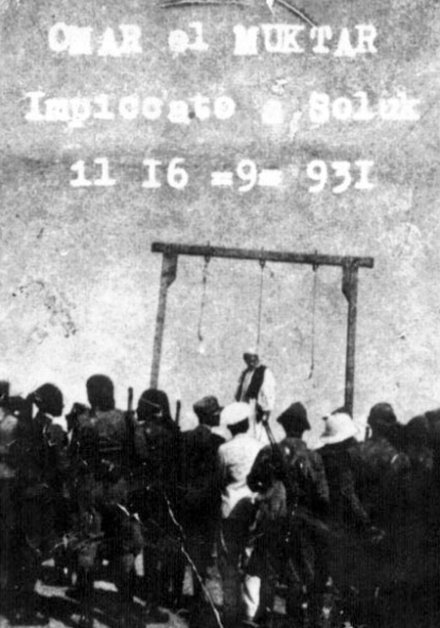
1931: Omar Mukhtar, Libyan revolutionary

On this date in 1931, Libyan independence martyr Omar [al-]Mukhtar was publicly hanged by the Italians at their concentration camp in Suluq.

Mukhtar (English Wikipedia entry | Italian) was born an Ottoman subject back in 1858 and had lived long enough to see his native Libya seized in the 1911-12 Italo-Turkish War.

Mukhtar, a religious teacher and follower of the Senussi movement, became the leader of the Libyan resistance that dogged the Italian occupation. Mukhtar proved an energetic and successful desert guerrilla fighter, and he had to be given the Italians’ mechanized military.

The Italians executed an estimated 4,000 Libyans in the 1920s, and drove hundreds of thousands into concentration camps, and gradually, only gradually, gained the upper hand on their adversaries.

Captured in battle after he abandoned a 1929 truce, Mukhtar was denied prisoner-of-war status and subjected to a snap military tribunal in one of the small coastal enclaves actually controlled by Italy — “a regular trial and consequent sentence, which will surely be death,” as the Italian general directed. It surely was.

He’s played by Anthony Quinn in the 1981 film Lion of the Desert — a better movie than you might think given that it was bankrolled by Muammar Gaddafi.

A national hero for contemporary Libyans across any social divide you’d care to name, Omar Mukhtar was valorized by the rebels who recently overthrew the aforementioned Gaddafi (here’s Mukhtar on a billboard in rebel-held Benghazi). “The whole world knows what Omar al-Mukhtar did,” Mukhtar’s 90-year-old son told media during the civil war. “That’s where they get their energy from. Ask the youth, they’ll tell you they are all the grandsons of Omar al-Mukhtar.”

His steely profile can be seen on Libya’s 10 10 dinar note.

On this day..

509 B.C.E.: The Sons of Brutus

August 21 is the harvest-time feast of Consualia, honoring the Roman god of grain storage, Consus.

We mark on this occasion the legendary capital punishment inflicted by Lucius Junius Brutus when he was consul of the ancient Roman Republic upon two rebels — his own sons, Titus and Tiberius.

The great Brutus had been one of the leaders of the revolt that expelled Rome’s last king, Lucius Tarquinius — reputedly after the king’s son raped Lucius’s kinswoman Lucretia. (Brutus was also Tarquin’s nephew.)

Upon completing his coup, Brutus immediately summoned the populace to swear an oath that no king would ever rule Rome again. So potent was the civic memory of this event that even centuries later when the Republic was well gone, Rome’s emperors dared not appropriate such an incendiary title as “King”.

But that was for a later time, after the winners wrote the history.

The exiled Etruscan king, subsequent Romans’ eternal watchword for tyranny, got the boot about 510 B.C.E., and in 509 was still hanging about looking for an opportunity to re-seat his dynasty. The plot he hatched is known as the Tarquinian conspiracy, and Brutus, to his grief, would discover that his own children had adhered to it. The statesman’s willingness to put his own flesh and blood to death for the security of Rome would long stand as a parable of manful patriotism.

Our account here is from Livy (line breaks have been added for readability), and the excuse to approximate this undated execution to summer’s harvest-time is bolded therein.

liberty was well nigh lost by treachery and fraud, a thing they had never apprehended. There were, among the Roman youth, several young men of no mean families, who, during the regal government, had pursued their pleasures without any restraint; being of the same age with, and companions of, the young Tarquins, and accustomed to live in princely style.

Longing for that licentiousness, now that the privileges of all were equalized, they complained that the liberty of others has been converted to their slavery: “that a king was a human being, from whom you can obtain, where right, or where wrong may be necessary; that there was room for favour and for kindness; that he could be angry, and could forgive; that he knew the difference between a friend and an enemy; that laws were a deaf, inexorable thing, more beneficial and advantageous for the poor than the rich; that they allowed of no relaxation or indulgence, if you transgress bounds; that it was a perilous state, amid so so many human errors, to live solely by one’s integrity.”

Whilst their minds were already thus discontented of their own accord, ambassadors from the royal family come unexpectedly, demanding restitution of their effects merely, without any mention of return. After their application was heard in the senate, the deliberation on it lasted for several days, (fearing) lest the non-restitution might be a pretext for war, and the restitution a fund and assistance for war. In the mean time the ambassadors were planning different schemes; openly demanding the property, they secretly concerted measures for recovering the throne, and soliciting them as if for the object which appeared to be under consideration, they sound their feelings; to those by whom their proposals were favourably received they give letters from the Tarquins, and confer with them about admitting the royal family into the city secretly by night.

The matter was first intrusted to brothers of the name of Vitellii and those of the name of Aquilii. A sister of the Vitellii had been married to Brutus the consul, and the issue of that marriage were young men, Titus and Tiberius; these also their uncles admit into a participation of the plot: several young noblemen also were taken in as associates, the memory of whose names has been lost from distance of time. In the mean time, when that opinion had prevailed in the senate, which recommended the giving back of the property, and the ambassadors made use of this as a pretext for delay in the city, because they had obtained from the consuls time to procure modes of conveyance, by which they might convey away the effects of the royal family; all this time they spend in consulting with the conspirators, and by pressing they succeed in having letters given to them for the Tarquins. For otherwise how were they to believe that the accounts brought by the ambassadors on matters of such importance were not idle?

The letters, given to be a pledge of their sincerity, discovered the plot; for when, the day before the ambassadors set out to the Tarquins, they had supped by chance at the house of the Vitellii, and the conspirators there in private discoursed much together concerning their new design, as is natural, one of the slaves, who had already perceived what was going on, overheard their conversation; but waited for the occasion when the letters should be given to the ambassadors, the detection of which would prove the transaction; when he perceived that they were given, he laid the whole affair before the consuls. The consuls, having left their home to seize the ambassadors and conspirators, crushed the whole affair without any tumult; particular care being taken of the letters, lest they should escape them.

The traitors being immediately thrown into chains, a little doubt was entertained respecting the ambassadors, and though they deserved to be considered as enemies, the law of nations however prevailed.

The question concerning the restitution of the tyrants’ effects, which the senate had formerly voted, came again under consideration. The fathers, fired with indignation, expressly forbad them either to be restored or confiscated. They were given to be rifled by the people, that after being made participators in the royal plunder, they might lose for ever all hopes of a reconciliation with the Tarquins. A field belonging to them, which lay between the city and the Tiber, having been consecrated to Mars, has been called the Campus Martius. It happened that there was a crop of corn* upon it ready to be cut down, which produce of the field, as they thought it unlawful to use, after it was reaped, a great number of men carried the corn and straw in baskets, and threw them into the Tiber, which then flowed with shallow water, as is usual in the heat of summer; that thus the heaps of corn as it stuck in the shallows became settled when covered over with mud: by these and the afflux of other things, which the river happened to bring thither, an island was formed by degrees. Afterwards I believe that mounds were added, and that aid was afforded by art, that a surface so well raised might be firm enough for sustaining temples and porticoes.

After plundering the tyrants’ effects, the traitors were condemned and capital punishment inflicted. Their punishment was the more remarkable, because the consulship imposed on the father the office of punishing his own children, and him who should have been removed as a spectator, fortune assigned as the person to exact the punishment.

Young men of the highest quality stood tied to a stake; but the consul’s sons attracted the eyes of all the spectators from the rest of the criminals, as from persons unknown; nor did the people pity them more on account of the severity of the punishment, than the horrid crime by which they had deserved it.

“That they, in that year particularly, should have brought themselves to betray into the hands of Tarquin, formerly a proud tyrant, and now an exasperated exile, their country just delivered, their father its deliverer, the consulate which took its rise from the family of the Junii, the fathers, the people, and whatever belonged either to the gods or the citizens of Rome.”

The consuls seated themselves in their tribunal, and the lictors, being despatched to inflict punishment, strip them naked, beat them with rods, and strike off their heads. Whilst during all this time, the father, his looks and his countenance, presented a touching spectacle, the feelings of the father bursting forth occasionally during the office of superintending the public execution.


Bummer: Jacques-Louis David‘s 1784 painting, Lictors Bring Home the Sons of Brutus.

This Brutus was an ancestor of the Brutus who helped assassinate Julius Caesar, and that later et tu, Brutus is commonly represented as having been convinced to turn against his friend and patron by, in part, the example of his legendary namesake.

O, you and I have heard our fathers say,
There was a Brutus once that would have brooked
The eternal devil to keep his state in Rome
As easily as a king.

-Cassius to Brutus in Shakespeare’s Julius Caesar (Act 1, Scene 2)

* “Corn” meaning not American maize, of course — which was not available before the Columbian exchange — but the word’s earlier meaning of whatever was the local grain: wheat, barley, and millet in Rome’s case. (The word corn derives from the Latin granum.)

On this day..

1936: Manuel Goded Llopis

On this date in 1936, the Spanish Republic executed Gen. Manuel Goded Llopis, who mounted an unsuccessful nationalist attack in the heart of Republican Spain, Barcelona.

Goded (English Wikipedia entry | Spanish) was born of Catalan ancestry in Puerto Rico. His family moved back to the mother country when the United States stripped that territory away in the Spanish-American War.

Goded advanced rapidly through the armed forces, becoming dictator Miguel Primo de Rivera‘s chief of staff by 1927. He was dismissed from this post for intriguing against the government, but soon found his way back to command and became (Spanish link) one of the circle of officers conspiring to check the advance of the left.

When the anti-Republican military mounted the revolt that became the Spanish Civil War, Goded was in Catalonia — freshly arrived on a mission to snatch Barcelona for the fascists at the revolt’s outset. Forces loyal to the Republican government, however, defeated Goded in the streets of Barcelona on 19 July. The general himself was captured on 11 August. A Republican court had him shot at Montjuic the very next day, along with another officer, Alvaro Fernandez Burriel.

His defeat, in the long run, might have been a gift by the Republicans to their conquerors: Goded was a partner but also a rival of Francisco Franco’s, and Goded’s presence in the postwar settlement among the nationalist victors might have introduced a fault line into the Franco regime.

On this day..