On this date in 1635,* the German aristocrat and general Hans Ulrich [von] Schaffgotsch lost his head in Regensburg.
Schaffgotsch (German Wikipedia entry: most information about him online is in German) would have appeared to have won the birthright lottery. Sure, he was no king, but being born to a hereditary Silesian baron of distinguished blue-blood lineage, and being dynastically married to a princess, put him squarely within the 1 percent’s 1 percent.**
Schaffgotsch caught one very bad break: he was born to come of age during the Thirty Years’ War.
The Schaffgotsch family had different branches going, but Hans Ulrich’s was Protestant — and this was also the predominant faith in early 17th century Silesia. (It adhered to the unsuccessfulBohemian Revolt.)
Doctrinal differences aside, Schaffgotsch had favorable terms from the Catholic emperor. He also made himself good friends with a fantastically wealthy duke named Albrecht von Wallenstein. Wallenstein was a little shaky on the religion question himself; he’d been raised Protestant and converted to Catholicism for unknown reasons.
When the Thirty Years’ War came calling again late in the 1620s, Wallenstein used his capacious wealth to field a large army in service of Ferdinand, and Schaffgotsch went right along as the generalissimo’s able adjutant. But Ferdinand, who was short on both cash and troops to call his own, soon came to fear this capable general upon whom he overmuch depended. When the opportunity arose, the sovereign abruptly relieved Wallenstein of command in 1630 — only to have to reinstate him in 1632† when his replacement got killed.
It turns out Ferdinand did have good cause for suspicion. Wallenstein was dissatisfied with the emperor’s treatment as well, and covertly treated with the Protestant league to switch sides or overthrow the emperor and rule in Bohemia. The detection of these plans in Vienna led Ferdinand to have Wallenstein judged by a secret court, then assassinated in 1634.‡
As his aide, Schaffgotsch too was soon dealt with. Unlike the dangerous Wallenstein, Schaffgotsch was a small enough target to arrest and prosecute in the conventional way — which happened in 1635. Schaffgotsch obstinately refused under torture to admit any involvement in treason, but he was condemned to death all the same.
The Silesian aristocrat might have felt hard done by, but he relieved some annoyance with an old-fashioned shopping spree. Schaffgotsch went out in style (German link) by plumping for black drapings for the scaffold, ordering a custom coffin, doing up all his servants in black mourning garb, and bribing the executioner of Regensburg to behead him seated in a chair. (The lord rooted himself so firmly in his seat that his head flew off at the sword’s stroke without his body toppling over.)
Afterwards, Schaffgotsch’s body was laid out for last respects for two days in Regensburg Blauen Krebs inn, which still exists to this day. (And has the story on its website.)
* Gregorian date. With Catholic and Protestant powers both going at it, dating gets confusing in this period; it would have been July 13 per the Julian calendar still in use by most Protestants, and this date is also sometimes attributed.
** Click here for some appealing views of Kynast (Chojnik), one of Schaffgotsch’s castles.
† Wallenstein commanded Habsburg forces at the Battle of Lutzen in November 1632, where Sweden’s King Gustavus Adolphus was killed.
‡ Wallenstein’s treachery and death are the topic of Schiller’s play Wallenstein.
On this date in 1979, Saddam Hussein executed a terrifying purge of the Ba’ath party.
Hussein had come to power just six days before by forcing out his cousin Ahmed Hassan al-Bakr.
On this date, some 400-plus Ba’ath party leaders were summoned to a pavilion near the Iraqi presidential palace. The secret police locked the doors behind them.
As film rolled, a man named Muhyi Abdel-Hussein came to the stage. Until just days prior, he had been the general secretary of the Revolutionary Command Council, the executive committee that ran the state. For opposing Saddam Hussein’s accession, he’d been arrested and endured God knows what. It was enough to break him, and make him the star in a drama worthy of the old Soviet show trials.
Speaking deliberately, Muhyi Abdel-Hussein* stood at the podium and accused himself of involvement in a Syrian plot against the regime. He had, moreover, been joined in his treason by a number of men in that very room. And then as the names were read off to the stunned audience, Mukhabarat men arrested them and dragged them out of the hall. Colleagues gaped as their ranks were culled around them, each paralyzed with the same panicked thought: am I next? Realizing their vulnerability, some began to chant feverishly their loyalty: “Long live Saddam Hussein!”**
All the while, the emerging dictator — younger and trimmer than we remember him at the end — sat steps away at a simple little table, coolly puffing his cigar. He would be the unquestioned master of Iraq for the next 24 years.
In all, 68 people were hauled out of the room; they were tried immediately and sentenced within minutes: 22 to die, the rest to the dungeons.† The condemned were shot that very day: in a diabolical twist, a number of their former, as-yet-unpurged Ba’ath Party colleagues were detailed for firing squad duty.
Nor was this the end. A wider purge of potential rivals with potential influence — party members, union leaders, intelligentsia, businessmen — unfolded throughout that week; by August 1, several hundred (the exact figure will never be known) had been condemned to die. Muhyi Abdel-Hussein, whatever they promised him, was among them.
* “Al-Khalil gives the last name of Muhyi Abdel-Hussein as Rashid. Matar gives it as Mashhadi. Since Mashhad is a place in Iran, one can only assume that this name was bestowed on the unfortunate Abdel-Hussein posthumously, after it had been discovered that ‘he had reached his position through devious means and that he was originally Persian.'” (Source)
** The entire liturgy of terror was stage-managed by Taha Yasin Ramadan, who became Iraq’s vice president (and, like his president, was eventually hanged for his trouble). Also making an appearance: Barzan al-Tikriti, who was likewise destined to hang during the American occupation; on July 22, 1979, he was one of the judges on the kangaroo court that issued the death sentences.
† Different sources produce slight variations on the counts of 68 arrests and 22 executions.
In the earliest years, people sluiced over the long border just anywhere. By Smolka’s time, that perimeter was buffered by an “internal border” that made it difficult for ordinary people to approach near enough to West Germany to escape. Consequently, most emigration by the the late 1950s occurred in the divided city of Berlin — a flow that East Germany would finally stanch in 1961 with the ultimate in immigration reform, the Berlin Wall.
One of the Cold War’s iconic photographs: East Berlin border guard Conrad Schumann leaps over the barbed-wire barrier into West Berlin on Aug. 15, 1961, just days after construction of the Berlin Wall began.
Like that more famous later escapee, Manfred Smolka (German link, as are most that follow) was a border guard; indeed, he was an officer. That gave him the ability, in 1958, to be far enough within the “internal border” to defect into West Germany
The very next year, he arranged to meet his abandoned wife and daughter on the Bavaria-Thuringia frontier to smuggle them over, too. Alas, it was a trap (pdf) laid by the feared East German secret police, the Stasi.
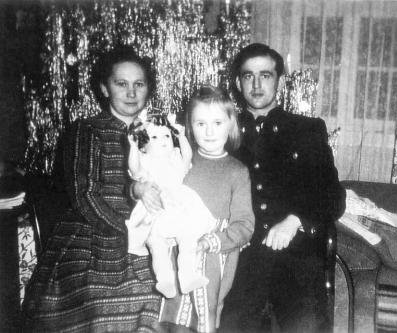
Happier times: Manfred Smolka with his wife and child.
According to press reports, Smolka was actually on West German soil when the Stasi men captured him.* (The Stasi were often up for a bit of kidnapping.)
West Germans were outraged by Smolka’s capture and subsequent death sentence for “military espionage,” but the case was deemed an apt one for the education of East Germany’s border security agents.
Only with post-Cold War German reunification could his family examine his file. “I am innocent, I can prove it a hundred times,” they read in the last letter the onetime defector wrote to his family — a letter which had never been delivered. “You need not be ashamed of me.” In 1993, a reunified, post-Cold War Germany officially agreed and posthumously rehabilitated Manfred Smolka.
There’s a few minutes of documentary video about him, in German, here.
* By a July 5, 1960 account in the London Times, Smolka was shot at and wounded as he crossed into East Germany but still managed to “crawl” back to West Germany — where his pursuers did not fear to follow him.
He cut his teeth — and a holy beard — as a surgeon and barber in the court of Saint Louis. When Louis died on crusade in 1270, Philip the Bold succeeded to the throne. Philip was tight with Pierre, so this seemed like great news for the chamberlain — and indeed, de La Brosse advanced rapidly with the new king’s patronage in wealth and influence.
The power of this Touraine arriviste did not fail to attract the enmity of the realm’s hereditary lords. As their grandchildren would do in Enguerrand de Marigny‘s time, they nursed their resentments and awaited only their chance.
King Philip’s marriage in 1274 to Marie of Brabant* gave them that chance.
His influence eclipsed by the new bride, de La Brosse developed a dangerous rivalry with the royal consort. When Philip’s firstborn son by his previous marriage and the heir to the French throne died suspiciously in 1276, Pierre de La Brosse allegedly made bold to suggest that the new queen herself might have poisoned the youth off.**
Philip “investigated” this by sending emissaries to consult a clairvoyant who, knowing she was speaking to representatives of the royal family, gave a judiciously positive appraisal of the queen, leaving de La Brosse on very tenuous footing indeed. The barons cut that footing out from under their foe a few months later when they produced documents, likely forged, implicating de La Brosse in a treasonable arrangement with the Spanish crown. De La Brosse was imprisoned for six months and condemned without a regular judicial proceeding: he has the unenviable distinction of being the first victim of an extraordinary royal commission in France. That commission destroyed the evidence (or “evidence”) in the case, but to judge from the positive appraisal de La Brosse enjoyed from chroniclers the popular sentiment for his innocence was widespread.
Pierre de La Brosse is among the several French royal counselors who are sometimes apocryphally said to have built the Montfaucon gallows only to hang upon them. The last word on him (and the more interesting trivia) belongs to Dante, who stationed the man in Purgatory as one who was unjustly slain but without opportunity to cleanse his soul with a last repentance.
I saw the soul
cleft from its body out of spite and envy —
not, so it said, because it had been guilty —
I mean Pier de la Brosse,
and may the Lady of Brabant
while she’s still in this world, watch
her ways—or end among a sadder flock
“A most infernal plot has lately been discovered here, which, had it been put into execution, would have made America tremble, and been as fatal a stroke to us, this Country, as Gun Powder Treason would to England, had it succeeded.”
On this date in 1776, Continental Army soldier Thomas Hickey was hanged before “a vast concourse of people” for a plot that might have strangled the American Revolution in its crib.
That revolution was a highly uncertain venture at this moment, and in a different timeline Thomas Hickey might have been a British hero for squelching it. “These are the times that try men’s souls,” revolutionary firebrand Thomas Painewrote late in 1776. Hickey had to face his trial in the flesh.
George Washington had holed up in New York City in the spring to fortify it against an expected British invasion — an invasion that did indeed arrive and eventually drove the Continental Army all the way to Philadelphia.* As Paine beheld, the wrong turn of events here could have been decisive. The Continental Army was badly outnumbered and afflicted by desertion. The Continental Congress itself had to abandon Philadelphia not long after boldly declaring independence on July 4.
Whatever one might say of the great-man historiographical mood, you’d have to think that knocking out the rebel army’s top general at this juncture would have been a coup for the British.
In June of 1776, New York was tense ahead of the fighting. A British ship of the line sat forebodingly in the harbor, and even as she awaited the coming British force, her crew members rowed freely ashore for provisions. Plots went abroad among the mixed population of “Patriot” and “Loyalist” citizens. Nathan Hale would soon earn his martyr’s laurels in New York, trying to reconnoiter behind enemy lines as Washington staged a series of losing battles and a gradual retreat.
Somewhat below this plane of world-shaping combat and statecraft, a guy named Isaac Ketcham (or Ketchum) found himself clapped in gaol for counterfeiting the easily-counterfeited colonial paper currency. There, Ketcham caught jailhouse scuttlebutt of Loyalist plots afoot in New York. Realizing this could be his ticket out of prison, Ketcham wrote New York’s Provincial Congress informing on the schemes.
Sadly, Ketcham’s full memorandum has been lost, and as the ensuing trial records are circumspect the “plot” or “plots” in question are a bit of a historical muddle. Roughly, there are two discernible thrusts:
A fifth-column plot against the patriot position in New York, with Loyalist-inclined soldiers set to desert back to the arriving British army.
A plot against the person of George Washington himself.
Ketcham was eagerly interrogated by the Provincial Congress on these matters, and returned to his dungeon in the capacity of an informant. There, he made the acquaintance of the Irish-born Thomas Hickey, a member of George Washington‘s personal guards who had on June 15th been committed for doing his own bit of private currency-printing.
Representing himself as a Tory loyalist, Ketcham apparently induced Hickey to boast about something quite a bit more serious than counterfeiting.
“In different conversations he informed me that the Army was become damnably corrupted,” Ketcham told the court-martial that tried Hickey. “That the fleet was soon expected; and that he and a number of others were in a band to turn against the American Army when the King’s troops should arrive.”
The whole scheme went under the pay of Loyalist New York mayor David Mathews, who was also arrested by patriot troops — although Mathews, whose execution might have turned the British very nasty in the various diplomatic conferences ongoing during the New York campaign, was never even tried.** He escaped to British protection shortly after capture.
No kid gloves were available to the treacherous Irishman Hickey, however. Word of the conspiracy against the patriots had also been obtained from a businessman, William Leary, who reported the attempt of his former employee to recruit him into it. The sheer quantity of highly indiscreet men blabbing about it in taverns and jails and the like makes the whole thing seem crazy in retrospect, but if it had succeeded in, say, destroying Kingsbridge, it might have trapped the Continental Army on Manhattan where they would have been easy pickings for the vastly superior British. Someone surely had to pay for this.
Several of Hickey’s accomplices provided evidence against him, and the speedy conclusion of the military commission that tried him was that Hickey should hang in order to, as Washington wrote the Continental Congress, “produce many salutary consequences, and deter others from entering into like traitorous practices.” So far as is known, however, Hickey was the only person to suffer this extremity.
The unhappy fate of Thomas Hickey, executed this day for mutiny, sedition, and treachery, the General hopes will be a warning to every soldier in the Army to avoid those crimes, and all others, so disgraceful to the character of a soldier, and pernicious to his country, whose pay he receives and bread he eats. And in order to avoid those crimes, the most certain method is to keep out of the temptation of them, and particularly to avoid lewd women, who, by the dying confession of this poor criminal, first led him into practices which ended in an untimely and ignominious death.
Physician William Eustis (eventually the U.S. Secretary of War), who was among the 20,000 to see Hickey hanged, wrote a friend that afternoon of the execution.
Their design was, upon the first engagement which took place, to have murdered (with trembling I say it) the best man on earth: Genl Washington was to have been the first subject of their unheard of Sacricide: our magazines which, as you know, are very capacious, were to have been blown up: every General Officer and every other who was active in serving his country in the field was to have been assassinated: our cannon were to be spiked up: and in short every the most accursed scheme was laid to give us into the hands of the enemy, and to ruin us. (Source)
The scarcity of original documentation makes it very difficult to say with confidence just how impressive this accursed scheme really was. One can see from Eustis’s letter that it was understood immediately to have compassed the murder of George Washington. This prospective “Sacricide” of America’s founding father par excellence has been worth a good bit of embellishment; one bit of utterly insupportable folklore congenial to vegetable-hating schoolchildren is that Hickey arranged to have General Washington’s peas poisoned with arsenic, but the faithful housekeeper exposed the scheme in the nick of time.
Only a bit more fantastical is the video game Assassins Creed III, whose representation of the death of Thomas Hickey — this version of Hickey is a Templar agent — uses a wacky sequence that begins with the public execution of the game player’s own assassin character, complete with first-person, inside-the-hood perspective.
It might well be that Hickey had been engaged in a plot not to murder but to kidnap the rebel general. David Mathews, the New York mayor, would later tell a royal commission in London autopsying Britain’s Revolutionary War defeat, “I formed a plan for the taking of Mr. Washington and his Guard prisoners but which was not effected.” It’s been speculated that the Continental Army itself chose to play up the “murder” angle for public consumption in preference to “kidnap” — perhaps because the notion that the Tories had the strength to contemplate the more complex objective of snatching Washington away from his own army, and were in a position to use his very own guards to accomplish it, implied a weakness in the revolutionary cause far too grave to acknowledge openly.
* It’s from this position that Washington would [re-]cross the Delaware amid December ice floes to conduct a morale-salvaging raid on Hessian troops in New Jersey after many long months of reversals. The British, for their part, held New York for the balance of the war, and this helped make adjacent New Jersey a battleground between pro-British and pro-American militias.
** Mathews administered New York until 1783, when the British ceded it to the victorious colonists.
On this date in 1794, Simon-Nicholas Henry Linguet was guillotined during the French Revolution for having written praise of foreign tyrants.
Linguet (English Wikpiedia entry | French) was a brilliant lawyer and a prolific but prickly man of letters. Famous in his own day for his prose, he’s of less account to a modernity that’s long forgotten the various axes he had to grind.
The one sure constant in his life was a gift for making enemies.
Linguet was an Enlightenment philosophe at the start of his public life, and made an early name for himself when his forceful intervention in the case of the Chevalier de la Barre helped save La Barre’s friends from sharing his fate.
He soon apostatized from the Reason-worshipping “fanatical”philosophes, and eventually found himself disbarred for irritating too many fellow barristers. Turning instead to journalism, his Annales politiques, civiles et litteraires — published mostly in exile from 1777 to 1792 — became, as his biographer put it, “a quasi-independent force for molding opinion and policy in the power centers of Europe. Maneuvering among the great powers of Europe wielding the power of his public’s opinion, Linguet institutionalized political influence for himself, and liberty as well.” And of course the writing business really let Linguet’s native gift for pissing people off shine.
He scalded the French Academy and settled scores with rivals old and new. Eventually a suit by one of them landed Linguet in the Bastille when the latter tried to return to Paris in 1780.
Linguet got out (and left France again) in 1782, turning his spell in the Bourbon dungeons into a Memoirs of the Bastille,* which didn’t buy him as much sympathy as one might assume come revolutionary times since he had scarcely incurred his sufferings on behalf of the masses.
Linguet was finally able to return to his country with the Austrian embassy courtesy of ennoblement conferred by Marie Antoinette‘s brother Emperor Joseph II. His restored relations with Europe’s crowned heads, however, did not prevent him taking up the cause of Belgium’s Brabant Revolution as well as the Haitian Revolution.
An early member of the Cordeliers and temporary enthusiast of the Revolution, Linguet would later be bold enough to write Louis XVI offering to defend him. He was easy pickings in the end for a revolutionary tribunal that accused him of prostituting his literary gifts to Europes various ancien regimes: Linguet had taken refuge in his time with all of revolutionary France’s principal enemies, and had flattered their princes for his trouble; his provocative pen had set his name to a defense of slavery; and he’d even mounted an attack on Alexander the Great which in the great tradition of contrarian provocateurs compared the legendary conquerer unfavorably (on the body count metric) with the Emperor Nero. Literally defended Nero was the epitaph his prosecutors pinned to him, and it’s never fully come unstuck. It’s unfair, sure … but Linguet was the last man in a position to complain, and not just because he’d had his head cut off.
A manuscript of a history of France Linguet was working on was found among his papers after his visit to the guillotine. It made fine cartridge paper for France’s muskets.
* At one point in this text — an overwrought rant against the rigors of his imprisonment from the pen of a man whose previous treatises had scornfully defended absolutism against his former buddies among the philosophes — he mounts a defense of executioners, who “ought to be much less ignominious in the public opinion.” After all, they
are only the ministers of an indispensible severity: they are officers, and necessary officers, of a lawful power they may sometimes execute unjust orders; but they act constantly in obedience to justice and the laws. They are certain that the unfortunate being who is delivered to them, either has had, or will have, the means of defending himself: they are sure, or at least must believe, that an equitable and impartial enquiry has preceded the rigorous decision under which they act. They are authorized to think that none but the guilty, or at least men justly suspected, have ever been the objects of them.
There he became involved in the Strasserite anti-Hitler “Black Front”. To Hirsch’s grief, this organization had been thoroughly penetrated by pro-Hitler spies.
In December 1936, Hirsch embarked on a train. His mission was to bomb something in Germany. The details of the plan remain murky to this day; Hirsch’s subsequent trial was held in secret and his worried family only learned the whereabouts of their son three months missing when they heard a radio broadcast in March announcing his condemnation for “preparation of high treason and criminal use of explosives endangering the public.”
It seems that Hirsch was supposed to have disembarked in Nuremberg and there picked up some left luggage deposited by a fellow conspirator; he may have been meant to deliver this payload Nazi party headquarters in Nuremberg, or perhaps to the offices of Julius Streicher’s propaganda sheet Der Stürmer.
The young would-be terrorist would tell his family in prison letters that he had instead bypassed Nuremberg and kept going all the way to Stuttgart to meet a friend, hoping the latter would talk him out of his wavering commitment to the plot. Instead, he was arrested that night by the Gestapo.
This case made news in the United States during the spring of ’37 because Hirsch’s father, Siegfried, was a naturalized American. That made Helmut a U.S. citizen, too, even though the son had never set foot in the United States.* U.S. Secretary of State Cordell Hull and the American ambassador to Germany William Dodd lobbied the Nazi government to spare Hirsch** — but to no avail.
Hirsch’s sister Kaete Hirsch Sugarman later donated her brother’s papers — letters, photos, architectural drawings — to Brandeis University, which maintains them as the Helmut Hirsch Collection. They include this touching final letter the young man wrote to his family on the eve of his execution.
Dear Mother, dear Father,
I have just been told that my appeal for clemency was turned down. I must die then.
We need not say anything any more to each other. You know that in these last months I have really found the way to myself and to life. Real beauty must stand before unswerving honesty. You know that I have lived every moment fervently and that I have remained true to myself until the end. You must live on. There can be no giving up for you. No becoming soft or sentimental. In these days I have learned to say “yes” to life. Not only to endure it but to love life as it is. It is our own inner gravity, the force by which we have entered life.
It must help you in some way that I know I have finally reached my own inner image and feel complete. And in this feeling is much of our time and our world.
The only way I know how to thank you is by showing you until the last moment that I have used all your love and goodness towards becoming a whole being of my time and my heritage. Do not think of the unused possibilities, but take my life as a whole. A great search, a foolish error, but on its path to finding of final truth, final peace.
Please care for Vally [his girlfriend, Valerie Petrova] as for a child. I embrace you, dear mother and you, my father, once more for a long, long time. Only now have I realized how much I love you.
Yours forever,
Helmut.
* Siegfried Hirsch was a naturalized American who had lived in the U.S. for a decade prior to World War I. Siegfried’s U.S. citizenship had been revoked in 1926 because he had left to live abroad, but when the matter came to prominence in 1937 it was reinstated and Helmut Hirsch explicitly acknowledged as a U.S. national.
** The shoe has been on the other foot for death-sentenced German nationals in the present-day U.S.
Thanks for the guest post to Nancy Bilyeau, the author of The Crown and The Chalice, thrillers set in Tudor England. The main character is Joanna Stafford, a Dominican novice.
On this day in 1521, Edward Stafford, 43, third duke of Buckingham, was beheaded on Tower Hill outside the Tower of London, found guilty of high treason against Henry VIII.
In Shakespeare’s play Henry VIII, the king said of Buckingham, “He hath into monstrous habits put the graces that were once his, and is become as black as if besmear’d in hell.” Today few believe that the duke actively plotted to overthrow his king. But Edward Stafford was guilty nonetheless — of being too noble, too rich and too arrogant to survive in the increasingly paranoid court of Henry VIII, his cousin once removed.
Buckingham’s life had been marked with loss and suspicion.
When he was five years old, his father, the second duke, was executed by Richard III. Young Edward Stafford was hidden from Richard III in relatives’ homes, not to emerge until Henry VII defeated the last Yorkist king at Bosworth.
He became a royal ward of the Tudor family, knighted at the age of seven. But as he grew into a proud, preening adolescent, Henry VII cooled toward him, fearing that he outshone the heir to the throne, the future Henry VIII.
Stafford was a direct descendant of Edward III and so had a solid claim to the succession. What didn’t help was that foreign ambassadors wrote admiringly of “my lord of Buckingham, a noble man and would be a royal ruler.”
Henry VIII succeeded to the throne in 1509, unchallenged by his older cousin. In fact, the duke was lord high steward for the coronation and carried the crown.
But over the next ten years he was pushed out of the center of power more and more. As friends, Henry VIII much preferred lower-born, jovial men like Charles Brandon and William Compton. And the man who ran the entire kingdom was Cardinal Thomas Wolsey. There was no place for Buckingham.
In response, Edward Stafford married a noblewoman of the Percy family, fathered four children (and several illegitimate children), and withdrew to his vast estates, where he was the unquestioned man in charge.
What changed in the cousins’ relationship to draw treason charges in 1521?
For one, it was becoming apparent that Henry VIII would have no male heir.
Catherine of Aragon‘s last pregnancy was in 1518. They had a daughter, Mary. But the Tudor dynasty was a new one, and Henry VIII and Cardinal Wolsey weren’t sure that the nobility would accept a female ruler someday. Might they not look to the duke of Buckingham, instead?
On April 8, 1521, the duke was ordered to London from his castle at Thornbury. He set out for the court, seemingly unaware of any danger, and was greatly shocked when arrested along the way and taken to the Tower. At his trial, he was charged with “imagining and compassing the death of the king,” through seeking out prophecy from a monk named Nicholas Hopkins about the chances of the king having a male heir. Evidence was supposedly obtained from disgruntled former members of the duke’s household.
Buckingham denied all charges. But a jury of 17 peers found him guilty, led by the duke of Norfolk, who condemned him — while weeping.
Edward Stafford died with dignity on Tower Hill, and was buried in the Church of the Austin Friars. One chronicler said Buckingham’s death was “universally lamented by all London.”
Parliament passed a bill of attainder, and the duke’s enormous wealth — his castles and holdings and titles — passed to the crown. The illustrious Stafford clan never rose to prominence again. They were the first noble family to be crushed by Henry VIII … but definitely not the last.
The 25-strong batch dispatched to the guillotine on the Place de la Revolution during the Terror on this date in 1794 included Princess Elisabeth, the sister of the late guillotined King Louis XVI.
Required by the revolutionary tribunal to identify herself, she retorted (since her brother’s death passed the succession to the imprisoned child Louis XVII), “I am called Elizabeth Marie de France, sister of Louis XVI, aunt of Louis XVII, your King.” The papers just reported that she said “Elizabeth Marie.”
This fate cannot have surprised her: her correspondence anticipates a bloody reckoning with the revolutionary “monsters from hell” from years earlier, and reflects the figure in the royal household pushing the king and queen on immoderate courses like their famous attempted escape. (Elisabeth posed as a maid with the fugitive party.) “The Assembly is still the same; the monsters are the masters,” she wrote in February 1790. “The king, and others, from the integrity of their own natures, cannot bring themselves to see the evil such as it is.”
Elisabeth was nevertheless quite attached to her brother and her sister-in-law, and swore an oath to keep with Louis XVI and Marie Antoinette during the royal couple’s harrowing attempt to ride out the revolution. She courageously quaffed the every terror that family endured all the way to the dregs; when the mob stormed the Tuileries on June 20, 1792, she was momentarily mistaken for the queen and thereby put in peril of her life. “Do not undeceive them!” she warned an associate who was about to save her by correcting the misapprehension.
Elisabeth’s correspondence shows her not “merely” self-sacrificing but a keen observer of events who pushed her brother to rein in the revolution by force … and pushed her exiled brother the Comte d’Artois** to do likewise. For Elisabeth, bloodshed would be necessary, and desirable sooner than later — in contrast to the national-reconciliation stuff the doomed king was still hoping for.
By the end Paris of the Terror probably didn’t really need any better reason to cut off Elisabeth’s head than the fact of her bloodlines — “sister of the tyrant.” There are enough little hagiographies out there concerning Elisabeth’s piety and loyalty, however, that some think she should eventually be proposed as a candidate for Catholic canonization.
* She might as well be: royals couldn’t save themselves even by going full Republican.
On this date in 1946, the Dutch fascist leader Anton Mussert was shot
Mussert was a young engineer who came to the fore in the interwar period as a strident right-wing populist. He co-founded in 1931 the Netherlands’ homegrown Nazi knockoff, the Nationaal-Socialistische Beweging; by 1935, it was polling 300,000 votes.
Mussert of course welcomed the German incursion into the Netherlands on the way to someplace else. That put the Dutch under wartime Nazi administration, but Mussert didn’t score a Quislingesque head-of-state plum out of the arrangement.
Instead, Mussert found himself brusquely shut out of any real power; the Austrian Arthur Seyss-Inquart ran the country instead, and would eventually hang via the Numremberg trial for his occupation atrocities, such as the wholesale deportation of the Dutch Jewish population that swept up diarist Anne Frank. Plum or no, however, what Mussert had done was more than enough to elevate him to the most conspicuous Nazi collaborator in the postwar Netherlands.
Mussert was captured after the war and shot at the open-air location near The Hague where over 250 people had been put to death during the war years.


 De La Brosse (
 Linguet (
 In Shakespeare’s play Henry VIII, the king

 Princess Elisabeth (
