1715: William Ainslie, Edinburgh Castle betrayer

Edinburgh, Scotland held a Christmas Eve 1715 hanging of a soldier for abortive plot in the abortive Jacobite rising of 1715

The plot was a bold conspiracy of Highlanders to seize Edinburgh Castle itself, which would have been every bit the coup it sounds like. Sergeant William Ainslie and two other soldiers of the garrison had been bribed to admit the plotters via a sally port.


(cc) image from Stephanie Kirby.

Once there, the Highlanders meant to seize the castle’s ample stock of weapons and cash, and also “fire three cannon; that when this signal should be heard by some men stationed on the opposite coast of Fife, a fire should be kindled on the heights; and that these beacons, continued northward from hill to hill, should, with the speed of a telegraph, apprise Mar of his advantage.”

One minor problem: the whole enterprise depended on the ability of at least 83 people to keep a secret, but “they were so far from carrying on their affairs privately, that a gentleman who was not concerned told me that he was in a house that evening, where eighteen of them were drinking, and heard the hostess say that they were powdering their hair to go to the attack of the Castle!” Even so, the word only barely got out in time, the conspirators self-defeating by showing up late (too much time powdering?) and with ladders that were too short.

William Ainslie, the sergeant who was planning to open the gate for the Highlanders, had to shout the alarm and play it off that way once he realized that the dawdling had wasted the opportunity, but he was soon found out and spectacularly hanged over the castle wall for his trouble. The inevitable hanging-ballad broadside (“The Lamentation, and Last Farewell, Of Serjeant William Ainslie, who was executed over the Castle-Wall of Edinburgh for High Treason and Treachery, on Monday the 24th of December, 1716”*) emphasizes the pecuniary motive at the expense of the patriotic, but maybe it should have been dedicated to the principle that loose lips sink ships.

Let all Bold Soldiers far and near,
That sees my dismal Fall,
Lament my sad and wretched End,
That’s brought my self in Thrall;
Here to the World I do declare,
The Castle to Betray.
Full Fifty Pounds I was to have,
for which I’m doom’d to Die.

My Name is William Ainslie,
A Serjeant Stout and Bold,
In Flanders I the French have Fought,
And would not be Control’d:
And Loyal was to King and Crown,
my Trust did ne’re Betray,
Till I was tempted with that Gold,
For which I’m Doom’d to Die.

While I did in the Castle ly,
In Irons close Confin’d
For my Dear Wife and Children all,
My Heart no Ease could find,
To GOD I did for Mercy cry,
As I in Fetters lay.
Both Night and Day to him I’le Pray,
Since I am Doom’d to Die.

Ah! wo be to that cursed Gold,
That did my Heart intice,
To act such a gross Treachery,
The Castle to Surprise;
But wo’s me, for my Treachery,
My Hour is drawing nigh.
For I most hang out o’re the Wall,
Most Just Deservedly.

Good People, pray do not revile,
My Wife and Children dear;
Whom I so dearly lov’d on Earth,
Lord to my Soul draw naer: [sic]
I hope in Mercy he’l appear,
For still to him I’ll cry;
Since I most Justly, am condemn’d,
Over the Wall to dy.

They told me a must hang some Days,
Over the Castle-Wall;
Until the Rope takes Fire and breaks,
Then to the Ground I fall:
But since that I must suffer here,
Unto the Lord, I’ll pray;
Take Warning by my shameful End,
I just deserve to dy.

Since many People here is come,
This Day to see me dy;
I hope their Prayers to God they’l send,
For me, before I dy:
My vital Breath will soon be gone,
With a strong Rope and Tree;
But yet I hope my Peace is made,
With God who lives on high.

Those that did cause my dismal End,
I do forgive them here;
For now my Life lyes at the Stake,
Oh! Lord, to me draw near:
My precious Soul I pray receive,
For unto Thee I’ll fly;
For I have acted Treason great,
And for it I must die.

I wish all People Warning take,
That’s come to see me die;
The World unto you I’ll leave,
For all Eternity:
I must away, farewel, adieu
My Wife and Children all;
For I must hang into the Air,
Over the Castle Wall.

All you that sees me here this Day,
I desire you all to pray;
That all my Sins God would forgive,
Since I am brough to die:
Let every one both far and near,
Take Warning now by me;
Your Trust, I pray, never betray,
For which you see me die.

FINIS.

* I believe this is misdated since the plot was clearly set for September 9, 1715

On this day..

1605: Niklaus von Gulchen, Nuremberg privy councillor

On this date in 1605, Nuremberg privy councillor Niklaus von Gulchen (or Gilgen) was beheaded for his scandalous corruption. The wheeler-dealer’s graft had problematically extended to playing false with and backstabbing any number of elite patrons, from Nuremberg burghers all the way up to the Prince of Sulzbach, and even gone so far as to provide advice to foreigners against the interest of his own city.

The great executioner Franz Schmidt, whose many diary entries record (often tersely) the hundreds of hangings, beheadings, drownings, burnings, and breakings on the wheel he performed for Nuremberg over his lifetime, made an unusually voluminous entry for this shocking treachery. And from the sound of it, the duplicitous Master Doctor earned every drop of his executioner’s opprobrium — even if, according to Schmidt’s biographer, the malefactor’s misused position still entitled him to the privilege of execution by the sword, exemption from torture, and a dignified black cloak to wear to his last performance.

December 23rd (a Monday).* Master Doctor Nicholas von Gilgen, who was by appointment a privy councillor in an honourable council and was bound to that council by oaths he did not observe; for the sake of money received wrote for and advised two (opposite) parties in many affairs; also gave evidence and sat in council for deliberations and decisions; also stole from my lords of this town the allowances for beer and wine, causing it to be stored by his servants.

Also he debauched before her marriage, forcing her to do his will, his servant whom he brought from Trier to this town, and whom he gave as a wife to his clerk Philip Tumbler, by a promise of 50 florins and large presents. According to her declaration she brought forth five children by him, three of which miscarried during delivery or by fright in the twelfth week, two remaining alive, a boy and girl, he being sponsor to the boy at baptism.

Similarly, by like promises, he forced his under-maid to consent to his will a year ago, and tried likewise to persuade his brother’s two daughters; one, the wife of Doctor Wurffbaum, he tried to compel, but she resisted, the other the wife of Doctor Calrot, who yielded to his will and consorted with him before and after her marriage, according to her account through fear and compulsion and the promise of many presents and a wedding portion (he did not admit he compelled her, and I do not believe he forced her).

Lastly he played false when serving the Prince of Sultzbach, whose advocate he was; he also mediated dishonestly between the families of Nuremberg, and between the noble families of Leschwitz and Redwitz, writing to, and advising both parties in one affair. Likewise he counselled the Italian Charles Albert Nello and other Italians against the rulers of our town; also stole the decrees from the office of an honourable councillor.

In Italy too, at Padua, he produced a false certificate, when he figured as a doctor there by means of a false certificate, for he became a doctor at Basel only long after. For his evil deeds he lay in prison for thirty-eight weeks in Lugins Land and in the jail. He was led out on Monday by favour in a long mourning cloak, his arms bound behind him with a black silk cord, and led by a cord, a black cloth being spread on the seat (on the scaffold).


Niklaus von Gulchen’s beheading, from the Nuremberg chronicle. Note that the illustration portrays the doomed pol kneeling, when in fact he was beheaded in a chair. In any stance, von Gulchen “was a mischievious, gold-grubbing man,” according to the chronicler.

When he had been beheaded his body was wrapped in the cloth and laid in a wooden coffin, nailed down and taken to St. Peter’s church by the assistant executioner, but removed at night in a cart to St. John’s by the little gate that leads to the Butts, and buried in the graveyard by the walls.

* Nuremberg, a Protestant city, was still on the Julian calendar.

On this day..

1475: Louis de Luxembourg, Count of Saint-Pol

On this date in 1475, the Louis de Luxembourg, Count of Saint-Pol was beheaded.

The French King Louis XI “had need of a head such as his” because of Louis de Luxembourg’s part in the pompously self-styled League of the Public Weal. The “public weal” in question comprised civil war on behalf of feudal prerogatives that had slipped from aristocratic hands during the Hundred Years’ War.

They were led by the ruthless Duke of Burgundy Charles the Bold.

Louis de Luxembourg’s allegiance with Charles the Bold netted him, during the League’s successes, the title of Constable of France and the hand of the queen’s sister as inducements from Louis XI.

But Saint-Pol was not the type to stay bought.

Treacherously maneuvering between the Burgundian party, the royals, and the English (Luxembourg’s uncle sold Joan of Arc to the English, so they went way back) Louis eventually managed to irritate them all. He ultimately hatched a plan to assassinate Louis XI himself and fracture the French realm among a variety of great lords.

The English and French kings having acquainted each other with the comte’s underhanded schemes on their respective sides of the channel, Saint-Pol was obliged to seek Charles the Bold’s protection — but the latter had himself contracted with the French crown to hand him over if captured, and duly forwarded the traitor to the Bastille. (There’s more about Saint-Pol’s prosecution in this volume.)

Louis did his sovereign one last little injury on his way off this mortal coil: sixty additional sous were required by the executioner of Paris “for having the old sword done up, which was damaged, and had become notched whilst carrying out the sentence of justice upon Messire Louis de Luxembourg.”

On this day..

1793: Jean-Jacques Ampère, father of a savant, for Joseph Chalier

(Thanks to Amelia Fedo, a graduate student in French literature, for the guest post.)

He didn’t know it yet, but on this date in 1793, a brilliant adolescent named André-Marie Ampère lost his father to the guillotine. If the name sounds familiar, it’s because it would eventually become the SI unit of electrical current.

Andre-Marie Ampere, one of the founding pioneers of electromagnetism (Ampere called the new field “electrodynamics”) lost his father to the French Revolution’s guillotines.

The father in question was Jean-Jacques Ampère, an intelligent and levelheaded man whose sense of duty outweighed his instincts of self-preservation.

He was determined to do every job he had to the best of his ability — whether the task was educating a son or discharging the office of justice of the peace — and this diligence cost him his life.

A bourgeois silk merchant (a quintessentially Lyonnais occupation), he lived with his wife and son in a tiny village outside of Lyon called Poleymieux-au-Mont-d’Or. It was there that he and his wife, who were one of only five bourgeois families in a primarily peasant population, raised the boy who would grow up to be the father of electrodynamics.

In 1782, he retired and devoted himself full-time to his children’s upbringing — particularly that of his son, whom he soon realized was not an ordinary child. Born partly of necessity (Poleymieux lacked a school) and partly of choice (Jean-Jacques had, after all, opted to move to Poleymieux, and some speculate that he wished to give his son an upbringing like the one advocated by Rousseau in Émile), André-Marie’s unorthodox education resembled what today’s DIY pedagogues might call “unschooling”: he was encouraged to take charge of his own learning, given access to his father’s library, and taught a variety of eclectic subjects according to what most held his interest at the moment.

For most children, this technique is questionable; but when your kid happens to be a genius and a polymath, it works just fine. André-Marie was an audodidact and proactive in his learning, which would be a force for good in his life: as we’ll see, it was what pulled him out of his depression after his father’s death.

When the Bastille fell in 1789, not much changed at first. Jean-Jacques embraced the ideals of the Revolution and even wrote a play called Artaxerxe ou le Roi constitutionnel [Artaxerxe or the constitutional king], which James Hofmann, author of André-Marie Ampère: Enlightenment and Electrodynamics, sees as a parable containing Revolutionary themes.

A month after the fall of the Bastille, he lost his job as local aristocrat Guillin Dumontet’s procureur fiscal (a “judicial and administrative position,” according to Hofmann). Then, in the fall of 1791, he took another bureaucratic job: justice of the peace and “presiding legal functionary for the police tribunal” in Lyon. He may have done it voluntarily, out of sincere political fervor; but he may also have done it to protect his family, since his former boss, Guillin Dumontet, had been beheaded and partially cannibalized by his peasants a few months prior. If he had indeed taken this post for the good of his family, his plan backfired horribly…

As has been detailed in the post on Joseph Chalier, 1793 was not a good year for the Lyonnais.

The Revolution ran counter to the grain of Lyonnais culture for a number of historical reasons (the strong Catholic tradition and the silk trade being two of them). More immediately, famine and taxes had not disposed the people of Lyon towards the local Revolutionary government — particularly the far-left Jacobin faction, which continuously struggled for control of the city.

When the Jacobins seized power in March 1793, they provoked opposition from Girondins and royalists alike, and on May 29 important members of the Jacobin leadership were arrested. Among those apprehended was Joseph Chalier, head of a major Jacobin club known as the “Central Club.” Someone had to open the case against Chalier, and that someone was Jean-Jacques Ampère.

In spite of the Convention’s attempts at negotiation (which quickly turned to threats), Chalier was sentenced to death on July 16 and guillotined the next day. It was not Jean-Jacques who condemned Chalier to death — that does not appear to have been part of his job — but it was he who sent out the warrant for his arrest, and this was more than enough to get him sentenced to death when the political tides turned. (If the judges who actually sentenced Chalier to death — Cozon, Pourret, Régnier, and Maret — were ever punished, I haven’t found any evidence for it.)

Paris responded by placing Lyon under siege on August 9, and two months later, the city surrendered to the Convention. Rather than flee, Jean-Jacques remained in the city, resolved to see his duty through to the bitter end. Throughout the siege, he instructed his wife not to tell their children of the danger he was in. When Lyon was taken, he was immediately arrested, and in the six weeks he spent in prison, he had little doubt about his fate.

Trial and execution

Much of his trial is preserved in court documents. They refer to Lyon as “Ville-Affranchie” — “Liberated City,” the name Bertrand Barère gave to the town before declaring, “Lyon has made war against liberty; Lyon is no more” — so you know they mean business.

During his interrogation, Ampère père was accused not only of having issued the warrant for Chalier’s arrest, but also of having sentenced male and female Jacobin club members to public humiliation and having their eyebrows shaved off, respectively — as well as just generally having been a jerk to Jacobin detainees during interrogations.

The responses he gives show a man resolved to keep both his pride and his honor in the face of certain death, a functionary convinced that he had committed no wrong. Ampère admits to having had Chalier arrested but vehemently denies the other charges. He was also asked if he had left his post and/or sent a revocation to Paris, and responded that he had kept his post and had “no revocation to make.” This probably sealed his fate.

Here’s the full text of his interrogation, from Histoire des tribunaux révolutionnaires de Lyon (take my translations of legalese with a grain of salt; I don’t speak it in any language):

Frimaire 2, Year 2 (November 22)

Interrogation of Jean-Jacques Ampère, 61 years of age, justice of the peace of the canton of Halle-aux-Blés, residing in Lyon, Quai Saint-Antoine, Number 44. — Responses he gave.

I was in Lyon during the siege.

I never had any correspondence with the so-called constituent authorities in Lyon.

Question: You are accused of having filed the whole procedure against the patriots, of having been president of the correctional police during the whole time of the counter-Revolution, and of having judged those who had committed no crime other than belonging to the [Jacobin] club, sentencing the men to be tied to the post [this refers to a punishment formally known as “exhibition,” which was sort of like the pillory] and the women to having their eyebrows cut off; of having condemned, among others, Cadet Rufard, member of the [Jacobin] club, to six months of imprisonment for having sought bread for his brother, put in chains on May 29. You are reproached with having said to all of those whom you interrogated, “You are scoundrels, you people with your clubs; you had agents all the way out in the country, and your plot was the destruction of honest people.” In a word, you are accused of the assassination of the virtuous Chalier, since it was you who filed the first procedure, and it’s thanks to your arrest warrant that he mounted the scaffold.

Response: I never had any part in the judgments against patriots, men or women, which pronounced the sentence of pillory against the men and shaved eyebrows against the women; I admit to having filed the procedure against Citizen Chalier, on the declaration that had been made to me on May 27 by the public prosecutor who had the right to provoke my ministry; I also made several investigations against certain municipal officers after May 29, and in ruling on these procedures, I followed the law in sending back the accused in the presence of the director of the jury, the indictment alone regulating the jurisdiction. I conformed to the investigation of the functions of police officers who are uniformly employed to gather the vestiges of crimes and send the judgment back to the courts who should be informed of them. The circumstances were such that prudence joined with my sense of duty in making me carry out the measure indicated by the law. Before ruling on the procedure against the municipal officers, I had also ruled on the fate of a municipal named Sautemouche. I let him out under an oath to return, and soon after his release, the unfortunate Sautemouche succumbed to the blows of malicious persons. He was murdered, and most of the sections shouted for my arrest, because I had obeyed my conscience and my opinion by delivering an innocent man.

Question: Did you leave Lyon and did you send your revocation to the Committee of Public Safety, according to the law?

Response: I have no revocation to make.

Question: Did you continue your functions during the siege in a city in revolt?

Response: Yes, from May 27 until the beginning of August.

Question: Did you issue the warrant for Chalier’s arrest?

Response: Yes, on June 7.

On November 22, the same day as his trial (other sources give the date as November 23, 24 or 25, but I’m going by the date of execution given in legal documents), he was guillotined in Place Bellecour along with three men who appear not to have been involved in the affair: Étienne Chazottier, a lawyer and the president and secretary of the “permanent section” (a local political office), for “offenses against patriots”; Pierre-Elisabeth Chaponnay, an aristocrat, for “giving considerable sums to, and favoring the plans of, counterrevolutionaries”; and Jean Freidière, a geometer and secretary of the “surveillance committee” — no crime given. Ampère was 61 years old.

Shortly before his execution, he was allowed to write a final letter to his wife. Here’s the most complete version I can find, taken from Portraits Littéraires by Charles-Augustin Sainte-Beuve:

My dear angel, I have received your comforting letter; it was a life-giving balm to the emotional wounds that had been inflicted on my soul by my regret at being misunderstood by my fellow-citizens, who have denied me, through the most cruel separation, a homeland that I have cherished so much and whose prosperity is so close to my heart. I wish for my death to be the seal of a general reconciliation between our fellow-men. I pardon those who rejoice in it, those who caused it, and those who ordered it. I have reason to believe that the national vengeance, of which I am one of the most innocent victims, will not extend to the few possessions that have been sustaining us, thanks to your wise money-saving and our frugality, which was your favorite virtue … After my trust in the Eternal, to whose breast I hope will be taken that which remains of me, my sweetest consolation is that you will cherish my memory as much as I cherished you. That much is owed me. If from my home in Eternity, where our dear daughter has preceded me, I am able to attend to things on earth, you and my dear children will be the object of my care and concern. May they enjoy a better fate than their father and always have before their eyes the fear of God, that salutary fear that makes innocence and justice act on our hearts in spite of the fragility of our nature! … Do not speak to Josephine [André-Marie’s younger sister, then about eight years old] of her father’s misfortune — make sure she does not know about it; as for my son, there is nothing I do not expect of him. As long as you have them, and they have you, embrace each other in my memory: I leave you all my heart.

The author then explains that “There follow a few pieces of advice concerning the household economy, notes about paying off debts, and meticulous scruples regarding antique probity, signed with these words: J.-J. Ampère, husband, father, friend, and forever-faithful citizen.”

He continues with a sentiment shared by most nineteenth-century commentators on this affair: “Thus died, with resignation, with grandeur, and expressing himself almost as Jean-Jacques [Rousseau] would have been able to, this simple man, this reclusive merchant, this justice of the peace from Lyon. He died like so many members of the National Assembly, like so many Girondins, sons of [the spirit of] ’89 and ’91, children of the Revolution, devoured by it, but pious to the end, and not cursing it!”

We are also treated to some of Ampère’s actual notes (it would have been nice if Sainte-Beuve had just reprinted them in their entirety instead of only snatches): “It is impossible, my dear friend, for me to leave you rich, or even moderately comfortable; you cannot attribute this to my bad conduct nor to any spendthrift behavior. My greatest expense was the purchase of books and geometrical instruments which our son could not do without; but that expense was itself a bargain, because he never had any tutor except for himself.”

The Jacobins greatly spun the proceedings against Ampère; in a November 25 letter to the Convention, Collot d’Herbois and Fouché claimed that: “It was liberty that they wanted to assassinate in killing Chalier; his executioners have confessed it; before coming under the blade of justice, they were heard to say that they were dying for the king, that they had wanted to give him a successor.” It goes without saying that there is no reason to believe that Ampère said any such thing on the scaffold—he lived and died a Republican.

Aftermath

To say the execution was a shock to the eighteen-year-old André-Marie would be an understatement.

He never truly recovered from the death of his father, which was neither the first nor the last personal tragedy that would befall him; his older sister Antoinette had died a year earlier, and he would also lose his first wife after only four years of marriage. James Hofmann points out in Enlightenment and Electrodynamics that Jean-Jacques was André-Marie’s only link to the world outside Poleymieux, where he was socially isolated in addition to being intellectually stimulated (his undersocialization did indeed have a permanent effect; he was extremely awkward all his life).

Although André-Marie made a “return to normalcy” through study, he was scarred for life; Hofmann asserts that the event “contributed to the permanently melancholy cast of his adult temperament.”

After hearing the news, André-Marie became catatonic for a year; according to his friend and fellow-scientist François Arago, “The blow was too hard; it was beyond the strength of a young man of eighteen: Ampère was shattered. His intellectual faculties, so active, so intense, so developed, suddenly gave way to a veritable idiocy. He spent his days mechanically contemplating the earth and sky, or making little heaps of sand.”

Yikes. Arago claims that André-Marie was able to snap out of it with the help of Rousseau’s writings on, of all things, botany: “This lethargy of all moral and intellectual feeling had lasted for more than a year, when the letters of J.-J. Rousseau, on botany, came into Ampère’s hands. The limpid and harmonious language of this work entered the soul of the sick young man and partially gave him his nerves back, as the rays of the rising sun pierce the thick fogs of morning and bring life to the heart of plants stiff from the night’s chill.” With that, Ampère’s intellectual life reawakened; he began to study, and eventually became more or less functional — although, according to Hofmann, direct discussion of the event remained a taboo subject.

Indirect references are another matter; he named his son Jean-Jacques, in memory of his father and also, some speculate, as an homage to Jean-Jacques Rousseau.

On this day..

1720: Edward Hunt, the first counterfeiter executed in colonial Pennsylvania

On November 19, 1720, Edward Hunt was hanged in Philadelphia. He was the only Pennsylvanian executed for treason prior to the American Revolution — that treason being not the betrayal of the state (in the sense we might think of it today), but counterfeiting.

In the bitterness of his scaffold speech, which disdains the customary acknowledge-my-guilt, pray-for-my-soul form of the genre to complain about his case, Hunt made plain that he was not reconciled to the justice men had rendered him.

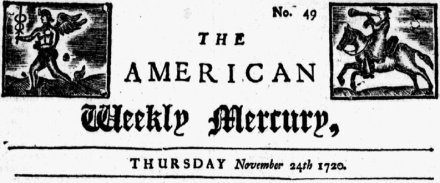
The American Weekly Mercury of Thursday, November 24 published “this extraordinary Piece” only with a preface complaining that “it is evident, that the following Speech was intended to misrepresent the Administration and Justice of this Government, as well as to infuse both ill Principles and Practices into the Minds of the People.”

The Dying Speech of Edward Hunt, formerly taken in Rebellion at Preston, and transported a bound Servant to the Island of Antigua, before his Execution upon the 19th Instant, at Philadelphia, where he had been legally convicted of High Treason, and most justly condemn’d for his Counterfeiting Spanish Silver Coin, made current* by Act of Parliament within all his Majesties Colonies in America.

It may be expected, that I should say some thing now concerning my Life and Conversation, which i must with Sorrow own to God and the Word has not been according to the Precepts and Principles of the Church, in which I was bred and educated: But with a sincere repentance and hearty Sorrow I do lament all the Errors of my past Life, firmly believing in my Saviour Jesus Christ, in whose Merits and ever flowing Mercy I do only trust for Salvation and Pardon, who has promised Eternal Life on no other Terms to the most Righteous upon Earth.

As to the Crime that now I suffer for in particular, I must own it is an Offence against the Laws, which I hope God will pardon me since he knows that I did not do it with any Design to cheat or defraud any one, or to make a Practice of Coining; but being ignorant of the Breach of any Laws of God or Man, I thought I might cut those Impressions as innocently as any other, or the Stamps that the Gentlemen of this place imploy’d me about, to make Farthings.** I am an English Subject, and desired to have the Privilege of the Laws of England, but it was not granted in any Point, except in Condemning me.

I am the first unhappy Instance of this kind that ever suffered in the King’s Dominions, pray God it may be a Warning to all, not to offend wilfully in the same that I did through Ignorance: For if I had known it, I would not have taken all the World to have done it. God give me a patient Resignation to submit to his blessed Will, in whatsoever he please.

I do heartily ask Forgiveness of all that I have offended in any manner of way, and do sincerely forgive all that have injured or offended me; particularly Mr. John Moore and Morris Birchfield, and the Evidence that swore against me in that Tryal. I do solemnly declare, That I know not any thing, or have been guilty of any one thing laid to my Charge in that Matter, or any of the other things laid to my Charge, by John Butler, either in England or Ireland.

I did petition the Honourable Governor for a Reprieve, until the King’s Pleasure was known concerning me, being I could not be tried by the Laws of England in all Points, as a Church of England Man ought to be: But it was a Privilege too great for me to obtain. Pray God to forgive them all, and every one that has a hand in taking away my Life any manner of way, and that my Blood be not required at their Hands, for they know not what they do. I am on Earth judged and condemned to die for the Breach of a Law of Man that was not duly published, which for that Reason I transgress’d it ignorantly, though the first that suffers for the Transgression of unknown Laws, or that was sentenced according to the Laws of England, without the Privilege of a Subject, which I desired of the Judge, which I know was not qualified by the same Laws to try me.

I do not know what Advantage there can be to any in my Death, and that I could not appeal to my King, neither before nor after my Tryal. I do not speak this because I am not in Charity with all the World, I do, from the Bottom of my Heart, forgive all in Obedience to my Saviour’s Command and Example, who suffered more for me, being innocent, and had not only done no Harm, but Good, and pray’d even for is cruel Persecutors and Murderers, and promised, That those that follow his Examples in this World by patiently enduring the Cross, shall reign with him to all Eternity: To Him therefore I commit all, an my poor Wife, beseeching him to help her, and be her Support and Comfort, and preserve her poor Soul free from the Polutions [sic] of the World, that through his precious Merits we may meet where we shall be both happy to all Eternity, in the merciful Arms of our dear Lord and Saviour Jesus, who I do beseech to receive my poor Soul.

According to Kenneth Scott’s Counterfeiting in Colonial America, Edward Hunt’s wife, Martha, got a £500 fine and a lifetime prison sentence for misprision of treason. (If that book is up your alley, Scott has an even more specific Counterfeiting in Colonial Pennsylvania.)

* Early colonial American commerce was severely hampered by a shortage of English/British currency. As a result, coins minted in Spain’s lucrative southern territories served as the colonies’ primary currency in the 17th and 18th centuries, particularly the iconic eight-real silver “pieces of eight”.

This is the reason why the currency of the present-day U.S. isn’t an “American pound sterling” but the almighty dollar: Dutch colonists had brought a coin called the leeuwendaalder to their former New Amsterdam (New York) province, the name deriving from the German thaler. As the pieces of eight corresponded to the thaler/daalder, it inherited the same name. Indeed, the “Spanish Dollar” remained legal tender in the post-colonial United States until 1857.

This is also the reason for reckoning of the eight constituent bits that comprised the dollar, and hence of the American colloquialism “two bits” to denote $0.25 … and, later, the adjective “two-bit” to man something cheap, mean, or small-time.

** They may have been Spain’s coins, but it’s wildly implausible that any Englishman could think he could counterfeit “innocently.”

On this day..

1698: The last Streltsy executed in October

This entry in our Corpses Strewn series on the October 1698 extirpation of the Streltsy is courtesy of the diaries of Austrian diplomat Johann Georg Korb, an eyewitness to the events.

Again, in front of the Kremlin Castle two others, whose thighs and extremities had been broken, and who were tied alive to the wheel, with horrid lamentations throughout the afternoon and the following night, closed their miserable existence in the utmoft agony. One of them, the younger of the two, survived amidst his enduring tortures until noon the following day. The Czar dined at his cafe (commode) with the Boyar Leo Kirilowicz Narefkin, all the representatives and the Czar’s ministers being present. The successive and earnest supplications of all present induced the monarch, who was long reluctant, to give command to that Gabriel who is so well known at his court that an end might be put with a ball to the life and pangs of the criminal that still continued breathing.

For the remainder of the rebels, who were still guarded in places round about, their respective places of confinement were also their places of execution, lest by collecting them all together this torturing and butchery in the one place of such a multitude of men, should smell of tyranny. And especially left the minds of the citizens, already terror-stricken at so many melancholy exhibitions of their perishing fellow men should dread every kind of cruelty from their sovereign.

But considering the daily perils to which the Czar’s Majesty was hitherto exposed, without an hour’s security, and hardly escaping from many snares, he was very naturally always in great apprehension of the exceeding treachery of the Strelitz, so that he fairly concluded not to tolerate a single Strelitz in his empire, — to banish all of them that remained to the farthest confines of Muscovy after having almost extirpated the very name. In the provinces, leave was given to any that preferred to renounce military service for ever, and with the consent of the Voivodes to addict themselves to domestic services. Nor were they quite innocent: for the officers that were quartered in the camp at Azov to keep ward against the hostile inroads of the enemy, told how they were never secure, and hourly expected an atrocious outbreak of treason from the Strelitz; nor was there any doubt but that they had very ambiguous sympathies for the fortunes of the other rebels. All the wives of the Strelitz were commanded to leave the neighbourhood of Moscow, and thus experienced the consequences of the crimes of their husbands. It was forbidden by Ukase, under penalty of death, for any person to keep any of them or afford them Secret harbour, unless they would send them out of Moscow to serve upon their estates.

On this day..

1480: Cicco Simonetta

On this date in 1480, Francesco Simonetta — known as Cicco to his contemporaries — was beheaded at the Castello of Pavia.

Simonetta (English Wikipedia entry | Italian) was your basic 15th century polyglot Italian humanist, whose aptitude saw him into the service of the condottiero Francesco Sforza.

Simonetta’s honors and appointments multiplied as Sforza’s reach expanded; when Sforza died, and then Sforza’s heir was assassinated, a 7-year-old became Duke of Milan.

The late 1470s saw a bitter power struggle during the child duke’s minority for effective control of the state: on the one hand, the boy’s uncle Ludovico; on the other, the boy’s mother Bona of Savoy. Simonetta was the able minister of state for Bona, and his faction briefly prevailed and saw Ludovico into exile.

Simonetta had put several years of hustle into balancing the political factions that kept Bona — and via Bona, himself — in control. Alas for their cause, Bona was eventually induced via her lover, a natural rival of Simonetta’s, to just go and invite Ludovico to return to Milan

Simonetta looked grave, as he well might, when he heard the news. “Most illustrious duchess,” he said to Bona the next day, “do you know what will happen? My head will be cut off, and before long you will lose this state.”

And so it was.

Bad news for Francesco Simonetta, sure, but Ludovico would one day use his position to commission Da Vinci’s The Last Supper.

Simonetta’s legacy beyond peninsular politics is somewhat less august. His treatise on code-breaking, Regule ad extrahendum litteras ziferatas sine exemplo (Rules for Decrypting Coded Documents), is a tipsheet for busting elementary substitution ciphers: determine the language, look for common words, exploit the letter patterns caused by standardized word endings (like -ing and -ed in English), isolate the vowels.

On this day..

1698: Old Believer popes and Princess Sophia’s petitioners

This entry in our Corpses Strewn series on the October 1698 extirpation of the Streltsy is courtesy of the diaries of Austrian diplomat Johann Georg Korb, an eyewitness to the events.

Today was assigned for the punishment of the popes — that is to say, of those who by carrying images to induce the serfs to side with the Strelitz, had invoked the aid of God with the holy rites of his altars for the happy success of this impious plot. The place selected by the judge for the execution was the open space in front of the church of the most Holy Trinity, which is the high church of Moscow. The ignominious gibbet cross awaited the popes, by way of reward in suit with the thousands of signs of the cross they had made, and as their fee for all the benedictions they had given to the refractory troops. The court jester, in the mimic attire of a pope, made the halter ready, and adjusted it, as it was held to be wrong to subject a pope to the hands of the common hangman. A certain Dumnoi struck off the head of another pope, and set his corpse upon the ignominious wheel. Close to the church, too, the halter and wheel proclaimed the enormity of the crime of their guilty burden to the passers by.

The Czar’s Majesty looked on from his carriage while the popes were hurried to execution. To the populace, who flood around in great numbers, he spoke a few words touching the perfidy of the popes, adding the threat, “Henceforward let no one dare to ask any pope to pray for such an intention.” A little while before the execution of the popes, two rebels, brothers, having had their thighs and other members broken in front of the Castle of the Kremlin, were set alive upon the wheel: twenty others on whom the axe had done its office lay lifeless around these wheels. The two that were bound upon the wheel beheld their third brother among the dead. Nobody will easily believe how lamentable were their cries and howls, unless he has well weighed their excruciations and the greatness of their tortures. I saw their broken thighs tied to the wheel with ropes strained as tightly as possible, so that in all that deluge of torture I do believe none can have exceeded that of the utter impossibility of the least movement. Their miserable cries had struck the Czar as he was being driven past. He went up to the wheels, and first promised speedy death, and afterwards proffered them a free pardon, if they would confess sincerely. But when upon the very wheel he found them more obstinate than ever, and that they would give no other answer than that they would confess nothing, and that their penalty was nearly paid in full, the Czar left them to the agonies of death, and hastened on to the Monastery of the Nuns, in front of which monastery there were thirty gibbets erected in a quadrangular shape, from which there hung two hundred and thirty Strelitz. The three principal ringleaders, who presented a petition to [Peter’s half-sister and rival] Sophia, touching the administration of the realm, were hanged close to the windows of that princess, presenting, as it were, the petitions that were placed in their hands, so near that Sophia might with ease touch them. Perhaps this was in order to load Sophia with that remorse in every way, which I believe drove her to take the religious habit, in order to pass to a better life.

On this day..

1698: 350 Streltsy by the boyars’ own hands

This entry in our Corpses Strewn series on the October 1698 extirpation of the Streltsy is courtesy of the diaries of Austrian diplomat Johann Georg Korb, an eyewitness to the events.

This differed confiderably from those that preceded. The manner of it was quite different, and hardly credible. Three hundred and thirty at a time were led out together to the fatal axe’s stroke, and embrued the whole plain with native but impious blood: for all the Boyars, Senators of the realm, Dumnoi, Diaks, and so forth, that were present at the council constituted against the rebel Strelitz, had been summoned by the Czar’s command to Bebraschentsko, and enjoined to take upon themselves the hangman’s office. Some struck the blow unsteadily, and with trembling hands assumed this new and unaccustomed task. The most unfortunate stroke among all the Boyars was given by him whose erring sword struck the back instead of the neck, and thus chopping the Strelitz almost in halves, would have roused him to desperation with pain, had not Alexasca* reached the unhappy wretch a surer blow of an axe on the neck.

Prince Romadonowski, under whose command previous to the mutiny these four regiments were to have watched the turbulent gatherings in Poland on the frontier, beheaded, according to order, one out of each regiment. Lastly, to every Boyar a Strelitz was led up, whom he was to behead. The Czar, in his saddle, looked on at the whole tragedy.

* Alexasca was a nickname for the (future) Gen. Aleksandr Menshikov, one of young Peter’s loyal boon companions.

Peter scornfully reproached many of the nobles who trembled at being compelled to behead some rebels; adding in a strain of sanguinary justice, “No victim is more acceptable to the Deity than a wicked man.” Mentchikof, however, did not labour under such delicate feelings; for as a prelude to the execution of one hundred and fifty Strelitz, he drove through the streets of Moscow in a sledge, brandishing a naked sword, and boasted of his adroitness in cutting off twenty heads. (Source)

On this day..

1698: 250 Streltsy from the walls of Moscow

This entry in our Corpses Strewn series on the October 1698 extirpation of the Streltsy is courtesy of the diaries of Austrian diplomat Johann Georg Korb, an eyewitness to the events.

To prove to all the people how holy and inviolable are those walls of the city [of Moscow], which the Strelitz rashly meditated scaling in a sudden assault, beams were run out from all the embrasures in the walls near the gates, on each of which two rebels were hanged. This day beheld about two hundred and fifty die that death. There are few cities fortified with as many palisades as Moscow has given gibbets to her guardian Strelitz.

On this day..