1660: Major-General Thomas Harrison, the first of the regicides

On this date in 1660, the restored House of Stuart began a week of bloody justice against Charles I‘s regicides by hanging, drawing and quartering Thomas Harrison at Charing Cross.

Stuart Little

Charles’ son and heir Charles II had been stuck on the continent during the 1650’s, until the Commonwealth came apart from its own internal contradictions after the death of Oliver Cromwell.

With anarchy looming, suddenly monarchy didn’t look so bad — and Charles II had a way back into the saddle.

Beheads I Win …

The first thing on everyone’s mind was what to do about the little matter of having lopped off his dad’s head.

Political reality drove the settlement: nearly everyone in the English gentry had in some manner acquiesced to the Commonwealth during its decade-plus turn steering the ship of state; an expansive line on treason would be a nonstarter. At the same time, His Soon-To-Be-Royal-Again Majesty expected a few examples made to do right by the old man and keep king-killing well off his future subjects’ agenda.

Result: the Indemnity and Oblivion Act, granting a free pardon to all supporters of the Commonwealth save a handful of those most directly implicated in Charles I’s execution.

Weeks of frantic negotiating between the parties and private settlements of borderline cases with the royalist camp preceded the action. But Thomas Harrison wasn’t part of any of it.

… Entrails you Lose.

The rigid Puritan, one of 59 who signed the last king’s death warrant and at one time the commander of England’s armies, had been on the outs with everyone since Cromwell set up the Protectorate in 1653. Godly Tom was a “Fifth Monarchist,” anticipating the imminent return of Christ perhaps in conjunction with the imminent year 1666 … and no government felt safe about these millenarians. He’d been imprisoned several times by the Protectorate, too.

Though many attainted regicides fled for Europe or America, Harrison (possibly motivated by age and infirmity) hung out, waited for arrest, and took his punishment stolidly.

God hath covered my head many times in the day of Battle. By God I have leaped over a wall, by God I have runned through a Troop, and by my God I will go through this death.

Specifically meaning, drawn on a hurdle from Newgate to Charing Cross (with a fine vantage for the doomed on Whitehall, where Charles I had met his end), hanged but revived, his genitalia cut off and bowels carved out and burned while still conscious, and finally beheaded and his body divided into quarters for gruesome public display around town.

You have selected regicide.

Harrison died on a Saturday, and his was the opening act of a busy week in the bowel-burning business; nine other fellow regicides condemned with him would share that fate during the week ahead:

  • John Carew, on Monday the 15th;
  • John Cook and Hugh Peters, on Tuesday the 16th;
  • Thomas Scot, Gregory Clemen, Adrian Scroop and John Jones, on Wednesday the 17th;
  • Francis Hacker and Daniel Axtel, on Friday the 19th.

Harrison was chosen as the first partly, perhaps, because the Fifth Monarchists were (justifiably) considered a still-extant menace, and partly because, as one account had it,

[h]e was a fierce and bloody enthusiast. And it was believed, that, while the army was in doubt, whether it was fitter to kill the king privately, or to bring him to an open trial, that he offered, if a private way was settled on, to be the man that should do it. So he was begun with. But, however reasonable this might be in itself, it had a very ill effect: for he was a man of great heat and resolution, fixed in his principles, and so persuaded of them, that he never looked after any interests of his own, but had opposed Cromwell when he set up for himself. He went through all the indignities and severities of his execution, in which the letter of the law in cases of treason was punctually observed, with a calmness or rather a cheerfulness that astonished the spectators.

“As cheerful as any man could do in that condition”

And this coda is attested by the age’s famous diarist, Samuel Pepys, whose neat and oft-quoted summation of Harrison’s fate runs thus:

I went out to Charing Cross, to see Major-General Harrison hanged, drawn, and quartered; which was done there, he looking as cheerful as any man could do in that condition … Thus it was my chance to see the King beheaded at White Hall, and to see the first blood shed in revenge for the blood of the King at Charing Cross.

Who overcomes by force hath overcome but half his foe

As might be expected, vindicated royalists sought more blood than the handful of exemplars could furnish. What compromise could expiate the sin of regicide?

Poet and polemicist John Milton, having been propagandist-in-chief for the now-abortive revolution, endured the jeers of his enemies for the conspicuously apolitical stuff (a grammar book!) by which he would set his table in the years ahead.

Upon John Milton’s not suffering for his traiterous Book when the Tryers were executed, 1660.

That thou escaped’st that vengeance, which o’ertook,
Milton, thy regicides, and thy own book,
Was clemency in Charles beyond compare:
And yet thy doom doth prove more grievous far.
Old, sickly, poor, stark blind, thou writest for bread:
So for to live thoud’st call Salmasius from the dead.

(Claudius Salmasius was a French intellectual whose defense of the Stuart royal rights had been savaged by Milton during the Protectorate.)

It’s thanks to the Indemnity and Oblivion Act’s not sending Milton the way of General Harrison that we have Paradise Lost.

On this day..

1911: Several revolutionaries on Double Ten Day

On the tenth day of the tenth month — Double Ten Day, as it has since been remembered in China and the Chinese diaspora — the quick execution of a few revolutionaries signaled the surprising end of China’s 2,000-year-old imperial government.

Actually, the collapse of imperial rule wasn’t such a surprise: China’s last dynasty had foundered in the face of the 19th century challenges of European colonialism; driven by multitudinous grievances, popular revolts and reform movements had buffeted China in recent years, most seriously the turn-of-the-century Boxer Rebellion.

The Qing Dynasty was a tinderbox. But one never knows what spark will set the flame.

On October 9, 1911, revolutionaries in the central China town of Wuchang — today merged with neighboring towns into the city of Wuhan — lit the fuse literally when a bomb they were building for a planned insurrection accidentally went off.

In the ensuing scramble, police raided the joint and found incriminating lists of thousands of revolutionary recruits. Arrests followed fast, and several (three*) of the arrested were summarily put to death on the morning of the tenth.

But the plot’s apparent misfortune actually turned out to be its spur to victory.
Realizing that their identities were exposed to the authorities, and that they were in danger of immediate execution, the revolutionaries … revolted.

Their military forces mounted a successful municipal coup d’etat.

While the central government dilated, insurrectionary Wuchang appealed to the provinces for solidarity, and within weeks the Wuchang Uprising had blossomed into full-fledged revolution: the Xinhai Revolution, to be exact. By the following February, China’s last child-emperor had been forced to abdicate.

For the first time in millennia, the fallen dynasty was not succeeded by another dynasty. Though the new state was itself heir to the myriad contradictions and weaknesses that dogged the Qing, it was a definitive turning point: China became Asia’s first democratic republic, the polity that today is Taiwan.

* The names Peng Chufan, Liu Yaocheng and Yang Hongsheng are proposed in this history.

Update: This excellent History Today article for the Double Ten centennial also specifies three executions, and even includes this outstanding public domain image from the Francis Stafford collection.

On this day..

1849: Lajos BatthyƔny and the 13 Martyrs of Arad

On this date in 1849, the shining lights of Hungary’s 1848 revolution met the Austrian Empire’s firing squadsexecutioners. (Correction: Most were hanged, not shot. See comments.)

Probably no polity in Europe stood more fundamentally in danger from the wave of 1848 revolutions than the Habsburg Empire. While governments would be overthrown and power renegotiated across the continent, the Austrian state’s dynastically welded hodgepodge of mingled ethnicities appeared existentially at odds with the nationalist stirrings afoot.

And none of those ethnicities answering to Vienna stirred as vigorously as the Hungarians.

The Hungarian Diet established a national government under Lajos BatthyƔny (English Wikipedia page | Hungarian) (or Louis Batthyani) in the spring of 1848* and soon pushed for more self-determination than Austria was prepared to countenance.

When Austrian troops turned on Hungary, the aspiring nation issued an 1849 declaration of independence full of vituperation for the ancient noble line.

[T]he house of Hapsburg-Lorraine, as perjured in the sight of God and man, has forfeited its right to the Hungarian throne …

Three hundred years have passed since the Hungarian nation, by free election, placed the house of Austria upon its throne, in accordance with stipulations made on both sides, and ratified by treaty. These three hundred years have been, for the country, a period of uninterrupted suffering.

…

This dynasty … which can at no epoch point to a ruler who based his power on the freedom of the people, adopted a course toward this nation from father to son, which deserves the appellation of perjury.

The house of Austria has publicly used every effort to deprive the country of its legitimate independence and constitution, designing to reduce it to a level with the other provinces long since deprived of all freedom, and to unite all in a common link of slavery.

Guess how that turned out.

Lajos Batthyany portrait by Hungarian painter Miklos Barabas.

It wasn’t much of a contest in the field, leaving this day’s doings the shooting of Batthyany at Pest (the city later merged with Buda and Obuda to form Budapest) and 13 Hungarian generals — the so-called 13 martyrs of Arad — in a Translyvanian city that is today part of Romania.

This was not, however, the last the Habsburg dynasty would hear of Hungary’s frustrated national aspirations.

Three years later, a Hungarian nationalist attempted to assassinate the youthful Emperor Franz Joseph,** and the strength of the Magyar lands’ self-determination movements would eventually drive a formal ratification of Hungarian privileges that rechristened the state as the Austro-Hungarian Empire, or simply Austria-Hungary.

All that stuff we said about you Habsburgs? Bygones.

While becoming half of a dual capital opposite Vienna meant a late 19th-century renaissance for Budapest, this cure by the Empire for its internal pressures proved almost as harmful as the disease. The pressures immediately discharged would pale in comparison to the conflicts Hungarians’ now-privileged status helped provoke with Slavs and other ethnic minorities (exacerbated by Hungarians’ ability to block Austrian foreign policy). In an early preview of a now-familiar pattern, the proto-nation-state of Hungary was a nastier piece of work for its ethnic minorities than the decadent old melting-pot ruled from Vienna … and the road from this day’s executions to the Austro-Hungarian Compromise ran straight on to 1914 Sarajevo and the graveyard of Habsburg history.

As for the executions this day, Batthyany was saluted by the great Hungarian composer Franz Liszt in his Funerailles:

More prosaically and much more pervasively, a legend that Austrians were jovially toasting the death of the 13 Martyrs as they were being executed translated into a still-active tradition against clinking beer glasses in Hungary.


The Martyrs of Arad (Sixth of October) by Janos Thorma

* Hungary’s March 15 National Day derives from this period.

** Franz Joseph was no mere abstract emblem of imperial absolutism: he had assumed the Austrian throne in December 1848 upon the abdication of his feebleminded uncle specifically to free the crown from the oaths his predecessor had taken to various reforms. From the Hungarian perspective — and the declaration excerpted above dwells at length on the perfidy of this maneuver — he was installed to crush the revolution.

On this day..

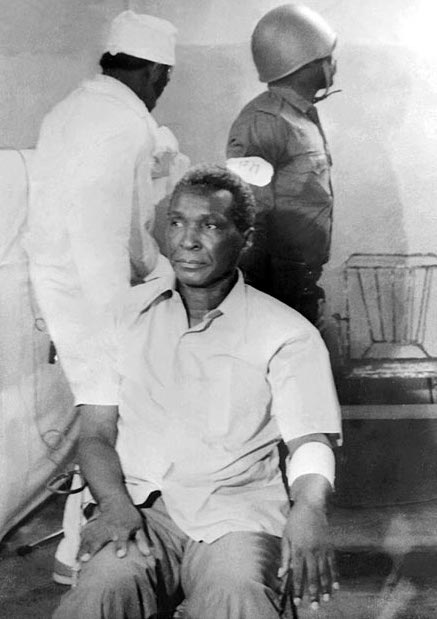
1979: Francisco MacĆ­as Nguema, President for Life

In the early afternoon this date, Equatorial Guinea’s former President for Life was sentenced to death with six aides at the end of a four-day trial for murder, treason, embezzlement, and genocide.

That evening, the seven were shot at Malabo’s Blabich Prison.

Nguema Biyoto Masie, nee Francisco MacĆ­as Nguema, rose from the Spanish colonial bureaucracy to win the first post-independence presidency of the minuscule African state.

He quickly created a one-party state and increasingly nutty cult of personality, answering to such horror-comic nicknames as “Unique Miracle”.

Nguema’s Unique Miracle for Equatorial Guinea was a Pol Pot-style catastrophe, killing or driving out most of the population (including Nguema’s own wife), eviscerating the economy, and getting into military brinksmanship with neighboring Nigeria.*

His nephew, Teodoro Obiang Nguema Mbasogo, overthrew him a few weeks before this date. Despite the speedy resolution of the case, international observers on the scene considered it a fair enough trial and the dictator’s guilt duly established; procedurally, the execution happened immediately because he was tried by the highest court in the land and there was nowhere to appeal.


Francisco Macias Nguema during his trial.

Still, the shooting itself was handled by hired Moroccan troops, rather than citizens of Equatorial Guinea: Nguema had convinced quite a lot of people that he had magic powers, and the locals weren’t eager to be the ones to test the proposition.

Bloody but necessary first step to parliamentary democracy?

Not quite. Teodoro Obiang Nguema Mbasogo, one of the worst dictators you’ve never heard of, still runs Equatorial Guinea in much the manner of his predecessor to this day.


Did we mention that Equatorial Guinea has oil?

* Francisco Macias Nguema’s daughter, “Empress Bella Syttam Macias”, lives in Utah and defends her dad. She seems to have been too young to have been personally involved in anything unsavory in the 70’s.

On this day..

1402: False Olaf

On this date in 1402, a Prussian commoner was put to death on the road between Falsterbo and Skanor in Sweden for masquerading as the long-dead King Olaf IV.

The real Oluf IV Haakonsson — or Olav, or Olaf — had inherited the crowns of Denmark and Norway and a claim to that of Sweden’s but died at the age of 17 in 1387. His mother, Margaret I (or Margrethe I), the real power behind the teenager, ruled outright upon her son’s death.

She proved an able hand and far-sighted ruler, cautiously welding Denmark, Sweden and Norway into the Kalmar Union that would hold until the 16th century. They called her “the Semiramis of the North,” centuries before Catherine the Great nicked the nickname.

But her son’s youthful demise had set persistent rumors abroad — that he was poisoned, for instance, and more to the point for our purposes, that he wasn’t dead at all.

So when his spitting image was recognized, and hailed as the prince of the realm … well, back in the day, equally audacious identity theft was attempted for much smaller stakes than a throne.

Anyway, “Olaf” got some robes befitting Olaf’s station and banged out some letters to Margaret demanding his kingdom back, and Margaret said, come on down.

That goes to show how far looks will take you in life.

Unfortunately for Olaf, his regal jawline wasn’t capable of enunciating Danish speech … so the jig was up as soon as he got to Margaret. One hopes he got a good ride out of his brief masquerade, because he was burned to ashes — possibly after being broken on the wheel — along with those presumptuous letters.

The date of False Olaf’s death comes from Horace Marryat’s 19th century Scandinavian travelogues, One Year in Sweden; including a visit to the isle of Gotland and A Residence in Jutland, the Danish Isles, and Copenhagen (both free reads at Google Books). In both volumes, Marryat identifies the date as the morning before Michaelmas.

The traditional last day of the harvest season celebrated on September 29, Michaelmas was once a four-star holiday on the medieval calendar.

There’s a fair amount of commentary online saying that an “Old Michaelmas” used to be celebrated on October 10 or 11. But that looks to this writer like an interesting inversion stemming ultimately from the celebration’s fall into obscurity as the entity once known as Christendom has become more secular and less agrarian — although it’s admittedly nothing to do with the fate of False Olaf, or Semiramis for that matter.

In 1752, when England finally switched to the Gregorian Calendar, the switch took place in early September.*

For logistical pragmatism (the harvest wasn’t going to come in 11 days earlier just because the calendar changed), the then-imminent Michaelmas got pushed back 11 days to October 10. October 10 then became known as “Old Michaelmas,” no longer Michaelmas by the church calendar but the 365-day interval from when it used to be celebrated, and more importantly, the real end of the harvest season.**

In the next century, the difference between Julian and Gregorian calendars would have advanced to 12 days, placing Old Michaelmas on the 11th; by this present day, it’d be 13 days in principle, but the original meaning of the holiday and the host of cultural traditions associated with it have fallen away … so “Old Michaelmas” is a footnote still pinned to October 10th or 11th, and moderns rediscovering it suppose from the name that it’s the former date of the feast.

* People inclined to think of their death dates as foreordained in heaven’s celestial notebook protested the switch: “give us back our 11 days!” This reform, incidentally, also moved the official beginning of the New Year to January 1 from Michaelmas’ springtime “Quarter Day” counterpart, March 25; winter dates from years prior are often written with both years, e.g. 1738/9. “Old Lady Day“, April 6, is still the beginning of the fiscal year in England, and Thomas Hardy uses its traditional contractual character in Tess of the D’Urbervilles (Aside: Tess’s hanged real-life inspiration) when the title character takes a farm job running through that date:

Tess was so wrapt up in this fanciful dream that she seemed not to know how the season was advancing; that the days had lengthened, that Lady-Day was at hand, and would soon be followed by Old Lady-Day, the end of her term …

At length it was the eve of Old Lady-Day, and the agricultural world was in a fever of mobility such as only occurs at that particular date of the year. It is a day of fulfilment; agreements for outdoor service during the ensuing year, entered into at Candlemas, are to be now carried out. The labourers — or “work-folk”, as they used to call themselves immemorially till the other word was introduced from without — who wish to remain no longer in old places are removing to the new farms.

… With the younger families it was a pleasant excitement which might possibly be an advantage. The Egypt of one family was the Land of Promise to the family who saw it from a distance, till by residence there it became it turn their Egypt also; and so they changed and changed.

** Residents of the former Soviet Republics who switched to the Gregorian calendar in the 20th century still celebrate both the familiar January 1 New Year’s and “Old New Year’s” 13 days later, and the same trick with the (lesser, there) holiday of Christmas too … packing four party occasions into a three-week span.

Part of the Themed Set: Semiramis.

On this day..

1792: Jacques Cazotte, occultist

On this date in 1792, Jacques Cazotte, a writer distinctly out of step with his times, was guillotined for treason in Paris.

The Martinique-born Cazotte (English Wikipedia entry | French) was into his 40s when he launched the writing career that earns him notice enough for this blog.

He wasn’t a liberte, egalite, fraternite kind of guy: Cazotte’s works, like Le Diable Amoureux (The Devil in Love),* were fantastical, Gothic — far from the rationalist fare of the Enlightenment.

And that wasn’t exclusively a literary posture.

Cazotte fancied himself gifted with prophecy — enthusiasts’ accounts have him prophesying the course of the Revolution — and preferred the mystical enlightenment of the illuminati to the Voltairean kind.** He viewed the onset of the French Revolution with horror.

When some scribblings to that effect were discovered in his papers, the mystical goose was cooked. The French Wikipedia entry credits his daughter with saving his life during the September Massacres … buying the 72-year-old only a few weeks of life.

Cazotte’s Le Diable Amoureux has the devil as a young man’s servant girl, endeavoring to seduce him. Here is Cesare Pugni‘s balletic rendition, Satanella, with its grand pas de deux, “Le Carnaval de Venise”:

Cazotte finds his way to us, as the dark arts are wont to do, through more meandering channels as well.

Le Diable Amoureux inspired supernatural mystery The Club Dumas by Spanish author Arturo Perez-Reverte. That novel in turn was riffed by Roman Polanski for the weird 1999 flick The Ninth Gate (review), starring Johnny Depp. (Cazotte’s book is explicitly referenced in both its progeny.)

Although only tangentially related, this digression into the occult gives us leave to notice one of the many cultural ephemera of executions linked to no particularly blog-friendly date. The Club Dumas and The Ninth Gate make use of striking woodcuts of modern vintage but after a style of centuries past that help unlock the central puzzle.

Charged with esoterica, the topical-looking “hanged man” print comes clearly modeled after its tarot cousin … although the tarot version, in most instances, is hoped to be of less deadly effect upon the plot.

* Available free in the original French at Project Gutenberg.

** Voltairean rationalism had its own ways of getting in trouble. It may have been an age of ideas, but it was hardly safe to have them.

On this day..

1652: Captain James Hind, royalist highwayman

On this date in 1652, James Hind, a highwayman who preyed on Roundheads, was drawn and quartered for treason.

Famed throughout the realm for his dashing heists on the roads, Hind was the subject of no less than 16 printed pamphlets of the nascent popular press in the early 1650’s, which magnified brigand’s feats, oratory and persona into a sort of populist Cavalier superhero: Marvel Comics for the woodcut age.

The highlights of Hind’s adventures receive rapturous attention from the Newgate Chronicles:

  • Setting upon Oliver Cromwell shortly after the execution of Charles I, his partner Thomas Allen being taken in the affray;
  • An amusing duel of Biblical citations while robbing regicide Hugh Peters, resolved in the characteristic manner of such impasses by reference to which disputant holds the gun.

    “Pray, sir, make no reflections on my profession; for Solomon plainly says, ‘Do not despise a thief’; but it is to little purpose for us to dispute. The substance of what I have to say is this: deliver thy money presently, or else I shall send thee out of the world to thy master in an instant.”

  • Any number of pleasing episodes with lesser personages suitable for the gallant highwayman — ladies charmed but un-pillaged, paupers subsidized, and always, wicked Parliamentarians chastened. Several excellent Hind anecdotes are gathered by Gillian Spraggs here.

As to the veracity of this stuff, the Captain himself suggests a pinch of caution.

A Gentleman or two, desired so much favour of [the gaoler], as to aske Mr. Hind a civil question; which was granted. So pulling two books out of his pocket, the one entituled, Hind’s Ramble, The other Hind’s Exploits, asked him whether he had ever seen them or not: He answered, yes; And said upon the word of a Christian, they were fictions: But some merry Pranks and Revels I have plaid, that I deny not.

But Hind’s adherence to the Stuart cause was real enough, or at any rate something he had the 17th century media savvy to play up. At his execution, he professed pleasure in having targeted Roundheads for most of his crimes, and it was not theft that saw him to the scaffold, but treason. He made free royalist talk upon his arrest, proposing a toast to the exiled king that otherwise sympathetic guests were too cautious to take up.

Hind fits symbolically into the tradition of the romantic outlaw of Robin Hood stock, and anticipates the 18th century rogues’ gallery of noble brigands fighting a doomed rearguard against capitalism. Hind’s acts, criminal by any standard, are justified by the illegitimacy of the society he preys upon; he embodies at once a social and political rejection of the nascent mercantile England, and a biographical realization of its actuating mythos — personal aptitude and acquisition,* with a cover story for why his victims had it coming.

Neither did I ever wrong any poor man of the worth of a penny: but I must confess, I have (when I have been necessitated thereto) made bold with a rich Bompkin, or a lying Lawyer, whose full-fed fees from the rich Farmer, doth too too much impoverish the poor cottage-keeper: And truly I could wish, that thing were as little used in England amongst Lawyers, as the eating of Swines-flesh was amongst the Jews.

A dead-end position — just like James Hind himself.

* In a supposed rhapsody over gold forced from the hand of John Bradshaw — yet another regicide; Hind seemingly met them at every turn — our robber rather has his cake and eats it too in extolling and condemning lucre.

Ay, marry, sir, this is the metal that wins my heart for ever. Oh! precious gold, I admire thee as much as Bradshaw, Prynne or other such villains, who would for the sake of it sell our Redeemer again, were He now upon earth.

On this day..

1822: Four Sergeants of La Rochelle

On this date in 1822, four sergeants from La Rochelle were guillotined at the Place de Greve with “Vive la liberte! on their lips for plotting to overthrow the restored Bourbon monarchy.

In the Restoration following Napoleon, the cautious gouty brother of the Revolution’s most famous guillotinee came to the throne as Louis XVIII.

And in a right-wing reaction following a royal assassination, Louis found himself in the anomalous position of having a government more monarchist than he himself. Though not renowned for his sagacity, the sovereign had the wit to see that completely reversing the Revolution was a nonstarter. His ultra-royalist deputies, however, wanted nothing less than the full restoration of an absolute monarchy.

The new Prime Minister cracked down hard on the Liberal opposition. Here’s the scene as described by The Cambridge Modern History, a Google Books freebie:

The Chief Minister [Villele] had the merit of keeping constantly in mind the fact that his friends owed their power to the forces of reaction and alarm, aroused in the country by the dagger of an assassin who had mortally wounded a member of the royal family. To keep this fear awake, in order to establish his authority, was his first care. In this he succeeded. The Liberals, finding themselves compelled to prudence, organized themselves into secret societies; and the Republcians, imitating the Neapolitans, actually formed in 1821 the Charbonnerie francaise, which avowedly aimed at giving back “to the French nation the free exercise of the right to choose its sovereign.” In order to give battle to the ancien regime and its Bourbon protectors, they recruited their soldiers and captains without hesitation from among the officers, commissioned and non-commissioned, of the old Imperial army. Villele showed particular skill in the discovery, exaggeration, and signal punishment of these conspiracies … With a magistracy obedient to its orders, the Ministry devoted itself assiduously to representing isolated movements no sooner known than crushed, as forming part of a permanent conspiracy organized by the Liberals, not only against the monarchy, but against society itself.

Les quatre sergents de La Rochelle — by the names of Bories, Goubin, Pommier and Raoulx — comprised perhaps the most egregious such case.

Driven underground (the link is French) like the rest of the Liberal opposition, they had joined the charbonnerie, a loose network modeled on Naples’ carbonari. (Lower-level officers were prime recruits for the dissidents, since their career prospects were truncated by aristocratic privilege in the upper brass.)

It was never clear that their subversiveness extended to anything beyond their affiliation with a criminalized ideology, and they kept their own peace to protect other associates in the charbonnerie. Guillotining them on this basis conformed neatly to the principles of, say, an Ann Coulter: “We need to execute [these] people … in order to physically intimidate liberals, by making them realize that they can be killed, too. Otherwise, they will turn out to be outright traitors.”

Back to The Cambridge Modern History:

It seemed that the Ministers were eager to multiply these trials and executions. Since certain deputies of the Liberal Opposition, Lafayette* among others, and D’Argenson, had openly associated themselves with these enterprises, which otherwise were devoid of danger, this supplied a fair pretext for exhibiting them publicly as criminals. The indictment with the King’s Procurator, Marchangy, formulated, in order to obtain the condemnation of the four sergeants of La Rochelle, left no doubt as to the intentions of the Government. Its chief aim was to terrorise the French people “by this vast conspiracy against social order, against the families of citizens, which threatened to plunge them once more into all the horrors of anarchy.” While keeping up the appearance of saving society, Villele gained forthwith the power to govern it in accordance with the wishes of his friends. The threat of anarchy, exploited by the judges in his service, allowed him to organise a despotism.

The public execution reportedly had its onlookers appalled, (more French) and as word of the young men’s heroic deaths got around, they elbowed into the vast host of (somebody’s) martyrs. (In Balzac’s Human Comedy, the courtesan Aquilina is said to have been involved with one of the four sergeants; in her appearances after the executions, she always commemorates him by wearing something red.) The Lantern Tower in their garrison’s city — depicted below in a 1927 Paul Signac painting — was renamed in their honor, Tour de Quatre Sergents.

* Lafayette always seemed to be somebody’s dangerous element. It’s a wonder he never got himself into this blog.

Part of the Themed Set: Counterrevolution.

On this day..

1803: Robert Emmet, “let no man write my epitaph”

On this date in 1803, Irish nationalist Robert Emmet was hanged and posthumously beheaded, a day after his trial for treason against England.

The well-to-do scion of a Protestant family, Robert Emmet followed his older brother into the Republican ferment of the time and led an unavailing uprising in Dublin on July 23, 1803.

Captured a month later when he romantically recklessly moved his hideout closer to his beloved Sarah Curran.*

Emmet won his great laurels in the annals of Irish Republicanism with a stirring “Speech from the Dock” addressed to the courtroom the day before he died. Or better to say that it was addressed in a courtroom, for knowing that his death sentence was a foregone conclusion, the real audience was posterity and a wider world.

Emmet found that audience with one of the great orations of the 19th century.

This clip is a truncated version of a longer speech not set to paper by Emmet, so no single definitive version exists. Versions can be found at this Irish history site, and at SinnFein.ie.

I have but one request to ask at my departure from this world — it is the charity of its silence! Let no man write my epitaph: for as no man who knows my motives dare now vindicate them. let not prejudice or ignorance asperse them. Let them and me repose in obscurity and peace, and my tomb remain uninscribed, until other times, and other men, can do justice to my character; when my country takes her place among the nations of the earth, then, and not till then, let my epitaph be written. I have done.

On the strength of such sentiment — and the public’s learning of his love for Sarah Curran — the 25-year-old became iconic in death. Robert’s own death inspired the mandatory Irish patriotic ditty, “Bold Robert Emmet”:

But that sundered love between Emmet and Sarah Curran — who broken-heartedly accepted another proposal and moved to Sicily — was at least as stirring to the Romantic imagination. Washington Irving dedicated a short story to the lost romance; Emmet’s friend Thomas Moore made Curran the subject of a poem (beware: link opens an auto-playing audio file).


Anti-British terrorist Robert Emmet has a statue on Washington, D.C.’s Massachusetts Ave, and probably an entry on the no-fly list.

* 19th century Irish poet Thomas Moore paid her tribute in “She Is Far From the Land”:

She is far from the land where her young hero sleeps,
And lovers are round her, sighing:
But coldly she turns from their gaze, and weeps,
For her heart in his grave is lying.

She sings the wild song of her dear native plains,
Every note which he lov’d awaking; —
Ah! little they think who delight in her strains,
How the heart of the Minstrel is breaking.

He had liv’d for his love, for his country he died,
They were all that to life had entwin’d him;
Nor soon shall the tears of his country be dried,
Nor long will his love stay behind him.

Oh! make her a grave where the sunbeams rest,
When they promise a glorious morrow;
They’ll shine o’er his sleep, like a smile from the West,
From her ow lov’d island of sorrow.

Part of the Themed Set: Counterrevolution.

On this day..

1938: Nikolai Kondratiev, purged economist

On this date in 1938, Stalin’s purges claimed Soviet economist Nikolai Kondratiev.

Not the most recognizable name in the Soviet Union’s 1930’s bloodletting, Kondratiev — also transliterated Kondratieff — was a pre-Keynesian economist of some note, who had a prominent hand in the fledgling USSR’s early agricultural direction.

Thus far goes the portfolio of many a forgotten academic or bureaucrat shot by Stalin.

But Kondratiev made a contribution still much remembered — and one that might just be due to re-emerge from its occult hibernation.

In a series of 1920’s papers, Kondratiev worked out the theory that capitalism had 50-to-60-year economic supercycles. Though not strictly the first to so hypothesize, he put the idea on the map; the (alleged) pattern still bears the name “Kondratiev wave” or “Kondratiev cycle”.

His belief that the intermittent major crises punctuating capitalism were not building towards systemic implosion but clearing the economic debris of bygone ages and allowing new growth were not the least of what got him into hot water with Stalin.

“Creative destruction,” as Joseph Schumpeter would call it, adapting the idea.

Though sidelined from mainline economics for much of the 20th century, Kondratiev waves have never gone entirely out of fashion. Congenial to any number of collateral theoretical hobbyhorses — technological innovation, entrepreneurship, generational psychology, statecraft, and the eternal bracing for end times right around the corner — Kondratiev waves are a niche player in economic theory both conventional and otherwise.

Here’s a site that lovingly describes them.

Its problem, even if you happen to buy into the concept, is its near uselessness as a predictive tool: half-century cycles don’t just arrive like clockwork, and the timing and very existence of particular cyclical epochs is highly dependent on the interpreter’s choice of data. The margins of error run out to decades. You never know at any given moment what you’re looking at — so you can find the supercycle crashing in 1998, or beginning its springtime of growth in this decade.

That very uncertainty accounts for Kondratiev’s intermittent mainstream resuscitation during economic crisis: when worried about Where Things Are Headed, some version of a Long Wave theory is almost sure to have a story to tell.

According to the New York Times‘ database of past articles, the word “Kondratieff” (its preferred transliteration; “Kondratiev” yields stories about New York Rangers prospect Maxim Kondratiev) went essentially unmentioned in the post-World War II paper before appearing in 20 articles from 1973 through 1984 — the period when the capitalist core was buffeted by energy crisis, stagflation, and the punishing Paul Volcker recession of the early Eighties.

And then Kondratiev/Kondratieff faded from the Grey Lady; after a few appearances during Wall Street’s woes in the late 80’s, it doesn’t seem to have appeared in print there since an offhanded reference in a 1992 William Safire column.

Have you seen the news lately? It’s mighty Kondratiev-friendly. His cycle of exclusion has probably just about run its course, and if you’re the wagering type, I’ll take Thomas Friedman against the field.

Behind the theorems, of course, there was the flesh-and-blood man; it so happens that not many dismal scientists went as poignantly as our principal.

Initially imprisoned in 1930, Kondratiev served eight years before he was re-sentenced and executed; he ached for the separation with his family. Kondratiev’s daughter, Elena — Alyona or Alyonushka in the Russian diminutive — preserved his correspondence to her, the only remnants of her father in her life.

The last letter — as it turned out; plainly the writer had no inkling of it — was dated August 31, 1938.

My sweet darling Alyonushka.

Probably your holidays are over now and you are back at school. How did you spend the summer? Did you get stronger, put on weight, get tanned? I very much want to know. And I would like very, very much to see you and kiss you many, many times. I still do not feel well, I am still ill. My sweet Alyonushka, I want you not to get sick this winter. I also want you to study hard, as you did before. Read good books. Be a clever and a good little girl. Listen to your mother and never disappoint her. I would also be happy if you managed not to forget about me, your papa, altogether. Well, be healthy! Be happy! I kiss you without end.

Your papa.

(From Orlando Figes’ The Whisperers: Private Life in Stalin’s Russia.)

On this day..