On this date in 1944, 24-year-old Krystyna Wituska [Polish language link] was guillotined inside the Halle-Saale Prison in Germany.
She’d been convicted of espionage and treason in relation to her activities with the Polish Underground.
Although for months she had feared the Germans were on to her, it wasn’t Krystyna’s own actions that lead to her arrest in October 1942. No, it was the ghost of lovers past.
A short time before, the Nazis had picked up a former boyfriend of hers who was coincidentally also involved with the Underground. The couple had been engaged at one time, but they hadn’t seen each other since 1938 and Krystyna’s passion for him had long since cooled. It was merely a remarkably unlucky chance that the Gestapo happened to find her name in his apartment.
Krystyna’s death sentence was confirmed in May 1943, but over a year passed before she was actually put to death.
During the interval she kept in touch with her family and friends by mail. Her letters, punctuated with requests for items like food and warm clothing, were remarkably cheerful and upbeat in spite of her gloomy surroundings.
Don’t think she was in denial about her fate, however, for she alluded to it frequently.
“I am not distressed that I must die,” she wrote to one acquaintance in August 1943. “If you have a good understanding of life, you know how to accept death. The important thing is to maintain one’s human dignity to the end.”
(The illustrations, their captions, and the footnotes are interpositions from ExecutedToday.com.)
In Boston, the earliest execution for witchcraft was that of Margaret Jones, of Charlestown, on June 15, 1648.* There seems to be no evidence that any earlier case of witchcraft was under investigation in the colony.
Her husband, Thomas Jones, was arrested at the same time on the same charge, but he was not convicted. The little we know of Margaret Jones we find in Governor Winthrop’s Journal. She was evidently a strong-minded woman, and a skilful practitioner of medicine … There was no charge that she had bewitched any one, and the usualphenomena of spectres, fits, spasms, etc. were wanting. The main evidence on which she was convicted was her imps, which were detected by “watching” her …
The Court Records and the Deputies’ Records … for May 18, give an order concerning Margaret Jones and her husband, without the mention of their names, as follows: —
This court, desirous that the same course which hath been taken in England for the discovery of witches, by watching [them a certain time] may also be taken here with the witch now in question: [It is ordered that the best and surest way may forthwith be put in practice, to begin tis night, if it may be, being the 18th of the 3d month] that a strict watch be set about her every night, and that her husband be confined to a private room and watched also” (Deputies’ Records, with the words in brackets inserted from the Court records).
The theory of the English law books was that every witch had familiars or imps, which were sent out by the witch to work deeds of darkness, and that they returned to the witch once a day, at least, for sustenance, and usually in the night. By watching the witch these imps might be detected, and thus furnish certain proof of guilt in the accused.
1647 frontispiece of English witch hunter Matthew Hopkins‘s tract The Discovery of Witches shows witches and their various named familiars.
Michael Dalton’s Country Justice, containing the Practice, Duty, and Power of Justices of the Peace, was a common book in the colonies, and was quoted in the witch trials at Salem. In the chapter on “Witchcraft” it has the following directions: —
Now against these witches, being the most cruel, revengeful, and bloody of all the rest, the justices of the Peace may not always expect direct evidence, seeing all their works are the works of darkness, and no witnesses present with them to accuse them; and, therefore, for the better discovery, I thought good here to insert certain observations, partly out of the ‘Book of Discovery of the Witches that were arraigned at Lancaster, Anno 1612, before Sir James Altham and Sir Edward Bromley, Judges of Assize there,’ and partly out of Mr. [Richard] Bernard’s ‘Guide to Grand Jurymen.’
These witches have ordinarily a familiar, or spirit, which appeareth to them, sometimes in one shape and sometimes in another; as in the shape of a man, woman, boy, dog, cat, foal, hare, rat, toad etc.
A 1579 English image of a witch feeding her familiars. (But not from secret teats.)
And to these their spirits they give names, and they meet together to christen them (as they speak). Their said familiar hath some big or little teat upon their body, and in some secret place, where he sucketh them. And besides their sucking the Devil leaveth other marks upon their body, sometimes like a blue or red spot, like a flea-biting, sometimes the flesh sunk in and hollow (all which for a time may be covered, yea, taken away, but will come out again in their old form). And these Devil’s marks be insensible, and being pricked will not bleed, and be often in their secretest parts, and therefore require diligent and careful search. These first two are main points to discover and convict those witches; for they fully prove that those witches have a familiar, and made a league with the Devil. So, likewise, if the suspected be proved to have been heard to call upon their spirits, or to talk to them, or of them, or have offered them to others. So if they have been seen with their spirit, or to feed something secretly; these are proofs that they have a familiar. They have often pictures [images] of clay or wax, like a man, etc., made of such as they would bewitch, found in their house, or which they may roast or bury in the earth, that as the picture consumes, so may the parties bewitched consume (Edition of 1727, p. 514.)
Mr. John Gaule, in his Select Cases of Conscience touching Witches and Witchcraft, 1646, p. 77, condemning the barbarous methods of discovering witches, thus describes the mode of “watching a witch” in use at the time: —
Having taken the suspected witch, she is placed in the middle of a room upon a stool or table, cross-legged, or in some uneasy posture, to which if she submits not, she is bound with cords. She is there watched, and kept without meat or sleep for the space of four-and-twenty hours. — for they say within that time they shall see her imp come and suck. A little hole is likewise made in the door for the imps to come in at.
…
Margaret Jones was “searched” and “watched;” the fatal witch-marks were discovered, and her imp was seen in “the clear day-light,” as appears in the record of the case which Governor Winthrop made in his Journal at the time: —
[June 15, 1648].** At this court, one Margaret Jones, of Chalrestown, was indicted and found guilty of witchcraft, and hanged for it. The evidence against her was —
That she was found to have such a malignant touch, as many persons, men, women, and children,, whom she stroked or touched with any affection or displeasure, or etc. [sic], were taken with deafness, or vomiting, or other violent pains or sickness.
She practising physic, and her medicines being such things as, by her own confession, were harmless, — as anise-seed, liquors, etc., — yet had extraordinary violent effects.
She would use to tell such as would not make use of her physic, that they would never be healed; and accordingly their diseases and hurts continued, with relapse against the ordinary course, and beyond he apprehension of all physicians and surgeons.
Some things which she foretold came to pass accordingly; other things she would tell of, as secret speeches, etc., which she had no ordinary means to come to the knowledge of.
She had, upon search, an apparent teat … as fresh as if it had been newly sucked; and after it had been scanned, upon a forced search, that was withered, and another began on the opposite side.
In the prison, in the clear day-light, there was seen in her arms, she sitting on the floor, and her clothes up, etc., a little child, which ran from her into another room, and the officer following it, it was vanished. the like child was seen in two other places to which she had relation; and one maid that saw it, fell sick upon it, and was cured by the said Margaret who used means to be employed to that end. Her behavior at her trial was very intemperate, lying notoriously, and railing upon the jury and witnesses, etc., and in the like distemper she died. The same day and hour she was executed, there was a very great tempest at Connecticut, which blew down many trees, etc. (ii. 397, ed. of 1853).
Mr. John Hale,† in his Modest Inquiry, p. 17, mentions the case, but none of the incidents recorded by Winthrop. He was born in Charlestown, was twelve years old at the time, and with some neighbors visited the condemned woman in prison the day she was executed. He says: —
… She was suspected, partly because that, after some angry words passing between her and her neighbors, some msichief befell such neighbors in their creatures [cattle] or the like; partly because some things supposed to be bewitched, or have a charm upon them, being burned, she came to the fire and seemed concerned.
The day of her execution I went, in company of some neighbors, who took great pains to bring her to confession and repentance; but she constantly professed herself innocent of that crime. Then one prayed her to consider if God did not bring this punishment upon her for some other crime; and asked if she had not been guilty of stealing many years ago. She answered, she had stolen something; but it was long since, and she had repented of it, and there was grace enough in Christ to pardno that long ago; but as for witchcraft she was wholly free from it, — and so she said unto her death.
There is no other contemporary mention of the case. It is a horrible record; and if downright, stolid superstition and inhumanity was not surpassed, if, indeed, it was equalled, at Salem forty-four years later. That it was an incident characteristic of the time, and that similar atrocities were being committed in every nation in Europe without shocking the sensibilities of the most refined and cultivated men of that day, are the only mitigating circumstances which can be suggested.
Thomas Jones, the husband of the woman executed, found, on his release from prison, that his troubles had only begun. He resolved to leave the country, and took passage in the Boston ship “Welcome,” riding at anchor before Charlestown … The weather was calm, yet the ship fell to rolling, and so deep it was feared she would founder … hearing that te husband of the executed witch was on board, between whom and the captain a dispute had arisen as to his passage-money, [the County Court of Boston] sent officers to arrest him, one of them saying “the ship would stand still as soon as he was in prison.” No sooner was the warrant shown, tan the rolling of the ship began to stop, and after the man was in prison it moved no more.‡
* Not to be confused with the first witchcraft execution in all of New England, witchwhich distinction belongs, so far as can be documented, to Alse Young in Connecticut the previous year.
** Winthrop does not date this entry himself. The author of this piece observes in a footnote here that “the date next preceding is June 4, 1648. The true date of the execution was doubtless June 15, as appears in Danforth‘s Almanac for that year.
† John Hale is of particular interest as one of the ministers later involved in the Salem witch trials — proceedings he initially supported, but turned against as they unfolded. He appears in that capacity as a character in Arthur Miller’s The Crucible; there’s a short YouTube video series exploring his character in that play: Part 1 | Part 2
The work cited here, A Modest Enquiry into the Nature of Witchcraft, was Hale’s post-Salem critique of witchcraft theology and jurisprudence.
‡ Suggestive evidence indeed. Montague Summers might encourage us to consider the possibility that the Joneses really were witches.
Belize, B. Honduras, June 5. — Nora Parham, aged 36, the East Indian mother of eight sons, was hanged today for the murder of the man with whom she had been living.
So ran a minute, page-10 wire story in the London Times* from the British Central American possession soon to become self-governing as the country of Belize.
The unfortunate subject of the story was the first, and remains to date the only, woman put to death in Belize.
But she’s very much more than a bit of trivia.
A domestic violence victim hanged for murdering her batterer — who just happened to be a cop — Parham remains a lively source of controversy down to the present day.
Nora’s position as the victim in an abusive marriage, combined with serious doubt about whether she truly killed her husband at all, have given her enduring appeal. There’s a going campaign to issue her a posthumous pardon. In fact, there was a going campaign before she died to issue her a humous pardon, opposed by a governing party paper on the grounds that “sympathy” ought not “change court rulings.”
And it’s hard not to feel sympathy for Nora Parham and the years of beatings she’s reported to have endured in her relationship with Ketchell Trapp. One doubts even the harshest magistrate would condemn a person in her situation to hang today.
“By refusing to treat the pair as wife and husband, not just cop slayer and cop,” argues this volume on gender politics in colonized Belize, “the government deepened its own highly political silence about domestic and community gender oppression and violence and added a threatening element to its re-call to ‘domestic womanhood.'”
That cop/husband was doused with gasoline and set afire, but admitted as he expired from these ghastly injuries that he had been beating Parham before the fatal fire.
Even so, it sounds like a calculated way to kill a person.
But many believe, as Parham testified at her trial** that it wasn’t homicide at all … that Trapp was incidentally splattered with gasoline during his donnybrook with his wife, then carelessly set himself ablaze lighting a cigarette while off in the outhouse. (While naked, no less. What a way to go.)
“While he came back in the bedroom, I had a gasoline iron [in] my hand with a pan of gasoline.
“He came in the bedroom with a stick in his hand and hit me on my head. When he was going to hit me another hit, I threw the gasoline on him and he grabbed away the pan from me, and I went through the backdoor and he stone me with the said pan.
“After he stoned [me], I ran around the house and he never see where I got to. I went in the house through the front door, then I took the gasoline iron from where I left it and put it in the box.
“While I was inside I heard a noise and I run to see what it was. When I went I saw Ketchell Trapp come out of the latrine under fire. I then run up to help him but I see I could not, then I continued running towards the Hospital back street, running towards the station.
-Nora Parham, at trial
That trial excerpt is drawn from a strongly pro-Nora account with more details about the case here.
Belize still hands down death sentences, but has not carried one out on anybody, man or woman, since 1985.
* June 6, 1963
** All-male jury, which was true of all juries in Belize until 1970.
On this date in 1955, Barbara Graham was gassed at California’s San Quentin Prison, along with two confederates in the brutal murder of an elderly widow.
Following the classic sob-story vector from orphan to juvenile delinquent to petty criminal, Graham found her calling as femme fatale.
She entered adulthood with World War II, and spent the war years alternating between failed marriages and the working-girl beat for Pacific military bases.
“Sure, I was a prostitute — and a damn good one,” she later confided to a reporter. “Why do people make so much of sex anyway? It’s part of our natural make-up, like getting hungry for food. If you want to eat, you go to a grocery store or a restaurant. If you need sleep, you sleep. If you want sex, why not get it?” (Source, a thorough .doc file)
Police made a bigger deal of perjury when she unwisely tried to help out some underworld friends by swearing to a demonstrably bogus alibi for them. She did some real time, tried to go straight in a boring Nevada town, and inevitably — for the likes of this site — returned to the siren lures of California.
It was back to the familiar job servicing the familiar hunger … but now with a new hunger of her own: heroin.
And heroin meant a now-ravenous appetite for cash.
Barbara Graham’s trip to the gas chamber and to California crime history began when she and some fellow-addicts tried to satiate that latter craving by burgling the Burbank home of Mabel Monohan, who was rumored to live alone with a lot of portable valuables.
The job was a botch from beginning to end: someone bludgeoned the crippled woman to death, but nobody found the supposed boodle. And as the police investigation led back towards the culprits, two of them flipped on their confederates.
(The first of them was kidnapped and murdered to prevent his testimony while everyone was still on the lam. The second happily took his place as the stool pigeon once everyone was in custody. Graham, proving that those who do not learn from history are doomed to repeat it, got caught on a wire trying to suborn perjury on her own behalf, dramatically destroying her alibi defense mid-trial.)
Shock murder authored by vamp courtesan? (The informant would testify that Graham personally pistol-whipped the victim into a bloody heap.) Hellooooo, California noir.
In its day, Graham’s case prompted all the moralistic hand-wringing familiar to the condemned-hottie tableau down to our present age. And at least that much unconcealed voyeurism. On the eve of her death, the Los Angeles Times palpitated:
“Nothing can be done now — I’m lost,” Mrs. Graham sobbed yesterday when told that Federal judges here and in San Francisco had turned down the latest bids for a stay of execution …
Two years in prison waiting for death have taken their toll of the once attractive convicted murderess.
Her reddish-blond hair has reverted to its natural black color. She has lost about 30 pounds. She is gaunt, tense and near hysteria.
The two men who shared her crime, her sentence, and her fate, did not endure a similar public microscope. Why would they? Jack Santo and Emmett Perkins — and this is the first we’ve even bothered to name them in this post — were just two dude hoods from central casting. Three hours after “Bloody Babs” succumbed to the fumes,* Santo and Perkins were gassed together as the forgettable postscript, “chatt[ing] amiably” with one another in the little metal shed while San Quentin’s personnel did all the preparatory business. (Los Angeles Times, June 4, 1955)
Graham’s persistence with a decreasingly plausible innocence story similarly amplified the pathos of her situation.
A 1983 television remake starred former Bionic Woman Lindsay Wagner.
* Given the standard advice for gas chamber clientele that breathing deeply makes it all go down easy, Graham aptly retorted, “How in the hell would you know?”
On this date in 1307, radical preacher Fra Dolcino was gruesomely put to death in a daylong public torture at the Piedmontese town of Vercelli.
Dolcino was the millenarian successor of Gerard Segarelli, whose itinerant commune of impoverished penitents — Apostles, they called themselves, to the chagrin of the Church hierarchy — had attracted followers for near half a century before the powers that be smashed it.
The shade of the burned firebrand (and the corporeality of his refugee onetime followers) haunt the murderous monastery of Umberto Eco’s The Name of the Rose. Here, the paternal Franciscan unraveling the novel’s mystery explains Fra Dolcino’s illicit movement to his naive protege.
We were talking about those excluded from the flock of sheep. For centuries, as pope and emperor tore each other apart in their quarrels over power, the excluded went on living on the fringe, like lepers … all of them were ready to hear, or to produce, every sermon that, harking back to the word of Christ, would condemn the behavior of the dogs and shepherds and would promise their punishment one day. The powerful always realized this. The recovery of the outcasts demanded reduction of the privileges of the powerful, so the excluded who became aware of their exclusion had to be branded as heretics, whatever their doctrine …
the movements of spiritual renewal were blocked; they were channeled within the bounds of an order recognized by the Pope. But what circulated underneath was not channeled. It flowed, on the one hand, into the movements of the flagellants, who endanger no one, or into the armed bands like Fra Dolcino’s …
From the cinematic adaptation of The Name of the Rose. The monk’s semi-coherent summons to “penitenziagite” is significant because it marks him as a former adherent of the penance-focused movement. An Italian metal band called Dolcinian had a song (and album) of that exact title.
But were they really an “armed band”?
Executed Today is pleased to mark this portentous anniversary in conversation with historian Dr. Jerry Pierce, currently working on a book about the outlaw movement.
JP: A lot of people get kind of caught up in the Dolcino part. It’s not about him until the very end.
The group itself originated in 1260, and it lasted 40-some years before it ran into any trouble. Their whole goal when they start is essentially, live a life of poverty like the original Apostles. And apparently that’s a problem for people later.
That’s really all it was about. It’s communal living, it’s not owning things at all, including houses. By 1260, they were better Franciscans than the Franciscans were.
And the Franciscans had a big presence in the city of Parma, where this thing got started, so they were slightly peeved.
So it’s a challenge to the Franciscans?
It’s not trying to show up the Franciscans, but it becomes a challenge.
The “Apostles” wander around, they beg for their food, they tell people to do penance.
The early Franciscans started off the same way, all about poverty, but once they became established, the order became all about money.
And the Apostles are not the only ones mounting this challenge.
Right. Waldensians in France predate the Franciscans by about 30 years or so.* You just have a guy in France who’s a businessman who hears a reading of the gospel saying to give up your possessions and follow Christ. And that’s what he does. He even pays someone to translate the Bible into vernacular French, which is a big no-no.
His group and Segarelli’s group are not an issue as long as they don’t say anything about the doctrine. So long as they don’t say anything about the Trinity or the Eucharist, they’re just calling people to penance — they’re okay.
But the reason these groups come along is that in that period, around 1150 — Europe is experiencing a big economic change. The haves are on the side of the church. This is the core of all of them, and it’s the core of the Dolcino philosophy as well — the church is preaching poverty, but it’s living wealthy.
So they were doing something within the practice of the Church’s community for decades. How did they get so dangerously on the outs?
The bishop of Parma actually patronizes the Apostles and grants indulgences to people who give money to them. They’re not just some kooky group that’s out there even though the main writings about them are by their opponents.**
But what happens is they become really, really popular, and people start following them, and the Franciscans get the hierarchy involved.
There’s nothing doctrinal about them until Dolcino that becomes heresy.
And what specifically is that?
You take Segarelli’s stuff about poverty and radical egalitarianism, and you have Dolcino either witness or know about the execution of Segarelli, and that sort of crystallizes for him that members of the Church are forces of evil.
Basically, Dolcino says that if they would kill this guy for preaching nothing other than poverty, which is their own message, then there’s something wrong.
Because of the persecution — Segarelli’s execution, the Inquisition moving in and questioning people — that kind of pressure is what spurs Dolcino to take off to the northern mountains. That’s sort of the catalyst for him to become apocalyptic.
But even suppressing that takes the Church years.
The chronology is muddy because we only have about three sources, but we think he joined the order before Segarelli was executed. And between 1300 and 1302 or 1303, he’s off in the northeast of Italy near Trento.
He’s from Valsesia, a river valley in the Piedmont, and he eventually returns with a bunch of followers across the mountains — between Novara and Vercelli. It’s an important area because the bishops of the two cities have been fighting each other for access to the valleys, and fighting the local feudal lords, the Biandrate.
This family that’s been controlling the region, they’ve been extending their influence far up the river valley and the farther you go up the valley, the more independent the people are up there; they hate people who encroach on their autonomy and they’ve recently rebelled and kicked them out.
Essentially, Dolcino enters this sovereign territory, and he’s saying to the inhabitants, the wealthy church and the people who live down on the plain are wicked and they’re going to assault you, and sure enough …
And that’s the rebellion that takes place, it’s these farmers and families who live up there against the Crusader army.
A Crusade?
The Pope† allowed a papal indulgence for people going on Crusade up there. They essentially recruit a mercenary army.
The irony of it is that the things that Dolcino and his followers are accused of is raiding people’s houses and stealing all their stuff, and raiding churches and stealing all the gold. Well, guess who actually did that? And all the mercenaries needed to say when they plundered was, “uh, yeah, Dolcino did that.”
You have these non-Valsesian Crusaders and mercenaries who sort of move into these territories and basically get beat by the locals several times.
We know there was this final pitched battle. The Dolcinians flee to a mountaintop awaiting the End Times. Essentially what the Crusader army did was they starved them into submission, basically just blockaded the whole area, and then overran a bunch of starving women and children.
“On that day more than a thousand of the heretics perished in the flames, or in the river, or by the sword, in the cruellest of deaths. Thus they who made sport of God the Eternal Father and of the Catholic faith came, on the day of the Last Supper, through hunger, steel, fire, pestilence, and all wretchedness, to shame and disgraceful death, as they deserved.” (Source)
Dolcino also had a female opposite number, and the sect preached egalitarianism. Did they have an egalitarian gender politics as well?
The woman, Margaret or Margherita, it’s hard to tell exactly who she is — there’s all this embellishment. She’s sometimes called the “wife” of Dolcino, or sources call her the “mistress”, which makes it sound seedier. But we don’t actually know if they were involved or not involved. She was a former nun, and we know a little bit about her family, but there’s just not much about her.†
As to gender generally, the sources will say, these Apostles believed that nobody should own any property so they shared all their things and even their women.
So you’re meant to think that they just pass them around, but that wasn’t the case at all; there weren’t orgies and such. In this case, they did stress radical egalitarianism.
This is actually the ideology of the Christians in the first century: they also say, the world we live in is wrong, and it’s about to end — one of the things about the world they live in is, it’s patriarchal, and they come up with radical egalitarianism because there’s not supposed to be any distinctions in heaven and they’re looking forward to that.
We don’t exactly know if, in the end, it was the Dolcinians themselves fighting or the inhabitants of the area who protected them. But whoever it was, the [anti-Dolcino] sources on the battles also say, basically, “oh my God, the women are wearing pants and fighting next to the men.”
What’s the legacy of this whole movement?
In its own time, there were remnants of the Order of the Apostles still in Parma and the area for the next 20 or 30 years. It’s not heresy to be part of the group per se. There are references to sort of straggler parts of the group in France, in Spain, for the next 100 to 200 years, but it’s really hard to tell.
We do know they spread out pretty far. At one point under Segarelli they sent people to Jerusalem.
The people who live in Valsesia still today totally revere Dolcino. You can go on Dolcino hiking tours!
And there’s been this long history of appropriating his meaning.
“Thou, who perchance
Shalt shortly view the sun, this warning thou
Bear to Dolcino: bid him, if he wish not
Here soon to follow me, that with good store
Of food he arm him, lest impris’ning snows
Yield him a victim to Novara’s power,
No easy conquest else.”
-Mohammed, in Dante’s Inferno (He sounds prophetic, but Dante wrote after Dolcino’s death, with the action set while the heresiarch was still alive.)
In 1407, members of the Church went out and built a church consecrated to the fight aganist the heretics near the site where the Dolcinians were wiped out, and the local populace was outraged.
In 1907, Dolcino was appropriated by the Italian socialists. There was a workers’ group that planted a big red flag, and then they built a monument to him, with a plaque on it with the lines from Dante‘s Inferno.
There’s pictures of this monument, with tons of people up on the mountainside and they’re all dressed in their best.
And the monument lasted until the mid-1920s when the fascists blew it up with pro-fascist clerics. It was rebuilt in 1974, and you can see the old Catholic church from it — two opposing claims on Fra Dolcino.
Obviously you’re pretty sympathetic to this movement. What do you think we ought to make of them?
I think for me the key to understanding the whole order is not just to say, “well, everyone understands it wrong.” There’s a sort of willful wrongness to it, that whenever you put apocalypticism in it, it immediately puts people in the crazy category.
But in this period, when people talked about the end of the world, it didn’t necessarily mean they were nuts.
And then the other thing is, they’re not as violent and threatening as they appear on first read. I’m not even sure that they ever lifted a finger against the Crusaders, they may have just fled. Which in a sense means that they hold true to their values to the end.
‡ Margaret was also executed — allegedly turning down several smitten suitors’ offers to marry her if she would abjure. (Margaret was rich.) Although she’s most picturesquely shown burnt to death in front of Fra Dolcino during or before the latter’s torture, the sources seem to be unreliable as to whether she was in fact also executed on June 1, or on some other date.
On or about this day in 1941, a twenty-two-year-old woman known only as Mirjam Sara P. was executed/murdered by means unknown, probably gassing.
The notice of her death was postmarked “Cholm Insane Asylum.” However, as psychiatrist Robert Jay Lifton notes in his book The Nazi Doctors: Medical Killing and the Psychology of Genocide, there was no such place: “As far as can be determined, the Cholm Insane Asylum was a fiction.”
Yes, Mirjam was Jewish. This certainly could not have helped her case, but she was actually killed as part of another genocide: the T4 program, the Nazi policy of involuntary euthanasia on people suffering from deformities, incurable illness, mental illness or anything else that made them into “useless eaters.”
Begun in 1939 with the killing of five-month-old Gerhard Kretschmar, who’d been born blind and missing two or three limbs, the T4 program would end the lives of over 200,000 people, about two-thirds of them after the program officially ended in 1941.
T4 had six death institutions, called “state nursing homes,” which were equipped with gas chambers. The operation was supposed to be a secret, but it was too big to be concealed and before long the German people thought they had a pretty good idea what was happening to their disabled loved ones.
Opencriticism of a fascist government is not advisable if you like your life, so the families were limited to publishing heavy hints in their relatives’ newspaper obituaries.
Perhaps the saddest part of Mirjam’s story is that she should have survived. Of course, none of the T4 victims should have been killed, but Mirjam had excellent odds of surviving the Nazi era … until a particularly boneheaded decision by Child Welfare Services and the immigration authorities in Palestine in October 1936.
What’s Palestine got to do with it, you ask? Mirjam P.’s story is told in Tom Lampert’s documentary history, One Life, and it begins in 1933:
This Adolf Hitler guy made Mirjam’s mother uneasy, and she decided to get her family to safety as soon as possible. Mirjam, fifteen years old, long considered a “difficult child,” had been staying in a juvenile reformatory school and sanitorium for the past eighteen months when her mother called her home. She had been sent there after she stole money from her mother and ran away from home.
Mirjam, her mother and her stepfather emigrated to the city of Tel Aviv in Palestine in September 1933, nine months after Hitler was sworn in as chancellor of Germany.
Palestine didn’t agree with Mirjam; she hated the weather and had trouble learning Hebrew and Arabic. A year after her arrival, she went to live with her father in Haifa. She left after only a couple of days, however, returned to Tel Aviv and embarked on a spree of petty crimes. Her mother asked for help from Child and Welfare Services, who had two doctors examine Mirjam.
The first doctor pronounced that Mirjam had
… an advanced case of severe psychopathy with pronounced ethical defects. She lies, incurs debts, and has stolen repeatedly from her mother and her friends. She has run away from home multiple times … She roams the streets and is in danger of becoming morally depraved as a result of her strong sexual drives. In order to avoid further violations of the law, she must be admitted to a mental institution as quickly as possible. Since such an institution does not exist here, it is absolutely essential that she be sent back to Germany immediately.
The second doctor agreed:
P. is a psychopath with severe ethical defects and insufficiently developed powers of judgement. She tends to thievery and vagabonding, incurs debts, and has already developed the traits of a swindler … In order to avoid the threat of moral depravity, it is urgent that she be admitted to a remedial educational home … I know that no such institution exists in Palestine or in the neighboring countries. Therefore, it is absolutely necessary that the patient be sent back to Europe without delay …
Child Welfare Services provided a private tutor for Mirjam, then sent her to a group home for girls, but she didn’t fit in there and was sent back to her mother. Very quickly she fell back into her old habits. She was arrested and put on probation, but she just got arrested again. In a remarkably stupid move by the authorities, she was expelled from the country and sent back to Germany in October 1936. Perhaps Palestine thought they’d given her enough chances.
Back to Germany.
The same country she had fled from to escape Hitler. The same country where by now, under Hitler’s regime, Jews had been banned from public high schools, universities, the civil service, the army and the medical field, where Jews had been deprived of their citizenship and the rights that went with it, where Jewish-owned businesses were boycotted, where things showed every sign of becoming worse and did.
To Germany Mirjam had been sent, to prevent “serious damage to … herself, to her family, and to society as a whole.” She was eighteen years old.
Mirjam spent a few weeks with her grandmother in Berlin, but she left because she was afraid (justifiably so) that the Nazis would put her in an “education camp.”
For the next several weeks she traveled around Europe, going to Luxembourg, Belgium, the Netherlands and Switzerland. She tried to find a job but she lacked the necessary papers. In March 1937, she was arrested in Zurich for borrowing money under false pretenses and not repaying it. After twelve days in jail, the Swiss dropped her off at the German border.
Back at square one, Mirjam got into trouble again for petty crimes and served eight months in prison. Then she confessed to having sex with a German boyfriend, in violation of the Law for the Protection of German Blood and Honor. Mirjam’s boyfriend was prosecuted and claimed he hadn’t known she was Jewish; Mirjam stated she had told him shortly after she met him. He was acquitted in December 1937.
After her release from jail, Mirjam was admitted to the Heckscher Psychiatric Hospital and Research Institute in Munich. She had her intelligence tested and performed poorly. Nurses at the hospital stated Mirjam was a demanding patient, she was lazy, she left her room a mess, she would not take responsibility for her mistakes, and she didn’t have realistic expectations for the future.
After three weeks there, the hospital sent a report to the Jewish welfare office in Munich, which indicated she hadn’t changed much since she was evaluated in Palestine:
In our judgment, P. is a mediocre but normally endowed, weak-willed, unrestrained, and asocial psychopath. Predominant are her physical urges, her limited powers of judgment and insight, and above all her lack of ethical and moral inhibitions. She is incapable of leading a responsible and purposeful life … External compulsion might gradually teach her the value of regular, long-term work and an orderly, honest life.
The evaluator suggested Mirjam be sent to the work unit of the State Mental Institution and Nursing Home.
A 21st-century reading of these evaluations suggests Mirjam was suffering first from Conduct Disorder and then its adult equivalent, Antisocial Personality Disorder. Conduct Disorder is noted “by a pattern of repetitive behavior wherein the rights of others or social norms are violated. Symptoms include verbal and physical aggression, cruel behavior toward people and pets, destructive behavior, lying, truancy, vandalism, and stealing.”
Antisocial Personality Disorder is diagnosed only in adults and is defined as “a pervasive pattern of disregard for, and violation of, the rights of others that begins in childhood or early adolescence and continues into adulthood.”
Both disorders are marked by impulsivity, recurring trouble with the law, persistent stealing and lying, and lack of empathy for other people, all traits Mirjam had. These conditions, while serious, would not by themselves merit inpatient psychiatric treatment today — although, in these days of managed care, almost nothing does.
In April 1938, Mirjam escaped from the psychiatric hospital and quickly found herself in jail — petty theft again. Writing from jail during her pretrial detention in May, she asked to be expelled from Germany so she could go live with her father in Palestine, because “as a Jew it is impossible for me to amount to anything here.”
Instead she was sentenced to fourteen months in prison. After her release, in mid-June 1939, the court committed her to the Philippshospital in Goddelau. It was her next-to-last stop on the road
On February 1, 1941, the Charitable Ambulance Service (a tool of T4) picked up 29 Jewish patients from Philippshospital. On February 4, 67 Jews, including the 29 Philippshospital patients, were registered in the logbook at the T4 death institution Hadamar.
Their names were not recorded, but chances are Mirjam was among the group. At Hadamar,
Up to 100 victims arrived in post buses every day. They were falsely told to disrobe for a medical examination. Sent before a physician, instead of examining them he assigned one of a list of 60 fatal diseases to every victim, then marked them with different-colored band-aids for one of three categories: Kill; kill and remove brain for research; kill and break out gold teeth.
Ten thousand people would die there before the end of the war, through gassing, starvation and deliberate drug overdoses.
The district attorney’s office inquired as to her whereabouts and received a death notice from Cholm Insane Asylum: “We wish to inform you that the patient Mirjam Sara P. died here on May 27, 1941. Heil Hitler!”
In fact, she was probably killed earlier than this; the death dates of T4 patients were often pushed forward so the institutions could continue to charge fees for their care.
On this date in 1647, the state of Connecticut carried out the first recorded execution of a witch in the American colonies.
A good half-century before the more renowned Salem witch trials, Alse Young — about whom little is recorded safe her infernal affiliations — hanged at Windsor for her devilry.
She was the first of several in Connecticut to suffer that penalty over the generation to come.
And though we’d be happy to blather on about it, we think you’ll find that Tim Abbott’s peripatetic Walking the Berkshires blog — still a font of compelling and original content in its sixth year on the beat — has Alse Young (and early Connecticut witchery) covered.
“Two weeks ago,” mused the May 26, 1911 Tulsa World “Deputy Sheriff George H. Loney went to the Nelson home in search of some stolen meat. He found it and started to make an arrest when he was shot and killed. Both the Nelson woman and her son at first claimed to have fired the fatal shot, but it was later admitted that it was the son who fired it.”
So Laura found her way into the annals of lynched women by that most quintessentially maternal act: attempting to protect her child.
As is typical in lynchings, the perpetrators remained permanently wink-wink “unknown”; indeed, the resulting investigation contributed some outstanding exemplars of racist patronizing — like the investigating judge’s charge to his grand jury of “the duty devolv[ing] upon us of a superior race and of greater intelligence to protect this weaker race from unjustifiable and lawless attacks.”
Thanks?
At least that compared favorably on the sympathy scale to the state’s governor, who slated the NAACP for stoking mob violence when the latter pressed for more vigorous anti-lynching action.
If your organization would interest itself to the extent of seeing that such outrages as this [i.e., the appointment of black federal officials in the state] are not perpetrated against our people, there would be fewer lynchings in the South than at this time, and you can do a great deal more to aid the Negro by seeing that other people of our section of the country are considered in these matters than you can issuing abusive statements against this country when a crime of this kind is committed.
Actually, a tweak here and there and that paragraph could go right into a present-day stump speech. The past, as they say, is not even past.
One face in the crowd — his exact role in the lynching seems to be unknown — was a local real estate hustler by the name of Charley Guthrie.
This blustery conservative southern Democrat would, the next year, name his third child for the Confederate-friendly academic Woodrow Wilson, who was then making a run for the White House that would see the U.S. to the nadir of its race relations.
Young Woodrow Wilson Guthrie — you know him as Woody — grew up with some different principles from dad; the counterculture folk troubadour was sufficiently haunted by his father’s proximity to this horrific exercise of mob justice to expiate it in song.
* Many web sites give the date as May 23, but the primary sources are unequivocal; the correct date is May 25.
Afghanistan’s hard-line Taliban religious rulers stoned a mother of seven to death in northern Afghanistan today after she was found guilty of committing adultery, the Taliban radio said.
On this date in 1655, Catholic forces under the Duke of Savoy carried out a notorious massacre of Waldensians* in the Piedmont.
This interesting, excommunicate sect had persisted for centuries in those hard-to-reach places in Alpine foothills, intermittently ignored and hunted. After Martin Luther, many Protestants inclined to see them as a proto-Reformation movement, or even a counter-papal apostolic succession reaching back to ancient Christianity.
At any rate, they sure weren’t Catholic.
And our friend the Duke decided — perhaps piqued by the murder of a missionary Catholic priest, or for whatever other reason — to mount one of those heresy-extirpating sorties and make them Catholic in 1655.
On April 17, the Marquis of Pianezza appeared with an overwhelming force of mixed Piedmontese, French, and Irish** troops. They conducted a few skirmishes, then made nice with the Waldensian civic leaders and induced them to quartering their troops temporarily further to some expedient pretext.
Alas! alas! these poor people were undone. They had received under their roof the executioners of themselves and their families. The first two days, the 22d and 23d of April, passed in peace, the soldiers sitting at the same table, sleeping under the same roof, and conversing freely with their destined victims …
At last the blow fell like a thunderbolt. At four of the clock on the morning of the 24th April the signal was given from the Castle of La Torre. But who shall describe the scenes that followed? On the instant a thousand assassins began the work of death …
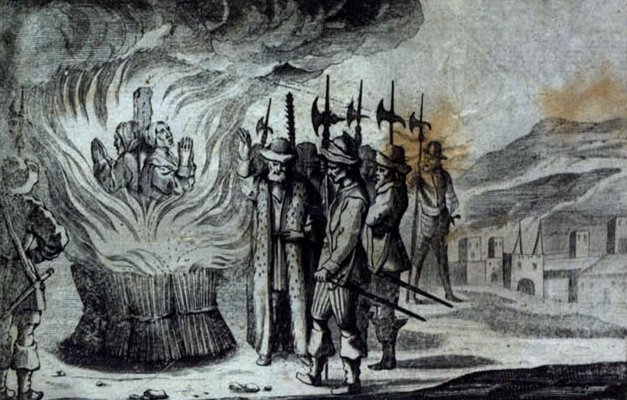
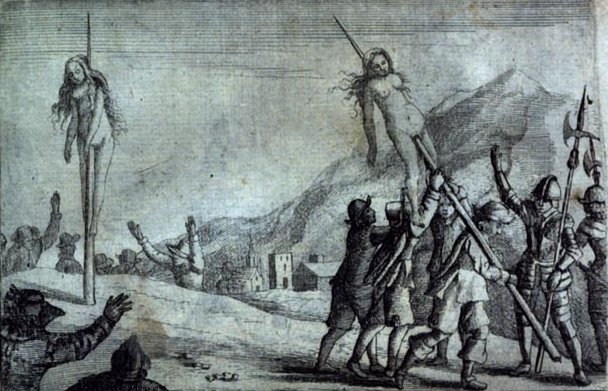
Little children were torn from the arms of their mothers, and dashed against the rocks; or, more horrible still, they were held betwixt two soldiers, who, unmoved by their piteous cries and the sight of their quivering limbs, tore them up into two halves. Their bodies were then thrown on the highways and the fields. Sick persons and old people, men and women, were burned alive in their own houses; some were hacked in pieces; some were bound up in the form of a ball, and precipitated over the rocks or rolled down the mountains … Some were slowly dismembered, and fire applied to the wounds to staunch the bleeding and prolong their sufferings; some were flayed alive; some roasted alive; others were disembowelled; some were horribly and shamefully mutilated, and of others the flesh and brains were boiled and actually eaten by these cannibals.
Without doubting the capacity of man’s inhumanity to man, the cannibalism charge reminds that we’re dealing with propaganda alongside historiography. And what great propaganda — like, babies-torn-from-incubators great.
Thumbnails (click for a larger, disturbing view) of selected images of this date’s atrocities from Samuel Morland’s The History of the Evangelical Churches of the Valleys of Piedmont
And there’s little doubt as to the overall savagery of the affair, which could well have become the opening salvo in a full-scale sectarian cleansing campaign. (A later addendum to Foxe’s Book of Martyrsnarrates the ensuing Piedmontese armed struggle, petering out before any definitive resolution in the field.)
Outrage at this hecatomb spread in Protestant Europe — which would also refer to the day’s doings as the “Bloody Easter,” since it corresponded with the eve of that celebration as reckoned by the Julian Calendar (source).
It was felt especially in Protectorate England, which intervened diplomatically.
A “day of solemn fasting and humiliation” was promulgated in Albion, along with collections for the relief of the survivors. Oliver Cromwell personally put £2,000 into the kitty.
More importantly, he dispatched diplomat Samuel Morland† to force the House of Savoy to lay off the persecution; in fact, he threatened to disrupt high statecraft between England and France unless the French twisted arms on behalf of the Waldensians.
Written correspondence for Morland’s diplomatic tour addressed to Louis XIV of France and various other continental potentates, as well as a fiery bit of oratory that Morland delivered to Savoy, all seem to have originated from the pen of Republican scribbler John Milton — the future author of Paradise Lost.‡
Milton, for whom the whole thing was more than just a day job, was further moved to put his umbrage at the slaughter into sonnet form:
Avenge O Lord thy slaughter’d Saints, whose bones
Lie scatter’d on the Alpine mountains cold,
Ev’n them who kept thy truth so pure of old
When all our Fathers worship’t Stocks and Stones,
Forget not: in thy book record their groanes
Who were thy Sheep and in their antient Fold
Slayn by the bloody Piemontese that roll’d
Mother with Infant down the Rocks. Their moans
The Vales redoubl’d to the Hills, and they
To Heav’n. Their martyr’d blood and ashes sow
O’re all th’ Italian fields where still doth sway
The triple Tyrant: that from these may grow
A hunder’d-fold, who having learnt thy way
Early may fly the Babylonian wo.
* The Waldensians in question here are interchangeably known as the Vaudois for their geographic region, actually above the Piedmont and abutting the Swiss region also known as Vaud. (These pages have visited the latter.)

 She’d been convicted of espionage and treason in relation to her activities with the Polish Underground.

 The unfortunate subject of the story was the first, and remains to date the only, woman put to death in Belize.
 Following the classic sob-story vector from orphan to juvenile delinquent to petty criminal,