1923: Edith Thompson and Frederick Bywaters

On this date in 1923, adulterous lovers Edith Thompson and Frederick Bywaters were simultaneously hanged at two different prisons in England for the murder of Thompson’s husband.

From left to right, Freddy Bywaters, Edith Thompson, and the victim, Percy Thompson. (Source.)

As a bored middle-class housewife, Edith had struck up an affair with their handsome, adventurous 18-year-old boarder.

The affair met a horrifying and sensational conclusion when Bywaters confronted the cuckold in October 1922 and slew him in the ensuing altercation.

Bywaters was unquestionably and confessedly guilty, but the case became a national cause celebre — and an enduring historical artifact — because of the widow’s place in it.

Mrs. Thompson had fled the crime scene to police distraught and implicated her paramour. The police didn’t view her as a witness, but as an accomplice. In dozens of love letters that soon surfaced, she had fantasized about escaping Percy Thompson and claimed to have attempted to poison him. Coroners could not establish that she had in fact done so, and no evidence but her letters linked her to the crime; those letters were not given to the jury as a whole but censored for her frank treatment of menstruation, abortion, and lovers’ rendezvous. Thompson’s defenders see them as some mixture of escapism and confused romanticism much less sinister than the crown charged — though the letters are indeed suggestive of more than sensuality.

Both were condemned.

Bywaters gallantly defended his lover’s innocence throughout the ordeal and more than a million people petitioned the government for her reprieve.

Edith Thompson’s fate bore an unmistakable stamp of gendered social prejudice from the start. “Mrs Thompson was hanged for immorality,” her lawyer would say later. That sense has only become more pronounced in the intervening 85 years.

Academics have taken on the matter:

Women in the 1920s had won certain freedoms, and writings on sex and marriage now presented married women as legitimate sexual beings, but there was still significant hostility towards the expression of explicit female sexuality, let alone a woman’s adultery, especially with a younger man. In the years immediately after the First World War there was particular concern to differentiate normal from deviant sexual behaviour, acceptable from unacceptable, and the War’s aftermath saw deep concern as to the disruptions of gender boundaries.

And here, in a piece contrasting the Thompson-Bywaters case with a recent hanging in Singapore:

[T]he stark contrast between the cases of the men, on the one hand, and the woman on the other, raises issues about the gendered aesthetics of sentimentality and abjection in media representations of contested death-penalty cases.

From a less exalted plane, Rene Weis, author of a book about Thompson, is convinced of Thompson’s innocence:

Edith Thompson paid a terrible price for daring to be ruled by her passions, and for behaving out of her social class. If confirmation were needed that it was her perceived immorality that brought her to perdition, it is provided by the foreman of her jury. “It was my duty to read them [the letters] to the members of the jury … ‘Nauseous’ is hardly strong enough to describe their contents … Mrs. Thompson’s letters were her own condemnation.”

The sexuality at the heart of the affair was to set its mark upon this day’s grim doings as well. When hanged, Thompson bled copiously from her vagina, feeding speculation that she had been pregnant or that her uterus had inverted.

Her hangman — who also executed Hawley Harvey Crippen — emerged from the secretive procedure raving, and retired shortly thereafter. Some friends thought a lingering disturbance over his part in the Thompson case eventually led him to commit suicide. (John Ellis reportedly hated hanging women.)

Besides Weis’ book, this renowned case has also generated a fictionalized treatment and a 2001 film, as well as inspiring the recent novel The Adulteress.

On this day..

1945: Josefa Llanes Escoda

On this day in 1945, Filipina suffragist Josefa Llanes Escoda was last seen before her presumed execution by the Japanese occupying troops holding her at Manila’s Far Eastern University.

Escoda came of age with her native archipelago under American colonization. An energetic and brilliant woman, Escoda lectured in sociology at the University of the Philippines, held several civil service posts, founded the Girl Scouts of the Philippines and helped win female suffrage.

During the Japanese occupation, her efforts to aid POWs — including those on the Bataan Death March — made her the “Florence Nightingale of the Philippines”.

But she declined to do so in the capacity of Japanese collaborator and she and her husband Antonio were arrested in 1944 and executed in the weeks following MacArthur’s return and push towards Manila.

Escoda is pictured on the Philippines’ current 1000-peso bill.


Escoda is in the center of the three figures on this banknote. Jose Abad Santos, also executed by the Japanese, is in the top left.

On this day..

1739: Penelope Kenny and Sarah Simpson

On this date in 1739, Penelope Kenny and Sarah Simpson were publicly hanged in colonial New Hampshire for “feloniously concealing the death of a[n] … infant bastard child.”

The first people — male or female — executed in New Hampshire history had separately disposed in August 1739 of their respective newborns. Unluckily for them, some never-discovered third woman did the same thing around the same time much less adroitly … and her dead infant was found in a well.

The ensuing investigation uncovered (in one case by the forcible ministrations of a midwife team) the recent pregnancies of this day’s victims, and though Simpson claimed her child was miscarried, she still fell under a law making a capital crime of covering up the death of a baby.

Today, Executed Today interviews New Hampshire historian Christopher Benedetto, whose research situates Kenny and Simpson in the context of their times:

In provincial New Hampshire, as was common across colonial America, the punishment of fornication and bastardy was harsh, and the stigma that followed could cost a working class woman her livelihood. When Penelope Kenny and Sarah Simpson gave birth in August 1739, they both knew that the physical product of their sexual improprieties must be concealed. It was an awful decision to have to make, but in their minds “infanticide might have seemed a matter of survival.” The discarding of illegitimate children, however, seems to have been an issue in New Hampshire long before 1739. In 1714, the General Assembly passed “An Act to Prevent the Destroying and Murdering of Bastard Children,” which declared

Whereas many lewd women that have been delivered of Bastard children, to avoid shame and escape punishment, do secretly bury or conceal the death of their children…Be it therefore enacted…that if any woman be delivered of any Issue of her body, male or female, which if it were born alive should by law be a Bastard; and that she endeavor privately either by drowning or secret burying thereof…so to conceal the death thereof that it may not come to light, whether it were born alive or not but be concealed. In every such case the Mother soe offending shall suffer Death…except such Mother cann make proof by one witness at least, the Child whose death was by her so intended to be concealed was born dead.

Executed Today: The first hanging in New Hampshire didn’t happen until 1739?!

Christopher Benedetto: There were plenty of capital laws and there definitely were cases where people were tried for their lives, but why it took so long … they had crossed some sort of a boundary. I’m sure the loss of so many children only a few years before [in a diphtheria epidemic] made these crimes that much more shocking.

ET: You’re working on a book on crime in New Hampshire.*

CB: The criminal history of Massachusetts has been studied for so long, but there’s really nothing like this for New Hampshire at all. And there’s so much there. There’s a whole chapter in the book on infanticide and child murder.

ET: What’s the perspective you get working deeply in a local milieu?

CB: I think having grown up here, my own family I’ve been able to trace back to the 1650’s in Massachusetts … it’s always been a big part of my life.

I like being able to go to different sites where these things actually happened. I think that’s true for any historian — you’re drawn to the specific places. The town I grew up in, Ipswich, they have plaques of people who lived there. Anne Bradstreet‘s house is still there.

I could walk on a lot of the streets or at least go to some of the places where these things took place.

But to me, history is about people. It’s about passions. To me, these people are so much like us today. Human nature has not changed a lot over the years.

ET: Does that lead to any conclusions on the death penalty in general?

CB: It’s one of the few things that’s as controversial now as it was two, three hundred years ago. I don’t think capital punishment prevents crime. I do think there are certain instances where the crime is so heinous, so bad — I don’t know, I’m sort of in the middle on it. I think we should reserve the right to do it, but does it improve our society at all?

ET: What advice would you have for a young person about being a historian? What’s the historical method for you?

CB: I would say, just be curious. You’ve got to be relentless. You’ve got to go after what you’re passionate about — nobody wants to do research about something they’re just not interested in.

To me, I love writing, but I think one of the most thrilling parts can be when you’re sort of on the hunt. I kind of see being a historian — and not just professionally; anyone who’s researching a family history — you’re almost like a quilter. You’re taking all these little pieces of fabric and just trying to create a whole picture. That might be my favorite part, taking all those pieces of information and just putting them together.

It’s not that nobody had ever written about that execution [of Kenny and Simpson] before, but maybe nobody had taken all that information and just kind of put it together in that way. You’re not always going to have something 100% new to say, but you might present it in a way that casts a new light or makes somebody think about it differently.

* Tentatively titled Gruesome Stories from the Granite State with an anticipated release in 2009 through regional press Commonwealth Editions.

Part of the Themed Set: The Spectacle of Public Hanging in America.

On this day..

1989: Nicolae and Elena Ceausescu

On this date in 1989, 71-year-old dictator Nicolae Ceausescu and his wife Elena were condemned by a secret military tribunal and immediately shot in Targoviste as Communism in Romania suddenly, stunningly collapsed.

The last of the Revolutions of 1989 that toppled Communism through much of Eastern Europe in a matter of weeks left the indelible image of the man who had dominated Romanian politics since the mid-60’s bewildered as a party-summoned mass rally at Bucharest’s Revolution Square turned against him.

It was to be Ceausescu’s last public address. Within a day, the country had slipped from his control; before week’s end, he would face a firing squad with “The Internationale” on his lips at the conclusion of a drumhead trial.

In a confused political situation — the police who intercepted Ceausescu and his wife held them for several hours, attempting to divine which way the winds were blowing before handing them over to the mutinous army — Romanian state television would soon broadcast footage of the trial and the first couple’s corpses (though not the execution itself).

Caution: This video contains graphic footage

Immediately afterwards, Romania abolished the death penalty. Nicolae and Elena Ceausescu remain the last people executed in that country.

On this day..

1594: Alison Balfour

On this date in 1594, Alison Balfour was burned as a witch on the strength of a confession extracted under the hideous torture of her family.

Balfour had been implicated in a plot — probably entirely fictitious — to poison the tyrannical young Earl of Orkney, with some misshapen blob of wax appearing as evidence of her communion with the infernal.

She was tortured, but she denied the charges.

Her 81-year-old husband was tortured in front of her, but she denied the charges.

Her son’s feet were crushed in front of her, but she denied the charges.

When at last her seven-year-old daughter was put to thumbscrews in front of her, she broke down and “confessed.”

Before her execution, she renounced her confession in heartbreaking words to be read in the original records:

sche … declarit and tuik upoun hir saull and conscience, as sche wald ansuer att the day of judgement … that sche wes als innocent and wald die als innocent on ony point of Wichcraft as ane barne new borne … the tyme of hir first Depositioun sche wes tortourit diverse and severall tymes in the Caschielawis, and sindrie tymis takin out of thame deid,* … as lykewyis hir guidman being in the stokis, hir sone tortourit in the Buitis, and hir dochtir put in the Pilliewinkis, quhairwith sche and thay wer swa vexit and tormentit, that pairtlie to eschew ane gretar torment and pwneischement, and upoun promeis of hir lyffe, and guid deid be the said Personne, falslie, aganis hir saull and conscience, sche maid that Confessioun, and na uthirwyis.

Just two years later, another supposed perpetrator of this same plot was acquitted in Edinburgh — the evidence of Balfour’s case thrown out as unreliably obtained under torture.

* “taken out of them dead” — i.e., unconscious

On this day..

1596: Francisca Nunez de Carvajal, her children, and four other crypto-Jews of her family

On this date in 1596, the Inquisition sent nine Jewish converts to Christianity to the stake in Mexico City for Judaizing — a cruel fate offering a window into a secret history of New World settlement.

When Spain expelled its Jews (and subsequently its Muslims), those who did not flee had to convert. Conversions at swordpoint being of suspect sincerity, the Inquisition spent much of the following centuries hunting Conversos — so-called “New Christians” — who secretly preserved their outlawed faiths.

For some crypto-Jews, the New World held an appeal akin to that which would draw later generations of northern Europe’s religious minorities.

Latin America in particular attracted considerable numbers of New Christians. The advantage of these territories was that they offered the New Christians a familiar culture and the possiblity of direct — even if infrequent — contact with the mother countries … These factors also helped permit [crypto-Jews] to practice Judaism.

The Carvajals (or Carabajals) were just such a family, settling in Monterrey under the aegis of their kinsman, Spanish governor Luis de Carvajal y Cueva.

But in 1590, the governor’s sister Francisa was tortured by the Inquisition into implicating her entire family in Judaism.

They got off with a humiliating public recantation, but evidence of a relapse a few years later resulted in Francisca being burned at the stake at an auto de fe — along with her children Isabel, Catalina, Leonor and Luis, and four of their in-laws. The 30-year-old Luis left a testimonial to his faith and his tortures.

A headstone in New Mexico, USA, suggests crypto-Jewish descent. Image used with permission.

Despite the grisly doings of this day, however, the Inquisition never could extirpate Jews from its American territory.

These hidden communities filtered into Mexico and north to the present-day United States, keeping adapted versions of Jewish traditions secretly alive.

Still, crypto-Jews produced scant potentially self-incriminating documentary evidence. Although DNA testing has latterly entered the scene, the true extent and nature of these populations has been the subject of lively scholarly controversy.

But the Carvajals and others like them, seemingly lost to the Inquisition’s depredations, are coming alive again. This day’s executions are the subject of a modern opera and a spring 2008 Texas A&M symposium.

And the wider community of crypto-Jews have their own umbrella organization and a burgeoning body of historical literature.

Books about crypto-Jews

On this day..

41 B.C.E.: Arsinoe IV, Cleopatra’s sister

On an unknown date late in 41 B.C.E., Cleopatra’s younger sister and rival Arsinoe was put to death in Asia Minor as the famous queen cemented her fatal alliance with Mark Antony.

Like Cleopatra herself, Arsinoe lived her short life in the internecine maelstrom of Ptolemaic politics under the sway of a Roman Empire itself immersed in civil strife. Violent death was something of an occupational hazard.

Nevertheless, had some flash of prescient irony visited her when Antony’s legionaries unsheathed their blades, she might well have wondered at the small happenstances of fate that left her a nigh-forgotten footnote in her sister’s story, rather than the other way around.

Three siblings had grasped at the Egyptian throne during the Alexandrian War, and whether it was charm or cold calculation won Caesar’s backing for Cleopatra, Arsinoe and her brother Ptolemy XIII still pressed the Roman garrison of Alexandria with a vastly superior force in a battle that was said to have set the Library of Alexandria aflame.

Timely Roman reinforcements decided the matter, and Arsinoe was marched in chains at Caesar’s sumptuous quadruple Triumph of 46 B.C.E. — though she was spared the execution that typically concluded such an ignominy and instead packed off to a temple on the coast of modern-day Turkey.*

In Margaret George’s historical novel The Memoirs of Cleopatra, the danger of maintaining an enemy who has styled herself Queen is neatly summarized in a conversation between Caesar and Cleopatra set after the Triumph:

“I have spared Arsinoe.” [said Caesar]

My [Cleopatra’s] first feeling was a rush of relief. My second was worry. Arsinoe the proud would not retire quietly.

“Where is she to go?”

“She has requested sanctuary at the great Temple of Diana in Ephesus,” he said. “And I will grant it, if you agree.”

Ephesus! Too close to Egypt! Better send her to Britain! Yet … I would gamble, and be merciful. Perhaps I was not enough of a Ptolemy after all. Arsinoe would not have granted it.

“Yes, I will allow it.”

That very perception of her potential danger hung over Arsinoe like the sword of Damocles.

The sword fell — figuratively and literally — five years later after Cleopatra seduced Mark Antony at Tarsus in the autumn of 41. Her terms for Egypt’s alliance supposedly included elimination of this lingering rival — though if Arsinoe had made common cause with Caesar’s Republican assassins, Antony may well have had his own reasons to dispatch the young woman.

Arsinoe’s death helped seal a pact that was itself destined for a bloody end. Distracted by his foreign paramour, Antony steadily lost political ground to his adversary Octavian. In another decade’s time, open war broke out again.

The Egyptian fleet would gather at Ephesus, not far from Arsinoe’s final resting place, bound for the catastrophic Battle of Actium whose outcome added Cleopatra’s and Antony’s blood to the soil from which sprung the long reign of Octavian — soon to be styled Augustus Caesar, the first emperor of Rome.

* A Temple of Artemis — either in Miletus (as Appian has it), or the wonder of the world in Ephesus (as Josephus has it). She met her death at the temple — whichever it was — dragged to its steps and put to the sword. Ephesus seems to be the more generally accepted locale, and an octagonal tomb there has been speculatively identified as Arsinoe’s.

Part of the Themed Set: The Fall of the Roman Republic.

On this day..

2001: Lois Nadean Smith

On this date in 2001, Lois Nadean Smith was executed by lethal injection in Oklahoma for the murder of her son’s ex-girlfriend.

By the standards of the 1,099 executions in the “modern” death penalty in America — those since the 1972 Furman v. Georgia Supreme Court decision — very little especially distinguished Smith‘s case.
Sentenced some 19 years before her death, she had committed a single horrifying and rather tawdry kidnapping and murder. Her guilt was in no question, although she stood trial along with her son — who received a life sentence — and would later argue on appeal that their lawyer had pursued a defense intentionally shifting blame onto her in order to save him.

As a woman, though, Smith was inherently an oddity. This date completed a remarkable year in which Oklahoma, having not put any woman to death since 1903, emptied its women’s death row with three such executions.

Including those three, only eleven women have been executed in the United States since Furman — or, indeed, since the Kennedy administration. There had been no calendar year in which three women were executed in the entire country since 1953 … and no single state had executed three women in one year since Virginia when the women in question were property.*

According to the Death Penalty Information Center:

Death sentences and actual executions for female offenders are also rare in comparison to such events for male offenders. In fact, women are more likely to be dropped out of the system the further the capital punishment system progresses. Following in summary outline form are the data indicating this screening out effect:

  • women account for about 1 in 10 (10%) murder arrests;
  • women account for only 1 in 50 (2.1%) death sentences imposed at the trial level;
  • women account for only 1 in 70 (1.4%) persons presently on death row; and
  • women account for only 1 in 90 (1.1%) persons actually executed in the modern era.**

At the end of a chain of improbabilities, Smith apparently met her death with composure. “To the families, I want to say I’m sorry for the pain and loss I’ve caused you,” she said from the gurney. “I ask that you forgive me. You must forgive to be forgiven.”

* See charts of female executions through 1962 and since 1900, both courtesy of the comprehensive Espy file of all executions in American history.

** This calculation appears to be slightly dated, with women currently accounting almost exactly 1 in 100 persons actually executed. The last 117 American prisoners executed have all been men.

(All stats are as of publication date in December 2007)

On this day..

1944: Lilo Gloeden, Erich Gloeden and Elisabeth Kuznitzky

On this date in 1944, Berlin housewife Elisabeth “Lilo” Gloeden was beheaded with an axe in Plotzensee Prison, along with her husband and mother.

They had been sentenced — and intentionally made an example of — just three days before for hiding a fugitive from the July 20 Plot to assassinate Hitler.

As Martin Gilbert observes in The Second World War: A Complete History, the fury of Hitler’s domestic crackdown came in inverse proportion to Germany’s fortunes in war.

[The family’s] fate was then publicized, as a warning to anyone else who might try to shelter the enemies of the Third Reich.

The fate of that Reich could not, however, be seriously in doubt. On the day of Lilo Gloeden’s execution, American troops drove the Germans from Mackwiller, in the Saar, inside Germany’s pre-war frontier. In Hungary, the Red Army entered Eger, less than twenty-five miles from the central Slovak frontier.

Part of the Themed Set: Women Against Fascism.

On this day..

1941: Zoya Kosmodemyanskaya

On this date in 1941, Soviet partisan Zoya Kosmodemyanskaya was hanged by the Wehrmacht for sabotaging buildings behind German lines near Moscow.

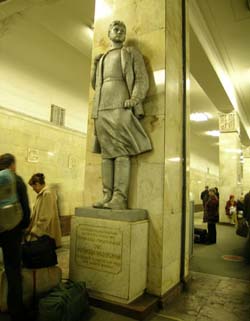
A statue of Zoya Kosmodemyanskaya stands vigil over Moscow’s World War II-era Partizanskaya metro station. Image used with permission.

One of the most famous Soviet war heroines and the first woman decorated as Hero of the Soviet Union during World War II, the 18-year-old had quit school to volunteer for a partisan unit only a few weeks before her hanging as Russia mobilized against Hitler’s race towards Moscow.

Known simply as “Tanya”, the nom de guerre which was the only information she volunteered during two days of torture, the power of the press offered her apotheosis into a propaganda coup for the Kremlin, and a symbol of courage that would long outlive Stalin. Before the public execution, the Nazis paused to photograph the scene; Kosmodemyanskaya availed the lull to harangue the Germans — “you can’t hang all 190 million of us!” — and call on the Russian villagers present to resist occupation.

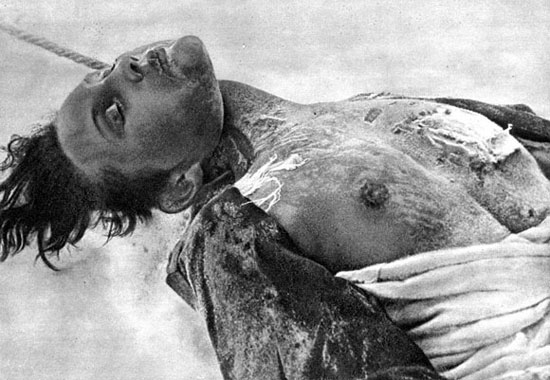
Her bayoneted, mutilated body hung on the gibbet until the Red Army recaptured the village; witnesses related the tale of her dying heroism to a newsman.

It was only after the story of “Tanya” hit the press in January 1942 that her identity was established … and then promulgated widely. Anonymous and obscure in death, Zoya Kosmodemyanskaya would inspire millions and become the heroic emblem of other women partisans.


Soviet propaganda poster unabashedly modeled on the already-iconic image of Zoya Kosmodemyanskaya’s abused corpse.

Zoya, a 1944 Soviet film, was scored by Dmitri Shostakovich.

Part of the Themed Set: Women Against Fascism.

On this day..