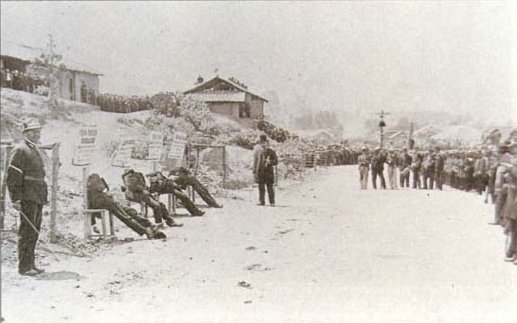
1312: Pierre Vigier de la Rouselle, Gascon

“It is unjust that that which is rightly judged should result in prejudice to us and bring damage to others …”

-Edward II, letter concerning the Pierre Vigier case

One is like to reckon the phenomenon of the interminable death penalty appeal a modern construct, product of the present day’s moral confusion or juridical inefficiency.

It’s been right about 700 years exactly since Pierre Vigier was hanged in the February-April neighborhood, in the year of our Lord 1312, for his impolitic sentiments on the governance of his native province. This medieval execution went with a very modern-sounding 12 years of indeteminate appeals.

Still, it is true what they say — “The past is a foreign country: they do things differently there.” In this foreign country, Gascony by name, they did the hanging first … and then did the appeals.

Our source here (virtually the only source short of plumbing the archives) is Joseph Kicklighter’s “English Bordeaux in conflict: the execution of Pierre Vigier de la Rousselle and its aftermath, 1312-24” from the Journal of Medieval History, no. 9 (1983).

And the source of all the judicial chaos was the bizarre situation of one king as a rival king’s vassal.

Gascony at this time was a sort of feudal leftover of the Angevin Empire whose Plantagenet descendants were still kings of England. This remaining Plantagenet patrimony* in southwestern France was a going source of conflict between the realms, the most recent of which had been expediently settled by making the English king also Duke of Gascony … and (with respect to Gascony) the French king his liege lord.


Seated French king Philip IV accepts the homage of his “vassal” Edward I.

The territory was worth the “submission”: ducal Gascony’s fertile land gave England a bounty in crops and wine. And the inevitable rivalry over sway in Gascony easily knocked on to the courts. As Barbara Tuchman put it in A Distant Mirror,

[t]he King of France still retained superior sovereignty under the formula of superioritas et resortum, which gave the inhabitants the right of appeal to the ultimate sovereign. Since his decisions were more than likely to go in their favor against their English overlord, and since the citizens, knowing this, exercised the right frequently, the situation was an endless source of conflict.

It was during such a conflict, when the rival factions of the Gascon capital of Bordeaux had the city in virtual anarchy as they jockeyed for power under the nominal lordship of English king Edward II, that the onetime royal castellan Pierre Vigier de la Rouselle apparently dumped on one of the new officials in conversation with a couple of informants.

The municipal government arrested Vigier and had him hanged — quickly, before Vigier’s inevitable attempted appeal to Parlement could save him.

(This all went down just a couple months before Edward II suffered a Gascon humiliation closer to home, when the Gascon nobleman Piers Gaveston, Edward’s dear friend and suspected lover, was executed by rival English lords.)**

Vigier’s aggrieved sons did pursue the appeal (it is they who provide posterity the circumstances of Pierre’s condemnation, so handle the story with care: one latter-day hypothesis is that Vigier was an outright rebel against the new appointees). Inevitably, the French backed their claim, allowing them undercut Edward’s ducal authority.


Productive relationship.

From there, the matter sank into an intractable mire of feudal Europe’s overlapping political authorities and factional rivalries. Parlement decreed some penalties. King Philip remitted some of them as a diplomatic gesture. The sons renewed their complaint. Bordeaux authorities tried to put the matter to bed by persecuting Vigier’s persecutors, only to be slapped down by an indignant King Edward. Persons were seized only to be ordered released, and estates likewise. Just as there was no single unambiguous authority to adjudicate it, there was no single wrongdoer to investigate, no single injury to repair (besides the matter of honor, there was the dead man’s property, and the fact that he was buried in unconsecrated ground), and no single arrangement of interested parties between the Vigier sons on the one side and the Plantagenet king on the other.

Edward seems to have taken particular affront at this imposition on his routine authority, and one must bear in mind that at this stage even the concept of sovereignty as we think of it today was simply not on the map. In some ways, the French appeals policy was pioneering it.

But as the suit bumped up and down or got kicked down the road by a Parlement that was probably enjoying its sport, Edward tried to dispose of it through such expedients as harassing its supporters and attempting to bankrupt the Vigiers. All this, naturally, just got rolled into the messy ol’ case.

Kicklighter:

Only time itself finally ended the appeal … in March 1324, King Charles IV announced the indefinite postponement of all ducal litigation at the Parlement of Paris becase of a mounting Anglo-French crisis which would soon lead to the brief War of Saint-Sardos. But even during the war, the court continued to deal with some aspects of the case; and the appeal was still under judgment when the Anglo-French feudal relationship was resumed with the accession of Edward III to the English throne.† It seems likely … Parlement had dropped the case by the 1330’s … in all probability, the Vigier case had lost the critical importance with which the king-duke and his officials had regarded it for so long. One might, with some justification, wonder why the appeal had ever enjoyed such attention.‡


In 1337, King Philip VI of France attempted to seize Gascony. In response, Edward III declared himself (not without at least some theoretical validity) the rightful King of France. The ensuing hostilities proved to be the opening act of the Hundred Years’ War.

“It was not the dynastic question that brought about the war,” wrote the historian T.F. Tout. “The fundamental difference between the two countries lay in the impossible position of Edward in Gascony.”

* Here’s a lovely free book about the preceding century’s backstory of English rule in Gascony.

** Potentially topical to this digressive connection: Edward’s loyal aide in Bordeaux, a gentleman by the name of Arnaud Caillau, may have been a cousin of Piers Gaveston. Edward certainly had a supportive Gascon faction that his own resentful alleged vassals were frequently keen to harass; maybe the whole Vigier intervention just struck a little too close to home.

† The reader will recall that Edward III’s route to power involved his French mother and her lover invading England and overthrowing Edward II. So there was a good deal of more interesting politics going on around this time than Pierre Vigier’s endless procedural appeal.

‡ Lest we misrepresent Kicklighter, he does go on to attempt to explain this hypothetical wonder as “a certain indication of the limited power of the English in Gascony.” I prefer my own stopping-point.

On this day..

1762: Jean Calas, intolerably

(Thanks to Mary O’Grady for the guest post. -ed.)

In the 1760s, Toulouse was no place for a Huguenot, not even for an affable, prosperous paterfamilias like Jean Calas. The whole southwestern region of France barely tolerated Protestants.

The Calas household included two adult sons, Louis, who had converted to Roman Catholicism, and Marc-Antoine, their sisters, as well as their parents, Jean Calas and his wife, and a longtime maid who was Catholic. Monsieur and Madame Calas and their daughters were Protestant, as was Marc-Antoine. Friends and associates described the ménage as placid, except for occasional outbursts of misbehavior by elder son Marc-Antoine.

Jean Calas was a textile dealer. On October 13, 1761, young Marc-Antoine Calas was found hanged in his father’s shop. Wishing to spare the family’s reputation from the stigma of suicide as well as his son’s corpse from the mutilation which was customary for suicides, Jean Calas at first claimed to the authorities that an intruder killed his son.

An ugly rumor swept Toulouse: Marc-Antoine was murdered by his own parents, because he planned to convert to Catholicism. (Never mind that Jean Calas kept his Catholic son Louis in the bosom of his family and employed a Catholic servant.) Jean Calas was arrested and subjected to a trial that was anything but fair; by this time, he had admitted, too late, that his son had hanged himself, probably over gambling debts.

No dice. The appellate court of Toulouse condemned Jean Calas to death on March 9, 1762. The execution was set for the following day.

Murder of a family member was held to be a particularly hideous crime, and hideous was the penalty: breaking on the wheel. Jean Calas was tied to a cartwheel in the main square of Toulouse. His limbs were broken with iron rods. He proclaimed his innocence until the executioner finally strangled him to death.

L’affaire Calas inspired Voltaire to new vigor in his fight for religious toleration. In 1763 he published A Treatise on Tolerance, a landmark document which remains well-read today.

O different worshippers of a peaceful God! if you have a cruel heart, if, while you adore he whose whole law consists of these few words, “Love God and your neighbor,” you have burdened that pure and holy law with false and unintelligible disputes, if you have lighted the flames of discord sometimes for a new word, and sometimes for a single letter of the alphabet; if you have attached eternal punishment to the omission of a few words, or of certain ceremonies which other people cannot comprehend, I must say to you with tears of compassion for mankind: “Transport yourselves with me to the day on which all men will be judged and on which God will do unto each according to his works.

“I see all the dead of past ages and of our own appearing in his presence. Are you very sure that our Creator and Father will say to the wise and virtuous Confucius, to the legislator Solon, to Pythagoras, Zaleucus, Socrates, Plato, the divine Antonins, the good Trajan, to Titus, the delights of mankind, to Epictetus, and to many others, models of men: Go, monsters, go and suffer torments that are infinite in intensity and duration. Let your punishment be eternal as I am. But you, my beloved ones, Jean Châtel, Ravaillac, Damiens, Cartouche, etc. who have died according to the prescribed rules, sit forever at my right hand and share my empire and my felicity.”

May all men remember that they are brothers! May they hold in horror tyranny exerted over souls, just as they do the violence which forcibly seizes the products of peaceful industry! And if the scourge of war is inevitable, let us not hate one another, let us not destroy one another in the midst of peace, and let us use the moment of our existence to bless, in a thousand different languages, from Siam to California, [God’s] goodness which has given us this moment.

-Voltaire, A Treatise on Tolerance

As a result of Voltaire’s efforts, 50 French judges were appointed to a panel to review Jean Calas’s case. Their charge was to decide whether anti-Huguenot prejudice had cost Jean Calas his life. They reversed Calas’s conviction on March 9, 1765, the third anniversary of the poor man’s condemnation.

A few French books about Jean Calas

On this day..

1784: Anton Joseph Suter, Appenzell politician

On this date in 1784, 64-year-old former Landammann of Appenzell,** was beheaded in a nasty bout of local politics.

The amiable and fair-minded Suter (wee German bio), a tavernkeeper, won election to his position at the head of a popular party — in the process defeating a local aristocrat who expected the gig as his birthright and nursed a terrible grudge against Suter for the defeat.


The cantonal form of direct democracy by which Suter was elected, the Landsgemeinde, is still practiced in Appenzell. This (cc) image from Götz A. Primke shows the 2009 assembly in Appenzell, at which crotchety, longsword-bearing residents voted a ban on nude hiking.

This aggrieved aristocrat, Geiger by name, had to bide his time all through the 1760s and into the 1770s, until the political stars aligned against Suter.

It seems a neighboring town had been able to take possession of a lush alpine slope in Appenzell’s environs by dint of an unpaid mortgage, a terrible wound to Appenzell’s pride and no small inconvenience to its residents.

Suter pushed an attempt to force repurchase of this land in a suit at the Swiss Diet, a sort of United Nations of otherwise-autonomous Swiss cantons. But he lost the suit, and the Diet demanded that Appenzell cough up the court costs as well.

Accustomed as we are today to the suits and countersuits that constitute the very cogs of late capitalism, it’s a little hard to understand how the trifling matter of a court fee could suffice to topple a government — but it did. Geiger’s people prevailed upon the canton’s executive council to drop the suit (Suter pursued it on his own), and now persuaded it to drop Suter.

Well, persuaded. It’s more like, it did several days frantic retail politicking from the pulpits and in the streets, then showed up when the council met to shout down Suter and drag him out by force, not neglecting to disenfranchise Suter’s many supporters who fought them on the point. As Suter fled into exile, Appenzell pronounced him a rebel on the strength of some super-secret documents.

That really could have been that, but Suter’s foes were so intent on his head that they contrived a ruse to lure him back into the canton’s territory on the pretext of a secret meeting with his daughter — then arrested him, tortured him with thumbscrews and the rack, and finally sentenced him to death.

On the day appointed the scaffold was closely surrounded by troops. Suter, maimed and pale, was assisted to his place. Standing there a moment he addressed the people, declaring himself robbed and murdered by his country. He then knelt down and in clear tones thrice pronounced the Ave Maria. With the last word of the last repetition of the prayer the sword descended and his head fell …

The sight of the blood of the ex-Landamman filled the people with rage. They had looked for a reprieve to the very last; and now that all hope was gone, they fell upon such of the victim’s enemies as were to be found lingering in the streets and fought and struggled with them in their desperation … The enemies of Suter were found to form no exception to the rule that retribution pursues the murderer. No sooner was the ex-Landamman in his grave than the Furies took up their task … Geiger, who formerly had gone about demanding Suter’s life, now — a pitiable victim to remorse — went about acknowledging that for seven long years he had pursued him without a cause. It is related concerning the member of the Blood Court that they all ever afterwards were harassed by terrors of conscience, one to such an extent that he even became insane. The guilt of Suter’s murder settled upon Inner-Rhoden irretrievably … like the very brand of Cain. Time went by and changes occurred, but that remained. Finally in 1829, forty-five years after the execution, the Great Council met and, with a solemnity befitting he occasion, unanimously revrsed the findings of the court by which Suer had been banished, as also of that by which he had been sent to the block.

Another summary of Suter’s career and sad end can be found here.

* Thanks to the same public-domain source, we’ve visited Appenzell before.

On this day..

1906: The would-be assassins of General Rafael Reyes

BOGOTA, Colombia, Tuesday, March 6. — The three men who on Feb. 10 attempted to assassinate Gen. Reyes, the President of the Republic of Colombia, were shot to-day at the spot where the attack took place.

-New York Times, March 8

Reyes had parlayed a successful military career into politics (Spanish link), and was the elected-ish but also dictatorial president of Colombia.

He had the misfortune to ascend to this illustrious post on the heels of a bitter civil war that had seen its Panama department break clean away. To Reyes’ administration would fall a variety of civil society infrastructure projects (more Spanish): constitutional reform, military modernization, a central bank, reconciliation with the Liberal party.

Marco Salgar (left) and Roberto Gonzalez, two of the failed assassins.

He couldn’t make these omelets without breaking a few eggs and his authoritarian power was challenged with at least two coup attempts and multiple assassination plots, as well as a bid by other Colombian territories to break away and join up with Panama.

But the most notorious angry-with-Reyes event was the 10th of February 1906 — also the title (Spanish again) of a book of photographs documenting the incident — when three gunmen ambushed Reyes on the outskirts of Bogota and somehow all managed to miss both the president and his daughter.

Reyes’ vengeance was extrajudicially old-school: the executions he arranged were not permitted under Colombian law at all, and by having them publicly shot at the scene of the crime, he added a downright medieval twist of lese-majeste.


Images from here. These are the three shooters mentioned by the Times, as well as a fourth accomplice.

However rough his methods, Reyes did accomplish some important reforms for his country, and he did have the grace to resign his position in 1909 under fire for financial and diplomatic mismangement. (The man’s five-year administration has its own periodization in Colombian historiography: the quinquenio.) There have been worse entries in the annals of dictatorship.

On this day..

1945: Lena Baker

What I done, I did in self-defense, or I would have been killed myself. Where I was I could not overcome it.

-Lena Baker’s final statement

The state of Georgia has only ever electrocuted a single woman: African-American maid Lena Baker, put to death on this date in 1945 for murdering her abusive employer.

Baker was a sharecropper and a former sex worker hired to care for white mill owner Ernest Knight as he recuperated from a broken leg. This, as Baker’s biographer Lela Bond Phillips puts it, “developed into a sexual relationship.”

A twisted, sometimes-violent relationship.

Both Knight and Baker were alcoholics, and the Knight liked to keep his domestic in the gristmill for days on end.*

As an interracial liason, it was also entirely taboo; Knight’s son tried everything to separate his dad from this scandalous arrangement, including moving the family and beating up Baker.

Knight pere was even more committed to keeping her.

On the night of April 29-30, 1944, the elder Knight locked Baker up in the mill, after she’d attempted to flee him. Baker testified that after Knight got back from church — it was Sunday, after all — Baker tried to leave over Knight’s threats. The two fought over Knight’s pistol, and the fight ended when the pistol discharged through Knight’s head. As to how it went off or who pulled the trigger, Baker said she didn’t know.

Although the irascible, hard-drinking Knight wouldn’t have won any popularity contests among his white neighbors, this breach of the color line was prosecuted both vigorously and speedily: a one-day trial that August (the all-white, all-male jury goes without saying, right?) sufficed to send the maid to her death.**

She’s (obviously) the subject of the 2008 film Hope & Redemption: The Lena Baker Story.

* Virtual imprisonment of domestic labor: not a thing of the past.

** In 2005, the Georgia Board of Pardons and Paroles — which turned down Baker’s clemency application in early 1945 — issued a posthumous pardon suggesting that a non-death penalty manslaughter charge would have been the more appropriate conviction. Baker’s family and defenders read that as vindication; there’s a detailed NPR story about it here.

On this day..

1845: John Gordon, the last hanged in Rhode Island

Last year, the Rhode Island General Assembly approved a measure posthumously pardoning John Gordon — who on February 14, 1845 was the last man executed in that state.

Gordon’s hanging, for the murder of a prominent industrialist who had bad blood with Gordon’s brother, was long notorious in Rhode Island as one secured on highly uncertain evidence in an atmosphere of anti-Irish prejudice.

Executed Today is pleased to welcome on this occasion University of Rhode Island labor historian Scott Molloy, author of Irish Titan, Irish Toilers and a major advocate of the Gordon pardon.

ET: Can you set the scene — what’s going on in Rhode Island at this time, and what are the tensions surrounding Irish immigrants?

SM: Rhode Island was the site of the first factory in America in the 1790s, called Slater Mill. It really changed the face of Rhode Island and eventually the rest of the US.

In Rhode Island, curiously, as more and more people left the farms to work on the mills, they had an unusual requirement that really didn’t make any difference years earlier: in order to vote, you had to have so much land. (Specifically, $134 worth of land.)

By 1840, not only were the usual suspects not able to vote — women, people of color, Native Americans — 60% of native-born white male Rhode Islanders were also unable to vote. It meant that just a handful of people ruled the state, compared to the time of the American Revolution when just about every white male could vote. And immigrants in particular — and in those days, that was the Irish — were basically precluded from voting. You had a residency requirement, a property qualification. It made Rhode Island almost unique in New England, almost like a southern state.

A group of reformers came to the forefront, a guy named Thomas Wilson Dorr, a blueblood aristocrat, Harvard-educated, one of the best legal minds of the country. He threw his lot in with the reformers to try to get people the right to vote. It really polarized the state in 1842.

The Irish were sympathetic, but Irish priests tried to keep them out of it because they wanted to acclimate. But because a lot of the animosity toward people having the right to vote was directed at Irish immigrants. People blamed the Irish even though the Irish didn’t get particularly involved in the Dorr War.

Often times they got blamed for everything whether they did it or not. And of course we face the same situation with immigrants today.

What was the crime and how did the Gordons come to be the focus of the prosecution?

In 1843, a Yankee industrialist out in Cranston by the name of Amasa Sprague was found on New Year’s Eve 1843 bludgeoned to death in what today we might call a hate crime. He had a gold watch still on him, he had money in his poket, and he had been beaten to death.

Amasa Sprague was a very influential guy. His older brother who helped run the mill with him and was the US Senator from Rhode Island had the local city council lift the liquor license from the Gordon family’s business, which for all intents and purposes ended their livelihood. This was Nicholas Gordon’s shop: John Gordon had only just crossed over from Ireland.

When Sprague was found dead about six months after the license was lost, they focused on the Gordon family. The authorities formed a posse and they went after this Irish family.

Book CoverHow did anti-Irish sentiment manifest itself at trial?

The juries in all three trials had no Catholics and no Irish that I’m aware of. There was a lot of religious and socioeconomic animosity.

At the time, the Supreme Court of the state would sit in on the whole trial just because it was a capital trial, and the trial judge would say in the transcript — which is still available (pdf) — he basically says to the jury, if you find testimony that contradicts itself between a Yankee and an Irish witness, you should give the Yankee testimony more credence.

Doesn’t the fact that John Gordon’s brothers were not convicted militate against the notion of overwhelming anti-Irish prejudice?

You can’t go overboard on these things. The juries — all three of them — they found one Gordon innocent and in the other case they had a hung jury. I don’t want to say they were completely prejudiced, because they weren’t, but almost everything else in Rhode Island at that time was stacked up against them.

The earlier Irish who came in the 1820s and 1830s were a little bit better off, a little bit better-educated [compared to later Irish immigrants after the potato famine]. The animus against the Irish was still intense; the Irish were seen as criminal, unskilled, uneducated, ignorant. The Protestant majority at the time, mostly of English heritage, kind of brought that over with them even though they had been there for a long time.

So how did the legal proceedings play out?

They put two of the recently immigrated brothers up for conspiracy for murder, but not the oldest brother. So John Gordon and his brother William go on trial first.

The jury came back with a guilty verdict for John Gordon, who didn’t have much of an alibi, but a not guilty verdict for William, who did have an alibi. So you’ve got a conspiracy conviction with only one conviction.

Then they put Nicholas Gordon on trial, and the jury comes back deadlocked. His second trial is not going to be until the spring of 1845. In the interim, his brother John was to be hanged, Valentine‘s Day 1845 — rather than wait to see what happened at Nicholas Gordon’s trial and whether there even is a conspiracy.

The defense petitions the governor and the general assembly to hold off the execution until after the trial of the oldest brother. The governor washes his hands of it, and the general assembly votes very narrowly to go ahead with the execution.

So they hang him, and what’s interesting in that part of it is an itinerant, traveling Catholic priest — a guy named Father John Brady — hears John Gordon’s last confession.

Well, they invite the elite of providence inside the prison to watch the hanging. (There’s about 1,000 Irish outside the prison in support of John Gordon.) When they put the noose around his neck, the priest is with him, and the priest berates the elites and authorities, and he says, John, you are going before a just God who has seen way too many of your countrymen.

I always argue in my writings that this guy, he’s an immigrant, he’s uneducated, he’s just been in America for a few months. I just can’t believe that this guy would ever lie to the priest hearing his last confession, and the priest would never berate the elites unless he’d heard a confession of innocence.

After John Gordon’s hanging, his brother Nicholas goes on trial as planned, and they come back with another hung jury — this time, with a majority voting him as innocent. They were going to try him again except about 18 months later, Nicholas dies of natural causes.

I’ve seen a lot of people describe growing up hearing unambiguously that this was a wrongful execution. Is that how it was perceived right from the start? How universal was/is that perception?

There was such a collective feeling of guilt about this that in 1854, Rhode Island abolished the death penalty and John Gordon was the last person ever executed there.

There’s one flaw in the law. This was added late in the 20th century, that anyone convicted of killing a prison guard during an escape could still be killed. And there was an incident, I remember it as a kid maybe 30 years ago, but they still didn’t condemn even that person to death. But Rhode Island has never changed that.

None of us who ever testified ever said categorically that John Gordon was innocent, because we just can’t prove that. But we did say that he never got a fair trial, just like Sacco and Vanzetti in the 1920s.

We did in our research was come up with two or three suspects who had much better reason to assassinate Sprague. But there were no witnesses to the case. It was all circumstantial evidence. I have to say, every time I look at the case — there are some pieces of evidence that would make the Gordons look very guilty. There are other aspects of it that make them look very innocent. If it was in today’s world, the police would interrogate them as people of interest.

It’s not as cut-and-dried as some people make it. All I know is that they got an unfair trial.

Gordon was posthumously pardoned last year. How did that campaign get going, and how receptive were folks in the capitol?

The problem was a lot of people had forgotten the case. I had been writing for a number of years op-ed pieces in the Providence Journal, and mentioned John Gordon from time to time.

But it was an 80-year-old guy named Ken Dooley, and he grew up a couple miles from the murder site near Cranston, and he was a playwright. He came back home and remembered his grandmother singing some little ditty of a song 70 years ago saying something like “Poor Johnny Gordon”, and so he researched it, and he wrote a play.

And they put it on in Cranston, and over the couse of the month several thousand people saw it. A state representative, an Irish guy, saw the play four or five times and then introduced that into the general assembly trying to obtain a posthumous pardon — just to say that the evidence didn’t support the execution.

And Gov. Chaffee, who comes from an ancient Yankee family in Rhode Island, signed the damn thing. It was that play that this guy wrote and we were all amazed that this kind of came out of the blue. We held a lot of events around it — had church services, put up ceremonial headstones. I always tell people that I want this on my headstone: that I had a hand in getting John Gordon pardoned.


There are some excellent resources already available online concerning the Gordon case, including:

On this day..

1992: Johnny Frank Garrett, “kiss my ass because I’m innocent”

On this date in 1992, Johnny Frank Garrett was executed by lethal injection, with the tart last words,

“I’d like to thank my family for loving me and taking care of me. And the rest of the world can kiss my everloving ass, because I’m innocent.”

Although Garrett was only 17 at the time a nun from a neighboring Amarillo convent was raped and murdered, and he may have qualified as developmentally disabled to boot — both factors that today would exclude him from execution — that whole innocence story didn’t have much public traction.

“No, no, not at all,” New Mexico attorney Jesse Quackenbush told this site in an interview. “He was villainized from day one: he was a nun-murderer who needed to be executed. The only sympathy really came from the Pope.”

But two decades on, Garrett’s dying profession is one of the more troublesome skeletons in the Texas execution machine’s closet, thanks in no small part to Quackenbush himself.

Quackenbush directed the documentary The Last Word (viewable free on Netflix), a powerful brief not only for Garrett’s innocence* but against the comprehensive rot of the system that shunted hm off this mortal coil — from the front-line investigators all the way through the Lone Star State’s intentionally broken executive clemency farce.

“It was a system-wide failure that caused this kid to die. It wasn’t just the legal system,” Quackenbush said. “The media played a part. The governor was looking more to her own re-election hopes.* There was a dysfunctional family. The Supreme Court wasn’t morally deep enough to realize that executing 17-year-olds and ‘mentally retarded’ prisoners was wrong. There’s the system in Texas that allowed the prosecutors to hand-pick the pathologists to provide junk science.

“It’s a multifaceted failure, and no one facet is more to blame than the others.”

Garrett, a white teenager, disappeared into a Kafkaesque legal labyrinth, after the alleged supernatural vision of a local soothsayer acclaimed him the culprit in the murder of a nun named Tadea Benz. Corporeal indicia of guilt falls somewhere between circumstantial and laughable: fingerprints in a convent he had visited many times, the inevitable jailhouse snitch, and an unrecorded supposed “confession” that Garrett refused to sign.

As in a preponderance of death cases, especially in Texas (pdf), a meek and all-but-unfunded defense team offered scant resistance as prosecutors made the most of this eminently disputable evidence: once the one-sided trial was in the books and the crucial direct appeals likewise slipped past, the proceedings lay beyond the reach of judicial review.

This novel is inspired by the Garrett case.

For all that, there yet remains one un-litigated piece of evidence.

Around the time of Sister Benz’s death, there was another rape-murder of another elderly Amarillo woman, a crime that authorities publicly described as “too similar” to the Benz case not to be part of the same crime spree.

That case went unsolved … but years after Garrett’s execution, DNA databases matched an old semen sample from that second crime to a Cuban rapist (he was among the criminals and undesirables that Castro expelled to the U.S. during the Mariel boatlift) named Leoncio Perez Rueda.

Suggestive.

More dispositive evidence in the form of still-testable crime scene samples may yet reside in Amarillo’s evidence lockers — semen and blood samples that, in the era of DNA, Quackenbush thinks would exonerate Johnny Frank Garrett.

If testing this sort of thing sounds like a no-brainer, you don’t work for Amarillo.

“The [Garrett] family offered the city of Amarillo complete civic immunity and they still refused to run a DNA test, and threatened to countersue** if the family tried to pursue it,” Quackenbush says. “In the state of Texas there are still only laws protecting DNA access for living people: if you’re already executed, you have no rights.”

Which is a particular pity — since “the chances of executing innocent people are still really high.”

* Quackenbush’s case for Garrett’s innocence is outlined in this legal memo (pdf). This site maintains an extensive archive of resources about the case.

** In this, it’s not unlike the Ruben Cantu case, where post-execution evidence of innocence has also been met with legal threats by the state.

On this day..

1860: John Guthrie, antislavery horse thief

On this date in 1860 in “Bleeding Kansas” — the frontier zone of dirty war by and against the Slave Power where John Brown got his start — a man named John Guthrie was hanged under scant-to-no color of law.

The site of this execution is still known as Guthrie’s Mountain or Mound … and it’s even alleged that the spot is still ill-omened by the event, and that the dying Guthrie “assailed his executioners for lynching an innocent man,” prophesying that “each of them would meet a horrible death” which curse the imminent U.S. Civil War carried into effect.

For a fuller account, see this pdf of a 1982 Kansas History article, “Guthrie Mound and the Hanging of John Guthrie”.


I know a story I think worth preserving of a Bourbon county execution without benefit of clergy, but it was not a lynching. I have had the story from a lot of people, including two eyewitnesses — not participants, of course. Away back in the later territorial days, when Bourbon county was in the ‘region beyant the law,’ a young man named Guthrie was caught up near Mapleton riding somebody else’s horse. Everybody knows that at that time in those parts, horse stealing and nigger chasing and homicide were offenses in a class by themselves. The hardheaded and hard-fisted farmers thereabouts gathered in a hurry. But there were no courts that they respected or had reason to respect. What to do?

Just across the river south of Mapleton in the Little Osage bottom is a little round hill about three hundred feet high shaped almost exactly like an overturned soup bowl. They adjourned to the top of that hill. There they elected a judge and a sheriff and a prosecuting attorney. They selected a jury and tried their man, who admitted his guilt. After the verdict and the proper sentence, the sheriff had no place to keep the man, so he executed the sentence at once by hanging him to the limb of a jack oak tree nearby. His body was buried where it was cut dawn. It is there yet.

From what I have been told I am quite satisfied that that trial was quite as regular and formal as many cases in the regular courts of that day, though not sanctioned by the law.

By the way, that hill is the same ‘pretty little hill’ where Lieut. Zebulon M. Pike ate the fried venison steak that September morning in 1806, as he notes in his journal. It is still called Guthrie mountain, and is one of the real beauty spots of old Bourbon.

C.E. Cory, 1932

The horse-thief story has different versions, in which Guthrie is either innocent of the charge or not. For what it may be worth, the 1860 New York Times also reported a “very imperfect” version of this take.


However, there’s at least one primary document suggesting that “thieving” may have been a pretext for killing the man over his anti-slavery stance.

Mapleton, K. T., Feb. 12, 1860. “MY DEAR PARENTS: … Last Sunday night about 1 o’clock a man named John R. Guthrie was hanged about a mile and a half from here on the top. of what is known as Tigret Mound. He was left suspended until Monday eve. His corpse was in plain sight from here as he hung. The proslavery’s hung him for an alleged crime of horse stealing. They arrested him without authority or shadow of law and never gave him even a mock trial, as has generally been the case. The country is again in commotion. I know not what will be the result, the probability is that unless Montgomery takes the field again it will soon blow over and give them a chance to hang the next ones that gets in their way.

Free Stater (i.e., anti-slavery) Alpheus H. Taylor

On this day..

1951: The first four of the Martinsville seven

On this date in 1951, the first of two batches comprising the “Martinsville Seven” — black, all — went to the Virginia electric chair for gang-raping a white woman. (The remainder were executed on Feb. 5)


Newspaper scan (click for larger image) via Mr. Beaverhousen (cc).

Somewhat forgotten today, the Martinsville Seven were in their day the locus of radical activism against Jim Crow in the South — very much like Willie McGee, who was put to death in Louisiana later that same year.

In fact, this case generated a bit of a legal milestone: a month before the executions began, the U.S. Supreme Court declined an appeal seeking relief on the then-novel grounds of equal protection — rather than due process.

The argument was that the Old Dominion’s superficially race-neutral rape statute was anything but; that argument was buttressed by data showing that Virginia had executed 45 black men for raping white women from 1908 to 1950, but never once in that period executed any white man for raping a black woman. (The high court only declined to take the appeal; it wouldn’t get around to explicitly ruling equal protection claims based on racial patterns out of bounds until 1987’s McCleskey v. Kemp.)

This seems to be the debut use for this gambit, bound to become an increasingly powerful one both in and out of the courtroom during the civil rights movement.

And it was available — and necessary — here because the Martinsville Seven basically looked guilty as sin. Their confessions and the victim’s accusation and the testimony of a young eyewitness said that, drink-addled, they had opportunistically grabbed a white Jehovah’s Witness housewife when she was proselytizing on the wrong side of the tracks.

Eric Rise, author of The Martinsville Seven: Race, Rape, and Capital Punishment, noted in a scholarly article,*

certain striking characteristics distinguished the proceedings from classic “legal lynchings.” The evidence presented at trial clearly proved that nonconsensual sexual intercourse with the victim had taken place. All seven defendants admitted their presence at the scene, and although some of the men may not have actually consummated the act … The prosecution emphasized the preservation of community stability, not the protection of southern womanly virtues, as the dominant concern of Martinsville’s white citizens. Most significant, the trial judge made a concerted effort to mute the racial overtones of the trials. Although white juries decided each case, blacks appeared in every jury pool. Race-baiting by prosecutors and witnesses, notably evident at Scottsboro and other similar trials, was absent from the Martinsville proceedings. By diligently adhering to procedural requirements, the court attempted to try the case “as though both parties were members of the same race.”**

The standard playbook for fighting a “legal lynching” case was leveraging outrage over a plausibly innocent convict and an outrageous kangaroo court.†

Paradoxically, by taking these elements out of the mix (relatively speaking), the Martinsville Seven perfectly isolated the extreme harshness of the penalty and the structural discrimination under which it was imposed. The NAACP took up the case on appeal strictly for its discriminatory characteristics, steering for its part completely clear of any “actual innocence” argument.

These challenges posed discomfiting questions that jurists shrank away from. The Virginia Supreme Court, in denying an equal protection application, fretted that actual legal relief could mean that “no Negroes could be executed unless a certain number of white people” were, too. Timeless.

Though a later U.S. Supreme Court would completely overturn death-sentencing for rape, based in part on its overwhelming racial slant, justices have generally avoided meddling to redress broad statistical patterns rather than identifiable process violations specific to particular cases.

Those questions of substantive — rather than merely procedural — equality in the justice system remain potently unresolved, still part of Americans’ lived experience of the law from death row to the drug war to driving while black. As if to underscore the point in this instance, just two days prior to the first Martinsville executions, the Wall Street bankster acting as American proconsul in conquered Germany pardoned imprisoned Nazi industrialist Alfried Krupp, and restored him to the fortune he had amassed working Jewish slaves to death during the war. It was a very particular quality of mercy the U.S. showed the world in those days. (The Martinsville case was known, and protested, worldwide.)

Carol Steiker (she used to clerk for liberal Justice Thurgood Marshall, who as an NAACP lawyer worked on the Martinsville case) argues‡ that the Martinsville Seven’s legacy is linked to their later obscurity, for “[t]heir attempt to present statistical proof of discrimination in capital sentencing represents a ‘road not taken'” — neither in 1951, nor since.

The road taken instead had Joe Henry Hampton, 22, Howard Hairston, 21, Booker Millner, 22 and Frank Hairston, 19 electrocuted one by one this morning in 1951. Their three co-accused, John Clabon Taylor, 24, James Luther Hairston, 23, and Francis DeSales Grayson, 40, followed them on February 5.

* “Race, Rape, and Radicalism: The Case of the Martinsville Seven, 1949-1951” in The Journal of Southern History, Aug., 1992.

** This quote an actual trial admonishment of the judge, Kennon Whittle.

† Graded on a curve: this is still Jim Crow Virginia. Six trials were wrapped up at warp speed in 11 days, with a total of 72 jurors — each one white. The implied comparison is something along the lines of, all seven tried together in the course of an afternoon, with a good ol’ boy defense attorney mailing it in.

‡ Review of Rise’s book titled “Remembering Race, Rape, and Capital Punishment” in the Virginia Law Review, Apr., 1997

On this day..

1971: Ousmane Balde, Barry III, Magassouba Moriba, Loffo Camara, Keita Kara Soufiana, and many others in Conakry

On this date in 1971, at least four former members of Guinea’s government were publicly hanged for supposed complicity in the previous year’s Portuguese invasion from neighboring Guinea-Bissau.*

The coup-threatened government of Sekou Toure was trying to send a message:

It did not scruple to make examples of men and women in very high places. Ousmane Balde (or Baldet) was Guinea’s former Finance Minister, Magassouba Moriba an Interior Minister, Barry III (also known as Ibrahima Barry; the link is French) the former Secretary of State. Keita Kara Soufiana had been Chief of Police. Loffo Camara was a National Assembly member.

Besides the quality of its reprisal victims, Conakry went in for quantity, too. Somewhere close to 100 death sentences were handed down with the barest of legal pretense, and the majority of them actually carried out on and around this date.

Personally arranging the grisly tableau for our hanged ex-ministers was a captain, Diarra Traore, who would one day help to overthrow the Guinean government, become Prime Minister … and wind up executed himself for his trouble.

* Guinea-Bissau was at that time still a Portuguese possession, known as Portuguese Guinea.

On this day..