1896: Chief Chingaira Makoni, Rhodesian rebel

On this date in 1897, the British captured, then summarily tried and shot, one of the most persistent native rebels of the Second Matabele War — or (since that’s the colonial British designation), the Chimurenga, or revolutionary struggle of what would become present-day Zimbabwe.

At this point, it was “Rhodesia”, named for imperialist wizard Cecil Rhodes. It was his British South Africa Company, relentlessly pursuing mineral exploitation,* that had pushed the Union Jack into this land.

For natives, of course, that meant dispossession by white settlers, with all the attendant conflicts.

Chief Chingaira of the Makoni district was one of these: “what annoyed him most was the pegging-out of the whole of his territory for farms or gold claims.”

That’s the sort of thing to annoy a man right into outright hostility — resource conflicts, after all, would soon put British and Dutch settlers into their own war, with memorable results for death penalty history.

Not the less affronted, Makoni rose in the Ndebele-Shona chimurenga of 1896-97.** Though the revolt was defeated, its progress ultimately would claim the lives of 372 settlers — one-tenth of Rhodesia’s white settler population.

Chingaira Makoni and a few dozen of his supporters were besieged from the end of August 1896 in a cave, and forced out after several days by dynamite and pledges of safe conduct. Makoni emerged into capture in the dark of night September 3-4, but as described in this public-domain history of Rhodesia, initial plans for some regular trial were hastily discarded upon the escape of some of his fellows.

… [after capture] it was feared that if Makoni should escape … the whole district would be in a blaze, and that the safety of Umtali itself might be endangered. A court-martial was therefore convened to try him, one of the native commissioners being appointed to act as interpreter, and as his defender. In spite of his assertion that he was innocent, he was found guilty of being a rebel, and of having caused the murder of the three traders; he was therefore sentenced to be shot, and the sentence was carried out at once. He was placed with his back to a corn-bin, on the edge of the precipice on which his kraal stood, and died with a courage and dignity that extorted an unwilling admiration from all who were present. One of the best known men in Salisbury, when talking to me about it, said, “I know of nothing grander than Makoni’s death, than the quiet way in which he spoke to his people, and told them to abstain from further resistance; for himself he only begged that he might be buried decently. ‘And now,’ he said, ‘you shall see how a Makoni can die.'”

As with so many entrants in these dolorous pages, the end of the vital signs were not the end of the story. In consequence of Makoni’s martyrdom:

  • The officer who ordered his drumhead trial and execution was himself court-martialed — but acquitted
  • Makoni’s head was allegedly (pdf) hewed off as a trophy (legend has it being sent to Cecil Rhodes† himself)
  • Chingaira Makoni was elevated into the national mythology of (eventually) Zimbabwe

Though it does not deal in any great detail with our day’s principal, this narrative of the campaign by one of the white soldiers involved makes topical reading.

* Rhodes also founded the De Beers diamond mining colossus.

** Actually (and this is a scholarly pdf),

Academic historians have debated whether or not Chingaira Makoni was really a resister, or whether he did not merely stumble into confrontation with the whites, or whether, indeed, he did nothing at all and was merely a victim of white paranoia. These revisionist debates are very remote from the terms of the Chingaira myth in Makoni in the 1970s. In the myth Chingaira was unequivocally the embodiment of resistance; the hero ambiguously slain; buried, no-one was quite sure where; maybe to come again.

The source cited for this entry’s description of Makoni’s death actually upholds the “he didn’t actually rebel at all” position in its chapter on Makoni.

† Rhodes’s disastrous Jameson Raid on the neighboring Transvaal Republic had itself set the stage for the second Matabele Rebellion by depleting Rhodesian troop strength. It also got brother Frank Rhodes sentenced to death — a sentence later commuted.

On this day..

1736: Both John Vernham and Joshua Harding survive a hanging

Bristol, September 4.

Yesterday at 12 o’Clock, Vernham and Harding, were carry’d from Newgate to the Place of Execution on St. Michael’s hill, attended by the Under-Sheriff, and his Officers, and the Constables of the City, (in a Cart, with Halters about their Necks;) the Divine who attended them, having finish’d his last Office, the Cart drew away: But to the Surprize of every one, after hanging the usual Time, and being cut down, Vernham was perceived to have Life in him, when put into the Coffin; and some Lightermen and others, who promis’d to save his Body from the Surgeons, carried him away to a House; and a Surgeon being sent for, immediately open’d a Vein, which to recovered his Senses, that he had the Use of Speech, far up, robb’d his knees, shook Hands with divers persons that he knew, and to all seeming Appearance, a perfect Recovery was expected.


Appropriately metaphorical image of a gateway on St. Michael’s Hill in Bristol, (cc) Daniele Sartori.

The Rumour of this, soon came to the Under-Sherif’s Ears, who, with Mr. Legg, and several Officers armed, went to know the Truth, and finding it certain, were about to remove him to a proper Place, in order to have him again under their Care for a second Execution,and finishing the Law; which we hear would have been done in a private Manner, without any Ceremony: But whether any secret Method was used to dispatch him, or not, he died about Eleven o’ Clock, in great Agony of Pain, his Bowels being very much convls’d, as appeared by his rolling from one Side to the other, and often on his Belly.

{He was bout 20 Years of Age; while [under] Sentence of Death he behaved very penitent, laying the whole of his Misfortune upon a fatal Companion,* particularly as to the breaking open Mrs. Atherton’s House. Harding behaved very unconcerned, charging his Wife with being the chief Inset to his Misfortunes, and even curs’d her just before he received the Sacrament that Morning.}

And to our second Surprize, Joshua Harding is also come to Life again, and is actually now in Bride-well, where great Numbers of People resort to see him, Particularly Surgeons, curious of Observations. He lies in his Coffin, covered with a Rug, has Pulsation, breathes freely, and has a regular Look with his Eyes; but he has not been heard to speak, only motions with his Hand where his Pain lies. ‘Twas thought he would be executed a second Time {to the finishing his unhappy Fate by a private Execution, at the same Tree he was cut down from}; but we are now told, he is to be provided for in some convenient House of Charity, with Restraint, he being to all Appearance defective in his Intellects. Two such Resurrections happening at one Instant in the World, was never heard of in the Memory of man.**

The Virginia Gazette, Dec. 24, 1736. {Curly-braces portions from an otherwise largely identical report in The South Carolina Gazette, Jan. 15, 1737.}

Coverage from The Daily Gazetteer is available here. The London Magazine adds the detail that all those curiosity-seekers visiting Harding “give him Money” and “are very inquisitive whether he remembers the Manner of his Execution: to which he says, he only can remember his being at the Gallows, and knows nothing of Vernham’s being with him.”

* This Annals of Bristol says that Vernham nearly refused to plead until the prospect of judicial pressing caused him to chicken out. (And ironically, to the extent it forwarded his execution date to this evidently felicitous occasion, almost saved his life.)

** Two hanged men reviving at once is remarkable indeed, but it was not so strange at this time for individual prisoners to survive their executions.

On this day..

1983: Jimmy Lee Gray, drunk-gassed

Just after midnight on this date in 1983, Jimmy Lee Gray gruesomely paid with his life in the Mississippi gas chamber for raping and murdering a three-year-old.

Mississippi’s gas chamber had had a checkered history since its first usage in 1955, and with America just emerging from a long lull in executions, Jimmy Lee Gray was its first client in 19 years.

“Sumbitch took a little three-year-old girl out into the bush and he raped her,” executioner T. Barry Bruce would later explain of the man’s crime. “Then he tried to shove her panties down her throat with a stick, then he pushed her head into a little crick full of running shit and then he broke her neck. So yeah, I feel real sorry for Jimmy Lee.”

Gray was on parole at the time for the 1968 murder of his teenage sweetheart, so no — nobody felt all that sorry for Jimmy Lee, not even his mom.

But the reason that questions about the affair were being directed at the executioner (usually a party as silent in these matters as he is implacable) was that Jimmy Lee Gray’s had been drunk on the job — and the execution was a notorious horrorshow.

“Gasping” or “moaning” a recorded eleven times, Gray convulsed wildly in the Parchman death chair, slamming his unrestrained head “with enough force to shake the chamber” against a metal pole that some user interface genius had positioned right behind the death chair. The witness room was cleared eight minutes into the affair, with Gray still thrashing about.

Though the Magnolia State contended that Gray was clinically dead within two minutes, that head-smashing act disturbed everyone.

As a result, for the third time in a half-century, Mississippi switched to a newer and supposedly more humane method for killing people — adopting lethal injection for anyone sentenced to death after July 1, 1984. (Three more prisoners already condemned under the old sentencing guidelines would die in the gas chamber in the late eighties, however.)

Actual executions in the U.S. were still novel enough in the early 1980s that Gray’s made national news — albeit distinctly second fiddle to the tense Cold War escalation occasioned by the September 1 Soviet downing of Korean Air Lines flight 007.

On this day..

1714: Maria Mouton and her slave Titus, lovers

On this date in 1714, a slave and his mistress — “mistress” in both senses of the word — were put to death in the Dutch Cape Colony for murdering her husband.

Marie or Maria Mouton had arrived in South Africa in 1699 as a nine-year-old with a refugee Huguenot family.

A decade and a half’s passage finds her a young woman wed to one Franz or Frans Joost/Jooste/Joostens, to whom she bore two sons … and, evidently, a homicidal grudge.

Early in 1714, Maria and her lover, a slave named Titus Bengale, murdered Frans, in consequence of which crime,

[s]he [Maria] is sentenced to be half strangled, after that to be scorched,* and after that strangled unto death. Titus to be empaled and to remain so, until death. After that his head and right hand are to be cut off and fixed on a pole, beyond the limits of his late master’s property. Fortuin, an accomplice, is also to have his right hand cut off, and without receiving the coup de grace, is to be broken on the wheel. After that he is to be placed on a grating until death takes place. After that his head is to be cut off, and with his hand placed on a pole, together with the head and hand of Titus. After that the bodies are to be taken to the outside place of execution, and there left exposed to the air and the vultures.

She’s the only white woman to be executed in 18th century South Africa.

Our Precise of the Archives of the Cape of Good Hope** notices that Titus, despite enduring his grotesque execution for two full days before succumbing, remained terribly jocund amid his public torture. (Not unlike other slaves tortured to death in Dutch colonies):

September 3 — The slave Titus, above mentioned, died about midday, having lived in his misery about 48 hours; something horrible to think of, to say nothing of personally beholding the misery. It is said that 4 hours after his empalement he received a bottle of arrack from which he drank freely and heartily. When advised not to take too much, lest he should get drunk, he answered that it did not matter, as he sat fast enough, and that there was no fear of his falling. It is true that whilst sitting in that deplorable state, he often joked, and scoffingly said that he would never again believe a woman. A way of dying, lauded by the Romans, but damnable among the Christians.

This case is discussed in more detail by Nigel Penn in “The wife, the farmer and the farmer’s slaves: adultery and murder on a frontier farm in the early eighteenth century Cape,” Kronos, vol. 28 (2002) — here’s an excerpt — and by the same author in Rogues, Rebels and Runaways: Eighteenth-Century Cape Characters.

* Literally, blaker. “To ‘blaker’ someone,” notes Nigel Penn in “The wife, the farmer and the farmer’s slaves: adultery and murder on a frontier farm in the early eighteenth century Cape,” Kronos, vol. 28 (2002), “was to hold burning straw to their face and to blacken it … a reference to the earlier practice of burning at the stake victims found guilty of heresy, witchcraft and sodomy. Surely we may also see, in the case of the blackening of Maria Mouton, a reference to her crime of cohabiting with slaves.”

** After another slaveowner was murdered later in the year, the chronicle laments that “crime is rapidly assuming large dimensions, in spite of the means used to prevent or suppress it. A clear proof that this Colony mainly consists of evil disposed, head-strong slaves and the refuse of convicts.”

On this day..

1923: Nathan Lee, the last public hanging in Texas

This date in 1923 was the passing of an era: the last legal public hanging in Texas.

The Texas of legend — the rough and vast frontier — fits the public hanging tableau (and its dark cousin, the lynching) like a hemp necktie.

And up until 1922-23, Texas executions had indeed been hangings administered by county sheriffs. But that newfangled killing technology, the electric chair, beguiled the legislature here as elsewhere. Oil wells popping up all over the state were rewriting its economic future … so why not a futuristic way of killing wrongdoers, too?

A 1923 bill centralized future executions in Huntsville, where they still remain today.

Denouncing countyseat [sic] executions as a barbaric relic of the frontier past, L.K. Irwin launched a one-man campaign to bring Texas in tune with the times. The state legislator converted many to his cause with the argument that public hangings harmed society almost as much as the condemned.

Irwin insisted executions usually degenerated into bloodthirsty carnivals that did nothing to instill in spectators a respect for the law. All too often untrained local officials made the spectacle even more gruesome, when the drop failed to snap the victim’s neck. On those occasions, he slowly strangled in full view of females and impressionable children.

In the 1923 session of the Lone Star legislature, Irwin introduced the Electric Chair Bill. In addition to doing away with the gallows, the proposal relieved county sheriffs of the responsibility of the carrying out death sentences. Future executions would be held behind closed-doors inside the Texas Department of Corrections.

That law took effect on Aug. 14, even though the electric chair hadn’t even been built yet. The hanging of one Roy Mitchell in Waco on July 30 figured to be the last, and thousands packed the public square to witness it. It’s still sometimes cited as the Lone Star State’s last hanging.

Grandfather Clause

But on that very same date in the Gulf town of Angleton, Nathan Lee, an illiterate middle-aged black sharecropper, was condemned to die for shooting his white employer dead in a dispute over money. (The Ku Klux Klan sent flowers to the funeral.)

A month later, he did so — albeit in an area whose public access had intentionally been curtailed, to chill out any potential carnival scene.

“I did it,” Lee said on the scaffold. “I am to blame, and no one else.”

On this day..

1996: Ebbisaa Addunyaa, extrajudicially executed

On this date in 1996, Oromo singer Ebbissaa Addunyaa was slain in his Addis Ababa home.

He “appeared to have been extrajudicially executed on suspicion of supporting the OLF,” according to Amnesty International. “No investigations were known to have taken place into allegations of torture, ”disappearance” or extrajudicial execution.”

“Extrajudicial execution” is a category challenge for these pages; Ebbisaa Addunyaa was not tried for anything, never mind convicted. His “execution” was a close cousin to simple murder … but a murder carried out by state security forces, targeting him specifically, and acting, if not under color of law, at least with legal impunity.

Ebbisaa and his friend Tana Wayessa

were at Ebbisaa’s home … north of the American Embassy in Addis Ababa, when gunmen burst in. Eyewitnesses claim the bodies were dragged from the house and put in a Land Rover with a government license plate. The security men, who carried out the murders, first cleared the street. Residents who looked out of their houses after the gunfire were told to get back indoors. The bodies were recovered [the] next day from the morgue at the Menelik II hospital.

All this took place in the turbulent 1990s wake of the collapsed Derg dictatorship. An initial multiparty post-Derg coalition government had included the Oromo Liberation Front — an organization upholding the rights of Ethiopia’s largest ethnic group — but the OLF soon withdrew from the coalition.

Ebbisaa was an OLF cadre who used his musical gifts for advocacy, and became a target when the outlawed OLF was forced underground.

A United Nations “Special Rapporteur” monitors “Extrajudicial, Summary or Arbitrary Executions” for the Economic and Social Council (ECOSOC).

Many of the Special Rapporteur’s reports dating back to the 1990s are available on the website of NYU’s Project on Extrajudicial Executions, and the 1997 country report (pdf) for Ethiopia reveals that Ebbisaa’s execution/assassination/murder was only one in a pattern.

The Special Rapporteur transmitted the following allegations of violations of the right to life concerning 16 identified persons and 13 unidentified persons: Ahmed Good Abdi, Ahmed Sanay Farah, Ahmed Sangaab and Hassan Ahmed Sagal, reportedly arrested and killed on 8 August 1996 in Toon-Ceeley by members of the Ethiopian armed forces; Ebissa Addunya, a singer and musician, and Tana Wayessa, reportedly shot and killed on 30 August 1996 by members of the Ethiopian security forces in the former’s house in Addis Ababa; 4 unidentified persons reportedly killed on 8 August 1996 in Gabababo; Awal Idire, aged 16, Awal Sani, aged 13, Badiri Shaza, aged 12, and Usen Kalu, aged 12, reportedly killed on 20 July 1996 by members of the Ethiopian armed forces because they had the initials of the Oromo Liberation Front tattooed on their hands; Mohamed Arabi Hirsi, Abdi Mohamed Yare, Gahnug Yusuf Aare, Mohamed Aw Farah Ga’iye, Haye Hirad, alleged to be tribal chiefs and clan elders, reportedly killed on 18 July 1996 by members of the Ethiopian armed forces; Sarecya Seerar Mohamed, her newborn child and eight other unidentified individuals, reportedly killed in mid-August 1996 by members of the Ethiopian armed forces in Qabridaharre (30 September 1996).

On this day..

1938: Bela Kun, Hungarian Communist leader

On this date in 1938 — so the Soviet government finally announced in 1989, after decades of opacity — the Hungarian Communist leader Bela Kun was secretly shot by firing squad in the gulag.

The pudgy and pugnacious* onetime journalist whose capture by the Russians during World War I enabled him to get in on the ground floor with the Bolshevik Revolution became the de facto leader of the short-lived Hungarian Soviet Republic. For a few months in 1919, it was the world’s second Soviet state after Russia itself.

Bela Kun’s moment in the sun was particularly notorious for his advocacy late in the Soviet Republic’s brief life of a Red Terror against internal opposition. Several hundred people were killed over the last few weeks of the state’s existence, until a Romanian invasion toppled the reds and sent Bela Kun fleeing back to the Soviets. There, he’s supposed to have brought his gift for wholesale murder to surrendered White prisoners in the Crimea.

Still, Hungary was an insurrectionary success next to most everywhere else, and Bela Kun was detailed to Germany to revive the flagging fortunes of a revolution that the Bolsheviks thought would be critical to sustaining their own. Modeling on Lenin’s own coup d’etat in 1917, Kun pushed the Germans to go all-in on an aggressive 1921 “March Action” offensive to capture state power — which backfired catastrophically, essentially marking the end of the post-World War I revolutionary window. Vladimir Ilyich gave his Magyar counterpart a dressing-down for that gambit at that summer’s Comintern summit.

He’d become associated in this time with Zinoviev, an Old Bolshevik whose comradeship would blow an ill wind come the killing time of the 1930s. Kun himself was long past his sell-by date at this stage, knocking around Moscow feuding with other Hungarian exiles.

Stalin eventually had him arrested for “Trotskyism”, and he disappeared into the Gulag never to be seen again.

Like many purge victims, Bela Kun was rehabilitated under Khrushchev, which also made him fitting source material for statuary congenial to the post-World War II Hungary, situated (however unhappily) within Moscow’s sphere. Some of the detritus of this age can be found at Budapest’s Mememto Park outdoor fairgrounds of discarded Communist kitsch.


Bela Kun, marshaling the Magyar masses. The streetlamp behind him (a literary symbol of hanging) alludes to his martyrdom. Wider views of the entire monument: 1 | 2

* He had a rep in his youth for fighting duels.

On this day..

1793: Adam Philippe, Comte de Custine

The best defense would have been a good offense for French General Adam Philippe, Comte de Custine — guillotined in Paris this date in 1793 for inadequacy in command of the French revolutionary armies fighting continental monarchist armies.

You must be this tall to go on the General Moustache* ride, and poor results in the field at this time could leave you shorter. Losing to the enemy looked an awful lot like conspiring with the enemy, especially when there was a “Comte” in your name.
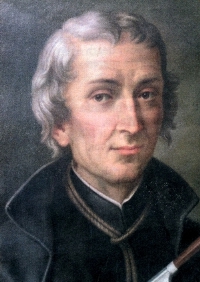
Custine spent the winter of 1792-1793 coughing up French conquests across the Rhine. (In his defense, several of them were things that he’d previously conquered himself.)

Recalled once to Paris to justify himself, the bewhiskered general was defended by no less than Robespierre, and thereafter returned to the field. Given this background, it was not wise of him to resume the losing streak — but he did.*

The resultant second recall saw the moustache — and its associated head — permanently shaved for treacherously throwing battles like the 1919 White Sox. This met with the great approval** of Hebert‘s Pere Duchesne :

“Epitaph on General Custine”

Here lies an headless General—(I’ll say dead)
As many living Generals want an head.

You have just done something worthy of me by denouncing Custine. You have brought into broad daylight his plots and his treason. If we had waited a few more days to recall him freedom would have been fucked. This infamous rascal, after having had the French in Frankfurt massacred, after having abandoned Mainz, after having allowed Valenciennes to be encircled, after having delivered Condé, only awaited the right moment to lead his army into a slaughter and to deliver the coup de grace to the republic by sacrificing its last resources. Fortunately, the bugger has been put to the side. His crimes have been proved, let his head promptly fall under the national razor, but let his not be the only one! Let all the scoundrels who compose his headquarters also be shortened. Pursue, denounce without rest the infamous Tourville, who was the right arm of Lameth, and who will deliver Maubeuge if we leave him in command. Make known the swindler Lapallière, and especially the ci-devant marquis de Verigni, known in all the gaming houses under the name of Debrulis. Tell the Sans Culottes in the army that this rat has emigrated twice. Don’t forget Leveneur, the intimate friend of Lafayette, and the henchman of Custine. Don’t allow these bandits a moments rest until they’ve been chased and punished as traitors.

Custine’s son also got the chop for defending his old man.

Surviving the purge: Adam Philippe’s then-three-year-old grandson, Astolphe Custine. Custine would become famous as “the de Tocqueville of Russia,” and for his aphoristic and still-current travelogue La Russie en 1839.

* Actual nickname.

** And characteristically profane. Pere Duchesne would not have had a lot of patience for coy little cunnilingus references where a salty sans-culotte f-bomb would do instead.

On this day..

1679: St. David Lewis, the last Welsh martyr

On this date in 1679, the Jesuit David Lewis was hanged, drawn and quartered.

Lewis suffered just days after a fellow priest and fellow victim of Titus Oates’ “Popish Plot” concoctions, John Kemble.

Lewis was arrested at the Wales town of Llantarnam where he was Tad y Tlodion, “father of the poor”; hauled to London’s Newgate Prison, he was returned to Usk, also in Wales, for execution.

As with Kemble, Lewis “discover the plot I could not, as I knew of none; and conform I would not, for it was against my conscience.” Where terroristic plotting could not be established, taking Holy Orders in the church would do just as well.

Lewis is not actually the last Catholic martyr in Britain* — Oliver Plunkett earned that distinction in 1681 — but at this late date he goes down as the last Welsh martyr, which is also the title of an energetic Catholic blog all about the man and his milieu.

Seems that site has a virtual pilgrimage to go along with the annual meatspace tradition that takes place this year on Sunday, August 29. The faithful might also enjoy friendsofsaintdavidlewis.co.uk.

* An inventory of martyrs for the faith in the Isles is here.

On this day..

2008: Behnam Zare, pleading for his life

On this date in 2008, Behnam Zare (or Zareh) was hanged in Shiraz for murdering, at the age of 15, another youth during a fight about a bird.

Evidently about 19 when he was finally put to death, Zare was hanged without any prior notice to his lawyer or his family.

A recording of Zare’s voice in what turned out to be his last call with his lawyer, pleading “I want to stay alive. Please, please I want to stay alive,” was used to open a 2008 documentary against executing juvenile offenders.

That attorney who represented Zare (and created the documentary) was Mohamad Mostafaei — an activist lawyer who described various forms of official harassment for his unwelcome work. Mostafaei has recently been in the news for his representation of Sakineh Mohammadi Ashtiani, the woman who made international headlines for receiving a sentence of stoning to death. (Mostafaei also represented cause celebre Delara Darabi, hanged in 2009.)

Just a few weeks ago, Mostafaei fled Iran ahead of an arrest warrant (several members of his family were also arrested as virtual hostages).

He was interviewed by the BBC in exile in Oslo. (Read on to the comments for a transcript.)

(Also of interest: Mostafaei’s gut-wrenching description of another child offender’s hanging in October 2009, and the desperate attempts to beg for mercy from the victim’s parents. StopChildExecutions.com has regular coverage of the juvenile death penalty in the Islamic Republic.)

On this day..