1939: Eugen Weidmann, the last public beheading in France

On this date in 1939, French murderer Eugen Weidmann dropped his head in the basket outside a prison in Versailles. France’s signal history of public beheadings died along with him.

The career criminal Weidmann knocked around prison in his twenties.

Further to the maxim that penitentiaries are the school of crime, Weidmann’s stint for robbery connected him right up with a couple of accomplices who started up a kidnapping-robbery-murder ring when they got out.

They left several bodies (and miles of newspaper copy) in their wake in late 1937 before the inevitable capture, confession, condemnation. (Weidmann’s accomplices all managed to avoid the chop.)

The beheading this day did not come off well; a massive crowd* jostled for a view, a scene belied by the tame crowd photo of the execution’s official witnesses.


Two photographs of Eugen Weidmann’s execution in Versailles 17 June 1939. (Click for larger images.)

The government immediately banned public executions. Although it wouldn’t be the government much longer, the change stuck.

But the crowd scene wasn’t the half of it.

Still photos of the guillotine had been snapped for years, but a delay putting justice into its heavy downward-crashing motion that morning meant the execution took place in plenty of light for an illicit moving picture.

Caution: Mature content. This is video of the guillotine in action.

From the time this film cut, France’s national razor would do its cutting only behind prison walls. It would be another 38 years yet before it trimmed its last client.

* According to his biography, British horror actor Christopher Lee — age 17 — was in the crowd.

On this day..

1441: Corrado Trinci, Lord of Foligno

On this date in 1441, Corrado Trinci was executed in Foligno.

Once the hereditary lord of that venerable town,* Trinci (English Wikipedia page | Italian), had turned tetchy with his Guelph family’s onetime papal patrons and suffered the consequences.

As the proper captain of an Italian city-state in the 15th century, Trinci had taken a few spins around the wheel of fortune in battle with his neighbors. He kicked off his reign in operatically sanguinary style when a neighboring town‘s castellan murdered Trinci’s brothers, suspecting one of them of adultery with his wife. Trinci revenged himself by sacking Nocera Umbra, which still holds a civic relay race (Italian link) commemorating the occasion.

Trinci didn’t fare as well when it came to picking on someone his own size.

For the next generation, Trinci would do the Machiavellian dance characteristic of his time and station — by turns allied with, at war with, or plotting with the papacy, Condottiero Francesco Sforza, the archbishop of Florence, and miscellaneous other peninsular neighbors and rivals. He was down. He was back up. He was beaten. He fought back. Etc.

Trinci pushed the wheel of fortune one turn too far by rebelling (again) against papal authority in the mid-1430s. His march on the Vatican-controlled Duchy of Spoleto was an initial success —

Corrado brought to Foligno four hundred youths of Spoleto, the standard of Spoleto, the chains, the locks from the city gates, the seal, and the clapper from the great bell of the commune.

Durante Dorio, as quoted and translated by Sergio Bertelli

That was in 1436. By 1439, Foligno itself (with Trinci inside it) had capitulated to a papal siege. Spoleto really wanted its clapper back.

Trinci was imprisoned with his family, and after a couple years’ languishing, put to death on this date. While both the English and Italian Wikipedia entries currently assert that he was strangled, the principal source for this gentleman’s biography, the freely-available Istoria della Famiglia Trinci by Durante Dorio, flatly asserts that the washed-up brawler was dispatched by decapitato.

By whatever method Corrado laid down his life, he retired with it not only the fame of his family but its Lordship of Foligno. The title fell extinct: Foligno became part of the Papal States and remain so right up to Italy’s 19th century unification.

* When next in central Italy, be sure to visit the lovely Palazzo Trinci. Corrado commissioned the Ottaviano Nelli frescoes in the chapel.

On this day..

1395: Ivan Shishman, falling to the Turks

On this date in 1395, Bulgarian tsar Ivan Shishman was beheaded in Nikopol by the Ottoman Empire then engaged in absorbing his crumbling empire.

Ivan is the little guy in the middle; the towering figures are his parents.

The mythical (though not quite literal) last emperor of Bulgaria, Shishman is ungenerously judged by Wikipedia “a vacillating politician whose inopportune choices speedily guided him to his violent end and the subjugation of the country by the enemy.”

The guy ruled a waning state under the shadow of a neighboring expansionist superpower. Only inopportune choices were available.

Shishman’s sister, Maria Thamara Hatun, had been married off to the Ottoman Sultan Murad I in a token of Bulgaria’s vassalage.

In 1389, said Murad smashed the Serbians at the Battle of Kosovo. Even though Murad died in combat, the Turks left the Field of Blackbirds with the Balkans by the throat and the Bulgarian Empire (or rather, Empires: Shishman and his brother had split the kingdom) nicely encircled.

Murad’s son Bayezid “the Thunderbolt” struck soon enough.

At the Siege of Tarnovo in 1393, the Turks essentially destroyed Shishman’s realm, while Shishman bugged out to be captured at a later mop-up operation.

The Ottomans took his head, but left Bulgaria a martyr whose iconography is still good for the nationalist metal audience.

The clips in this video are from the 1969 Bulgarian flick Tzar Ivan Shishman.

On this day..

1622: Not quite Squanto (Tisquantum), Pilgrim befriender

On this date in 1622, or very close to it, the Patuxet Native American Tisquantum (better known as Squanto) was about to be yielded by Plymouth Colony Governor William Bradford to Wampanoag chief Massasoit for immediate execution … when the unannounced appearance of a strange ship fortuitously saved him.

Squanto is most famous as the Indian godsend who saved the Mayflower Pilgrims at the Plymouth Bay colony from starvation by teaching those pious wayfarers how to live off the land in the New World.

In that capacity, he made possible (and participated in) the “First Thanksgiving” harvest gorger in 1621 that figures as the antecedent of the modern American holiday. Our day’s principal has therefore been portrayed on the stage by generations of schoolchildren from Cape Cod Bay to California.

But this was only the tail end of one of the most remarkable lives in history.


Photo of Tisquantum bust by N. Ayad of Cupids Cove Chatter. Photo was taken courtesy of the Pilgrim Hall Museum, Plymouth, MA, United States.

As a youth, Squanto was kidnapped from his native soil by English explorer George Weymouth, who sold him into slavery in Europe. Squanto wound up in London in some sort of forced-labor capacity, before hitching a ride back to the Americas with Captain John Smith — the Pocahontas guy.

It was thanks to this improbable abduction and return trip that Squanto was available to materialize out of the woods, speaking the Queen’s English on this alien continent, in the nick of time to save the Plymouth immigrants from disaster.**

However, because Squanto was a real person and not a Disney character, he began exploiting his privileged intermediary position for his own advantage.

According to Plymouth Gov. William Bradford’s chronicle Of Plymouth Plantation,

Squanto sought his own ends and played his own game, by putting the Indians in fear and drawing gifts from them to enrich himself, making them believe he could stir up war against whom he would, and make peace for whom he would. Yea, he made them believe they kept the plague buried in the ground, and could send it amongst whom they would, which did much terrify the Indians and made them depend more on him, and seek more to him, than to Massasoit. Which procured him envy and had like to have cost him his life; for after the discovery of his practices, Massasoit sought it both privately and openly, which caused him to stick close to the English, and never durst go from them till he died.

Seeking Squanto’s life both privately and openly, Massasoit sent messengers to the Plymouth colony requesting the Machiavellian diplomat’s return in accordance with the colony’s treaty arrangements with the Wampanoag.

Bradford ducked and dilated, not wanting to give up this valuable asset, but the precarious colony also needed the amity of its Indian neighbors.

Massasoit remained insistent, according to the account of Edward Winslow,

entreating [Bradford] to give way to the death of Tisquantum who had so much abused him … [Massasoit] sent his own knife and [two messengers] therewith to cut off his head and hands and bring them to him

Bradford was on the point of yielding to this demand when a strange boat appeared unannounced — and the guv hit the “pause” button on everything.

he would first know what boat that was ere he would deliver him into their custody (not knowing whether there was a combination of French and Indians). Mad with rage and impatient at delay the messengers departed in great heat.

The delay turned out to be permanent … which for Squanto was only a few more months before he caught ill† and died later in 1622.

The ship that quite unknowingly bought Squanto this extra purchase on life had nothing at all to do with the drama unfolding between Bradford and Massasoit: it was the Sparrow, the advance party of the coming Wessagusset (or Weymouth) colony which would plant itself adjacent to the Plymouth settlers and completely crash and burn.

And the Pilgrims and the Indians lived happily ever after.

* This site asserts May 31 was the date that the Sparrow came ashore at Plymouth. Most sites are slightly less specific, noting only that the ship arrived in very late May.

** Among Squanto’s good deeds for the fledgling colony was tracking down a boy who got lost in the wilderness. The boy was John Billington, the eponymous son of the first man hanged in the Plymouth Colony.

† Some suspect that Squanto’s “illness” wasn’t so accidental, and the frustrated Wampanoag chief simply dispensed with the diplomatic rigmarole and poisoned him off.

On this day..

1797: Gracchus Babeuf, for the Conspiracy of Equals

If the “revolutionary extremist” exists at all as an identifiable type, he exists in purest incarnation in Gracchus Babeuf. No revolutionary better fits the description “narrowminded to the point of genius”; few have defined their heaven more clearly or crusaded so fanatically, ascetically, so religiously to bring it to earth.

Gracchus Babeuf: The First Revolutionary Communist

On this date in 1797, Francois-Noel Babeuf lost his head for the Conspiracy of Equals — the last Jacobin upheaval of the French Revolution, or the first Communist upheaval of post-Revolution modernity.

Francois-Noel — he styled himself “Gracchus” after the populist Roman tribunes — was a young man of Desmoulins‘ generation but from a considerably more hardscrabble background. Like the starry-eyed Dantonist scribbler, Babeuf discovered himself a brilliant journalist and pamphleteer with the onset of the Revolution; he did several prison stints during various revolutionary phases of the early 1790s for his too-radical-for-school opinions.

He did another in 1795 under the French Directory for his firebreathing rag Le Tribun du Peuple, which was particularly unfashionable stuff during the post-Robespierre Thermidorian regime.

Nothing daunted, Babeuf emerged from prison the leading apostle of the Parisian proletariat which had by then been decisively separated from power.

The order of the day was class consolidation with the spoils of the aristocracy apportioned among a new oligarchy of wealth. As France rushed headlong towards Bonaparte and Bourbon restoration, Babeuf was the man left to rally “the party which desires the reign of pure equality.”

The French Revolution was nothing but a precursor of another revolution, one that will be bigger, more solemn, and which will be the last.

The people marched over the bodies of kings and priests who were in league against it: it will do the same to the new tyrants, the new political Tartuffes seated in the place of the old.

Manifesto of the Equals, 1796

One can see why later revolutionaries — Marx included; Babeuf makes a cameo in the Communist Manifesto — would adopt this sort of thing as a harbinger of the next century’s revolutions.

And if the Directory had known who Nicholas II would be, it would have had no intention of going the way of his family.

Instead, it shut him down in February, 1796: Napoleon Bonaparte personally carried out the operation, just days before he wed Josephine.


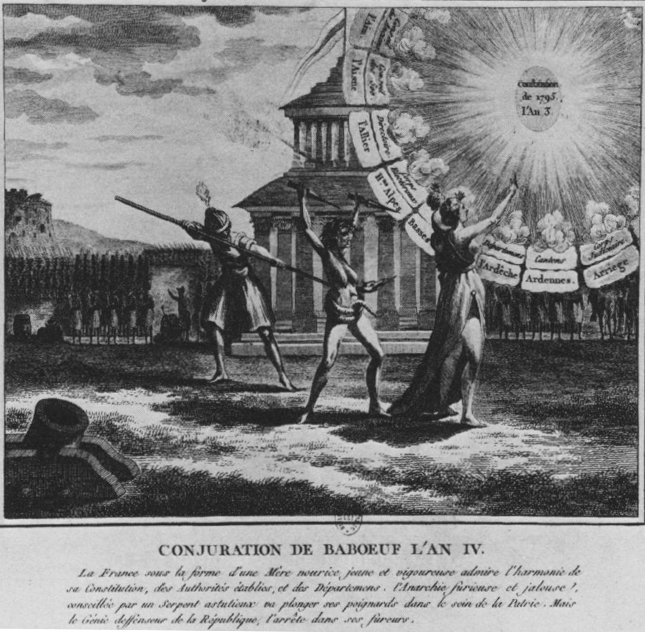
The Babeuf Conspiracy. Anonymous French print.

Babeuf’s party comes down to us as a “conspiracy,” under which word the state would charge him and which his follower Philippe Buonarroti would later rebrand the “Conspiracy of Equals”. It was not so much a grassy-knoll type of conspiracy as it was an underground organization.

When its adherents placarded Paris with the seditious “Analysis of the Doctrine of Babeuf” as the city endured a potentially dangerous economic crisis in April 1796, the government was put to a test of its strength.

It passed.

Having infiltrated Babeuf’s network, it arrested the principals on the eve of the Conspiracy’s intended insurrection. They were hailed out of Paris (a safeguard against sympathetic risings) to the commune of Vendome and there put on trial.* Babeuf and his associate Augustin Alexandre Darthe were condemned to death on May 26th and guillotined the very next day.

The last gasp of the French Revolution dropped with their heads into the basket.

Revolutionary Babeuvism, however, had scarcely just begun.

I don’t know what will become of the republicans, their families, and even the babies still at their mothers’ breasts, in the midst of the royalist fury that the counter-revolution will bring. O my friends! How heart-rending these thoughts are in my final moments! … To die for the fatherland, to leave a family, children, a beloved wife, all would be bearable if at the end of this I didn’t see liberty lost and all that belongs to sincere republicans wrapped in a horrible proscription.

-Babeuf’s last letter to his family

* The trial of Babeuf was itself a jurisprudential milestone: it was the first French trial to be transcribed verbatim.

What might look today like a nifty little advance for efficient judicature was bitterly controversial in 1797. The French Revolution had overturned an ancien regime practice of professional magistrates accepting legal testimony by written deposition and deciding matters behind closed doors. The liberte, egalite, fraternite way would instead demand that testimony be given live in the courtroom where citizen jurors could weigh its credibility.

Babeuf’s lawyer, Pierre-Francois Real, protested against the court stenographers, arguing that “The law insists that the system of written depositions not be restored in any way. That system will undoubtedly return if any means are used to save testimony given orally.”

There’s a fascinating disquisition on the curious and contradictory development of this issue and the way it “violates … common assumptions about the advance of textuality in the West” during the French Revolution in Laura Mason, “The ‘Bosom of Proof’: Criminal Justice and the Renewal of Oral Culture during the French Revolution” The Journal of Modern History, March 2004.

On this day..

1946: Marcel Petiot, Vichy serial killer

Paris, 1942.

On the run from the Gestapo — as a Jew or a Gypsy, a common criminal or a Resistance fighter whose cover is blown — you get wind of a man who can help.

“Dr. Eugène” will (for a fee) spirit you over the Pyrenees and thence to South America. In his house at rue le Sueur, you make the arrangements. One small matter: the tropics requires an inoculation, which le bon docteur will readily provide. One small prick of the needle and then …

The needle contained cyanide and the destination turned out to be a lime pit, and so “Dr. Eugène” — Marcel Petiot — was guillotined this date in 1946.

His opportunistic exploitation of the dangerous Vichy years is what he’s famous for, but Petiot had decades of crime behind him by the time he got his phony “underground railroad” up and running.

From youthful compulsive thieving, Petiot graduated into a shady medical practice in Villeneuve-sur-Yonne where he was the resident black market abortionist.

He’s thought to have killed a mistress there, and maybe a couple of others, but was able to segue into a political career by winning the mayoralty of Villaneuve when he sabotaged his opponent’s campaign appearances. The sticky-fingered Petiot naturally plundered the town treasury and was forced out of office in 1931.

By the time the war years had rolled around, Petiot had judiciously relocated to Paris where he retained his capacity for professional advancement in the face of profoundly disturbed behavior: he was institutionalized for kleptomania the same year he was appointed an official médecin d’état-civil.

So he had the requisite two-faced background for his whackadoodle wartime “escape route”, which he creepily code-named “Fly-Tox.”

Twists and turns elided — trutv.com and crimemagazine.com both have detailed biographies/case histories — Petiot’s enterprise was quasi-exposed early in 1944 when the stink of incinerating bodies prompted neighbors to summon the police and uncover his charnel house.

Amazingly, Petiot was able to beg off with the claim that he was a Resistance activist — these were French police — and that the victims were Nazis or collaborators who had been eliminated by his network on orders. The Gestapo had sniffed him out too late in the war to do anything about him, but its judgment that Petiot was a “dangerous lunatic” actually turned out to bolster the deranged doctor’s case that he was an anti-fascist.

The alibis fell apart as the war wrapped up, and Petiot was finally recognized in a Paris manhunt and brought to trial for 27 homicides. Police thought 60-plus was more like it — maybe even into the hundreds — but secured 26 of the 27 counts. That’s more than enough to do a man to death, especially since they were the for-fun-and-profit murders of desperate people already on the run from the late and hated occupying army. Bit of a touchy subject in France in ’46.

But there was good news.

This London Times (May 27, 1946) observed that Petiot’s beheading marked

the first time that the guillotine has been used since the war. Until now executions have been by firing squads. Although gruesome, it is one more indication of the return of this country to normal civil ways of life.

On this day..

1393: The Muzaffarids, by Timur

On this date in 1393 — or 10 Rajab 795 on the Islamic lunar calendar — the feared conquerer Timur (or Tamerlane) disposed of the squabbling ruling dynasty he had recently overturned, the Muzaffarids.

The House of Muzaffar came to prominence under the Mongol Ikhanate that stretched itslef from Persia to the Mediterranean in the 13th century.

As the Ilkhanate broke up in 1335, a guy like Yazd governor Mubariz al-Din Muhammad ibn Muzaffar could bloodily carve out a state of his own.*

Renowned for his cruelties, Mubariz al-Din ended his life blinded by his heir, Shah Shuja (or Shah Shujaa).

And in this generation, the House Muzaffar rapidly became a house divided, with brothers and cousins vying with each other (and with neighboring princelings). They were easy pickings for the rising Timurid Empire and its eponymous founder.

Exploiting a letter** sent by the aging Shuja (after a lifetime warring with his fellow Muzaffarids) recommending Shuja’s son to Timur’s protection, Timur rolled in and set up his own puppet Muzaffar. (It wasn’t the recommended son. C’est la vie.)

No sooner had Timur decamped for his next conquest than yet another of the Muzaffar clan — a brother of Timur’s puppet by the name of Shah Mansur† — revolted and set himself up as king.

It didn’t work, but Edward Gibbon was moved to pay tribute to Mansur’s intrepidity as he surveyed the Timurid annexations:

[P]etty tyrants might have opposed him with confederate arms: they separately stood, and successively fell; and the difference of their fate was only marked by the promptitude of submission or the obstinacy of resistance. Ibrahim, prince of Shirwan, or Albania, kissed the footstool of the Imperial throne. His peace-offerings of silks, horses, and jewels, were composed, according to the Tartar fashion, each article of nine pieces; but a critical spectator observed, that there were only eight slaves. “I myself am the ninth,” replied Ibrahim, who was prepared for the remark; and his flattery was rewarded by the smile of Timour. Shah Mansour, prince of Fars, or the proper Persia, was one of the least powerful, but most dangerous, of his enemies. In a battle under the walls of Shiraz, he broke, with three or four thousand soldiers, the coul or main body of thirty thousand horse, where the emperor fought in person. No more than fourteen or fifteen guards remained near the standard of Timour: he stood firm as a rock, and received on his helmet two weighty strokes of a cimeter: the Moguls rallied; the head of Mansour was thrown at his feet; and he declared his esteem of the valor of a foe, by extirpating all the males of so intrepid a race.

* The Muzaffarids’ most famous subject was the Persian poet Hafez (or Hafiz), whose lifetime was roughly paralleled the dynasty’s own. Hafez was patronized by the powers that be, though his favor waxed and waned.

** Timur himself would not think of empire-building; he accrued a mighty central Asian realm strictly by happenstance. “God is my witness that in all my wars I have never been the aggressor, and that my enemies have always been the authors of their own calamity.”

“For every war,” observes Gibbon of Timur and his ilk, “a motive of safety or revenge, of honor or zeal, of right or convenience, may be readily found in the jurisprudence of conquerors.”

† The Muzaffarid family tree is unnecessarily confusing, but a genealogy here may clarify matters.

On this day..

1641: Thomas Wentworth, Earl of Strafford

On this date in 1641, the doomed English monarch Charles I regretfully sacrificed one of his ablest ministers to the headsman.

Thomas Wentworth and loyal doggie, painted c. 1639 by Anthony van Dyck.

Thomas Wentworth, Earl of Strafford had cut his teeth in Parliament in the 1620s as an advocate of the rights of the Commons as against those of the king, but the notion that he’d be hoisted by his own petard would be little comfort to a King soon destined to find himself in similar straits.

After Parliament forced through the 1628 Petition of Right (and Wentworth’s pro-monarchist personal rival George Villiers, Duke of Buckingham had been conveniently assassinated) Wentworth went over to the king’s camp with the sententious declaration

The authority of a king is the keystone which closeth up the arch of order and government.

The authority of that king, which Wentworth now worked vigorously to uphold during the crown’s Parliament-free Personal Rule of the 1630s, also elevated Wentworth to higher honors.

He would have occasion to exercise his own “personal rule” as dictatorial viceroy in Ireland, and when push came to shove between King and Commons, advocated the most tyrannical measures to compel the compliance of obstinate Englishmen.

By 1640, Wentworth had become in the eyes of his enemies the very embodiment of the monarch’s every sin, and when Charles was obliged by his deteriorating situation to summon Parliament once more, its first order of business was the impeachment of this obnoxious retainer. When Wentworth skillfully repelled the charges and won acquittal on April 10, his parliamentarian opponents simply passed a bill of attainder condemning him to death anyway.

The only thing that stood in the way of the chop was the signature of that ruler whom Wentworth had served so loyally. As Charles dithered — for he had personally guaranteed Wentworth his safety upon his most recent summons to London — popular hatred for the Earl threatened to escalate the crisis into something much more dangerous for the throne.

In one last gesture of fealty, Wentworth dashed off a note to his sovereign, magnanimously releasing him from any obligation save political calculation.

Sire, out of much sadness, I am come to a resolution of that which I take to be the best becoming me; and that is, to look upon the prosperity of your sacred person and the commonwealth as infinitely to be preferred before any man’s private interest. And therefore, in few words, as I have placed myself wholly upon the honour and justice of my peers, I do most humbly beseech you, for the preventing of such mischiefs as may happen by your refusal to pass this bill, by this means to remove this unfortunate thing forth of the way towards that blessed agreement, which God, I trust, shall for ever establish betwixt you and your subjects. Sire, my consent herein shall acquit you more to God than all the world can do beside. To a willing man there is no injury done; and as, by God’s grace, I forgive all the world with a calmness and meekness of infinite contentment to my disloding soul, so, Sire, I can give the life of this world with all cheerfulness imaginable, in the just acknowledgment of your exceeding favours; and only beg that, in your goodness, you would vouchsafe to cast your gracious regard upon my poor son and his three sisters, less or more, and no otherwise, than their unfortunate father shall appear more or less guilty of this death. (Quoted here)

This letter’s place in the annals of sacrificial loyalty is compromised only slightly by its author’s dismay upon finding out that his feckless majesty had quickly taken up the offer:* Wentworth rolled his eyes heavenward and exclaimed

Put not your trust in princes, in a son of man, in whom there is no salvation.**

But the miscalculation was done.

Two days after Charles signed off, Wentworth was beheaded on Tower Hill to the rapture of an audience supposed to have numbered 200,000 strong.


Strafford Led to Execution, by Paul Delaroche, with Thomas Wentworth, Earl of Stafford, receiving the blessing of his ally, the imprisoned Archbishop William Laud.


1642 pamphlet illustration of the beheading, from here.

As things went from bad to worse for Charles in the years ahead, he would have many occasions to regret the sacrifice of so loyal and energetic a minister … and to lament, upon hearing his own death sentence, that he was suffering divine judgment for this date’s act of expedient faithlessness.

A few books about Thomas Wentworth

* In acceding to the sentence, Charles proposed giving Strafford the best part of a week to prepare himself. Parliament ignored that request and set the execution for the very next day.

** That’s Psalm 146:3.

On this day..

1794: Antoine Laurent Lavoisier, father of modern chemistry

On this date in 1794, French scientist Antoine Laurent Lavoisier was guillotined in Paris for “adding water to the people’s tobacco.”

Portrait of Monsieur de Lavoisier and his Wife, chemist Marie-Anne Pierrette Paulze, by Jacques-Louis David (1788) Marie assisted Lavoisier in the laboratory; she also studied art under David the better to illustrate the resulting publications.

Tobacco-watering was the least of Lavoisier’s pastimes.

The man’s resume* of 50 busy years in chemical and biological experimentation included

  • Proving the law of conservation of mass
  • Naming oxygen and hydrogen
  • Demonstrating oxygen’s role in combustion and respiration
  • Writing the first chemistry textbook, with the first list of elements

Unfortunately, Lavoisier funded these eggheaded avocations with an investment in the Ferme générale, the hated tax-farming syndicate to which the crown outsourced its revenue-squeezing operations.

This is just the sort of operation one would expect to find in the crosshairs of the French Revolution’s Terror: hence, watering the people’s tobacco.

(Allegedly, Jean-Paul Marat also had it in for Lavoisier personally, on account of the latter’s having blown off Marat’s pre-Revolution scientific efforts.)

The company was shut down in 1790.

But at the height of the Terror, Lavoisier and 27 fellow tax-farmers of the Ferme were rounded up and quickly condemned.

Lavoisier’s appeal for a stay of execution to complete some experiments met a brusque refusal from the people’s tribunal: “The Republic has no need for scientists.”

Mathematician Joseph Louis Lagrange, whom Lavoisier had helped escape the Revolution’s proscription, left the chemist his epigrammatic epitaph:

It took only an instant to cut off that head, and a hundred years may not produce another like it.

* And yet,

[i]n spite of his great services it is impossible to overlook the sins of Lavoisier in appropriating to himself discoveries made by chemists who were his contemporaries or predecessors. Oxygen was first discovered by Hales in 1727, and had already been prepared from mercuric oxide by Priestley in 1774, by Bayen in the same year, and still earlier by Scheele in 1771. It was at a dinner at Lavoisier’s house that Priestley confidentially communicated his discovery to Lavoisier, in 1774; in 1778 Lavoisier then claimed for himself the discovery of the composition of water, whilst, as is now known, Blagden, a friend of Cavendish, when visiting Paris in 1781, told Lavoisier that Cavendish had discovered the composition of water in a very simple manner by burning inflammable air (hydrogen), as water alone was formed during this combustion.

Lavoisier and Laplace immediately repeated the experiment and then communicated the discovery to the French Academy in 1783.

These facts certainly do not obscure the fame of the great scientist when we remember his eminent services, but in the interests of historic accuracy and justice it is impossible to pass them over in silence.

On this day..

738: Copan king 18-Rabbit (Uaxaclajuun Ub’aah K’awiil)

Mayan history has thus far been difficult to examine due to a major communication gap. Much of the Western world’s understanding of its own history comes from the written word, such that the deciphering of ancient scripts is not only a linguistic triumph, but it also pushes aside centuries of debris to expose a new corner of human culture.

It is this evolving ability to crack codes from classic Mesoamerica that has yielded a close approximation of the true name of the man formerly known only as 18-Rabbit: Uaxaclajuun Ub’aah K’awiil.*

(Alternately, Waxaklajuun Ub’aah K’awiil. The name means “Eighteen Images of K’awiil”; K’awiil was a Mayan divinity.)


Image (c) Matt Stokes of guatemalaholla.blogspot.com and used with permission.

By any name, he was one of the greatest rulers of the Mayan Classical Era, reigning from the Rio Copan Valley in today’s Honduras, near the present border with Guatemala. His life is preserved in several sets of stelae on temples around Copan and describes a man intent on advancing the culture of Copan.

In the city itself, Uaxaclajuun Ub’aah K’awiil greatly contributed to the design of the Great Plaza, which housed one of the great ball courts in the region. More obviously, though, his reign was marked by a drastic sculptural shift away from the angular designs of the Early Classical period and straight into the more complete and rounded designs that persisted through the remainder of the Mayan era.

Reliefs from: the preceding 12th Ruler period (left); and, from 18 Rabbit’s period (right).

In spite of these major cultural moves, little about Uaxaclajuun Ub’aah K’awiil is known directly. However, for the 20th anniversary of his ascension to the throne — on March 27, 715 AD** — Temple 22 was dedicated to the ruler, with a rare inscription ascribed to the ruler himself etched thereon.

It would be another 23 years before Ruler 13 was, as his conquering neighbor put it, “axed”. In 738, the Quirigua region — now in southeastern Guatemala — was considered part of the Copan empire. The Quirigua are now mostly known only for the size of their sculptures, which eclipse others in the region. But in 738, the Quiriga were mostly known for their fearsome king, Kawak Sky, or K’ak’ Tiliw Chan Yopaat, occupied the city just 50 km away and executed (or sacrificed) its former ruler.

That move ended a span of Copan dominance in the area and briefly put the Quirigua on top. Strangely, Yopaat was not apparently responsible for overseeing a particularly fruitful Quiriga culture. Almost nothing was built in his honor until after Uaxaclajuun Ub’aah K’awiil’s death, after which several monuments to Yopaat’s glory were erected. It has been suggested that Yopaat was a brother or cousin of Uaxaclajuun Ub’aah K’awiil, as Kawak Sky’s biography indicates that he both took the throne under Uaxaclajuun Ub’aah K’awiil’s authority and executed his predecessor; this suggests that the move was not a full-on coup.

Regardless of their relationship, in the aftermath of the execution, Copan declined rapidly, presumably as their new Quirigua ruler exploited its labor and material resources to build up his own name. As one Copan scribe later lamented, “[There are] no altars, no pyramids, no places.” But the Copan would rise again: Ruler 15, or Smoke Shell, polished off the unfinished Temple 26 and built up its heiroglyphic staircase to highlight the dynastic history of Copan and its connection to its northerly neighbor, Teotihuacan. His son, Yax Pak Chan Yat, would be the last of the 16 rulers of Copan in the Yax K’uk’ Mo’ line.

* Because of his place in the dynastic sequence of Copan, Uaxaclajuun Ub’aah K’awiil is sometimes referred to simply as Ruler 13.

** Mayan dates are surprisingly easy to nail down once the system is understood. While Europeans moved from Roman to Julian to Gregorian calendars — with the Eastern Orthodox Church and several traditionally Orthodox nations hanging onto the Julian one into the 20th Century — the Mayans had a consistent system that advanced day-to-day and was tied to verifiable events. Hence the ability to date Dec 21, 2012 as the end of the Mesoamerican Long Count calendar, which began on Aug 11, 3114 BCE.

In a way, the MLC is the precursor to the astronomical system of Julian Dates (which are not the same as the Julian calendar).

On this day..