1640: Bishop John Atherton, buggerer

On this date in 1640, John Atherton achieved the unenviable distinction of being the only Anglican bishop hanged for buggery.* (His proctor, and alleged lover, John Childe, got the same treatment a few months later.)
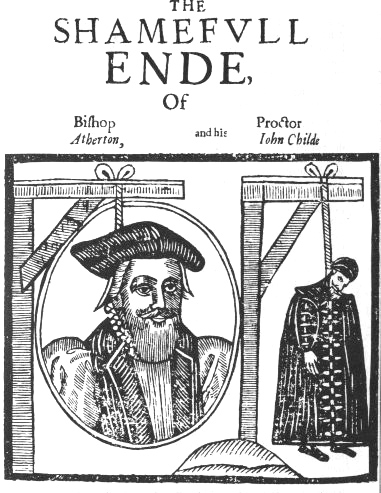

Suppose a Devill from th’infernall Pit,
More Monsterlike, then ere was Devill yet,
Contrary to course, taking a male fiend
To Sodomize with him, such was the mind
Of this Lord Bishop, he did take a Childe
By name, not years, acting a sinne so vilde
-From the text of the pamphlet this image decorates

The Oxford-educated Englishman was appointed Lord Bishop of Waterford and Lismore by King Charles‘s hated governor Thomas Wentworth.

It may well have been the internecine politics of the day that claimed Atherton’s life, just as the civil wars they engendered in the ensuing decades claimed the original trial records.

While posterity is left to speculation, Atherton was defended in print in those years as well. (Defended as no homo, that is — not defended on principle against ubiquitous anti-gay laws.) If it wasn’t really a voracious sexual appetite (not exclusively same-sex**), goes this argument, it was intra-Protestant infighting, with Atherton’s successful clawback of land for the weak Irish Anglican church stepping on the toes of the local land barons who had recently expropriated it.

This politics outside the boudoir argument gets compelling treatment in Mother Leakey and the Bishop, a historical investigative thriller that links Atherton to a weird ghost story† in his native Somerset — that of “Old Mother Leakey,” the Minehead ghost.

Mother Leakey was Atherton’s mother-in-law, and Somerset family members claimed she haunted them — including with a message for the bishop that one of his sisters-in-law actually went to deliver in Ireland. The message isn’t known; in legend, this was a warning from beyond against the prelate’s ungodly behavior; in reality, it was more probably a family shakedown.‡

Despite the skepticism of the Leakey family’s own contemporaries, the facts, allegations, suppositions, and pure flights of fancy somehow managed to blend and recombine into a lasting tale of the paranormal that Minehead still retails to this day.

And it goes right back to the public opprobrium Bishop Atherton endured — as described in that 1641 hanging pamphlet:

“demonstrates the link between the stories of Mother Leakey and Bishop John Atherton … in a highly readable and often entertaining fashion”

… through pride, high fare, and lustfull life,
Incest committed with the Sister of his wife,
For which he sued his pardon, and then fled
To Ireland, where a worser life he led

…

He surely warned was to mend his life,
By his own Sister Master Leakies wife,
Which Master Leakies Mother being dead,
And in her life-time conscious how he led
His lustfull life, her Ghoast in gastful wise
Did oft appeare before her Sisters Eyes,
But she feare-strucken durst not speak unto it,
Till oft appearing forced her to doe it:
Then thus she spake, Mother in Law what cause
You from your rest, to my unrest thus drawes?
Who answered, daughter tis the wicked life
Your Brother leads, warne him to mend his life;
If not, then plainely tell him tis decreed,
He shall be hangd, bid him repent with speede:
Then shall my restless spirit be at rest,
And not till then; Thus vanisht. She addrest
Herselfe for travaile, Into Ireland went
With this sad message unto him was sent:
Which how he tooke to heart may plaine appeare
By the slight answer he returned her,
What must be, shalbe: If I must, I must dye,
Mariage, and hanging, come by destiny.
Thus scoft her counsell, sent her back, and when
Shee was returnd, he grew farre viler then
He was before, if Viler man may be,
For one bad Act before, committed three.

* According to Who’s Who in Gay and Lesbian History, Atherton and Childe were the second pair of alleged homosexual lovers executed in the British Isles. The first was the Earl of Castlehaven in 1631, along with his manservants.

** “[O]ne should note the compound sexual nature of the ‘sodomy’ charge in this context, a portmanteau omnibus of non-procreative sex, which is what ’sodomy’ was widely held to be.”

† Walter Scott footnotes this legend in Rokeby: “Mrs Leakey … dispatched her [daughter-in-law] to an Irish prelate, famous for his crimes and misfortunes, to exhort him to repentance, and to apprize him that otherwise he would be hanged; and how the bishop was satisfied with replying, that if he was born to be hanged, he should not be drowned.”

‡ Archbishop William Laud dispatched a team of ghost-whisperers to investigate the Leakey story well before the ectoplasm hit the fan for Atherton, and they weren’t buying: “certainly it is a fiction and a practice … it may be some money business.” Bishop Atherton had left home under a cloud with the suspicion that he’d had an affair with his wife’s sister, and this was part of the eventual Irish complaint against the horny goat.

On this day..

1641: Thomas Wentworth, Earl of Strafford

On this date in 1641, the doomed English monarch Charles I regretfully sacrificed one of his ablest ministers to the headsman.

Thomas Wentworth and loyal doggie, painted c. 1639 by Anthony van Dyck.

Thomas Wentworth, Earl of Strafford had cut his teeth in Parliament in the 1620s as an advocate of the rights of the Commons as against those of the king, but the notion that he’d be hoisted by his own petard would be little comfort to a King soon destined to find himself in similar straits.

After Parliament forced through the 1628 Petition of Right (and Wentworth’s pro-monarchist personal rival George Villiers, Duke of Buckingham had been conveniently assassinated) Wentworth went over to the king’s camp with the sententious declaration

The authority of a king is the keystone which closeth up the arch of order and government.

The authority of that king, which Wentworth now worked vigorously to uphold during the crown’s Parliament-free Personal Rule of the 1630s, also elevated Wentworth to higher honors.

He would have occasion to exercise his own “personal rule” as dictatorial viceroy in Ireland, and when push came to shove between King and Commons, advocated the most tyrannical measures to compel the compliance of obstinate Englishmen.

By 1640, Wentworth had become in the eyes of his enemies the very embodiment of the monarch’s every sin, and when Charles was obliged by his deteriorating situation to summon Parliament once more, its first order of business was the impeachment of this obnoxious retainer. When Wentworth skillfully repelled the charges and won acquittal on April 10, his parliamentarian opponents simply passed a bill of attainder condemning him to death anyway.

The only thing that stood in the way of the chop was the signature of that ruler whom Wentworth had served so loyally. As Charles dithered — for he had personally guaranteed Wentworth his safety upon his most recent summons to London — popular hatred for the Earl threatened to escalate the crisis into something much more dangerous for the throne.

In one last gesture of fealty, Wentworth dashed off a note to his sovereign, magnanimously releasing him from any obligation save political calculation.

Sire, out of much sadness, I am come to a resolution of that which I take to be the best becoming me; and that is, to look upon the prosperity of your sacred person and the commonwealth as infinitely to be preferred before any man’s private interest. And therefore, in few words, as I have placed myself wholly upon the honour and justice of my peers, I do most humbly beseech you, for the preventing of such mischiefs as may happen by your refusal to pass this bill, by this means to remove this unfortunate thing forth of the way towards that blessed agreement, which God, I trust, shall for ever establish betwixt you and your subjects. Sire, my consent herein shall acquit you more to God than all the world can do beside. To a willing man there is no injury done; and as, by God’s grace, I forgive all the world with a calmness and meekness of infinite contentment to my disloding soul, so, Sire, I can give the life of this world with all cheerfulness imaginable, in the just acknowledgment of your exceeding favours; and only beg that, in your goodness, you would vouchsafe to cast your gracious regard upon my poor son and his three sisters, less or more, and no otherwise, than their unfortunate father shall appear more or less guilty of this death. (Quoted here)

This letter’s place in the annals of sacrificial loyalty is compromised only slightly by its author’s dismay upon finding out that his feckless majesty had quickly taken up the offer:* Wentworth rolled his eyes heavenward and exclaimed

Put not your trust in princes, in a son of man, in whom there is no salvation.**

But the miscalculation was done.

Two days after Charles signed off, Wentworth was beheaded on Tower Hill to the rapture of an audience supposed to have numbered 200,000 strong.


Strafford Led to Execution, by Paul Delaroche, with Thomas Wentworth, Earl of Stafford, receiving the blessing of his ally, the imprisoned Archbishop William Laud.


1642 pamphlet illustration of the beheading, from here.

As things went from bad to worse for Charles in the years ahead, he would have many occasions to regret the sacrifice of so loyal and energetic a minister … and to lament, upon hearing his own death sentence, that he was suffering divine judgment for this date’s act of expedient faithlessness.

A few books about Thomas Wentworth

* In acceding to the sentence, Charles proposed giving Strafford the best part of a week to prepare himself. Parliament ignored that request and set the execution for the very next day.

** That’s Psalm 146:3.

On this day..

1644: Looters in conquered Beijing

The Shun Dynasty only lasted two months in China, but it still managed to find its way to these pages by deposing the ruling Ming Dynasty and setting the scene for the Q’ing Dynasty.

In the early 1500s, the Ming Dynasty significantly increased contact with Europe, and it immediately saw the value in exploited mineral wealth from the West. At the time, the government was having difficulty maintaining a currency with perceived value: paper money was a massive flop and standard copper coins could not be trusted. Something new was needed, and European silver was a quick and easy answer.

But the decision to move to silver coins backfired a century later, when a variety of converging factors cut the silver supply to China and caused a spike in the price of the metal. As a result, the economy sagged. In the mid-1640s, a drought also gripped the country, and the Ming government was in the unenviable position of watching over a collapsing nation. It didn’t help that the government was highly centralized, with almost all activity occurring in Beijing; a working regional governing mechanism may have allowed it to dig out of the hole, but with the rise of an elite class — and prospective officials seeking every opportunity to serve as close to the power center as possible — there was no hope of a savior once the emperor’s power waned.

Enter the Manchu.

(This is long.)

Originating in Northeast China and Southeast Siberia,* the Manchu occupied their own territory under a local khan. The Manchu army was building strength at the same time that the economic woes under Ming rule increased. While the Manchu originally considered themselves distinct from and superior to the Han Chinese, they made several legal concessions to match the social mores of those they ruled over which enhanced their credibility.

With the Ming Dynasty weakening, the Manchu saw their opportunity to move south.

But even as the Ming fought to repel those Manchu invaders, an internal insurrection was brewing under a man named Li Zu’cheng, an apprentice ironworker from Yan’an. The Chuang Wang (“Roaming King”, Li’s regnal name) was considered a savior of the common folk, even earning a widespread local song looking forward to the day he would arrive:

You’ll feed your mates,
You’ll dress your mates,
You’ll open wide your city gates.
When Prince Chuang arrives, there’ll be no more rates.

(Source)

Li had a strong foothold in the heart of the country, and he was persistent. More importantly, the Ming government was hemorrhaging cash to its frontiers. Eventually, the money began to dry up, and even the ministers within the Chongzhen Emperor’s circle saw the writing on the wall. By mid-March, the Manchus were known to be marching through nearly undefended lines; by mid-April, the treasury stopped paying its military entirely.

On April 24, with Li Zu’cheng at the city gates, Emperor Ch’ung Chen tried in vain to escape his own compound. In his wake, he left the corpse of the empress (suicide), the corpse of his daughter (killed by the drunken emperor in a rage), and a seriously injured crown princess (maimed by the drunken emperor). Having mowed through his family, the emperor joined his chief eunuch Wang Cheng’en, climbed atop a local hill, and, shortly after midnight on April 25, hanged himself.

Li Zu’cheng entered the city unopposed, the gates (as the ditty had promised) flung open for his invading army.

Government officials hid in an attempt to escape retribution, but Li’s forces were reportedly quite orderly and did not seek revenge. Instead, they marched slowly through the city, where many of the locals marked themselves as Shun-min, or subjects of Li’s Shun dynasty.

Looters and bandits, however, were not tolerated, and the well-disciplined force dispatched them quickly and without trial. Their bodies were put on display by nailing them to local streetposts, and by noon, the city was calm.

The Roaming King only managed to hold power for a few weeks before his army was swept away by the Manchus. Li Zu’cheng lived almost two more years on the run, still claiming his title of Emperor of Shaanxi as he fled the newly installed government. It would be several more years before the Manchu would retake Southern China,** but the Q’ing Dynasty would dominate China until the Xinhai Revolution in 1912.

* The Manchurians were technically Tungusic, a significant Chinese minority both then and now. The Manchu largely resisted integration into Han society until the latter half of the 19th century.

** Southern China remained, technically, a distinct entity called the Southern Ming Dynasty, south of the Huai River, until 1662.

On this day..

1645: William Laud, given to the devil

On this date in 1645, Archbishop William Laud was beheaded on Tower Hill for treason.


Portrait of William Laud by Anthony Van Dyck. For this image’s subsequent life in popular circulation (and its contribution to its subject’s beheading) see Mercurius Politicus.

This diminutive “martinet” made himself odious to the rising Puritan party through his rigorous (some would say narrow-minded) enforcement of so-called “High Church” dogma and decor. It was a time when believers were prepared to rend the fabric of the church over a literal fabric, the surplice worn by the clergy — among other innumerable points of doctrinal rectitude.

Laud’s run as Archbishop of Canterbury also happened to coincide with Charles I‘s 11-year personal rule, sans parliament. The overweening divine’s influence on secular as well as religious policy would do his sovereign no favors in the public mind.

Roughly enforcing an unpopular minority position, Laud got the woodblock blogosphere in a tizzy with heavy-handed stunts like having dissenters’ ears cut off.

That’s the sort of thing that’ll give a guy an image problem. The king’s fool, Archibald Armstrong, is supposed to have tweaked our high and mighty subject (and warned the king against his influence*) with the punny aphorism,

Give great praise to the Lord, and little laud to the devil.

Funny because it’s true.

So when Charles ran out of money and finally had to call parliament in 1640, that august representative of the nation had some business with Laud. Ironically — since the prelate was always sensitive about his height — it would involve shortening him.

Laud was impeached as early as December 1640 and soon tossed in the Tower, where his neck awaited the unfolding radicalization of the pent-up Puritans and the onset of armed hostilities in their contest with the obdurate king. (While his hands blessed the allies who preceded him to the block.)


Wenceslas Hollar’s etching of William Laud’s trial.

For more about Laud’s life and work, check out the detailed Britannica entry or this Google books freebie.

* If a warning, it apparently was not heard. This 19th-century publication of Armstrong’s jests cites a 1637 royal order to the effect that

the King’s Fool, for certain scandalous words of a high nature, spoken by him against the Lord Arch-Bishop of Canterbury his Grace … shall have his coat pulled over his head, and be discharged of the King’s service, and banished the Court.

On this day..

1649: John Poyer, the lucky winner

On this date* in 1649, John Poyer, late the mayor of Pembroke, was shot at London’s Covent Gardens for switching sides in the English Civil War.

John Pembroke had earned his Round head by taking Carew Castle from King Charles‘ forces in the First English Civil War.

But the silly hats in Parliament wanted much of the potentially dangerous army to demobilize, and do so without settling the small matter of its back pay. Poyer refused to hand over his command and Pembroke Castle to a Parliamentary agent, and sought a better deal from monarchists.**

Only with a painstaking siege was the imposing medieval fortress of Pembroke reduced. Poyer, his superior Rowland Laugharne, and Rice Powell were hauled to London and condemned to death.†

In an interesting twist, it was decided that one example would prove the point as well as three, and to allot the clemencies by chance. When the three refused to draw their own lots, a child was given the job instead, and distributed three slips of paper. Laugharne and Powell read “Life given by God.” Poyer’s was deathly blank.

Mark Twain latched onto the singular role of a child in this deadly lottery, and wrung it for every drop of pathos in a short story, “The Death Disk”.

Unlike the proposed victim of that story, Poyer did not benefit from any last-second Cromwellian pity. His death is related in the zippily titled “The Declaration and Speech of Colonell John Poyer Immediately Before his Execution in Covent-Garden neer Westminster, on Wednesday, being the 25 of this instant April, 1649. With the manner of his deportment, and his Proposals to the people of England.”‡

Having ended his speech, he went to prayers, and immediately rising up again, called the men designed for his execution to him, which were six in number, and giving them the sign when they should give fire, which was by holding up both his hands, they observed his motion, who after some few expressions to his friends about him, prepared an embracement for death, and casting his eyes to Heaven, with both hands lifted up, the Executioners (with their fire locks) did their Office, who at one voley bereav’d him of his life, his corps being taken up, was carryed away in a Coach, and the Souldiery remanded back again to White-Hall.

* A few sources say April 21, but the overwhelming majority concur on the 25th — as do the primary citations available in 17th-century comments on his death (e.g., “he was upon the 25 of this instant Aprill being Wednesday, guarded from White-Hall in a Coach, to the place of execution” in “The Declaration and speech of Colonell John Poyer before his execution…”)

** D.E. Kennedy observes that the divide between Parliament and Royalist was not so bright as might be imagined — and that Cromwell himself was at this time negotiating with the future Charles II as an expedient to get around Charles I.

† The rank and file of Welsh insubordination basically skated, a display of clemency from the Lord Protector that Ireland would not enjoy.

‡ The title promises much more scaffold drama than two and a half forgettable pages deliver — basically, that Poyer died (a) penitent; (b) Anglican; and (c) wishing for peace.

On this day..

1649: Charles I

On this date in 1649, the struggle between parliament and crown cost the Stuart monarch Charles I his head.

Charles‘ political clumsiness and unreconstructed authoritarianism had seen the realm whose unitary sovereignty he insisted upon blunder from disaster to disaster: into bankruptcy, military defeat, religious conflict and the English Civil War.

The assignation of cause and consequence in that war’s genesis has much exercised historians.

What is beyond dispute is that the confrontation between monarch and subject, pitting against each other political and economic epochs, theories of state and power, rates as one of history’s most captivating courtroom dramas.

Charles refused to answer the court’s charge of treason, occasioned most particularly by the king’s fomenting the Second Civil War while already a defeated prisoner of parliament following the first Civil War. He rested firmly on royal prerogatives against what some interlocutors take to be an almost desperate plea by his judges for some hint of acknowledgment that could open the door to compromise:

[A] King cannot be tried by any superior jurisdiction on earth. But it is not my case alone — it is the freedom and the liberty of the people of England. And do you pretend what you will, I stand more for their liberties — for if the power without law may make laws, may alter the fundamental laws of the kingdom, I do not know what subject he is in England that can be sure of his life or anything that he calls his own. Therefore, when that I came here I did expect particular reasons to know by what law, what authority, you did proceed against me here.

It must be borne in mind that the trial of a king was a completely unprecedented event. Charles might be forgiven his attitude, even if it smacked of the impolitic high-handedness that had forced this deadly test of powers.

Parliament’s position — here in the words of its President — is distinctly in the stream of political discourse (if not always actual practice) ascendant in the West to this day.

Sir, as the law is your superior, so truly, sir, there is something that is superior to the law and that is indeed the parent or author of the law — and that is the people of England.

…

And therefore, sir, for this breach of trust when you are called to account, you are called to account by your superiors — “when a king is summoned to judgment by the people, the lesser is summoned by the greater.”

The modern and the medieval, facing each other at the bar.


A fragment from a World War II bomb-damaged and only-recently-rediscovered Hippolyte Delaroche painting situating Charles in the Christlike pose of enduring the mockery of his captors.

Charles played his lordly disdain to the end, refusing to admit parliament’s jurisdiction by making any sort of plea.

The line between heroic defiance and pig-headed obstinacy being very much in the eye of the beholder, the confrontation is typically played straight-up for its arresting clash of principles — as in the 1970 biopic Cromwell, with Alec Guinness as the monarch:Probably more troubling for the parliamentary party than the regicide taboo was consideration that the execution would transfer royalist loyalties from a man safely imprisoned to an heir beyond their power, who could be expected to (as in fact he did) resume the civil war.

Competing philosophies expounded for the competing interests; the dispute involved the era’s intellectual titans, in conflict over the most fundamental concepts of the state. Thomas Hobbes wrote his magnum opus The Leviathan as a royalist exile in Paris, and its abhorrence for rebellion and divided sovereignty unmistakably reflects the English Civil War experience. John Milton earned his bread as a republican polemicist; his poetic celebration of Satan’s failed rebellion in Paradise Lost, written after the Stuart restoration, can be read as a political critique.

Separated at the block? Charles I and Hobbes’ Leviathan

It’s conventionally thought that the beheading was conducted by a radical minority, though that supposition is debatable, colored as it is by the ultimate restoration of the crown. But although England would have a king again, the weight of political authority would steadily, permanently, gravitate towards parliament, organ of the merchant classes who would steer England henceforward.

Did it have the right? Two implacable powers each claimed an indivisible object; “between equal rights, force decides.” So on this cold winter’s afternoon — Charles wore thick undergarments, so he would not shiver with the appearance of fright — the deposed king was marched to a scaffold erected at Whitehall. He gave a short final address, with the famous words for his principle of martyrdom — “a sovereign and a subject are clean different things” — then laid his head on a low block, where a masked executioner (never definitively identified) cleanly chopped it off.

After the monarchy’s restoration, Charles was canonized as a saint by the Church of England: he’s still the last person so venerated, an odd salute to a mortal career of unalloyed arrogance and incompetence. Observance of the cult was toned down in the 19th century, although a Society of King Charles the Martyr dedicated to its preservation still exists; monarchists of a more secular inclination also continue to mark his martyrdom on this anniversary.

Less reverent by far was Monty Python’s homage:

“The most interesting thing about King Charles the First is that he was five foot six inches tall at the start of his reign, but only four foot eight inches tall at the end of it.”

Part of the Themed Set: The English Reformation.

On this day..