1653: Jasper Hanebuth, robber and murderer

On this date in 1653, the German bandit Jasper Hanebuth was broken on the wheel in Hanover.

An illiterate farmer’s son from Groß-Buchholz, Hanebuth came of age during the calamitous Thirty Years’ War and thereby made his bread for a time as one of the numberless strong arms enlisted to let out one another’s blood.

Hanebuth is the titular villain in the German historical fiction novel The Murderer’s Concubine.

In a time of crisscrossing armies with conflicting loyalties and uncertain pay, it was a fine line between soldiers and thieves — sometimes just the hour of the day. What matter to a rural family or a vulnerable traveler if the gang of armed men who dispossessed him did so under the banner of God or that of opportunism? And given means and opportunity, what matter to the armed gang itself? Victims in such a chaotic environment, either actual or potential, were liable in their own turn to resort to brigandage as the only viable option, paying the devastation forward.

“It defies the pen to recount all the miseries and horrors” from those years of pillage and rapine, wrote August Jugler in his history of Hanover.

True to the template, Hanebuth parlayed wartime soldiery into an alarmingly bold career of opportunistic robbery in the still-extant Eilenriede. A purported “Hanebuth’s Block” in the vicinity of the present-day zoo there long preserved the association; there’s still a street in the forest known as Hanebuthwinkel.

He was reputed an especially vicious outlaw, who would raid singly as well as jointly with other farmers and decommissioned warriors, and would as readily for sport or pleasure shoot a convenient target dead before bothering to approach and find out if the business end of the felony was even worth the murder. He ultimately confessed to 19 homicides.

But it was still the pecuniary motive that drove things. Hanebuth approached crime-lord status with secret smuggling tunnels allegedly set up to move his ill-gotten gains and regular traffic with Hanover merchants. Hanebuth also set up as a horse-trader, exploiting his predilection for violence to obtain stock by force. One trader who refused a shakedown simply had his horses outright stolen the next night, and this man at last reported Hanebuth, resulting in his arrest, torture, and execution on the wheel.

He remains one of Hanover’s most iconic historical criminals.


Jacques Collot’s 1633 cycle “The Miseries of War” might have foretold Hanebuth’s fate: here, a soldier of the Thirty Years’ War who has turned to robbery is punished, as Hanebuth would be, on the wheel. The caption explains:

The ever-watching eye of the divine Astrée [Justice]
Banishes entirely the mourning from the country
When holding the sword and scales in her hands
She judges and punishes the inhuman thief
Who awaits passersby, hurts them, and plays with them
[And] then becomes himself the plaything of a wheel.

On this day..

1655: Grete Adrian, Ruethen witch

On this date in 1655, Grete Adrian heard her final condemnation as a witch, then was ushered to the marketplace of Ruethen where she was beheaded and burned.

A remarried widow, Grete was the daughter of a woman who in her own day had been suspected of witchcraft; Grete had lost siblings to witch-hunts during the recent Thirty Years War.

The family history with devilry would help to implicate her when allegations arose that she had produced milk by conjuration and turned into a wolf to kill a neighbor’s horse. Grete didn’t stand up to the torture very long; within a couple of days she agreed that she had taken the devil as a lover, cast malevolent spells, attended witches’ covens, and all the usual Hexenprozesse stuff. All she asked was for quick execution.

In 2011, schoolchildren from Ruethen’s Friedrich-Spee-School — its namesake was a noted critic of torture and witch trials in the 17th century — successfully petitioned local authorities to issue a blanket posthumous pardon for 169 men, women and children executed for witchcraft between 1573 and 1660 … Grete Adrian included.

On this day..

1656: The Chief Black and White Eunuchs of Topkapi Palace

On this date in 1656, an Istanbul mutiny against debasing coinage resulted in thirty-odd high officials hanged at the gates of the Blue Mosque.

In Ottoman periodization, 1656 is the end point of the Sultanate of Women — a century-plus span stretching all the way back to Roxelana when powerful harem women consistently defined Topkapi Palace intrigue, often alongside shaky male executives.

Many of the sultans in that span were minors, as was the the putative head of state for our scene, 14-year-old Mehmed IV. Their succession was invariably achieved by the skillful maneuvering of their mothers, who then figured to graduate to Valide Sultan, “Mother Sultan” and wield considerable power in their own right. In Mehmed’s case, Mother Sultan was a Ukrainian former slave named Turhan Hatice … but you can just call her the power behind the throne.

(Actually, Turhan was initially aced out of the powerful Valide Sultan gig by Mehmed’s paternal grandmother when Mehmed inherited the throne at the age of six; Turhan herself was only about 20 years old at that time. Turhan had that woman assassinated in 1651 to swipe the position.)

Come the 1650s, the Ottomans were mired in a long war with Venice over control of Crete — ultimately a Pyrrhic victory for the Ottomans in view of the enormous cost.

One of the ongoing costs of that conflict was currency depreciation; silver coins were so hard to come by that European traders made tidy money hauling debased silver-coated copper coins to sell in Istanbul — and had no shortage of buyers who knew exactly what they were getting and were happy to have it. According to Caroline Finkel, “1000 aspers of [official coinage] was valued at less than one hundred aspers in the market-place.”

Janissaries* aggrieved at being paid in rubbish “marched to the Hippodrome, vociferously demanding that those who had deceived Sultan Mehmed by implementing the debasement be killed.”

That’s an experience to drop your gonads when you’re 14 years old. The Janissaries, the capital’s elite warrior clique, had the sultanate by the short and curlies and were known to enforce their whims to the detriment of the empire’s interests. They had, indeed, revolted over currency depreciation in the 1580s; they also deposed Mehmed’s uncle, 17-year-old Sultan Osman II, when that young man tried to curb Janissaries’ dangerous power.

Undoubtedly these mutinous Janissaries would have enforced their demands with similar desperation. Jenkins says that the execution of the Mother Sultan was one of those demands, but at least the teen sultan was able to cross her name off the hit list. The various attendants, aghas, and eunuchs who irritated the Janissaries were not so fortunate.

Ah, the eunuchs.

We’ve titled our post with the most titillating of this date’s targets of Janissary wrath. Ottoman Eunuchs** came in the “Black” and “White” varieties, as in black and white races; because Islam prohibited castration, they were obtained by slavers in Africa or in the Balkans, where Christians and Jews did the dirty work.

European “White Eunuchs” from the Balkans had their testicles removed; these were sought by the hundreds as palace bureaucrats in Istanbul. African “Black Eunuchs” from Egypt or Ethiopia typically had their entire genitalia cut off, and had the more powerful position of serving the royal persons. (They had usurped that role in the late 16th century from the formerly preeminent white eunuchs.)

Each racial set had its own hierarchy and its own chief. The Chief Black Eunuch was the master of the harem and a powerful, trusted emissary of the Valide Sultan: it was her black eunuch that Turhan Hatice had sent to murder Mehmed’s original Valide Sultan.


A black eunuch — I think? — looms over a new concubine in Alexander Russov’s 1891 Bought for the Harem. Lest one think this sort of lascivious Orientalism is solely the relic of a bygone age, check out the Harlequin bodice-ripper of the same title.

These chief eunuchs, and especially the chief black eunuchs, were among the sacrificial executions the Janissaries required for their obedience. Mehmed did not attempt to protect them; one doubts that he could have done so.

The sultan’s acquiescence in these executions set him up for a 39-year reign, the longest since Suleiman the Magnificent. But it was also under Mehmed that the Sultanate of Women gave way to the civil administration. Later that same year of 1656, continuing crisis forced the appointment of Koprulu Mehmed Pasha as Grand Vizier.

The Albanian Koprulu wielded virtually dictatorial powers and founded a whole dynasty of Ottoman Grand Viziers† that dominated Ottoman politics into the 18th century.

* The Janissaries were infantry; their less-(in)famous cavalry counterpart, the Sipahis, also participated in this 1656 mutiny.

** Eunuchs persisted in the Ottoman sultanate right up until the end of World War I, and ex-eunuchs (well, still eunuchs) of the ex-Sublime Porte were still to be found in Turkey as late as the 1970s. One of them recounted the experience of being kidnapped and castrated in Ethiopia for export to the Ottoman palace.

† Including Kara Mustafa Pasha, the Ottoman commander executed for losing the Battle of Vienna.

On this day..

1656: Joris Fonteyn, anatomized and painted

“On January 28th 1656, there was punished Joris Fonteyn [or Fonteijn] of Diest, who by the worshipful lords of the law court was granted to us an anatomical specimen. On the 29th Dr. Joan Deyman made his first demonstration on him in the Anatomy Theatre, three lessons altogether”.”

-Records of the Amsterdam Anatomy Theatre (cited in this pdf)

Dr. Joan Deyman had succeeded Dr. Nicolaes Tulp in the redoubtable position of the guild’s Praelector Anatomiae — the physician entrusted with the guild’s once-per-year public anatomical reading over the dissection of an executed criminal. In his day, Tulp and his dissection had been painted by Rembrandt.

With the new praelector in the wealthy city came its guild’s need for fresh art to keep up with the Joneszes.

New subject, new work … but the same artist. A mere sapling when he rendered Dr. Tulp, Rembrandt was a fully mature painter of 50 when he put this scene to canvas.

Sadly, this painting was damaged in a 1731 fire, destroying most of its figures, including the titular one.


Braaaaaaaaaaaaaiiiiinnnnnssssssssss! Dr. Deyman’s hands are all that remain of him. The cadaverous Joris Fonteyn, however, belongs to the ages.

Since it was part of the anatomization law for the unfortunate subjects to be given a decent burial, Fonteyn’s exit from the annals of history is another entry (pdf) in the surgeon’s guilds records:

Wednesday, February 2, at 9 o’clock in the evening the body was interred with fitting dignity in the South Churchyard.

On this day..

1655: Jane Hopkins, Bermuda’s last known witch execution

The last known witchcraft execution in Bermuda history occurred on this date in 1655.

The isolated English colony was at this period laboring under social crisis, or a set of crises. It had been declared in rebellion by Cromwell‘s parliament for taking too-vigorous umbrage at King Charles‘s execution. Its official C of E ministers were being challenged by breakaway independents of various stripes of Puritanism. The tobacco crop blew away one year. And it may have had a perilous gender imbalance (too many women, too few men: Bermuda definitely did have this problem in the 18th century). (Source for this whole paragraph) Perhaps it’s no surprise that its Puritan governor* would oversee a spasm of witch persecutions from 1651 to 1655.

Jane Hopkins and another woman named Elizabeth Page were both stuck in the dock on this occasion. They’d recently arrived on the Mayflower** and the captain “did vehemently suspect them to be witches,” seemingly on account of their traveling sans male.

Page bewitched the ship’s helm according to a witness who beheld her run “her finger over the compas, And yt ran round from North to South, And turned backe againe.” That’s pretty impressively infernal, but here in the 17th century they knew to look for some hard forensic evidence … so a group of matrons in Bermuda was empaneled to feel Elizabeth Page up in search of a witch’s teat. Much to the woman’s good fortune, she possessed “not any marke or spotts or signes … only something more than ordinary (in a certain place).” She was accordingly acquitted.

Jane Hopkins’ body was not so ordinary.

The eyewitness testimony against her was a fellow-passenger to whom Hopkins sighed that she wished God would send some sign clearing up all these suspicions of devilry. A rat — ubiquitous in seafaring life, mind you — promptly appeared. To add to this damning divine indictment, a peeping tom on the ship watching her dress had noticed some sort of mark on her shoulder.

Sure enough, Hopkins’s gropers discerned “in her mouth a suspicitious marke and under her arme she hath a dugge or Teat, And upon her shoulder a wart, and upon her necke another wart … all these were insensible when they were prickt.” With this sort of slam-dunk evidence, the jurymen could hardly do otherwise than agree that Hopkins “hath felonously and wickedly consulted and covenanted with the Devil & him hath suckled and fedd contrary to nature & the law of God and man, as doth appeare by markes & signes upon her body.” (The full trial records can be perused here)

It’s not absolutely certain that Jane Hopkins was the last person executed in Bermuda for witchcraft. There were several additional witch prosecutions to follow in the 17th century: some ended in acquittal, others in conviction. There was even at least one more death sentence, but that hanging was stayed and the final disposition of the case is unknown.

* Governor Josiah Forster’s legacy for the isles — other than hanging witches — was the “Forster Chair” made in his honor.

** Not the same ship as the Mayflower of Plymouth Colony fame.

On this day..

1652: Joan Peterson, the Witch of Wapping

“Let the sceptical read the ‘Country Justice’ to see what subtle threads were strong enough for a witch-halter!” (Source)

On this date in 1652, Joan Peterson was hanged at Tyburn for witchcraft.

Joan is a long time in the ground, and her dying refusal to be cowed by the officious prelate ordained to badger her into self-incrimination would alone stand her in very worthy stead in these pages. Even the hangman got annoyed when Joan, at the gallows,

was by the Ordinary nine on ten times earnestly pressed to confesse something against the said Mrs. Levingstone: Whereupon the Executioner told the Ordinary, he might be ashamed to trouble a dying woman so much, to which he replyed, he was commanded so to doe, and durst doe no otherwise. And afterwards the said Ordinary still insisting in his discourse, and very often pressing the said Peterson to confesse and discharge her conscience before God and the world; she answered that she had already confessed before the Bench, all she had to confesse; that she had made her peace with God; and therefore desired to dye in quiet, for now she was to appeare before God who presently would Judge her, and that God was witnes, that she dyed Innocently, and was in no wise guilty of what was laid to her charge.

Go, Joan.

This account comes to us from one of the surviving pamphlets (pdf) about her case, a document that, were it produced today, would probably draw a severe sanction under Britain’s nasty libel laws for its scandalous indictment of Joan’s persecutors.

It lays out an unscrupulous conspiracy of local grandees scrabbling after inheritance money, in which the “Witch of Wapping” swung for being the only honest broker in the room. Sure, we can’t prove it. But the rival, anti-Joan pamphlet (also at that same pdf link) has a lot of rot about our woman damningly chattering with a diabolical familiar in the cunning guise of a squirrel.


Satan’s minion. (cc) image from alphakilo2bravo.

According to the pro-Joan pamphleteer, the trouble started when an elderly woman named Lady Powell died, leaving her wealth to a particular relative — the “Mrs. [Anne] Levingstone” mentioned in the excerpt above — and stiffing several others.

These others contrived a scheme to charge Anne Livingston with witchery in order to separate her from her windfall and get their own hands on it. Though witch-hunting never really reached the epidemic dimensions in England that it often achieved on the continent — the English ban on torture helped prevent self-sustaining cycles of forced denunciations — it did have its moments, and the characters in question may have been encouraged by the recent exploits of notorious witch-diviner Matthew Hopkins in preposterous judicial homicide.

But they weren’t targeting Joan Peterson at all. They just wanted to use her to get at Livingston.

When Peterson, a local healer with a knack for fixing migraines, refused a bribe to accuse Livingston of sorcering, the plotters made it an offer she couldn’t refuse (and protected themselves from exposure) by accusing Joan herself.

Our pamphlet presents a riveting and revolting story of the conspirators essentially being one with the local judicial officials — in fact, when it comes to trial, they’re literally Joan Peterson’s judges — but even as they groped her for witches’ teats and the like, they endeavored “to perswade the said Peterson to confess [since] she needed not fear what she confessed, for it was not her life they aimed at, but to have matter whereby to accuse one Mrs. Levingston, who had gotten the said Lady Powels estate, and thereby had undone 36 Persons of the said Ladyes Kindred.”

Playboy parliamentarian (and, recently, regicide) John Danvers* made a rare appearance in the neighborhood to help orchestrate events. Danvers was a sound man to have for an expedient financial racket; he was famous for acquiring his fortune by marrying an older widow. She’d since died, and he’d since squandered it.

Even with the fix in, however, Joan’s ability to produce physician testimony and a written post-mortem ascribing Lady Powell’s death to natural causes — the doctors were impressed she’d managed to make it to age 80 what with the “the Dropsie, the Scurvey, and the yellow Jaundies” — ran that whole case aground.

Considering the incriminating threats and blandishments Joan had heard, however, they just got her on a second, simultaneous indictment — for bewitching one Christopher Wilson, on the grounds that he’d gone to her for a cure, gotten a little better, and then relapsed. If you think modern libel law is harsh, you should see Protectorate malpractice law.

Wilson, one should add, did not make this complaint himself: others were induced to level the charge on his behalf, while the court itself barred most defense testimony with threats to imprison the witnesses as probable witches themselves. (Nevertheless, some did appear for Joan.) Somehow, this was enough for conviction.

Even after her condemnation,

the said confederates and their agents went very often to her promising her a Repreive or Pardon if she would confesse that Mrs. Levingstone had Imployed her to make away the life of the Lady Powell, to which she replyed she could not, because it was altogether false. But one of the said confederates urging her againe to say something against Mrs. Levingstone, she told him he was a rogue, and gave him a blow on the face, which made his nose bleed: Where it is to be noted, that what for love of money they could not tempt her to, they resolved at last for love of her life to force her to, by necessitating her either unjustly to confesse a notorious falsehood against the said Mrs. Levingstone or else to dye without mercy or Repreive, which otherwise was proffered her by the said Confederates, to make her unjust in doing the same.

Go, Joan.

* There’s a street named for him in Chelsea. His family name (though not selected specifically for John Danvers) also adorns the town of Danvers, Massachusetts … which was renamed in the 18th century to help bury its notoriety as Salem Village, an epicenter of the Salem witch trials.

On this day..

1655: Henry Manning, Protectorate spy

“There certainly can be no doubt,” wrote a Venetian diplomat late in the rule of Oliver Cromwell, “that Charles [II] is betrayed by some of those who stand about him, otherwise it would be impossible for Cromwell to find out the secret plans he meditates.”

And indeed, on this date* in 1655, just such a one was shot by the exiled royalists as a Protectorate spy.

Henry Manning, the son of a royalist colonel who died fighting for Charles’s late beheaded father, had impeccable credentials for the Stuarts. The alleged English king was now parked on the continent, trying to conjure up some route back to the throne.

So when the pedigreed Manning turned up at exile camp, packing “a considerable sum of money” he was willing to give to the cause, he was welcomed with open arms.

Too open.

While royalist courtiers blabbed, Manning was filing enciphered reports for Cromwell’s spy chief (and the source of that considerable sum of money) John Thurloe. And these reports disclosed royalist collaborators in England who were rounded up in great numbers in 1655 — a year in which Cromwell dissolved parliament and resorted to direct military rule, growing correspondingly more worried about plots against his person.

It seems that Cromwell’s intelligence men lacked a certain subtlety, however. After an English traveler illicitly met with Charles on the continent during the dead of night, and was picked up for questioning when he returned to the island, the Stuart men naturally reasoned that only the small handful of people involved in that meeting could have been the mole. Manning was done for as soon as his apartments were searched.

Under interrogation, Manning gave up everything he knew, trying desperately to save his skin by offers of turning double-agent and exploiting his relationship with the Protectorate for the royalists’ benefit.** As late as December 14 the captured spy — hearing “sad rumours of a sudden end intended me, nay, to-morrow morning” — addressed a letter to royal aide Edward Nicholas, “humbly crav[ing] you would once more try his most gratious Majesty.”

His Majesty’s concern, however, was of fading into ridiculousness and irrelevance, and the play here was to make an example of treachery. Without apparent legal sanction — the word of the shadow king Charles was law enough here, and his German hosts were content to look the other way — Manning was pistoled to death in a woods outside of Cologne, and the fact made known abroad.

Everyone who’s had a look at Henry Manning agrees that the guy was a small and abject man, easy prey for these great ministers of state. But then, when Thurloe himself was arrested for treason upon the monarchy’s eventual restoration, he procured his own parole by spilling his secrets to King Charles.

* The Gregorian date, per the Holy Roman Empire where Manning was shot — not the Julian date still in use in England. Note as well that the 15th is the most readily inferred date from the available evidence, particularly Manning’s letter of the 14th, but that the event itself does not appear to have been affirmatively recorded on this (or any) specific date by contemporaries. There’s little room for variance, as correspondents are commenting on the death of Manning by the end of December.

** “The end and aim of spying in all its five varieties is knowledge of the enemy; and this knowledge can only be derived, in the first instance, from the converted spy. Hence it is essential that the converted spy be treated with the utmost liberality.” –Sun Tzu

On this day..

1655: Massacre of Waldensians

On this date in 1655, Catholic forces under the Duke of Savoy carried out a notorious massacre of Waldensians* in the Piedmont.

This interesting, excommunicate sect had persisted for centuries in those hard-to-reach places in Alpine foothills, intermittently ignored and hunted. After Martin Luther, many Protestants inclined to see them as a proto-Reformation movement, or even a counter-papal apostolic succession reaching back to ancient Christianity.

At any rate, they sure weren’t Catholic.

And our friend the Duke decided — perhaps piqued by the murder of a missionary Catholic priest, or for whatever other reason — to mount one of those heresy-extirpating sorties and make them Catholic in 1655.

On April 17, the Marquis of Pianezza appeared with an overwhelming force of mixed Piedmontese, French, and Irish** troops. They conducted a few skirmishes, then made nice with the Waldensian civic leaders and induced them to quartering their troops temporarily further to some expedient pretext.

Alas! alas! these poor people were undone. They had received under their roof the executioners of themselves and their families. The first two days, the 22d and 23d of April, passed in peace, the soldiers sitting at the same table, sleeping under the same roof, and conversing freely with their destined victims …

At last the blow fell like a thunderbolt. At four of the clock on the morning of the 24th April the signal was given from the Castle of La Torre. But who shall describe the scenes that followed? On the instant a thousand assassins began the work of death …

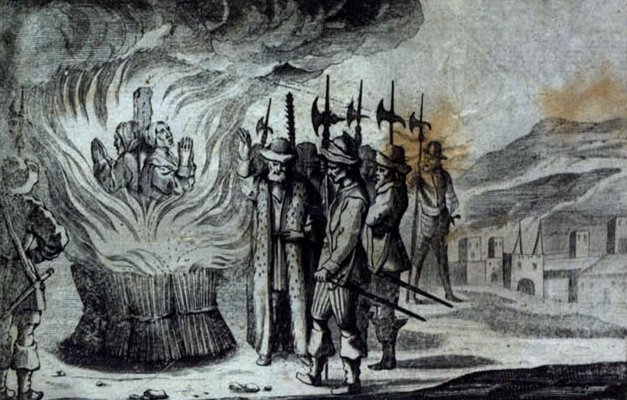
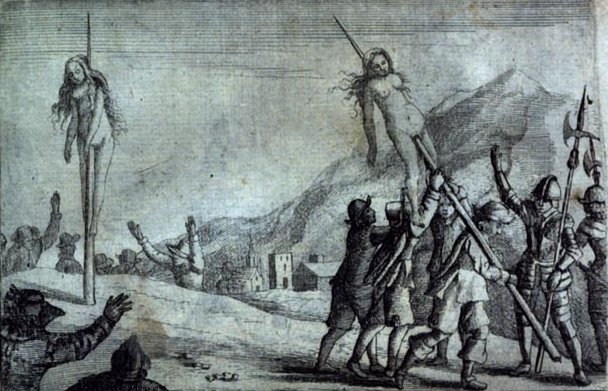
Little children were torn from the arms of their mothers, and dashed against the rocks; or, more horrible still, they were held betwixt two soldiers, who, unmoved by their piteous cries and the sight of their quivering limbs, tore them up into two halves. Their bodies were then thrown on the highways and the fields. Sick persons and old people, men and women, were burned alive in their own houses; some were hacked in pieces; some were bound up in the form of a ball, and precipitated over the rocks or rolled down the mountains … Some were slowly dismembered, and fire applied to the wounds to staunch the bleeding and prolong their sufferings; some were flayed alive; some roasted alive; others were disembowelled; some were horribly and shamefully mutilated, and of others the flesh and brains were boiled and actually eaten by these cannibals.

Source, whose atrocity accounts channel those in this French tome

Without doubting the capacity of man’s inhumanity to man, the cannibalism charge reminds that we’re dealing with propaganda alongside historiography. And what great propaganda — like, babies-torn-from-incubators great.

Thumbnails (click for a larger, disturbing view) of selected images of this date’s atrocities from Samuel Morland’s The History of the Evangelical Churches of the Valleys of Piedmont

And there’s little doubt as to the overall savagery of the affair, which could well have become the opening salvo in a full-scale sectarian cleansing campaign. (A later addendum to Foxe’s Book of Martyrs narrates the ensuing Piedmontese armed struggle, petering out before any definitive resolution in the field.)

Outrage at this hecatomb spread in Protestant Europe — which would also refer to the day’s doings as the “Bloody Easter,” since it corresponded with the eve of that celebration as reckoned by the Julian Calendar (source).

It was felt especially in Protectorate England, which intervened diplomatically.

A “day of solemn fasting and humiliation” was promulgated in Albion, along with collections for the relief of the survivors. Oliver Cromwell personally put £2,000 into the kitty.

More importantly, he dispatched diplomat Samuel Morland† to force the House of Savoy to lay off the persecution; in fact, he threatened to disrupt high statecraft between England and France unless the French twisted arms on behalf of the Waldensians.

Written correspondence for Morland’s diplomatic tour addressed to Louis XIV of France and various other continental potentates, as well as a fiery bit of oratory that Morland delivered to Savoy, all seem to have originated from the pen of Republican scribbler John Milton — the future author of Paradise Lost.‡

Milton, for whom the whole thing was more than just a day job, was further moved to put his umbrage at the slaughter into sonnet form:

Avenge O Lord thy slaughter’d Saints, whose bones
Lie scatter’d on the Alpine mountains cold,
Ev’n them who kept thy truth so pure of old
When all our Fathers worship’t Stocks and Stones,

Forget not: in thy book record their groanes
Who were thy Sheep and in their antient Fold
Slayn by the bloody Piemontese that roll’d
Mother with Infant down the Rocks. Their moans

The Vales redoubl’d to the Hills, and they
To Heav’n. Their martyr’d blood and ashes sow
O’re all th’ Italian fields where still doth sway

The triple Tyrant: that from these may grow
A hunder’d-fold, who having learnt thy way
Early may fly the Babylonian wo.

* The Waldensians in question here are interchangeably known as the Vaudois for their geographic region, actually above the Piedmont and abutting the Swiss region also known as Vaud. (These pages have visited the latter.)

** Fresh from being on the receiving end of another infamous massacre.

† Morland is more regarded for his post-Restoration labors as an inventor; he created an early calculator and internal combustion engine.

‡ The speech in particular is not definitively attributed; see Robert Fallon, “Milton in Government: Denmark and Savoy,” Milton Quarterly, May 1989.

On this day..

1659: The first two Boston Martyrs

October 27 is International Religious Freedom Day, dating to the execution this date in 1659 of Quakers Marmaduke Stephenson and William Robinson on Boston Commons. They were two of the four Boston Martyrs, Quakers whose necks were stretched in Massachusetts for failing to either keep quiet or stay out of town.

(Fellow Quaker Mary Dyer, perhaps the more famous martyr, was led out to execution with Stephenson and Robinson but reprieved at the last moment. Her time was still some months away.)

As Puritans had fled C-of-E persecution earlier in the 17th century, Quakers migrated to the New World with Cromwell‘s Puritan ascendancy.

And in the Massachusetts Bay Colony, the old dissidence had become the new orthodoxy — as described by the (obviously partisan) Horatio Rogers. (Via)

In June, 1659, William Robinson, a merchant of London, and Marmaduke Stephenson, a countryman of the east pan of Yorkshire, “were moved by the Lord,” in Quaker phrase, to go from Rhode Island to Massachusetts to bear witness against the persecuting spirit existing there; and with them went Nicholas Davis of Plymouth Colony, and Patience Scott of Providence, Rhode Island, a girl of about eleven years of age … During their incarceration Mary Dyer was moved of the Lord to go from Rhode Island to visit the prisoners, and she too was arrested and imprisoned. On September 12, 1659, the Court banished the four adults from Massachusetts upon pain of death

… On October 8, within thirty days of her banishment, Mary Dyer with other Rhode Island Quakers went to Boston, …where she was again arrested and held for the action of the authorities. Five days later William Robinson and Marmaduke Stephenson, who had been travelling about spreading their doctrines through Massachusetts and Rhode Island since their release from prison, also went to Boston to look the bloody laws in the face, in the words of the Quaker chronicler; and they too were arrested and cast into prison. …

The issue was now clearly made between Quaker and Puritan. The Quaker defied the unjust Puritan laws, and dared martyrdom. Dare the Puritan authorities inflict it?

On October 19 the three prisoners were brought before Governor Endicott and the Assistants, and demand having been made of them — Why they came again into that jurisdiction after having been banished from it upon pain of death if they returned? — they severally declared that the cause of their coming was of the Lord and in obedience to him. The next day they were again brought before the magistrates, when the Governor called to the keeper of the prison to pull off their hats, which having been done, he addressed them substantially as follows: “We have made many laws and endeavored in several ways to keep you from among us, but neither whipping nor imprisonment, nor cutting off ears, nor banishment upon pain of death, will keep you from among us. We desire not your death.” Notwithstanding which, he immediately added: “Hearken now to your sentence of death.” … When the Governor ceased speaking, however, Stephenson lifted up his voice in this wise: “Give ear, ye magistrates, and all who are guilty, for this the Lord hath said concerning you, who will perform this promise upon you, that the same day that you put his servants to death shall the day of your visitation pass over your heads, and you shall be cursed forevermore, the Lord of Hosts hath spoken it; therefore in love to you all take warning before it be too late, that so the curse might be removed; for assuredly if you put us to death, you will bring innocent blood upon your own heads, and swift destruction will come upon you.” …

Great influence was brought to bear to prevent the execution of the sentences. Governor Winthrop of Connecticut appeared before the Massachusetts authorities, urging that the condemned be not put to death. He said that he would beg it of them on his bare knees that they would not do it. … Governor Endicott, the Rev. John Wilson, and the whole pack of persecutors, however, seemed to thirst for blood; and it was determined that somebody must die.

The 27th of October, 1659, was fixed for the triple execution and elaborate preparations, for those days, were made for it. Popular excitement ran high, and the people resorted to the prison windows to hold communication with the condemned, so male prisoners were put in irons, and a force was detailed, in words of the order, “to watch with great care the towne, especially the prison.”…

The eventful day having arrived, Captain Oliver and his military guard attended to receive the prisoners. The marshal and the jailer brought them forth, the men from the jail, and Mary Dyer from the House of Correction. They parted from their friends at the prison full of joy, thanking the Lord that he accounted them worthy to suffer for his name and had kept them faithful to the end. The condemned came forth hand in hand, Mary Dyer between the other two, and when the marshal asked, “Whether she was not ashamed to walk hand in hand between two young men,” for her companions were much younger than she, she replied, “It is an hour of the greatest joy I can enjoy in this world. No eye can see, no ear can hear, no tongue can speak, no heart can understand, the sweet incomes and refreshings of the spirit of the Lord which now I enjoy.” The concourse of people was immense, the guard was strong and strict, and when the prisoners sought to speak the drums were caused to be beaten.

The method of execution was extremely simple in those days. A great elm upon Boston Common constituted the gallows. The halter having been adjusted round the prisoner’s neck, he was forced to ascend a ladder affording an approach to the limb to be used for the fatal purpose, to which limb the other end of the halter was attached. Then the ladder was pulled away, and the execution, though rude, was complete.

The prisoners took a tender leave of one another, and William Robinson, who was the first to suffer, said, as he was about to be turned off by the executioner, ‘I suffer for Christ, in whom I lived, and for whom I will die.” Marmaduke Stephenson came next, and, being on the ladder, he said to the people, “Be it known unto all this day, that we suffer not as evil-doers, but for conscience sake.”

Next came Mary Dyer’s turn. Expecting immediate death, she had been forced to wait at the foot of the fatal tree, with a rope about her neck, and witness the violent taking off of her friends. With their lifeless bodies hanging before her, she was made ready to be suspended beside them. Her arms and legs were bound, and her skirts secured about her feet; her face was covered with a handkerchief which the Rev. Mr. Wilson, who had been her pastor when she lived in Boston, had loaned the hangman. And there, made ready for death, with the halter round her neck, she stood upon the fatal ladder in calm serenity, expecting to die….

Just then an order for a reprieve, upon the petition of her son all unknown to her, arrives. The halter is loosed from her neck and she is unbound and told to come down the ladder. She neither answered nor moved. In the words of the Quaker chronicler, “she was waiting on the Lord to know his pleasure in so sudden a change, having given herself up to dye.” The people cried, “Pull her down.” So earnest were they that she tried to prevail upon them to wait a little whilst she might consider and know of the Lord what to do. The people were pulling her and the ladder down together, when they were stopped, and the marshal took her down in his arms, and she was carried back to prison. . .

It was a mere prearranged scheme, for before she set forth from the prison it had been determined that she was not to be executed, as shown by the reprieve itself, which reads as follows: “Whereas Mary Dyer is condemned by the Generall Court to be executed for hir offences, on the petition of William Dier, hir sonne, it is ordered that the sajd Mary Dyer shall have liberty for forty-eight howers after this day to depart out of this jurisdiction, after which time, being found therein, she is forthwith to be executed, and in the meane time that she be kept a close prisoner till hir sonne or some other be ready to carry hir away within the aforesajd tyme; and it is further ordered, that she shall he carrjed to the place of execution, and there to stand upon the gallowes, with a rope about her necke, till the rest be executed, and then to returne to the prison and remajne as aforesaid.

Mary Dyer once again returned from exile the following year, and was hanged in June 1660.

The hours were numbered, however, for New England Puritans in their most cartoonishly obnoxious form. Upon the restoration of the monarchy in the mother country, an edict forbidding the death penalty for Quakerism closed the doors to the Boston Martyrs club.

An Account of the Sufferings of Marmaduke Stephenson is available free on Google books.

On this day..