This entry in our Corpses Strewn series on the October 1698 extirpation of the Streltsy is courtesy of the diaries of Austrian diplomat Johann Georg Korb, an eyewitness to the events.
Only six were beheaded today, who had the advantage of rank over the others, if rank be a distinction of honour in executed criminals.
This entry in our Corpses Strewn series on the October 1698 extirpation of the Streltsy is courtesy of the diaries of Austrian diplomat Johann Georg Korb, an eyewitness to the events.
To this exhibition of avenging justice the Czar’s Majesty invited all the ambassadors of foreign fovereigns, as it were to aflert anew on his return that fovereign prerogative of life and death which the rebels had disputed with him.
The barracks in Bebraschentsko end in a bare field which rises to the summit of a rather steep hill. This was the place appointed for the executions. Here were planted the gibbet stakes, on which the foul heads of these confessedly guilty wretches were to be fet, to protract their ignominy beyond death. There the first scene of the tragedy lay exposed. The strangers that had gathered to the spectacle were kept aloof from too close approach; the whole regiment of guards was drawn up in array under arms. A little further off, on a high tumulus in the area of the place, there was a multitude of Muscovites, crowded and crushing together in a dense circle. A German Major was then my companion; he concealed his nationality in a Muscovite dress, besides which he relied upon his military rank and the liberty that he might take in consequence of being entitled by reason of his being in the service of the Czar to share in the privileges of the Muscovites. He mingled with the thronging crowd of Mufcovites, and when he came back announced that five rebel heads had been cut off in that spot by an axe that was swung by the noblest arm of all Muscovy. [i.e., Peter’s own] The river Jaufa flows pall the barracks in Bebraschentsko, and divides them in two.
On the opposite fide of this stream there were a hundred criminals set upon those little Muscovite carts which the natives call Sbosek, awaiting the hour of the death they had to undergo. There was a cart for every criminal, and a soldier to guard each. No priestly office was to be seen; as if the condemned were unworthy of that pious compassion. But they all bore lighted tapers in their hands, not to die without light and cross. The horrors of impending death were increased by the piteous lamentations of their women, the sobbing on every fide, and the shrieks of the dying that rung upon the sad array. The mother wept for her fon, the daughter deplored a parent’s fate, the wife lamenting a husband’s lot, bemoaned along with the others, from whom the various ties of blood and kindred drew tears of sad farewell. But when the horses, urged to a sharp pace, drew them off to the place of their doom, the wail of the women rose into louder sobs and moans. As they tried to keep up with them, forms of expression like these bespoke their grief, as others explained them to me: “Why are you torn from me so soon? Why do you desert me? Is a last embrace then denied me? Why am I hindered from bidding him farewell?” With complaints like these they tried to follow their friends when they could not keep up with their rapid course. From a country seat belonging to General Schachin [Shein] one hundred and thirty more Strelitz were led forth to die. At each side of all the city gates there was a gibbet erected, each of which was loaded with six rebels on that day.
When all were duly brought to the place of execution, and the half dozens were duly distributed at their several gibbets, the Czar’s Majesty, dressed in a green Polish cloak, and attended by a numerous suite of Muscovite nobles, came to the gate where, by his Majesty’s command, the imperial Lord Envoy had flopped in his own carriage, along with the representatives of Poland and Denmark. Next them was Major-General de Carlowiz, who had conducted his Majesty on his way from Poland, and a great many other foreigners, among whom the Muscovites mingled round about the gate. Then the proclamation of the sentence began, the Czar exhorting all the bystanders to mark well its tenor. As the executioner was unable to dispatch so many criminals, some military officers, by command of the Czar, came under compulsion to aid in this butcher’s task. The guilty were neither chained nor fettered; but logs were tied to their legs, which hindered them from walking fast, but still allowed them the use of their feet. They strove of their own accord to ascend the ladder, making the sign of the cross towards the four quarters of the world; they themselves covered their eyes and faces with a piece of linen (which is a national custom); very many putting their necks into the halter sprang headlong of themselves from the gallows, in order to precipitate their end. There were counted two hundred and thirty that expiated their flagitious conduct by halter and gibbet.
On this date in 1699, Madame Angelique-Nicole Tiquet lost her beautiful head … eventually.
The talk of every Parisian in the spring of 1699 for attempting the life of her husband, Angelique-Nicole Carlier had been well-known in Paris circles since the 1670s; coincidentally or not, that was a period when a perceived boom in “husband-killing” burgeoned the phenomenon into an outright moralpanic.
In those bygone days, Mademoiselle Carlier did her manslaying metaphorically, wielding only her limitless charms (not excluding a wealthy inheritance left by her industrious albeit untitled late father). This reputed “masterpiece of nature,” alas, exchanged her magnum opus for deniers on the livre when she succumbed to the suit of Claude Tiquet, a respected councilor of the Parlement of Paris so bedazzled by the young woman that he did not pause to consider her liberalities. Although quite past her in age, Tiquet won her hand with the promise of wealth so capacious that he wooed his intended with a bouquet of flowers studded with 15,000 l. worth of diamonds — and plied her aunt with still more largesse to advance his case.
But actually, Monsieur Tiquet was not wealthy. He stretched his fortune to acquire these amorous bribes as, let us say, investments in a happy future.
“Thus they united their fortunes for life, equally blinded as to each other,” George Henry Borrow wrote. “Such are the steps that lead to the most unhappy destinies.”
The wife’s prodigality — and her belated discovery as she blew through the putative family fortune that it was he who had married the money, and not she — soon brought domestic relations to a frosty pass.
Madame kindled a more edifying romance with a young captain of the guards; Monsieur strove in vain to check her moves with locked doors and snooping skulks. They separated to distinct wings of the family house, seeing one another only rarely — and in deathly silence — while each schemed his or her embittered schemes. Years they wasted at this intolerable impasse.
Despairing at last of being rid of either her horrible husband or his horrible debts, Madame Tiquet took her plotting far enough to compass her spouse’s death. “It is impossible,” she cried in one unguarded moment to a friend, “for me to have any enjoyment of myself while my husband lives, who is in too good health for me to look for such a quick revolution of fortune.”
So she engaged the services of her porter and of a freelance villain, and on the evening of April 8, 1699, these two assassins ambushed Claude Tiquet as he returned from a friend’s house and shot him three times. One ball only barely missed the heart. Tiquet survived, and he demanded those who came to his aid take him not to his own house but back to his friend’s. Of enemies, he said, “I have none but my own wife.”
This scenario speedily became the talk of Paris, and it did not take long for sentiment to coalesce against the wife. The hired assassins implicated Madame Tiquet in a years-long conspiracy to murder her husband whose previous installments — a missed ambush; a failed poisoning — had come to naught. Both Madame Tiquet and the porter, Jacques Moura, received a sentence of death, each appropriate to their respective stations: she to lose her neck, and he to swing from his.
There nevertheless remained some ambiguity about her real guilt, for the evidence was mostly circumstance and inference and colored by the purely titillating qualities of the public scandal. And then there was the fact that she was an attractive woman.
Angelique’s brother, a guardsman like the condemned woman’s lover, organized a petition for pardon. Surprisingly, even Monsieur Tiquet threw himself at Louis XIV‘s feet to plead for the life of his would-be murderess and the mother of his children. But it is said that when the Sun King wavered in his firmness, the Archbishop of Paris himself insisted upon the sentence. That prelate’s warning that save Madame Tiquet’s head should drop, no man could feel safe in his house must have fallen very ominously from the lips of the executive manager of Parisian confessionals.
Madame Tiquet heard the final failure of her appeals this day from an official who in the springtime of life had himself numbered among Mademoiselle Carlier’s suitors. And because the condemned would still not consent to confess the plot, that admirer was further obliged to order her to the cruel water torture to extract her statement.
In this procedure, the poor sinner is stretched out as on the rack, and eight pots of water painfully forced down the gullet. Madame Tiquet endured only a single pot before she calculated her inability to withstand the procedure and admitted all. Even so she continued to insist on the innocence of her lover: “I took care not to let him into the secret, else I had lost his esteem forever!”
These justice-satisfying preliminaries dispensed with, the condemned were conducted to the Place de Greve to suffer the penalty of the law. Thousands crowded the streets and windows, as was becoming the style for the execution spectacle of the era. Genuinely contrite or else wanting to play the part, she conversed humbly with her confessor and her condemned porter, exchanging absolutions and exhortations to die with Christian firmness.
Proceedings were delayed by a thunderstorm, although Madame Tiquet showed nothing but equanimity to wait at the foot of the scaffold while the weather passed. Jacques Moura hanged first: the undercard attraction.
Then the talk of all the town mounted those beams to give her own final performance, one remarked upon by all observers for its poise and stagecraft. The later memoirs of the Sanson family, written after that name inscribed itself on the guillotine during the French Revolution, dramatized the scene. It includes the regrettable inability of their own ancestor Charles Sanson de Longval* to equal the doomed woman’s grace under pressure.
When Angelique’s turn was come, she advanced, gracefully bowing to my ancestor, and holding out her hand, that he might help her to ascend the steps. He took with respect the fingers which were soon to be stiffened by death. Mdme. Tiquet then mounted on the scaffold with the imposing and majestic step which had always been admired in her. She knelt on the platform, said a short prayer, and, turning to her confessor,
“I thank you for your consolations and kind words; I shall bear them to the Lord.”
She arranged her head-dress and long hair; and, after kissing the block, she looked at my ancestor, and said:
“Sir, will you be good enough to show me the position. I am to take?”
Sanson de Longval, impressed by her look, had but just the strength to answer that she had only to put her head on the block.
Angelique obeyed, and said again:
“Am I well thus?”
A cloud passed before my ancestor’s eyes; he raised with both hands the heavy two-edged sword which was used for the purpose of decapitation, described with it a kind of semicircle, and let the blade fall with its full weight on the neck of the handsome victim.
The blood spurted out, but the head did not fall. A cry of horror rose from the crowd.
Sanson de Longval struck again; again the hissing of the sword was heard, but the head was not separated from the body. The cries of the crowd were becoming threatening.
Blinded by the blood which spurted at every stroke, Sanson brandished his weapon a third time with a kind of frenzy. At last the head rolled at his feet. His assistants picked it up and placed it on the block, where it remained for some time; and several witnesses asserted that even in death it retained its former calmness and beauty.
For an interesting consideration of the Tiquet affair, including her posthumous use in polemical melodrama either critiquing or celebrating her repentance of a life of iniquity, there’s a freely downloadable academic paper here. It’s by the author of this wild true-crime mystery unfolding elsewhere in France at just about the same time.
* Charles Sanson de Longval was the first Sanson executioner, the founder of the dynasty of headsmen. He had fallen into the dishonorable profession from a much more respectable social station and had been transplanted to Paris from Rouen only a few years before.
December 21 was an execution date at Tyburn in 1692, with eleven men and women put to death.
They were, as usual, physically escorted on the 21st — and spiritually escorted in the days leading up to that black date — by the Ordinary of Newgate.
We have often referred to this character and, in the present series, cited him repeatedly.
This clergyman was appointed to London’s stinking prison to tend to the souls of its inmates, particularly those condemned to die.
Under the tenure of Samuel Smith, the Ordinary of Newgate began in about 1684* to put out a regular broadsheet published the day after London’s eight or so annual hanging-days. Laboriously titled The Ordinary of Newgate, His Account of the Behaviour, Confession, and Dying Words of the Malefactors who were Executed at Tyburn, it was sold by street-peddlers for (at first) a penny.
A typical Ordinary’s account by Smith had a three-act arc:
An account of the honored clergyman’s own sermonizing, even the literal day-by-day exhortations and their progress (or not) in bringing the condemned round to a satisfactory spiritual state. The Account for December 21, 1692, for instance, begins:
THE Ordinary preacht several Sermons to the Condemed Criminals being Twenty One. The first was on the Lord’s-Day immediately before their Condemnation on the Monday following, from this Text, viz. The 19th. Psalm, the 12th. Verse. Who can understand the Errors of his Life? Cleanse thon me from my secret Faults. The Observation from the Words was this, That the smallest Sins even Errors in Opinion and Infirmities in our Obedience to God’s Laws, ought to be repented of, as needing pardoning Mercy.
Biographical thumbnails of the condemned, of no regular format but often remarking the person’s age, profession, birthplace, and life circumstances … and always attentive to whether s/he had come by repentance. This is Samuel Smith’s take on one of the 11 hanged today:
Robert Marshal: Condemned for Murthering William Curtys, in White-Chappel. He pretended now, as formerly, that he is blind, and Begged under that Disguise. But being denied Relief by Curtys, Marshal, with his Begging-staff, in both his Hands, struck him on the Head, and made a Fracture in his Skull, of which he died; and he immediately attempted to run away. He confessed on Tuesday, that though his Sight was not strong enough for Labour, yet he could see his Way, in Walking, so as to go safely. He was born in Jamaica, bred up a Sea-man . He was unwilling to give any Account of his Life, being very obstinate.
The scene at Tyburn itself, with the Ordinary’s prayers and the public behavior and confessions of the doomed.
They were fervently exhorted to Confess their Faults, the Effects of which had brought them to such disgrace: After which the Ordinary took great pains with them in Prayer, and other suitable Applications, to bring them to a sense of the near approaches of Death; to which they adher’d, and joined in the Prayers; and singing of a penitential Psalm in as fervent a manner as could be reasonably expected from Persons of so mean Education, as were the most of them. They lamented their dismal Fall, desiring all Spectators of such a Tragedy to be warn’d by them, &c.
As to the Particulars of their Confessions. they did not much enlarge themselves; only the Blind Man was penitent, and desired all Persons to take warning by him; owning that he could see; hoping God would forgive him all his Offences, &c.
In the 18th century these hang-day reports would expand even further.
For historians these records, formulaic as they are, remain “a unique and inestimable source of knowledge of the poor people who were hanged.” (Linebaugh).
For the Ordinary’s contemporaries, they were something else besides: the voice of authority on “the Malefactors,” their usual submission, the facts of their lives and the expected public lessons of the crimes and punishments.** Certainly the Ordinary was at pains to assert his “official” status; in the Account at issue for this date’s hanging, he appends the notice,
Whereas there formerly have been, and still are, several False Accounts in Print, in relation to the Condemned Prisoners; and particularly, this very Session, that Robert Marshal, the Blind Beggar, was Executed two Days since; which is utterly false: The Ordinary thinks it necessary to acquaint the World, (to prevent the like for the future,) that no true Account can be given of the Condemned Prisoners Behaviour, Confessions, and Last Dying Speeches, which is not Attested under his own Hand.
Accept no substitutes!
The Ordinary had good reason to defend his position, for the Ordinary’s own livelihood depended upon his marketing his black-bordered pamphlets. This was naked entrepreneurship, direct to Smith’s pocket, and his product stood in competition with every other scandal-sheet hawker crowding the gallows.
Nor was the printed word the only way to monetize the office of Ordinary. In an environment when many people were condemned to death and many were pardoned, Smith was accused of shaking down prisoners to intervene for more lenient treatment.
For instance, in this wonderfully vicious send-off to the cleric after he died in 1698, satirist Thomas Brown accuses Smith (in the bolded passage) of taking payola to help illiterate prisoners claim benefit of clergy — an anachronistic legal mechanism wherein a condemned first-time offender could escape the noose by showing that he could read. (The loophole was reformed in 1706 to eliminate the reading test entirely, although this also came with making many offenses no longer “clergyable” at all.)
An Elegy on that most Orthodox and Pains-taking Divine, Mr. Samuel Smith, Ordinary of Newgate, who died of a Quinsey, on St. Bartholomew’s Day, the 24th of August, 1698.
Tyburn, lament, in pensive sable mourn,
For from the world thy ancient priest is torn.
Death, cruel death, thy learn’d divine has ended,
And by a quinsey from his place suspended.
Thus he expir’d in his old occupation,
And as he liv’d, he dy’d by suffocation.
Thou rev’rend pillar of the triple-tree,
I would say post, for it was prop’d by thee;
Thou penny-chronicler of hasty fate,
Death’s annalist, reformer of the state;
Cut-throat of texts, and chaplain of the halter,
In whose sage presence vice itself did faulter:
How many criminals, by thee assisted,
Old Smith, have been most orthodoxly twisted?
And when they labour’d with a dying qualm,
Were decently suspended to a psalm?
How oft hast thou set harden’d rogues a squeaking,
By urging the great sin of Sabbath-breaking;
And sav’d delinquents from Old Nick’s embraces,
By flashing fire and brimstone in their faces?
Thou wast a Gospel Smith, and after sentence
Brought’st sinners to the anvil of repentance;
And tho’ they prov’d obdurate at the sessions,
Couldst hammer out of them most strange confessions,
When plate was stray’d, and silver spoons were missing,
And chamber-maid betray’d by Judas kissing. Thy christian bowels chearfully extended
Towards such, as by their Mammon were befriended.
Tho’ Culprit in enormous acts was taken,
Thou would’st devise a way to save his bacon;
And if his purse could bleed a half pistole,
Legit, my lord, he reads, upon my soul.
Spite of thy charity to dying wretches,
Some fools would live to bilk thy gallows speeches.
But who’d refuse, that has a taste of writing,
To hang, for one learn’d speech of thy inditing?
Thou always hadst a conscientious itching,
To rescue penitents from Pluto’s kitchen;
And hast committed upon many a soul
A pious theft, but so St. Austin stole:
And shoals of robbers, purg’d of sinful leaven,
By thee were set in the high road to heaven.
With sev’ral mayors hast thou eat beef and mustard,
And frail mince-pies, and transitory custard.
But now that learned head in dust is laid,
Which has so sweetly sung, and sweetly pray’d:
Yet, tho’ thy outward man is gone and rotten,
Thy better part shall never be forgotten.
While Newgate is a mansion for good fellows,
And Sternhold‘s rhimes are murder’d at the gallows;
While Holborn cits at execution gape,
And cut-purse follow’d is by man of crape;
While Grub-street Muse, in garrets so sublime,
Trafficks in doggrel, and aspires to rhime;
Thy deathless name and memory shall reign,
From fam’d St. Giles’s, to Smithfield, and Duck-lane.
But since thy death does general sorrow give,
We hope thou in thy successor will live.
Newgate and Tyburn jointly give their votes,
Thou may’st succeeded be by Dr. Oates.
* There are irregular Smith accounts from the late 1670s (he took over the position in 1675) as he felt out the genre, but he only institutionalized the periodical in the mid-1680s.
** Smith and all the Ordinaries harp endlessly on what amount to “gateway crimes”: idleness, drunkenness, bad company, and especially (as our satirist observes) breaking the Sabbath. They’re constantly inveigling prisoners to warn the execution crowd against these vices.
“Having Intangled themselves in the snares of Death, by their Dissolute Practices, against all the warnings of Publick Justice on other Criminals,” as the Ordinary’s Account puts it, 11 men and women “provokt the Lord to set them out, as monuments of his present severe, yet Righteous Judgement” and therefore hanged together on this date at London’s Tyburn gallows.*
Murderers (and -esses)
William Harsey was taken literally red-handed, found by the St. Katherine’s watch passed out drunk, still gripping a bloody knife. He’d wetted the blade in three different bodies that night, one of them his good friend (also drunk). Two died; one survived to testify against Harsey.
Mary Mott‘s infant son was found lying dead in a gutter on her rooftop, by a laborer working on the chimney. She claimed it was stillborn, but was unable to prove it: the presumption in such instances went against the mother, on the grounds that every infanticide would simply claim stillbirth otherwise.
Thieves
William Smith “said that he was guilty of all sins except Murther, he named Sabbath breaking, Drunkenness, and Uncleanness.” John Barret, a burglar, copped to the same trio of gateway sins.
Less repentant were two other robbers who had no use for the Ordinary’s god-bothering, to the detriment of their bloggable biography: Richard Johnson, who “was not concerned for his bad Life, and withdrew himself from Chappel,” and Anne Miller, who “refused to come to the Chappel, saying she was a Papist.”
Posterity has much more on Mary Jones, a scarf-maker whose lover squandered all her revenues and drove “Moll” to make an illicit living by the dexterity of her fingers. Having been branded on the hand for picking the royal chocolatier’s pocket, Jones turned to the boom trade in shoplifting London’s growing traffic of valuable little textiles like stockings and lace.
She must have had no small gift for the five-fingered discount as she practiced it for 3-4 years. “She was apprehended for privately stealing a piece of satin out of a mercer’s shop on Ludgate Hill, whither she went in a very splendid equipage and personated the late Duchess of Norfolk, to avoid suspicion of her dishonesty; but her graceless Grace being sent to Newgate, and condemned for her life at the Old Bailey.”
Hanging day would hardly be complete in the late 17th century without a highwayman like William Good, who with a buddy (uncaptured) carriage-jacked a gentleman on the London-Hackney road and made off with the 12-Days-of-Christmas-like trove of “a Dyaper Napkin Value 12 d. Twelve Larks, Two Ducks, and an Embroidered Wastcoat.”
Where Good hangs, there will you also find Malice — Humphrey Malice, to be exact, “Condemned for Robbing a Gentleman in Chelsy Field” in which crime he nevertheless enjoyed “no share in the spoil.” His better remunerated (and less interestingly named) confederate Edward Booth hanged with him. The gentleman in question was Malice and Booth’s second victim of the night, the first having been a more working-class sort who was stripped stark naked and could still only produce eight coppers. Malice and Booth gave him a vengeful thrashing for their trouble and told him “that the next time he went abroad, he should put more Money in his Pocket.”
Thomas Taylor, a parson’s son “addicted to idleness,” was in fact quite industrious when it came to robbery. There’s a story from his career of engineering a buffoonish caught-in-the-town-pillory routine to distract a crowd of yokels while his pickpocket buddies plucked them clean. His fatal crime was an even more audacious twist on the same, in which Tom, acting alone this time, fired a barn, then joined the resulting rescue scramble and made off with a trunk full of plate and £140 cash. He would later admit this was not the first time he had used this gambit.
The arson was the source of his condemnation, but we could not pass over the Newgate Calendar’s remembrance of a different and dreadfully amusing larcenous exploit … which also goes to show the very private, and very punitive, nature of crime prevention in those days.
Taylor being pretty expert at picking of pockets, he set up for himself; and one day going to the playhouse in Drury Lane, very well dressed, he seated himself by a gentleman in the pit, whose pocket he picked of about forty guineas, and went clean off. This good success tempted Tom to go thither the next day in a different suit of clothes, when, perceiving the same gentleman in the pit whose pocket he had picked but the day before, he takes his seat by him again. The gentleman was so sharp as to know his face again, for all his change of apparel, though he seemed to take no notice of him; whereupon putting a great quantity of guineas into the pocket next Tom, it was not long before he fell to diving for them. The gentleman had sewed fishing- hooks all round the mouth of that pocket, and our gudgeon venturing too deep, by unconscionably plunging down to the very bottom, his hand was caught and held so fast that he could in no manner of way disentangle it.
Tom angled up and down in the pocket for nearly a quarter of an hour; the gentleman, all the while feeling his struggling to get his hand out, took no notice, till at last Tom, very courteously pulling off his hat, quoth: “Sir, by a mistake, I have somehow put my hand into your pocket instead of my own.” The gentleman, without making any noise, arose and went to the Rose Tavern at the corner of Bridget Street, and Tom along with him, with his hand in his pocket, where it remained till he had sent for some of his cronies, who paid down eighty guineas to get the gudgeon out of this dry pond. However, the gentleman, being not altogether contented with this double satisfaction for his loss, most unmercifully caned him, and then turning him over to the mob, they as unmercifully pumped him and ducked him in a horse-pond, and after that so cruelly used him that they broke one of his legs and an arm.
Taylor, the Ordinary reported, “behaved himself very undecently and unhandsomely, all the way from Newgate to Tyburn.”
* A good round number: it was Tyburn’s second 11-spot of the year.
On this date in 1691, Jack Collet was hanged for “sacrilegious burglary.”
This little-known highwayman ditched an apprenticeship with a Cheapside upholsterer to take the road, and carved a niche as the guy what robbed while dressed up as a bishop. (Once having lost his ecclesiastical garb at dice, he re-robed by sticking up a churchman on the road and forcing his victim to dis-.)
“As if he had been determined to live by the Church,” clucks the Newgate calndar, “he was at last apprehended for sacrilege and burglary, in breaking open the vestry of Great St Bartholomew’s, in London, in company with one Christopher Ashley, alias Brown, and stealing from thence the pulpit cloth and all the communion plate.”
For this bid to render un-from God, Caesar rendered Collet unto Tyburn.
(Thanks for the guest post to Robert Wilhelm of the Murder By Gaslight historic crime blog, and author of the book Murder And Mayhem in Essex County. Executed Today readers are sure to enjoy Wilhelm’s detailed investigations into long-lost historic crime. -ed.)
The Emersons of Haverhill, Massachusetts, were the kind of family that just could not stay out of trouble. Death was a common feature in the Emerson household; only nine of their fifteen children survived infancy. Michael Emerson’s first child, Hannah, would marry Thomas Duston and, become famous for escaping Indian captivity by murdering and scalping ten of her captors.
The sixth child was a daughter named Elizabeth, born in 1664. Twelve years later, Michael was brought to court “for cruel and excessive beating of his daughter with a flail swingle and for kicking her, and was fined and bound to good behavior.” Corporal punishment was not considered wrong in and of itself, but Michael’s beating of Elizabeth was criminally excessive. There is no way to know why Elizabeth was being punished, but the impression is, that she was a rambunctious, strong-willed child living in a violent household.
Another of Elizabeth’s sisters, Mary Emerson, was married in 1683 to Hugh Mathews of Newbury. Though there is no record of premature offspring, Hugh and Mary were both brought to court and found guilty of fornication before marriage. They were sentenced to be “fined or severely whipped.”
Perhaps with her sister as an example, Elizabeth also engaged in premarital sex. In 1686, Elizabeth Emerson gave birth to an illegitimate daughter she named Dorothy. It is not clear whether Elizabeth was ever punished for this, but court records indicate that Michael Emerson accused a neighbor, Timothy Swan, of being the father. Timothy’s father, Robert Swan, vehemently denied that Timothy was the father because he “… had charged him not to go into that wicked house and his son had obeyed and furthermore his son could not abide the jade.” He further threatened to “carry the case to Boston” if Timothy was formally accused. Michael did not pursue the charges and little Dorothy remained fatherless.
Five years later, with Elizabeth and her daughter still living at her parents’ house, Elizabeth became pregnant again. She somehow managed to keep this a secret from her parents, but the neighbors were suspicious. Sometime during the night of May 7, 1691, Elizabeth, who slept at the foot of the bed where her mother and father slept, gave birth to twins without waking her parents. The twins were either stillborn or murdered by their mother. She hid the bodies in a trunk for three days then sewed them into a sack and buried them in the backyard.
The following Sunday, while her parents were at church, the neighbors who had suspected Elizabeth’s pregnancy, came to the house with a warrant from the magistrates of Haverhill. While the women examined Elizabeth, the men went to the backyard and found the bodies buried in a shallow grave. Elizabeth was arrested for murdering her bastard infants.
Elizabeth maintained that she had kept the pregnancy and birth a secret out of fear. Her mother had been suspicious, but whenever asked about it, Elizabeth denied she was pregnant. Michael claimed he had no idea that Elizabeth was pregnant but this time put the blame on Samuel Ladd, age 42, a married man, nine years older than Elizabeth. Elizabeth also named Samuel Ladd as the father, saying that the “begetting” had taken place at an inn house. She also stated that Ladd was the only man with whom she had ever slept, implying that Dorothy was Ladd’s daughter as well.
Although Samuel Ladd had been previously found guilty of a misdemeanor and fined for an earlier episode involving sexual advances on a younger woman, Ladd was never questioned in Elizabeth Emerson’s case. Elizabeth was already the mother of a bastard child, and Samuel Ladd was the son of an early settler — her story was not believed.
Elizabeth Emerson was sentenced to hang and remanded to the custody of the Boston prison on May 13, 1691. An accompanying letter explained the facts and said that she had been examined for “whore-dom.” By English law, concealment of the death of a bastard child had been punishable by execution. Though this law had been repealed in England, it was still on the books in Massachusetts. It did not matter whether Elizabeth Emerson had murdered her babies or merely concealed their death — she would be hanged.
The hanging was scheduled for 1693. Elizabeth was imprisoned during the height of the Salem witch trials, and though he played an active role in the trials, Reverend Cotton Mather found time to take an interest in her case. Mather worked on her soul and before her execution Elizabeth confessed that “when they were born, I was not unsensible, that at least one of them was alive; but such a Wretch was I, as to use a Murderous Carriage towards them, in the place where I lay, on purpose to dispatch them out of the World.” But Mather believed she had more to confess and held little hope for her salvation.
Elizabeth Emerson was hanged in Boston on June 8, 1693, along with a black indentured servant named Grace. Before the execution Cotton Mather preached a sermon during which he read the following declaration written by Elizabeth:
I am a Miserable Sinner; and I have Justly Provoked the Holy God to leave me unto that Folly of my own Heart, for which I am now Condemned to Dy … I believe, the chief thing that hath, brought me, into my present Condition, is my Disobedience to my Parents: I despised all their Godly Counsils and Reproofs; and I was always an Haughty and Stubborn Spirit. So that now I am become a dreadful Instance of the Curs of God belonging to Disobedient Children.
One was the Sun King, Louis XIV of France, whose decades-long rivalry with William tracked William’s interesting career all the way to the throne of England.
William III, equestrian. Consider yourself foreshadowed.
Another was Sir John Fenwick, an English nobleman whom William supposedly slagged* when they were fighting together in the Low Countries — and who likewise still carried the enmity when William had become his sovereign.
On this date in 1697, the latter rivalry came to a fatal end for John Fenwick on the headsman’s block. The funny thing was that the stroke turned out to cost King William III his own life as well.
You couldn’t say that Fenwick came late to the Jacobite cause; he’d been a strong adherent of the beleaguered Catholic-esque Stuart dynasty, and signed off on the 1685 execution of its previous Protestant challenger Monmouth.
But if it prosper, none dare call it treason. In 1688, the Low Countries prince with the low estimation of Baronet Fenwick hopped the channel and successfully overthrew the last Stuart monarchking James II.
With the Glorious Revolution, Fenwick’s personal and political were very conveniently aligned in loyalty to the exiled James … except that his formerly patriotic loyalty to James was now the traitorous cause of Jacobitism.
Fenwick kept up his Jacobiting in the 1690s, got arrested and released once, and then finally found himself implicated in a plot to murder William. Though his allies managed to spirit one of the potential witnesses against him away to the continent, Parliament passed — ever so narrowly — a bill of attainder to condemn Fenwick to death. (There’s a more detailed account of the legal and political maneuverings here and here.)
A failed assassin in life, Fenwick would blunder Gavrilo Princip-like into accidental success … but only after his own execution.
As a condemned traitor, Fenwick’s estate was seized by the crown, and the king personally claimed his prey’s equine ride (either a horse with a sorrel coat, or a horse named Sorrel, or both).** Not long after Fenwick’s death, this horse stumbled on a molehill, throwing its royal rider. William broke his collarbone in the accident, developed pneumonia, and died — leading Jacobite sympathizers to dote on the animals (both horse and mole) who had authored their enemy’s misfortune.
Illustrious steed, doubtless most worthy of the sky,
To whom the lion, bull, and bear would give place;
What happy meadows bore thee happily?
What happy mother gave you her nutritious teats?
Is it from the land of Erin you are come to oblige your country,
Or is it Glenco or the Fenwick race which produced you?
Whoever thou art, mayst thou prosper, I pray memorable one: and
May saddle never more press thy back, nor bit thy mouth.
Avenger of the human race, when the tyrant dies,
Mayst thou thyself enjoy the liberty thou wilt give to others.
A lovely sorrel enjoys the liberty of a happy meadow. (Nutritious teats not pictured.) (cc) image from SMALLORBIGOFMEN.
* During the Dutch campaign, William “had reflected very severely upon his [Fenwick’s] courage, which occasioned his making returns that provoked the Prince to say, that if he had been a private person he must have cut Sir John’s throat.” Just your basic primate poo-flinging.
** Leaving aside his ultimate fate, quite an understandable move by William: the Fenwicks were famous for their horse husbandry.
This date in 1692 was the third of four execution dates during the notorious Salem witch trials.
Five souls were dispatched at Gallows Hill this date. With the executioner’s due respect to John Willard, George Burroughs, George Jacobs, Sr. and The Crucible main character John Proctor, we’re elated this date to focus on the only woman among them — Martha Carrier.
Carrier is the subject of the recent historical novel The Heretic’s Daughter by her tenth-generation descendant Kathleen Kent, whom we’re delighted to welcome for an interview on this anniversary.
How did you first learn of your connection to Martha Carrier, and how does your family feel about this link?
I was very fortunate to have heard stories of the colonial Carriers from the time I was a young child. My first memory of hearing about the Salem witch trials was when I was eight years old, visiting my maternal grandmother. She was the first one to tell me that my grandmother back nine generations, Martha Carrier, had been hanged as a witch in 1692. When I asked her if Martha was in fact a witch, my grandmother said, “Sweetheart, there are no such things as witches, just ferocious women.”
She, along with the rest of my family, had a great sense of pride over Martha’s courage in standing up to her accusers. She was one of the few people, out of the 150 New Englanders accused of practicing witchcraft, who not only refused to admit to being guilty, but also never accused anyone else of being a witch, which most people did to save themselves.
Your book tells the story of Martha Carrier from the perspective of her 10-year-old daughter. As an author, how did you approach the research, especially when it comes to Martha as an individual? Is that something you were able to source pretty strongly or did it require a lot of filling in the blanks?
The Heretic’s Daughter was my first novel, and it took five years of research and writing to complete it.
Fortunately, there is a wealth of historical information about the colonies during that time. The courts where the witch trials were conducted kept very meticulous records so I was able to gather a lot of facts regarding the magistrates and deponents, as well as the accused. There are so many wonderful fiction and non-fiction books alike that have been written about the Salem witch trials, but I wanted to write a very personal story about the Carrier family; how they lived day to day, how they survived disease, Indian raids, hostility from their neighbors, and ultimately the witch trials. I was able to weave in a lot of my family’s stories — the cow that gave golden milk, Andrew’s near death experience in the prison — that have been passed down through 10 generations.
When I first began working on the book, it was written from Martha’s point of view, but I decided it would make more compelling reading if the narrator was one of the Carrier children, Sarah, and it is through her eyes that we see the growing hysteria over witchcraft, and her struggle with Martha’s strong, unyielding character. This theme of mother-daughter conflict is central to the book’s development.
So, who was Martha Carrier and why did she become one of the people caught up in the Salem witch trials?
Martha Carrier had evidently long been resented by the community in Andover, where the Carrier family lived during the Salem witch trials, because of her forceful nature. She argued over boundary lines with several neighbors (which was a common occurrence amongst the settlers), telling one neighbor, “I will stick as close to you as bark on a tree.” (source: Salem witch trial deposition; see this document) She was also married to a man who had fought in the English Civil War, and was widely rumored to be one of the executioners of King Charles I of England. Martha fell outside of the Puritan ideal of what a woman was supposed to be and was so vocal in her own defense during the trials that when she was asked by her judges if she had ever seen the Devil, she responded by telling them that the only devils she had ever seen were the men sitting in judgment before her.
Her own children accused her of witchcraft. Are you descended through those kids as well? And do we know anything about how they later dealt with or rationalized that act?
My family is descended from Tom, Jr., and I learned the full genealogy at an early age from my grandparents. Four of Martha’s five children were arrested to compel her to admit to being guilty. Her two oldest sons were arrested first, and they were tortured until they agreed to testify against their mother. Tom and Sarah were then arrested — the real Sarah being only 7 years old at the time, and the second youngest child to be imprisoned during the trials — and they quickly admitted that they, too, were complicit in witchcraft.
During the research, I discovered how truly awful the conditions were in the Salem jail. Nearly half of the 150 people arrested from towns all over New England were under the age of 18. The surprising thing was not that people died, but that anyone survived at all. The four children were kept imprisoned for months after their mother was hanged and they were finally released in the fall of 1692. Within a few years, their father, Thomas, collected his children and grandchildren and moved to the wilds of Connecticut to start a new life.
How did she try to defend herself?
Martha Carrier was so vocal in her own defense during the trials that Cotton Mather, one of the most famous theologians of his day, named her the “Queen of Hell.”
This Rampant Hag, Martha Carrier, was the Person, of whom the Confessions of the Witches, and of her own Children among the rest, agreed, That the Devil had promised her, she should be Queen of Hell.
When she was confronted by the accusing girls, she turned to her judges and said, “It is a shameful thing that you should listen to these folks who are out of their wits.”
By the time of her arrest, several women had already been sentenced to be hanged, and she knew that her refusal to confess would mean death. She never wavered in her testimony and never accused another person to save herself, even when her four children were arrested and two of her sons were tortured.
Do you feel like she’s an overlooked figure in this affair? She’s not, for instance, even a character in The Crucible.
Arthur Miller did extensive research for The Crucible, but he did make changes to the historical facts for fictional purposes: for example John Proctor was in his seventies during the trials; hardly the strapping figure played by Daniel Day Lewis in the film adaptation.
There were so many remarkable people and events during the trials that he had to choose selectively in order to illustrate his primary motivation in writing the play which was to shed light on the McCarthy era communist “witch” trials.
Nathaniel Hawthorne wrote about Martha Carrier, as did Cotton Mather, but her forceful character made her a difficult subject, especially when there were more motherly figures like Rebecca Nurse, or titillating young characters like Abigail Williams to explore.
At this distance of time, Martha Carrier must have a great many descendants. Are you in touch with other branches of the family?
Soon after publishing The Heretic’s Daughter, I started getting emails and letters from fellow descendents of Thomas and Martha Carrier telling me that they, too, had heard many of the stories that I had grown up with.
For the release of my second novel, The Wolves of Andover, about Thomas Carrier’s life, I decided it would be fun to invite some of these extended family members to Salem for a book launch. On November 5th, 2010, nearly 250 Carrier descendents, some of them flying in from as far away as Washington State, California and Arizona, came to Salem for a weekend of author talks, receptions and story swapping. A video on my web site captured some of the highlights from that remarkable weekend.
We came as strangers and left Salem as family.
Ultimately, what’s changed about you yourself from your literary encounter with this famous ancestor?
The Salem witch trials were a dark period in American history, but from researching those events I discovered that positive changes occurred over time in the judicial system, the penal system, and for religious tolerance. I am awe-struck by the courage and fortitude of the settlers who sacrificed so much for their children and grandchildren.
And I am especially proud of my heritage: that my 9x great-grandmother defended her principles and conscience, even in the face of death. An interviewer once asked if, having written the novel, I felt I was speaking for Martha Carrier, and I said that I felt she had been speaking for me. A ferocious woman indeed!
With your second book, The Wolves of Andover, you’ve written two about the Carrier family. What’s your next project?
Wolves is a prequel to Heretic, as it explores the life of Thomas Carrier during the English Civil War and his journey to the new world from London.
I am about halfway through my third novel, but this one is quite different from the first two. It takes place during reconstruction era Texas in 1870, and chronicles a particularly chaotic, violent time in Texas history.
There’s another fine interview with Kathleen Kent here. -ed.
On this date in 1691, Jacob Leisler was executed in New York, a New World casualty of the Glorious Revolution back in the mother country.
In an era when transatlantic communication moved at the speed of a galleon, the 1688 overthrow of England’s Stuart monarchy initiated an agonizing period of political uncertainty in Albion’s far-flung American provinces.
And to the question of who was really in charge were appended the many local political issues of the colonies — religious, economic, political.
One of the empire’s dominant fault political fault lines in the foregoing years had been the succession to follow England’s last Catholic monarch, James II. For Calvinists whose dynastic champion was the House of Orange, the marriage of their guy William III to James’s daughter raised the prospect of an eventual claim on the English throne. Those hopes seemed dashed when James fathered a son, to the elation of Catholics who now aspired to a lasting Catholic line.
When word reached New York, still a majority-Dutch city thanks to its original mother country, of the ascent of that their countryman William III and England’s Protestant establishment had forcibly disinherited the infant prince and his dad, it did not take long for local Dutch factions to run off the former King James’s plenipotentiaries. (An irony, since New York was named for that very same now-deposed King James: he’d been the Duke of York when it was seized for the Dutch in the 1660s.)
That ex-monarch’s brief reign had seen the establishment of a much-resented Dominion of New England, welding together everything from New Jersey to Maine into a super-colony whose high-handed boss was arrested by a Boston mob. (He sailed for England.) That gentleman’s lieutenant, in New York, likewise absconded as his own authority crumbled … a sort of American Glorious Revolution shadowing the one across the pond.
The Frankfurt-born Leisler was a colonial mercantile magnate, one of the 17th century’s wealthiest New Yorkers, notable for his Orangist sympathies and Calvinist religious inclination. It was to this important private citizen (who was also a militia captain) that de facto executive power fell in the New York colony — and it was indeed the New York colony specifically, since the reassertion of local prerogatives and pre-1685 administrative units had been one of the immediate consequences of the shakeout in America.
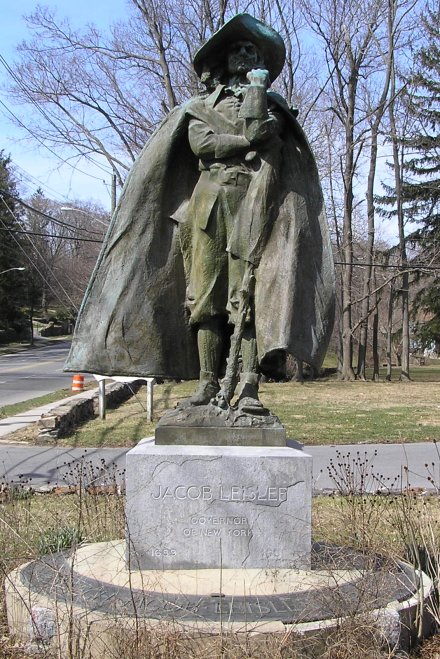
Statue of Jacob Leisler in New Rochelle, N.Y. — which Leisler helped create as a settlement for refugee Huguenots.
And once in the saddle, the Dutch Calvinist Leisler essentially ran a populist administration against the colonial oligarchy, which replied by vilifying him as a “usurper” and “rebel”.
Internal politics in New York and its neighbors during those months make fascinating reading.* Quakers and Catholics aligned against Protestants. Albany aligned against New York, until Leisler brought the former to heel. Clergy chose up sides. Leisler summoned a sort of proto-continental congress of colonial representatives (all the way to the West Indies) to hash out their situation.
And what was that situation? There had been a revolution, after all, and there was no agreed-upon representative of the royal authority present in New York. An assembly of militia leaders had asked Leisler to assume leadership, so was he really outside his rights to treat as his the London dispatches addressed to “such as, for the time being, take care for preserving the public peace and administering the law in New York”?
It’s a moment whose ferment of democratic energy can be read to presage the next century’s (proper) revolution.
Yet it was also not a revolution in the Cromwellian, world-turned-upside-down sense. For the English polity, and certainly for the conduct it preferred in its frontier possessions, continuity was the order of the day. Even in England herself, William and Mary were more than pleased to govern with Tories who could see their way to releasing their fealty to the Stuarts.
There was an empire to run, after all.
From that standpoint, Leisler’s anti-oligarchical policies and fractious disputes with other colonial elites were a bad business. There’s no sense in letting France make inroads because your governors are bickering over predestination or some such.
So formally, the realm’s new rulers continued all non-Catholic personnel in their posts. With the Dominion governors ejected, it was just a matter of dispatching fresh executives to take over. It’s just that this process required months … during which Leisler was managing New York the way he figured it ought to be managed, and his enemies were consequently painting him as a rebel.
Leisler pronounced himself, this whole time, anxious to submit his authority to the new governor upon the production of proper credentials. If he was surprised that the new monarchs tendered appointees of the very same factions recently expelled,** Leisler showed it only in his exactitude for procedure: because of a logistical cock-up, an aide to the new colonial governor arrived first, and when Leisler refused to hand over his fort without the royal warrant, a tense standoff ensued. It was resolved when the real governor, Henry Sloughter of ominous name, finally showed up.
Sloughter had his “predecessor” immediately arrested, along with others of his circle and harshly tried for treason and murder by a court stacked with anti-Leisler political enemies.†
Ultimately Leisler was condemned to die along with his secretary and son-in-law Jacob Milborne, but even Sloughter was loath to enforce the sentence. The story goes that Leisler’s most implacable foes had to get Sloughter drunk to put his signature on the death-warrant. (Sloughter died a couple of months later himself, for maximum operatic effect.)
On Saturday morning, May 16, 1691, the largest crowd ever gathered in New York City stood, rain soaked and weeping, all eyes fixed as a limp body was cut from the gallows and placed on the block. With a clean blow, the executioner’s ax cut off the head of the “halfe dead” Jacob Leisler — loyal lieutenant governor or rebel tyrant, depending on one’s point of view. Amid the “shrieks of the people,” fainting women (some “taken in labour”), and tumultuous jostling for “pieces of his garments” and strands of his hair, as “for a martyr,” the newly arrived and unfortunately named royal governor, Henry Sloughter, worried that his decision to execute Leisler might not, after all, end the “diseases and troubles of this Government.” Indeed, for years afterward New Yorkers bitterly divided over Leisler and the 1689 uprising that, in the wake of England’s Glorious Revolution, had led to his assumption of power in the provincial government.
-David Voorhees, who elsewhere contends that these divisions “continue to inform American politics to the present day.”*
A few years later, a more Leisler-friendly Parliament restored the dead man’s estate to his heirs, a sort of implicit admission that the whole head-chopping thing might have been a bit much.
This character figures to bear more historical consideration than he has heretofore enjoyed; further to that end, there’s a Jacob Leisler Papers Project devoted to marshaling at New York University the primary documents connected with Leisler.
* See, for instance, David Voorhees in “‘to assert our Right before it be quite lost’: The Leisler Rebellion in the Delaware River Valley” in Pennsylvania History, Winter 1997 — and, Voorhees again in “The ‘fervent Zeale’ of Jacob Leisler,” The William and Mary Quarterly, July 1994.
** Literally so: Francis Nicholson, whom Leisler ousted from New York, tried to get himself appointed governor; he was instead sent to Virginia and continued in royal service in the colonies for decades to come.
† e.g., Joseph Dudley, one of Leisler’s judges, whose penchant for authoritarian justice has been noted elsewhere in these pages.

 The sixth child was a daughter named Elizabeth, born in 1664. Twelve years later, Michael was brought to court “for cruel and excessive beating of his daughter with a flail swingle and for kicking her, and was fined and bound to good behavior.” Corporal punishment was not considered wrong in and of itself, but Michael’s beating of Elizabeth was criminally excessive. There is no way to know why Elizabeth was being punished, but the impression is, that she was a rambunctious, strong-willed child living in a violent household.