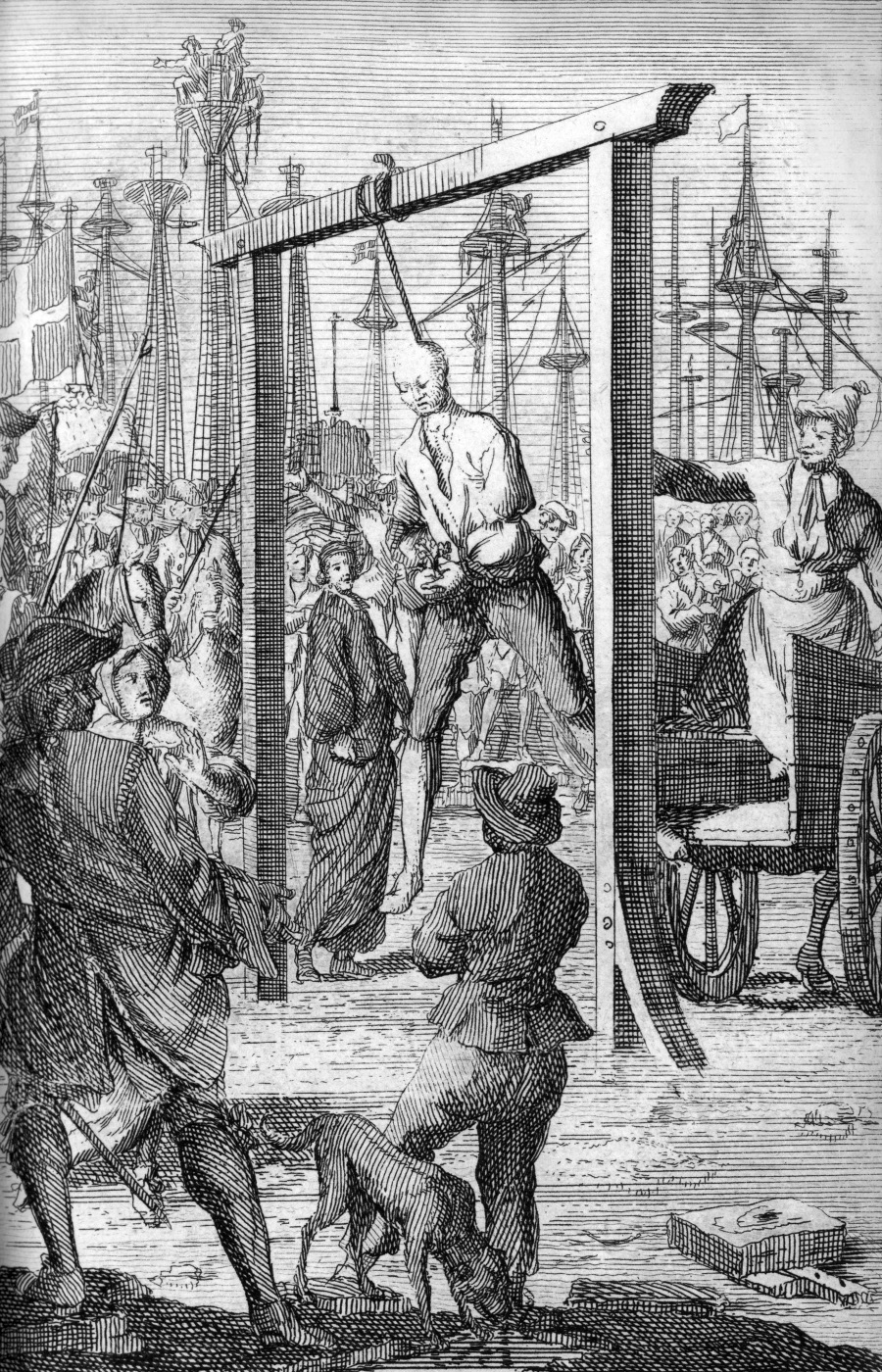
1715: William Ainslie, Edinburgh Castle betrayer

Edinburgh, Scotland held a Christmas Eve 1715 hanging of a soldier for abortive plot in the abortive Jacobite rising of 1715

The plot was a bold conspiracy of Highlanders to seize Edinburgh Castle itself, which would have been every bit the coup it sounds like. Sergeant William Ainslie and two other soldiers of the garrison had been bribed to admit the plotters via a sally port.


(cc) image from Stephanie Kirby.

Once there, the Highlanders meant to seize the castle’s ample stock of weapons and cash, and also “fire three cannon; that when this signal should be heard by some men stationed on the opposite coast of Fife, a fire should be kindled on the heights; and that these beacons, continued northward from hill to hill, should, with the speed of a telegraph, apprise Mar of his advantage.”

One minor problem: the whole enterprise depended on the ability of at least 83 people to keep a secret, but “they were so far from carrying on their affairs privately, that a gentleman who was not concerned told me that he was in a house that evening, where eighteen of them were drinking, and heard the hostess say that they were powdering their hair to go to the attack of the Castle!” Even so, the word only barely got out in time, the conspirators self-defeating by showing up late (too much time powdering?) and with ladders that were too short.

William Ainslie, the sergeant who was planning to open the gate for the Highlanders, had to shout the alarm and play it off that way once he realized that the dawdling had wasted the opportunity, but he was soon found out and spectacularly hanged over the castle wall for his trouble. The inevitable hanging-ballad broadside (“The Lamentation, and Last Farewell, Of Serjeant William Ainslie, who was executed over the Castle-Wall of Edinburgh for High Treason and Treachery, on Monday the 24th of December, 1716”*) emphasizes the pecuniary motive at the expense of the patriotic, but maybe it should have been dedicated to the principle that loose lips sink ships.

Let all Bold Soldiers far and near,
That sees my dismal Fall,
Lament my sad and wretched End,
That’s brought my self in Thrall;
Here to the World I do declare,
The Castle to Betray.
Full Fifty Pounds I was to have,
for which I’m doom’d to Die.

My Name is William Ainslie,
A Serjeant Stout and Bold,
In Flanders I the French have Fought,
And would not be Control’d:
And Loyal was to King and Crown,
my Trust did ne’re Betray,
Till I was tempted with that Gold,
For which I’m Doom’d to Die.

While I did in the Castle ly,
In Irons close Confin’d
For my Dear Wife and Children all,
My Heart no Ease could find,
To GOD I did for Mercy cry,
As I in Fetters lay.
Both Night and Day to him I’le Pray,
Since I am Doom’d to Die.

Ah! wo be to that cursed Gold,
That did my Heart intice,
To act such a gross Treachery,
The Castle to Surprise;
But wo’s me, for my Treachery,
My Hour is drawing nigh.
For I most hang out o’re the Wall,
Most Just Deservedly.

Good People, pray do not revile,
My Wife and Children dear;
Whom I so dearly lov’d on Earth,
Lord to my Soul draw naer: [sic]
I hope in Mercy he’l appear,
For still to him I’ll cry;
Since I most Justly, am condemn’d,
Over the Wall to dy.

They told me a must hang some Days,
Over the Castle-Wall;
Until the Rope takes Fire and breaks,
Then to the Ground I fall:
But since that I must suffer here,
Unto the Lord, I’ll pray;
Take Warning by my shameful End,
I just deserve to dy.

Since many People here is come,
This Day to see me dy;
I hope their Prayers to God they’l send,
For me, before I dy:
My vital Breath will soon be gone,
With a strong Rope and Tree;
But yet I hope my Peace is made,
With God who lives on high.

Those that did cause my dismal End,
I do forgive them here;
For now my Life lyes at the Stake,
Oh! Lord, to me draw near:
My precious Soul I pray receive,
For unto Thee I’ll fly;
For I have acted Treason great,
And for it I must die.

I wish all People Warning take,
That’s come to see me die;
The World unto you I’ll leave,
For all Eternity:
I must away, farewel, adieu
My Wife and Children all;
For I must hang into the Air,
Over the Castle Wall.

All you that sees me here this Day,
I desire you all to pray;
That all my Sins God would forgive,
Since I am brough to die:
Let every one both far and near,
Take Warning now by me;
Your Trust, I pray, never betray,
For which you see me die.

FINIS.

* I believe this is misdated since the plot was clearly set for September 9, 1715

On this day..

1711: Phebe Ward, Thomas Pritchet and John Matthews

“Of these twelve Persons, 9 having obtain’d the Mercy of the QUEEN’s most gracious Reprieve (which I hope they will take care to improve) only 3 are now order’d for Execution.”

Ordinary of Newgate

The three unlucky ones order’d for Execution on December 22, 1711, were these:

Phebe Ward was a young woman who had lately moved to London from Yorkshire … but not alone, as it turned out. She was pregnant by a Yorkshire lad whose marriage proposal she nonetheless spurned.

Ward got a maidservant gig in a London home, but vigorously denied her condition. Pregnant servants were liable to firing, though the Ordinary of Newgate says that Ward’s tried to offer hers good treatment and care for the little bastard. Ward stuck to her “I’m not pregnant” story, delivered the child, suffocated it, and threw it down a well.

Thomas Pritchet was a mere 16 years old but already had seven years service in the royal navy. A native son of the London proletariat, Pritchet had robbed two men (one upon the highway, another by burgling his house) not five weeks before his execution; at the gallows he insisted that these were his first forays into crime.

John Matthews was “born of good Parents” and “formerly liv’d like a Gentleman” in Wales, but having no profession the exhaustion of his revenues caused him to become a professional thief … specializing in the increasingly valuable 18th century status symbol, the wig.

He’d been pardoned for his crimes twice before, so this indictment for stealing 24 ounces of hair and two perukes sealed his fate.

We noticed yesterday the voice of the Newgate Ordinary. A generation on here, the former Ordinary Samuel Smith was long in the ground. His successor, Paul Lorrain had really figured out Smith’s profitable racket.

Lorrain banked a healthy £200 annually selling his Ordinary’s Accounts, which he standardized and padded out from Smith’s versions into six-page pamphlets — not to mention spinoff publications (pdf) capitalizing on his gallows brand.

The celebrated sincerity of every culprit’s dying conversion led a later wag to call the hanged “Lorrain’s Saints.” In Moll Flanders, published two years after Lorrain’s 1719 death, Defoe has an unnamed character of his office who seems clearly based on the late divine. Moll, like Defoe himself,* finds the Ordinary repulsive.

THE Ordinary of Newgate came to me, and talk’d a little in his way, but all his Divinity run upon Confessing my Crime, as he call’d it, (tho’ he knew not what I was in for) making a full Discovery, and the like, without which he told me God would never forgive me; and he said so little to the purpose, that I had no manner of Consolati|on from him; and then to observe the poor Creature preaching Confession and Repentance to me in the Morning, and find him drunk with Brandy and Spirits by Noon; this had something in it so shocking, that I began to Nauseate the Man more, than his Work, and his Work too by degrees for the sake of the Man; so that I desir’d him to trouble me no more.

It’s less certain that Lorrain’s ministrations were unwelcome to all of Newgate’s denizens, or that they were hypocritical or cynical on their own terms.

He preached a theology (surely requisite for one in his position) of a saving grace capable of overcoming the most dissolute life and appears every ounce in earnest in exerting himself for what he took to be the redemption of his charges. He reports preaching to this date’s trio that they ought “to implore it of that good and merciful God, who is always more ready to give, than Men can be to ask; and who (as he has declar’d) desires not the Death of Sinners, but that they should turn from their wicked ways, and live: i.e. that they would return to God by sincere Repentance, and Amendment of Life here, and so obtain (thro’ a lively Faith in Christ) an Eternal Life of Bliss and Glory hereafter.”

In the last prior hanging date before this one, Lorrain had found one seasoned burglar “obstinate” and plainly irritated by his ministrations.

“But I told him,” Lorrain related, “that I must not flatter him to the destruction of his Soul, and thereby bring Guilt upon my own. And therefore, I would not give over pressing him to make such a sincere Acknowledgment of his Faults, and give such Proof of his Repentance, as might rejoyce my Heart from the Satisfaction I should have, that this would procure Peace to his Conscience.

“Though you exclaim never so much against what I offer you, I am fully resolv’d to endeavour the Salvation of your Soul.”

Lorrain got his man. He did more times than not.

He plied even ready confessors for “Particulars” to ferret out their crimes — and sometimes, their accomplices. (Recall that London had no police force at this time.) Those who bent themselves to Lorrain’s appeals would expunge all their wrongdoing, embrace the ceremony of their own mortal expiation, purging themselves of their sins, supplicating heaven, announcing the justice of their fate and warning the onlookers against it. They would, so the Ordinary thought, be fit for divine salvation no matter how bloody their former deeds.

One other point on which we can’t help but feel some kinship to this industrious priest: in the best tradition of death-bloggers everywhere, this content so piously wrung from wicked hearts Lorrain did not scruple to monetize:

ADVERTISEMENTS.

ROBERT WHITLEDGE, who formerly lived at the Bible in Creed-Lane, is removed to the Bible and Ball in Ave-Mary-Lane near Ludgate, where all Booksellers and others may be furnisht with Bibles and Common-Prayers of all Sorts, with Cuts or without, Ruled or Unruled, Bound in Turky Leather or Plain. Mr. Sturt’s Cuts Curiously Engrav’d; also other fine Cuts fitted for all Sizes and Common-Prayers. The Welsh Bible, Welsh Common-Prayer, and Welsh Almanack. The Duty of Man’s Works of all Sizes. The Duty of Man in Latin. Latin and French Common-Prayers. Tate and Brady’s New Version of Psalms, with the New Supplement. Dr. Gibson on the Sacrament. The Statutes at large, in Three Volumes. Washington and Wingate’s Abridgment of them. The Lord Clarendon’s History of the Rebellion, in Folio and Octavo. The New Translation of Æsops Fables. Also Bp. Beveridge’s Works, in 5 vol. And Dean Stanhope on the Epistles and Gospels, in 4 vol. All which Books and Cuts are likewise sold by J. Baker in Mercers-Chapel

Lately publish’d for the Use of Schools,

Vocabularium Latiale; or, a Latin Vocabulary in two parts. The First being a Collection of the most usual and easie Latin words, whether primitive or derivative; with their signification in English, after the order of the Eight parts of Speech, giving a Specimen of each, and most naturally shewing the gender, increase, declension and motion of Nouns and Pronouns, with the Conjugation-Preterperfect Tense and Supine of Verbs both Simple and Compound. The Second, shewing the variation and declining of all the declinable parts, both regular an irregular. By Tho. Dyche, School-Master in London, Author of a new Spelling-book, entitul’d, A Guide to the English Tongue. Printed for S. Butler, at Bernard’s-Inn-Gate, in Holbourn, J. Holland, near St. Paul’s Church-yard, and A. Collins, at the Black-Boy in Fleet-street. Price 1 s.

London printed, and are to be Sold by J. Morphew, near Stationers Hall.

* For more about Paul Lorrain (and Defoe’s loathing of him), see:

Robert Singleton, “Defoe, Moll Flanders, and the Ordinary of Newgate,” Harvard Library Bulletin, Oct. 1976.

Lincoln Faller, “In Contrast to Defoe: The Rev. Paul Lorrain, Historian of Crime,” Huntington Library Quarterly, Nov. 1976.

On this day..

1719: Mary Hamilton, lady in waiting

On this date in 1719, Mary (Marie) Hamilton, lady-in-waiting upon the tsaritsa Catherine I, was beheaded in St. Petersburg for infanticide.

A frightened Mary Hamilton contemplates her imminent execution in this 1904 painting by Pavel Svedomsky.

Lady Hamilton — her Scottish family had emigrated generations earlier — did not like to wait on her libido.

She could tell you if Peter the Great deserved his nickname, and dish on any number of other courtiers, nobles, and hangers-on.

This pleasing sport, of course, assumes with it the risks imposed by an equally impatient biology. Hamilton’s gallantries two or three times quickened her womb.

Her decision to dispose of these unwanted descendants in the expedient way — once by abortion, and again by infanticide — was done on the sly (voluminous court gowns helped) but surely also with no expectation of such a severe sanction in the unlikely event of detection.

But according to Eve Levin,* Russia’s longtime slap-on-the-wrist policy for infanticide was changing, and beginning “to distinguish between a woman who killed her child to hide illicit sexual conduct, and a woman who killed her child because she was too poor to care for it. In the first instance, the killing of the child reflected selfish behavior and was considered to be murder.”

Mary Hamilton was obviously not too poor to raise children.

In 1717, an unrelated investigation of another of Hamilton’s lovers led him to accuse the libertine lady-in-waiting of practicing post-natal birth control, which Mary admitted to,** certainly expecting her mistress the queen and her paramour the king to look forward, not back.

Peter, the towering and intense “learned druzhina” with his eye fixed on the West and a modernity that Russia lagged behind, was a liberal man in many respects. But he remained eminently capable of ruthlessness in service of an idea. This affair played out, after all, in his brand-new capital St. Petersburg, built on the bones of thousands peasants who threw up the city over swampland at Peter’s command. In 1718, he’d had his own son knouted to death.

Apparently infanticide was one of those ideas.

After all, executing women for infanticide was happening where the Hamiltons had come from. And it would still be good enough for late 18th century Enlightenment philosophers.

On the day of the execution, the prisoner appeared on the scaffold in a white silk gown trimmed with black ribbons. Peter climbed the structure to stand beside her and spoke quietly into her ear. The condemned woman and most of the spectators assumed that this would be her last-minute reprieve. Instead, the Tsar gave her a kiss and said sadly, “I cannot violate the laws to save your life. Support your punishment with courage, and, in the hope that God may forgive you your sins, address your prayers to him with a heart full of faith and contrition.” Miss Hamilton knelt and prayed, the Tsar turned away and the headsman struck.

Then, the bystanding tsar picked up the severed head that had once shared his pillow and discoursed to the multitude on its anatomical features — another idea imported from the West. That strange tsar afterward had the disembodied dome preserved in a jar until Catherine the Great ran across it and (after remarking that the woman’s youthful beauty had been preserved this half-century) had it decently buried.

Something else of Mary Hamilton outlasted her pickled cranium, however.

In one of those unaccountable twists of history, Hamilton maybe became conflated with the “four Marys”, Ladies-in-Waiting of Mary, Queen of Scots — and the story seemingly became translated backwards into this altogether different time and place. This is a much-disputed hypothesis† but for purposes of a blog post is well worth the noticing, while resigning to wiser heads the literary forensics at stake.

There was no “Mary Hamilton” among the Queen of Scots’s attendants, but in at least some of the many different versions of this ballad that survive, a person of this name is held to have become the lover of the king (“the highest Stuart,” in this case) and been put to death for killing her illegitimate child.‡ It is, at the very least, rather difficult to miss the parallel.

O little did my mother ken,
The day she cradled me,
The lands I was to travel in,
Or the dog’s death I wad d’ee!

Variants of this ballad remain popular to this day.

* “Infanticide in Pre-Petrine Russia,” Jahrbücher für Geschichte Osteuropas, Neue Folge, Bd. 34, H. 2 (1986).

** She had also pilfered some effects from the Queen.

† Dissenting opinions on identifying the “Mary Hamilton” of the ballad with our Mary Hamilton can be read here and here.

Presumed basis for the conflation: an actual 1563 infanticide scandal featuring the illicit offspring of Mary’s apothecary and “a Frenchwoman that served in the Queen’s bedchamber.”

On this day..

1715: Four Jacobites including George Lockhart’s brother

On this date in 1715, four Jacobites who had participated in the 1715 Jacobite rising were shot together at Preston.

These executions came in the aftermath of the Battle of Preston, with the Jacobite cause in full collapse. It was an affecting scene, the first of many among the Preston captives.

After [Major John Nairn] was shot, Captain Lockhart would not suffer any of the common soldiers to touch his friend’s body, but, with his own hands and the help of the other two gentlemen [about to be executed], laid Major Nairn in his coffin, and, with the greatest composure of mind, performed the last offices to his dear companion: After which, he was shot, and the other two performed the like to his body.

Then the others [John Shaftoe and John Erskine] were shot, and laid together, without a coffin, in a pit digged for that purpose. Which tragical scene being thus finished, Mr. Nairn and Mr. Lockhart were decently buried. (Source)

False Equivalent

The “Captain Lockhart” named here was Philip Lockhart, brother to anti-unionist politician George Lockhart.* George Lockhart, years before, somehow ended up on the committee whose job it was to hammer out the terms on which that union would take place.

As a result, Lockhart’s memoirs record an inside look at the tawdry payoffs that roped Scottish elites into the union arrangement — beginning first of all with “the Equivalent”, a massive British inducement to Scottish lords who had lately gone comprehensively bust gambling on the dot-com scam of New World colonization, the Darien scheme.

the Equivalent was the mighty Bait; here was the Sum of 398,085 Pound Sterling to be remitted in Cash to Scotland (tho’ the Scots were to pay it and much more back again in a few Years, by engaging to bear a Share of the Burthens impos’d on England, and appropriated for Paymnt of England’s Debts.) … here was a swinging Bribe to buy off the Scots Members of Parliament from their Duty to their Country, as it accordingly prov’d: For to it we may chiefly ascribe, that so many of them agreed to this Union. The Hopes of recovering what they had expended on the African Company, and obtaining Payment of Debts and Arrears due to them by the Scots Government (it being articled in the Treaty, that it should be expended this Way) prevail’d upon many to overlook the general Interest of their Country.

Just Deserts

This, however, was not the reason that Philip et al were first in line for punishment after Preston. Instead, they were in trouble because they were British officers who had deserted.

At least, that was the crown’s position. As a legal matter, it wasn’t quite that simple: the “deserters” weren’t on active duty, but rather, were half-pay officers.

This ambiguous category had been introduced as a sort of reserve system to keep idled officers available to the army, but developed into a general dumping-ground of incompetents, invalids, and retirees (half-pay could be used as an ad hoc pension) in an army still only semi-professionalized. Moreover, according to Margaret Sankey, the system

was thoroughly corrupt by 1715. Much of the half-pay list was made up of men who were unfit to be called back into active service, while many of the commissions had been sold to brokers for an immediate cash settlement … [some officers] saw half-pay as a well-deserved personal gift from Queen Anne for … service under Marlborough, and one that carried no obligations to the current monarch whatsoever ‘as no more than a gratuity and a reward for the hazards they had run and the fidelity they had shewn their late mistress.’

It was also a period of dynastic turnover: six different monarchs representing three different houses had ruled England/Great Britain in the preceding 30 years, each man or woman coming to the throne under contestable circumstances. Various gentlemen-officers had sworn various oaths to various entities and they in good faith did not necessarily consider those blanket oaths transferable to the new “British” state and to every Tom, Dick, and German elector who styled himself king of it.

Martial Prowess

These neither-fish-nor-fowl soldiers, then, presented a delicate jurisprudential question. No less a personage than the Lord High Chancellor suggested back in Privy Council that, since half-pay officers would not be eligible to sit on a court-martial jury, they must likewise not be eligible to be court-martialed.

The plurality of the government, and certainly the military, saw it otherwise.

Nevertheless, all concerned were constrained not to be entirely indiscriminate. Of six men prosecuted, the one who was able to prove that he had “thrown up” his half-pay commission walked altogether: he’d been in rebellion, but he hadn’t deserted to do it. Another defendant, who threw himself on the court’s mercy rather than trying to parse a half-reason why half-pay licensed his revolt, received that mercy. (It didn’t hurt that that one was also the child of a (loyal) duke.)

The rest of the lot was abandoned to its fate, leading the correspondent who recorded the particulars of their execution concluded to conclude,

this is a swatch of the usage people may expect that fall into some men’s clutches, from whom all good Christians and true Scotsmen should fervently pray, that God, out of his infinite goodness and mercy, would deliver every honest man!

* These Lockharts were sons of the Scottish judge George Lockhart whose senseless 1689 murder we have previously noticed.

On this day..

1716: Four Jacobite rebels at Liverpool

We doubt this entry can stack up to the one preceding for melodrama, but not every rebel on the gallows can be a peer of the realm or a guardian of the chalice of Christ. Big names get the big headlines, but other folk make up their smaller fame by their greater volume.

From the interesting Lancashire Memorials of the Rebellion, we learn of the unhappy fate of several dozen Jacobite rebels in a chapter titled, “The Prisoners Tried at Liverpool, and Their Sentences.”

At the beginning of January 1716, the Government sent down a commission of Oyer and Terminer, to try the prisoners who had been distributed in the various prisons of Lancaster, Chester, and Liverpool. As Liverpool had the reputation of being in the Whig interest [i.e., the Hanoverian, anti-Jacobite party], having sent to Parliament two Members of this party, it was conceived expedient, that the trials of so many rebels, which, under the most favourable circumstances, could not fail to have caused much factious excitement and sensation, should take place in a town, more devoted to the Whig cause than any other in Lancashire.

The judges appointed for the trial were Mr. Baron Burry, Mr. Justice Eyre, and Mr. Baron Montague, who, on the 4th of January, set out, with all their attendants, from London. For the sake of making an impression upon the country, they travelled leisurely through all the towns upon the route, so as to occupy seven days on the journey. On the 11th of the same month, they arrived at Liverpool.

Upon the day following, January 12th, the judges opened their commission; the Grand Jury were summoned, and the court sat. There had been Commissioners previously appointed to take precognitions of such as were made witnesses in reference to the fact of rebellion at Preston; which, having been laid before the Grand Jury, bills of indictment were found against 48 of the prisoners.

Copies of the Indictments were then given to the persons against whom the bills were found, and the court was adjourned for eight days, in order to afford the prisoners legal time to prepare their defense …

n the 20th of January the Court again sat, between which date and that of the 9th of February following, it is said that 74 persons were tried.

Thirty-four of these wretches drew death sentences, which were meted out in a sort of traveling road show in the realm’s northern reaches to make sure everybody got the message.

That show’s closing performance was on this date.

Liverpool, Feb. 25th. — The circuit of the Hangmen here ended.On this day suffered Mr. Burnett of Carlops, a most active gentleman in the Rebellion, along with Alexander Drummond, and two Northumberland gentlemen, viz., George Collingwood and John Hunter.

In the High Sheriff’s account is the following item: “Feb. 25. Charge of executing Bennet” [Burnet] “and three more at Leverpoole, £10, 3s.”

On this day..

1716: Lords Kenmure and Derwentwater but not Lord Nithsdale

This date in 1716 saw the beheading of two Jacobite lords, but it was more famous for the third who ducked the executioner in one of the Tower of London’s greatest escapes.

Lord Nithsdale, Escape from the Tower by Emily Mary Osborn(e)

Three were doomed to the block this date:

They were the fruit of Parliament’s impeachment of Jacobite leaders. Six of these fellows threw themselves upon the mercy of the Commons, and were rewarded with a death sentence by William Cowper. Only half managed to wrangle mercy from the crown.

On the eve of this date’s execution, Lord Nithsdale received a visitation of his wife, Winifred … who helped him swap clothes with one of her maids, in which garb he audaciously marched out the Tower gates in the train of his spouse.

The king whom Nithsdale had purposed to dethrone was a good sport about it. “It was the best thing a man in his condition could have done,” he declared.

The fugitives managed to cross the channel — that required another bit of dress-up, in the livery of the Venetian ambassador — and absconded to Rome. William Maxwell, Lord Nithsdale, outlived his appointment with the headsman by 28 years.

They are gone — who shall follow? — their ship’s on the brine,
And they sail unpursued to a far friendly shore,
Where love and content at their hearth may entwine,
And the warfare of kingdoms divide them no more.

“The Dream of Lord Nithsdale”

A letter detailing the escape from the pen of the intrepid Lady Nithsdale herself is well worth the read.

Her reputation as a romantic heroine (only enhanced by the romantic futility of the Jacobite struggle itself) has lent itself to all manner of literary expropriation, like this 19th century historical novel.

All very well for these two lovebirds. But the remaining 67% of the day’s scaffold carrion did not escape the Tower in women’s clothing, or men’s, and paid with their heads as scheduled.

Derwentwater went out with a peevish scaffold a ballad, “Lord Derwentwater” (or “Lord Allenwater”, or several similar variants), and another aptly titled “Derwentwater’s Farewell”.

His partner at the chop, Lord Kenmure,** also made the folk playlist in “O Kenmure’s On And Awa, Willie”, one of the ditties gathered by Robert Burns.

Having beheld all these various exemplars, Derwentwater’s brother and fellow Stuart supporter Charles Radclyffe decided to emulate them all.

Later that same year, Charles Radclyffe also made a successful prison break and got to the continent.

As a result, he was still around to participate in the 1745 Jacobite rising … and finally get executed for that.

(All part of God’s mystical plan for Radclyffe: look sharp and you’ll find him succeeding Isaac Newton as CEO of the legendary Holy Grail-keeping secret society Priory of Sion in Holy Blood, Holy Grail and its pulp novel knockoff The Da Vinci Code.)

* It’s impossible not to notice that this cross-dressing escape foreshadows that of Bonnie Prince Charlie when the Jacobite cause flamed out for good thirty years later.

** And like Lord Nithsdale, he was also blessed with a perspicacious wife — albeit one who wasn’t able to extricate him from the Tower.

On this day..

1714: Various rebel slaves in the Cape Colony

This site has previously noticed a milestone 1714 execution in the Dutch Cape Colony of South Africa.

That execution of a black slave and his white lover was exceptional — and, of course, the chronicles of the Cape are replete with less exceptional fare, the humdrum penal brutality of an 18th century colony disposed of in a sentence of two between reports of smallpox outbreaks, price fluctuations, the transit of slave ships, and all the other business of frontier life.

A slave condemned to be burnt alive for arson; another to be hanged for theft … Two white men hanged for desertion, sheep-stealing, and attempt to murder … A Javanese “Guru” sentenced to death for instigating slaves to run away, harbouring and arming them … Matthys of Ternate punished for running away and cattle theft, &c. Sentenced to be hanged … A slave hanged for breaking into the house of Lieutenant Captain Slotsboo … Five slaves sentenced to be broken, and a female slave to be scourged … Two soldiers sentenced to run the gantlope …

And so on.

This date marks a number of such executions for a minor slave revolt (incidents of slave insubordination also pepper the Colony records). At three full entries in the chronicle, 16 implicated slaves, and some spectacularly savage punishments, it must have been one of the more noteworthy of its day; what the colonial register leaves us is just enough to suggest the forgotten suffering and resistance of the half-nameless chattel of yesteryear.

1714.

January 7 — Some 16 fugitive slaves who had conspired, armed themselves, and did much mischief. They resisted the officers of justice, shot a soldier, and murdered a Hottentot woman. They were now brought up for examination.

February 7 — The sentences passed on the fugitive slaves, and the whole history of the case. “Tromp” to be empaled alive, and to remain in that position till he dies. “Cupido” to be put on a cross, his right hand to be cut off, and with “Neptunus” to be broken on the wheel, and then to be left on a hurdle until dead. “Titus” to be broken with the coup de grace. Jeroon and Thomas to be hanged; three others to be scourged and have their right heels cut off. The eleventh prisoner is merely to look on, and afterwards to be sent home; paying the costs however.

February 8 — The empaled convict found strangled in the morning. He had received some linen from a kind friend during the night for the purpose. He would otherwise have been still alive.

On this day..

1718: Stede Bonnet, gentleman pirate

On this date in 1718, the Barbados buccaneer Stede Bonnet was hanged for piracy in Charleston, S.C.

Bonnet had few of the typical swashbuckler’s resume-builders during this Golden Age of Piracy: he was neither a mariner by trade nor a desperate outlaw by circumstance, but a wealthy English landowner in Bermuda.

“He had the least Temptation of any Man to follow such a Course of Life, from the Condition of his Circumstances,” wrote the pseudonymous author (alleged to be Daniel Defoe) of A General History of the Pyrates. But as age thirty hove into view and the seven-year itch demanded scratching, Bonnet undertook an abrupt career change “said to have been occasioned by some Discomforts he found in a married State.”

Bonnet’s version of a cherry-red convertible was a six-gun sloop named Revenge,* which he tricked out from his ample inherited fortune and took cruising for action on the North American coast.

Or, just get this Victorian satire free from Google books.

He raided from New England to the Carolinas, fell in with Blackbeard (which more credible cutthroat charismatic promptly appropriated Bonnet’s hireling** crew), lost his ship, got it back, turned himself in, got a pardon … the rich guy packed plenty of adventure into little more than a year of raiding, but he never seems to have advanced his freebooting skills past the “gentleman hobbyist” level.

South Carolina ships captured Bonnet near Cape Fear, which is actually North Carolina, but never mind: South Carolinians well remembered this character from his involvement with Blackbeard’s recent blockade of Charleston.

Bonnet got gentleman’s quarters upon detention, and his elite education enabled him to favor the colony’s governor with a simpering plea for clemency.

Honoured Sir,

I have presumed, on the Confidence of your eminent Goodness, to throw my self, after this manner, at your Feet, to implore you’ll graciously be pleased to look upon me with tender Bowels of Pity and Compassion; and believe me to be the most miserable Man this Day breathing: That the Tears proceeding from my most sorrowful Soul may soften your Heart, and encline you to consider my dismal State …

if I had the Happiness of a longer life in this World … I’ll voluntarily put [wickedness] ever out of my Power, by separating all my Limbs from my Body, only reserving the Use of my Tongue, to call continually on, and pray to the Lord, my God, and mourn all my Days in Sackcloth and Ashes to work out confident Hopes of my Salvation …

Good grief.

All of which pathos was unwisely belied by an escape attempt which made pardon completely untenable.

Most of Bonnet’s captured crew was hanged en masse on Nov. 8; Bonnet managed to drag on several stays of execution before he followed them from his comfortable digs to the common gallows. A stone monument marks the spot.

* There were many pirate ships Revenge, including that of famous women pirates Anne Bonny and Mary Read and that of the Dread Pirate Roberts. There’s also a band “The Pirateship Revenge”.

** Bonnet paid his crew out of his own pocket, a practice at odds with the more egalitarian pirate norm of crews taking like shares and choosing (or demoting) their own captains.

On this day..

1714: Maria Mouton and her slave Titus, lovers

On this date in 1714, a slave and his mistress — “mistress” in both senses of the word — were put to death in the Dutch Cape Colony for murdering her husband.

Marie or Maria Mouton had arrived in South Africa in 1699 as a nine-year-old with a refugee Huguenot family.

A decade and a half’s passage finds her a young woman wed to one Franz or Frans Joost/Jooste/Joostens, to whom she bore two sons … and, evidently, a homicidal grudge.

Early in 1714, Maria and her lover, a slave named Titus Bengale, murdered Frans, in consequence of which crime,

[s]he [Maria] is sentenced to be half strangled, after that to be scorched,* and after that strangled unto death. Titus to be empaled and to remain so, until death. After that his head and right hand are to be cut off and fixed on a pole, beyond the limits of his late master’s property. Fortuin, an accomplice, is also to have his right hand cut off, and without receiving the coup de grace, is to be broken on the wheel. After that he is to be placed on a grating until death takes place. After that his head is to be cut off, and with his hand placed on a pole, together with the head and hand of Titus. After that the bodies are to be taken to the outside place of execution, and there left exposed to the air and the vultures.

She’s the only white woman to be executed in 18th century South Africa.

Our Precise of the Archives of the Cape of Good Hope** notices that Titus, despite enduring his grotesque execution for two full days before succumbing, remained terribly jocund amid his public torture. (Not unlike other slaves tortured to death in Dutch colonies):

September 3 — The slave Titus, above mentioned, died about midday, having lived in his misery about 48 hours; something horrible to think of, to say nothing of personally beholding the misery. It is said that 4 hours after his empalement he received a bottle of arrack from which he drank freely and heartily. When advised not to take too much, lest he should get drunk, he answered that it did not matter, as he sat fast enough, and that there was no fear of his falling. It is true that whilst sitting in that deplorable state, he often joked, and scoffingly said that he would never again believe a woman. A way of dying, lauded by the Romans, but damnable among the Christians.

This case is discussed in more detail by Nigel Penn in “The wife, the farmer and the farmer’s slaves: adultery and murder on a frontier farm in the early eighteenth century Cape,” Kronos, vol. 28 (2002) — here’s an excerpt — and by the same author in Rogues, Rebels and Runaways: Eighteenth-Century Cape Characters.

* Literally, blaker. “To ‘blaker’ someone,” notes Nigel Penn in “The wife, the farmer and the farmer’s slaves: adultery and murder on a frontier farm in the early eighteenth century Cape,” Kronos, vol. 28 (2002), “was to hold burning straw to their face and to blacken it … a reference to the earlier practice of burning at the stake victims found guilty of heresy, witchcraft and sodomy. Surely we may also see, in the case of the blackening of Maria Mouton, a reference to her crime of cohabiting with slaves.”

** After another slaveowner was murdered later in the year, the chronicle laments that “crime is rapidly assuming large dimensions, in spite of the means used to prevent or suppress it. A clear proof that this Colony mainly consists of evil disposed, head-strong slaves and the refuse of convicts.”

On this day..

1716: Banda Singh Bahadur

On this date in 1716, legendary Sikh warrior Banda Singh Bahadur attained his martyrdom.

Born Lakshman Dev, the man who would become Banda Bahadur went on a spiritual wandering jag as a young man and chanced to be plucked out of hermitage by Sikh guru Gobind Singh.

When this guru’s efforts to make inroads for Sikh interests with the new Mughal Emperor Bahadur Shah foundered, the converted hermit (now returned to the martial exercises of his caste) was tasked with a punitive expedition against one of the more obnoxious governors.

The zealous general did his mentor one better, attracting thousands of sympathetic followers and carving out a Sikh kingdom in Punjab in the early 1710s.

This proto-state (forerunner of an actual state in the next century) was in due time outmuscled by the Mughals, capturing the rebels’ last redoubt by means of a perfidious assurance of leniency that would not be forthcoming. Not at all.

The captured were marched back to Delhi, along with the pike-mounted heads of their fallen comrades, and there subjected to grisly mass executions.

British diplomats making nice with the Mughal court at the time recorded the scene.

The great rebel Guru (Bandu, the Sikh) who has been for these twenty years so troublesome in the province of Lahore, is at length taken with all his family and attendance by the Subahdar, or Viceroy, of that province. Some days ago they entered the city laden with fetters, his whole attendants which were left alive being about 780,* all severally mounted on camels, which were sent out of the city for that purpose, besides about 2,000 heads stuck upon poles, being those who died by the sword inb attle. He was carried into the presence of the King, and from thence to a close prison. He at present has his life prolonged with most of his officers, in hopes to get an account of his treasure in several parts of his kingdom, and of those that assisted him, when afterwards he will be executed for the rest. There are one hundred each day beheaded. It is not a little remarkable with what patience they undergo their fate, and to the last it has not been found that one has apostatised from the new formed religion.

Their captain’s turn finally came this date when — spurning conversion to Islam, as had his fellows — he saw his son slaughtered before his eyes, then was hacked limb from limb.

On this day..