On this date in 1795, a Balzac story La Comedie humaine reaches its climax as the tumbrils of the Thermidorian Reaction wind their way to the scaffold.
It transpires in an exchange between the two that the stranger’s own conscience is somehow troubled.
“Remember, my son, [said the abbe] that it is not enough to have taken no active part in the great crime; that fact does not absolve you. The men who might have defended the King and left their swords in their scabbards, will have a very heavy account to render to the King of Heaven — Ah! yes,” he added, with an eloquent shake of the head, “heavy indeed! — for by doing nothing they became accomplices in the awful wickedness—-”
“But do you think that an indirect participation will be punished?” the stranger asked with a bewildered look. “There is the private soldier commanded to fall into line — is he actually responsible?”
We have no more answer in the text than we have in life.
Spoiler (That You Saw Coming) Alert
The stranger returns on the anniversary of the king’s martyrdom, but he remains enigmatic, until the abbe is caught up in a crowd watching the procession to the guillotine.
“What is the matter?” [the abbe] asked Madame Ragon.
“Nothing,” she said; “it is only the tumbril cart and the executioner going to the Place Louis XV. Ah! we used to see it often enough last year; but to-day, four days after the anniversary of the twenty-first of January, one does not feel sorry to see the ghastly procession.”
“Why not?” asked the abbe. “That is not said like a Christian.”
“Eh! but it is the execution of Robespierre‘s accomplices. They defended themselves as long as they could, but now it is their turn to go where they sent so many innocent people.”
The crowd poured by like a flood. The abbe, yielding to an impulse of curiosity, looked up above the heads, and there in the tumbril stood the man who had heard mass in the garret three days ago.
On this date in 1796, insurrectionary Jose Leonardo Chirino was hanged in Caracas for leading a slave revolt in Spain’s oppressive New World sugar plantations.
Nearly all the information readily available online about Chirino is in Spanish, and all the links in this post are to Spanish pages.
The influence of the Haitian Revolution, and the philosophical precepts of the French Revolution that had helped spawn it, sent waves through the Caribbean washing up on every shore it touched.
Most of those lands had a ready audience under the lash of European colonial masters; the eastern Venezuelan city of Coro, home to the sugar aristocracy and the groaning underclass that crop implied, must have had one of the readiest.
On May 10, 1795, Chirino — a Zambo of mixed African and Amerindian blood who was himself a free farmer — led an uprising of the Congolese slaves in the area who worked the sugarcane and declared a Republic under the “Law of the French,” with slavery and white privilege abolished.
The rebellion’s attempt on Coro itself failed, and it was swiftly put down by the colonial authorities. Though many involved were killed summarily, the Spanish took their sweet time after capturing Chirino in August 1795: only the following year was he transferred to Caracas for execution, after which his body was dismembered and his head set in an iron cage displayed on the road to Coro. (For good measure, they sold his family into slavery.)
Of course, Chirino was on the right side of history. The city square in Caracas where Chirino hung is now Plaza Bolivar, named for Latin America’s eponymous liberator.
Coro itself is today served by Jose Leonardo Chirino airport, and for the African diaspora in Venezuela, Chirino is a special inspiration.
[audio:Jose_Leonardo.mp3]
Like any worthwhile symbol, he’s also contested territory — claimed as a forerunner (if a questionable one) of socialism by the “Bolivarian Republic” now governed by Hugo Chavez.
The sovereign’s bed implied a station of wealth and extravagance, but the low birth that caused Marie to turn up her nose didn’t much help this day’s victim standing with the Jacobins.
Poor Madame du Barry, at 50 years of age, had not lost an ounce of her considerable zest for life … and her apparently ingenuous joie de vivre while the Revolution raged looks somewhere between innocent and daft.
While nobles were scrambling to get out of France, the Comtesse born Jeanne Bécu shuttled back and forth over the English Channel in 1792 to settle her jewelry accounts … and decided to stay in France, returning after the September Massacres no less. Later, she would detail to her gaolers where she had stashed her baubles around her estate, in the delusion that they could buy her life — or at least, “did not each word give her a second of time?”*
She’s remembered for the uncommon scene she made being hauled to the guillotine this date — in a time when the scaffold’s pageantry demanded a stoic public dignity from the guillotine’s victims, the Comtesse came apart, and begged the crowd for her life so frantically and heart-wrenchingly that the executioners felt hurried to dispatch her lest the scene turn against them.
Even to the last, hopeless second she implored Sanson,
Encore un moment, monsieur le bourreau, un petit moment.**
One could make the case that if more clients of the national razor had displayed such naked humanity to onlookers, the guillotine‘s technical and social capacity for mass butchery might have been lessened.
Whether true or not, she gives us a glimpse, oddly unusual in these pages, of unadulterated fright — of that visceral instinct to cling to life, even under the blade, even for one little moment more.
After all this honour and glory, after having been almost a Queen, she was guillotined by that butcher, Samson. She was quite innocent, but it had to be done, for the satisfaction of the fishwives of Paris. She was so terrified, that she did not understand what was happening. But when Samson seized her head, and pushed her under the knife with his foot, she cried out: ‘Wait a moment! wait a moment, monsieur!’ Well, because of that moment of bitter suffering, perhaps the Saviour will pardon her other faults, for one cannot imagine a greater agony.
Spare a thought for that moment of bitter suffering, next time you … uh, dine on cauliflower?
* This line, obviously in the vein of her famous last request to the headsman, is from Memoirs of the Comtesse Du Barry, actually a 19th century work of historical fiction by Baron Etienne Leon Lamothe-Langon.
** “One moment more, executioner, one little moment!”
Fully engaged with the liberal intellectual currents of the Enlightenment, de Gouges spent the 1770’s and 1780’s in Parisian salon circles cranking out plays (over 40) and petitions, pamphlets and manifestos on animal welfare, poverty, the treatment of orphans, and ending slavery.
The latter issue, and not women’s rights, was the cause her contemporaries would have most associated with her.
But the natural-born gadfly didn’t pick her battles with injustice, and the Terror was a bad period to be indiscriminate. Like some of her Girondist associates, she risked the Paris mob’s wrath by openly opposing Louis XVI‘s execution — right in character, Olympe was down on the whole idea of the death penalty — and she carried principle into foolhardiness by printing broadsides savaging Robespierre.
There can be no mistaking the perfidious intentions of this criminal woman, and her hidden motives … calumniating and spewing out bile in large doses against the warmest friends of the people, their most intrepid defender.
Olympe de Gouges, born with an exalted imagination, mistook her delirium for an inspiration of nature. She wanted to be a man of state. She took up the projects of the perfidious people who want to divide France. It seems the law has punished this conspirator for having forgotten the virtues that belong to her sex.
And strange to say, that condescension outlived Robespierre by centuries.
Only recently, as mainstream thought has (sort of) caught up with de Gouges, has the scope of her work (French link) attracted renewed appreciation, and Olympe been acknowledged an Olympian herself.
* Article 10: “Woman has the right to mount the scaffold; she must equally have the right to mount the rostrum.” The work was dedicated to Marie Antoinette.
On this date in 1792 — a surprisingly late date, just nine months before the king himself would die under its blade — debuted the iconic symbol of the French Revolution, the guillotine.
Today, it turned a thief and killer named Nicolas Pelletier from thug to trivia. Much more illustrious names would follow, and anon.
Though predecessors of the grim machine had been used centuries before in Scotland, Italy and Switzerland, the guillotine ushered in a distinctly modern era of technological application to capital punishment informed by egalitarianism — prior to the French Revolution, nobles and commoners had different modes of execution — and by legal and medical expertise aimed at minimizing pain.*
In fact, the device’s namesake, physician Joseph-Ignace Guillotin, opposed the death penalty altogether; he approved scientific and “painless” execution as a stopgap measure.**
For his troubles, the humane doctor’s name became synonymous with terror, enough so that his descendants changed their handle. One wonders how the doctor judged his own legacy; certainly better for any condemned person to die on the guillotine than the breaking wheel, but the mechanical efficiency of the “French razor” and the depersonalization of the condemned in relation to the headsman and the witnesses also made possible the mass executions the French Revolution is known for.
Singular Guillotin, respectable practitioner: doomed by a satiric destiny to the strangest immortal glory that ever kept obscure mortal from his resting-place, the bosom of oblivion! … “With my machine, Messieurs, I whisk off your head (vous fais sauter la tete) in a twinkling, and you have no pain;”–whereat they all laugh. (Moniteur Newspaper, of December 1st, 1789 (in Histoire Parlementaire).) Unfortunate Doctor! For two-and-twenty years he, unguillotined, shall near nothing but guillotine, see nothing but guillotine; then dying, shall through long centuries wander, as it were, a disconsolate ghost, on the wrong side of Styx and Lethe; his name like to outlive Caesar’s.
* Pain reduction was distinctly not the order of the day under the ancien regime. Often, quite the opposite.
** It was still another physician, Antoine Louis, who actually designed the decapitation machine; for a time, it was known as the Louisette. The working model was built from Louis’ design by a piano maker — and it may be more than coincidence that the science of constructing this mechanically complex musical instrument was also bursting with creativity on the cusp of the Industrial Revolution.
A Catholic man with the name Giovanni Battiste (“John the Baptist”) Bugatti could hardly have had a more ironic role in church history than the man who, on this date in 1796, dispatched his first victim as official executioner of the Papal State. Nicholas Gentilucci was hanged for killing a clergyman and his coachman, then robbing two friars while on the lam; Gentilucci’s corpse was subsequently quartered.
Little is known about Gentilucci, but much is known of his then-17-year-old executioner, for Bugatti, who would become known simply as Mastro Titta, turned out to be the most individually prolific taker of life in turn-of-the-19th century Rome.
Bugatti was born in Rome in 1779 and, even while putting criminals of the state to death, lived and worked on the west side of the Tiber River as an umbrella painter. Executions were a side job, and these ghastly deeds were recognized as such by the church, which compensated him a paltry three cents of a Roman lira for each body.
“Minister of Justice”
Mastro Titta brandishes an executed woman’s head.
The original Mastro Titta — the titular corruption of the “Minister of Justice” — took responsibility for each of his “patients” (as he called them, and as they were notoriously referred to by others), dutifully noting each of the 516 in his memoir. He stood for 69 years as the primary administrator of the death penalty in papal Rome, killing variously by beheading, hanging, and use of the mallet. Some were charged with murder, others with conspiracy, others with more petty crimes, but all were found guilty by the court of judges chosen by the Church’s bishops and cardinals.
The Minister’s performances were not without an (increasingly practiced) flair, heavy on the religious symbolism. Bugatti’s residence on the west side of the river meant that, when he was to carry out a punishment, he had first to cross the river.
Initially, the executions were carried out in the Piazza del Popolo, but that location was retired in the 1820’s; it’s not clear how consistent the location was after this, but at least one later execution occurred near San Giovanni decollato, home to the group of monks dedicated to comforting the condemned even when the final blow didn’t occur at its doorstep. Regardless of the locale, a spectacle soon arose surrounding that crossing and the parade which followed, as documented by Italian dialect poet G.G. Belli in 1835 (presumably for the execution of Giovanni Orioli di Lugo on July 11 of that year):
The Dilettante at the Bridge
They approach: Attention: the ceremony is brief.
Behold the condemned, neck bare and stretched.
He is the first man of the opera, the Patient,
The Ace of Spades, lord of the fesitval.
And behold the professor that will soon be
The surgeon acting for the people
For three pence, the community,
He will cure the ills of their pained head!
But not the man on the left: the other, to the right.
He in the second place is the Assistant.
The proceedings wait for Mastro Titta.
Do you want the usual from me, who takes the head?
I who never miss it: I am consistent;
And I know him as well as I know the Pope.
The translation is largely mine, with help on some difficult sections from a well-written and complete description of Mastro Titta’s life and work here and here.
Just a Job
A pinch of snuff before I snuff you?
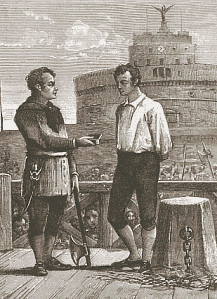
Bugatti was known for playing the role of executioner in a manner which left no doubt as to his feelings towards the act: it was his job, his service to the Church itself, undisturbed by any personal animus towards the condemned — particularly early in his career.
He often offered snuff to his victims and spoke briefly and quietly with them prior to the execution, likely ploys to ease the victim into his role in the spectacle. Dickens viewed one of Mastro Titta’s beheadings on 8 March 1845*, and, in his Pictures From Italy, he remarked on the callousness of the event.
In keeping with this attitude, most of the entries in Mastro Titta’s memoir are fewer than 20 words. They reflect a man who seeks to distance himself from the crowd’s bloodlust. A selection:
“Tommaso Tintori, guilty of homicide, 28 February 1810″ (The first using the “new edifice for beheading from the French government” — that is, the guillotine)
“Pecorari Angel, of Poli, aged 29. Peasant guilty of premeditated homicide of one woman, condemned to «death as an example» in Poland on 21 January 1847.” (There were a number of prisoners sentenced in other Catholic parts of Europe sent to Rome for Titta’s ministrations.)
“Sabbatino Proietti, aged 25, «decapitated» in Rieti for petty theft and highway robbery and murder on 20 August 1853, died converted, executed through administration of justice at the public square at the Bridge.”
“Angelo Lisi di Alatri, found guilty of premeditated highway robbery and murder in Frosinone, «dead» on 30 April 1862.”
An Anomalous Man
Bugatti was born just seven years prior to the Grand Duchy of Tuscany becoming the first of the Italian states to abolish the death penalty. There, Leopold II barred torture and punishment of death, a decision heavily influenced by Cesare Beccaria’s On Crimes and Punishments and a desire to distance his nation from Rome.
In the neighboring Papal State, however, the practice continued, the embodiment of the church’s power over its people in matters earthly and spiritual. Executions of the time performed for various reasons, but with a handful of exceptions, they were almost exclusively performed on persons in the lower class. Many relied on the use of torture or testimony from confessionals. Papal executions were carried out until the 1870s and only declared unnecessary (though not banned by the Church) by Pope John Paul II in the 1990s.
A complete discussion of the role of executions in the Catholic Church is too much for this space,** but a man like Bugatti serves usefully to exemplify the absurdity endowed in these killings by the Catholic Church. Where the half-dozen popes who served over Bugatti thought such executions to be necessary for the control of the masses, they had no such ideas about nobles who committed crimes.
The execution itself consisted of a parade with masked priests, banners, scriptural readings, and sermonizing, culminating in the death of the condemned. John L Allen of the National Catholic Reporter described the treatment of these executions in that day as “a liturgy”, and descriptions from writers such as Lord Byron show a scene which could only be described as a mix of Catholic Mass and town festival.
Such ritualized killing came to contrast starkly with the Italian celebration of an anti-death penalty position, and the two stood at odds for over a century. In 1909, the topic was hot enough that a plaque glorifying two Italians executed by Bugatti in 1825 was erected; a dozen years later, its contents were concealed out of deference to Rome until after the Second Vatican Council. The commemorated, Angiolo Targhini and Leonida Montanari (here’s their Italian Wikipedia page), were convicted essentially of riling the people, and they were summarily beheaded; their story was the inspiration for Luigi Magni’s 1969 classic Nell’anno del Signore:
“So ends the long list of Bugatti.”
Mastro Titta was given an official residence, and at the end of his term, he was handsomely rewarded with a pension for his service — 30 scudi per year. His final executions were carried out on 17 August 1864, wearing his traditional red cloak (now on display at the Criminology Museum of Rome): Antonio Olietti of Rome and Domenico Antonio Demartini were beheaded for homicide.
The Minister of Justice was 85, four and some years from the end of his life, and the final line in his memoir reads, “So ends the long list of Bugatti. May that of his successor be shorter.”
Indeed it was.
The final executions in Rome occurred on 24 November 1868 at the hands of Antonio Balducci, Bugatti’s long-time apprentice; the event was marked by Pope Pius IX famously intoning in response to calls for a stay, “I can’t, and I don’t want to.” The last execution in the Papal State was of Agatino Bellomo on 9 July 1870, in Palestrina, shortly before the nascent unified Italy absorbed Rome.
Mastro Titta is still known in Italy,† but, adrift amid a particularly violent period of revolution, his legacy as papal executioner is largely lost to the rest of the world.
* The day’s guillotinee was Giovanni Vagnarelli, 26, from Augustine; he killed Bavarian Anna Cotten and robbed her, and her wife’s statement at confessional was used to convict Vagnarelli. Such confessional convictions were not uncommon, as Bugatti’s own memoir confirms.
** There’s surprisingly little reading out there about this topic, though it would seem ripe for a book or two. Here’s what I can find:
“Fear and Loathing in Bologna and Rome: The Papal Police in Perspective”, Steven Hughes, Journal of Social History, 1987.
“Capital Punishment: The Curious History of its Privileged Place in Christendom”, James J. Megivern, Proceedings of the American Philosophical Society, 2003.
† A half dozen kilometers from the bridge that Mastro Titta crossed on his way to carry out Papal justice now stands the Mastro Titta Pub. It is reportedly “tastefully done” and serves mostly Belgian beers.
On an unspecified date in December 1793 is set one of literature’s immortal execution scenes, when ne’er-do-well Sydney Carton heroically goes to the guillotine in the place of his aristocratic doppleganger Charles Darnay at the climax of A Tale of Two Cities.
The dissolute, tormented Carton is the respectable Darnay’s literary dark twin, whose appearance he also happens to strikingly resemble. Driven by an unrequited love for Darnay’s wife, who stands in danger not only of losing her husband but of following him to the scaffold, Carton contrives to switch places with the doomed noble.
While those saved by his sacrifice flee for England, Carton goes to the guillotine in a batch of 52 condemned prisoners,* one of them a sweet and frightened girl he comforts tenderly.
His prophetic thoughts as he awaits the blade form the conclusion of the novel, and the last sentence ranks among literature’s most recognizable lines.
“I see that I hold a sanctuary in their hearts, and in the hearts of their descendants, generations hence. I see her, an old woman, weeping for me on the anniversary of this day. I see her and her husband, their course done, lying side by side in their last earthly bed, and I know that each was not more honoured and held sacred in the other’s soul, than I was in the souls of both.
“I see that child who lay upon her bosom and who bore my name, a man winning his way up in that path of life which once was mine. I see him winning it so well, that my name is made illustrious there by the light of his. I see the blots I threw upon it, faded away. I see him, fore-most of just judges and honoured men, bringing a boy of my name, with a forehead that I know and golden hair, to this place — then fair to look upon, with not a trace of this day’s disfigurement — and I hear him tell the child my story, with a tender and a faltering voice.
“It is a far, far better thing that I do, than I have ever done; it is a far, far better rest that I go to than I have ever known.”
A Tale of Two Cities is one of thousands of public-domain books available for free at Project Gutenberg. Stanford’s “Discovering Dickens” community reading project guide annotates the novel here.
* Never one for understatement, Dickens crowds his mass execution tableau with far too many extras. “The Terror” is usually dated from September 1793 through July 1794, but only during its bloodiest last two months would so many as 52 have been guillotined together; at the time of Carton’s execution, half as many would have constituted a large group.
On this date in 1799, Judith van Dorth was shot on the outskirts of Winterswijk for supporting an attempted restoration of the House of Orange to the Dutch throne against the Batavian Republic.
Although the Netherlands had been a Republic for two centuries, it was torn by revolutionary conflict from the mid-1780’s — predating the French Revolution, but finally coming to power in 1795 when its neighbor’s mass conscript armies drove William V of Orange to England.
The 52-year-old van Dorth, an impoverished noble of Orangist sympathies, recklessly tried to raise an internal revolt [linked page in Dutch] backing an English-Russian invasion to restore William in 1799.
The uprising came to nothing, and after the invasion — a footnote in the sweep of Revolutionary Wars — was repelled, van Dorth was condemned for treason by a military tribunal to set an example. [linked page in Dutch]
She was shot within 24 hours near Winterswijk’s Jewish cemetery, and apparently survived the barrage. One of the firing squad had to shoot again when he saw her move — legend has it that this occurred when she had already been packed into her coffin.
She remains the only woman in history executed by a Dutch military court. A biography of her life is available in Dutch.
The House of Orange, one of the most successful of European dynasties, regained power in the Netherlands following the Napoleonic Wars. William V’s great-great-great-great-granddaughter Queen Beatrix reigns there today.

 Nearly all the information readily available online about Chirino is in Spanish, and all the links in this post are to Spanish pages.

 Most recognizable today for her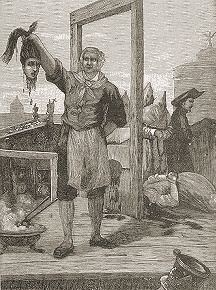
 Mastro Titta was given an official residence, and at the end of his term, he was handsomely rewarded with a pension for his service — 30 scudi per year. His final executions were carried out on 17 August 1864, wearing his traditional red cloak (now on display at the
  She was shot within 24 hours near Winterswijk’s Jewish cemetery, and apparently survived the barrage. One of the firing squad had to shoot again when he saw her move — legend has it that this occurred when she had already been packed into her coffin.